S O F T W A R E
Open Access
Toward almost closed genomes with GapFiller
Marten Boetzer and Walter Pirovano
*Abstract
De novoassembly is a commonly used application of next-generation sequencing experiments. The ultimate goal is to puzzle millions of reads into one complete genome, although draft assemblies usually result in a number of gapped scaffold sequences. In this paper we propose an automated strategy, called GapFiller, to reliably close gaps within scaffolds using paired reads. The method shows good results on both bacterial and eukaryotic datasets, allowing only few errors. As a consequence, the amount of additional wetlab work needed to close a genome is drastically reduced. The software is available at http://www.baseclear.com/bioinformatics-tools/.
Background
De novosequencing of unknown species and variants has become a major application of next-generation sequen-cing (NGS) technologies. As a consequence, there is a high demand forde novoassembly tools that can recon-struct the genomic sequence from millions of short reads. At present a vast number of tools is available to create a draft assembly that represents the genome in a number of contiguous sequences (contigs), such as Velvet [1], ABySS [2], and SOAPdenovo [3]. Nonetheless, the full closure of a complete genome remains a challenging and often expensive task. Generally, problems reside in the assembly of low-coverage areas and repetitive ele-ments. Even though the distance information of paired-read sequences can help to bridge these difficult areas by linking the contigs into larger scaffolds [4,5], scaffolding does not solve the inherent problem of low-coverage and repetitive elements: it does not add novel sequence infor-mation to the draft assembly. At present, two strategies have been proposed to automatically close draft assem-blies: Liet al. [3] included a gap closure routine to their SOAPdenovo assembly software, whereas more recently Tsaiet al. [6] introduced the IMAGE algorithm. Both methods use De Bruijn graphs to create a local assembly and seek to fill the gaps with the resulting contigs. A drawback of these strategies is that no prior knowledge of the estimated gap size is taken into account. Therefore, the local assembly might not reflect the true genomic situation. Also, the practical usability of these methods by a broad audience requires additional development. As
a consequence, at present, most genome assemblies are still incomplete after scaffolding and would ideally require accurate gap closure. Given that manual closure of incomplete regions with Sanger sequencing is expen-sive, genome assemblies submitted to sequence databases often lack a significant number of nucleotides, especially in the case of larger eukaryotes. Importantly, the missing repetitive or low-coverage regions may contain essential functions for the organism studied.
In this study we aim to reduce the number of unde-fined nucleotides by automatically filling in the gapped regions within scaffolds. For this purpose, paired reads are (re)used. In brief, our GapFiller method seeks to find read pairs of which one member matches within a sequence region and the second member falls (partially) within the gap. The latter reads are then used to close
the gap through sequence (k-mer) overlap. Gaps are
entirely closed only if the size of the sequence insertion corresponds closely to the estimated gap size after scaf-folding, which is based on the alignment of paired reads to the contigs. The process is iteratively repeated until no further gaps can be closed. We demonstrate that GapFil-ler gives promising results both on bacterial and eukaryo-tic datasets and accurately closes most of the gaps. From a comparative analysis with IMAGE and SOAPdenovo we show that our algorithm provides the most reliable outcomes. Finally, we investigate the nature of the closed regions in the human genome and show that these con-tain important coding and non-coding information. The software is designed to be accessible to a broad audience given its user-friendly design and limited memory usage. GapFiller can be downloaded from [7].
* Correspondence: [email protected]
BaseClear BV, Einsteinweg 5, 2333 CC, Leiden, The Netherlands
Results
Findings on the bacterial datasets
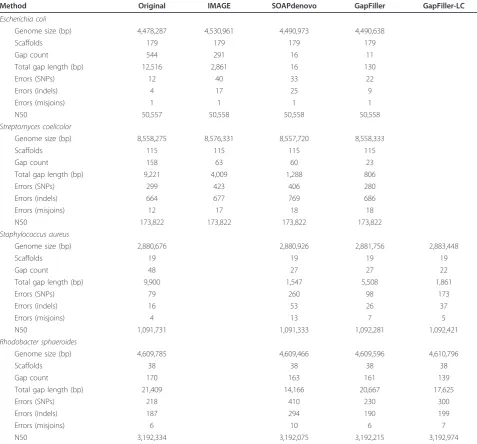
GapFiller was evaluated on four distinct bacterial datasets that are characterized by different genome sizes, levels of complexity and short-read sequence input. Also, the assembly strategy underlying the construction of the scaf-folds varies and provides some good practical examples of draft assemblies (see Materials and methods for more information). Quality assessment was performed through comparison with the known (closed) reference genome and error types were classified into three categories -SNPs, indels and misjunctions - according to [8]. A first observation on these datasets is that automated gap clo-sure can indeed be an important step in finishing (bacter-ial) genomes. In Table 1 we show that all methods can effectively close a significant amount of gaps and also that the total gap length is drastically reduced. However,
from theEscherichia coliandStreptomyces coelicolor
datasets it is apparent that the IMAGE strategy clearly underperforms the other two strategies on most quality measurements: the total gap length is reduced at most by 60% even though the number of errors increases signifi-cantly. This is partly due to the fact that IMAGE can not handle multiple libraries (nor mate pair libraries), and therefore the analysis was performed using only the library with the shortest insert size. In contrast, SOAPde-novo and GapFiller show more promising results: in
E. colithe number of gaps (gap count) can be reduced by 97% and 98%, respectively; inS. coelicolorthese numbers are 62% and 85%, respectively. Overall, the results indi-cate GapFiller closes a larger amount of gaps while mak-ing significantly less errors than the other methods. Arguably, the total gap length is shorter after gap closure with SOAPdenovo, but apparently at the cost of an increased number of misassemblies. The latter two ten-dencies are more pronounced in theStaphylococcus aur-eus and Rhodobacter sphaeroides datasets. A likely explanation resides in the fact that the raw input FASTQ reads are heavily filtered with Quake [9], leading to a relatively low genome coverage. For comparison pur-poses we reran our GapFiller algorithm with less strin-gent settings (GapFiller-LC: min coverageo= 1, ratior= 0.5) to yield a more similar gap length to SOAPdenovo. We observe that applying less conservative settings leads (obviously) to more errors, but that these are still signifi-cantly less than those made with SOAPdenovo (regard-less of the error type).
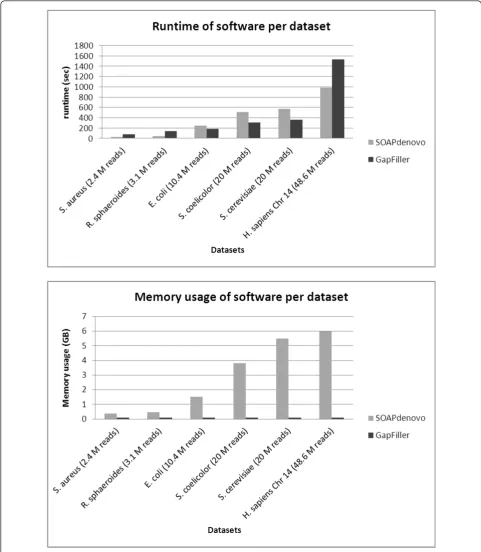
Another interesting observation concerns the compu-tational resources needed to run the software. Figure 1 shows a comparative analysis between the runtimes and memory usage of SOAPdenovo and GapFiller based on one iterative cycle. Apparently SOAPdenovo can com-plete the process faster if the number of input reads is very low or high, but for intermediate data sizes (10 to
20 million reads) GapFiller needs somewhat less time. Differences are more pronounced when comparing the memory usage of both methods: SOAPdenovo requires an increasing amount of memory to analyze larger input datasets (up to 3.8 GB for S. coelicolor and 6.0 GB for human) whereas GapFiller shows stable memory usage of approximately 0.1 GB. This is because GapFiller seeks to store the intermediate output temporarily rather than maintaining it in the memory. As a consequence the method is well suited for computing systems with smal-ler amounts of memory.
Summarizing, we provide strong evidence that bacter-ial draft assemblies can be accurately closed using an automated strategy. The few gaps that are left open by GapFiller mainly concern more difficult repeated areas. Here the extension method finds multiple alternatives with an equal ratio. These regions can eventually be closed through additional Sanger sequencing using only a limited number of reactions.
Gap closure in a small and large eukaryote: analysis of the yeast model organismSaccharomyces cerevisiaeand the human chromosome 14
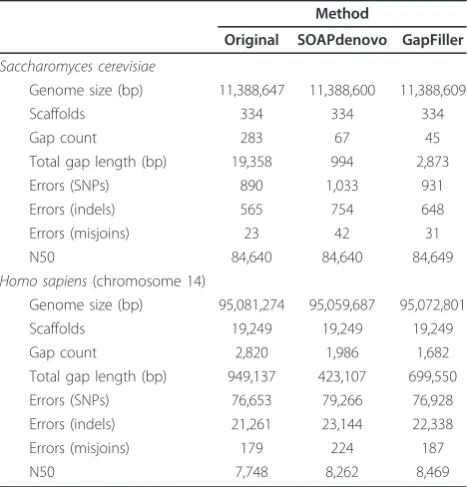
Saccharomyces cerevisiaeis perhaps the most commonly used yeast and plays an important role in fermentation of beer and bread. We used the 288c reference genome to simulate two paired-end libraries, which were subse-quently used for assembly (see Materials and methods for more specifications). In Table 2 we show that Gap-Filler can also be of value in closing genomes of smaller eukaryotes such as yeast: the number of gaps can be reduced with 84% (against 76% for SOAPdenovo) at a relatively low error rate. Nonetheless, as observed also for the bacterial datasets, SOAPdenovo more effectively reduces the total gap length (95% against 85% for Gap-Filler). The IMAGE method was not evaluated on eukaryotic datasets due to the very large computation time needed.
of these closures can be attributed to collapsing of (repeated) elements.
From a practical point of view it should be observed that both methods can run well on small scale systems: SOAP-denovo appears to be faster on larger input sets whereas GapFiller uses significantly less memory (Figure 1).
Functional analysis of the human chromosome 14
To further analyze the nature of the closed region, we extracted all annotations from the human GRCh37
[image:3.595.57.535.101.545.2]chromosome 14 [GenBank:NC000014] and then aligned the corresponding sequences to the scaffolds (before and after closure with GapFiller). For each annotation type we counted the number of gapped nucleotides that were closed with GapFiller. Results are provided in Table 3 and show that novel nucleotides are incorpo-rated in a wide range of functional regions, showing that gap closure adds mostly functional residues to the assembly. The largest relative increase of nucleotides is seen in coding regions (38.67% for genes, 30.53% for
Table 1 Gap closure results obtained on the bacterial datasets
Method Original IMAGE SOAPdenovo GapFiller GapFiller-LC
Escherichia coli
Genome size (bp) 4,478,287 4,530,961 4,490,973 4,490,638
Scaffolds 179 179 179 179
Gap count 544 291 16 11
Total gap length (bp) 12,516 2,861 16 130
Errors (SNPs) 12 40 33 22
Errors (indels) 4 17 25 9
Errors (misjoins) 1 1 1 1
N50 50,557 50,558 50,558 50,558
Streptomyces coelicolor
Genome size (bp) 8,558,275 8,576,331 8,557,720 8,558,333
Scaffolds 115 115 115 115
Gap count 158 63 60 23
Total gap length (bp) 9,221 4,009 1,288 806
Errors (SNPs) 299 423 406 280
Errors (indels) 664 677 769 686
Errors (misjoins) 12 17 18 18
N50 173,822 173,822 173,822 173,822
Staphylococcus aureus
Genome size (bp) 2,880,676 2,880,926 2,881,756 2,883,448
Scaffolds 19 19 19 19
Gap count 48 27 27 22
Total gap length (bp) 9,900 1,547 5,508 1,861
Errors (SNPs) 79 260 98 173
Errors (indels) 16 53 26 37
Errors (misjoins) 4 13 7 5
N50 1,091,731 1,091,333 1,092,281 1,092,421
Rhodobacter sphaeroides
Genome size (bp) 4,609,785 4,609,466 4,609,596 4,610,796
Scaffolds 38 38 38 38
Gap count 170 163 161 139
Total gap length (bp) 21,409 14,166 20,667 17,625
Errors (SNPs) 218 410 230 300
Errors (indels) 187 294 190 199
Errors (misjoins) 6 10 6 7
N50 3,192,334 3,192,075 3,192,215 3,192,974
mRNA and 26.89% for coding sequences). Overall, the method is applicable on the relatively large genomic spectrum and does not just solve regions that are bound to specific functional characteristics.
Discussion
Dramatic advances in sequencing technologies have opened new possibilities for whole genome analysis. The increasing read length of next-generation sequencing platforms, as well as the promising perspectives of third
generation sequencing platforms, will inevitably lead to better assemblies and represent genomes in large stretches of DNA. Also, third generation technologies (such as the PacBio and IonTorrent systems) will be capable of outputting sequencing reads with large unde-fined inserts, thus providing valuable paired read infor-mation for the assembly and scaffolding process. Concurrently, the development of genome closure soft-ware should also receive attention to overcome difficult genomic regions that cannot be covered by draft assemblies.
Our results with GapFiller indicate that gapped geno-mics regions can be reliably closed through an auto-matic protocol that uses only short sequencing reads. Costly Sanger sequencing can therefore be limited to a few difficult repeat areas. Also, we show that the method is suited for both bacterial and (large) eukaryo-tic datasets in terms of accuracy, time and memory usage. In the human dataset we underscore that gapped regions may contain diverse but crucial functional infor-mation, which is missed in the draft assembly.
From in-depth investigation of closed regions with GapFiller and SOAPdenovo, we argue that our GapFiller method has three main advantages. First, it takes into account the estimated gap size prior to closure, thus dis-carding erroneous closures that are shorter or larger than expected. Second, it does not try to fill a gap through local assembly of reads into contigs, but rather
seeks to extend the contigs from each end throughk
[image:5.595.57.291.111.355.2]-mer overlap. The latter point is especially important to overcome short tandem repeats. And third, it takes into account the contig edges, often a source of misassem-blies, and re-evaluates these during gap closure. Impor-tantly, GapFiller requires only limited computational resources and thus is also suited for (larger) eukaryotic genomes. Also, SOAPdenovo shows a good performance in terms of speed and memory usage and appears a valuable alternative to our strategy. From the results obtained on both bacterial and eukaryotic datasets, it appears SOAPdenovo is better able to close larger gaps.
Table 2 Gap closure results obtained on the eukaryotic datasets
Method
Original SOAPdenovo GapFiller
Saccharomyces cerevisiae
Genome size (bp) 11,388,647 11,388,600 11,388,609
Scaffolds 334 334 334
Gap count 283 67 45
Total gap length (bp) 19,358 994 2,873
Errors (SNPs) 890 1,033 931
Errors (indels) 565 754 648
Errors (misjoins) 23 42 31
N50 84,640 84,640 84,649
Homo sapiens(chromosome 14)
Genome size (bp) 95,081,274 95,059,687 95,072,801
Scaffolds 19,249 19,249 19,249
Gap count 2,820 1,986 1,682
Total gap length (bp) 949,137 423,107 699,550
Errors (SNPs) 76,653 79,266 76,928
Errors (indels) 21,261 23,144 22,338
Errors (misjoins) 179 224 187
N50 7,748 8,262 8,469
Results of SOAPdenovo and GapFiller obtained for theS. cerevisiaeand human genome show the suitability of both methods to close gaps also in eukaryotic genomes. Patterns are similar to the observations made for bacteria: overall, GapFiller yields the most reliable results and the lowest gap count whereas SOAPdenovo yields a significantly shorter total gap length (though at the cost of a fairly increased error rate). In human the shortened genome size and total gap length obtained by SOAPdenovo (together with the increased indel and misjoin error rate) might indicate that some gaps are eventually closed by collapsing of (repeated) elements.
Table 3 Functional properties of gap closed regions
Annotation type Total size in NC_000014 (bp) Nucleotides closed with GapFiller (bp) Portion of total nucleotides closed (%)
Gene 38,883,890 33,969 38.67%
mRNA 34,180,962 26,818 30.53%
CDS 29,380,348 23,617 26.89%
Other RNA 3,245,865 2,755 3.14%
V-segment 78,961 655 0.75%
C-region 36,984 23 0.03%
ncRNA 11,447 0 0%
Total 105,818,457 87,837 100.00%
[image:5.595.57.538.594.704.2]The explanation might reside in the fact that GapFiller implements a more conservative strategy than SOAPde-novo. Given that larger gaps usually represent more complex regions than smaller gaps, GapFiller may be simply more careful in avoiding dubious closures. This is also in line with the observation that GapFiller yields generally more accurate results than SOAPdenovo. Alternatively, a different explanation for GapFiller being less effective in closing larger gaps could be provided by the first advantage mentioned above. If the estimated gapsize in the scaffold does not meet the size of the closed fragment, such closure will be rejected. However, from a practical point of view it is still relatively difficult to estimate the exact gap size based on next-generation sequencing paired-read libraries. In particular, mate pair libraries can show a relatively large insert distribution, thus making it hard to define the correct distance between the pairs. Also paired-end background noise in mate pair data is commonly observed and leads to incorrect scaffolds. Consequently, there is a possibility that a correct closure is rejected because of the erro-neous gap size estimation after scaffolding. Future research will hopefully lead to better insight into these issues.
The IMAGE method instead has several limitations in terms of quality, speed and ease of use (the method can handle only one library per analysis). Notably, the strat-egy produces relatively large genomes, and this is most likely a consequence of sequence extension of the left and right scaffold edges.
The findings in this paper have been derived using dif-ferent short-read Illumina libraries. The length of the gapped regions is limited to the insert distance of paired reads. Nonetheless, the promising outcomes strongly indicate that long-range gaps can also be effectively closed with high quality 454 and/or single molecule paired sequence reads. Also, we have put emphasis on creating a user-friendly and fast tool so that it can be of wide use for the community. We feel GapFiller can make a significant contribution to (almost) closing gen-ome assemblies in a reliable manner.
Materials and methods
GapFiller algorithm
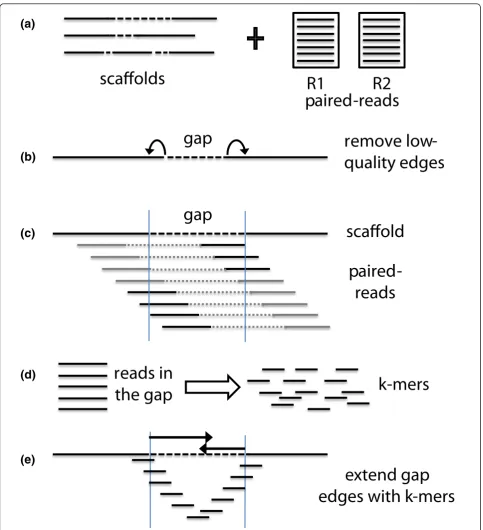
The GapFiller method works as follows (see Figure 2 for a schematic overview). The input consists of a set of scaffold sequences (in FASTA format) with gapped nucleotides represented as Ns and one or multiple sets of paired reads (in FASTQ or FASTA format). The data handling and analysis are setup in a multithreaded man-ner, thus allowing multiple datasets (libraries) to be pro-cessed simultaneously (by default one thread is used, but for this study we set this to eight). In a pre-filtering step the nucleotides at the edges of each gap are
trimmed off (parameter t, default = 10 nucleotides)
since these often contain misassemblies. Then all pairs are aligned to the trimmed input scaffolds with Bowtie [10] or the Burrows-Wheeler Aligner (BWA) [11]. The alignment method can be selected by the user, but we recommend using BWA in case of long reads. Bowtie instead is more suited for shorter reads, also because of the decreased runtime. For this study we used BWA on all datasets. Pairs are only kept if a) one read can be aligned and b) the second read (partially) falls within a gapped region. The latter is calculated based on the expected distance between the read pairs: the maximum allowed deviation used for this study was 25% of the pre-defined distance between the pairs. The final set of reads, which is expected to be (partially) in a gapped region, is then split into shorter k-mers that are used to gradually close the gap from each edge. The k-mer size is set by default to 30 nucleotides (1+ m, where m cor-responds to a default sequence overlap of 29 nucleo-tides). Gaps are iteratively filled from the left and right edge by incorporating one overhang nucleotide at a time, provided the position is sufficiently covered
(para-meter o, default = 2). In case of ambiguous overhang
nucleotides (that is, in a situation of allelic differences), a majority voting ratio is applied (parameterr, default = 0.7). If a nucleotide is incorporated, the k-mer(s) used for extension are removed and the algorithm checks if the gap can be closed. Gaps are only considered to be closed if a) an overlap can be found between the two extensions (parameter n, default = at least 10 nucleo-tides) and b) the sequence insertion corresponds to a pre-estimated gap length in the scaffold (parameterd, default = maximally 50 nucleotides difference). Other-wise, the next iteration is started. If no overhang nucleo-tides can be incorporated anymore, the whole process is repeated a second time by re-using all k-mers. Finally, the user can decide to repeat the complete analysis (alignment and gap closure) on the novel assembly. The number of such ‘global’iterations can be specified using the (parameteri, default = 10).
Short-read datasets
(b)
(a)
R1
scaffolds
paired-reads
(c)
(d)
(e)
R2
gap
remove
low-quality edges
gap
scaffold
paired-reads
k-mers
reads in
the gap
[image:7.595.57.541.86.617.2]extend gap
edges with k-mers
which is part of the SAM tools package [12]. ForS. coe-licolorwe used the A3(2) reference genome [GenBank: AL645882] to construct two paired-end libraries (insert sizes of 200 and 500 bp, 70 cycles, 10 million reads per library, whereas for S. cerevisiae we used all chromo-somes of the S288c genome [GenBank:NC001133 to NC_001148] to construct two paired-end libraries (insert sizes of 200 and 500 bp, 70 cycles, 20 million reads per library). For S. aureus, R. sphaeroidesand H. sapiens (chromosome 14) quakeCor-filtered [9] short-read datasets were taken from the Genome assembly
Gold-standard Evaluations website [13]. For S. aureus
this included a paired-end (insert size of 180 bp, 88 cycles, 0.8 million reads) and a mate-pair library (insert size of 3,500 bp, 37 cycles, 1.6 million reads). Similarly, forR. sphaeroides this also included a paired-end (insert size of 180 bp, 76 cycles, 1.5 millino reads) and a mate-pair library (insert size of 3,500 bp, 72 cycles, 1.5 million
reads). For H. sapiens (chromosome 14) the dataset
included one paired-end library (insert of 155 bp, 93 cycles, 32.6 million reads) and two mate-pair libraries (shortjump library: insert size of 2,283 to 2,803 bp, 82 cycles, 14.5 million reads; longjump library: insert size of 35,295 to 35,318 bp, 79 cycles, 2.0 million reads).
Assembly and scaffold construction
For three organisms a draft assembly was made using
the paired-end libraries. For E. coliwe used
SOAPde-novo v1.3 [3] whereas for S. coelicolorand S. cerevisiae
we used the CLCbio de novoassembler v4.9. Scaffolds
were produced using the same libraries as follows. For
E. coli the 1,111 contigs of the draft assembly were linked into 179 scaffolds using SSPACE Premium v1.0 [4]. For the S. coelicolor and S. cerevisiae genomes a similar strategy was adopted resulting in 115 scaffolds (430 contigs) and 334 scaffolds (733 contigs), respec-tively. For the remaining three species, S. aureus, R. sphaeroides and Homo sapiens, assemblies were retrieved from the GAGE website [13]. Based on the outcomes of the comparative analysis, we decided for the bacterial species to use the scaffolds produced with ALLPATHS-LG strategy [14] and for human the scaf-folds (≥200 bp) produced with ABySS [2].
IMAGE and SOAPdenovo gap closure software
Comparative analysis with IMAGE [6] was performed using version 2.3, which was downloaded from [15]. The program was run at default settings using a k-mer size of 31 and with 10 iterations. The insert size of the paired-end libraries was specified accordingly. SOAPde-novo gap closer software version 1.10 was downloaded from [16]. The program was run at default settings using ak-mer size of 30 and in total 8 threads.
Quality assessment of assemblies
In order to assess the quality of the assemblies, we fol-lowed the criteria set by [8]. Errors were classified into three categories: SNPs, indels (including indels ≤5 bp and indels > 5 bp) and misjoins (including inversions, relocations and translocations).
Compute server specifications
All analyses were performed on a 32 GB Linux machine (Intel Xeon X7350, 2.93 GHz).
Availability of software
The software can be downloaded from [7]and is free of charge for academic users.
Abbreviations
bp: base pair; BWA: Burrows-Wheeler Aligner; LC: low coverage; SNP: single nucleotide polymorphism.
Acknowledgements
This research was partially funded by the WBSO (BaseClear grants SO201101 and SO201209).
Authors’contributions
MB conceived of the study and wrote the program, WP participated in its design and coordination and wrote the manuscript. All authors read and approved the final manuscript.
Competing interests
The authors declare that they have no competing interests.
Received: 10 April 2012 Revised: 11 May 2012 Accepted: 25 June 2012 Published: 25 June 2012
References
1. Zerbino DR, Birney E:Velvet: algorithms forde novoshort read assembly using de Bruijn graphs.Genome Res2011,18:821-829.
2. Simpson JT, Wong K, Jackman SD, Schein JE, Jones SJ, Birol I:ABySS: A parallel assembler for short read sequence data.Genome Res2009, 19:1117-1123.
3. Li R, Fan W, Tian G, Zhu H, He L, Cai J, Huang Q, Cai Q, Li B, Bai Y, Zhang Z, Zhang Y, Wang W, Li J, Wei F, Li H, Jian M, Li J, Zhang Z, Nielsen R, Li D, Gu W, Yang Z, Xuan Z, Ryder OA, Leung FC, Zhou Y, Cao J, Sun X, Fu Y,
et al:The sequence andde novoassembly of the giant panda genome.
Nature2010,463:311-317.
4. Boetzer M, Henkel CV, Jansen HJ, Butler D, Pirovano W:Scaffolding pre-assembled contigs using SSPACE.Bioinformatics2011,27:578-579. 5. Dayarian A, Michael TP, Sengupta AM:SOPRA: Scaffolding algorithm for
paired reads via statistical optimization.BMC Bioinformatics2010,11:345. 6. Tsai IJ, Otto TD, Berriman M:Improving draft assemblies by iterative
mapping and assembly of short reads to eliminate gaps.Genome Biol
2010,11:R41.
7. GapFiller..[http://www.baseclear.com/bioinformatics-tools/]. 8. Langmead B, Trapnell C, Pop M, Salzberg SL:Ultrafast and
memory-efficient alignment of short DNA sequences to the human genome.
Genome Biol2009,10:R25.
9. Li H, Durbin R:Fast and accurate short read alignment with Burrows-Wheeler transform.Bioinformatics2009,25:1754-1760.
10. Li H, Handsaker B, Wysoker A, Fennell T, Ruan J, Homer N, Marth G, Abecasis G, Durbin R, 1000 Genome Project Data Processing Subgroup:The Sequence alignment/map (SAM) format and SAMtools.Bioinformatics
2009,25:2078-2079.
12. Salzberg SL, Phillippy AM, Zimin A, Puiu1 D, Magoc T, Koren S, Treangen TJ, Schatz MC, Delcher AL, Roberts M, Marçais G, Pop M, Yorke JA:GAGE: a critical evaluation of genome assemblies and assembly algorithms.
Genome Res2012,22:557-567.
13. GAGE..[http://gage.cbcb.umd.edu/results/index.html].
14. MacCallum I, Przybylski D, Gnerre S, Burton J, Shlyakhter I, Gnirke A, Malek J, McKernan K, Ranade S, Shea TP, Williams L, Young S, Nusbaum C, Jaffe DB: ALLPATHS 2: small genomes assembled accurately and with high continuity from short paired reads.Genome Biol2009,10:R103. 15. IMAGE..[http://sourceforge.net/projects/image2/].
16. SOAPdenovo..[http://soap.genomics.org.cn/soapdenovo.html].
doi:10.1186/gb-2012-13-6-r56
Cite this article as:Boetzer and Pirovano:Toward almost closed genomes with GapFiller.Genome Biology201213:R56.
Submit your next manuscript to BioMed Central and take full advantage of:
• Convenient online submission
• Thorough peer review
• No space constraints or color figure charges
• Immediate publication on acceptance
• Inclusion in PubMed, CAS, Scopus and Google Scholar
• Research which is freely available for redistribution