Theorizing construction industry practice
within a disaster risk reduction setting : is
it a panacea or an illusion?
Ingirige, MJB
http://dx.doi.org/10.1080/01446193.2016.1200735
Title
Theorizing construction industry practice within a disaster risk reduction
setting : is it a panacea or an illusion?
Authors
Ingirige, MJB
Type
Article
URL
This version is available at: http://usir.salford.ac.uk/id/eprint/47236/
Published Date
2016
USIR is a digital collection of the research output of the University of Salford. Where copyright
permits, full text material held in the repository is made freely available online and can be read,
downloaded and copied for noncommercial private study or research purposes. Please check the
manuscript for any further copyright restrictions.
Full Terms & Conditions of access and use can be found at
http://www.tandfonline.com/action/journalInformation?journalCode=rcme20
ISSN: 0144-6193 (Print) 1466-433X (Online) Journal homepage: http://www.tandfonline.com/loi/rcme20
Theorizing construction industry practice within
a disaster risk reduction setting: is it a panacea or
an illusion?
Bingunath Ingirige
To cite this article: Bingunath Ingirige (2016) Theorizing construction industry practice within a disaster risk reduction setting: is it a panacea or an illusion?, Construction Management and Economics, 34:7-8, 592-607, DOI: 10.1080/01446193.2016.1200735
To link to this article: https://doi.org/10.1080/01446193.2016.1200735
© 2016 The Author(s). Published by Informa UK Limited, trading as Taylor & Francis Group
Published online: 05 Jul 2016.
Submit your article to this journal
Article views: 796
View related articles
View Crossmark data
Theorizing construction industry practice within a disaster risk
reduction setting: is it a panacea or an illusion?
BINGUNATH INGIRIGE
**Centre for Disaster Resilience, School of the Built Environment, University of Salford, Manchester, UK
Received 12 July 2015; accepted 7 June 2016
Construction industry practice is strongly influenced by the culture surrounding its operations and, with the prevailing emphasis on achieving efficiency, there is a strong focus on outcome metrics such as profitability and employee productivity. With the recent increases in natural hazard events worldwide, and the likelihood that this will worsen still further with anticipated climate changes, the industry is increasingly contributing to building resilience within disaster-affected communities. Existing industry expertise, its educational approaches and the related theoretical frameworks, however, all require adjustment if these changing needs are to be fully addressed. Most importantly, an agenda shift is required from the philosophical side and a more pragmatic approach is needed if community resilience goals and objectives are to be met, rather than the narrower focus of the current metrics-driven management system. A synthesis of the current literature is therefore presented, along with relevant case histories illustrating how such an agenda shift within a disaster management context may influence the development of appropriate theory, as well as impacting upon grass-roots educational requirements. The research concludes by discussing how the ‘mainstreaming’ of disaster management within construction industry practice could drive forward developments in theorizing expertise and educational provisions across the constituent disciplines.
Keywords: Construction education, construction industry, construction industry practice, disaster resilience, theorizing.
Introduction
Construction industry (hereafter CI) practice is
strongly influenced by the culture surrounding its oper-ations. Some of the common problems faced by the industry include its fragmented nature, the complex coordination and communication structure, lack of per-manence in its workforce and skill shortages. The industry does, however, contribute quite significantly to the overall economy of a country in terms of output. The overarching philosophy within CI practice has, therefore, been to improve performance at firm and project levels, in order to achieve overall improvements across the industry and the wider economy. Some of the reports published in the UK by government task
forces, notably Latham(1994)and Egan(1998)
identi-fied the synergy of the many smaller improvements as a significant opportunity. A very strong metrics
manage-ment system in evaluating outcomes (both at firm and project level) has become paramount in construction management, with a focus on timely completion, meet-ing of budgets and fulfilment of quality standards. From a philosophical point of view, this is indicative
of a normative emphasis (Fuller,1988) with
manage-ment of key performance indicators (KPIs), exception reporting, further short-term targets and profitability being the key outcome goals or norms. This is consis-tent with the rationalist paradigm, adopted by the con-struction management research community as well,
according to Dainty(2008). It could be argued,
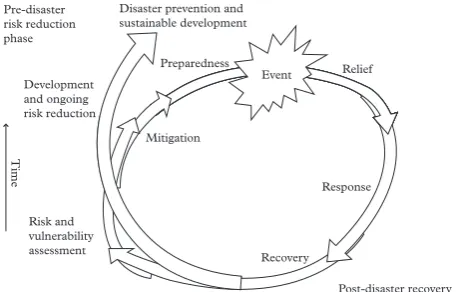
how-ever, that relying on too many quantitative measures does not help in understanding the big picture. For example, the CI plays a leading role in the rebuilding phase following natural hazards; indeed, it is linked quite positively to the entire disaster management
(hereafter DM) cycle (see Figure 1), from the point
*E-mail:[email protected]
*Present address: Global Disaster Resilience Centre (GDRC), School of Art Design & Architecture, Huddersfield, University of Huddersfield, UK.
©2016 The Author(s). Published by Informa UK Limited, trading as Taylor & Francis Group.
This is an Open Access article distributed under the terms of the Creative Commons Attribution-NonCommercial-NoDerivatives License (http:// creativecommons.org/licenses/by-nc-nd/4.0/), which permits non-commercial re-use, distribution, and reproduction in any medium, provided the
original work is properly cited, and is not altered, transformed, or built upon in any way.
of preparedness to recovery and reconstruction.
Figure 1 is an adaptation of the Royal Institution of
Chartered Surveyors (RICS, 2009) spiral model and
O’Brienet al.(2010)’s four-stage model for DM.
DM involves plans, structures and arrangements established to engage the normal endeavours of governments, voluntary and private agencies in a com-prehensive and coordinated way to respond to the whole spectrum of emergency needs Moe and
Pathra-narakul (2006). The intangible outcomes, in terms of
community preparedness and vulnerability reduction achieved, which are part and parcel of DM are more socially constructed, far outweigh the normative targets that may be applied purely in a CI context. Therefore, when CI operates within a DM context, its scope is likely to extend towards satisfaction of community needs; hence, terms such as ‘community preparedness’ and ‘vulnerability reduction’ become the key in determining CI’s performance. According to Yodmani
(2001), vulnerability reduction aims to increase a
community’s capacities, their resources and coping strategies so that they are better prepared in facing a disaster. Communities are better prepared when the root causes of their vulnerability are either removed or their impact reduced. At a community level, social construction methods are used to create community preparedness plans so that community goals and
expec-tations and actions are well represented (Lucini,2014).
With changing climate and extreme weather events
becoming more widespread (Stern, 2007), such social
construction measures are likely to become of
increasing importance but, thus far, such community
benefits seem to be taken for granted within
construction. Although socially constructed viewpoints
and benefits have been noted in some of the
construction management literature, the theorizing of this does not seem to be linked to what the construction
practice dictates. Hence, a more pragmatic approach
(Denscomb, 2008) is needed to theorize expertise in
CI practice with a DM setting.
The aim of this paper was to consider whether there are particular kinds of expertise that integrate the social element of construction practice within the disaster recovery life cycle and what sort of expertise is needed to meet the demands of key stakeholders in disaster response and recovery. It further discusses how con-struction education might develop this such that the
performance improvement within construction is
steered towards a naturally progression incorporating social accountability pathways, rather than a purely metrics-oriented management system. This could per-mit the involvement of the CI within DM to be assessed as being a panacea or an illusion.
Construction industry practice and the
desired agenda shift in theorizing
During the time period 1994–2000, three high profile
government reports (Latham, 1994; Egan, 1998 and
Department of the Environment, Transport and the
Regions,2000) were published, each of which stressed
the importance of improving efficiency within the CI, particularly cost-effectiveness in resource utilization. More recently, the same agenda of cost savings has been pursued, but with a renewed focus on the use of modern technologies and management processes (such as supply chain management and framework agree-ments) to improve efficiency in the industry. With the
new ‘Construction 2025’ strategy (McMeeken,2013),
this emphasis has been further reinforced, with a call for a 33% reduction in the whole life costs of built assets by 2025.
Whilst pursuing an efficiency agenda is important, understanding that the CI has a wider remit beyond a purely commercial focus should form an important and powerful consideration for theorizing expertise. In the longer term, this view may not only sustain the industry but also increase the number of new participants. Myers
(2003)postulates an agenda shift, so that the CI con-tributes more towards sustainable development, includ-ing consideration of community goals. This would result in a more balanced portfolio of goals consisting of social and environmental targets, and moving away from the existing sole consideration of pursing an agenda of efficiency improvements. With changing climate, and increases in both natural and anthropogenic hazard events in many parts of the world (Intergovernmental
Panel on Climate Change,2014), CI practice has been
brought further to the fore. The greater involvement of the CI and its practitioners in the area of DM (Bosher
and Dainty,2011) provides an opportunity not just to
Pre-disaster risk reduction phase
Development and ongoing risk reduction
Risk and vulnerability assessment
Disaster prevention and sustainable development
Preparedness Relief
Response
Recovery
Post-disaster recovery Mitigation
Time
[image:4.609.63.292.68.214.2]Event
Figure 1 The disaster risk management and response spiral (adapted from Obrien et al., 2010 and Max Lock Centre,
maximize revenue, profitability and the commercial goals, but also to contribute towards the betterment of community, environmental and other social outcomes. In the longer term, this might confer an advantage upon both the industry and its participants, in terms of con-tributing to both vulnerability reduction and improving coping capacity and resilience of communities.
Accord-ing to O’Brien et al. (2010), often the extensive media
coverage on the disaster event focuses upon the involve-ment of the CI to a certain extent. But when considering the broader aims of DM, which is to reduce vulnerability and improving coping and resilience to disasters, the media coverage presents a narrow view of the CI involve-ment. This involvement rarely portrays the host of services that the CI can play within the DM context,
however: for example, Scott (2010) identifies DM as a
‘growth market’, highlighting some of the opportunities that it might create for businesses. Such contexts,
accord-ing to Bosher et al. (2007) and Bosher and Dainty
(2011), provide opportunities for the CI to have more of a deeper engagement to contribute towards the rest of the phases of the DM cycle. This necessitates the the-orizing of expertise to integrate DM and construction: for instance, construction practitioners are increasingly engaged in the area of building resilience and ‘building
back better’ (Changet al., 2011) after a natural hazard
event (which, according to Lyons(2009), is one of the
ways in which resilience can be enhanced). Although, from a research point of view, the practical value of such a role makes sense, and the value has been demonstrated from a theoretical point of view, there is very little theory that drives this process from the construction side, hence developing expertise in such a direction has not been rec-ognized as of any significant value. It can be argued that the CI practice community is to a certain extent distracted by the efficiency drive, hence the difficulty of maintaining a more balanced outlook. From an educa-tion and training point of view, it is proving challenging to address this problem, as the CI–DM nexus is difficult
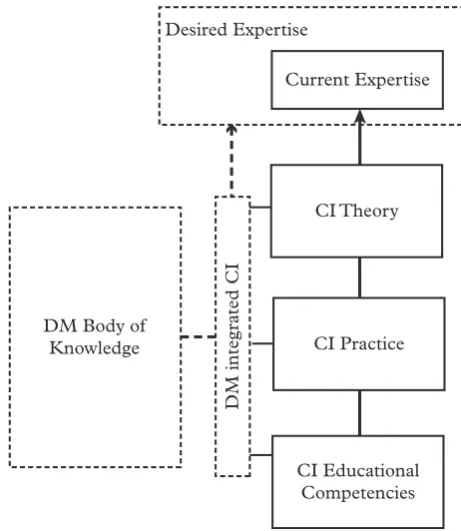
to develop. Figure2shows how the desired expertise can
be created holistically, with a proper integration between DM and CI practice incorporating the integrated theoriz-ing approach as proposed within this paper.
According to Figure2, the desired expertise (the CI
expertise that is appropriate when the full extent of the DM is considered) that assists in theorizing construc-tion practice within a DM context is ‘pulled’ through in a systematic way by addressing competencies at a grass-roots level (which is the entry or the starting level for skills and competencies), which will then potentially develop the DM-embedded CI practice and ultimately lead to the theorizing as required within a DM setting.
According to Ericsson and Smith (1991), the goal of
expertise research is to:
understand and account for what distinguishes outstanding individuals in a domain from less outstand-ing individuals in that domain, as well as from people in general. (p. 2)
A further characteristic of expertise is that it has, in the past, been equated with years of experience (Collins
and Evans, 2002), such that a person with extensive
experience was automatically regarded as an expert. Arguably, expertise may be seen as the culmination of knowledge and experience, which can then be devel-oped within the desired setting or context. Heidegger
(1997), in discussing expertise-in-context identified the value of practical knowledge in that the expertise becomes natural and action within a given context becomes instantaneous. Expertise is, thus, developed
over time: for example, Dreyfus and Dreyfus (1986)
present a 5-stage model to depict ‘expertise’ as a very
high-level position in terms of skill acquisition,
compared to the grass-roots scale, represented by
entry-level Stage 1. Hoffmanet al., (2013), however,
identified expertise as amenable to accelerated skills acquisition: although expertise is usually accumulated over time, the process of acquiring high proficiency can be foreshortened by specific training techniques. As more frequent and extreme disasters arise, there is a necessity to accelerate the integration of DM within CI, in order to advance from the present ‘Stage 1 level’ and this can be achieved by mainstreaming of DM
Desired Expertise
Current Expertise
CI Theory
CI Practice
DM integ
ra
ted CI
CI Educational Competencies DM Body of
[image:5.609.315.546.66.332.2]Knowledge
within CI. Applying and adapting the UN ‘gender
mainstreaming’ definition (United Nations, 2002),
the term could be best described as the integration of DM in CI in a process that includes the development of a methodology, tools and information materials to fulfil appropriate integration within the study’s context.
Positioning and conceptualizing
expertise-in-context within a philosophical base
Expertise in the construction industry comprises a whole host of skills, consisting of managerial (decision-making, financial and commercial), technical (adopting a variety of technologies, contracts, designs) and social aspects
(teamwork, trust, culture). Addis (2010) argues that
the reality, and the way the general public perceives what these construction activities actually represent, seems to be widely different. Effectively, the industry was need-lessly ‘selling itself short’ as CI professionals tend to describe their expertise more simplistically than
war-ranted. Reed (1995)identified a similar phenomenon
amongst adult care nursing practitioners, as they often downplayed their role as experts (for example, they described their role as boring – ‘You might feel that you have come to a really boring place. We don’t do
much here’ (p. 339). According to Hackley(1999)and
Boyd and Addis(2011), there is a strong tacit element
embedded within expertise and this can be seen in the construction industry too. The skills represented within the CI industry are not only spread across a wider domain, as identified earlier, but also very difficult to articulate in terms of specific requirements (Polanyi,
1962). People who possess these skills tend to attribute
less and less value to them when they acquire additional
skills and proficiencies.Reed (1995)found that it takes
considerable time to develop ‘quick assessments and judgement skills’ (which is the level of expertise needed to react instantaneously to a situation) for the nurses, but this is often taken for granted by the nurses them-selves, along similar lines to construction professionals. Kuhn (1996) explains this phenomenon as similar to the way in which scientific progress takes place when a set of paradigmatic assumptions ceases to be implicit. But, quite in contrast to scientific progression, the exper-tise in CI remains implicit and it is challenging for the developing expert to acquire the appropriate skills.
The CI’s long-standing drive to improve profitabil-ity, via cost-effectiveness in resource utilization, adds to the public representation of the CI industry as overly commercially driven, overlooking the important reali-ties such as the strong social outcomes that now need to be further developed within the CI skill set to suit
the DM context. Figure2conceptualizes both the
cur-rent CI expertise and how it should, more desirably, be
situated. Labuschagne and Brent(2005)argue that this
target-based focus is mainly caused by the extremely ‘time pressed agenda’ which is typical of any construc-tion project. Adhering to a commercially driven target-orientated approach in CI, where commercial targets or KPIs predominate, also fails to bring about innovations
(Styhre, 2010). According to Hoffman et al. (1995),
experts, as one would expect, are very adept at their usual or familiar tasks; thus, the knowledge and experi-ence within the CI tend to be guided and contextual-ized within the current target-driven system. The underlying system of education and training is, there-fore, similarly designed and driven currently, as
indi-cated by the continuous line in Figure 2. This
becomes the primary goal, currently supported as a ‘collective norm’ by the majority of construction
profes-sionals (Lapinski and Rimal, 2005) despite the wide
variety of education and training applicable to their constituent disciplines.
Increasing opportunities for CI professionals to work in non-commercial environments, subjected to natural hazards and contexts where there is a humani-tarian catastrophe embedded within the CI, modifies the environment where the application of a
target-orientated focus might cause tensions. McCann et al.
(2015)studied UK’s National Health Service (NHS) performance improvement schemes and argued that the excessive adoption and rigid application of target-based systems can actually foster dramatic organiza-tional failures. They argue that, whilst such numerical target-based systems might be very effective in, say, automobile manufacture or back-office processing, these industries involve work typically performed on ‘inanimate objects or digital information’. In the con-struction industry, not only project success but also very strong people-orientated approaches such as team-work and trust are important social outcomes to be achieved, and numerical targets might not work: indeed, they might cause total failure. From a
philo-sophical point of view, McCannet al.(2015)argue that
it needs an interpretivist approach that takes into account several ‘pragmatic improvisations’
(Maynard-Moody and Musheno, 2003, p. 165) on underlying
more sympathetic towards betterment of communities or creating better social outcomes. This is the desired CI expertise as indicated by the ‘dotted’ lines and boxes
in Figure 2. The necessity to consider the potentially
valuable strong social element within CI and to differentiate from an ‘inanimate’ setting appropriate to a factory-based quality improvement system,
think-ing in similar lines of McCann et al. (2015), helps in
further reinforcing the phenomenological philosophical position for integrating DM within CI. The strong con-text-dependent nature of a phenomenological position
(Benner, 1984) also supports this view, as it will help
from transcending the CI expertise within a DM
context in a pragmatic way (Denscombe,2010).
Construction industry practice and its link to
disaster management
Haighet al.(2009)argue that CI practice has a role in
every aspect of the DM cycle. Looking at the construc-tion process from the point of view of a life cycle allows its activities, from inception to eventual demolition, to be viewed in a systematic way. By deconstructing CI practice, it is also possible to see its existing and potential future contribution to the DM process (considering the established mature practices within a DM context), so that the said overall contribution can be carefully
exam-ined. Blanchard and Fabrycky (1998), for instance,
present the life cycle of asset systems, encompassing a broader view of CI practice, with its components of con-ceptual design; preliminary design; detail design and development; construction; utilization; and finally retirement and disposal. The DM cycle can be viewed as consisting of mitigation, preparedness, response and
recovery phases (O’Brienet al.,2010); alternatively, as
discussed by Hystad and Keller (2008), it can be seen
as three phases: pre-disaster (prevention/mitigation), disaster and post-disaster (response/recovery).
Preven-tion, according to Sena and Michae (2006), involves
haz-ard identification (in which the actual threats facing a community are identified) and vulnerability assessments (in which an evaluation of community risk and capacity is conducted). Recovery according to the some of the UK
government guidance (Cabinet Office,2013) is defined
as the process of rebuilding, restoring and rehabilitating the community following an emergency; although dis-tinct from the response phase, recovery should be an integral part of the response from the very beginning, as actions taken at that point in the cycle can influence the longer term outcomes for a community.
Haigh et al. (2009) recommend that CI practice
should explore ways in which it could contribute towards improved resilience, such as the adoption of a more expansive view of the construction life cycle to
encompass the need to anticipate, assess, prevent, prepare, respond to and recover from disruptive chal-lenges. This requires a framework that integrates the construction life cycle with the DM life cycle. The ulti-mate goal of disaster risk management is to break the
disaster life cycle (Frumkin, 2010): CI practice can,
arguably, take up this challenge by becoming involved in all of the phases of the DM cycle. Max Lock Centre’s
(2009) proposal of a spiral model (as shown in Figure1)
attempts to demonstrate that a particular cycle can be broken and elevated to a recovery situation that will enable a community to face up to future disasters with more confidence. Taking up this challenge can also serve as an opportunity for CI practice to alter the focus from the current outcomes metrics to a more socially constructed community outcome, in order to antici-pate, assess and prevent disasters. However, from a the-oretical side, there appears to be inadequacy in existing expertise: some of the standard norms and processes developed within CI practice seem unlikely to cater to the unique demands of the DM context. For instance,
Crawfordet al.(2013)studied the Queensland flooding
in 2011 and argued that the currently accepted con-struction project management techniques are inappro-priate for meeting the demands of key stakeholders in disaster response and recovery. The misalignment of the existing standard CI practice with the desired level is often highlighted when proactive resourcing strate-gies and planning measures are not taken up during
post-disaster scenarios (Mitchell,2004). However,
lim-ited good practice and individual achievements have been noted from time to time during reconstruction efforts after disasters and those responsible tend to be
recognized as role models (Crawford et al., 2013). It
can be argued that such unique achievements are noteworthy precisely because there is an absence of pre-determined processes available to which the experts can refer. This is indicative of the gap within the current level of expertise (due to the shortfall of knowledge and experience of CI participants in DM) as well as the lack of institutionalization (Bartlettet al.,2007) of this expertise (as this tends to be pragmatically addressed within the appropriate education system).
Mapping the disaster management life cycle
with the appropriate levels of education in the
construction industry
According to Bosheret al.(2007), disaster risk
its flow of activities in the form of a cycle, with the intention of determining the ‘pull and the push’ forces for theorizing, as highlighted earlier, provides a pro-gressive way forward for further analysis. As it is stated
by Bosher and Dainty (2011) that the construction
industry is ‘poorly positioned for embracing the tenets of disaster risk reduction’, analysing how DM can be mainstreamed within the components of a cycle might prove to be a very detailed and a coordinated way to tackle the issue of effective DM in CI education, given
that scholars such as Ofori(2008)advocate that
curric-ula in the built environment need redesigning to achieve this mainstreaming effectively. Several aca-demics have argued the importance of developing
DM education within CI: for example, Bosher et al.
(2015)advocate that institutes providing civil engineer-ing education should educate their students on the roles of disaster risk reduction within the civil
engineer-ing curriculum; Wedawatta et al. (2012) address the
importance of educating the surveying professions in the same area. Several studies have been undertaken that addresses resilient designs and resilient
architec-ture (see Flowers,2014). Lamond et al.(2010)called
for knowledge enhancement in the behaviour of prop-erty prices after disasters such as flooding. The four stages of the DM cycle based on a spiral model (see
Figure1) are considered in the process of investigating
the key educational competencies for DM expertise development in construction.
A majority of the work where the CI is (currently) involved in DM is in the latter stages of the cycle: the response and recovery stages where reconstruction is required, of which the immediate aftermath of the dis-aster is the key phase. After the initial rescue of sur-vivors, the response phase is concerned with the distribution of basic supplies (including water, food, clothing, shelter and medical care) to prevent further loss of life, and it typically occupies the first few hours or days after the disaster impact. The recovery phase then commences, during the weeks and months follow-ing the disaster, and this begins the process of restorfollow-ing normality to the locality, which include the first steps of reconstruction. Finally comes mitigation, which is a much longer term activity; once this stage is reached, then there is time for reflection and rethinking. This sequence, where recovery is followed by mitigation, does not always happen in practice, but for the pur-poses of setting out our educational mapping, we con-sider this as taking place in an ideal world. However, the most important final stage is where the community preparedness and improvements in disaster planning occurs: for example, a significant number of tsunami warning towers were built after the 2004 South Asian tsunami caused much devastation (Saengpassa and
Samsamak,2012).
The response and recovery phases after a disaster can offer many challenges, which are determined by the specific type of disaster, the location in which the disaster happens and the specific context. As experi-enced during the 2015 earthquake in Nepal (Burke
et al., 2015), the authorities responsible for recovery efforts were ‘guesstimating’ both the human catastro-phe as well as the economic catastrocatastro-phe. As argued
by Crawfordet al.(2013), it is often the case that what
is known as ‘traditional’ project management practices and processes in the CI are too much time-consuming and inflexible for use under circumstances of high uncertainty and complexity which may pertain in the case of disasters. The need to deploy rapid response within a context of a complex multi-stakeholder envi-ronment is often a constraint as the situation demands more flexibility, typically having to start the process without much knowledge on specific requirements
and outcomes. Koskela and Howell(2002)argue that
the underlying theory of project management is obso-lete, considering the application of production theories to project management. Their argument stems from the unrealistic assumptions that are often made in tradi-tional project management in construction, when com-pared with what is usually found in practice. Koskela
and Howell (2002)present an argument relating to a
typical construction project, as follows:
… customers or clients … do not necessarily know their requirements at the beginning. Typically, customer requirements are poorly investigated at the outset, and the process of requirement clarification and change leads disruption in the progress of the construction project. (p. 11)
This argument is all the more pertinent in the context of a reconstruction project after a disaster: it is not appropriate for the progress of the work to be con-trolled based on a ‘performance baseline’. The confu-sion and the chaos that prevails during the immediate aftermath of a disaster requires a more flexible
approach according to Crawford et al. (2013) who
advocate ‘participatory project management’. Such participatory methods enable stakeholders within a dis-aster setting to share a common vision of the project as the team works towards successful outcomes, which are derived out of participatory mechanisms of teamwork
and engagement. Development of participatory skills,
knowledge and understandingis, therefore, the first tenet of education that needs to progress towards a new understanding of expertise and is also important in theorizing.
Once the immediate aftermath has been dealt with, the DM cycle moves to the recovery phase where
contributes significantly. Quarantelli (1995) for instance, defines four typical stages of reconstruction plans specific to the housing sector, comprising imme-diate relief, immeimme-diate shelter, temporary housing and permanent housing. What is important in this process
is the timing of each of the stages, but Johnson et al.
(2006), who used this framework in the contexts of post-earthquake housing construction in both Western Turkey and Columbia, found that the process did not work according to the specified method. Instead, the authorities were forced to employ several ad hoc
mea-sures. As Johnson et al. (2006) argue, post-disaster
reconstruction is a process that is both comprehensive and involves cross-disciplinary contributions of a wide variety of stakeholders. Although the degree of resili-ence of the community affected should increase with
longer term cost-effective solutions (Godschalk et al.,
2009), the speed of providing these usually reduces
when moving from the immediate relief to permanent housing due to problems typically associated with avail-ability of funding, social problems, economic problems
and technological problems (Johnston et al., 2006;
Ingirigeet al., 2008). The degree of funding allocated
to each of the stages or solutions should be appropri-ately managed, as mismanagement of any of the stages of housing provision will result in the community not being settled in permanent housing for a longer period. CI expertise, therefore, has an opportunity to fill an
existing vacuum in the area ofmanaging finance in
col-laboration with governmental and non-governmental actors and key community stakeholders. This area contributes significantly to development of the desired level of expertise; hence, at an educational level, this area needs considerable development within the CI.
Koskela and Howell(2002)note that, quite often in
the CI, some of the alternative methods developed from practical observations and needs have not had a theo-retical explanation, which has slowed down their diffu-sion. Although this was a general comment made in relation to many construction settings, it has particular relevance when theorizing within the construction prac-tice during recovery and reconstruction stages after a disaster. The lack of an underpinning theory has ren-dered education and training more difficult and has hampered effective professionalization of the CI’s role in DM. Most importantly, according to Crawford
et al. (2013)on most occasions, CI practice tends to maintain its status quo, irrespective of the context, and consequently lacks the flexibility required to cater to an unfolding disaster situation. This view is
consis-tent with Davidson’s (2010) observation that lack of
adequate organization may be a key reason why recon-struction fails, as it is bound to involve complex pro-cesses of planning, procurement and building that requires decision-making appropriate to a gradually
unfolding situation. Lizarralde (2010) also states that
the emergency focus of the initial phase should eventu-ally progress to a sustainability phase (referring to effec-tive recovery and reconstruction on a continuous basis without jeopardizing any of the existing resources that might inhibit any future potential for the communities to meet their needs), with a much longer term orienta-tion, yet this progression seems to be a big step for the CI to manage. To achieve this, it will be necessary to
build up some practical case scenarios and flexible
man-agement systems from an educational point of view.
Josephet al.(2014)show the importance of cost-benefit
analysis as a measure of justifying measures of
adapta-tion at property level against flood risk. Joseph et al.
(2014)’s work also contributes to the argument of mak-ing available more practical case scenarios to enable further CI contributions to preparedness to integrate DM within CI practices so that, as argued by Lizarralde
(2010), the process eventually progresses towards a sustainability phase.
In taking the step towards sustainability, as
Lizarralde (2010) points out, the initial mitigation
and disaster preparedness phase is propelled to impor-tance. The phase incorporates a range of activities, reflecting the degree to which a community is in a state of readiness immediately before the disaster strike. It covers short-term emergency planning (that includes insurance), hazard warning (e.g. early warning sys-tems), evacuation procedures (documentation and preparation of manuals and guidance) and the
stockpil-ing (Coffrin et al., 2011) of appropriate supplies to
meet resource shortages. The phase should also address effective planning of supply chain logistics and just-in-time inventory control systems (Richey,
2009). Although at present the CI is less involved
dur-ing the preparedness phase of a disaster, experts such as urban planners, together with representatives of strategic bodies (such as professional organizations and government departments), already play major roles in strategizing within the preparedness phase. This can help to minimize any unplanned shocks likely to occur during the disaster and post-disaster phases: for exam-ple, in the aftermath of the South Asian tsunami, the CI in many countries experienced severe skilled
shortages and capacity gaps (Ingirige et al., 2008;
Le Masurieret al.,2006). The wage bill for both skilled
tsunami (Changet al., 2010). In the UK, there was a similar experience as a lot of property owners found there to be a dearth of builders after the Cumbrian
flooding in 2006 (Felsted,2007). From an educational
point of view, therefore, there should be adequate skills
to understand and study theeconomics of a disaster
situ-ationand gain an awareness of what preparedness and planning are needed.
In contrast to normal construction projects, post-disaster reconstruction is likely to suffer project defi-ciencies in relation to the availability of resources
(Chang et al., 2011), which the pre-disaster planning
and preparedness stage needs to take into account.
The field observations by Russell (2005) and Zuo
et al. (2008) provided examples of rework or disruption of reconstruction projects, as a result of failure to procure resources required for projects post-disaster. Generally the supply chain in the CI that deals with reconstruction is quite extensive and may sometimes span across several geographic boundaries. Although it is impossible for managers to eliminate all the risks in the supply chain, the challenge now is how to make them sufficiently resilient so that they too can bounce
back, and potentially thrive, from catastrophes
and disruptive events (Abidin and Ingirige, 2015;
Natarajarathinam et al., 2009). Lack of an effective
supply chain often results in cost/time overruns, poor quality of work, technical defects and lack of durable and long-lasting construction (Olawale and Sun,
2010; Abdul-Rahman et al., 2008). To address these
problems, building resilience towards disruptive events requires key players in the supply chain to focus not on their self-interest alone, but also take into consideration the interest of others. Thus, instead of a silo approach, all parts of the supply chain need to work together to build resilience to disruptive events and improve
pro-ject performance. Knowledge of the operation of the
wider supply chainis necessary as another tenet of edu-cation, to uplift the status quo of construction to be mainstreamed within a DM context.
New approaches and insights will contribute to the
pragmatism (Denscombe, 2010) of energizing the
desired theory and practice. If this were to be taken for-ward from a grass-roots educational level within CI, the following knowledge and skills are arguably important:
(1) Development of participatory skills, considering
the unique make-up of the stakeholder group that undertakes construction within a DM con-text. The skills demanded tend to be unique, as the scope of stakeholder interaction extends
beyond the normal stakeholder group in
construction.
(2) Managing finance with a longer term view,
con-sidering vulnerability reduction and resilience
building as the primary consideration for better community benefits within a DM context. This also involves a shift towards becoming social out-comes orientated and able to employ pragma-tism in working within the political climate that emerges in a developing disaster situation.
(3) Enhancement of preparedness phase expertise,
integrating planning measures and improved early warning systems within a comprehensive disaster preparedness plan.
(4) Education on parameters to justify the
eco-nomics of a disaster and the disaster prepared-ness phase.
(5) Knowledge on key criteria for success of effective
supply chains in DM.
The above knowledge and skills meriting the devel-opment of education to mainstream DM within con-struction can be considered as falling into two subgroups: the first two can be studied at micro level, utilizing documented cases; the last three areas within an educational strategy are more long-term orientated and hence taken forward at a longer term policy-making level and will be discussed as part of the synthe-sis of the case study discussion. Two documented case histories, in which there was involvement of the CI in the recovery efforts, will now be examined, to study the link between the CI–DM nexus and also to investi-gate how the developments could be linked to improved education at the grass-roots level. The origi-nal research questions are further refined as follows:
(i) What sort of expertise is needed to meet the
demands of key stakeholders in disaster
response and recovery?
(ii) How might construction education develop this
expertise, grounded within the chosen philo-sophical position?
Analysis of documented cases method
‘Documented cases’ is a form of secondary research using case studies conducted and reported in the past.
Bieniawski(1978)used documented cases as histories
Although the documented cases come from two diverse contexts, the main common thread in both sce-narios is the protracted reconstruction effort, which is the focus of this research, which merits the choice of the two documented cases. The discussion of docu-mented cases add value to this research, as the salient points can be drawn out of very specific locally held knowledge that can have wider benefits to a much larger population.
When, as is often the case, data on CI involvement in DM are scarce, the analysis of documented cases provides a refreshing way to address the research questions raised in this study. Documented cases also provide the basis of modifying and populating the
original CI expertise development model (Figure 2)
proposed earlier. The first case looks at property-level flood protection in the UK, whilst the second discusses an international case of housing reconstruction after a major disaster. The latter caused much destruction and devastation including more than 30 000 deaths in Sri Lanka, whereas the former created disruption and damage to livelihoods of people.
(1) The case of small businesses recovering after
the 2009 flood event in Cockermouth in Cum-bria: an opportunity missed by the Construc-tion Industry
The UK has in recent times experienced several sev-ere flood events in places such as Somerset levels
(McEwen et al., 2014), Cumbria (Environment
Agency,2009) and Hull (Crichton,2007). At an
indi-vidual property level, there is renewed focus for protec-tion against flooding, as argued by Hopkins and
Warburton (2014) and Wedawattaet al.(2014). Whilst
the recovery process in all such events has several layers of institutions involved, at the small business level the process seems to be driven mainly by the insurance industry. The entire recovery and reconstruction effort involves several participants in construction, but they are largely recruited, deployed and in certain circum-stances led by insurance industry professionals. Several small businesses affected by the flooding of 2009 in Cockermouth reported that the organization of the recovery activity seemed to be uncoordinated, activities fragmented and often lacked a coherent strategy and
direction (Joseph et al., 2011; Wedawatta et al.,
2014), extending over a long time period. Wedawatta
et al. (2014) discussed the case of small-and-medium-sized enterprises (SMEs) and the interactions between DM and CI experts in their recovery efforts after the 2009 flood event in Cockermouth in Cumbria. The resilience measures adopted by the SMEs have been brought together as a single case synthesis of SME resilience and recovery efforts within the context of the flood event. In all, 4 SME business owners and
2 professionals who advised SMEs on flood mitigation were interviewed, providing the basis for some of the synthesis made of their recovery and reconstruction efforts in 2009.
In all of the SMEs highlighted in Table1, the
recov-ery efforts did not require any structural adjustments to properties and the work involved was mainly focused upon interiors (including addressing some of the cos-metic damages to gas and electrical services) and recti-fications of minor damages. One of the professionals interviewed stated that:
Most people think that flooding causes structural prob-lems of buildings and a lot of structural work needs doing, which is a wrong notion
The above comment represents a typical observation by members of the public in that there is widespread belief that a flood causes structural instability of properties. This may be true for a minority of properties, but in most of the cases, the damage is to the finishes of the property, which are really cosmetic. At a macro level, the entire reconstruction effort was carried out on the basis of ‘like for like’ reinstatement, based on the insur-ance principle of ‘non-betterment’, which precludes adequate levels of adaptation. Whilst the businesses were quite keen to restart their activities as soon as pos-sible, it required strong leadership and commitment to put in place a longer term solution. The small busi-nesses were focused on quick recovery timescales, which does not necessarily incorporate longer term resilient reinstatement measures. It seems, from a gov-ernment policy perspective, that several steps can be taken to promote long-term resilience against future flood events as the main driver in the recovery phases. This would allow appropriate holistic technical consid-erations to be taken into account, rather than short-term measures alone.
The Cockermouth case shows that the construction participants who were involved in refurbishment and reinstatement of properties did not adequately engage with the property owners/occupiers during the recon-struction process. Although the DM context opened up several opportunities for the construction partici-pants to have more of a deeper engagement with the businesses affected by flooding, such engagement was not considered either a priority or an opportunity. As the recovery and reconstruction during the aftermath of the flood was predominantly driven by the insurance
industry (Wedawatta et al., 2014), this to a certain
extent prevented appropriate input by the CI and that
contributed towards an inefficient process. This
resonates well with Davidson’s (2010) argument that
engagement of CI shows that the first tenet of CI
edu-cation within a DM context, namelyparticipatory skills,
was not appropriately developed. If DM is to be
consid-ered as a market (Scott, 2010), such key expertise is
essential to the development of objectives and goals in the area.
(2) The case of housing reconstruction in Sri
Lanka after the 2004 South Asian Tsunami
Sri Lanka was badly affected by the South Asian tsunami that occurred in December 2004: it destroyed about two-thirds of the Sri Lankan coastline and affected more than 1 000 000 people. It not only affected the lives of the community, but also had a dev-astating effect on their housing and livelihoods. The overall loss of 100 000 or more houses proved to be a major challenge to the emergency response teams and
disaster planners. According to Manatunga (2005),
Sri Lanka’s natural rate of house building at the time was as low as 4000–5000 units per annum; therefore, the loss of 100 000 houses in 4 h overwhelmed the capacities and capabilities of the various authorities responsible for housing construction and private hous-ing developers alike. The endurhous-ing reconstruction pro-cess after a disaster, therefore, provides a useful focus for exploring the process of expertise development in CI within a DM context.
Sri Lanka faced several challenges in its post-tsu-nami reconstruction, and this resulted in a focus upon
short-term rather than long-lasting solutions (Ingirige
et.al., 2008). Often, post-disaster, permanent recon-struction is inefficiently managed, uncoordinated and
takes time to initiate (Lloyd-Jones, 2006). Under
extreme conditions, both long-term performance and the satisfaction and requirements of the intended occu-pants are issues that are often overlooked by policy-makers, practitioners, funding bodies and the occu-pants themselves.
The reconstruction efforts in Sri Lanka were carried out utilizing two methods: the donor-assisted pro-gramme (DAP) and the owner-driven mechanisms
(Lyons,2009) (whilst Changet al.(2011) cover a third
method known as ‘contractor driven’, this being embedded in this paper under the umbrella of DAP). The owner-driven mechanism included technical sup-port and funding and organization of self-help schemes. All affected households that were able to demonstrate ownership to land were entitled to a grant from the State. In addition, several NGOs provided additional payments, or provided labour, materials and general technical assistance to support families rebuilding their own homes. This strategy was also termed ‘assisted
self-help’ by Johnsonet al.(2006).
[image:12.609.59.556.83.340.2]The DAP was mainly targeted at people living within the buffer zones attached to the coastal areas affected by the tsunami, who had to be relocated. Under this strategy, the affected families were entitled to a house built by a donor agency, on land allocated
Table 1 Highlights of experiences of the flood-affected businesses (adapted from Wedawattaet al.,2014)
Case
No. Type
Extent of work done in reconstruction of
flood-damaged properties Involvement of CI Experiences of affected property owners Case 1 Public
house and restaurant
Reinstatement of floors and retrofitting of power sockets and interior works
All reconstruction work done by a small redecoration company
The claims procedure and the reconstruction process initiated by the insurance company
Case 2 Newsagent shop
Mainly interiors Several building trades worked independently. The property owner was faced with coordinating the project
The process was initiated by the insurance company and the loss adjustor. Then, the whole process of managing the separate tradesmen fell on the property owner
Case 3 Hardware shop
Mainly interiors Single contractor employed for refurbishment of premises
Difficulties faced in selecting the contractor as several small construction firms started advertising by dropping leaflets in the premises. Contractor was recommended by the drying firm Case 4 Lighting
and electrical shop
Mainly interiors A lot of professionals from both construction and insurance industry involved in putting the project together
by the State, in accordance with Sri Lankan govern-ment standards. The donor provided each new settle-ment with an internal common infrastructure, whilst the Sri Lankan government provides the services up to the relocation site.
Figure 3 (Ingirige et al., 2008) compares the user
satisfaction in the two schemes adopted during post-tsunami housing reconstruction in Sri Lanka. The sur-vey was conducted in the Galle district in Sri Lanka, where the effect of the tsunami was significantly higher. The questionnaire was administered within the Galle district amongst 226 victims of the 2004 tsunami. The sample represented a good cross-section of the dif-ferent types of permanent and temporary housing pro-visions. The survey sample was divided into DAP housing and owner-driven housing.
The comparison of respondent satisfaction of the
two housing strategies in Figure 3 shows that the
occupants of DAP housing were significantly more satisfied than occupants of owner-driven houses, in the areas of aesthetics of the building, quality, dura-bility and the functionality. However, the survey results also show that owner-driven house occupants were generally more satisfied than their DAP coun-terparts, with respect to availability of space, ability to influence design changes and affording flexibility to perform future expansion to the house. The main cause for this comparatively lesser satisfaction was that it fell short of meeting the communities’ subtle demands related to dynamics of life, particularly in terms of understanding how their livelihoods were connected to the types and location of housing. In simple terms, lower satisfaction level tended to be
an indication of lower community participation
through which the ‘softer’ needs of the people did not seem to have been addressed. In owner-driven housing, owners had the opportunity of identifying their needs and engaged in various community partic-ipatory schemes, allowing them to indicate their pref-erences in relation to parameters such as space, design changes and flexibility for future expansion.
Thus, Figure 3 provides insights into the effects of
the lower levels of community engagement in DAP properties compared to owner-driven methods. For example, the South Asia Disaster Report (Duryog
Nivaran, 2006, p. 38) states that:
coastal women in Sri Lanka traditionally engaged in … home based activities such as processing coir from coco-nut husks … and other craft based work.
Some of these houses were not appropriate to meet the needs arising from the activities of these women:
as highlighted by Ofori (2004), houses and
liveli-hoods have a strong interconnection; hence, the poor satisfaction score related to space, current design and future flexibility of the DAP houses. The excessive dissatisfaction of the DAP scheme can be directly attributed to the poor ability of the contractors to engage with the community effectively. Hence, the post-tsunami DM context also shows the poorly
developed participatory skills, which is the first tenet
of CI education within a DM context. The commu-nity consultation is not only on user needs but those needs should also be translated into the use of appro-priate materials and construction methods, consider-ing that the post-disaster context is a new ‘market’
(Scott, 2010). CI expertise within the DM context
presents some unique avenues for development as regards vulnerability reduction and resilience build-ing. Overall within a context of reconstruction after
a disaster, Lloyd-Jones (2006) states that the skills
developments should progress through the areas of sourcing construction materials and equipment, pro-curement and project management, aiding logistical planning and finance over a longer term duration. Zuo et al. (2008) also identify that construction con-tractors have the unique opportunity of creating a boost to resource availability with better planning and preparedness. The post-disaster context also
indi-cates the poorly developed skills in managing finance
with a longer term view, considering vulnerability reduc-tion and resilience building as the primary considerareduc-tion for better community benefits within a DM context,
which is the second tenet identified above. In other words, reconstruction processes should be considered as a redevelopment opportunity, with environment protection a priority on the sustainability agenda.
0 10 20 30 40 50 60 70 80 90
% of Satisfaction
Condition
Perceived satisfaction of owner-driven
Flexibility to future changes Availability to influence design Space availability Functionality
Architecture/Aesthetic
Quality/Strength & Durability
housing
[image:13.609.60.293.497.680.2]Perceived satisfaction of donor-driven housing
Synthesis and the modified expertise
development model: a panacea or an illusion?
The two documented cases highlight the first two CI knowledge and skills (1 and 2) that need to be devel-oped for effective DM integration, as currently the industry often fails to fully engage with communities during recovery and reconstruction efforts. Developing such knowledge and skills would improve understand-ing of each community’s unique needs which, in con-junction with a CI background, could potentially translate into successful recovery and reconstruction. It was reported that the lower the level of involvement of the CI during the needs assessment stage after a dis-aster, the less satisfied the community was. The level of involvement of the CI in other phases of a disaster is even more minimal, not being observed in either of the documented cases.
The other knowledge and skills (3, 4 and 5) argued and synthesized from the literature are relevant to broader community or government level development and belong to the preparedness and planning phases. It is also anticipated that a firm grounding of such core planning and preparedness knowledge and skills will further influence more positive development of the same at a micro level (knowledge and skills 1 and 2). Knowledge and skills 3, 4 and 5 will enable the CI experts to gain an understanding of the ‘big picture’ when it comes to reconstruction efforts, as the projects tend to be led by people outside the industry. In the case of flood recovery in the UK, the projects were scat-tered around the country in fragmented fashion and they were being led by the insurance industry and loss
adjustors (Wedawatta et al., 2014). In the case of
post-tsunami reconstruction, the projects were being led by public organizations and non-governmental organizations, who did not necessarily possess con-struction skills. This gap defies all CI efforts to develop grass-roots skills in order to enhance expertise; it can-not, however, be closed just by a process of skills or competency development of DM within the CI. It needs a renewed emphasis on participatory community engagement by the CI, which changes the prevailing culture of achieving an efficiency drive based on a nor-mative scale of performance. Education developments alone, therefore, cannot close this gap.
The availability of more documented cases which cover all phases of the DM cycle will give the CI the added impetus to be able to prepare their response in a more coordinated and a cohesive way. The phe-nomenological position with all its characteristics could be better fulfilled by extending the current target-driven normative focus to a more social outcomes-based
strat-egy. The conceptual model in Figure 2 can be taken
forward as an explanatory theoretical model in Figure4.
This will provide the context and the basis for the desired expertise to emerge, in order to cater for better integration of the CI within DM.
Figure4is a theoretical model that shows the ‘pull’
forces that demand DM mainstreaming within CI edu-cation and its interconnected elements, based on a phe-nomenological philosophical position that is context dependent. The continued context-dependent nature is brought about by the need for more cases to be col-lected to enrich the case bank. The original conceptual
model (Figure2) is modified in the light of the
synthe-sis discussion, where it emerged that the mainstreaming of DM within CI should commence from an educa-tional level but also move into a theoretical and practi-cal level, thereby building up the desired capability of the CI to seek more opportunities and exploitations within DM. The desired expertise (the word ‘desired’ here referring to the satisfaction of stakeholder interests in DM) is the culmination of the capability enhance-ment at a micro level (knowledge and skills 1 and 2), preparedness planning (knowledge and skill 3), grass-roots education that considers economics of DM (knowledge and skill 4) and theoretical and practical awareness to better understand community needs and unique contexts (knowledge and skill 5) in a way that integrates DM within the CI. It is important that the desired expertise is developed in such a way that DM is contextualized within CI in practice, thus enhancing theorizing in terms of a better CI–DM nexus. It is important to consider construction at times of disasters
Desired Expertise & Capability Enhancement
Desired Theory
DM integ
ra
ted CI
DM Body of
Knowledge DesiredPractice Pull forces
DM mainstreamed in CI Education
Case Bank for more practical
and theoretical awareness of CI input
[image:14.609.317.548.458.685.2]into DM
as forming unique contexts of complexity, resource lim-itations and connected humanitarian and social issues, requiring continuous needs assessments and engage-ment of communities.
Bosher et al. (2015) question the extent to which
prominent hazards such as floods and coastal storms are being considered in civil engineering education.
Similarly, Wedawatta et al. (2012) identified gaps in
competencies of chartered surveyors in undertaking flood risk management advice. The design professions are also calling for the incorporation of resilient design as a means of building in both resilience and sustain-ability from the outset; hence, such competencies
should be taught in design courses (Flowers, 2014).
There seem to be gaps in grass-roots education in the CI when trying to meet DM context needs and these appear as gaps in the CI professions as well. It is, there-fore, obvious that construction professions should seek a wider role in reconstruction efforts, so that such
edu-cational gaps at grass-roots level are resolved. Figure4
shows this connection through the links to the ‘DM body of knowledge’ box and the populating of the ‘case bank’ for more CI in DM box: these linkages will step up the grass-roots DM mainstreamed within CI educa-tion. Governments should also be made aware of both the theoretical benefits (the overall economic and the
social improvements likely to be achieved) and
the practical benefits of construction involvement in the process (so that the involvement is more wide-spread and covers the full life cycle of the DM spiral,
as illustrated in Figure 1). CI leadership should be
brought to the fore, enabling deeper engagement of
construction professionals with communities and
removing or reducing some of the existing barriers; this will then determine the position of the CI in DM as a panacea, rather than an illusion.
Conclusion
The research suggests that a ‘unified DM focus’ needs establishing within the CI and this could be the guiding principle for theorizing in the context of DM in the CI. This will, in the longer term, counteract the ‘time pressed agenda’ within construction and will make the industry better prepared for DM. A strategy that involves both a bottom-up and a top-down approach is suggested to achieve this change. The bottom-up approach is suggested to enhance capacity building
within construction education (in Figure 4 this is the
starting point, shown as ‘DM mainstreamed within CI education’). Reports suggesting this mainstreaming have already been published by two of the relevant
institutions: the ICE (Bosher et al. 2015) and the
Royal Institution of Chartered Surveyors (RICS;
Lloyd-Jones,2006; Wedawatta et al.,2012; Max Lock
Centre,2009). Studies have also emerged in
architec-ture as well as the property industries, in areas of resi-lient designs and property price behaviours after flooding and weather extremes. However, the process also needs a top-down approach, with the understand-ing that the process cannot be ‘self-propelled’ as several industry, cultural and political barriers exist, all of which need careful management at government and policy-maker level. In the UK, for example, during the immediate aftermath of a natural hazard event such as flooding, the insurance industry tends to undertake leadership of the recovery process and this affects the ability of CI participants to manage the process effec-tively. Educating the insurance industry on CI skills is not recommended, due to the rigorous study processes in CI education and professional membership, but instead, CI leadership should be developed within DM that leads to more resilience and long-lasting solu-tions. Further, within the international context, a wide variety of organizations (including governmental, non-governmental and community-based volunteers) tend to take leadership of recovery processes, which do seem to undermine CI efforts. Both the insurance industry and non-governmental actors tend to be very short-term orientated, in that their primary consideration tends to be returning people to usual locales as soon as possible, without consideration of the ‘big picture’ and the longer term sustainability of communities. Good practice, via better awareness of successful com-munity resilience measures and practical schemes, might create improved awareness and sustainability. On the other hand, some disasters may create positive impacts on the industry as discussed earlier under the case of the 2004 Tsunami in Sri Lanka resulting in a certain extent of emergence of better working condi-tions and pay structures for local construction workers and establishment of smaller construction companies, increasing the net construction output in Sri Lanka.
agencies have a shared role in cascading some of the requirements as good practice amongst industry stake-holders via good practice cases to increase the uptake of DM within CI.
In addition, for CI professionals and companies with hard-wired systems embedded in their knowledge bases, the research provides a refreshing conceptual basis to rethink on the basis of mainstreaming of DM within the CI. For the CI to be exploited as a ‘panacea’ for this mainstreaming, it is important that the appropriate DM in CI expertise is embedded in both theory and practice for longer term sustainability of the industry.
Disclosure statement
No potential conflict of interest was reported by the author.
References
Abdul-Rahman, H., Yahya, I.A., Berawi, M.A. and Wah, L.W. (2008) Conceptual delay mitigation model using a project learning approach in practice.Construction Manage-ment and Economics,26, 15–27.
Abidin, N.A.Z. and Ingirige, B. (2015) Building resilience of construction supply chain to disruptions: development of a conceptual framework, Proceedings of the 12th International Postgraduate Research Conference, 10th–12th June, pp. 518–36.
Addis, M. (2010) The thinking man’s industry. Construction manager magazine, 11th November. CIOB publication. Bartlett, J., Tywoniak, S. and Hatcher, C. (2007) Public
rela-tions professional practice and the institutionalisation of CSR. Journal of Communication Management, 11(4), 281–99.
Benner, P. (1984)From Novice to Expert: Excellence and Power in Clinical Nursing Practice, Addison-Wesley Publishing Company, Menlo Park, CA.
Bieniawski, Z.T. (1978) Determining rock mass deformabil-ity: experience from case histories. International Journal of Rock Mechanics and Material Science,15, 237–47.
Blanchard, B.S. and Fabrycky, W.J. (1998)Systems Engineer-ing and Analysis, 5th edn, Prentice-Hall, Upper Saddle River, NJ.
Bosher, L. and Dainty, A. (2011) Disaster risk reduction and ‘built-in’ resilience: towards overarching principles for con-struction practice.Disasters,35, 1–18.
Bosher, L., Dainty, A., Carrillo, P., Glass, J. and Price, A. (2007) Integrating disaster risk management into construc-tion: a UK perspective. Building Research & Information,
5(2), 163–77.
Bosher, L., Johnson, C. and Von Meding, J. (2015) Reducing disaster risk in cities: moving towards a new set of skills. Proceedings of the Institution of Civil Engineers: Civil Engineering,168(3), 99.
Boyd, D. and Addis, M. (2011) Moving from Knowledge Management to Expertise Management: A Problem of Contexts – Centre for Environment and Society Research Working Paper series no. 3, Birmingham City University, Birmingham, AL.
Burke, J., McCurry, J. and Jones, S. (2015) Nepal earth-quake: authorities struggle to cope despite international aid efforts, The Guardian. Available at http://goo.gl/
pG18Wz(accessed on 11 July 2015)
Cabinet Office2013. Emergency response and recovery – non statutory guidance accompanying the civil contingencies Act 2004, in Civil Contingencies Secretariat (ed.) 28/10/ 2013 ed. London: H M Government. Available from
http://goo.gl/crs5l3(accessed on 23 February 2016)
Chang, Y., Wilkinson, S., Potangaroa, R. and Seville, E. (2010) Resourcing challenges for post-disaster housing reconstruction: a comparative analysis. Building Research & Information,38(3), 247–64.
Chang, Y., Wilkinson, S., Potangaroa, R. and Seville, E. (2011) Identifying factors affecting resource availability for post-disaster reconstruction: a case study in China. Construction Management and Economics,29(1), 37–48. Coffrin, C., Van Hentenryck, P. and Bent, R. (2011)
Strate-gic stockpiling of power system supplies for disaster recov-ery.IEEE,1(8), 24–9.
Collins, H.M. and Evans, R. (2002) The third wave of science studies: studies of expertise and experience’.Social Studies of Science,32(2), 235–96.
Crawford, L., Langston, C. and Bajracharya, B. (2013) Participatory project management for improved disaster resilience. International Journal of Disaster Resilience in the Built Environment,4(3), 317–33.
Crichton, D. 2007. The Hull Floods of June 2007 – some insurance industry implications.Alert (Newsletter of Benfield UCL HRC)[Online], 22.
Dainty, A. (2008) Methodological pluralism in construction management research, in Knight, A. and Ruddock, L. (eds.)Advanced Research Methods in the Built Environment, Wiley-Blackwell, Chichester, pp. 1–13.
Davidson, C.H. (2010) Multi-actor arrangements and project management, in Lizarralde, G., Johnson, C. and Davidson, C.H. (eds.) Rebuilding after Disasters: From Emergency to Sustainability, Spon Press, New York, pp. 88–109. Denscombe, M. (2010)The Good Research Guide for
Small-scale Social Research Projects, McGraw-Hill, Maidenhead. Department of the Environment, Transport and the Regions
(DETR). (2000)Performance Indicators Show Improvement, Construction Monitor, 4 May.
Dreyfus, H. and Dreyfus, S. (1986)Mind over Machine, Free Press, New York.
Duryog Nivaran,2006. South Asia Disaster Report: 2005 – Tackling Tides and Tremors. Joint publishers: Practical Action, South Asia Programme and Rural Development Policy Institute, Pakistan. Available fromhttp://www.duryo
gnivaran.org/(accessed on 5 January 2008)
Egan, J. (1998) Rethinking Construction, Department of the Environment, Transport and the Regions, London. Environment Agency (2009) Cumbria 2009 Floods – Lessons