International Journal of Emerging Technology and Advanced Engineering
Website: www.ijetae.com (ISSN 2250-2459,ISO 9001:2008 Certified Journal, Volume 5, Issue 11, November 2015)
199
PAPR Reduction in OFDM with Partial Transmit Sequence
Technique using Median Filter
Valmik Tilwari
1, Vinita Nigam (Saxena)
1, Aparna Singh Kushwaha
2, Rakesh K. Arya
31,2Department of Electronics and Communication, UIT, RGPV, India 3M.P. Council of Science and Technology, Bhopal, India
Abstract— This Paper presents the significant reduction in Peak to average power ratio (PAPR) in Orthogonal frequency division multiplexing (OFDM) by Partial Transmit Sequence (PTS) using median filter. Simulations are performed for comparative analysis of proposed method with exhaustive search and suboptimal method using OFDM signals with 64, 126, 512, 1024 and 4-QAM subcarriers with oversampling factor L = 4. The performance evaluation is done in terms of complementary cumulative distribution function vs. PAPR. Graphical analysis depicted in figures shows the results is better than other techniques for all cases.
Keywords—Orthogonal Frequency Division Multiplexing (OFDM), peak-to-average-power-ratio (PAPR), Selective Mapping (SLM), Complementary Cumulative Distribution Function (CCDF), Bit Error Rate (BER).
I. INTRODUCTION
Today OFDM is broadly used in many applications because of its high program broadcasting capability and end-to-end transmission system [1]. In serial transmission system, the data symbols were transmitted serially in which each data occupy whole available bandwidth. But Orthogonal frequency division multiplexing is an individual form of the multicarrier modulation technique where parallel transmission of data takes place over single carrier with more lower rate subcarriers using FDM [2]. This technique is widely used in today generation because of its major different features like OFDM provides strength not in favor of inter symbol interference and multipath fading because for the lower rate subcarriers, the symbol period increases. OFDM robust against narrowband interference with the utilization of adaptive modulation technique, OFDM allow resourceful utilize of on hand radio frequency (RF). It enables the bandwidth-on-demand technology and advantaged spectral efficiency.
So OFDM does not necessitate adjacent bandwidth for operation. OFDM makes on its own frequency networks possible, which is for the most part attractive for broadcasting applications. However, there are many problems that need to be champion before OFDM finds widespread use in recent wireless communication systems. OFDM has comparatively large peak-to-average power ratio (PAPR), which tends to condense the power efficiency of RF amplifiers. Framing up of OFDM signals with lower crest-factor is predominantly significant if the number of subcarriers is more because the peak power of a
sum of N sinusoidal signals can be as large as N times the
mean power. Furthermore, output peak extracting produces out of band transmission due to inter-modulation distortion. Multicarrier systems are naturally more weak to phase noise and frequency offset. Doppler shift and Frequency jitter between the transmitter and receiver causes inter-carrier-interference (ICI) which humiliates performance of the system unless suitable compensation techniques are employed. OFDM remains a chosen modulation scheme for future broadband radio area systems because of its inherent flexibility in power loading across the subcarriers and concerning adaptive modulation.
International Journal of Emerging Technology and Advanced Engineering
Website: www.ijetae.com (ISSN 2250-2459,ISO 9001:2008 Certified Journal, Volume 5, Issue 11, November 2015)
[image:2.612.87.549.133.310.2]200
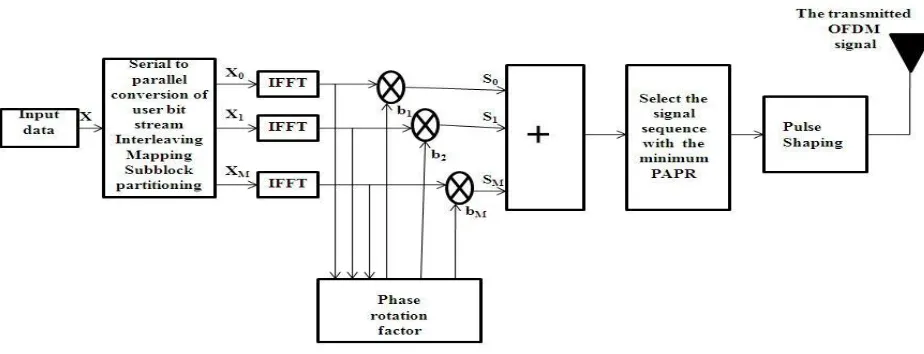
Figure 1: A typical structure of transmitter for PTS combined with interleaved OFDM signal
In the PTS technique [4, 5] is the most attractive scheme because of good PAPR reduction performance and no restrictions to the number of the subcarriers. In the PTS approach, the input data block is partitioned into disjoint sub blocks. Each sub block is multiplied by a phase factor, which is obtained by the optimization algorithm to minimize the PAPR value. However, PTS techniques set up additional complexity and a little bit loss of the spectral efficiency due to the side information insertion. The side information about the phase rotation factors would be necessary to transmit for correct OFDM symbol recovery. The interleaving method has the lowest computational complexity but it has the worst PAPR performance because the generated candidates are not fully independent [6]. In PAPR reduction was achieved through a pulse shaping method at the expense of an increase in the error probabilities of the system, and different pulse shaping waveforms result in different probabilities of errors. Furthermore, the modified PTS scheme with median filter is proposed to lower the computational complexity while maintaining the PAPR reduction performance compared with the ordinary PTS scheme.
II. PAPR PROBLEM IN OFDM
In OFDM, information is carried on several narrowband orthogonal subcarriers, each subcarrier being modulated by a complex constellation like QAM. The input data block of
N symbols, Xk =(X0,X1, ....XN−1), is formed with each
symbol modulating the corresponding subcarrier from a set of subcarriers. The N subcarriers are chosen to be orthogonal, with a pulse shape waveform of duration T, and
fs =1/T is the frequency spacing between adjacent
subcarriers.
In OFDM system, the time-domain OFDM signal for N subcarriers can be written as
Where Xk denotes the modulated symbol in the kth
subblock The symbol- spaced sampling sometimes misses some of the signal peaks and results in optimistic results for the PAPR. In practice, this transform can be implemented very efficiently by the IFFT. Using the IFFT significantly is reduced the amount of calculations by exploiting the regularity of the operations in the IDFT [1]. The PAPR of the transmitted OFDM signal is given as the ratio of the maximum to the average power, written as
Where E[・] is the expected value operator.
The PAPR of the continuous-time OFDM signal cannot be precisely computed in the Nyquist sampling rate, which corresponds to N samples per OFDM symbol. When this is not the case, the achieved PAPR reduction might be lower and suboptimal [9]. To achieve effective PAPR reduction for this case, signal peaks may be skipped and PAPR estimates are not precise corresponding passband PAPR.
III. PARTIAL TRANSMIT SEQUENCE IN OFDM
International Journal of Emerging Technology and Advanced Engineering
Website: www.ijetae.com (ISSN 2250-2459,ISO 9001:2008 Certified Journal, Volume 5, Issue 11, November 2015)
201
With this approach, disjoint subblocks of OFDM subcarriers are phase shifted separately after the IFFT is computed. If the subblocks are optimally phase shifted, they exhibit minimum PAPR and consequently reduce the
PAPR of the merged signal. The number of subblocks (V)
and the partitioning scheme determine the PAPR reduction. The main problem of PTS arises from the computation of multiple IFFTs, resulting in a high computational complexity proportional to the number of subblocks.
Subblock partition for PTS OFDM is a method of division of subbands into multiple disjoint subblocks. In general, it can be classified into 3 categories; interleaved partition, adjacent partition, and pseudo-random partition [10]. For the interleaved method, every subblock signal spaced apart is allocated at the same subblock. In the adjacent scheme, successive subblocks are assigned into the same subblock sequentially. And each subblock signal is assigned into any one of the subblocks randomly in the pseudo-random scheme. It can be noted that the computational complexity of the interleaved subblock partitioning scheme is reduced extensively as compared to that of the adjacent and pseudo-random partition scheme.Fig.1 shown transmitter of PTS in OFDM sign
A. Complementary Cumulative Distribution Function
CCDF computes the power complementary cumulative distribution function (CCDF) from a time domain signal. The CCDF curve shows the amount of time a signal spends above the average power level of the measured signal, or equivalently, the probability that the signal power will be above the average power level.
IV. SIMULATION RESULTS
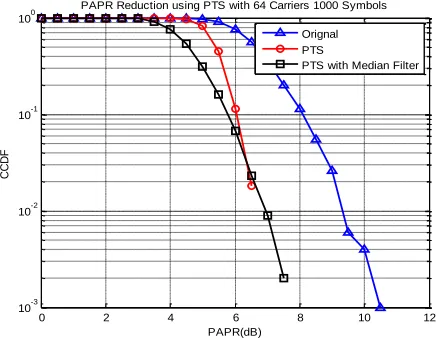
In the OFDM system under consideration, PTS technique with median filter is applied to the subblocks of uncoded information, which is modulated by QAM modulation, and the phase rotation factors are transmitted directly to receiver through subblock. The performance evaluation is done in terms of complementary cumulative distribution function vs. PAPR. Computer simulation is used to compare the performance of our algorithm with that of exhaustive search and the suboptimal FA [5]. We simulate OFDM signals with 64,126,512 and 1024 4-QAM
subcarriers and an oversampling factor L = 4 is used. Fig.
2,3,4,5 AND 6 compares the complementary cumulative density functions (CCDF’s) of the PAPR where the number
of sub blocks in PTS is 8 (M = 8).
Also, the PTS phase factors are chosen from P = {+1,
−1}. Note also that our proposed method and exhaustive
search perform identically, verifying that our proposed method is optimal, resulting in approximately 2-dB additional reduction compared to the PTS. All this simulation can be done in Matlab R2012b (version 8.0).In this simulation the computational time of the proposed optimizer can be as low as 65% of that of an exhaustive optimizer. CCDF’s for the case that the number of sub
blocks in PTS is 4 (M = 4). CCDF computes the power
complementary cumulative distribution (CCDF) function from a time domain signal. The CCDF curve shows the amount of time a signal spends above the average power level of the measured signal, or equivalently, the probability that the signal power will be above the average power level. Again, the results show that the proposed
algorithm and exhaustive search have identical
performance in PAPR reduction. Note that it give additional PAPR reduction compared to into the same subblock sequentially. And each subblock signal is assigned into any one of the subblocks randomly in the pseudo-random scheme. It can be noted that the computational complexity of the interleaved subblock partitioning scheme is reduced extensively as compared to that of the adjacent and pseudo-random partition scheme. Fig.1 shown transmitter of PTS in OFDM signal. FA. The PAPR is calculated for 64, 128, 256, 512, 1024 FFT sizes and 1000 OFDM symbols. The system is evaluated under original condition and PTS with Median Filtering.
0 2 4 6 8 10 12
10-3 10-2 10-1 100
PAPR(dB)
CCDF
PAPR Reduction using PTS with 64 Carriers 1000 Symbols
Orignal PTS
[image:3.612.336.555.489.658.2]PTS with Median Filter
International Journal of Emerging Technology and Advanced Engineering
Website: www.ijetae.com (ISSN 2250-2459,ISO 9001:2008 Certified Journal, Volume 5, Issue 11, November 2015)
202
0 2 4 6 8 10 12
10-3 10-2 10-1 100
PAPR(dB)
CCDF
PAPR Reduction using PTS with 64 Carriers 1000 Symbols Orignal PTS
PTS with Median Filter
0 2 4 6 8 10 12
10-3 10-2 10-1 100
PAPR(dB)
CCDF
PAPR Reduction using PTS with 128 Carriers 1000 Symbols
Orignal PTS
PTS with Median Filter
Fig. 3 PAPR Reduction using PTS with 128 Carriers 1000 Symbols
0 2 4 6 8 10 12
10-3 10-2 10-1 100
PAPR(dB)
CCDF
PAPR Reduction using PTS with 256 Carriers 1000 Symbols
Orignal PTS
[image:4.612.337.555.136.302.2]PTS with Median Filter
Fig. 4 PAPR Reduction using PTS with 256 Carriers 1000 Symbols
0 2 4 6 8 10 12
10-3 10-2 10-1 100
PAPR(dB)
CCDF
PAPR Reduction using PTS with 512 Carriers 1000 Symbols Orignal PTS
[image:4.612.336.557.336.525.2]PTS with Median Filter
Fig. 5 PAPR Reduction using PTS with 512 Carriers 1000 Symbols
0 2 4 6 8 10 12
10-3 10-2 10-1 100
PAPR(dB)
CCDF
PAPR Reduction using PTS with 1024 Carriers 1000 Symbols
Orignal PTS
[image:4.612.61.280.532.701.2]PTS with Median Filter
Fig. 6 PAPR Reduction using PTS with 1024 Carriers 1000 Symbols
V. CONCLUSIONS
International Journal of Emerging Technology and Advanced Engineering
Website: www.ijetae.com (ISSN 2250-2459,ISO 9001:2008 Certified Journal, Volume 5, Issue 11, November 2015)
203
REFERENCES
[1] Van Nee,R., and Prasad, R., OFDM for Wireless Multimedia
Communication, London, Artech House, 2000.
[2] Li, X., and Cimini, L.J., “Effect of Clipping and filtering on the
performance of OFDM”, IEEE Communications Letters, May 1998, pp. 131-133.
[3] Baumal, R., Fischer, R., and Huber, J., “Reducing the
peak-to-average power ratio of multicarrier modulation by selective mapping”, Electronics Letters, October 1996, vol. 32, no. 22, pp. 2056-2057.
[4] Cimini, L.J., and Sollenberger, N.R., “Peak-to-average power ratio
reduction of an OFDM signal using Partial Transmit Sequences”, IEEE Communications Letters, March 2000, vol.4, no.3, pp. 86-88.
[5] Tarokh,V., and Jafarkhani,H., “On the computation and reduction of
the peak-to-average power ratio in multicarrier communications”, IEEE Transactions on Communications, January 2000, pp. 37- 44.
[6] Lu, G., Wu, P., and Carlemalm-LogothetisC., “Enhanced
Interleaving partitioning PTS for peak-to-average power ratio reduction in OFDM systems”, IEEE Electronics Letters, August 2006, vol. 42, no. 17, pp. 983-984.
[7] Ben Slimane, S., “Peak-to-average power ratio reduction of OFDM
signals using pulseshaping”, Proceedings of IEEE Vehicular Technology Conference, USA, September 2002, pp. 889-893.
[8] Xiuyan, Z., and Guobin,T., “The research of improved PTS method
for peak-to-average power ratio reduction”, Proceedings of IEEE 3rd international conference on wireless, mobile and multimedia networks, Beijing, China, September 2010, pp. 104-107.
[9] Xinchun Wu, Zhigang Mao, Jinxiang Wang, Bin Zho, “ A novel
PTS technique with combinative optimization in real part and imaginary part for PAPR reduction in OFDM systems”, Proceedings of Third International Conference on Next Generation Mobile Applications, Services and Technologies, Cardiff, Wales, UK, September 2009, pp. 215-218.
[10] Mukunthan, P., and Dananjayan, P., “Modified PTS with
interleaving and pulse shaping method for PAPR reduction of OFDM signal with QPSK subcarriers”, Proceedings of International Conference on Information and Communication Technology,
Chennai, India, 24th December 2011, pp. 65-71.
[11] Spector, A. Z. 1989. Achieving application requirements. In