Full Length Research Paper
Intelligent routing information protocol using full
triggered update mechanism
Abdullah Gani
1, M. K. Hassan
1,A. A. Zaidan
2,3*and B. B. Zaidan
2,31Faculty of Computer Science and Information Technology, University of Malaya, 50603 Kuala Lumpur, Malaysia. 2Faculty of Engineering, Multimedia University, 63100 Cyberjaya, Selangor Darul Ehsan, Malaysia.
3Predictive Intelligence Research Cluster, Sunway University, No 5, Jalan University, Bandar Sunway, 46150 Petaling
Jaya, Selangor, Malaysia.
Accepted 06 April, 2011
The heartbeat of network is the routing services which are available upon the execution of protocols. Many routing protocols emerge over one another to strive for betterment in performing the main function of routing the packets to destination efficiently. Despite the superiority of the new protocols in certain feature, the old routing information protocol (RIP) is still widely used due to its simplicity. RIP updates its routing table on a constant interval period by checking the existence of neighbor nodes and changes on the path availability. This mechanism, however, has some drawbacks of bandwidth consumption and higher routing overhead generation. This paper studies the affect of periodic update mechanism on the consumption of bandwidth and proposes a new routing update mechanism. Our technique eliminates the periodic update mechanism in RIP and replaces it with full triggered update by topology change detection mechanism (TRIP). The proposed mechanism triggers the update when topology change is detected. We tested our proposed mechanism in Network Simulator 2 (Ns 2) simulations. The results show that TRIP consumes less bandwidth and sends less routing packets by 70% than RIP. This work contributes significantly to small network as bandwidth is obviously limited.
Key words: Distance vector routing, routing information protocol (RIP), triggered update, periodic update, link failure detection.
INTRODUCTION
Routing protocol is a protocol that specifies how routers communicate with each other, distribute information that enables them to select routes between any two nodes on a computer network, the purposes of routing protocols development are to reduce the time delay (Aydogan et al., 2010; Meng et al., 2008), improve the bandwidth usage (Shih et al., 2010), reducing power consumption (Khan et al., 2010; Shi et al., 2010) reduced the packet loss rate (Hamza et al., 2010; Jasem et al., 2010) reducing the routing overload (Kara et al., 2010; Jasem et al., 2011) reduce the number of messages exchange (Çelik et al., 2010; Al-Sharabi et al., 2008) and improves throughput (Al-Sharabi et al., 2008). In the last decade many routing algorithms have been developed for traditional wired LANs/WANs and those routing protocols
*Corresponding E-mail: [email protected]
protocol with minimum routing overhead and efficient in bandwidth consumption becomes an active research target (Boppana and Konduru, 2001).Routing information protocol (RIP) has several benefits. It is in widespread use, and the only interior gateway protocol that can be durable enough to run everywhere in deferent types of routers. So in a mixed equipment environment, RIP may be our only option for dynamic routing. Configuring a RIP system requires little effort, ahead of setting path costs. RIP uses an algorithm that does not require complicated computation or large storage requirements on hosts or routers (Marina and Das, 2001).
Motivation
Today, computer networks are the core of modern communication. (Sameer et al., 2011; Medani et al., 2011). For example, all modern aspects of the public switched telephone network (PSTN) are computer-controlled, and telephony increasingly runs over the Internet Protocol, although not necessarily the public Internet. The scope of communication has increased significantly in the past decade and this boom in communications will not have been possible without the progressively advancing computer network.
It is becoming increasingly more important to manage network bandwidth, and to admit the need to guard against the inefficient use of both network bandwidth and a router's resources. Many routing protocol offer an efficient routing mechanism which produce less routing overhead and bandwidth consumption than other types of routing protocols such as the routing information protocol but the RIP is very simple easy to configure than most of the other complex routing protocol. The modification of the routing information protocol (RIP) by applying full triggered update mechanism will result in reduced bandwidth consuming and will create minimum routing overhead.
Problem statement
There are a number of issues relevant to RIP. First, the slow convergence may cause inconsistent routing entries, normally results in routing loops. When there is a link failure, other routers cannot receive the failure notification before sending their own updates. Consequently, the network bounces the incorrect routing table and increments the metric. The metric can eventually approach to infinity. In order to correct this problem, combinations of solutions have been implemented.
By defining 15 to be the maximum number of hops, the infinite looping problem can be prevented. A second solution uses split horizon, which forbids the router from sending information about a route back in the direction from which the original packet arrived. Moreover, a
Gani et al. 2751
hold-down timer can be used. It instructs the router to delay any changes that involves the defected routes. Finally, the router can send messages as soon as it notices a change in their routing table (triggered update).
There are several disadvantages of RIP. The network is restricted to the size of 15 hops due to the solution to the count to infinity problem. In addition, the periodic broadcast of the routing table consumes bandwidth and the convergence time is too slow. The periodic checking and broadcasting, which is performed at regular intervals (every 30 s) regardless of whether the internetwork has changed, can cause excessive overhead traffic on some internetworks which in turn waste the network bandwidth.
Objective of study
In networking, bandwidth represents the overall capacity of the connection. The greater the capacity, the more likely that better performance will result. From this preview the idea of design a new algorithm that reduces the amount of routing table advertisements in order to save the network bandwidth became very important as the network is growths the number of the connected routers is increased which in turn increase the routing table entries, accordingly the need for new algorithm that reduce this advertisements became important. In this paper we have set of objective’s which can be summarized as the following:
(i) To propose and model an improved routing information protocol through the use of adaptation criteria and the modification to the existing protocol.
(ii)To simulate the new RIP model by NS-2 simulator and evaluate the overall network throughput as a performance metric.
Research questions
The research presented in this paper implement a new algorithm for RIP routing protocol to improve the efficiency and bandwidth consumption. The research questions for this paper are:
(i) How to improve the efficiency of the routing information protocol (RIP) by applying on-demand techniques?
(ii) How does the new algorithm decrease the bandwidth consumption?
RELATED WORKS
study a number of this works. We looked at different kind of routing algorithms but they all related that they are all distance vector (DV) Routing.
Mittal and Vigna (2002) proposes to place a set of sensors in the links within a RIP network. Each of the sensors is provided with network topology and the positions of all the other sensors and each sensor computes all the possible paths from each router to each subnet. The sensor then analyzes the routing updates and checks the distance using its information. If a distance in RIP update is not in the same range, alarm is raised. Otherwise, a query is sent to all the sensors along all the possible paths that have this distance in order to further verify the distance. This approach does not eliminate the periodic update problem beside it might have difficulty applying it in a very dynamic network since it requires the administrator to perform manual configuration and position knowledge.
Perkins and Royer (1999) proposes algorithms that broadcast discovery packets only when necessary and distinguish between local connectivity management (neighborhood detection) and general topology maintenance. To disseminate information about changes in local connectivity to those neighboring mobile nodes which are likely to need the information. The algorithm proposed nodes do not discover and maintain a route to another node until the two nodes are in need to communicate, which can cause delay. Our proposed algorithm however maintains that when the topology is initiated for the first time nodes shall discover and maintains route to all the other nodes in the topology, but they do not keep flooding the network with those updates until there is a topology change or need for an update.
Marina and Das (2001) proposes an algorithm witch computes multiple loop-free and link-disjoint paths and computes multiple paths in a single routing discovery attempt, According to that, they manage to achieve faster and efficient recovery from route failures in dynamic networks. The proposed protocol that called as ad hoc on demand multipath distance vector (AOMDV) comes as an extension for the AODV routing protocol. The main different from AODV is in AOMDV where at the initial routing discovery it calculates multipath for each node in order to reroute quickly when topology change take place. Even the algorithm manages to react to topology change faster than AODV. However the mechanism of adding extra route paths in the routing table will cause extra bandwidth consumption. The algorithm is designed for rapidly changing topology there will be a point where all the paths will have been used and a new route calculation is needed.
Robba and Maestrini (2007) proposes Virtual Distance Vector routing protocol in which every node in the network, has the role of a scout, keeps distance vectors pointing to nodes in a predefined subset, referred to as its peers. For arbitrary source destination pair, packets going from source to destination can be routed along a
sequence of scouts and peers, where the first scout is the source, and the last peer is the destination. As VDV sets proactively the distance vectors kept by the scouts, data packets originating in the source can be transmitted without the need for prior discovery of routes. As a result an overhead of route is reduced and the delivery of packets becomes faster. This technique however is useful in steady topology but in highly changed topologies this approach will not be valuable.
Espes and Teyssie (2007) proposes an enhancement to AODV capabilities by assuming that nodes use the global positioning system (GPS) to determine their location in order to reduce the number of control packets and increasing the available bandwidth. These assumptions however have not been practiced in real life and in large topology the cost will be high.
Gerasimov and Simon (2002) proposes a novel solution to the QoS path finding problem in ad hoc networks. They present QoSAODV, a protocol that combines on-demand routing with an efficient MAC layer resource reservation mechanism. The protocol is a modified and enhanced version of the ad hoc on-demand distance vector (AODV). In particular, they have introduced link and path bandwidth calculation mechanisms and a resource reservation protocol into the original AODV protocol. The focus of their work is on bandwidth reservation. However their approach adapting lots of calculations and since the routing table entries are created on “per call ID” basis, the number of entries can grow quite high. And they have to adopt periodic removing for the routing entries; this approach is not suitable for our case since our idea is to provide efficient and simple routing algorithm.
Chakrabarti and Manimaran (2003) proposes a scalable algorithm for detecting and recovering from router attacks in distance vector routing protocols. The algorithm sends predecessor and path sum metrics along with the distance vector updates, instead of the traditional hop length information. The drawbacks of this algorithm that it causes more bandwidth consumption by adding more information in the routing update.
Routers which apply RIP routing algorithm exchange information about nodes destinations for the reason of computing routes all over the network. Destinations may be individual hosts, routers, networks, or special destinations used to express a default route (Malany et al., 2009), RIP generates more protocol traffic than other routing protocols such as OSPF, because it propagates routing information by periodically transmitting the entire routing table to neighbouring routers. This periodic broadcasting for the entire routing table also leads to consuming the network bandwidth (Pun, 2010).
2001).
The extreme need for a mechanism of updating the routing table without causing network overhead and bandwidth consumption becomes a top priority achievement in networking (Pathan et al., 2008).
The aim of the research is to improve the efficiency of the routing information protocol (RIP) by applying on-demand techniques. The full triggered update mechanism is used to reduce the routing overhead and improve the bandwidth consumption.
MATERIALS AND METHODS
NS-2 framework
The ns-2 network simulator is an object-oriented, discrete event simulation which uses C++ and an OTcl interpreter. They support detailed MAC and routing algorithms model in an efficient programming language, and specifying network configurations giving simplicity of scripting language. The ns-2 simulation environment allows investigating the characteristics of networks as it has a large number of models.
TRIP model in NS-2
We implemented routing information protocol (RIP)in the network simulator NS2 as an extension to the distance vector routing protocol provided by NS2.The routing table is to be advertised when there is a topology change and the maximum path is limited to 15 hops.
TRIP node model
In order to create the network topology in our simulation, NS-2 does not provide drag and drop facilities and user friendly GUI similar to OPNET++, all the nodes and the links are created manually.
Implementing TRIP model in NS-2
We modify the implemented routing information protocol (RIP) in the network simulator where the periodic updates are avoided and replaced with full triggered updates with topology change detection mechanism. The rest of the configurations are similar the RIP configuration.
Triggered update
After the node detects a change in the topology, for example link break-down, or new link connection, at that point only an update will be initiated and broadcasted to directly connected nodes. Triggered updates include exclusively the routes that have been added, changed, or became invalid since the last update.
Link failure and change detection
The network dynamics models use an internal queuing structure to ensure that simultaneous events are correctly handled. It is called the Routing Queue .Then notifies that the process will then invoke instance procedures at all of the nodes that were incident to the affected links. Each route model stores the list of nodes in its
Gani et al. 2753
instance variable array; it will then notify the RouteLogic instance of topology changes. rtModel: (routing Model) creates an instance of the appropriate type, defines the node or link that the model will operate upon, configures the model, and enables tracing.The rtModel object invokes the class Node instance procedure intf-changed .in /ns-2/dynamics.tcl Node::intf-intf-changed for each of the affected nodes. Node::intf-changed will notify any rtObject at the node of the possible changes to the topology. After that the change will be detected and handled.The configuration steps are applied just when the simulator starts it creates rtmodel-configure in ./ns-2/dynamics.tcl Simulator: rtmodel-configure just before starting the simulation. This occurrence procedure first acquires an occurrence of the class rtQueue, and then invokes configuration for each route model in its list, rtModel.
TRIP framework
The following algorithm for Enhancing Routing Information Protocol Performance Using Full Triggered Update Mechanism procedure as shown in Figure 1
SIMULATION
Simulation environment setup
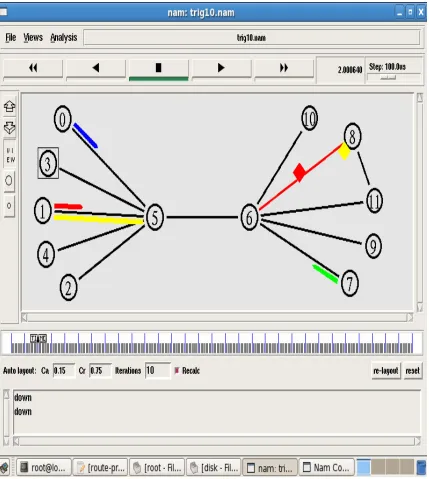
We applied our project simulation in the network simulator NS-2 version 2.31 under Linux operating system. The simulation simulates two networks with the five nodes in each one, we apply the original RIP routing protocol and the new improved RIP update mechanism, and compare the results of the simulation (Figure 2).
Communication and network parameters
All the nodes in the network are connected to the router with 2 MB link capacity with delay 2 ms, and between the two routers the link capacity 2 MB with delay 1 ms.
We apply the drop tail method for the packets that can be in the queue buffer for any node, ten packets is the maximum number that can be queued in each queue.
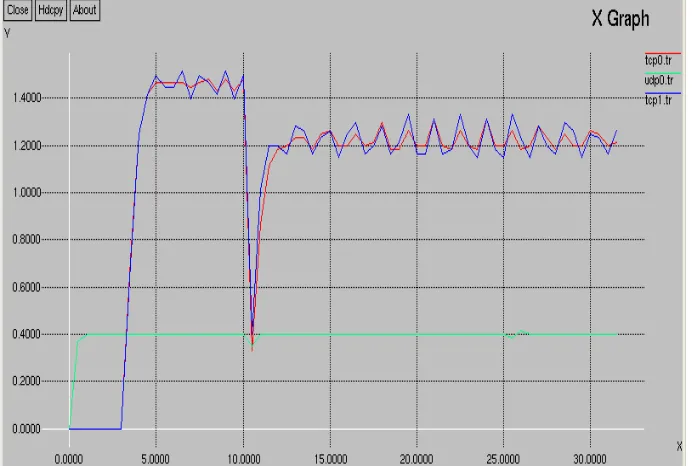
The UDP transmitting protocol is the default protocol which is used in the RIP routing protocol. The reason for using UDP not TCP is to minimize the latency and consumption of the bandwidth and the speed of the transmitting and receiving process, we had the chance during our simulation to see the difference when using TCP and UDP which shows the difference between them in the bandwidth consumption (Figure 3).
RIP and Trip simulation scenarios
The scenario of the simulation consists of two networks with the five nodes in each one; we use the CBR (constant bit rat) mechanism for sending the packet.
Lookup backup next
hop
Drop the packet
Y N
Y
Y
N
N
Y
Forward the packet
Backup next hop
is reachable
Insert the failure information Delete
the unreacha b-le node
Check if next hop is reachable?
Backup set is empty?
Update routing table Examine
Topology change
Failure information
set not empty?
N
Gani et al. 2755
[image:6.612.138.484.94.327.2]Figure 2.The network topology.
Figure 4. The packet forward between the Nodes 1 and 8.
but according to the extra over head for sending both triggered and periodic update it’s not considered a suitable solution).
In this paper the authors apply the simulation for 30 s and set the RIP periodic update to 3 s the default is 30 s but we change it to 3 s to minimize the simulation time, hence reducing the trace file size. In the simulation the authors cause the link to break at the 2nd second of the simulation. As shown in Figure 4 and activated again in the fourth second. In Figures 5, 6 and 7, we show different Actions in the TRIP simulations.
Routing protocols configurations
The appearance of programmable routers brings opportunities to implement and design new routing protocols with expressive policy,
which meet the needs of network operators better than the current range of protocols. This also introduces significant challenges in designing and understanding protocols.
RIP configuration
Gani et al. 2757
Figure 5. The link break between the Nodes 6 and 8.
TRIP configuration
In our new implementation, we apply a new mechanism by eliminating the periodic update and make the update on demand. That means only if there a topology change or occurrence of some event, then there will be an update. The configuration is similar to the normal RIP. The hops count is 15, and the preference number is 120.
Traffic generation parameters
Traffic is generated in the network by using the CBR (UDP) module,packet are being transmitted at the rate of 448 kbs, which
is the default number in the NS-2.The packets size are set at 1000 kb.
DATA ANALYSIS AND RESULTS Comparison of RIP and TRIP
Figure 6. Updating the routing table through the nodes.
Gani et al. 2759
Triggered update
Periodic update
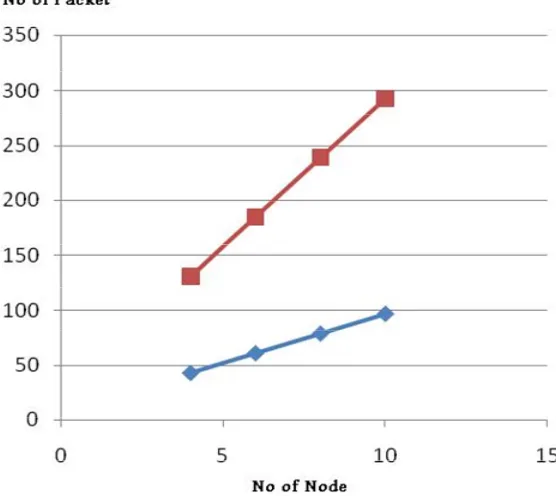
[image:10.612.98.376.101.349.2] [image:10.612.104.518.422.460.2]Figure 8. Difference in number of routing packets between RIP and TRIP.
Table 1. Difference in the number of RP being sent.
Node No. 4 6 8 10
RIP packet 131 185 239 293
TRIP packet 43 61 79 97
In order to see the relation between the number of packets being sent and the number of nodes in the topology, we had to make a simulation with four nodes in each network and run the simulation for a period of time after the results have been captured. The simulation is repeated again with two additional nodes in each side. We repeated this until we had ten nodes in each said. Table 1 shows the difference in the number of routing packet being sent.
Throughput
In communication networks, network throughput is the average rate of successful message delivery through a communication link. These data may be delivered through a physical or a logical link, and may pass through a certain network node. The throughput is usually measured in bits per seconds (bit/s or bps), and sometimes in data packets per second or data packets per time slot.
Static scenario results
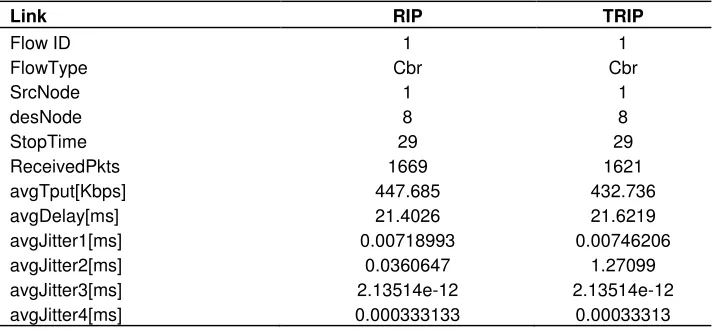
We have captured the result of the throughput for one link in the network for a period of time as shown as in Table 2.
DISCUSSION
Table 2. Static scenario results.
Link RIP TRIP
Flow ID 1 1
FlowType Cbr Cbr
SrcNode 1 1
desNode 8 8
StopTime 29 29
ReceivedPkts 1669 1621
avgTput[Kbps] 447.685 432.736
avgDelay[ms] 21.4026 21.6219
avgJitter1[ms] 0.00718993 0.00746206
avgJitter2[ms] 0.0360647 1.27099
avgJitter3[ms] 2.13514e-12 2.13514e-12
avgJitter4[ms] 0.000333133 0.00033313
21.4026 ms as compared 21.6219 ms for the TRIP. This extra delay comes from the elimination of periodic update since it keep the routing table distributed among the topology, but in term of the benefit in saving the bandwidth and reducing the routing over head, the little extra delay became tolerable.
The avgJitter shows the variation time between packet arrivals. Proactive routing protocols tend to provide lower latency than on-demand protocols because it maintains routes to all the nodes in the network all the time. Nevertheless, the bad thing about proactive routing is that it heavily consumes the network bandwidth through the periodic update.
Conclusion
In this paper, we proposed a new method to improve the efficiency of RIP by incorporating an element of intelligence. The update of routing table is triggered by the mechanism that detects the changes in the topology. Our method avoids the waste of bandwidth in updating the routing table by activating an update only when there is a change in topology. Hence, it reduces the volume of update works which obviously carried by a router on a fixed interval even there was no change in the network topology. The proposed method serves as initial step in creating self-configured network. For the future work, we intend to work further by incorporating self-organised element within the detector of the topology changes.
ACKNOWLEDGEMENTS
We would like to express our deepest gratitude to many individuals who were very helpful in offering advices and guides in this research. We also like to thank the Multimedia University for unlimited support.
REFERENCES
Al-Sharabi NA, Li Ren F, Algamali MH (2008). Applied packet`s received time prediction to reactive ad-hoc routing protocol. J. Appl. Sci., 8(6): 1035-1041.
Aydogan T, Kutlu A, Ekiz H (2010). Interconnections of WorldFIP, CAN and PROFIBUS fieldbuses over an ATM backbone, Scientific Res. Essays, 5(14): 1845-1851.
Boppana RV, Konduru SP (2001). An Adaptive Distance Vector Routing Algorithm for Mobile, Ad Hoc Networks. In Proceedings of IEEE INFOCOM, 5(3): 1753-1762.
Chakrabarti A, Manimaran G (2003). An Efficient Algorithm for Malicious Update Detection and Recovery in Distance Vector Protocols. IEEEXplore, 7(3): 1952-1956.
Çelik F, Zengin A, Tuncel S (2010). A survey on swarm intelligence based routing protocols in wireless sensor networks. Int. J. Phys. Sci., 5(14): 2118-2126.
Espes D, Teyssie C (2007). Approach for Reducing Control Packets in AODV-based MANETs. Conference on Universal Multiservice Networks. IEEEXplore, 8(7): 93-104.
Gerasimov I, Simon R (2002). A Bandwidth-Reservation Mechanism for On-Demand Ad hoc Path Finding. IEEEXplore, 10(7): 27-34. Hamza BJ, Ng CK, Noordin NK, Rasid MFA, Ismail A (2010). The
seamless vertical handover between (universal mobile telecommunications system) UMTS and (wireless local area network) WLAN by using hybrid scheme of Bi-mSCTP in Mobile IP, Sci. Res. Essays, 5(22): 3474-3489.
Jasem HN, Zukarnain ZA, Othman M, Subramaniam S (2010). The delay with new-additive increase multiplicative decrease congestion avoidance and control algorithm. Inf. Technol. J., 4(7): 1327-1335.
Jasem HN, Zukarnain ZA, Othman M, Subramaniam S (2011). Efficiency and fairness of new-additive increase multiplicative decrease congestion avoidance and control algorithm. J. Appl. Sci., 11(3): 438-449.
Kara R, Ozcelik I, Ekiz H (2010). A new routing algorithm in MANETs: Position based hybrid routing. Sci. Res. Essays, 5(3): 328-238. Khan ZS, Sher M, Rashid K, Rahim A, (2010). Presence enabled
conditional call setup model for IP multimedia subsystem. Int. J. Phys. Sci., 5(8): 1248-1255.
Marina MK, Das SR (2001). On-demand multipath distance vector routing in Ad-hoc networks. IEEE, 8(5): 14-23.
Malany AB, Dhulipala VRS, Chandrasekaran RM (2009). Throughput and Delay Comparison of MANET Routing Protocols Copyright ©ICSRSPublication,www.emis.de/journals/IJOPCM/Vol/09/IJOPC M(vol.2.3.10.S.9).pdf
Meng LW, Fu Z, Xu J, Zhang J (2008). A novel Ad hoc routing protocol based on mobility prediction. Inf. Technol. J., 7(6): 537-540.
Mittal V, Vigna G (2002). Sensor-Based Intrusion Detection for Intra Domain Distance-Vector Routing. ACM CCS’s 02, 4(4): 127-137. Pathan AS, Monowar M, Rabbi3 M, Alam M, Hong C (2008). NAMP:
Neighbor Aware Multicast Routing Protocol for Mobile Ad Hoc Networks. Int. Arab J. Inf. Technol., 5(1): 102-107.
Perkins CE, Royer EM (1999). Ad-hoc On-Demand Distance Vector Routing. Proc. WMCSA99: 2nd IEEE Workshop Mobile Comput. Syst. Appl., 10(5): 90-100.
Pun H (2001). Convergence Behavior of RIP and OSPF Network Protocols. IEEEXplore, 8(2): 1-50.
Gani et al. 2761
Robba A, Maestrini P (2007).Routing in Mobile Ad-hoc Networks: the Virtual Distance Vector Protocol. IEEEXplore, 5(6): 1-9.
Sameer HAl, Kiah ML, Zaidan AA, Zaidan BB, Alam GM (2011). “Securing Peer-to-Peer Mobile Communications Using Public Key Cryptography: New security strategy.“ Int. J. Phys. Sci., 6(4): 930-938.
Shih BY, Chen CY, Shih CH, Tseng JY (2010). The development of enhancing mechanisms for improving the performance of IEEE 802.15.4. Int. J. Phys. Sci., 5(6): 884-897.