
International Journal of Emerging Technology and Advanced Engineering
Website: www.ijetae.com (ISSN 2250-2459,ISO 9001:2008 Certified Journal, Volume 4, Issue 2, February 2014)
921
Video Inpainting using Nearest Neighbor Field Algorithm
Ankita S. Bagul
1, Asha S. Bhalerao
2, Vaishali N. Dhage
31,2,3Computer Department, Pune University, GESCOE, Nasik, India
Abstract—Video inpainting or completion is a vital video improvement technique used to repair or editing of digital videos. In this paper, we are proposing video inpainting algorithm for repairing damaged frames in video films, focusing on maintaining good spatiotemporal continuity. It has been used all over the world to convert cultural artifacts such as vintage videos and films into digital form. However, such types of videos are usually very poor in quality and most of the time it contain unstable luminance and damaged content. Experiment on many frames of videos show the benefits of our proposed approach which lead to natural looking videos with less annoying artifacts.
Keywords— inpainting, avi splitter, patch, masking, avi, nearest neighbor field.
I. INTRODUCTION
Now days, converting cultural and historical artifacts such as vintage films and videos into digital format have become an important trend. Because of their age visual quality of such frames and videos after digitization is usually low and often contain unstable luminance and damaged content. Video inpainting is one of the most challenging techniques, which helps users to repair frames where content is missing or damaged.
Video inpainting is the technique in which the damaged frames are extracted from the entire video and after that the damaged area is selected and this selected damage areas are filled by pasting the best match patch from the neighboring or current frame and these newly repaired frames are replaced by old damaged frames. Thus video completion or video inpainting repair the damaged frame in the video and finally gives the good quality video as output [1]
In our proposed video inpainting approach entire video Sequence is analyzed, after that masking algorithm is applied. once the damaged frames detected then we used nearest neighbor algorithm to find best match patch for that damaged patch .once we found best match patch then patch pasting process is carried out . In this way frames are repaired. Thus the technique increases the quality of the video.
II. LITERATURE SURVEY
The high synthesis quality of patch optimization methods requires more search iterations, which is the clear complexity bottleneck in all of these methods.
The search problem is even more critical in applications such as patch-based inpainting because the input image is typically much larger than the texture synthesis which usually take small image as input. Several technique for this search have been proposed, these techniques involves tree structures such as TSVQ [3], kd-trees [4] ,[5], [6] and VP-trees [7] each of which provide both exact and approximate search (ANN).
In case of synthesis applications, in many problems approximate search is used in combination with dimensionality reduction techniques such as PCA [4],[5],[8] because ANN methods are much more time- and memory-efficient in low dimensions. Ashikhmin [9] proposed a local propagation methods exploiting local coherence in the synthesis process by restricting a patch search space to the source locations of its neighbors in the exemplar texture. The same coherence assumption is used in our propagation search step. The k-coherence method [10] integrate the propagation methodology with a precomputation stage in which the k nearest neighbors of each patch are cached, and after that searches take advantage of these recomputed result sets. Although this speed up the search phase, in the input k-coherence still requires a full nearest-neighbor search for all pixels, and has only been demonstrated in the texture synthesis context. It assumes that the initial offsets are close enough that it needs to search only a small number of nearest neighbors. This may be true for small pure texture inputs, but we found that for large complex images our random search phase is required to escape local minima.
If we compare speed and memory utilization of our algorithm against kd-trees with dimensionality reduction, and we show that it is at least an order of magnitude faster than the best competing combination (ANN+PCA) and uses significantly less memory. Our algorithm also provides more generality than kd-trees because it can be applied with arbitrary distance metrics, and easily modified to enable local interactions such as constrained completion.
International Journal of Emerging Technology and Advanced Engineering
Website: www.ijetae.com (ISSN 2250-2459,ISO 9001:2008 Certified Journal, Volume 4, Issue 2, February 2014)
922 III. AVISPLITTER
It is a simple and easy to split AVI file. We can split a large AVI file into smaller AVI files, by using an AVI Splitter or to extract manually selected segments of an AVI file to new AVI files. For image processing Extraction of frame is always required. AVI video file .Extracted image is saved as BMP image. The BMP file format can store 2D digital images of arbitrary width, height, and resolution [11]
IV. SCRATCH DETECTION &MASKING ALGORITHM
A. Scratch detection algorithm
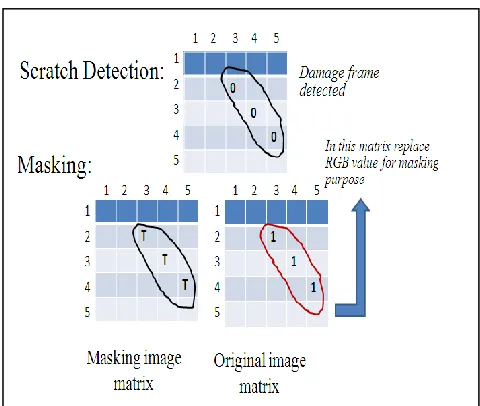
Our proposed algorithm analyze each and every frame of input video after that it check RGB value of each pixel of every frame & when RGB value get as 0 then the frame from which RGB value get as 0 which frame is select as damage frame.
B. Masking algorithm
First initialize mask as Boolean matrix. Initialize original image as pixel matrix, after that load masking & original image.
This mask matrix is initially taken a empty, take in loop it.. The algorithm read every pixel (x,y) coordinate value from original image matrix. Then extract RGB value of that pixel. If pixel’s RGB value is 0 (means white color) then set Mask = T in the pixel (x,y) coordinate value in mask matrix.
[image:2.612.325.565.120.323.2] After that, take in loop original image matrix. Read every pixel’s (x,y) coordinate value. Take every pixel’s value from original image matrix & compare it with same pixel’s coordinate in mask matrix. If pixel’s value in mask matrix is founded as Mask = T then change the RGB value of same pixel’s coordinate in original image matrix for identification purpose that this area is mask & need to inpaint .[11]
Figure 1: Scratch Detection & Masking Algorithm
V. NEAREST NEIGHBOR ALGORITHM
Our System relies upon the fast randomized algorithm for approximating nearest neighbor correspondence between two images. We define a nearest-neighbor field (NNF) as a function f: A 7-> R2 of offsets, defined over all possible patch coordinates (locations of patch centers) in image A, for some distance function of two patches D. Given patch coordinate an in image A and its corresponding nearest neighbor b in image B, f (a) is simply b-a. We refer to the values of ƒ as offsets, and they are stored in an array whose dimensions are those of A.
Pixels are Initializing with random patch offsets.
Check if neighbors have better patch offsets.
Better patch offsets is Search in concentric radius around the current offset
International Journal of Emerging Technology and Advanced Engineering
Website: www.ijetae.com (ISSN 2250-2459,ISO 9001:2008 Certified Journal, Volume 4, Issue 2, February 2014)
923 A.Initialization
The nearest-neighbor field can be initialized either by assigning random values to the field, or by using prior information. When initializing with random offsets, we use independent uniform samples across the full range of image B. If we use only this initial guess, the algorithm can sometimes get trapped in suboptimal local minima. To retain the quality of this prior but still preserve some ability to escape from such minima, we perform a few early iterations of the algorithm using a random initialization, then merge with the up sampled initialization only at patches where D is smaller, and then perform the remaining iterations.[2]
B.Iterative Update
After initialization, we perform an iterative process of improving the NNF. Each iteration of the algorithm proceeds as follows: Offsets are examined in scan order (from left to right, top to bottom), and each undergoes propagation followed by random search. These operations are interleaved at the patch level. [2]
C.Propagation.
[image:3.612.327.579.130.252.2]We attempt to improve f (x;y) using the known offsets of f (x-1;y) and f (x;y-1), assuming that the patch offsets are likely to be the same. For example, if there is a good mapping at (x - 1;y), we try to use the translation of that mapping one pixel to the right for our mapping at (x;y). Let D(v) denote the patch distance (error) between the patch at (x;y) in A and patch (x;y)+v in B. We take the new value for f (x;y) to be the arg min of f D( f (x;y)), D( f (x-1;y)), D( f (x;y-1))g. The effect is that if (x;y) has a correct mapping and is in a coherent region R, then all of R below and to the right of (x;y) will be filled with the correct mapping. Moreover, on even iterations we propagate information up and left by examining offsets in reverse scan order, using f (x+1;y)and f (x;y+1) as our candidate offsets. Random search. Let v0 = f (x;y). We attempt to improve f (x;y) by testing a sequence of candidate offsets at an exponentially decreasing distance from v0.[2]
Figure 2 : The randomized NNF algorithm Phases:(a) patches initially have random assignments; (b) the blue patch checks above/green and
left/red neighbors to see if they will improve the blue mapping, propagating good matches; (c) the patch searches randomly for
improvements in concentric neighborhoods.[2]
D.Random search.
Let v0 = f (x;y). We attempt to improve f (x;y) by testing a sequence of candidate offsets at an exponentially decreasing distance from v0
ui = v0+waiRi (1)
Where in Eq.1.Ri is a uniform random in [-1;1] x [-1;1], w is a large maximum search ―radius‖, and α is a fixed ratio between search window sizes. We examine patches for i = 0;1;2; ::: until the current search radius wa^i below 1 pixel. In our applications w is the maximum image dimension, and α= 1/2, except where noted. Note the search window must be clamped to the bounds of B.
International Journal of Emerging Technology and Advanced Engineering
Website: www.ijetae.com (ISSN 2250-2459,ISO 9001:2008 Certified Journal, Volume 4, Issue 2, February 2014)
924 VI. INPAINTING ALGORITHM
Take input as an input_ image, mask & radius.
Create mask image.
Initialize pyramid array.
In loop take source width greater than radius & source height greater than radius. In this loop, assign down sampling to source. Add source to pyramid & increment pyramid level.
Initialize level with maximum level.
In loop, take level greater than zero. Check that if level is equal to maxlevel-1, if yes then load source image to target image, initialize target mask with false & by using source, target & radius, find nearest neighbor.
Return the target image[11]
VII. RESULT ,CONCLUSION AND FUTURE WORK
Our video inpainting approach is sufficient for many practical synthesis applications also our algorithm avoids the expensive computations of the joint patch compatibility term and inference or optimization algorithms. Figure 4 shows the result of our video inpainting approach. Our algorithm does have some failure cases. Most notably, for pathological inputs In addition, extreme edits to a frame of video can sometimes produce ―ghosting‖ or ―feathering‖ artifacts where the algorithm simply cannot escape a large local minimum basin. However, we point out that the speed of our algorithm makes it feasible to either introduce additional constraints or simply rerun the algorithm with a new random seed to obtain a different solution. Although such repeated trials can be a burden with a slower algorithm.
We used Nearest-neighbor framework for inpainting the damaged area in video frame and nearest-neighbor algorithm for quickly computing approximate nearest-neighbor fields between pairs of images .This algorithm increase the speed of matching nearest neighbor.
Some important points in this domain for future work are GPU implementations, additional speed gains may be realized, create an opportunity for new applications in real-time vision and video processing.
Acknowledgment
International Journal of Emerging Technology and Advanced Engineering
Website: www.ijetae.com (ISSN 2250-2459,ISO 9001:2008 Certified Journal, Volume 4, Issue 2, February 2014)
925 REFERENCES
[1] Video Inpainting on Digitized Vintage Films via Maintaining Spatiotemporal Continuity Nick C. Tang, Chiou-Ting Hsu, Member, IEEE, Chih-Wen Su, Timothy K. Shih, Senior Member, IEEE, and Hong-Yuan Mark Liao, Senior Member, IEEE
[2] Patchmatch: A Randomized Correspondence Algorithm for Structural Image Editing Connelly Barnes1 Eli Shechtman2;3 Adam Finkelstein1 Dan B Goldman2 1Princeton University 2 Adobe Systems 3 University of Washington
[3] WEI, L. Y., AND LEVOY, M. 2000. Fast texture synthesis using tree structured vector quantization. In ACM SIGGRAPH, 479–488. [4] HERTZMANN, A., JACOBS, C. E., OLIVER, N., CURLESS, B.,
AND SALESIN, D. 2001. Image analogies. In ACM SIGGRAPH, 327–340.
[5] KOPF, J., FU, C.-W., COHEN-OR, D., DEUSSEN, O., LISCHINSKI, D.,AND WONG, T.-T. 2007. Solid texture synthesis from 2d exemplars.ACM SIGGRAPH 26, 3, 2:1–2:9.
[6] WEXLER, Y., SHECHTMAN, E., AND IRANI, M. 2007. Space-time completion of video. IEEE Trans. PAMI 29, 3 (March), 463– 476.
[7] KUMAR, N., ZHANG, L., AND NAYAR, S. K. 2008. What is a good nearest neighbors algorithm for finding similar patches in images? In European Conference on Computer Vision (ECCV), II: 364–378.
[8] LEFEBVRE, S., AND HOPPE, H. 2005. Parallel controllable texture synthesis. ACM SIGGRAPH 24, 3, 777–78
[9] ASHIKHMIN, M. 2001. Synthesizing natural textures. In I3D ’06 Proc., ACM, 217–226
[10] TONG, X., ZHANG, J., LIU, L., WANG, X., GUO, B., AND SHUM, H.-Y. 2002. Synthesis of bidirectional texture functions on arbitrary surfaces. ACM SIGGRAPH 21, 3 (July), 665–672. [11] VIDEO INPAINTING Chayanica Das1, Sachet Sharma2, Gaurav
Mishra3JSPM’s Wagholi ,ICOER(Computer Engineering, Pune, India) 1, 2,patchmatch - A Randomized Correspondence Algorithm for Structural Image Editing
[12] Http://www.youtube.com/watch?V=fme19otz6vk(ceffectsstudio) [13] Patchmatch: A Randomized Correspondence Algorithm for
![Figure 2 : The randomized NNF algorithm Phases:(a) patches initially have random assignments; (b) the blue patch checks above/green and left/red neighbors to see if they will improve the blue mapping, propagating good matches; (c) the patch searches randomly for improvements in concentric neighborhoods.[2]](https://thumb-us.123doks.com/thumbv2/123dok_us/8719792.883872/3.612.327.579.130.252/randomized-algorithm-initially-assignments-propagating-improvements-concentric-neighborhoods.webp)
