Spotify tailoring for B2B product
development
Salameh, A and Bass, J
Title
Spotify tailoring for B2B product development
Authors
Salameh, A and Bass, J
Type
Conference or Workshop Item
URL
This version is available at: http://usir.salford.ac.uk/id/eprint/51715/
Published Date
2019
USIR is a digital collection of the research output of the University of Salford. Where copyright
permits, full text material held in the repository is made freely available online and can be read,
downloaded and copied for noncommercial private study or research purposes. Please check the
manuscript for any further copyright restrictions.
For more information, including our policy and submission procedure, please
Spotify Tailoring for B2B Product Development
Abdallah Salameh
Computing, Science and Engineering University of Salford
Salford, UK [email protected]
Julian M Bass
Computing, Science and Engineering University of Salford
Salford, UK [email protected]
Abstract—Agile software development has become increasingly common in the context of large-scale organisations. Typically, software organisations tailor agile methods to fit their needs and ultimately maximise success. The size of the organisation, business goals, and operative models are some examples of factors for which agile methods are tailored.
Spotify model is introduced to facilitate the development of a very large-scale project with a Business-to-Consumer (B2C) model, but mission-critical large-scale projects with Business-to-Business (B2B) model are not addressed by the model. Hence, a question that imposes itself is: What are practitioner perceptions of agile tailoring when using the Spotify model?
In this paper, we conduct a longitudinal embedded case study to investigate practitioner perceptions of agile method tailoring on a large-scale mission-critical project in B2B environment. The case study lasted over 21 months during which 14 semi-structured interviews were conducted. To analyse the collected data, the Grounded Theory (GT) is adopted.
As a result, we identify 44 tailored practices and attributes for B2B product development. Based on this tailoring, 4 influ-ential factors on “Spotify Tailoring” have been derived. These derived factors are worth considering for other organisations concerned with agile method tailoring for large-scale mission-critical projects in B2B context.
Keywords-Agile methods tailoring, Spotify tailoring, B2B, Large-scale, Mission-critical, Offshore, Outsource, Product De-velopment, Longitudinal embedded case study
I. INTRODUCTION
Software development environments are complex and ex-hibit several challenges such as physical distances, time zones, culture differences, strategic issues, process differences, and knowledge management [1]. The introduction of agile meth-ods shows a fundamental shift in how organisations try to cope with encountered complexity and volatility issues [2]. Agile methods are built around empowered and self-organising teams with a strong focus on communication and collaboration through various agile practices [3]. However, organisations tend to tailor agile methods to scale employed practices and to fit their needs best [3], [4].
Spotify model is originally introduced to facilitate the development of music streaming services in a very large-scale1B2C project environment, which demands satisfying the needs of end-users [6]. The substantial notion of the Spotify model is to create autonomous yet collaborative squads [6]. Since Spotify values innovation, product development follows
1“Very large-scale projects” have more than 10 teams [5]
Lean Startup methodology [6]. Spotify model does not provide guidelines for developing large-scale2 mission-critical
finan-cial projects in B2B environment [6]. B2B environment is deemed as complicated because of having conflicting agendas, politics and different priorities between two or more parties (organisations) [7]. Product development in B2B environment often requires the participation of many stakeholders from all businesses sides [7]. Those stakeholders at the supplier side should posses good industry knowledge to gain customers’ trust. Thus, Product Owners (PO) and Key Account Managers (KAM) are expected to be the face of the product, lead innovation and help the customers (i.e., organisations that acquire a product or a software service from a supplier) to gain strong competitive advantage [7]. In this paper, we con-tribute to answer the research question:What are practitioner perceptions of agile tailoring when using the Spotify model in a large-scale mission-critical B2B project environment?
We carried out a longitudinal embedded case study in a very large-scale organisation, which has a large-scale mission-critical B2B project environment. We conduct direct observa-tions over 21 months, during which 14 semi-structured inter-views were conducted to find out how agile method tailoring is actually performed. Due to confidentiality agreement, a limited description of the explored project is provided. The Grounded Theory (GT) approach was adopted to analyse collected data. As a result, we identify 44 tailored practices and attributes, in terms of B2B product development, which are described by practitioners and identified during our observations. This “Spotify Tailoring” highlights 6 modified, 28 newly intro-duced, and 10 followed practices and attributes as originally introduced by Spotify model.
II. SPOTIFY MODEL
Spotify model is introduced to facilitate software devel-opment for hundreds of developers across 4 cities [6]. In Spotify, squads are autonomous but tightly aligned, and can use their own preferable agile methods [6]. The autonomy of the squads is manifested in their ability for bypassing layers of management. The alignment of squads refers to the extent to which the organisation strategy is proudly undertaken by having focused team interactions rather than tactics [6], [8].
Product development in Spotify follows Lean Startup [6], [9]. When the organisation decides that it is worth moving forward, it builds a Minimum Viable Product (MVP), which is just enough to feel the narrative, but far enough for the feature to be complete. Afterward, the organisation releases the built MVP into production for few percent of the end users to start learning and analysing data. Thereby, it continues monitoring the data and tweaking the feature until it reaches the desired impact. As a result, the feature is gradually rolled out for all end users around the world. Spotify is not concerned with release planning and predictability but rather about innovation [6]. As long the organisation does not rollback a new feature and it reaches desired impact without considering specific velocity, then it is a success [6]. A 100% of predictability means 0% of innovation as Spotify focuses on business value delivery instead of plans fulfillment [6].
Spotify adopts fail-friendly environment by employing fast failure recovery strategy where some squads have aFail Wall, which is shared with other squads to learn quickly and to eliminate such failures in future. To mitigate future risks, the organisation adopts aPostmortem Documentationprocess, which is performed at the end of projects, to determine what were successful or unsuccessful [6]. Thereby, the organisation tends to fix the process not just the product by capturing learning lessons to avoid the same problem in the future. To build experiment friendly culture and to minimise ripple effect of possible failure in releases, Spotify introduced a Limited Blast Radius technique [6]. It gives squads courage to do lots of small releases on a limited number of end-users to do experiments and learn quickly instead of wasting time predicting and controlling all risks in advance.
III. RESEARCHDESIGN ANDMETHODOLOGY
Our case study is carried out in a multinational very large organisation, which is a market leader in the financial industry. The company employs approximately 650 staff members in 60 markets and processes around 60 billion e per year. This paper focuses only on one project, which manages mission-critical autonomous financial services. These autonomous sys-tems are collection of connected sub-syssys-tems which operate under the control of one administrative software that presents a common defined management policy to the service. From the customers’ point of view, this project is perceived as an offshore outsourced project based on ˇSmite’s proposed terminology and taxonomy for GSD [10]. In this project, the developers are distributed over 6 co-located squads. Also, there are 3 KAMs, 5 POs (2 of them are empowered with KAM role), 1 architect, 2 agile coaches, and 1 test lead.
The research draws on direct observation of around 225 ceremonies over 21 months, and on conducting 14 semi-structured interviews. The observed ceremonies include daily stand-ups, backlog grooming, planning sessions, and retro-spectives. Direct observation provides deep understanding of the studied phenomenon and prevents any suspected deviation between “semi-structured interviews” view of matters and the “real” case [11]. To provide interviewees with the opportunity
to raise any other issues, an open-ended guide was used. The questions were revised after the second interview. Each interview was recorded (around 50 minutes) and transcribed verbatim for detailed analysis in a continuous basis.
The GT (Glasserian approach) is employed to analyse collected data while having absence of up-front clear research problem [12]. This is achieved by harnessing a constant comparison of data at increasing levels of abstraction. In essence, this is a process of continuous undertaking of mem-oing, sorting, data collection, coding, constant comparison, and theoretical saturation. After each interview, the audio file and its written transcripts was carefully reviewed to ensure consistency. To facilitate the coding process a few questions suggested by Glaser were answered while conducting the open coding. Constant comparison was employed to refine the emerging categories from identified concepts. Moreover, the observations were analysed and compared to the concepts derived from the analysed interviews. We identified minor contradictions, which were explored and accommodated in the resulting grounded theory.
IV. FINDINGS
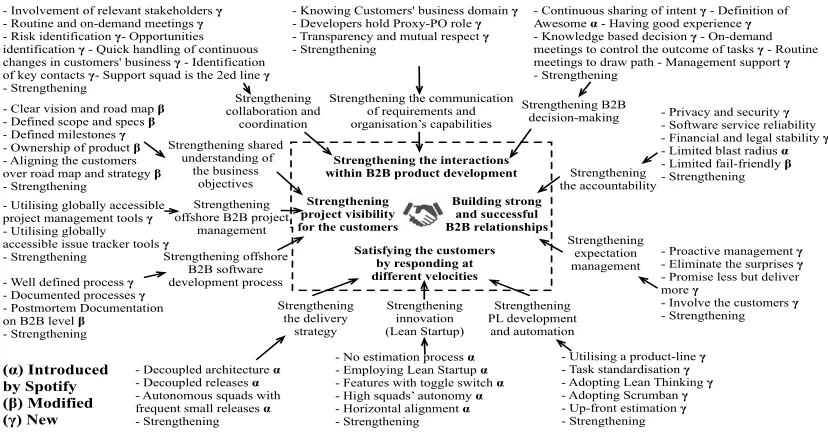
A synergy has been discovered between the following categories (i.e., factors), which are depicted in Fig. 1, and in-fluencing“Spotify Tailoring”in terms of product development for a large-scale mission-critical project in B2B environment.
A. Strengthening project visibility for the customers
1) Strengthening shared understanding of the business ob-jectives: Establishing clear vision, by defining the scope and having a set of specifications, provides customers and squads with directions to avoid confusion during the development process. In fact,“project vision is communicated frequently, but it changes quite often. This is mainly due to the market demands since it is volatile.”–P10, PO. Since the customers are scattered around the globe, they need to know what the target is. Therefore, the project vision, which provide long term direction is broken down by the POs into milestones, provides 1) the squads with short term motivation and guidance, and 2) meet the customers’ needs. “Frequently communicating clear targets and establishing milestones based on the defined specifications is considered important for both of the squads and the customers”–P7, PO and KAM. To maintain shared project vision and specifications, the POs ensure in their regular meeting of 1) the ownership of the provided software service itself, and 2) the alignment of the product strategy and the overall roadmap of the organisation. “We have a regular weekly meetings between the POs to prevent the deviation from product’s main purpose... the provided features should not only cover the needs of a specific customer but they should be also usable by all customers within a specific domain”–P12, PO.
- Clear vision and road map β - Defined scope and specs β - Defined milestones γ - Ownership of product β - Aligning the customers over road map and strategy β - Strengthening
- Utilising globally accessible project management tools γ - Utilising globally accessible issue tracker tools γ - Strengthening Strengthening shared understanding of the business objectives Strengthening offshore B2B project
management
Satisfying the customers by responding at different velocities Strengthening the interactions within B2B product development
Building strong and successful B2B relationships Strengthening
project visibility for the customers
- Well defined process γ - Documented processes γ - Postmortem Documentation on B2B level β
- Strengthening
Strengthening offshore B2B software development process
(α) Introduced by Spotify (β) Modified (γ) New
- Decoupled architecture α - Decoupled releases α - Autonomous squads with frequent small releases α - Strengthening
- Utilising a product-line γ - Task standardisation γ - Adopting Lean Thinking γ - Adopting Scrumban γ - Up-front estimation γ - Strengthening - No estimation process α
- Employing Lean Startup α - Features with toggle switch α - High squads’ autonomy α - Horizontal alignment α - Strengthening
- Knowing Customers' business domain γ - Developers hold Proxy-PO role γ - Transparency and mutual respect γ - Strengthening
- Continuous sharing of intent γ- Definition of Awesome α - Having good experience γ - Knowledge based decision γ- On-demand meetings to control the outcome of tasks γ- Routine meetings to draw path - Management support γ - Strengthening Strengthening the delivery strategy Strengthening PL development and automation Strengthening innovation (Lean Startup) Strengthening the accountability
- Privacy and security γ - Software service reliability - Financial and legal stability γ - Limited blast radius α - Limited fail-friendly β - Strengthening
Strengthening expectation management
- Proactive management γ - Eliminate the surprises γ - Promise less but deliver more γ
- Involve the customers γ - Strengthening Strengthening the communication
of requirements and organisation’s capabilities Strengthening collaboration and coordination Strengthening B2B decision-making - Involvement of relevant stakeholders γ
[image:4.612.98.512.54.272.2]- Routine and on-demand meetings γ - Risk identification γ- Opportunities identification γ - Quick handling of continuous changes in customers' business γ- Identification of key contacts γ- Support squad is the 2ed line γ - Strengthening
Fig. 1. Emergence of the influential factors on Spotify Tailoring (codes, concepts and categories – using the GT)
low coordination overhead. “To align B2B product develop-ment, we provide our customers with shared Kanban boards... This in turn facilitates the planning activities as customers can observe the progress and take decisions accordingly.”–P11, KAM. Due to the strong culture of cross-pollination, all squads follow a standardised operational process that is controlled by Kanban and follows the employed definition of “DONE”.“The definition of “DONE” ensures tasks’ completeness, rules the overall process flow, and satisfies customers’ needs”–P7, PO and KAM. Hence, the squads can respond to customers’ needs in a highly transparent and disciplined manner.
3) Strengthening offshore B2B software development pro-cess: To improve project and process visibility in B2B en-vironment, the organisation embraces well-defined and docu-mented processes.“Continuously, we share with our customers feature instructions, release notes, and highlight on software development processes to streamline the business develop-ment”–P10, PO. Also, the organisation utilises Postmortem Documentation process, which is introduced by Spotify, to continuously document project related aspects, and to improve the development process. Therefore,“at the end of each small project, we get customer’s feedback to improve the product and the process if needed”-P11, KAM.
B. Strengthening the interactions
1) Strengthening the collaboration and the coordination: Offshore outsourced software product development demands sufficient collaboration and coordination between the two sides of B2B. More complex issues in this mission-critical project require regular and on-demand involvement of multiple stakeholders from both sides. “Key players from both parties meet up on weekly basis to discuss the progress over an online Kanban board... we also meet up whenever is needed.”– P11, KAM. Being highly involved in the process keeps all sides informed, enables the identification of possible risks that
both sides might overlook, and enables the identification of potential opportunities that might invest in.“The involvement of key stakeholders from both sides is considered crucial. Otherwise, we may realise that things should have been handled in different ways. Thus, our priorities are coming into focus or changing”–P7, PO and KAM.
The identification of key contact persons in the two sides strengthens the interaction in business and product develop-ment, and facilitates a continuous communication flow. POs and KAMs tend to “highlight on external communication hierarchy, internal structure, and squads’ missions to make sure that all parties are on the same page”–P10, PO. Also, the support squad, which represents the second line of contact, is “continuously helping the customers, in a low Resolution Time, with service configuration management, issues inves-tigation, requirements engineering, and continuously giving feedback to the POs and KAMs”–P14, Support Manager.
2) Strengthening the communication of requirements and the capabilities of the organisation: Product development is tightly linked with the continuous communication of require-ments and the continuous communication of the organisation’s (i.e., supplier) capabilities to the customers. Misunderstanding of the requirements or organisation’s capabilities puts even simple implementations at serious risk.
vagueness of newly requested features”–P9, Senior Developer. Both sides have different interests, but they overlap. The customers utilise the provided service to perform a business functionality that is outside their business domain.“A success-ful product development relies on success-fulfilling customers’ needs and maintaining respect for what we need to accomplish”– P10, PO. The organisation has developed a corporate culture based on transparency and mutual respect by “continuously communicating what capabilities (time and resources) we can provide within the upcoming period”–P11, KAM.
3) Strengthening B2B decision-making: The organisation emphasises on continuous sharing of intentions at different levels to facilitate decision-making. “As we are familiar with the intentions behind each component or feature, we are able to make the right decisions quickly”–P6, PO and KAM. Also, utilising the“Definition of Awesome”, which is introduced by Spotify, in each area of the provided software service facilitates decision-making. “Possessing good knowl-edge about how the GOOD should looks like in all areas improves our product development”–P7, PO and KAM. In fact, decision-making is mostly shifted from a domain-based approach, which relies on routine decisions, to a knowledge-based approach, which relies on expertise. “Our POs’ squad have long experience and knowledge in this industry, which in turn facilitates our work”–P12, PO.
“On-demand decision process is employed to control the outcome of tasks having high uncertainty ”–P11, PO
“POs meet up regularly to ensure...and the ownership of our project as customers are enthusiastic about using our software service in their own way”–P11, PO
C. Building successful B2B relationships
1) Strengthening the accountability of the provided software service: The customers rely on this software service to of-fer their end-users wide range of payment solutions. Thus, the customers rely on the accountability of the organisation in question to provide stable, reliable, and secure financial software service, which impact the Return Of Investment (ROI).“If things go wrong with the provided software service, it will negatively affect customers’ business, reputation, and revenues”–P11, KAM. Actually,“end-users assume that if a specific part of a customer’s product is bad, then the whole product is bad too”–P13, KAM. Also, “the stability of the provided service is also about the financial and legal stability of the provided software”–P1, Agile Coach and Architect.
The organisation emphasises on continuously providing 24/7 stable software service. Instead of rolling out new im-plemented features to all customers at once, a“Limited Blast Radius technique is utilised to perform experiment on a limited number of end-users”–P8, Senior Developer. Consequently, the responsible squad decides whether to gradually rollout the new feature or roll it back based on the monitoring results.
The organisation employs a limited fail-friendly environ-ment since it provides mission-critical software service. “As we provide financial software services, failure is not tolerated since it affects directly our reputation”–P1, Agile Coach and
Architect. However, failures can be encountered during the pilot launch of newly implemented features, which aim to improve and verify features’ behaviours. These failures are utilised to learn and improve both of the process and the product. “In our squad-of-squads weekly meeting, we share the reasons behind encountered release issues to improve the product and the process if needed”–P12, PO.
2) Strengthening expectations management: Proactively managing the expectations builds strong B2B relationships. To achieve this, “a deeper understanding of the customers, at company and business domain levels, is considered im-portant to provide customers with better solutions that would strengthen their competitive advantage”–P13, KAM. The or-ganisation tends to eliminate possible surprises when working on tasks with high-level of uncertainty and complexity. “An-nouncing the initiation of implementation for a task brings customers’ excitement and builds expectations. Not being able to deliver on time causes dissatisfaction and a loose of confidence in our ability to produce in the future.”–P7, KAM. Hence, POs and KAMs tend to“always promise less but try to deliver even more–P5, PO. To mitigates possible dissatisfaction, POs and KAMs are continuously involving key stakeholders at the customer side in the process to eliminate possible misunderstandings.“When meeting customers, we try to avoid possible pitfalls by having a conversation in which both sides openly discuss what is expected from the other side to prevent possible misunderstandings”–P7, PO and KAM.
D. Satisfying customers by responding at different velocities
Since squads have different missions and adopt different tailored methods, they respond to customers’ needs at differ-ent velocities. While some missions value innovation more than plan fulfilment, others value plan fulfilment more than innovation. We ignorestrengthening the delivery strategyand strengthening innovationsince they are covered by Spotify [6].
1) Strengthening product-line development and automation: The adoption of a product-line (PL) provokes task standardis-ation to streamline the development process. Since the project manages autonomous sub-systems, it “utilises a PL architec-ture, which facilitates the process of integrating the project into external sub-systems”–P9, Senior Developer. Eliminating waste, which is a key principle in Lean Thinking, is re-alised through the employment of predefined checklists. These “checklists are utilised to facilitate requirement extraction, code review, planning, estimation, documentation, knowledge sharing, etc”–P8, Senior Developer. This in turn, helps in automating and speeding up the development process.
TABLE I
INFLUENTIAL FACTORS ON“SPOTIFYTAILORING”
Factor Concepts / disciplines Spotify Case Study
Project visibility
Shared understanding of the business objectives ≈Yes Yes
Globally accessible project management tools No Yes
Employing offshore product development processes No Yes
Employed interactions
Collaboration and coordination No Yes
Communication of requirements and the organisation’s capabilities No Yes
Facilitating decision-making ≈Yes Yes
B2B relationships
Accountability of the provided software service ≈Yes Yes
Expectation management Unknown Yes
Relying on the relationships among stakeholders No Yes
The response time
Proper delivery strategy (based on the product-level and the mission) Yes Yes Facilitating innovation by employing Lean Startup Yes Yes Utilising PL development and automation increase predictability No Yes Yes: covered,≈Yes: partially covered as depicted in Fig. 1,No: not covered,Unknown: no evidence
V. DISCUSSION ANDCONCLUSION
To maximise success in software development, organisations tend to tailor agile methods to fit their needs best. Spotify model is introduced to facilitate the development of a very large-scale project within B2C context [6], [8]. In fact, Spotify follows Lean Startup methodology for product development since it values innovation more than plan fulfilment [6]. The model as originally introduced cannot adequately serve large-scale mission-critical projects in B2B environment without further adaptation and tailoring. Despite the fact that agile method tailoring has been a hot research topic in the agile community for some years now, limited scientific research has addressed the Spotify model [8].
Observing and collecting practitioner perceptions of how Spotify model is actually practiced in the industry can high-light important aspects that can be considered for agile tai-loring. To this end, we conducted a longitudinal embedded case study in a very large-scale organisation, which has a mission-critical large-scale project with B2B environment. The study lasted over 21 months during which 14 semi-structured interviews were conducted to collect data. The collected data were analysed using the GT (Glasserian approach).
Our case study discovered 44 tailored practices and at-tributes by the organisation to fit for large-scale mission-critical B2B product development. These practices and at-tributes were classified into three main types, as follows:
1) Modified: 6 practices and attributes were modified to better fit the needs of the organisation under discussion. 2) New: 28 practices and attributes were newly introduced to cover some needs that are not considered by Spotify. 3) Already exist: 10 practices and attributes were followed
as originally introduced by Spotify.
Based on our findings, we discovered a synergy between 1) the identified factors by our case study, and 2) influencing “Spotify Tailoring”, in terms of product development. Table I presents 4 identified factors and their concepts in our product development case study. Each concept is supported by a set of practices and attributes as depicted in Fig. 1. The table also indicates the coverage of the adopted practices and covered attributes by the Spotify model and the organisation. Moreover, the table clarifies the extent of which Spotify model has
been tailored in the organisation. These factors are worth considering by organisations having the same context and concerned with agile tailoring.
To gain more confidence in the results, we aim to conduct a comparative study. The intended study will investigate the influential factors on“Spotify Tailoring”by highlighting mod-ified and newly introduced practices and attributes.
REFERENCES
[1] M. Niazi, S. Mahmood, M. Alshayeb, M. R. Riaz, K. Faisal, N. Cerpa, S. U. Khan, and I. Richardson, “Challenges of project management in global software development: A client-vendor analysis,”Information and Software Technology, vol. 80, pp. 1 – 19, 2016.
[2] T. Dyb˚a and T. Dingsøyr, “Empirical studies of agile software devel-opment: A systematic review,” Information and Software Technology, vol. 50, no. 9, pp. 833 – 859, 2008.
[3] P. J. ˚Agerfalk, B. Fitzgerald, H. Holmstr¨om Olsson, and E. ´O Conch´uir, “Benefits of global software development: The known and unknown,” inMaking Globally Distributed Software Development a Success Story, Q. Wang, D. Pfahl, and D. M. Raffo, Eds. Berlin, Heidelberg: Springer Berlin Heidelberg, 2008, pp. 1–9.
[4] A. S. Campanelli and F. S. Parreiras, “Agile methods tailoring a systematic literature review,”Journal of Systems and Software, vol. 110, pp. 85 – 100, 2015.
[5] T. Dingsøyr, N. B. Moe, T. E. Fægri, and E. A. Seim, “Exploring software development at the very large-scale: A revelatory case study and research agenda for agile method adaptation,” Empirical Softw. Engg., vol. 23, no. 1, pp. 490–520, Feb. 2018.
[6] B. Linders, “Don’t copy the spotify model,” October, 2016. [Online]. Available: https://www.infoq.com/news/2016/10/no-spotify-model [7] T. Sauvola, L. E. Lwakatare, T. Karvonen, P. Kuvaja, H. H. Olsson,
J. Bosch, and M. Oivo, “Towards customer-centric software develop-ment: A multiple-case study,” in2015 41st Euromicro Conference on Software Engineering and Advanced Applications, Aug 2015, pp. 9–17. [8] A. Salameh and J. Bass, “Influential factors of aligning spotify squads in mission-critical and offshore projects – a longitudinal embed-ded case study,” in Product-Focused Software Process Improvement, M. Kuhrmann, K. Schneider, D. Pfahl, S. Amasaki, M. Ciolkowski, R. Hebig, P. Tell, J. Kl¨under, and S. K¨upper, Eds. Cham: Springer International Publishing, 2018, pp. 199–215.
[9] R. Kuusela and M. Koivuluoma, “Lean transformation framework for software intensive companies: Responding to challenges created by the cloud,” in Software Engineering and Advanced Applications (SEAA), 2011 37th EUROMICRO Conference on. IEEE, 2011, pp. 378–382. [10] D. ˇSmite, C. Wohlin, Z. Galvin¸a, and R. Prikladnicki, “An empirically
based terminology and taxonomy for global software engineering,”
Empirical Software Engineering, vol. 19, no. 1, pp. 105–153, Feb 2014. [11] H. Robinson, J. Segal, and H. Sharp, “Ethnographically-informed empir-ical studies of software practice,”Information and Software Technology, vol. 49, no. 6, pp. 540 – 551, 2007.