A positive soundscape evaluation system
Davies, WJ, Adams, MD, Bruce, NS, Cain, R, Jennings, P, Carlyle, A, Cusack, P,
Hume, K and Plack, C
Title
A positive soundscape evaluation system
Authors
Davies, WJ, Adams, MD, Bruce, NS, Cain, R, Jennings, P, Carlyle, A,
Cusack, P, Hume, K and Plack, C
Type
Conference or Workshop Item
URL
This version is available at: http://usir.salford.ac.uk/2468/
Published Date
2009
USIR is a digital collection of the research output of the University of Salford. Where copyright
permits, full text material held in the repository is made freely available online and can be read,
downloaded and copied for noncommercial private study or research purposes. Please check the
manuscript for any further copyright restrictions.
Edinburgh, Scotland
EURONOISE 2009
October 26-28
A positive soundscape evaluation tool
William J Daviesa, Mags D Adams, Neil S Bruce
Acoustics Research Centre, University of Salford, M5 4WT, United Kingdom
Rebecca Cain, Paul Jennings
Warwick Manufacturing Group, University of Warwick, United Kingdom
Angus Carlyle, Peter Cusack
London College of Communication, University of the Arts, United Kingdom
Ken Hume
Division of Health Science, Manchester Metropolitan University, United Kingdom
Chris Plack
Human Communication & Deafness Division, Manchester University, United Kingdom
ABSTRACT
Current policy on environmental sound is largely based on noise control. There is considerable interest in exploiting the soundscape concept to provide a more sophisticated way of managing our acoustic environment. For this to happen, a tool for assessing soundscape quality is needed. This paper reports on an exploratory attempt to define a soundscape evaluation tool. It is based on the work of the Positive Soundscape Project which has provided a qualitative and quantitative account of soundscape perception. The evaluation tool integrates these perceptual results with outlines of what can be measured and how user behaviour can be characterised to supply the information that an urban design or planning team might need. Soundscape evaluation could be used to support planning decisions related to how a new development might change the current soundscape as well as helping decide where and how to intervene in a soundscape.
a Email address: [email protected]
1. INTRODUCTION
There are many examples in the literature of techniques to assess a soundscape. Restricting ourselves to in-situ assessment (rather than laboratory experiments) we find soundwalks,1
interviews,2 rating scales,3 categorical responses,4 diaries,5 acoustic measurements6 and
various combinations of these.7 The use of these methods could all be fairly characterised as
research projects, typically designed to obtain data on soundscape perception, rather than an „engineering‟ method, designed to evaluate a soundscape for policy or planning purposes. Obtaining subjective soundscape data is time-consuming and expensive, so most reports are of a single method used on a small number of soundscapes. Yet there is growing interest in the possibility of bringing soundscape research concepts into environmental planning and policy systems, areas which currently deal with sound as simply noise. An obvious example is the European Noise Directive8 which, while it mandates the production of noise maps based on predicted Lden, also requires identification of quiet and relatively quiet areas. It seems
need for a robust soundscape evaluation method, one that could be used by people involved in urban planning and design other than soundscape researchers. The only assessment method in the literature explicitly identified as this type of evaluation tool is due to Berglund and Nilsson.10 Their tool consisted of twelve semantic differential scales (soothing, pleasant, light,
dull, eventful, exciting, stressful, hard, intrusive, annoying, noisy, and loud) which were used on structured soundwalks. There may be some redundancy in the number of scales, since a principal component analysis found that 85% of the variance in the user responses could be explained by three components. The tool was used to show that traffic noise was a significant influence on perceived soundscape quality.
A significant use for a soundscape evaluation tool would be in planning the built environment. One possibility might be to incorporate a soundscape evaluation into an existing planning tool. However, a search of the literature on such planning support systems reveals that they are often not taken up and used in practice. This seems to be partly because some are perceived as complex: one common type of system is typically a GIS-based map of layered quantitative indicators.11 This sort of system is in any case not suitable for soundscapes
evaluation because reliable objective soundscape metrics have yet to be developed. The second reason for the slow uptake of some planning tools seems to be the sheer number of them. Hardcastle et al. reviewed planning tools for assessing sustainability and found 675.12
Clearly, if a soundscape evaluation tool is going to be used in planning it must be simple, have clear utility and probably have a legislative driver behind it.
Adams et al have developed an urban planning process map which shows how soundscapes could be incorporated into the planning process.13 It identifies four points in the
planning process where soundscape input could feature. These four stages are: preliminary design concept and layout, developing the design concept, detailed drawings and documentation and the planning decision. The map envisages a soundscape expert advising the design team. Adams et al discuss tools to support the soundscape interventions, including auralisation and structured soundwalks. The need for more assessment tools to support the next version of the process map is identified. The evaluation tool reported here was developed in part to fulfil this need.
2. POSITIVE SOUNDSCAPE EVIDENCE
A. Methods
The evaluation tool proposed here was developed from research undertaken by the Positive Soundscape Project (PSP). PSP is an interdisciplinary effort to characterise perception of and response to urban soundscapes.14 The results from field work and lab experiments of PSP
provide the rationale for the tool in its current form. To help achieve an interdisciplinary synthesis, the project used multiple methods to intensively study a small number of places. The main methods used were chosen because they were capable of capturing key elements of listener experience. The methods used were: soundwalks, interviews, focus groups (all qualitative), laboratory listening tests (qualitative and quantitative), physiological measurements, including functional magnetic resonance imaging (fMRI, all quantitative), synthesis and reproduction (artistic and quantitative) and questionnaires (artistic). Early on, the team chose to focus on external urban soundscapes, partly because these represented potential for variety, conflict and the need for design.
Binaural recordings were made of the soundscapes along the soundwalk route for laboratory listening tests. Listeners evaluated a set of eight 30s recordings on six semantic differentials and a principal component analysis (PCA) was conducted to characterise the dimensions of listening space. The question asked of the listeners was “How does the soundscape make you feel?” and the rating scales used were: calmness & relaxation, comfort and reassurance, vibrancy & arousal, informative, intrusiveness and pleasantness15 . In a
separate experiment, the same recordings were played to subjects in an fMRI scanner.16 fMRI
scanners offer near real-time measures of blood flow within the brain, information which can be interpreted to show which areas of the brain are most active when the subject listens to each soundscape. This part of the project sought to obtain neurological validation of the PCA dimensions developed from the listening tests.
Alongside these methods built around the soundwalk recordings, we also conducted four focus groups. A focus group is a focussed discussion on a specific issue facilitated by a researcher. The process facilitates the emergence of ideas in a non-confrontational setting, but which allows for the possibility of disagreement. Participants are encouraged to explore the areas of agreement and disagreement and the researcher captures these in a way that allows for thematic analysis later. The aims of these focus groups were to explore the idea of a positive soundscape and how a soundscape affects behaviour and psychological response. The four focus groups used different participants: those aged 18-25, aged 60+, hearing impaired and built environment professionals.
B. Results
Transcripts of the soundwalk interviews were analysed and a diagram was constructed that demonstrates the different ways in which people describe what they can hear in an urban environment.14 It was found that the terms used could be grouped into three concepts: sound
sources (such as people, music, traffic, etc), sound descriptors (such as babble, echo, flap, move, etc.) and soundscape descriptors (cacophony, hubbub, constant, temporal). The focus on physical objects and events is striking: what is heard is often associated with events (which have meaning). The division of source, sound and soundscape seems to relate to the widely used soundscape concept of foreground and background sounds17-19 and which also emerged
spontaneously from our focus groups.
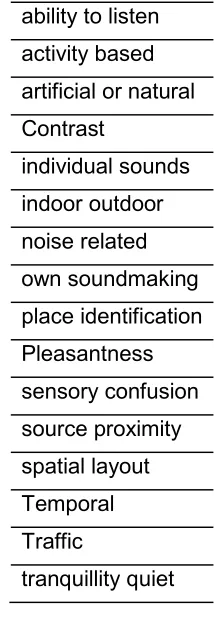
The interview and focus group data was also analysed to produce the list of soundscape categories shown in Table 1. These categories emerged from language used in spontaneous description of soundscapes by participants. There is an important distinction between this sort of grouping and the classification which might be drawn up by researchers. Participants were asked to articulate what made different soundscapes different; how might they distinguish between one soundscape and another. This resulted in a list of suggested categories which provide some possibilities for discriminating between soundscapes. However, these categories are not mutually exclusive and one soundscape may fit into one or more category. These catetories were then analysed further in order to generate soundscape classifications.
The laboratory listening tests found that almost 80% of listener variance was explained by two principal components. These have been tentatively labelled Calmness/Relaxation and Vibrancy. (These two would seem to agree well with the first two dimensions found by Kang20
from field rating scales: relaxation and dynamics.) Initial analysis of this data combined with the qualitative results above14 suggests that the two dimensions from the soundwalk interviews are
Cacophony-Hubbub (describing the mixture of sound sources) and Constant-Temporal (describing how this mix changes over time). It is suggested that these are both sub-categories of Vibrancy.
Listening tests in the fMRI scanner produced evidence of changes in the brain when listening to soundscapes rated along calmness/relaxation16 even though the recordings were
equalised for LAeq. Changes were evident in the amygdala, a region of the brain associated with
recordings equalized for LAeq produce significantly different cognitive responses depending on
[image:5.612.250.357.146.456.2]their content. Further analysis is now underway to seek neural correlates of the vibrancy scale.
Table 1: Soundscape categories.
ability to listen activity based artificial or natural Contrast
individual sounds indoor outdoor noise related own soundmaking place identification Pleasantness sensory confusion source proximity spatial layout Temporal Traffic
tranquillity quiet
3. EVALUATION TOOL
The results outlined above represent an inter-disciplinary characterisation of urban soundscape perception. They have been used as the basis for the first iteration of the proposed soundscape evaluation tool. This is important because a soundscape evaluation tool must be true to the research data – it should evaluate what we think is significant for human perception/cognition. This veracity should be transparent, so the tool should provide access to the rationale for each question asked, so that the user can „drill down‟ to the original research reports.
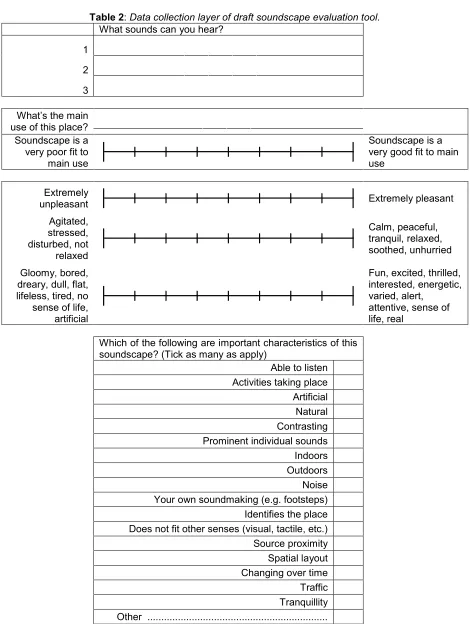
Table 2: Data collection layer of draft soundscape evaluation tool.
What sounds can you hear?
1
2
3
What‟s the main use of this place? Soundscape is a very poor fit to main use
Soundscape is a very good fit to main use
Extremely
unpleasant Extremely pleasant
Agitated, stressed, disturbed, not relaxed
Calm, peaceful, tranquil, relaxed, soothed, unhurried
Gloomy, bored, dreary, dull, flat, lifeless, tired, no sense of life, artificial
Fun, excited, thrilled, interested, energetic, varied, alert,
attentive, sense of life, real
Which of the following are important characteristics of this soundscape? (Tick as many as apply)
at each step of the process. This role may initially be filled by acoustic consultants, who can be assumed to have the technical training, and who develop an interest in soundscapes, as a distinct addition to purely quantitative noise assessment. This is likely to be the initial user of the draft tool proposed here.
Table 2 shows the top layer of the draft soundscape evaluation tool. This is the data capture layer. The layer below this would contain lay language summaries of the research rationale for each question asked, at a similar level of detail to section 2 of this paper. The bottom layer would consist of links and citations to published research papers discussing the research evidence in full. A web interface is likely to be convenient.
The tool is intended to be used with a structured soundwalk in a real existing outdoor location. It consists of four sections. The first section asks the simple open question “What sounds can you hear?” This will usually be an easy question to answer and may help the user to start listening. The data is important because we know that any prominent sounds are significant features in our overall impression of the soundscape. The second section deals with the principal use of the space. This data is useful for two reasons. Firstly, there is evidence that soundscape perception varies with listening mode, and listening mode varies with user activity.18 Secondly, the principal use of a space is usually already known for planning purposes,
though more than one typology of space exists in UK planning guidance.21, 22 The extent to
which the current soundscape enables, or does not hinder, the performance of activities identified under the apparent principal use will be useful data when soundscape concepts are incorporated into the planning process. The third section of the tool invites the soundscape evaluator to rate the soundscape on three scales: overall pleasantness, and the two principal scales found in the PSP listening tests (calmness/relaxation and vibrancy). Once a large enough number of evaluation sheets had been completed for different soundscapes, it should be possible to map subjectively significant changes in these values across geographical areas. The last section of the evaluation tool implements a soundscape classification system based closely on the categories in Table 1. This allows the swift capture of characteristics likely to be significant in distinguishing between different soundscapes.
4. DISCUSSION
The soundscape evaluation tool in Table 2 is very much an initial draft. It uses entirely subjective ratings because sufficient objective measurements have yet to be developed. It features a relatively small number of mostly closed questions for speed. There are a smaller number of scales used here than in Berglund and Nilsson‟s tool, because our scales are the output of a PCA reduction process.
The next stage in the development of the evaluation tool will be to conduct a field trial across a number of different geographical locations. This would allow some refinement of the tool, but would also generate a useful catalogue of evaluations of different soundscape types. This data could be analysed for characteristics such as the relationship between overall pleasantness and the other measures for different soundscape types.
Future versions of the evaluation system could incorporate objective metrics. If objective correlates to subjective calmness and vibrancy can be found, then this opens up the prospect of automation. (Full automation is also likely to require automated identification of foreground sounds, though this may soon be possible.23) Objective soundscape assessment is probably
ACKNOWLEDGMENTS
The Positive Soundscape Project is wholly funded by the UK Engineering and Physical Sciences Research Council, under grant number EP/E011624/1.
REFERENCES
1. M. Adams, et al., "Soundwalking as a methodology for understanding soundscapes", in Proc. I. o. A., Reading, U.K., 2008.
2. B. Schulte-Fortkamp and A. Fiebig, Soundscape analysis in a residential area: An evaluation of noise and people's mind, Acta Acustica United with Acustica92(6), pp. 875-880, (2006).
3. M.E. Nilsson and B. Berglund, Soundscape quality in suburban green areas and city parks, Acta
Acustica United with Acustica92(6), pp. 903-911, (2006).
4. K. Nyunt, "Waterfront soundscape of Auckland", in 18th International Congress of Acoustics, Kyoto, Japan, 2004.
5. A. Fiebig, B. Schulte-Fortkamp and K. Genuit, "New options for the determination of environmental noise quality", in Inter-Noise 2006, Honolulu, Hawaii, USA, 2006.
6. M. Rychtáriková and G. Vermeir, "Acoustical categorization of urban public places by clustering method", in NAG/DAGA 2009 International Conference on Acoustics, Rotterdam, 2009.
7. M. Raimbault, C. Lavandier and M. Berengier, Ambient sound assessment of urban environments: field studies in two French cities, Applied Acoustics64(12), pp. 1241-1256, (2003). 8. European Commission, Directive 2002/49/EC of the European Parliament and of the Council of 25 June 2002 relating to the assessment and management of environmental noise, Official
Journal of the European CommunitiesL189, pp. 12–25, (2002).
9. A.L. Brown and A. Muhar, An Approach to the Acoustic Design of Outdoor Space, Journal of
Environmental Planning and Management,47(6), pp. 827–842, (2004).
10. B. Berglund and M.E. Nilsson, On a tool for measuring soundscape quality in urban residential areas, Acta Acustica United with Acustica92(6), pp. 938-944, (2006).
11. G. Vonk, S. Geertman and P. Schot, Bottlenecks blocking widespread usage of planning support systems, Environment and Planning A37(5), pp. 909-924, (2005).
12. C. Hardcastle, et al., Integrated assessment of urban sustainability, Engineering Sustainability
158(2), pp. 57-65, (2005).
13. M. Adams, B. Davies and N. Bruce, "Soundscapes: an urban planning process map", in
Internoise 2009, Ottawa, Canada, 2009.
14. W.J. Davies, et al., "The positive soundscape project: A synthesis of results from many disciplines", in Internoise 2009, Ottawa, Canada, 2009.
15. R. Cain, et al., "Emotional dimensions of a soundscape", in Internoise 2009, Ottawa, Canada, 2009.
16. A. Irwin, D.A. Hall and C.J. Plack, "How do listeners react to different urban soundscapes? An fMRI study of perception and emotion", in Internoise 2009, Ottawa, Canada, 2009.
17. R.M. Schafer, The tuning of the world. New York: Knopf. 1977.
18. R. Cain, et al., "SOUND-SCAPE: A framework for characterising positive urban soundscapes", in
Acoustics 08, Paris, 2008.
19. B. Berglund, Ö. Axelsson and M.E. Nilsson, "Are similar acoustic soundscapes perceived as similar?" in EuroNoise 2006, Tampere, Finland, 2006.
20. J. Kang, Urban Sound Environment. London: Taylor and Francis. 2007.
21. Department of the Environment, Assessing needs and opportunities: a companion guide to PPG17, London: HMSO. 2002.
22. Office of the Deputy Prime Minister, National Land Use Database: Land Use and Land Cover Classification, version 4.4. London: HMSO. 2006.
23. C. Karatsovis and S.J.C. Dyne, "Instrument for soundscape recognition, identification and evaluation: An overview and potential use in legislative applications", in Proceedings of the