Lorandi, A. and Karmiloff-Smith, Annette (2012) Sensitivity to consciousness:
the morphological knowledge and model of redescription representational.
Letras de Hoje: Estudos e Debates em Linguistica Literature e Lingua
Portuguesa 47 (1), pp. 6-16. ISSN 0101-3335.
Downloaded from:
Usage Guidelines:
Please refer to usage guidelines at or alternatively
Linguagem e cognição:
I
nterfaces
entre
L
InguístIca
, P
sIcoLogIa
e
n
eurocIêncIas
From sensitivity to awareness: morphological knowledge
and the Representational Redescription model
1Da sensibilidade à consciência: o conhecimento morfológico e o modelo de Redescrição Representacional
Aline Lorandi
Universidade Federal do Pampa – Rio Grande – Rio Grande do Sul – Brasil Annette Karmiloff-Smith
Birkbeck Centre for Brain and Cognitive Development – University of London – England
Abstract: The present investigation is dedicated to the study of the Brazilian Portuguese children’s morphological knowledge and its relation with levels of mental representations as postulated by the Representational Redescription model (KARMILOFF-SMITH, 1992). The
data consist of regularized verbal forms, changes of inflectional suffixes as well as lexical novelty
(morphological variant forms) taken from spontaneous speech and of three morphological tests,
which involve derivation and inflection of nonce words, extraction of nonce base from derived nonce words, and judgment of words as well as a metalinguistic explanation. The survey of
the responses reveals morphological knowledge that goes from sensitivity – morphological variant forms – to linguistic awareness – morphology tests. Thus, the data pointed to the plausibility of all the different levels of representation across development. In our view, this
work embodies a first step towards an explanation of the mental representations that underlie
both the comprehension and production of children’s growing morphological knowledge and
goes beyond the simple implicit/explicit dichotomy used in most previous work. Keywords: Language acquisition; Linguistic awareness; Morphology
Resumo: O presente trabalho é dedicado ao estudo do conhecimento morfológico de crianças falantes do Português Brasileiro e sua relação com os níveis de representação mental, tais como postulados pelo modelo de Redescrição Representacional (KARMILOFF-SMITH, 1992). Os
dados consistem em formas regularizadas, mudanças de sufixos flexionais e inovações lexicais
(formas morfológicas variantes), presentes na fala espontânea, e de três testes morfológicos, que
envolvem derivação e flexão de palavras inventadas, extração de base de palavras inventadas e julgamento de palavras, bem como explicação metalinguística. O levantamento das respostas
revela conhecimento que vai da sensibilidade – formas morfológicas variantes – à consciência linguística – testes morfológicos. Assim, os dados apontam para a plausibilidade de todos os diferentes níveis de representação durante o desenvolvimento. Em nossa opinião, este trabalho
significa um primeiro passo em direção a uma explicação das representações mentais que
subjazem tanto a compreensão quanto a produção do conhecimento morfológico e vai além da
simples dicotomia implícito/explícito utilizada em trabalhos anteriores. Palavras-chave: Aquisição da linguagem; Consciência linguística; Morfologia
introduction
1
Investigating language acquisition is an intriguing task. The way young human beings perceive the speech stream, segment chunks of language, give meaning
1 This research study had the support of CNPq.
to these chunks and form sentences is a fascinating research endeavour. From the moment that they can put
two words together, children start to refine their analysis
of language by progressively introducing aspects of
morphology and syntax. From then on, they tend to
the adult language (e.g., using verbal forms like “sabo”
instead of “sei” (I know), “trazi” instead of “trouxe” (I
brought) and “fazo” instead of “faço” (I do)), as well
as changes of inflectional suffixes (like “usia”, instead
“usava” (I wore) or “comei”, instead of “comi” (I ate)),
and lexical novelty (“massageira”instead of “massagista”
(masseuse)). Besides this kind of implicit sensitivity to the morphological resources of language revealed by spontaneous overgeneralisations, children are also able to
produce responses to more explicit questions, like those
involving metacognitive awareness of the morphology of their language.
In general, when referring to linguistic awareness, several researchers consider just two levels: implicit
and explicit. However, this leads to doubts about when
linguistic awareness arises and how we can classify
sensitivity data, because it is often difficult to distinguish
whether knowledge remains simply implicit when it cannot be verbally reported.Karmiloff-Smith (1986, 1992) attempted to surmount this problem by presenting a model of representational redescription which has four levels
of increasing explicitness, consisting of a hypothesis in
which the mind progresses via a reiterative process of redescription of knowledge into four different formats,
from the implicit level to three explicit levels.
The main goals of the present studyare to describe the different levels of morphological knowledge of a group of 2- to 11-year-old children, all of them Brazilian Portuguese speakers, and to relate this knowledge to the
implicit-to-explicit levels postulated by the Representational
Redescription model (hitherto, RR model)(Karmiloff-Smith, 1992). To reach this goal, we bring data from spontaneous speech and from three morphological tests (LORANDI, 2011), i.e., from anecdotal spontaneous
data and from systematic experimental research. We
present a qualitative rather than quantitative analysis of
the data, with a semi-experimental approach, since the
objective of the data is to illustrate the underlying mental representations revealed by the behavioral outputs.
We start by presenting the RR model, the spontaneous speech data and the three morphological tests. We then
analyze these data as a function of the RR model, based on work deriving from Lorandi’s PhD thesis (2011) and support for the analysis given by Karmiloff-Smith during Lorandi’s visiting scholarship to her lab in London.
1 The Representational Redescription model
The RR model has as its premise the fact that a truly developmental approach is critical to understand how cognitive development occurs. Unlike the nativism approach to modularity which claims built-in
encapsulated modules (Fodor, 1983, Leslie, 1992; Spelke & Kinsler, 2007; van der Lely, 2005), Karmiloff-Smith (1992) believes in a process of gradual modularization. In this sense, if the adult human mind/brain ends up with
modular structure,this is considered to be the product of
development over time, even in the case of language, invoking the plasticity of early brain development. Furthermore, Karmiloff-Smith distinguishes
domain-general/domain-specific predispositions from what she terms “domain-relevant” biases which suffice to constrain
the input that the infant mind computes (Karmiloff-Smith, 1992, 1998, 2009). In this way, with time, different brain
circuits become progressively domain-specific over time.
The RR model is an attempt to account for the ways in which children’s representations become more
manipulative and flexible over time, to allow for the
emergence of the conscious access to implicit knowledge. Karmiloff-Smith (1992) argues that representational redescription is a process by which implicit information
in the mind subsequently becomes explicit for the mind,
first within a domain, then, sometimes, across domains.
From the perspective of the child’s mind, a “domain”
is a set of representations that sustain a specific area of
knowledge: language, number, space, and so forth. There are microdomains as well, like pronoun acquisition, which can be thought of as a subset within the particular domain of language. In its turn, a module consists in an information-processing unit that encapsulates that knowledge and the computations on it. In this sense,
considering development domain-specific does not mean
modularity, because storing and processing information
may be domain specific without being encapsulated.
The RR model has four levels in which knowledge is represented and re-represented. They are: Implicit (I),
Explicit 1 (E1), Explicit 2 (E2) and Explicit 3 (E3).
Karmiloff-Smith maintains that these different forms of representation do not constitute stages related to ages. Rather, they are reiterative cycles that go on inside different micro-domains over time. In brief, behavioral mastery is achieved at a certain level, knowledge is then redescribed in a way that makes it internally accessible
to the next level.
• Implicit (I): the information is in a procedural
format, representing the input as a whole, but not analyzable in its component parts (e.g., a child might know the word “walked” but not yet be able to decompose it into “walk + -ed).
• Explicit 1 (E1): the representations are in an explicit format, but they are not yet available to
conscious access nor to verbal report. Children seem to analyze level I information, which are
now in a new format, and extract information that
-ed to “went-ed” without being able to say why).
• Explicit 2 (E2): the representations are in an explicit
format, available to conscious access, but not to verbal report (e.g., the child might be aware that walked, wented, hoped, etc. all have something in common but not yet be able to say what).
• Explicit (E3): the representations are in an explicit
format, available to conscious access and to verbal
report (e.g., the child can explicitly say that in
order to talk about things happening in the past, one adds the sound -ed to verbs).
• The present Portuguese Brazilian data will be analyzed for the first time as a function of the
RR model, illustrating how these different levels of mental representation can capture subtle differences between different verbal behaviors related to morphological awareness.
2 methodology
We present two types of data, both related to
sensitivity to morphological resources of language and to morphological awareness, including spontaneous speech data, related to overgeneralisation changes of
inflectional suffixes and lexical novelty and three tests of
morphological awareness, using off-line tasks.
2.1 Morphological Variant Forms
As to the first type of data,we present some of
children’s production of morphological variant forms. These data were collected from children’s spontaneous speech between the ages of 2 and 8 years (LORANDI,
2004), as well as drawing from data in the Inifono2
database, which also consists of the spontaneous speech of one child between the ages 1 and 4 years and other spontaneous data collected from children between 2 and 5 years of age (LORANDI, 2011). Data were also sought
in other language acquisition studies, like Simões (1997)
and Silva (2007).
2.2 Morphological Tests
Three morphological tests were developed to verify morphological awareness. They involve derivation of
words, extraction of the base from derived words, inflection
of words, judgment of incorrect word and verbal report about why they are considered incorrect. These three tests
2 Database which contains spontaneous speech from children of different
ages. It is located at Pontifícia Universidade Católica do Rio Grande do Sul and at Universidade Católica de Pelotas, both in Rio Grande do Sul, Brazil.
were based on nonce words. We believe, as Berko (1958),
that if children are able to apply linguistic resources to nonce words this is because they already know something about how language works.
A pilot test was applied to 10 adults and 10 children in order to check if they would provide adequate responses. They performed quite well in this pilot test and this was considered good evidence that the tests were adequate to show the morphological knowledge of the subjects of our study.
2.2.1 Test 1: Derivation of words
Test 1, the word derivation test, consists of three parts
with six questions. The children were asked to derive words
from a given coined base. These forms were coined from Portuguese templates and Portuguese stress patterns.
2.2.1.1 Coined bases to Test 1
The first coined base, flopo [′flo.pu], has two syllables, the first of which has a CCV structure and the second a CV structure, and resembles words like “bloco” [′blo.ku] (block) or “prato” [′pra.tu] (dish). So, the nonce word flopo is a familiar word structure for a Portuguese speaker, with the same stress pattern as “bloco” and “prato”. This base was created with a simple, common structure in order to
check if it would involve less difficulty for children in their attempts to apply adequate suffixes and prefixes.
The second coined base, segor [se′gor], has two
syllables as well, the first of which has a CV structure and the second a CVC structure, resembling words like “calor” [ka′.lor] (heat) or “bolor” [bo′.lor] (mold.) The
coined word segor has the same stress pattern as “calor”
and “bolor”. The main differences between the first and
the second coined bases are that the second word, segor,
ends in a consonant. This base was created in order to
check if ending with a consonant and a CVC structure in
the second syllable would interfere with children’s ability
to apply adequate suffixes and prefixes to the base and with their choice of suffixes and prefixes.
The third coined base of Test 1 is mafata [ma.′fa.ta].
This word has the simplest structure because it presents
three simple syllables with CV structure. However, it is the
longest one. The stress is on the second syllable, which is the most common stress pattern in Brazilian Portuguese. The same structure and stress patterns are found in real
words like “barata” [ba.′ra.ta] (cockroach) and “batata” [ba.′ta.ta] (potato.). It was decided to use coined words
with different patterns of stress, but they are all three very
common in Brazilian Portuguese. Moreover, mafata has
a feminine noun ending(-a-), which is common in the language and should have less interference for children when applying morphological resources to the base as
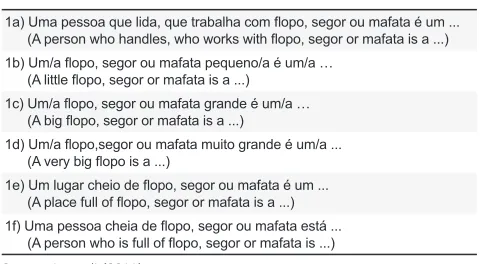
2.2.1.2 Test 1 questions
The six questions with the coined bases require children to derive words, using adequate suffixes or prefixes for each question. Table 1 presents the questions
[image:5.624.62.302.176.308.2]related with the bases (with a translation below each question).
Table 1 — Test 1 questions
1a) Uma pessoa que lida, que trabalha com flopo, segor ou mafata é um ... (A person who handles, who works with flopo, segor or mafata is a ...) 1b) Um/a flopo, segor ou mafata pequeno/a é um/a …
(A little flopo, segor or mafata is a ...) 1c) Um/a flopo, segor ou mafata grande é um/a …
(A big flopo, segor or mafata is a ...)
1d) Um/a flopo,segor ou mafata muito grande é um/a ... (A very big flopo is a ...)
1e) Um lugar cheio de flopo, segor ou mafata é um ... (A place full of flopo, segor or mafata is a ...) 1f) Uma pessoa cheia de flopo, segor ou mafata está ...
(A person who is full of flopo, segor or mafata is ...)
Source: Lorandi (2011).
It is important to stress that there are many possibilities
for derived words with adequate suffixes for each question.
For instance, to a person who handles flopos, an adequate response would be flopeiro, flopista or flopador. A little flopo would be a flopinho, while a big flopo would be a flopão. A very big flopo would be a flopaço, a place full
of flopos would be a floparia and, finally, a person full
of flopo would be floposa or floporenta. There are other
possibilities of responses, and these same suffixes could
be applied to the nonce words segor and mafata as well.
2.2.2 Test 2: Extracting the base of the derived form and inflecting the basic form
The second test, related to the extraction of the base of the derived form and to the inflection of verbal forms,
consists of a little story followed by relevant questions. The responses would involve coined bases that are either
extracted forms of a given base (in the first part of the test) or past tense and present continuous inflected forms
(in the second part of the test). The derived forms used in the test were based on the responses of pre-test 1 with adults and children (pilot study). Below, we list the forms used:
– Esse é nosso amigo Winki. Ele gosta de visitar muitos
lugares estranhos e diferentes e aprende muitas coisas em suas viagens.
(This is our friend Winki. He likes to travel to several
weird and different places and he learns lots of things in his trips.)
– Imagine que esses dias ele contou que conheceu um
zoque [‘zO.ke]. Viu zoquinhos [zO.‘ki.us] e zocões
[zo.’kõjs]. O que significa zoquinho?
(Imagine that just the other day he told me that he met a zoque. He saw zoquinhose zocões. What do you think
zoquinho3 means?)
– E zocão [zo.’kãw]?
(And what does zocão4 mean?)
– Ele andou muitos quilômetros e entrou em uma zocaria
[zo.ka.’Ri.a]. O que significa zocaria?
(He walked several kilometers and came in a zocaria5.
What do you think zocaria means?)
– Assim que ele saiu de lá, percebeu que estava todo
enzocado [in.zo.’ka.du]. Como será uma pessoa
enzocada?
(As he left the place, he realized that he was all
enzocado6. What kind of person is an enzocada?)
– Winki também me disse que gosta muito de plomos
[‘plo.mus]. Você sabe dizer o que é plominho
[plo.’miu]? E plomão [plo.’mãw]?
(Winki also told me that he likes plomos a lot. Do you know what plominho means? And what does plomão mean?)
– Sempre que ele viaja encontra muitos plomistas
[plo.’mis.tas]. O que será que significa plomista? (Frequently in his travels he comes about several
plomistas7. What do you thinkplomista means?)
– Winki diz que nas viagens ele mila [‘mi.la] muito. Se
ele mila muito, ontem ele também _____________.
Todo dia ele também chugue [‘ʃu.gi] na hora do
almoço. Ontem mesmo ele _____________. Sua mãe
ferte [‘fε|.tʃi] todos os dias. Agora mesmo ela está
_____________.
(Winki says that in his trips he milas a lot. If he milas a lot, yesterday he ____________ too. Every
day he also chuguesat lunchtime. Yesterday he
______________. His mother fertes every day. Now
she is _________________.)
– Os plomistas são muito milantes [mi.’ln.tSis]. O que
será que significa milante?
(Plomistas are very milantes. What do you think
milante8 means?)
– Agora Winki cansou. Ele vai dormir um pouquinho. Diga “tchau” para o Winki. Até a próxima!
(Now Winki is tired. He is going to take a nap. Say “bye” to Winki. See you!).
3 The suffix -inho means dimminutive in Portuguese.
4 The suffix -ão (in this case, ões – plural) means augmentative in
Portuguese.
5 The suffix -ria is one of the possibilities of suffixes that means locatives
in Portuguese.
6 The formation in -ado indicates a nominal form of the verb (participle),
which, as in English, shares characteristics of both verbs and adjectives.
7 The suffix -ista indicates agentive.
8 The suffix -nte is a suffix which represents a complexity of the morphology in Portuguese, since, it forms especially adjectives, as in “gratificante”
(gratifying), but also can form substantives, as “participante” (participant).
Adequate responses are those in which the children
extracted the base and interpreted the meaning of the suffix with respect to the part related to the extraction
of the base (zoquinho, zocão, zocaria, enzocado,
plominho, plomão, plomista and milante), and inflected
forms for the part related to inflection (mila, chugue and
ferte).
2.2.3 Test 3: Word judgments
In the third test, the child was asked to make a judgment about words. He or she had to say whether the word in the sentence was correct or incorrect and then
explain why. The word was stressed by the experimenter.
All the words for judgment were morphological variants forms, which are naturally produced by young children during the language acquisition process. The test took the following form:
– Vamos brincar de professor(a). Essa é uma boneca, e
tu serás a professora dela. Ela é muito pequenininha e ainda não sabe falar algumas palavras direito. Se tu ouvisses ela dizer: “agora eu vou “borrachar”, dirias que está certo ou não? Por quê?
(Let’s play of being a teacher. This is a doll, and you will be her teacher. If you heard her saying: “now I will borrachar,” what would you say? Is it correct or
incorrect? Why?)
– E se ela dissesse: “eu usia uma blusa”? Está certo ou errado? Por quê?
(And if the child says: “I usia a blouse?” Is it correct
or incorrect? Why?)
– E “eu fazi um bolo”? Está certo ou errado? Por quê?
(And what about “I fazi a cake”? Is it correct or
incorrect? Why?)
– E se a boneca dissesse “o chinelo serveu”, o que tu dirias para ela?
(And if the child says “the slipper serveu,” what would
you say to her? Is it correct or incorrect? Why?)
Adequate responses are those in which the child
answers that the word is wrong and explains why.
2.3 Participants
Eighty-four children, all from a regular school of
Farroupilha.9 and aged between 3:410 and 10:11 took
part in the three morphological tests which were run in November 2009. Table 2 shows the number of participants and their respective ages.
[image:6.624.324.562.86.200.2]9 City in Rio Grande do Sul, Brazil. 10 3 years: 4 months.
Table 2 – Children’s ages per grade
Grade Children’s ages Number of children
4th grade 9:10 to 10:11 10
3rd grade 8:3 to 9:9 14
2nd grade 7:7 to 8:4 10
1st grade 6:5 to 7:2 21
Kindergarten III 5:3 to 6:3 12 Kindergarten II 4:4 to 5:3 11 Kindergarten I 3:4 to 4:4 6
Source: Lorandi (2011).
3 Results
3.1 Morphological Variant Forms
We can classify the morphological forms
spontaneously produced by children, whichdo not belong to the adult repertoire, into three categories:
Overgeneralisations, changes of inflectional suffixes (related to verbs) and lexical novelty (related to verbs
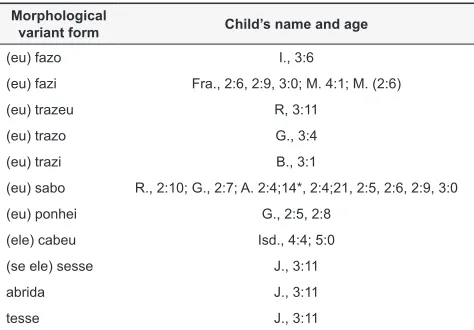
or names). Tables 3, 4 and 5 illustrate these data, with the initial letter of the name of the child and her/his age. Related to overgeneralisations, we found verbal forms related to the verbs: “fazer” (to do), “trazer” (to bring),
“saber” (to know), “pôr” (to put), “caber” (to fit), “ser”
(to be), “abrir” (to open) and “ter” (to have), as can be seen in Table 3.
Table 3 – Morphological variant forms – over- generalisations
Morphological
variant form Child’s name and age
(eu) fazo I., 3:6
(eu) fazi Fra., 2:6, 2:9, 3:0; M. 4:1; M. (2:6)
(eu) trazeu R, 3:11
(eu) trazo G., 3:4
(eu) trazi B., 3:1
(eu) sabo R., 2:10; G., 2:7; A. 2:4;14*, 2:4;21, 2:5, 2:6, 2:9, 3:0 (eu) ponhei G., 2:5, 2:8
(ele) cabeu Isd., 4:4; 5:0 (se ele) sesse J., 3:11
abrida J., 3:11
tesse J., 3:11
Source: Lorandi (2011). * 2years: 4 months; 14 days.
With respect to changes of inflectional suffixes, we
found verbal forms which changedthe 2nd conjugation
class suffixes for those from 1stconjugation class and vice-versa. We also found one production that added a suffix indicating the 1stperson – eu (I), as can be seen in
[image:6.624.324.561.469.634.2]Table 4 – Morphological variant forms – changes of inflectional suffixes
-ei (1st conj.) → -i (2nd conj.) -i (2nd conj.) → -ei (1st conj.) -va (1st conj.) → -ia (2nd
e 3rd conj.) -ia (2nd e 3rd conj.) → -va (1stconj) Ø → o (1st person, present) boti (A.L., 2:1*) comei (M., 3:0) usia (H., 3:4) conheciva (Isd., 4:6) fizo (G., 2:7) di (R., 4:10) mexei (M., 3:0;15) duava (M., 4:4)
Source: Lorandi (2011). * Child’s name and age.
Lexical novelties present verbs and names coined
[image:7.624.324.562.164.282.2]by children to substitute one to whichs/he forgot or to create a form to specify the meaning that s/he was trying to convey, as illustrated in Table 5.
Table 5 – Morphological variant forms – lexical novelty
Child’s coined form Child’s name and age
massageira Ra., 5:4
remedieiro Isab., 5:10
oscarzês (language spoken by Oscar) Isab., 6:2
amigosa A., 8:1
gala (galinha/chicken) A.C., 2:10
borrachar A., 3:8
xizar (to mark an “X” in an option) A., 6:11
demoreiro I., 4:4
Source: Lorandi (2011).
3.2 Morphological Tests
3.2.1 Test 1
This test presents six questions. Questions A
are related to agentives, questions B to diminutives, questions C to augmentatives, questions D to “very big” augmentatives, questions E to locatives and questions F to
adjectives. The data are presented in three groups: 1 (3rd
and 4th grades, with 24 subjects), 2 (1st and 2nd grades,
with 31 subjects) and 3 (Kindergarten I, II and III, with 29 subjects). Each subject represents one answer to a question.
By grouping the responses to the questions A, B, C,
D, E and F related to the three bases (flopo, segor and
mafata), we can examine children’s performance and
note differences between the questions, ascertaining
whichwere more difficult or which were easier for children. The following figures show the quantity of
adequate and inadequate responses for all questions,
for each group. For the 3rd and the 4th grades there
were 72 responses, for the 1st and the 2nd grades 93
[image:7.624.63.301.286.409.2]responses and for the Kindergarten I, II and III 87 responses.
Figure 1 – Responses to the questions A to F – 3rd and 4th grades.
Fig.1 illustrates the performance for the 3rd and the
4th grades on all questions. Note that there is a balance
between adequate and inadequate responses and that
performance is similar for almost all questions, except
for questions D (a very big flopo, segor or mafata is a…)
and E (a place full of flopo, segor or mafata is a…), in
which there were more inadequate responses. Children presented good performance on all the other questions,
but only question A (a person who works with flopo, segor
or mafata is a…) showed more adequate than inadequate responses, which suggests that question A was the easiest
[image:7.624.324.562.513.627.2]for the 3rd and the 4th grades.
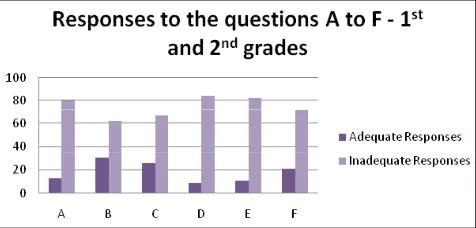
Figure 2 – Responses to the questions A to F – 1st and 2nd grades.
The 1st and 2nd graders provided less adequate
responses than the 3rd and the 4th grades. For all questions,
there were more inadequate responses. Questions D and E turned out to be the most difficult for this younger group.
The best performance was for question B (a small flopo,
Figure 3 – Responses to the questions A to F – Kindergarten I, II and III.
The youngest group, Kindergarten I, II and III,
presented even less adequate responses than the 1st and
the 2nd grades. The majority of adequate responses is
accounted for by Kindergarten III performance because Kindergarten I and II failed to make adequate responses to most of the questions. The best performance was on
question A (a person who works with flopo, segor or
mafata is a…), followed by performance on question F
(a person full of flopo, segor or mafata is…).
Summing up, performance improved over develop- mental time from Kindergarten to 4ª grade. Besides this fact, questions A (agentives), B (diminutive) and F (adjectives) were the easiest and questions D (“more
big” augmentative) and E (locatives) the most difficult for children. Question C (augmentative) was easy for
the 1st and the 2nd grades, but it was difficult for the
Kindergarteners. A and F were the easiest questions for the
first and the third groups and B and C were the easiest for
the second group. All groups presented good performance on question F.From Kindergarten on children revealed the beginning of morphological awareness, something we
will later attempt to explain using the RR model.
3.2.2 Test 2
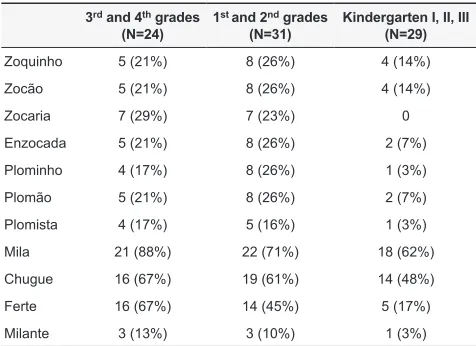
This test deals with the extraction of the base from derived words and with inflection of verbal forms. Table
6 shows the quantity and percentage of adequate response
for children from each group. The first group, 3rd and 4th
grades, presented 24 responses, the second groups, 1st and
2nd grades, 31 responses, and the third group, Kindergarten
I, II and III, 29 responses. Due to the design of the test, each child provided one response to each question. It is important to highlight three points: (i) this test is more
difficult than Test 1 (except for the verbal inflection part), (ii) according to Carlisle (2000), extracting the base is more difficult than derivating words, and (iii) some adults
did not provide adequate responses to every question on this test (pilot test).
Table 6 – Quantity and percentage of adequate responses to Test 2
3rd and 4th grades
(N=24) 1
st and 2nd grades
(N=31) Kindergarten I, II, III (N=29)
Zoquinho 5 (21%) 8 (26%) 4 (14%) Zocão 5 (21%) 8 (26%) 4 (14%)
Zocaria 7 (29%) 7 (23%) 0
Enzocada 5 (21%) 8 (26%) 2 (7%) Plominho 4 (17%) 8 (26%) 1 (3%) Plomão 5 (21%) 8 (26%) 2 (7%) Plomista 4 (17%) 5 (16%) 1 (3%) Mila 21 (88%) 22 (71%) 18 (62%) Chugue 16 (67%) 19 (61%) 14 (48%) Ferte 16 (67%) 14 (45%) 5 (17%) Milante 3 (13%) 3 (10%) 1 (3%)
This test may be divided in two parts: extraction of the base and verbal inflection. The results for these
two parts, as we can see in Table 6, are very different.
The questions about the words zoquinho, zocão, zocaria,
enzocada, plominho, plomão, plomista and milante are
related to decomposition, while the questions about the
words mila, chugue and ferte are related to inflection. This
may explain the high percentages related to these three
last words. Carlisle and Nomanbhoy (1993) state that
children perform better on inflection than on derivation.
These data point to a similar conclusion.
Analyzing the part related to derivation, we can conclude that, although the quantity is not high, children
in all groups are able to work with the extraction of the
base in nonce word derivation, showing a similar result for all questions.
Analyzing the part related to inflection, children performed considerably better. In the inflection of the
verbal forms mila and chugue, children in all groups
were able to perform adequately. Surprisingly, children
from Kindergarten III performed better than the 1st
graderson this test, although this was not the case for Test 1. Moreover, there is an increase in the percentage of adequate responses from the Kindergarten I, in which one child provided adequate responses for both
these items, through to the 4th grade, in which almost
all children provided adequate responses. The questions
about mila and chugue concern past tense formation.
Although the verbal form “chugue” presents a 2nd
conjugation class structure and, because of this, could
be considered irregular, children inflected it as a 1st class conjugation form, in the exact same way as they inflected the verbal form mila. Some children used the
verbal thematic vowel -i- (2nd conjugation class) in the
inflected form “chuguiu”, but most times they used the
verbal thematic vowel -a- (1st conjugation class), like
[image:8.624.62.302.113.211.2]in “chugou”11. In the formation of progressive (-ing
forms)12, the results are quite similar for all groups, except
for the youngest groups, who failed to provide adequate responses.
The most difficult question was the final one, in which children were asked to extract the base mila from the nonce adjective milante. Few children could do this
and even few adults succeeded. Perhaps it was difficult to
identify the form “mila” inside “milante” because of the
change between “ə” in “milante” and “ɐ” in “mila”. None
of the questions seem to be easier than the other, except for the fact that inflection is easier than decomposition. The suffix -nte is a complex one, because it forms adjectives
and substantives. Although Miranda (1980) considers this
suffix a productive one in Portuguese, few subjects could identify its function and, from this, to extract the base.
3.2.3 Test 3
Test 3 consists of questions that involve word judgment. Children were asked to say whether the words
were correct or incorrect and explain why, and then
[image:9.624.62.303.384.503.2]provide a correct form. Fig. 4 compares the performance between all groups.
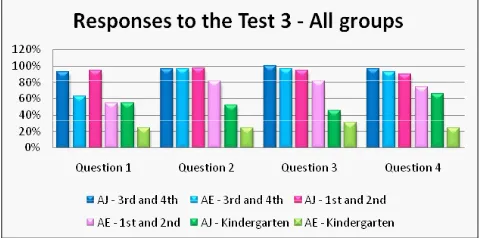
Figure 4 – Responses to the Test 3 – All groups. Source: Lorandi (2011).
Fig. 4 presents percentages in order to compare
performance between all groups. The two first columns
of each question are related to the 3rd and the 4th grades,
the the two subsequents are related to the 1st and the 2nd
grades, and the two following, to the Kindergarten. The
first column of each grade refers to adequate judgments (AJ) and the second one to the adequate explanations (AE). Question 1 gave rise to lower levels of adequate
responses from the 3rd and the 4th grades as well as from
the 1st and the 2nd grades. The Kindergarten presented the
same low percentage across almost all questions. Taking into account performance on adequate judgments, there
11 The verbal thematic vowel -a- becomes -o- in the 1st person past tense
forms, like in “falou” from “falar” (it spoke from to spike) and “andou” from “andar” (it walked from to walk).
12 “-ndo” forms in Portuguese.
is an improvement from Kindergarten to the 1st and the
2nd grades, but this group presents a similar result in
comparison to the 3rd and the 4th grades. Nevertheless,
taking performance on the adequate explanations into
account, there is an improvement from Kindergarten to
the 1st and the 2nd grades and from this group to the 3rd
and the 4th grades.
4 The RR model and data analysis
4.1 Implicit and E1 Representations
As mentioned in the introduction, while most theorists consider the development of children’s grammar and linguistic awareness in terms of only two levels –
implicit and explicit knowledge – the Representational
Redescription (RR) model presents four levels – Implicit,
Explicit 1 (E1), Explicit 2 (E2) and Explicit 3 (E3). Each
of these levels has its importance and characteristics. Although this model may be applied across several different domains of cognitive development, Lorandi (2011) aimed to apply the RR model to linguistic data,
specifically Portuguese morphology. The children’s overt
productions are clues to what is happening inside the mind/brain. In other words, data are possible behavioral evidence of mental representations.
Around the second year of life, children start to produce verbal forms (TITONE, 1983; KARMILOFF-SMITH, 2001). These early verbal forms resemble those of adults, but they actually are what Bowerman (1982) calls nonanalyzed forms. Bowerman argues that this initial correct usage is due to the child having learnt forms as independent individual cases (see also KARMILOFF-SMITH, 1979). It is a phase in which children produce irregular forms correctly, like “eu sei” (I know), “eu
faço” (I do) and “eu trouxe” (I brought). According to
our analysis under the light of the RR model, these early correct verbal forms are representations that are in an implicit format, bracketed, unavailable to analysis, and independently stored. They seem correct because they are stored as a total unit, which keeps their component parts unanalyzable. They are actually forms that children can repeat, imitating the linguistic input, but do not produce as part of their developing linguistic system. At the implicit level, children are focused on the linguistic input, not on their internal representations of that input. The production of these correct forms indicates that they have reached behavioral mastery, which subsequently triggers the representational redescription of this information to a new format: E1 representations.
This second level – Explicit 1 – is important because
the RR model brings in comparison to other models and theories. E1 representations are the result of redescription of the level-I format to a new non-bracketed format. The E1 representations constitute the beginning of a
flexible cognitive system upon which the child’s nascent theories can be built. Level E1 involves explicitly defined
representations. E1 representations are available as data to the system, but they are not necessarily available to conscious access and verbal report. As Karmiloff-Smith
(1992) states, to verify the existence of this first level of
redescription, more subtle empirical clues must be sought, such as late-occurring errors and self-repairs (Karmiloff-Smith, 1992, p. 48).
Based on this account of E1 representations, our morphological acquisition data show that after the early correct production of verbal forms, children start to produce some different forms: regularized, with changes
of inflectional suffixes, and even lexical novelty based
on known verbal forms.These forms are not acceptable in adult grammar, but their structure could have been acceptable because they do use acceptable Portuguese
morphemes; they just happen not to exist. Moreover,
these productions bear witness to children’s sensitivity to morphological linguistic resources.
Karmiloff-Smith (1992) argues that in E1 repre- sentations, the child redescribes and then analyzes the
level-I representations, extracting the implicit information
they contain. In the case of overregularisations, children
extracted implicit information about the stems of the
paradigms which are more regular or more frequent in
the linguistic input and added adequate suffixes to them.
Any verbal form is constructed the same way – one stem
plus affixes. Examiningovergeneralisations, it is clear that
children’s E1 representations are not directly based on data
from the input anymore, but involve an examination of
relevant aspects of the internallinguistic system per se, since they do not hear these forms from their parents. Seeking
regularities that they do not find in the adult input, children
create new forms, with a stem from the paradigm and
suffixes which express the meaning they intend to convey.
Although this kind of data is not available to conscious access and verbal report, it points to the beginning of a
more flexible cognitive system and the children’s nascent
linguistic theory about basic forms in irregular paradigms upon which they build temporary regularity.
In the case of changes in inflectional suffixes,
children replaced a 1st conjugation suffix by a 2nd or a
3rd conjugation one or vice-versa. This tends to suggest
that children can deal with the internal structure of the
word and recognize13or show sensitivity to the suffixes of
13 Children “recognize” linguistic resources in the way that E1 repre-
sentations do it: There is no access to knowledge or verbal report yet.
the language. The changes involve the same grammatical classes: conjugation. The grammatical idea of tense, for
example, is maintained – it is just the conjugation class
that is changed. At this level, children are no longer focused on the environmental data, but on the internal system, discovering how they can put together the linguistic puzzle.
In the case of lexical novelty, children coined new
words based on those words that they already knew. Again, they show that they are able to use morphological resources in an adequate way – albeit not grammatically acceptable, but fully understandable. According to Katamba and Stonham (2006), productivity constraints restrict the way one can coin words. If there is already
a word for “demora” (“delay”), for example, one cannot
coin “demoramento”. But adults tend to create such novel formsat times when they lack the right word or when they cannot access the word at that time. Therefore, in this study, we have shown that children do likewise.
The morphological variant forms – overregularisation,
changes of inflectional suffixes and lexical novelty –
demonstrate children’s sensitivity to morphological resources. Although they may be interpreted as errors, they actually consist of E1 representations. This level is a step toward morphological awareness (E2 and E3 phases).
4.2 E2 and E3 representations
The three off-line tests were developed to check the morphological awareness of children, in which children were asked to keep the information in mind, work on it and produce a response. This involves the intentional manipulation of data and, consequently, other mental skills different from those required in simple linguistic production. This is the main difference between levels E1
and E2 and E3 in the RR model. When the representations
are in E1 format, what we can see behaviorally is just production errors/changes, not intentional manipulation of linguistic data.
At level E2 representations are available to conscious access, but not yet to verbal report. As Karmiloff-Smith (1992) asserts, although many theorists reduce consciousness to verbal reportability, the RR model postulates that E2 representations are accessible to consciousness, but that they are in a similar representational code as the E1 representations of which they are redescriptions. So, spatial representations remain in spatial format at level E2 but are translated into verbal format at level E3. The situation is a little different for the case of language because it is already in linguistic format. In our analysis,we deem that when a child is able
questions in Tests 1 and 2, s/he reaches E2/E3 levels. Information in the mind is available to conscious access and this enables the child to manage off-line tasks that demand that information is kept in the mind, processed and then available for the child to produce a response. In Test 3 questions, children were asked to judge a word and
provide an explanation of why that word is incorrect. This
proceeding requires full verbal report and consequently E3 level of representations. So why were some children in Test 3 capable of judging the incorrect word but not of
providing an explanation? It is possible to interpret this
difference by arguing that children had reached the E2 level, but is evidence that verbal report is not the only sign of consciousness. Children who have the knowledge redescribed in E2 format are able to judge correctness or incorrectness (acceptability) of a word, but they cannot
yet explain why. When the children reach E3 level, they
are capable of giving verbal reports and of formulating
good explanations about how some aspects of language
function.
It is important to highlight that there is no such thing as a “phase 3 child”. As Karmiloff-Smith (1992) says, the child’s representations are in E3 format with respect to a given microdomain. In this case, the child is in E3 format with respect to morphology. The same child might have reached I or E1 for other aspects of language.
Taking a look at the results of the tests, weargue that all levels of redescription are represented in the data presented. The youngest groups – the Kindergarten I and the Kindergarten II – are in E1 level and cannot work
with offline tasks in an adequate way, although they have explicit representations, which are demonstrable
with morphological variant forms; in Kindergarten III there are some children who already reached the E2 level and are able to deal with off line tasks, but are not yet able to make verbal reports, and there are some children who already reached E3 level because they could
explain why the words in Test 3 were incorrect. We can
verify evidence of E1, E2 and E3 levels in all grades. This fact corroborates Karmiloff-Smith’s statement that the RR model is not age-related. Although there is an
improving performance from Kindergarten I to the 4th
grade, there are children in the 4th grade who were not
able to work with nonce words and with morphological resources.
conclusion
An analysis that takes into account the RR model has two advantages: 1) the postulation of E1 and E2 representations, since other theorists merely differentiate
between implicit and explicit representations. 2) the RR model helps to explain the progressive development in
morphological development of Portuguese-speaking children. Although children in the E1 level did not show their sensitivity to morphology in the tests, we presented other kind of data that reveals this sensitivity – morphological variant forms. These data reveal that
such young children do already possesssome explicit
kinds of knowledge that are redescriptions of I-level
representations. Children extract information from I-level
representations, like the analysis of irregular paradigms
to find a stem to regularisations, and this knowledge
is redescribed in a new format – E1 representations.
When the E1 representations are redescribed in a new
format – E2 representations – children become able to have conscious access to knowledge, which was demonstrated by the performance of off line tasks in the three morphological tests. However, only when children reached the E3 level could they elaborate responses that
required explanations.
In summary, to understand the progressive changes in children’s linguistic knowledge, it is critical to go beyond
the simple implicit-explicit dichotomy and focus on more
subtle aspects of representational change, as postulated by the RR model.
References
CARLISLE, J. F. Awareness of the structure and meaning of
morphologically complex words: impacts on reading. Reading and Writing: an Interdisciplinary Journal, Netherlands: Kluwer Academic Publishers, n. 12, p. 169-190, 2000.
CARLISLE, J. F.; NOMANBHOY, D. M. Phonological and
morphological awareness in first grades. Applied Psycho-linguistics, Cambridge: Cambridge University, n. 14, p. 177-195, 1993.
KARMILOFF-SMITH, A. From meta-processes to conscious access: Evidence from children’s metalinguistic and repair data.
Cognition, n. 23, p. 95-147, 1986.
KARMILOFF-SMITH, A. Beyond Modularity: a developmental perspective on cognitive science. Cambridge (MA): MIT, 1992. 234 p.
KARMILOFF-SMITH, A. Development itself is the key to understanding developmental disorders. Trends in Cognitive
Sciences, v. 2, n. 10, p. 389-398, 1998.
KARMILOFF-SMITH, A. Nativism versus neurocons- tructivism: Rethinking the study of developmental disorders. Developmental Psychology: Special Issue on the Interplay of Biology and Environment,v. 45, n. 1, p. 56-63, 2009.
LESLIE, A. M. Pretence, autism, and the theory-of-mind-module. Current Directions in Psychological Science, n. 1,
p. 18-21, 1992.
LORANDI, A. “Erros” Morfológicos na produção de verbos: evidências da gramática infantil. 2004. 101 p. Trabalho de Conclusão de Curso (Graduação de Letras) – Faculdade de
Letras, Universidade do Vale do Rio dos Sinos, São Leopoldo,
LORANDI, A. Formas morfológicas variantes na gramática infantil: um estudo à luz da Teoria da Otimidade. 2007. 185 p. Dissertação (Mestrado em Letras) – Faculdade de Letras, Pontifícia Universidade Católica do Rio Grande do Sul, Porto Alegre, 2006.
LORANDI, A. From sensitivity to awareness: the morphological knowledge of Brazilian children between 2 and 11 years old and the representational redescription model. 2011. Tese (Doutorado em Letras) – Faculdade de Letras, Pontifícia Universidade Católica do Rio Grande do Sul, Porto Alegre, 2011.
MIRANDA, M. Agentivos denominais e deverbais: um estudo
da produtividade lexical em português. 1980. Dissertação
(Mestrado em Letras) – Universidade Federal do Rio de Janeiro, Rio de Janeiro, 1980.
SILVA, Carmem Luci da Costa. A Enunciação e o modo de instauração da criança na língua. 2007. Tese (Doutorado em
Estudos da Linguagem) – Instituto de Letras, Universidade Federal do Rio Grande do Sul, Porto Alegre, 2007.
SIMõES, Luciene J. Sujeito nulo na aquisição do português brasileiro: um estudo de caso.1997. Tese (Doutorado em Letras) – Faculdade de Letras, Pontifícia Universidade Católica do Rio Grande do Sul, Porto Alegre, 1997.
SPELKE, E. S.; KINzLER, K. D. Core knowledge. Develop-mental Science, v. 10, p. 89-96, 2007.
vander LELY, H. K. J. Domain-specific cognitive systems:
Insight from grammatical specific language impairment. Trends
in Cognitive Sciences, v. 9, p. 53-59, 2005.