IJPSR (2011), Vol. 2, Issue 7 (Research Article)
Received on 22 April, 2011; received in revised form 07 May, 2011; accepted 18 June, 2011
QUALITY CONTROL OF VARUNA KWATHA CHURNA, AN AURVEDIC FORMULATION AND ITS COMPARATIVE STUDY WITH MARKETED FORMULATIONS
P. R.Waghmare 1, N. I.Kochar *2 and A. V. Chandewar 1
Department of Quality Assurance, P. Wadhwani, College of Pharmacy 1, Yavatmal- 445001, Maharashtra, India Department of Pharmacology, P. Wadhwani, College of Pharmacy 2, Yavatmal- 445001, Maharashtra, India
ABSTRACT
Pharmacognostic standardization of the Varuna Kwatha Churna an ayurvedic formulation formulated from various medicinal plants as bark of varuna, pashanbheda rhizome, fruit of gokshura and rhizome of sunthi which is used to treat urolithiasis. The varuna kwatha churna manufactured by the formula in the ratio as specified in the ayurvedic formulary of India given in specified quantities as cited in the Cakradatta, it has been coarsely powdered and passed through sieve, weighed, was carried out to determine its macro- and microscopical characters and also some of its quantitative standards. Various standardization parameters such as physicochemical standards, chemo profiles as preliminary analysis, TLC fingerprint profiles and safety evaluation as microbial contamination, heavy metal determination were also evaluated with the market formulations. These findings will be useful towards establishing pharmacognostic standards on identification, purity, quality and classification of the plant, which is gaining relevance in plant drug research.
INTRODUCTION: Plants and plant-derived products are part of health care system since ancient human civilizations. There are different types of ayurvedic preparations, such as asava, arishta, ghruta, taila, churna, kwatha. Thus, the churna is a fine powder of well dried drug or drugs described in ancient literature. The kwatha churna, type of churna is the combination of drugs made into coarse powder, kept for preparation of kasaya made with the ingredients in the formulation. The powder completely passed through sieve no. 85. It was found in yellow to brown in color with characteristic odor and taste, bitter as well as texture was like coarse powder.
Outer cork composed of thin walled, tangentially
elongated cork cells, middle layer with
parenchymatous cortex with a number of starch grains, stone cells vary consisting of sieve tubes,
companion cells, parenchyma, alternating with medullary rays, few rhomboidal crystals of calcium oxalate also found in this region (Varun); cork found as outer layers of slightly compressed, brown colored cells, inner zone multilayered, thin-walled tangentially elongated and colorless cells, some cells contain rosette crystals of calcium oxalate and simple starch grains, vascular bundles, arranged in a ring and xylem consist of fibers, trachieds, vessels (Pashanbheda); the five wedge-shaped coccus lined by single layered epidermis, the cells protrude outwards to form long, unicellular trichome with zone of sclerenchymatous cells which in turn encloses a cavity for seed contains prismatic crystals (Gokshur); broad or reticulated vessel debris, long non-lignified fibers, starch grains large, upto 50 u, oval hilum were observed (Sunthi).
Microscopic studies vary depending on the
morphological groups to be incorporated in the Correspondence to Author:
Prof. Dr. N. I. Kochar
Department of Pharmacology, P. Wadhwani, College of Pharmacy, Yavatmal- 445001, Maharashtra, India
Keywords:
Pharmacognostic standardization, Physicochemical evaluations,
Urolithiasis, TLC fingerprint profiles,
formulation examined as it has been combined powdered bark of varuna, pashanbheda rhizome, fruit of gokshura and rhizome of sunthi.
Thus, Varuna kwatha churna has been examined using these parameters and results were shown in experimental work.
It contains chemical constituents as glucosinolates, plant sterols including lupeol; saponins; alkaloids as cadabicine; tannins as (-) Epiafzelechin, (-) Epiafzelechin-5-β-D glucoside, Catechin; triterpenes as Diosgenin, β-Sitosterol, Lupeol, Varunol, Lupenone; flavonoids as Rutin, Quercetin, Isoquercetin, glucocappain and also contains bergenin, gallic acid, mucilage, wax, albumin and starch, catechin, gingerols.
The herbal formulation can be useful in urinary calculi as it removes the kidney stones. Demulcent, stomachic, laxative, diuretic, antipyretic, alternative, tonic, useful in calculus affections i.e. antiurolithiatic 1, disorders of urinary organs and used in snake bite, rubifacient. It shows a potent immunomodulatory 2 effect, astringent, cardiotonic, wound healer, antihelmentic, expectorant and anti-inflammatory. They are useful in renal and vesical calculi, helminthiasis, anaemia, scabies, ophthalmia and general weakness, digestive, carminative, aromatic and used widely for indigestion, malaria. It is said to be used for morning sickness, nausea, rheumatism, sore throat and vomiting.
The formulation was stored in well airtight container in dry and cool place 3. Pharmacognostic studies have not been reported for the formulations of Varuna kwatha
churna. Therefore the main aim of the present investigation is to study the standardization parameters such as physicochemical standards, chemo profiles as preliminary analysis, TLC fingerprint profiles and safety evaluation as microbial contamination, heavy metal determination were also evaluated with the market formulations of Varuna kwatha churna which could be used to prepare a monograph for the proper identification of the plant.
MATERIALS AND METHODS:
Collection and Authentication: The market formulations were collected from the town of
Lukhnow and Nagpur district, India. The plant species for the proposed study was identified and authenticated by senior scientist, MGIRI, Wardha- 442001.
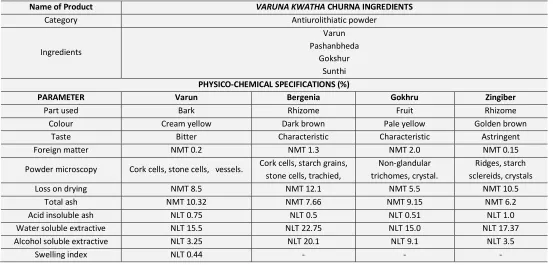
[image:2.612.313.586.316.384.2]Formulation: The Varuna Kwatha Churna an ayurvedic formulation formulated from various medicinal plants as bark of varuna, pashanbheda rhizome, fruit of gokshura and rhizome of sunthi. Then, it has been coarsely powdered and passed through sieve no.85, weighed. The Varuna kwatha churna manufactured by the formula in the ratio as specified in the ayurvedic formulary of India 3 given in specified quantities as cited in the Cakradatta, ed. Jagadishvar Prasad, Varanasi: Chawkhamba Sanskrit Series Office, 1961 4 given in the table 1.
TABLE 1: COMPOSITION OF FORMULATION OF DRUG
Name of Plant Latin names Part Used Composition in parts
Varun Crataeva nurvala Brk. 1
Pashanbheda Bergenia ligulata Rz. 1
Sunthi Zingiber officinale Rz. 1
Gokshura Tribulus terrestris Fr. 1
Pharmacognostic Standardization: Morphological studies were done by using simple microscope. The shape, size, color, odor, taste were determined. Microscopic studies were done by warming a few mg with chloral hydrate, washed mounted in glycerin; few mg treated with iodine solution and mounted in glycerin; few mg heated in 2 per cent aqueous potassium hydroxide, washed in water and mounted in glycerin. Powders of the dried parts were used for the observation of powder microscopical characters 5-11.
Physico-Chemical Evaluations: Foreign matter, total ash, acid-insoluble ash, swelling and foaming index, assay to determine tannin content, successive extractive values were determined. Alcohol and water-soluble extractive values were determined to find out the amount of water and alcohol soluble components. The moisture content was also been determined 5-11.
TABLE 2: PHYTOCHEMICAL STUDIES OF VARIOUS EXTRACTS
Plant constituents Identification test n-Hexane extract Chloroform extract Alcoholic extract Acetone extract Aqueous extract
Alkaloids
Mayer’s test + + - + -
Hager’s test + + - + -
Dragendroff’s test + + - + -
Carbohydrates
Wagner’s test + + - + -
Molisch test - - + - +
Fehling’s Test - - + - +
Glycosides Borntrager’s test - - + - +
Legal’s test - - + - +
Phenolic
compound Fecl3 test - - + - +
Tannins
Lead acetate test - - + - +
Fecl3 test - - + - +
Alkaline reagent test - - + - +
Lead acetate test - - + - +
Protein and amino acids
Millon’s test - - + - +
Ninhydrin test - - + - +
Biuret test - - + - +
Saponins Foam test - - + + +
Sterols Liebermann Burchard test + + - + -
Fixed oils, fats Spot test + + - + -
Flavonoids Shinoda’s test - - + - +
Alkaline reagent test - - + - +
+ : Test positive; – : Test negative
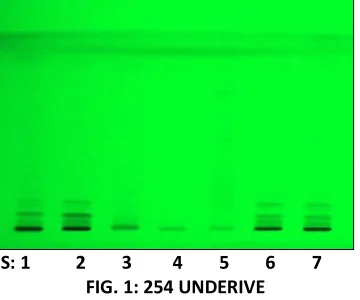
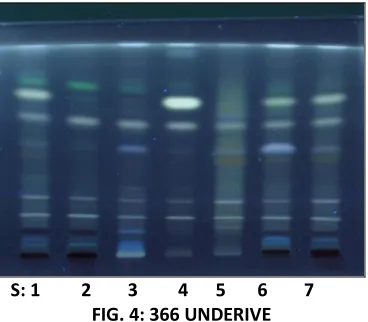
Fluorescence study of powdered drug shows the color change due to varied chemical constituents at different wavelength. Along with this powdered study, the comparison with the marketed samples can be made on the basis of the TLC profile (figure 1-4) which shows different bands on various wavelengths and TLC fingerprint profiles carried out by preparing the extract with 50ml methanol and 2.5g powdered drug, filtered with whatman filter paper. TLC of this alcoholic extract on Silica gel “G” plate using Toluene: Methanol: Ethyl acetate (6:1:1) shows spots; on spraying with methanolic sulphuric acid reagent and heating the plate for ten minutes at 105oC were determined.
S: 1 2 3 4 5 6 7 FIG. 1: 254 UNDERIVE
[image:3.612.18.611.73.353.2]S: 1 2 3 4 5 6 7 FIG. 2: 366 UNDERIVE
[image:3.612.364.546.350.705.2] [image:3.612.70.250.576.726.2]S: 1 2 3 4 5 6 7 FIG. 4: 366 UNDERIVE
S: Sample; 1: Varuna kwatha churna; prepared drug, 2: Bergenia, 3: Gokshur, 4: Varun, 5: Zingiber, 6: Market drug (A), 7: Market drug (B)
Safety evaluation: The drug was evaluated for the various safety 16 and toxicological parameter like microbial content and metal determination. The various tests for microbial contamination 17-19 had been performed such as, E. coli, salmonella,
staphylococcus aureus etc. may contaminate the
herbal drugs and cause serious health hazard. In literature information is available regarding the presence of metals in herbal drugs. If these are present beyond the certain limit may causes toxic effects. Quantitative determinations of heavy metals
20 such as lead, cadmium were carried out.
RESULT AND DISCUSSION: The powder of Varuna kwatha churna were observed to be light yellow to brown in color having specific odor and taste. In microscopic studies of powder shows the presence of epidermis, starch grains, stone cells, cork cells trachieds, trichomes, cortex, phloem, endodermis. The study revealed the presence of fibers, vessels,
xylem fibers, trichomes and parenchyma along with crystals.
The total ash is particularly important in the evaluation of purity of drugs, i.e. the presence or absence of foreign matter such as metallic salts or silica. The moisture content of the drug is not too high, thus it could discourage bacterial, fungi or yeast growth, as the general requirement for moisture content in crude drug is not more than 11.5% w/w. The ash values, extractive values and moisture content of leaves were determined. As varuna bark, gokshur, sunthi shows negligible foam and tannins, so foaming index and tannin content could not be determined. As bergenia, gokshur, sunthi shows negligible foam, so swelling index could not be determined.
Phytochemical analysis gives the information about phytoconstituents present in the crude drug (table 2). Along with this powdered study, the comparison with the marketed samples (table 5, 6) can be made on the basis of the TLC profiles (figure 1-4) which shows different bands on various wavelengths. The safety evaluations carried out the various tests were microbial load and heavy metals detection. The study shows that lead and cadmium presents within the permissible limits as per WHO. The herbal drug formulations passed all tests and it revealed that the herbal drug formulations were safe for human consumption as like marketed drug. The results are depicted in Table 3.
Since the Varuna kwatha churna is useful in traditional medicine for the treatment of urolithiasis, it is important to standardize it for use as a drug. TABLE 3: MONOGRAPH OF VARUNA KWATHA CHURNA; PREPARED DRUG
Name of Product Varun kwatha churna
Category Antiurolithiatic powder
Ingredients
Varun Pashanbheda
Gokshur Sunthi PHYSICO-CHEMICAL SPECIFICATIONS
PARAMETER LIMIT PROTOCOL
Appearance Coarse powder Visual inspection
Color Yellow to brown
Organoleptic evaluation
Taste Characteristic
[image:4.612.33.582.589.750.2]Powder microscopy Parenchymatous cortex cork cells in surface, stone cells, trachied, starch grains, non-glandular trichomes, vascular bundles, vessels.
Loss on drying Not more than 11.5 per cent
Total ash Not more than 7.11 per cent
Acid insoluble ash Not more than 0.93 per cent
Water soluble extractive Not less than 13.5 per cent
Alcohol soluble extractive Not less than 10.12 per cent
Swelling index Not less than 0.13 per cent
Foaming index Not less than 0.12 per cent
Assay Tannin content 15.56 per cent
TLC
TLC of alcoholic extract on Silica gel “G” plate using Toluene: Methanol: Ethyl acetate (6:1:1) shows spots; on spraying with methanolic sulphuric acid reagent and heating the plate for ten minutes at 1050C.
Extractive values Not less than 6.97 per cent
n-Hexane Not less than 6.4 per cent
Chloroform Not less than 3.52 per cent
Acetone Not less than5.64 per cent
Methanol Not less than 5.76 per cent
MICROBIOLOGICAL SPECIFICATIONS
Total Viable Count <10 5cfu/g
The Ayurvedic Pharmacopoeia of India
E-coli Absent
Salmonella/gm Absent
Staphylococus aureus/gm Absent
Pseudomonas aeruginosa/gm Absent
Yeast &Mould Count <10 3cfu/g
HEAVY METALS Lead: NMT 0.7736 ppm
Cadmium: NMT 0.0171ppm AOAC Methods
PRODUCT PACKAGING
[image:5.612.32.585.490.755.2]Storage instruction At dry place, away from direct sun light.
TABLE 4: MONOGRAPH OF THE INGREDIENTS OF VARUNA KWATHA CHURNA
Name of Product VARUNA KWATHA CHURNA INGREDIENTS
Category Antiurolithiatic powder
Ingredients
Varun Pashanbheda
Gokshur Sunthi PHYSICO-CHEMICAL SPECIFICATIONS (%)
PARAMETER Varun Bergenia Gokhru Zingiber
Part used Bark Rhizome Fruit Rhizome
Colour Cream yellow Dark brown Pale yellow Golden brown
Taste Bitter Characteristic Characteristic Astringent
Foreign matter NMT 0.2 NMT 1.3 NMT 2.0 NMT 0.15
Powder microscopy Cork cells, stone cells, vessels. Cork cells, starch grains, stone cells, trachied,
Non-glandular trichomes, crystal.
Ridges, starch sclereids, crystals
Loss on drying NMT 8.5 NMT 12.1 NMT 5.5 NMT 10.5
Total ash NMT 10.32 NMT 7.66 NMT 9.15 NMT 6.2
Acid insoluble ash NLT 0.75 NLT 0.5 NLT 0.51 NLT 1.0
Water soluble extractive NLT 15.5 NLT 22.75 NLT 15.0 NLT 17.37
Alcohol soluble extractive NLT 3.25 NLT 20.1 NLT 9.1 NLT 3.5
Foaming index - NLT 0.45 - -
Assay - NLT 28.4 - -
TLC Shown in figure 1-4
EXTRACTIVE VALUES
n-Hexane NLT 7.0 NLT4.66 NLT 9.96 NLT 7.48
Chloroform NLT 2.15 NLT 4.4 NLT 3.74 NLT 3.75
Methanol NLT 0.76 NLT 8.7 NLT 1.54 NLT 0.5
Acetone NLT 2.3 NLT 13.93 NLT 6.36 NLT 2.37
Water NLT 6.95 NLT 9.23 NLT 8.18 NLT 11.92
MICROBIOLOGICAL SPECIFICATIONS
Total Viable Count <105cfu/g <105cfu/g <105cfu/g <105cfu/g
E-coli Absent Absent Absent Absent
Salmonella/gm Absent Absent Absent Absent
Staphylococus aureus/gm Absent Absent Absent Absent
Pseudomonas aeruginosa/gm Absent Absent Absent Absent
Yeast & Mould Count <10 3
cfu /g
NMT 0.03 <10
3 cfu /g NMT 0.05
<103cfu /g NMT 0.045
<103cfu /g NMT 0.5 HEAVY
METAL(ppm)
Lead
Cadmium NMT 0.01 NMT 0.03 NMT 0.01 NMT 0.09
PACKAGING
[image:6.612.32.585.365.749.2]Storage instruction At dry place, away from direct sun light
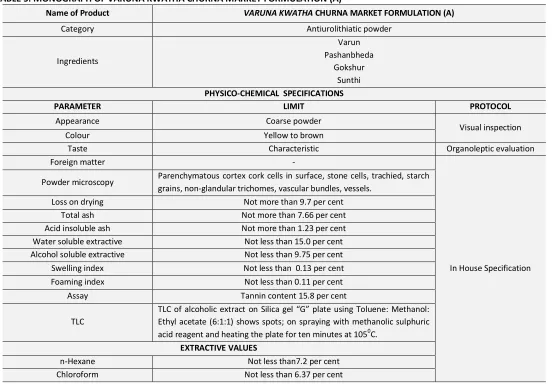
TABLE 5: MONOGRAPH OF VARUNA KWATHA CHURNA MARKET FORMULATION (A)
Name of Product VARUNA KWATHA CHURNA MARKET FORMULATION (A)
Category Antiurolithiatic powder
Ingredients
Varun Pashanbheda
Gokshur Sunthi PHYSICO-CHEMICAL SPECIFICATIONS
PARAMETER LIMIT PROTOCOL
Appearance Coarse powder
Visual inspection
Colour Yellow to brown
Taste Characteristic Organoleptic evaluation
Foreign matter -
In House Specification Powder microscopy Parenchymatous cortex cork cells in surface, stone cells, trachied, starch
grains, non-glandular trichomes, vascular bundles, vessels.
Loss on drying Not more than 9.7 per cent
Total ash Not more than 7.66 per cent
Acid insoluble ash Not more than 1.23 per cent
Water soluble extractive Not less than 15.0 per cent
Alcohol soluble extractive Not less than 9.75 per cent
Swelling index Not less than 0.13 per cent
Foaming index Not less than 0.11 per cent
Assay Tannin content 15.8 per cent
TLC
TLC of alcoholic extract on Silica gel “G” plate using Toluene: Methanol: Ethyl acetate (6:1:1) shows spots; on spraying with methanolic sulphuric acid reagent and heating the plate for ten minutes at 1050C.
EXTRACTIVE VALUES
n-Hexane Not less than7.2 per cent
Methanol Not less than 4.14 per cent
Acetone Not less than 5.62 per cent
Water Not less than 10.67 per cent
MICROBIOLOGICAL SPECIFICATIONS
Total Viable Count <10 5cfu/g
The Ayurvedic Pharmacopoeia of India
E-coli Absent
Salmonella/ gm Absent
Staphylococus aureus / gm Absent
Pseudomonas aeruginosa / gm Absent
Yeast & Mould Count <10 3cfu /g
HEAVY METALS Lead: NMT 0.515 ppm
Cadmium: NMT 0.0189 ppm AOAC Methods
PRODUCT PACKAGING
[image:7.612.37.566.289.751.2]Storage instruction At dry place, away from direct sun light
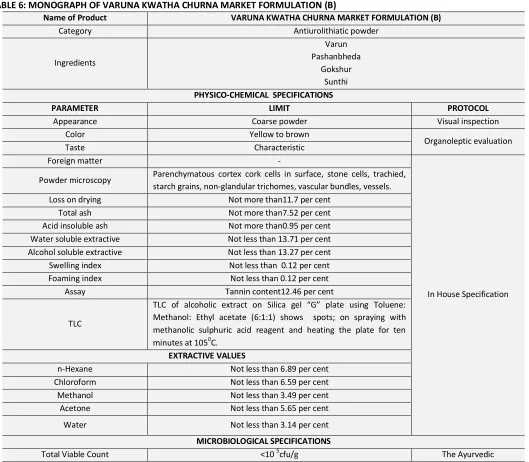
TABLE 6: MONOGRAPH OF VARUNA KWATHA CHURNA MARKET FORMULATION (B)
Name of Product VARUNA KWATHA CHURNA MARKET FORMULATION (B)
Category Antiurolithiatic powder
Ingredients
Varun Pashanbheda
Gokshur Sunthi PHYSICO-CHEMICAL SPECIFICATIONS
PARAMETER LIMIT PROTOCOL
Appearance Coarse powder Visual inspection
Color Yellow to brown
Organoleptic evaluation
Taste Characteristic
Foreign matter -
In House Specification Powder microscopy Parenchymatous cortex cork cells in surface, stone cells, trachied,
starch grains, non-glandular trichomes, vascular bundles, vessels.
Loss on drying Not more than11.7 per cent
Total ash Not more than7.52 per cent
Acid insoluble ash Not more than0.95 per cent
Water soluble extractive Not less than 13.71 per cent Alcohol soluble extractive Not less than 13.27 per cent
Swelling index Not less than 0.12 per cent
Foaming index Not less than 0.12 per cent
Assay Tannin content12.46 per cent
TLC
TLC of alcoholic extract on Silica gel “G” plate using Toluene: Methanol: Ethyl acetate (6:1:1) shows spots; on spraying with methanolic sulphuric acid reagent and heating the plate for ten minutes at 1050C.
EXTRACTIVE VALUES
n-Hexane Not less than 6.89 per cent
Chloroform Not less than 6.59 per cent
Methanol Not less than 3.49 per cent
Acetone Not less than 5.65 per cent
Water Not less than 3.14 per cent
MICROBIOLOGICAL SPECIFICATIONS
CONCLUSION: From the present investigation various standardization parameters such as physicochemical standards, chemo profiles and safety evaluation were carried out, it can be concluded that the formulation of
Varuna kwatha churna contains all good characters of
an ideal churna and it was found to be harmless, more effective, and economic.
The monograph of the Varuna kwatha churna having the parameters as per pharmacopoeia can be used as a standard by the pharmaceutical companies as the ingredients and the preparation is authentic and standardized. The comparison with the marketed samples can be made on the basis of the TLC profile which shows satisfactory results, but the efficacy of the products can only be judged by doing the pharmacology of which is suggested as future scope of R and D.
The study shows that the contents of formulation presents within the permissible limits as per WHO, all these investigations are not specified in the standard literature such as in pharmacopoeia, which could helpful in authentication of Varuna kwatha churna. The result of present study will also serve as reference monograph in the preparation of drug formulation.
ACKNOWLEDGMENT: I express my sincere thanks to Prof. Dr. A. V. Chandewar, M. Pharm, Ph.D., F.I.C., Principal, P. Wadhwani College of Pharmacy, Yavatmal; who took interest in looking into our research needs and thus providing us with the best available resources.
REFERENCES
1. Varalakshmi P., Shamila Y., Latha E., Effect of Crataeva nurvala in experimental urolithiasis. J Ethnopharmacol; 1990, 28, 313.
2. Umashankar D.C., Phytochemical and Antiinflammatory investigations of Bergenia ligulata, Yeo. Ph. D thesis, Punjab University, Chandigarh, 1997.
3. Ayurvedic Pharmacopoeia of India, Govt. of India, Ministry of health and family Welfare, Published by the Controller of Publication, New Delhi, 1999, volume II, 1st Edi., 190-191. 4. Cakradatta, ed. Jagadishvar Prasad, Varanasi: Chawkhamba
Sanskrit Series Office, 1961.
5. Mukherjee P. K., Quality control of herbal drugs, 1st Edi., Business Horizons, 2002, 97- 98,184-195, 248-249, 529-567, 701-725, 750-766.
6. Indian Herbal Pharmacopoeia, 1998, A Joint Publication of Regional Research Laboratory and Drug Manufacturers Association, volume I, 194-197.
7. British Herbal Pharmacopoeia, 1996, 4th Edi, British Herbal Medicine Association, 196-197.
8. Ayurvedic Pharmacopoeia of India, 1999, Govt. of India, Ministry of health and family Welfare, Published by Publication Controller, New Delhi, Part I, volume II, 1st Edi., 190-191. 9. Khandelwal K. R., Textbook of Pharmacognosy, 10th Edi, Nirali
Prakashan, Pune, 2003, 157-160, 162-165.
10. Kokate C. K., Purohit A.P. and Gokhale S.B., 2002, Pharmacognosy, 21st Edi, Nirali Prakashan, 106-113.
11. World Health Organization, 2005, Quality Control methods for medicinal Plant Materials, Revised Draft update, working document QAS/05.131/Rev.1, 24-27.
12. Kapoor L.D., Singh A, Kapoort S.L. et al, Survey of Indian Medicinal plants for saponins, 1989.
13. Kokate C.K., Practical Pharmacognosy, 4th Edn. Vallabh Prakashan, New Delhi. 112-120. 1994.
14. Harbone JB, Phytochemical methods, 3rd Edn, London: Chapam and hill; 49 - 244. 2005
15. Evans, W.C., Trease and Evan’s Pharmacognosy, WB, Sounders Company Limited, London. 15th Edition, Reprinted 2002; p. 98-99.
16. McGuffin M., Hobbs, C. and Upten, R., 1997, Botanical safety handbook, published by American herbal product association, 1- 3.
17. Saper R. B., Kales S. N. and Paqine J., 2004, Heavy Metal Content of Ayurvedic Herbal Medicine Products, American Medical Association, 292(23), 2868-2873.
18. Singh R. M., 2007, Impurities-Heavy metal, Indian pharmacopoeia commission, Central Indian Pharmacopoeia Laboratory, Govt. of India, Gaziabad.
19. Ajasa A.M.O., Bello M. O., Ibrahim A. O., Ogunwade I. A. and Olawore, O. N. 2004, Heavy Trace Metals and Macronutrients status in herbal plants of Nigeria, Food Chemistry, 85, 67-71. 20. Gupta, A, K., 2003, Quality standards of Indian medicinal plant,
published by council of Medical research, 244-
E-coli Absent Pharmacopoeia of India
Salmonella/ gm Absent
Staphylococus aureus / gm Absent
Pseudomonas aeruginosa / gm Absent
Yeast & Mould Count <10 3cfu /g
HEAVY METALS (ppm) Lead: NMT 0.671
Cadmium: NMT 0.016 AOAC Methods
PRODUCT PACKAGING