R E S E A R C H
Open Access
Energy efficient temporal load aware
resource allocation in cloud computing
datacenters
Shahin Vakilinia
Abstract
Cloud computing datacenters consume huge amounts of energy, which has high cost and large environmental impact. There has been significant amount of research on dynamic power management, which shuts down unutilized equipment in a datacenter to reduce energy consumption. The main consumers of power in a datacenter are servers, communications network and the cooling system. Optimization of power in a datacenter is a difficult problem because of server resource constraints, network topology and bandwidth constraints, cost of VM migration, the heterogeneity of workloads and the servers. The arrival of new jobs and departure of completed jobs also create workload heterogeneity in time. As a result, most of the previous research has concentrated on partial optimization of power consumption, which optimizes either server and/or network power consumption through placement of VMs. Temporal load aware optimization, minimization of power consumption as a function of time has vastly been studied. When optimization also included migration, then solution had been divided into two steps, in the first step optimization of server and/or network power consumption is performed and in the second step migration of VMs has been taken care of, which is not an optimal solution. In this work, we develop joint optimization of power consumption of servers, network communications and cost of migration with workload and server heterogeneity subject to resource and bandwidth constraints through VM placement. Optimization results in an integer quadratic program (IQP) with linear/quadratic constraints in number of VMs assigned to a job on a server. IQP can only be solved for very small size systems, however, we have been able to decompose IQP to master and pricing sub-problems which may be solved through column generation technique for systems with larger sizes. Then, we have extended the optimization to manage temporal heterogeneity of the workload. It is assumed that time-axis is slotted and at the end of each slot jobs makes probabilistic complete/partial release of the VMs that they are holding and there will also be new job arrivals according to a Poisson process. The system will perform re-optimization of power consumption at the end of each slot that also includes the cost of VM migration. In the re-optimization, VMs of unfinished jobs may experience migration while new jobs are assigned VMs. We have obtained numerical results for optimal power consumption for the system as well as its power consumption due to two heuristic VM assignment algorithms. The results show optimization achieves significant power savings compared to the heuristic algorithms. We believe that our work advances state-of-the art in dynamic power management of datacenters and the results will be helpful to cloud service providers in achieving energy saving.
Keywords:Cloud computing, Virtual machine placement, Integer linear programming, Integer quadratic programming, Optimization, Resource allocation, Column generation, Datacenter power management
Correspondence:[email protected]
Synchromedia Lab, ETS, 500 Rue Jean D’Estress, Montreal, QC H3C6W1, Canada
Introduction
The datacenters have been growing exponentially and together with that their power consumption. The energy consumption results in high operational cost and large impact on the environment. It is expected that the elec-tricity demand for datacenters to rise more than 66% over the period 2011–2035 [1]. As a result, there has been significant research on how to reduce power con-sumption of the datacenters. The main consumers of power in a datacenter are servers, communications net-work and the cooling system. It has been determined that an idle server consumes about 70% of its peak power [2]. Dynamic power management together with server consolidation has been used to reduce power con-sumption by temporarily shutting down servers when they are not required. Server consolidation refers to mi-gration of VMs to as few servers as possible so as to pre-vent underutilization of the servers. However, server consolidation is challenging because energy cost of mi-gration and, if not carefully done, network communica-tions cost may rise. Server consolidation may result jobs being assigned VMs from multiple servers, which may increase communication traffic between VMs. Thus it is important that optimization of power consumption in-cludes servers, network communications and cost of mi-gration. It has been determined that network accounts for at least 20% of the energy consumption of a cloud computing center and it may rise upto 50% under light job loading, which is typical of the data centers [3]. Since dynamic power management turns off the idle servers, it also reduces power consumption of the cooling system.
The optimization of power consumption also needs to take into account heterogeneity of the workloads and servers. Cloud workloads often have very large variations in their resource requirements, arrival rates and execu-tion times. Cloud centers also have heterogeneity in their servers. In time, datacenters update the configur-ation of their resources and upgrade the processing cap-abilities, memory and storage spaces. They also construct new platforms based on the new high per-formance servers while the older servers are still oper-ational. The heterogeneity of both servers and workloads increases complexity of the optimization of power consumption.
In this paper, we developed joint optimization of power consumptions of the servers, network communi-cations and cost of VM migration with workload and server heterogeneity subject to server resource and net-work bandwidth constraints. We assumed a hierarchical two-tier datacenter network, though the work can be easily extended to higher tier networks. Optimization re-sults in an integer quadratic program (IQP) with linear and quadratic constraints in number of VMs assigned to a server. This IQP problem is NP-hard [4] and it can
only be solved for very small size systems. Due to simi-larity between our optimization problem and cutting stock problem, we utilized column generation (CG) technique to solve this optimization problem for larger systems. Then, we have extended our solution to handle temporal heterogeneity of the workload due to arrival and departure of the jobs. We assumed that the time-axis is slotted and at the end of each slot jobs are com-pleted either partially or fully and new jobs arrive to the system according to a Poisson process during each time slot. In the partial completion a job releases each of its VMs according to independent Bernoulli trials, while in full completion each job departs from the system ac-cording to independent Bernoulli trials. Thus at the end of each slot, the workload load of the system consists of new arriving jobs during the present slot and unfinished jobs from the previous slots. We determine new VM placement by solving this optimization problem that also allows migration of the VMs of unfinished jobs in the system. VMs migrate if the energy savings outweigh cost of the migration. Management of VM migration requires addition of new constraints to the optimization. The main contributions of our work is as follows,
It formulates joint optimization of server, network and migration power consumption with bandwidth constraints for a given network topology. It performs power optimization and VM migration
simultaneously. The optimization problem is expressed as an IQP with quadratic constraints, which can only be solved for very small size systems.
We have been able to cast this optimization problem into an integer linear programming (ILP), which may be solved through column generation technique for larger size systems. It appears that this is the first application of the column generation technique to the solution of the optimization of power consumption problem in cloud computing systems.
The work incorporates temporal variation of the workload to the optimization, which allows general arrival and departure of the jobs as a function of discrete-time. This enables re-optimization of the power consumption at the discrete-time instants.
regarding the analysis in the paper. Section 9 discuss the details of assumptions made in this research. Finally, sec-tion 10 presents conclusions of the paper.
Related work
In this section, we will present a survey of the related work on the dynamic power management in cloud com-puting centers. The previous work on dynamic power management may be classified into two as with or with-out power optimization and the first case may be further subdivided into two depending on whether or not optimization is joint over the servers and network power consumption. Classification may also include other pa-rameters such as workload and server heterogeneity awareness and VM migration. Almost all of the previous works present heuristics rather than solving the optimization problem due to its complexity and then, they perform simulation to determine accuracy of the proposed heuristic.
First, we describe the previous work on dynamic power management without power optimization, which simply turns off idle servers to conserve power con-sumption. In [5], the effectiveness of dynamic power management in data centers had been investigated using
M/M/k queuing model with matrix analytic technique. In [6], this analysis had been extended to the heteroge-neous workload case.
Next we explain the previous work on dynamic power management with optimization of network power con-sumption, which is also referred to as traffic aware VM placement. In [7], an ad-hoc framework has been pro-posed which minimizes energy consumption of the data-center network. The framework consists of two steps, and it assumes that the traffic patterns of the jobs are known. In the first step, VM assignment is done in a manner that the traffic in the network is reduced. In the second step, energy-efficient routing of the traffic is car-ried out that minimizes the number of active switches. In [8], it has been observed from real datacenter net-work traces that traffic demands of different flows do not peak at exactly the same time. As a result, [8] pro-posed monitoring of the traffic flows in the network and their consolidation into a small subset of links and switches periodically and shutting down of unutilized switches for energy saving.
Next, we describe previous work on dynamic power management with joint optimization of server and net-work power consumption. In [4], VM placement prob-lem taking into account server operation and network communication costs had been studied. There is a trade-off between physical machine (PM) cost and network cost where the PM cost is minimized if minimum num-ber of servers is active. However, this may result in jobs being assigned VMs from multiple servers, which
increases the network cost. The work proposes an algo-rithm minimizing the network-cost with fixed PM-cost. The proposed algorithm doesnot consider resource con-straints of the servers, network topology and bandwidth constraints of the links. In [9] also VM placement min-imizing power consumption has been studied. The work considers both server and communications network power consumptions as well as bandwidth constraints of the links. Server power consumption is assumed to be function of CPU operating frequency. Network infra-structure is assumed to have a hierarchical tree topology and following the optimization, idle servers and switches are turned off. They prove that job load of the servers should be balanced to achieve minimum server power consumption. Starting from this result, they propose a heuristic to assign the VMs to servers, which assigns VMs with high communication requirements among them to the same server. The work assumes that servers are homogeneous and doesnot consider resource con-straints of the servers. The joint server and network power consumption optimization has also been studied in [10]. They proposed a unified model that combines server and network optimization by converting the VM assignment to a routing problem. However, optimization problem hasnot been solved due to its complexity, and instead the network is divided into clusters, which are optimized in parallel. The assignment of VMs to the servers and flows to the links in clusters are performed using a heuristic. The [11] also studied the joint optimization of server and network power consumption. They formulated the problem as an integer program-ming problem, proved that it is NP-hard and then pro-posed two greedy algorithms for VM scheduling.
“Harmony” was proposed to perform dynamic capacity provisioning that minimizes the total energy consump-tion and scheduling delay considering heterogeneity as well as reconfiguration costs. The work assumes that a job will always be placed on a single server, as a result the optimization doesnot include network communica-tions cost.
Next we describe the previous work on VM migration aware dynamic power management. In [14], an algo-rithm named as Peer VM Aggregation (PVA) has been proposed to migrate VMs of a job with high communi-cation demands to the same server in order to reduce network utilization and power consumption. Simulation results show that average network utilization is reduced by %25. In [2], a two stage VM placement algorithm minimizing power consumption with migration has been proposed. In the first stage, VM placement is de-termined by solving a bin packing problem that mini-mizes power consumption. In the second stage, VM migration is applied at job departure points from the system that adapts the VM placement according to the released resources. Both stages of the problem are for-mulated as mixed integer linear programming (MILP) problem. While the work includes resource constraints of the servers in the optimization, but not network communications cost.
The work in this paper combines several of the above optimization problems together, therefore its results are more comprehensive and reliable. Our work jointly opti-mizes power consumption of servers and communica-tions network and it includes both workload and server heterogeneity, resource constraints of the servers, net-work topology and link bandwidth constraints. Our work allows optimization to be done at discrete-time in-stants as the time evolves and some jobs depart and new ones arrive. It also models the VM migration and its cost, which enables adjustment of VM placement that re-optimizes power consumption under the new work-load. In the previous work, optimization involving mi-gration was performed in two steps, the first step performing VM placement that minimizes power con-sumption and the second step performing individual VM migration if it is cost effective. Clearly, this is not optimal because of partitioning of the problem into two separate sub-problems and piecemeal migration. Our work also includes the time-dimension in the optimization, which is absent from the previous work.
System model
In this section, we will present model of the system under consideration for optimization of power con-sumption through placement of VMs for the jobs. A datacenter consists of servers and communications net-work that provides connectivity among the servers and
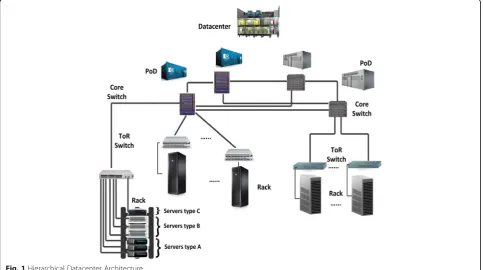
they are the main consumers of power in the system. Power consumption of a datacenter depends on its architecture, and in this work, we assume a hierarchical architecture, which is one of the commonly used topolo-gies in the datacenters. It is assumed that the datacenter consists of a collection of Performance Optimized modular Data Centers (PoD). Each PoD consists of a number of racks and each rack contains a collection of servers. In Fig. 1, we show a typical two-tier datacenter network [15, 16], which has servers housed in a rack connected to a Top-Of-Rack (TOR) switch. The TOR switch provides connectivity among the servers of a rack and also connects the rack to the Core Switch (CS) of its host PoD. Core switches depending on the datacenter topology such as clique or fat-tree [15] may have differ-ent types of connectivity that provides varying amounts of bandwidths for communications among the PoDs. In this work, we assume that connectivity of core switches has the mesh topology.
The main activities resulting in power consumption are processing of the jobs by the servers and the com-munications between the servers. A job may be served by multiple VMs, which may be located on different servers. A job will have communications demand, when it is assigned VMs on different servers. The magnitude of this demand between two servers will be assumed to be proportional to the product of the number of VMs assigned to that job on the two servers. We assume that servers will be in one of two states, eitheronoroffstate. A server will be in the onstate if it has at least one VM assigned to one of the jobs and otherwise it will be in the offstate. Anon server will consume constant power and anoffserver zero power.
We include server and workload heterogeneity in the model. We assume that a datacenter has T types of servers, where each server type is determined by the amount of different types of resources that it contains. A server type may haveKdifferent types of resources such as bandwidth, storage, CPU and memory. The amount of resources owned by a server of each type are given by a unique resource vector. We let Mtdenote number of
typetservers in the datacenter, andm’th typetserver as
mt∈{1t,…,Mt} with t∈{1,…,T}. Power consumption of
an on type t server will be denoted by Qt. We assume
that a server may have R different VM configurations. Each VM configuration is determined by the amount of different types of resources that it is allocated. We let ikr
denote the type kresource requirement of a typerVM. We assume that there are H types of jobs, where each job type requires a random number of VMs from a group of VM types. Each job type has a different mix of VM types and a geometrically distributed service time in number of slots with a different parameter. We let
h∈{1,…,H}, and vr
nh denote the number of typerVMs
that jobnhrequires,nh∈{1h,…,Nh}. Let alsoNdenote total
number of jobs in the datacenter, then,N ¼PHh¼1Nh. The optimization problem also includes communica-tion network bandwidth constraints to prevent traffic congestion. We assume that, there is no communica-tion congescommunica-tion between the servers located in the same rack because they are connected to their ToR switch with high capacity links. The communications conges-tion may occur either in the (TORS-CS) links or in PoD links (CS-CS). We assume that a ToR switch will be turned off if none of the servers in that rack are be-ing utilized. Similarly CS in a PoD will be turned off if all the servers connected to its racks are off. We note that anonswitch consumes a constant power plus load dependent variable power; the former will be referred to as static and the latter as dynamic power respect-ively. We will letPSℓ;eToRS;PSCSℓ denote static power
con-sumption of a ToR switch on the e’th rack of PoD ℓ, and CS switch in PoD ℓ respectively. Similarly, we will let PDℓ;eToRS;PDCSℓ denote dynamic power consumption
of these switches for per bit transmission rate. We also let PWNIC denote the dynamic power consumption at
the network interface card (NIC) of a server for per bit transmission rate.
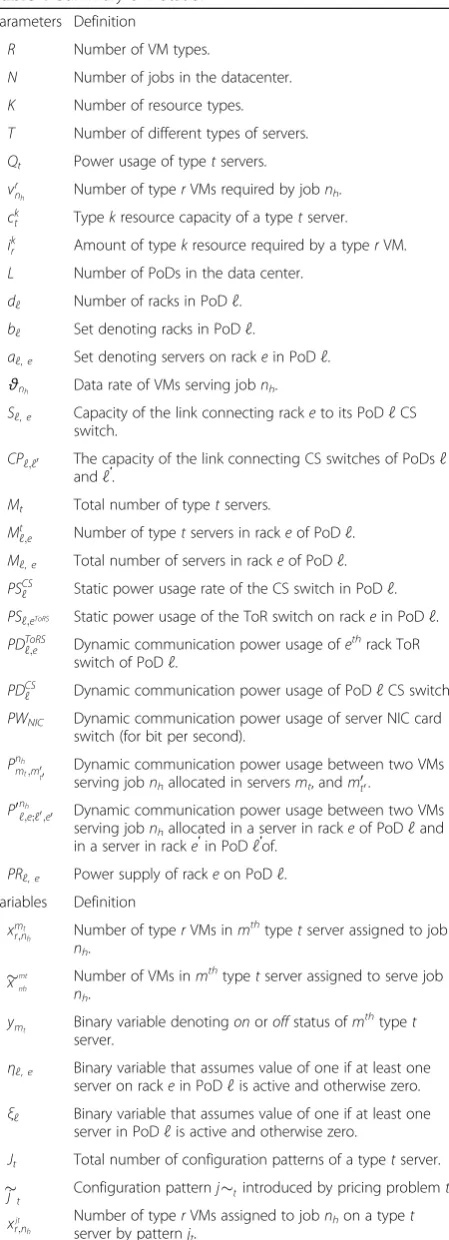
The notation introduced in the above as well as others for this optimization problem has been summarized in Table 1. From this table,
Mt ¼ XL
ℓ¼1
Xdℓ
e¼1M
t
ℓ;e ð1Þ Mℓ;e¼
XT t¼1M
t
ℓ;e ð2Þ aℓ;e¼1ℓ;e;…; ;mℓ;e; ::Mℓ;e ð3Þ where mℓ, edenotes the m’th server on the e’th rack of
PoD ℓ. The total power consumption of the datacenter will be minimized if the job load is served by minimum number of servers and each job is assigned VMs from as few servers as possible. In the next two sections, we will model the optimization problem first using IQP and then CG technique.
Modeling of the optimization problem with Integer Quadratic Programming (IQP)
In this section, we will model optimization problem of the system described in the previous section as an inte-ger quadratic programming (IQP). The power consump-tion of a datacenter consists of static and dynamic power consumptions of the switches, dynamic power consumption of the interface cards and power consump-tion of the servers.
We first determine the dynamic power consumption due to communications of two VMs. Let Pnh
mt;m0t0 denote
total dynamic communication power consumption be-tween two VMs located on servers mt, m0t0 and serving jobnh, then it is given by,
In the above, it has been assumed that communication power consumption between two VMs assigned to a job depends on the type of job but not on the types of VMs. As may be seen, this power depends on the location of the servers housing the VMs and on the data rate, which depends on the job type.
As defined in Table 1., the scheduling variablexmt
r;nh
de-notes number of type r VMs on the server assigned to serve job nhand connectivity variable xmnht denotes total
number of VMs assigned to jobnhon themthtypet
ser-ver assigned to serve job nh, where, xmnht ¼ PR
r¼1xmr;nth.
We would like to determine optimal values of the sched-uling variables xmt
r;nhthat minimizes the datacenter power
consumption. Next let us define the binary variables,ymt
to denoteonoroffstatus ofmthtypetserver,ηℓ,estatus
of the ToR switch serving to rack e on PoD ℓ as active or not, andξℓstatus of the CS serving PoDℓas active or not. Then from the notation introduced in Table 1.,
ymt ¼
1 PHh¼1PNhnh¼1hxmt nh >0
0 PHh¼1PNhnh¼1hxmt nh ¼0 8
<
: ð5Þ
ηℓ;e¼
1 PTt¼1Pmt∈aℓ;eymt >0
0 PTt¼1Pmt∈aℓ;eymt ¼0 (
ð6Þ
ξℓ¼ 1
Pdℓ
e¼1ηℓ;e>0
0 otherwise
(
∀e∈f1;…;dℓg;∀ℓ∈f1;…;Lg:
ð7Þ
Then, the optimization problem for minimization of total power consumption is given below,
Min
" XH
h¼1
XNh nh¼1h
XT t¼1
XT t0¼1
XMt mt¼1t
XMt mt0¼1t0P
nh mt;mt0 x
mt nhx
m0 t0 nh
þXL
ℓ¼1 ξℓPSℓCSþ Xdℓ
e¼1ηℓ;ePSℓ; e ToR
þXT
t¼1Qt XMt
mt¼1ymt #
ð8Þ
ST.(5), (6), (7),
x mt
nh ¼ XR
r¼1x
mt
r;nh∀nh∈f1;…;Nhg;mt∈f1t;…; ;Mtg
ð9Þ XT
t¼1
XMt mt¼1tx
mt r;nh≥v
r
nh∀r∈f1;…;Rg;nh∈f1h;…; ;Nhg;h∈f1;…;Hg
ð10Þ
XH h¼1
XNh
nh¼1h
XR r¼1x
mt
r;nhi
k
r≤ckt∀k∈f1;…;Kg;mt∈f1t;…; ;Mtg ð11Þ
XH h¼1
XNh
nh¼1hϑnh
X
mt∈aℓ;e
XL
ℓ0¼1
Xdℓ0
e0¼1 X
m0t0∈aℓ0;e0 x
mt
nhx
m0t0
nh
−Xt0 m0∈aℓ;e x
mt
nhx
m0t0
nh
≤Sℓ;e∀e∈f1;…;dℓg;∀ℓ∈f1…Lg
ð12Þ XH
h¼1
XNh nh¼1hϑnh
Xdℓ
e¼1
X mt∈aℓ;e
Xdℓ0
e0¼1
X
m0t0∈aℓ0;e0 x mt
nhx
m0t0
nh
≤CPℓ;ℓ0∀ℓ;ℓ0∈f1…Lg;ℓ≠ℓ0
ð13Þ
We note thatmt∈{1t,…,Mt} stands for∀t∈{1,…,T}.
In the objective function, the first term corresponds to the total dynamic communication power consumption in the datacenter. Second term represents the static part of communication power consumption and finally the last term corresponds to the power consumption of the servers. Constraint group (10) ensures that VM require-ments of each job are satisfied and group (11) guaran-tees that resource demands of jobs scheduled on a server do not exceed that server’s resource capacities. The constraints (12) and (13) ensure that bandwidth de-mands do not violate the capacities of TORs to CS and CS to CS links respectively. In these constraints, as de-fined in Table 1., Sℓ,e, CPℓ;ℓ0 denote capacities of TORS
to CS and CS to CS links respectively.
From the Eqs. (8–13), the optimization problem is in the form of Integer Quadratic Programming (IQP) in the scheduling variables xmt
r;nh. However, from the
defini-tions of the variablesymt,ηℓ,e,ξℓgiven in Eqs. (5–7), the IQP problem has other nonlinear constraints. Next, we would like to convert the nonlinearities due toymt,ηℓ,e, ξℓ into a form with linear constraints, which will make the problem simpler. This can be achieved by replacing each of the equations in (5–7) by a pair of constraints as follows,
XH h¼1
XNh nh¼1hx
mt
nh−ymt≥0 ð14Þ
Pnhmt;m0
t0
¼
0; if mt ¼m0t0
ϑnh 2PWNICþPDℓ;eToRS
; if mt;m0t0∈aℓ;e;mt≠m0t0
ϑnh 2PWNICþPDℓ;eToRSþPDCSℓ þPDToRSℓ;e0
;if mt∈aℓ;e;m0t0∈aℓ;e0;e≠e0 ϑnh 2PWNICþPDℓ;eToRSþPDℓCSþPDCSℓ0 þPDℓToRS0;e0
;if mt∈aℓ;e;m0t0∈aℓ0;e0;ℓ≠ℓ
0
g
8 > > > > > < > > > > > :θymt−XH h¼1
XNh nh¼1hx
mt
nh≥0 ð15Þ
XT t¼1
X
mt∈aℓ;eymt−ηℓ;e≥0 ∀e∈f1;…;dℓg;∀ℓ∈f1…Lg
ð16Þ
θηℓ;e− XT
t¼1
X
mt∈aℓ;eymt≥0 ∀e∈f1;…;dℓg;∀ℓ∈f1…Lg
ð17Þ Xdℓ
e¼1ηℓ;e−ξℓ≥0 ∀ℓ∈f1…Lg ð18Þ
θξℓ−
Xdℓ
e¼1ηℓ;e≥0 ∀ℓ∈f1…Lg ð19Þ
Thus we replace Eq. (5) with inequalities (14, 15). Def-inition in (5) implies that PHh¼1PNh
nh¼1hx
mt
nh = 0⇔ ymt =
0 andPHh¼1PNh
nh¼1hx
mt
nh > 0⇔ymt = 1. From these
obser-vations, the inequalities in (14, 15) follow, where θ de-notes a very large integer number. The correspondence between (6) and (16, 17) and between (7) and (18, 19) may be established similarly. In the remainder of the paper, these pairs of constraints will be referred to as “positive integer to binary linear conversion constraints” (IBLC).
As a result, our optimization problem has been con-verted to IQP with linear and quadratic constraints given by (8, 19). This optimization problem is NP hard and it can only be solved for very small size systems using the branch and bound technique [17].
Modeling of the optimization problem with column generation (CG) method
In this section, we will apply column generation tech-nique to obtain another solution to our problem, which may be used with larger size systems. This technique originally had been applied to cutting-stock problem, which consists of cutting a set of available stock lengths to meet customer orders for items in required lengths and quantities with the objective of minimizing the wasted material [18]. Distinct combination of items in length and quantities cut from a stock length is called a pattern. In column generation approach, the optimization problem is divided into two types of sub-problems referred to as restricted master and pricing problems [18]. The Restricted master problem (RMP) determines if the explored patterns satisfy the job de-mand constraints. The pricing problem finds a new pat-tern to feed the RMP. The objective function of the
Table 1Summary of notation
Parameters Definition
R Number of VM types.
N Number of jobs in the datacenter. K Number of resource types. T Number of different types of servers. Qt Power usage of typetservers.
vr
nh Number of typerVMs required by jobnh.
ck
t Typekresource capacity of a typetserver.
ik
r Amount of typekresource required by a typerVM.
L Number of PoDs in the data center. dℓ Number of racks in PoDℓ.
bℓ Set denoting racks in PoDℓ.
aℓ,e Set denoting servers on rackein PoDℓ. ϑnh Data rate of VMs serving jobnh.
Sℓ,e Capacity of the link connecting racketo its PoDℓCS
switch.
CPℓ;ℓ0 The capacity of the link connecting CS switches of PoDsℓ andℓ′.
Mt Total number of typetservers.
Mt
ℓ;e Number of typetservers in rackeof PoDℓ.
Mℓ,e Total number of servers in rackeof PoDℓ.
PSCSℓ Static power usage rate of the CS switch in PoDℓ. PSℓ;eToRS Static power usage of the ToR switch on rackein PoDℓ.
PDToRS
ℓ;e Dynamic communication power usage ofe
thrack ToR
switch of PoDℓ.
PDCS
ℓ Dynamic communication power usage of PoDℓCS switch. PWNIC Dynamic communication power usage of server NIC card
switch (for bit per second).
Pnh
mt;m0t0 Dynamic communication power usage between two VMs serving jobnhallocated in serversmt, andm0t0.
P0nh
ℓ;e;ℓ0;
e0 Dynamic communication power usage between two VMs serving jobnhallocated in a server in rackeof PoDℓand
in a server in racke′in PoDℓ′of.
PRℓ,e Power supply of rackeon PoDℓ.
Variables Definition
xmt
r;nh Number of typerVMs inm
thtypetserver assigned to job
nh.
x mt
nh
Number of VMs inmthtypetserver assigned to serve job nh.
ymt Binary variable denotingonoroffstatus ofm
thtypet
server.
ηℓ,e Binary variable that assumes value of one if at least one
server on rackein PoDℓis active and otherwise zero.
ξℓ Binary variable that assumes value of one if at least one server in PoDℓis active and otherwise zero.
Jt Total number of configuration patterns of a typetserver.
j
t Configuration patternjtintroduced by pricing problemt.
xr;nh
jt Number of typerVMs assigned to jobnhon a typet
server by patternjt.
Table 1Summary of notation(Continued)
x jt
nh Number of VMs assigned to jobpatternj nhon a typetserver by
t.
mjt
ℓ;e Number of active typetservers with patternjtin theeth
pricing problem is in fact the reduced cost coefficient of the RMP. The RMP and pricing problems collaborate until reduced cost coefficients (objectives) of the pricing problems become negative indicating optimal solution has been reached. In our problem, there will be T pri-cing problems, one for each server type. RMP is in the form of integer linear program (ILP) and pricing prob-lems are combinatorial optimization probprob-lems. RMP is solved using continuous relaxation, which at the end re-quires integer rounding of the results. There has been some work for application of column generation tech-nique in quadratic programming [19–21].
In relation to the cutting-stock problem, server types and jobs are similar to stock and item lengths respect-ively, however server types and jobs have multiple re-source constraints, while stocks and items have length as the only limit factor. Further, we have a complicated objective function compared to cutting stock problem. Let us define a pattern as a distinct combination of the number of VMs from each type of VMs that a server can accommodate. Let jt denote such a pattern and Jt
total number of patterns available for a type t server, thenjt∈{1t,…,Jt}. At the end of the solution, each active
server is assigned one of these patterns. The new intro-duced notation may also been found in Table 1. Letxjt
r;nh
denote number of typerVMs that has been assigned to job nh in a server with patternjt and similarly, x
jt
nh
de-note total number of VMs assigned to jobnhat a server
with patternjt. Then, we have the following equality
be-tween the two variables,
x jt
nh¼ XR
r¼1x
jt r;nh
The column vectorajt¼ x jt 1;n1; ::
;xjt 1;nH;::;x
jt
r;n1; ::;x
jt
r;nH ;::;xjt
R;n1; ::;x
jt
R;nHÞ
Trwill denotej’th pattern of typetserver. Let us define binary variable yjt
mt to denote whether or
not a given typetserver has patternjt, then,
yjt mt¼
1 ifm0th server of typetis active and hasjtpattern:
0 otherwise
ð20Þ
Next, let mjt
ℓ;e denote number of active type t servers with patternjtin theethrack of PoDℓ,
mjt
ℓ;e¼ X
mt∈aℓ;ey jt
mt ð21Þ
Finally, the state of rackeon PoDℓ as active or not is determined as,
ηℓ;e¼ 1
PT t¼1
PJt jt¼1tm
jt
ℓ;e>0
0 otherwise
(
ð22Þ
We note that total dynamic communication power consumption between two VMs located on servers mt, m0t0 and serving jobnhis still given by Eq. (4). Then, the
optimization problem for the RMP is given by,
Min
" XH
h¼1 XNh
nh¼1h XT
t¼1 XT
t0¼1 XMt
mt¼1t XMt
mt0¼1t0 XJt
jt¼1t XJt0
jt0¼1t0
Pnh
mt;mt0 y
jt
mtx
jt
nhy
jt0
mt0x
j0t0
nh
þXLℓ¼1
ξℓPSℓCSþ
Xdℓ e¼1ηℓ;ePS
ℓ;e ToR
þXT
t¼1Qt XMt
mt¼1 XJt
jt¼1ty
jt
mt #
ð23Þ
ST.(18), (19)
~
xjt nh ¼
XR r¼1x
jt
r;nh; ∀nh∈f1;…;Nhg;jt∈f1t;…; ;Jtg
mjtℓ;e¼X mt∈aℓ;ey
jt
mt ∀jt∈f1t;…; ;Jtg;t∈f1;…;Tg;
∀e∈f1;…;dℓg;∀ℓ∈f1…Lg
XT t¼1
XMt mt¼1t
XJt jt¼1ty
jt mtx
jt
r;nh≥ vrnh ∀r∈f1;…;Rg; nh∈f1h;…; ;Nhg;
h∈f1;…;Hg ð24Þ
XH h¼1
XNh
nh¼1hϑnh
XT t¼1
X
mt∈aℓ;e
XJt
jt¼1t
" XL
ℓ0¼1
Xdℓ0
e0¼1 XT
t0¼1 XJt0
jt0¼1t0
X
t0 m0∈aℓ0;e0 y
jt
mtx
jt
nhy
jt0
mt0x
j0
t0
nh
−Xm0 t0
∈aℓ;e yjt
mtx
jt
nhy
jt0
mt0x
j0t0
nh
#
≤Sℓ;e∀e∈f1;…;dℓg;∀ℓ∈f1…Lg ð25Þ XH
h¼1
XNh nh¼1hϑnh
Xdℓ
e¼1
XT t¼1
X mt∈aℓ;e
XJt jt¼1t
Xdℓ0
e0¼1
XT t0¼1
X t0 m0∈aℓ0;e0
XJt0
jt0¼1t0 y
jt
mtxjnht yjmtt00x j0t0
nh
≤CPℓ;ℓ0∀ℓ;ℓ0∈f1…Lg;ℓ≠ℓ0
ð26Þ XJt
jt¼1tm jt
ℓ;e≤Mtℓ;e ð27Þ
XT t¼1
XJt jt¼1tm
jt
ℓ;e−ηℓ;e≥0 ∀e∈f1;…;dℓg;∀ℓ∈f1…Lg
θηℓ;e− XT
t¼1
XJt jt¼1tm
jt
ℓ;e≥0 ∀e∈f1;…;dℓg;∀ℓ∈f1…Lg
ð29Þ
We note that in the above optimization problem, scheduling and connectivity variables xjt
r;nh;xjnth are
treated as constants. In the objective function, (23), the first term corresponds to power consumption of the interface cards and dynamic power consumption of ac-tive switches due to communication load, second term to static power consumption of active switches and the third term to power consumption of active servers. Con-straint (24) ensures satisfaction of the VM requirements of the jobs. The constraints (25) and (26) ensure that bandwidth demands of the jobs do not violate the cap-acities of the TORS to CS links and CS to CS links re-spectively. Constraint (27) ensures that the demand for servers donot exceed the available server capacity. Con-straints (28) and (29) are IBLC for the variableηℓ, e
de-fined in (22). However, the variables yjt
mtand y
j0t0
m0t0defined
in (20) and their product makes the objective function and the constraints (25, 26) nonlinear. Let us define the following binary variable in order to remove this nonlinearity,
φjt;j0t0 mt;m0
t0
¼yjt mty
j0t0
m0t0 ð30Þ
Then,
φjt;j0t0 mt;m0
t0 ¼
1 if yjt mt ¼y
j0t0
t0 m0
¼1
0 otherwise
(
ð31Þ
The binary multiplication in the above can be linear-ized through the following constraints,
φjt;j0t0 mt;m0
t0≥ yjt
mt þy j0t0
m0t0−1 ð32Þ
φjt;j0t0 mt;m0
t0≤ yjt
mt;φ jt;j0t0 mt;m0
t0≤ yj
0
t0 m0t0 φ
jt;j0t0 mt;m0
t0≥
0 ð33Þ
Thus the constraints (32, 33) need to be added to the above optimization problem given in (23–29).
Next, we present theT pricing problems one for each server type. The pricing problem for server type t at-tempts to introduce the new pattern jt to the RMP through solution of the following optimization problem,
MaxXH
h¼1
XNh nh¼1h
XR r¼1u
t r;nh xj
t r;nh
ð34Þ
ST:XH h¼1
XNh nh¼1h
XR r¼1x
j
t
r;nhikr≤ckt∀k∈f1;…;Kg
ð35Þ
where xjt
r;nh represents number of type r VMs assigned to job nh by pattern j
t . The pricing
problem’s objective function is the reduced cost function of the RMP with respect to server type t and utr;nh coefficients denote the values of the dual variables of the RMP for type t server. Constraint group (35) ensures that resource constraints of the servers are satisfied.
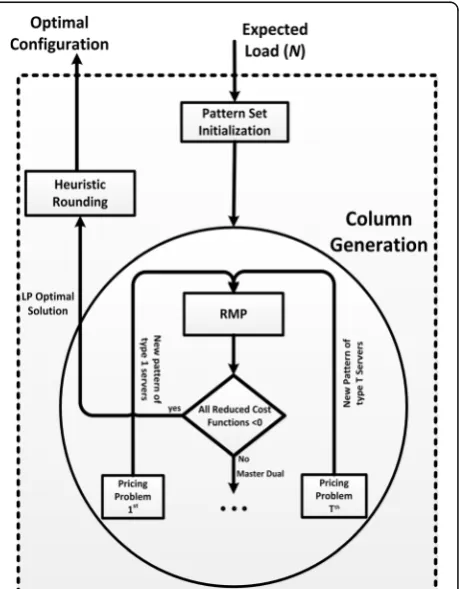
As shown in Fig. 2, in the column generation tech-nique, RMP and pricing problems are solved itera-tively. In each iteration, following solution of the pricing problems, the pattern of the server type t with the highest objective function value is introduced to the RMP. The iterations continue, as long as there are reduced cost functions with positive values. The algorithm terminates when all the reduced cost func-tions become negative and as a result no new pattern is introduced to the RMP. However, the obtained so-lution corresponds to the continuous relaxation of the problem, and therefore the results need to be rounded into integer values, which will be dealt in a later section.
We note that CG gives us a linear solution of the problem, which reduces solution’s complexity but this is achieved at the expense of substantial increase in number of variables and constraints [22].
Probabilistic model
In the previous sections, we have assumed deterministic traffic rates for communications between VMs and con-stant power consumption for active servers; however, in practice these quantities are random and vary as func-tions of time. In this section, we extend the optimization problem of the previous sections to a more realistic model, where VM communication rates and server power consumption are considered as random variables.
First, we assume that the data rate between two VMs serving to a type h job, ϑnh, is a random variable. As a
result, bandwidth constraints given in (12, 13) for IQP and (25, 26) for CG become probabilistic. For example (12) and (25) may be expressed as,
Pr XH
h¼1ϑnh
XNh
nh¼1hΨℓ;e;nh >Sℓ;e
≤p ð36Þ
whereΨℓ;e;nh for IQP and CG are given by, Ψℓ;e;nh¼
X
mt∈aℓ;e
" XL
ℓ0¼1
Xdℓ0
e0¼1
X
m0t0∈aℓ0;e0 x
mt nhx
m0t0
nh
−Xm0
t0∈aℓ;e x mt
nhx
m0t0
nh
#
;for IQP
ð37Þ
Ψℓ;e;nh¼
XT t¼1
XJt
jt¼1t
("
x jt
nh
X
ℓ0∈f1; ::Lg;ℓ≠ℓ0
Xdℓ0
e0¼1;
XT t0¼1
XJt0
j0t0¼1t0
X
mt∈aℓ;e
X
m0t0∈aℓ0;e0φ
jt;j0t0
mt;m0t0
x j0t0
nh # þ " x jt nh X
e0∈bℓ;e0≠e
XT t0¼1
XJt0
j0t0¼1t0
X
mt∈aℓ;e
X
m0
t0
∈aℓ0;e0φjt;j 0 t0
mt;m0 t0
x j0t0
nh
#)
;for CG
ð38Þ
In the above the objective is to keep probability of link congestion below a threshold value ofp.
As in [23], we assume that total traffic rate follows a Gaussian distribution, which from the Central Limit Theorem remains an accurate model even if the individ-ual flows are non-Gaussian [24, 25]. Next, we assume that mean and standard deviation of ϑnh are given by λh
and σh respectively, then the constraint (36) may be expressed as,
XH h¼1 λh
XNh
nh¼1hΨℓ;e;nh
þζ
ffiffiffiffiffiffiffiffiffiffiffiffiffiffiffiffiffiffiffiffiffiffiffiffiffiffiffiffiffiffiffiffiffiffiffiffiffiffiffiffiffiffiffiffiffiffiffiffiffiffiffiffiffiffiffiffiffi XH
h¼1σh
2 XNh
nh¼1hΨℓ;e;nh
2
r
≤Sℓ;e ð39Þ
where ζ=Φ−1(1−p) and Φ−1 is the inverse function of the normal CDF. From [25], the LHS may be bounded, which reduces the above constraint to,
XH
h¼1 ðλhþζσhÞ
XNh
nh¼1hΨℓ;e;nh
h i
≤Sℓ;e ð40Þ
In the previous sections, we assumed that power con-sumption of anontypetserver is a constant denoted by
Qt. In fact, power consumption is random and depends
on processing utility, I/O, load, memory usage etc. Let
qt denote power consumption of a type t server, then
from [23],qthas a general probability distribution, which
varies in the range [0.5Qt, Qt] with mean and standard
deviation denoted by ωt, δt respectively. It is better to avoid high power consumption at the rack level in order to prevent system failure [26]. As a result, we introduce the following probabilistic constraint,
Pr XT
t¼1qt
XJt jt¼1tm
jt
ℓ;e>PRℓ;e
≤p ð41Þ
wherePRℓ,edenotes the power supply of rackeon PoD ℓ. As before, from the central limit theorem we assume that the total power consumption at the rack level has a Gaussian distribution. Similar to the analysis for Eq. (36), Eq. (41) can be linearized as follows,
XT t¼1ωt
XJt jt¼1tm
jt
ℓ;eþζ XT
t¼1δt
XJt jt¼1tm
jt
ℓ;e≤PRℓ;e
ð42Þ
This completes the extension to a probabilistic model with random server power consumption and link utilization. Thus new optimization problem also includes constraints (42) on rack’s power consumption and on link utilization (25) is replaced by (40).
Temporal load aware VM placement
allowed. If VM migration is allowed, then leftover jobs are scheduled like the new jobs, on the other hand, if no mi-gration is allowed then the new jobs can only be scheduled to VMs not utilized by the leftover jobs. As a result of mi-gration, the system may end up in a state that consumes less power, however, migration has communication and processing overhead that optimization needs to take into account. Let Gr denote normalized power consumption
cost of migration of typerVMs, which from [27] may be determined as follows,
Gr¼ðVM Migration power Consumption Sourceð þDestinationÞÞ
Migration Duration Time Slot Duration
Optimization will allow VM migration if power saving due to migration offsets the cost of migration. As a result, the optimization may result in partial VM migration.
Since jobs release their VMs according to the Ber-noulli trials, number of leftover jobs to the next slot will be a random variable with Binomial distribution. However, to make the analysis tractable we will as-sume that number of leftover jobs is a constant given by the mean of the Binomial distribution. Let Nh0 de-note number of the type h leftover jobs from the current slot and Nh total number of jobs to be
sched-uled in the next slot, which include both leftover as well as new arriving jobs. We note that Nh≥Nh0 and
nh∈ð1h; ::;Nh0; ::; ;NhÞ and the first Nh0 jobs in the set correspond to the leftover jobs from the current slot. Next, we will develop both dynamic IQP and CG models for re-optimization of power consumption.
DynamicIQPmodel
Let us consider nhth job, which is in the system in the
current slot and will continue to receive service in the next slot. Let x0mt
r;nh, x
mt
r;nh denote the number of type r
VMs assigned to this job over themth typetserver dur-ing the current and next slots respectively. Based on the new notation introduced in Table 2, we define the fol-lowing binary variable,
βmt r;nh¼
1 ifxmt
r;nh−x0mtr;nh<0
0 otherwise
ð43Þ
The value of βmt
r;nh shows whether typerVMs required
by job nhhave migrated or not. In the case of VM
mi-gration from this type of server, thenxmt
r;nh<x
0mt
r;nh and as
a result βmt
r;nh will have a nonzero value and in all other
cases a zero value. The objective function of this optimization problem is given by,
Min
" 8
ð Þ þXHh¼1XNh0
nh¼1h
XR r¼1
XL
ℓ¼1 Xdℓ
e¼1 XT
t¼1 X
mt∈aℓ;eGrβ
mt
r;nhx
mt
r;nh−x
0mt
r;nh
#
ð44Þ
where absolute value of ðxmt
r;nh−x0mtr;nh ) corresponds to number of VM migrations. In the above, migration of a VM will be allowed if it results in power saving larger than cost of migration. Qt in (8) also is considered as a
linear function of total number ofxmt
nhs to better approxi-mate the dependence of the utilization of the server in power consumption.
Job scheduling without VM migration can be achieved by assigning to Gr a very large value, which
prevents migration as its cost cannot be offset by any amount of power saving. As a result, unfinished jobs will preserve their VM assignments. Finally, we have to add the following constraints into the optimization problem in order to linearize Eq. (43),
xmtr;nh−x0mtr;nhþθβmtr;nh<1 ð45Þ
xmt
r;nh−x0mtr;nhþθβmtr;nh≥0 ð46Þ
where (45), (46) are ∀r∈{1,…,R}, mt∈{1,…,Mt}, t∈{1,…,T}, nh∈{1h,…,Nh}, h∈{1,…,H}.
Dynamic CG model
Next, we consider the dynamic CG model. Assume that nh
th
job is in the system in the current slot and will continue to receive service in the next slot. Let
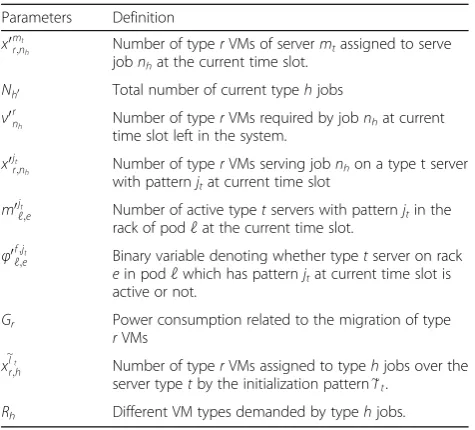
Table 2Additional notation
Parameters Definition
x0mt
r;nh Number of typerVMs of servermtassigned to serve
jobnhat the current time slot.
Nh0 Total number of current typehjobs
ν0r
nh Number of typerVMs required by jobnhat current
time slot left in the system.
x0jt
r;nh Number of typerVMs serving jobnhon a type t server
with patternjtat current time slot
m0jt
ℓ;e Number of active typetservers with patternjtin the
rack of podℓat the current time slot.
φ0f;jt
ℓ;e Binary variable denoting whether typetserver on rack
ein podℓwhich has patternjtat current time slot is
active or not.
Gr Power consumption related to the migration of type
rVMs xI
t
r;h Number of typerVMs assigned to typehjobs over the
server typetby the initialization patternIt.
x0jt
r;nh, x
jt
r;nh denote number of type r VMs assigned to
this job over the jt’th pattern during the current and
next slots respectively. Similarly, φ0f;jt
ℓ;e, φfℓ;j;et are binary variables indicating whether f’th type t server on rack
e in PoD ℓ is active and has pattern jt during the
current and next slots respectively. In this model, we define binary variable βfℓ;t;e;r;n
h to show whether or not r type VMs required by job nh have migrated or not
from a server as follows,
βf;t
ℓ;e;r;nh ¼ 1if PJt
jt¼1t x jt r;nhφf;jt
ℓ;e−x0jtr;nhφ0fℓ;j;et
<0
0 otherwise
(
ð47Þ
We note that the summation in the above allows the use of a different pattern at the server as long as
it preserves the number of VMs assigned by the ori-ginal pattern to this job. The objective function of this optimization problem is given by,
Min "
23
ð Þ þXHh¼1XNh0 nh¼1h
XR r¼1Gr
XL
ℓ¼1
Xdℓ e¼1
XT t¼1
XMt
ℓ;e f¼1β
f;t
ℓ;e;r;nh XJt
jt¼1t x jt
r;nhφf;jℓ;et−x0r;nhjt φ0fℓ;j;et
#
ð48Þ
As in the previous subsection, job scheduling with-out VM migration can be achieved by setting Gr to
a very large value. Finally, similar to the previous subsection, we have to add the following constraints to the problem in order to linearize (47),
Table 3Characteristics of Server types
Index (t) Model Num. of Coresct, 1 Memoryct, 2 Num. of PMsMt Power SupplyQt ωt,δt
1 Dell PE T110 4 16GB 1000 350 W 200 W, 20 W
2 Dell PE T410 8 128GB 300 580 W 400 W, 20 W
3 Dell PE M910 32 512GB 200 2750 W 1500 W, 100 W
4 Dell PE R810 16 512 GB 250 2200 W 1200 W, 100 W
5 Dell PE M915 64 1 TB 100 2750 W 1500 W, 100 W
6 Dell PE R910 40 2 TB 150 3000 W 1500 W, 100 W
7 HP DL320e Gen8 4 32GB 1000 350 W 200 W, 20 W
8 HP DL360e Gen8 8 384GB 500 750 W 400 W, 50 W
9 HP DL380p Gen8 8 768GB 250 1200 W 700 W, 50 W
10 HP DL360 G7 4 768GB 250 1200 W 700 W, 50 W
11 HP DL385p G7 16 768 GB 150 2000 W 1200 W, 100 W
12 HP DL370 G6 16 2 TB 100 2300 W 1150 W, 100 W
Table 4No. of servers per type per rack of PODℓ
Mtℓ;eℓ->
t ℓ
=1 ℓ=2 ℓ=3 ℓ=4
1 12 0 22 6
2 4 0 8 8
3 6 0 8 6
4 8 0 6 6
5 12 0 8 0
6 8 0 4 4
7 0 12 0 28
8 0 10 0 10
9 0 6 0 4
10 0 2 0 8
11 0 10 0 0
12 0 4 0 0
Sum 50 44 56 80
Table 5No. of servers per type per PoD
PoD No(ℓ) Server type(t) ℓ=1 ℓ=2 ℓ=3 ℓ=4
1 144 0 264 72
2 48 0 96 96
3 72 0 96 72
4 96 0 72 72
5 144 0 96 0
6 96 0 48 48
7 0 144 0 336
8 0 120 0 120
9 0 72 0 48
10 0 24 0 96
11 0 120 0 0
12 0 48 0 0
XJt jt¼1t x
jt
r;nhφf;jℓ;et−x0r;nhjt φ0f;jℓ;et
þθβf;t
ℓ;e;r;nh <1 ð49Þ XJt
jt¼1t x jt
r;nhφf;jtℓ;e−x0jr;nht φ0f;jtℓ;e
þθβf;t
ℓ;e;r;nh≥0 ð50Þ where (49), (50) are ∀r∈f1;…;Rg;f∈ 1;…;Mt
ℓ;e
n o
;t∈ 1; ; ;T
f g;nh∈f1h;…; ;Nhg;h∈f1;…;Hg.
Optimization structure and complexity mitigation In this section, we consider initialization of the optimization and rounding of the solution of relaxed problem to integer values.
CG initialization
We use offline initialization to reduce computation time for the solution of the optimization problem. Without initialization, in the first iterations, the RMP does not contain adequate columns to provide beneficial dual in-formation to pricing sub-problems [28]. An appropriate initialization helps to reduce number of iterations of the solutions of RMP and pricing problems through intro-duction of optimal patterns, which are patterns that maximize resource utilization of active servers. Using the notation introduced in Table 2, we define the initialization (optimization) problem as follows,
MaxXR
r¼1x
I
t
r;hikr ð51Þ
ST: Xr¼1 ∇r∈Rh
R xIt r;hik
0
r ≤ckt0∀k0∈f1;…;Kg ð52Þ
where, Rh denotes the set of VM types available to type h jobs. Solving this problem for each {k,t,h} results in the bestΥtpatterns for different types of jobs. Then, for a typetserver we will haveΥtHKinitial patterns. To ob-tainxIt
r;nhs, which are introduced in the previous sections and are related to the initial patternIt,xIr;ht is assigned to a type h job while other jobs are set to zero. Hence, for each xIt
r;h variable there would be Nh different
pat-terns. Thus, initial number of patterns for server type t will be equal to PHh¼1NhΥtK . So in the proposed initialization, we may have separate candidate patterns for each job. Then through collaboration of the pricing problems and RMP, new patterns, that consider different jobs in a server will be introduced by pricing problems.
Heuristic rounding termination algorithm
As mentioned earlier, LP problem (solvable in polyno-mial time) has less complexity compared to ILP problem (NP-hard optimization problem). In the CG solution of our optimization problem, RMP has been formulated as a LP and pricing problems as ILP type. As a result, we need to determine the optimal ILP solution of the RMP after the solution of the relaxed LP. Typically, this is done through the branch and bound algorithm [18], which is time consuming, as a result, we propose a heur-istic method that satisfies the scheduling time constraint [28, 29]. The proposed method will round up and down the values of the scheduling variables,mjt
ℓ;e, of the LP so-lution [30, 31]. This operation will be carried out after
mjt
ℓ;e have been sorted according to their priorities. mjℓt;es more likely to be rounded down will be given higher pri-ority. Following this operation, it is possible that all the servers of a rack will become inactive in which case TOR switch serving to that rack will be turned off to save power.
Table 6Characteristics of Typical Switches
Switch Type Interface data rates Product name Power (static) PSToRℓ =CS
Power max Power (Dynamic) PDToRℓ;e=CS
TOR 10 GbpS int NEC IP8800 25 W 145 W 65 nano w/bps
40 GbpS, ext. (Sℓ,e)
Core Switch 200 Gbps (CPℓ;ℓ0) HP A12500 200 W 10,700 W 10 nano w/bps
Table 7VM configurations
Index (r)
Model vCPU
ði1
r)
Mem (GiB) i2
r
1 t2.micro 1 1
2 t2.small 1 2
3 t2.medium 2 4
4 m3.medium 1 3.75
5 m3.large 2 7.5
6 m3.xlarge 4 15
7 c3.large 2 3.75
8 c3.xlarge 4 7.5
9 c3.2xlarge 8 15
10 c3.4xlarge 16 30
11 c3.8xlarge 32 60
12 r3.large 2 15.25
13 r3.xlarge 4 30.5
14 r3.2xlarge 8 61
15 r3.4xlarge 16 122
16 r3.8xlarge 32 244
17 g2.2xlarge 8 15
First, let us define sℓ, e as the set of scheduling
vari-ables for the rackeon PoDℓ,
sℓ;e¼ mjℓt;e;jt∈f1t;…; ;Jtg;t∈f1;…;Tg
n o
and define setSas the set with its elements given by the subsetssℓ,eas given below,
S¼sℓ;ej1ℓ≤e≤dℓ;1≤ℓ≤L
Next, we splitSinto two mutually exclusive subsets,
S¼fS1; ;S2g
where S1 consists of all sℓ, e that have their scheduling
variables with values strictly less than one andS2 other-wise. The elements of S1denote potentially inactive racks, while the elements of S2 active racks. From the above definition, elements of S1are given higher priority than S2in the rounding operation. Next, we explain the steps of the proposed heuristic, we note that Step i) ap-plies only toS1, while the remaining steps apply both to
S1andS2.
Step i) Sort the elements of set S1 according to the number of active servers in a rack, PTt¼1PJt
jt¼1tm
jt
ℓ;e, in
Table 8Jobs Types and their VM requirements
Index (h) Job types VM type VM types Percentage Ch αh Traffic rates,ωh,σh(Mbps)
1 Graphical Processing Jobs g2.2xlarge %70 50 0.14 3, 0.2
cg1.xlarge %30
2 Scientific Jobs 1 c3.largec3 30% 100 0.14 0.7, 0.05
c3,xlarge 30%
c3.2xlarge 20%
c3.4xlarge 10%
c3.8xlarge 10%
3 Scientific Jobs 2 r3.large 30% 100 0.14 0.7, 0.05
r3,xlarge 30%
r3.2xlarge 20%
r3.4xlarge 10%
r3.8xlarge 10%
4 Scientific Jobs 3 m3.medium 50% 100 0.14 12, 2
m3.large 30%
m3.xlarge 20%
5 Data Search m3.xlarge 30% 100 0.14 1, 0.1
r3.large 20%
r3,xlarge 20%
r3.2xlarge 10%
r3.4xlarge 10%
r3.8xlarge 10%
6 Enterprise Infrastructure Services t2.micro 30% 100 0.15 3, 0.5
t2.small, 20%
t2.medium 20%
m3.medium 10%
m3.large 10%
m3.xlarge 10%
7 Peer 2 Peer Services c3.large, c3,xlarge 30%, 30% 100 0.15 10, 1
c3.2xlarge, c3.4xlarge 20%, 10%
c3.8xlarge 10%
+ + +
r3.large, r3,xlarge 30%, 30% 50
r3.2xlarge, r3.4xlarge 20%, 10%
ascending order with the first element of S1having the least number of active servers. We note that the order of the elements of S2 isnot significant for rounding operation.
Step ii)Sort the scheduling variables in eachsℓ, e
sub-set according to server type efficiency and resource scar-city. First, we explain how to determine server type efficiency. Depending on the job load some resources become critical and may become performance bottle-neck [32, 33]. As a result, we first sort resources accord-ing to their criticalities. For a given job load, let
Lkdenote the total demand for typekresource,
Lk ¼XhH¼1XNh nh¼1h
X r¼1
R
vrnhikr ∀k∈f1;…;Kg
Then, the resource types may be ordered according to their criticality using the following formula,
maxk Lk PT
t¼1Mtckt
ð53Þ
Thus higher is the ratio of total demand to total amount of that resource in the datacenter, then higher will be the criticality of that resource. Next, we define efficiency of a server type with respect to resource type k as the ratio of (ckt=Qt) with higher value indicating higher efficiency. Then, we order server types according to their efficiency for the
critical resource. In the case of a tie, server efficien-cies with respect to second critical resource will be used to break down the ties and so on and so forth. System will prefer to use the server types with higher efficiencies. The scheduling variables in each
sℓ, e subset will be sorted in ascending order
accord-ing to the efficiency of their server types.
Step iii) Sort the scheduling variables with common server type in each sℓ, e subset according to pattern
efficiency:
The patterns of each server type will be sorted in as-cending order according to their resource utilization PH
h¼1 PNh
nh¼1h PR
r¼1x
jt
r;nhi
k r.
Step iv) Apply the rounding down operation. Fol-lowing the completion of sorting, all the mjt
ℓ;e s within the set S have been assigned priority with the first element of the set having the highest prior-ity in rounding down operation. Initially, we round up all the mjt
ℓ;e variables with non-integer values. Then, rounding down operation is applied from the highest to lowest priority mjt
ℓ;es one by one. In this operation, each mjt
ℓ;e is decremented by one if the
demand constraints are not violated, PLℓ¼1Pdℓ e¼1 PT
t¼1 X
jt∈Jt x
jt
n;r
mjt
ℓ;e<vrn.
Fig. 4Optimal power consumption as a function of time for individual and simultaneous VM release with parameterρh=0.3 and migration costGr=0.3
The complexity order of the proposed algorithm may be approximated as,
O XT
t¼1MtJt minðlog
XT t¼1MtJt
;NR
where, Mt, N, R and Jt are number of type t servers,
number of jobs, number of VM types and number of
patternsP of type t servers respectively.
T
t¼1MtJtðlog PT
t¼1MtJt
is due to the sorting part and NRPTt¼1MtJt is due to the demands for constraints part.
Numerical results
In this section, we present some numerical results re-garding the analysis in the paper. Numerical results plot a performance metric for assignments of VMs to new ar-riving jobs either at an empty or non-empty system that optimizes power consumption. In an empty system, all the VMs are available, while in a non-empty system some of the VMs are occupied by the jobs already in the system. In the non-empty case, a performance metric is plotted as a function of discrete-time and new jobs ar-rive to the datacenter according to a Poisson process
with parameterλand VMs of the jobs in the system are released according to independent Bernoulli trials.
We compare performance of our optimal VM placement algorithm with that of two heuristic VM scheduling algorithms to be referred to as determin-istic and random. The determindetermin-istic algorithm is similar to the scheduling scheme proposed in [34] that assigns a job to the PoD and rack with the smallest index number, which has enough idle re-sources to serve the job. In the random algorithm, each VM of a job is placed to a randomly chosen rack of a PoD with enough idle resources given that communication demand does not violate the link capacities; otherwise a new rack is randomly chosen for the placement of VM.
IBM ILOG CPLEX version 12.4 on a machine at 3.4 GHz(core i7) with 32GB RAM is used as a platform to solve the optimization problem. We solve the optimization problem using both IQP and CG tech-niques. IQP technique provides exact solution but is ap-plicable to only small size systems, while CG is applicable to systems with large sizes but has rounding approximation. As a result, we test the accuracy of the CG technique against the IQP at the end.
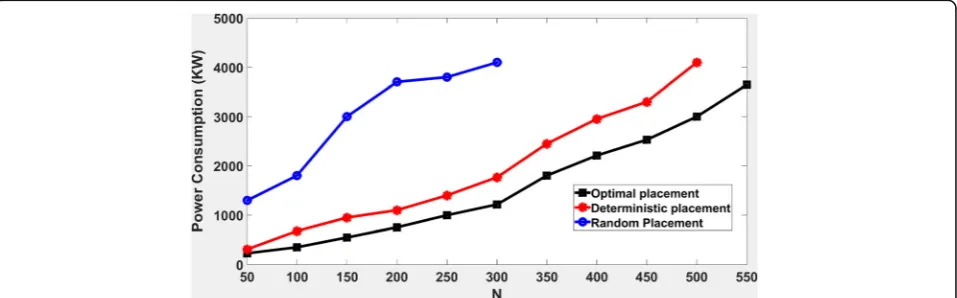
Fig. 6Optimal, deterministic and random heuristic power consumptions as a function of the number of jobs in the system for random server power consumption
We assume a datacenter with the hierarchical top-ology shown in Fig. 1. We presume that the datacen-ter has 4 PoDs and each PoD having 12 racks. In consonance with [35], we assumed that each rack contains 40 to 80 servers and all the racks of each PoD have the same server composition. Next, we present the parameters of the system used in the gen-eration of numerical results.
i) Servers and Server Types
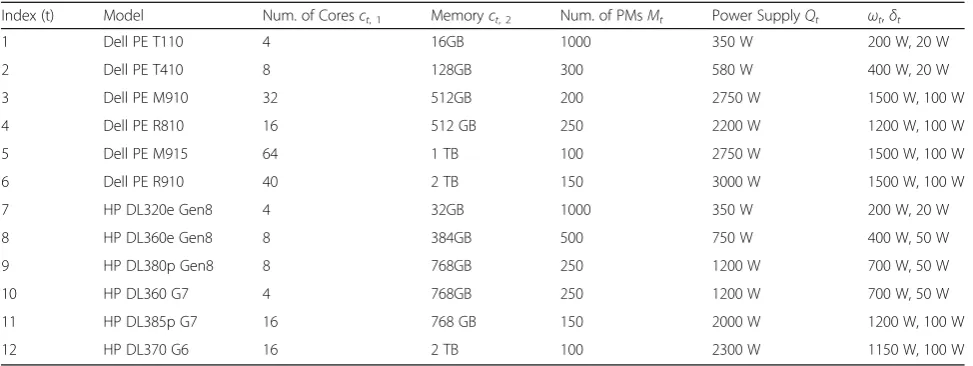
Considering Amazon instances and Google clusters, we assumeT = 12server types with two types of resources, CPU cores and memory. Table3presents the amount of resources and power consumption of each server type. Note thatQtvalues are for
maximum utilization cases. Table4presents number of servers per server type per rack at each PoD. Table5shows number of servers per server type per PoD, which is obtained by multiplication of each entry of Table4by 12.
ii)Communication Network Parameters
Table6presents the performance characteristics of the chosen switches for the communications network. Power consumption parameter values of the switches,PDℓ,eandPSℓ,e, are the same as given in [36–38]. We also assume that dynamic power consumption of a NIC is given byPWNIC= 0.6microW. ToR switches offer a combination of internal (int) and external (ext) interfaces. The internal interfaces connect to NIC of the blade-servers while the external interfaces connect to Core switches. It is assumed that internal and external in-terfaces support up to 10 Gbps and 40 Gbps trans-mission rates respectively.
iii)Parameters of VM Types
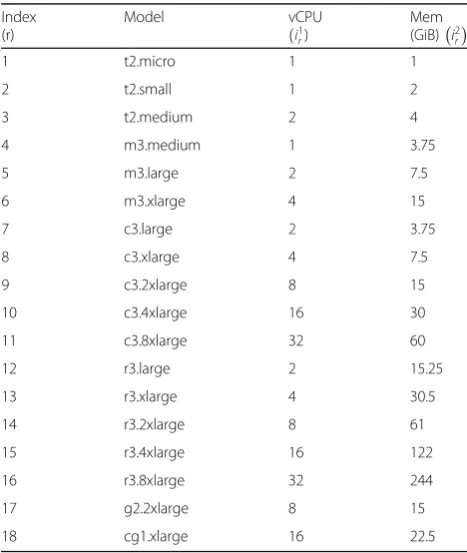
We presume that number of VM types isR = 18 with their resource requirements given in Table7. Resources of VMs consist of number of CPU cores and amount of memory. It is assumed that each physical core of a CPU is utilized as a virtual CPU (vCPU). In order to balance CPU, memory and network resources, Amazon t2 and m3 series are
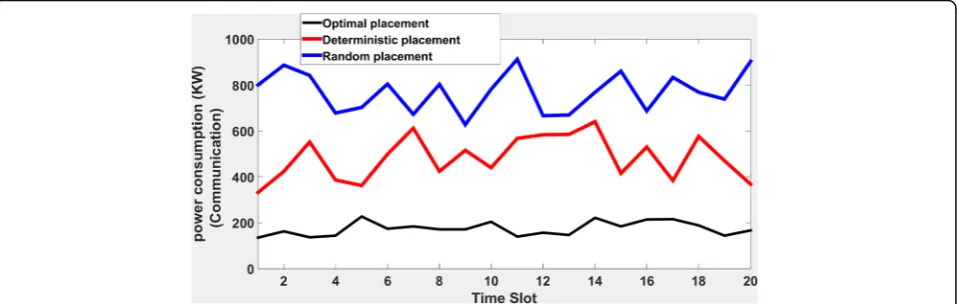
Fig. 8Communication power consumption for the optimal placement with migration (Gr = 0.3) together with deterministic and random heuristics as a function of time
appropriate for many applications and servers, Microsoft SharePoint, and enterprise applications. c3 series with higher ratio of vCPU to memory
represent compute-optimized Amazon instances which are appropriate for high-traffic web sites, on-demand batch processing, distributed analytics, web servers, and high performance science and engineer-ing applications. r3 series represent memory opti-mized amazon instances and are recommended for memory bound applications such as high perform-ance databases and distributed cache, in-memory an-alytics, genome assembly, and larger deployments of SAP. cg1 and g2 are also considered for game streaming, video encoding, 3D application streaming and other server-side graphic workloads.
iv)Parameters of job types
We assume that the number of job types equals to
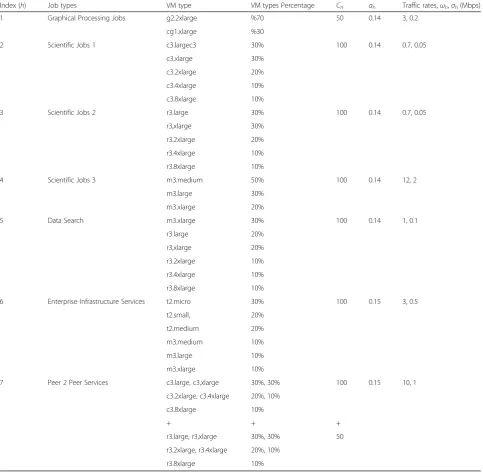
H = 7 with h = 1..H. Table8presents requirements and appropriate applications for each job type. The type of each job is determined probabilistically through the values given in the column for parameterαh. The number of VMs required by a typehjob is determined by the constantCh. From Amazon recommendations in [39,40], the table
present the mixture of VM types required by a job of each type. In each job type, the VMs are chosen probabilistically from the allowed VM types according to the percentages given in the table. Thus, first the type of a job and the number of VMs it requires are determined and then the types of each of its VM.
We assume that the traffic rate between two VMs of a job is either a random variable or a constant. In the former case, the mean and standard deviation of the traffic rate for each job type is given in the last column of the Table 8. In the latter case, the traffic rate for each job type is a constant that equals to the mean value of the variable traffic rate (ωh). We considered both indi-vidual and simultaneous release of VMs of jobs at the end of a slot according to Bernoulli trials. In either case, the success probability in a Bernoulli trial is assumed to be ρh for a type h job. For this example, we assumed homogeneous Bernoulli trials with ρh=0.3∀h∈{1,…,H}. Finally for the power constraint in the probabilistic model, we assume that power supply of a rack is PRℓ, e
= 25kW[26] and maximum power overloading probabil-ity of the racks is set top = 0.02. In the following results,
Fig. 10Histogram of the number of TORS to CS links for optimal, deterministic and random placement of the jobs as a function of the link transmission rate with variable VM traffic rate
unless otherwise stated, the arrival of new jobs will be according to a Poisson process with parameter λ= 200 jobs/slot with constant server power consumptions and VM traffic rates.
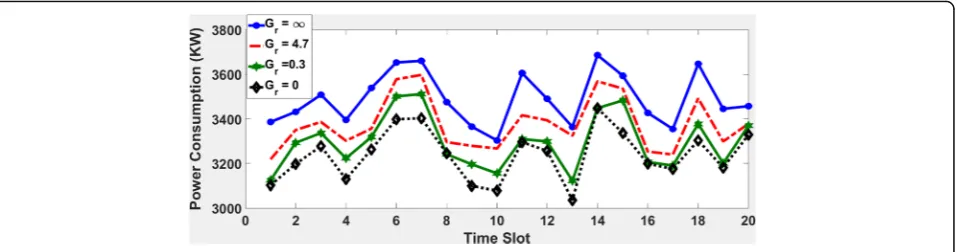
The Fig. 3 presents optimal power consumption of the system as a function of the number of time slots with VM migration cost Gr as a parameter and with
individ-ual VM release. It may be seen that optimal power con-sumption increases with the rising cost of VM migration cost. The zero cost migration (Gr= 0) and no migration
(Gr=∞) provide lower and upperbound for power
con-sumption with about 8% difference between them. Figure 4 presents optimal power consumption of the system as a function of the number of time slots for both individual and simultaneous release of the VMs assigned to a job and migration cost of Gr=0.3. As may
be seen, simultaneous release results in lower power consumption compared to individual release.
Figures 5 and 6 show power consumption as a func-tion of the number of jobs in the system for optimal placement of VMs as well as according to the determin-istic and random heurdetermin-istics for constant and random
server power consumptions respectively. As may be seen, in both cases, optimal placement of the jobs results in the lowest power consumption, and next to it is deter-ministic placement. It is also seen that the random ser-ver power consumption results in lower system power consumption compared to constant server power consumption.
Figure 7 presents optimal power consumption with mi-gration costGr=0.3 as a function of the number of time
slots. Also shown in the figure are the power consump-tions of deterministic and random heuristics. It may be seen that optimal placement results in about 15% lower power consumption than deterministic heuristic and lower by a bigger amount than random heuristic. For the system of Figs. 7 and 8 shows communication component of the power consumption. As may be seen again, optimal placement results in lower communication power con-sumption than the two heuristics even by larger margins than the total power consumption.
Figures 9 and 10 show histogram of the number of TORS to CS links as a function of the link transmission rates for optimal, deterministic and random placement
Fig. 12Comparison of values of the objective functions among IQP, CG/Proposed Rounding and CG/Random Rounding