ORIGINAL RESEARCH ARTICLE
EFFECT OF PARAMETERS ON SECURE OPTICAL COMMUNICATION
BASED ON CHAOS SYNCHRONIZATION
*
Jiuli Yin, Lishuang Bian and Lixin Tian
Faculty of Science, Jiangsu University, Zhenjiang, Jiangsu, 212013, China
ARTICLE INFO ABSTRACT
For further understanding optical secure communication, we study chaos synchronization modeled by the nonlinear Schrödinger equation with Kerr law nonlinearity. By Melnikov method, we get the chaos signal which generated from rupturing of homoclinic orbits. By using feedback control technology and Lyapunov stability theory, we obtain the sufficient criteria of of chaos synchronization. Finally, we analysis the effects of all parameters on synchronization. Result shows that faster wave speed, higher perturbation amplitude and larger nonlinear dispersion coefficient can delay the process of synchronization. Meanwhile, larger control coefficient can speed up the process of synchronization.
Copyright ©2017,Jiuli Yin et al. This is an open access article distributed under the Creative Commons Attribution License, which permits unrestricted use, distribution, and reproduction in any medium, provided the original work is properly cited.
INTRODUCTION
Optical communication is an important technology which has been applied to various aspects of society. Multimedia is applied by optical FFH-CDMA communication systems (Thiruchelvi et al., 2002). Ring launching scheme is analyzedby hollow optical fiber mode converter (Bunge et al., 2006). Data encryption of optical fibre communication is considered based on pseudo-random spatial light modulation (Kowalskiand Zyczkowski, 2016). Recently, large capacity and long distance are required in optical fiber communication. Optical soliton as the most ideal carriers of information just meets these demands. Optical soliton like-pulses is obtained in ring-cavity fiber lasers of carbon nanotubes (Younis and Rizvi, 2016), controllable behaviors of spatiotemporal breathers is considered in a generalized variable-coefficient nonlinear Schrödinger model from arterial mechanics and optical fibers (Chen and Zhu, 2015), transmission characteristics of dark solitons have been studied in homogeneous optical fibers modeled by nonlinear Schrödinger equation (Pan, et al., 2015). With the development of technology and military, traditional communication can not grantee the safety and effectiveness of the information transmission. So we want to study the optical secret communication. Chaos synchronization technology is an effective method to study secure communication. Long-distance multi-channel bidirectional chaos communication has been constructed by synchronized VCSELs subject to chaotic signal injection (Xie
et al., 2016), Different types of synchronization in coupled network based chaotic circuits (Srinivasan, 2016), chaos
synchronization is studied in two weakly coupled delay-line oscillators(Levy and Horowitz,2012), dynamics and synchronization are applied in coupled fractional-order nonlinear electromechanical systems (Ngueuteu et al.., 2012). The purpose of this paper is to devise optical secure communications based on the nonlinear Schrödinger equation by chaos synchronization. The inspiration comes from the fact as follows. In the process of the actual transmission, the signals are influenced by the external environmental perturbations, so we consider perturbed nonlinear Schrödinger equation with Kerr law nonlinearity
),
(
cos
]
)
(
[
1 2 2 3 22
ct
x
u
u
u
u
u
u
i
u
u
u
iu
t
xx
xxx
x
x
(1)*Corresponding author: Jiuli Yin,
Faculty of Science, Jiangsu University, Zhenjiang, Jiangsu, 212013, China.
ISSN: 2230-9926
International Journal of Development Research
Vol. 07, Issue, 12, pp.17782-17789, December,2017
Article History:
Received 26th September, 2017
Received in revised form 21st October, 2017
Accepted 19th November, 2017
Published online 29th December, 2017
Key Words:
Optical Secure Communication, Chaos Synchronization, Feedback Control.
Citation: Jiuli Yin, Lishuang Bian and Lixin Tian. 2017. “Effect of parameters on secure optical communication based on chaos synchronization”,
International Journal of Development Research, 7, (12), 17782-17789.
where
i(
i
1
,
2
,
3
)
are real parameters, is a positive constant,
,
0
denote the amplitude and the frequency of the parametricexcitation, respectively. More details for the model can be seen in (Taghizadeh et al., 2013; Yin et al., 2014). This paper is organized as follows. In Section 2, we proved that the soliton can evolves into chaos under periodic perturbation proved by Melnikov method. In Section 3, we construct a master-salve synchronization scheme and find out the criteria for chaos synchronization. The numerical investigation is given in Section 4. Last is the conclusion.
2 Soliton evolves into chaos under perturbation
Supposed that (1) has traveling wave solutions in the form
,
),
exp(
)
(
)
,
(
x
t
a
i
t
x
ct
(2)here
c
representing the transmission speed of wave
c
0
.
By the way of (Taghizadeh et al., 2013),we get
,
cos
3
1
a
ca
a
a
(3)where 2 3
3
2
3
1
refer to the parametric of linear and nonlinear terms. Equation (3) is the fiber-optic signal transmissionsystem in ideal environment.
By setting
1
1
andb
a
,
the system (3) can be rewritten as the following form
.
)
)
cos(
(
,
3
a
a
c
b
b
a
(4)If
0
,
the equation (4) is changed into (5)
.
,
3
a
ca
b
b
a
(5)Analysis of homoclinic orbits
We consider the homo clinic orbits of system (5), which has three equilibrium points ( ,0)
1
c
E , 2( ,0)
c
E and
E
3(
0
,
0
)
. LetJ
Eibe the Jacobian matrix for these equilibrium points and we have
0 3
1 0
2
a c J
i
E
.
It is easy to find that its eigenvalues are
J ci
E 2
2 ,
1
and 3
JE3 c. So theE
1,E
2 are the center equilibrium and)
0
,
0
(
3
E
is a saddle point for anyc
0
.Furthermore, system (5) has the following Hamiltonian function:
,
4
1
2
1
2
1
)
,
(
a
b
a
2ca
2a
4h
H
(6)where
h
is a constant. It is noted that the Hamiltonian function is composed of two homoclinic orbits at the pointE
3.
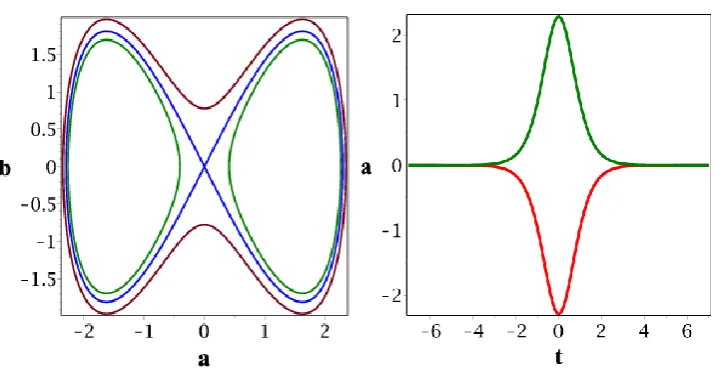
According to the bifurcation theory (13), system (5) has two optical solitons followed by two homoclinic orbits: Positive one achieve its crestat
2c , and negative one has valley at
Figure 1. Phase portrait and the profile of optical soliton of unperturbed system
Melnikov analysis
For searching chaos signal, we will take advantage of the Melnikov’s method. The corresponding Melnikov function for system (3) is given as
dt
t
t
t
a
t
b
t
M
(
0)
0(
)
0(
)
cos(
(
0))
(
)
cos(
(
))
(
)
sin(
(
))
]
2
02 0 0
2
0
a
x
t
t
a
t
t
t
dt
a
02(
t
)
cos
t
sin
t
0dt
2
,
sin
2
t
0I
(7)
where
a
t
tdt
I
2(
)
cos
0 and
(
a
,
b
)
(
a
0(
t
),
b
0(
t
))
is unperturbed homoclinic orbit. Using the above results and Melnikov’stheorem, the chaos occurs if
M
(
t
0)
0
and(
0)
0
'
t
M
for somet
0.
It is easy to findt
0
0
satisfying
.
0
)
cos(
,
0
)
sin(
0 0
t
t
(8)
So the optical soliton always turns into chaos under the perturbation formed as (1). To verify the above fact, we will investigate the Lyapunov exponents and phase portraits of system (4). Parameters of system (4) used for simulations are listed as follows:
5
.
0
,
98
.
0
,
5
.
2
[image:3.595.52.480.648.766.2]c
and
0
.
17
.
Then the Lyapunov exponents are shown in Fig. 2(a) and the phase portraits are shown in Fig. 2(b), It is clearly that chaos always appears for all given cases.Figure 2.
(
a
)
Lyapunov exponents versus
of perturbed system,(
b
)
The corresponding portraits ofa
b
.
Construction of error system
The equivalent vector form of chaotic oscillator (3)as flows
),
(
)
(
t
x
f
x
A
X
(9)with
(
,
)
2,
2
1
x
R
x
X
T
,
0
)
(
,
0
)
(
1
0
)
(
3
x
x
f
t
t
A
(10)where
(
t
)
cos(
t
)
c
. Next we construct a master-salve synchronization scheme (Wu, 2008) for two chaos oscillators coupled by a linear state error feedback controlleru
(
t
)
K
(
x
z
)
:
),
(
)
(
)
(
:
),
(
)
(
:
t
z
f
z
t
A
Z
S
x
f
x
t
A
X
M
(11)where
Z
(
z
1,
z
2)
T
R
2,andK
R
22denotes a constant control matrix. Define an error variablee
x
z
.
since,
)
(
0
)
(
0
0
)
(
)
(
e
M
t
e
t
F
z
f
x
f
(12)With
(
)
1 1 12,
2
1
x
z
z
x
t
F
we can obtain a time -varied error system.
]
)
(
)
(
[
)
(
)
(
]
)
(
[
. . .e
K
t
M
t
A
z
f
x
f
e
K
t
A
z
x
e
(13)Next, we are seeking to find such a control matrix
K
on any initial conditions ofx
(
0
)
andz
(
0
)
, the trajectoriesx
(
t
)
andz
(
t
)
satisfy,
0
)
(
)
(
lim
lim
e
tx
t
z
t
t (14)
Where
denotes Euclidean norm of a vector .Criteria for chaos synchronization
According to Lyapunov’s direct method we get the criteria for chaos synchronization as follows.
Lemma. If there exists a symmetric 22
12 12
12 11
0
R
p
p
p
p
P
and a control matrix 2212 21 12 11
R
k
k
k
k
K
where.
0
)
3
(
2 12 21 12 11 111
p
k
p
k
p
u
c
m
H
(15).
0
)
1
(
12 22 2212
2
p
k
p
k
H
(16).
)]
3
(
)
(
)
1
(
[
4
1
2
p
11
k
12
p
12k
11
k
22
p
22k
21
p
22u
c
m
2 2 (17)Then the master-salve scheme (11) achieves chaos synchronization .
,
)
(
e
e
Pe
V
T with0
22 12 12 11
p
p
p
p
P
.The derivative of
V
(
e
)
with respect to time along the trajectory of error system (13) equals]
)
)
(
)
(
[(
]
)
)
(
)
(
[(
)
(
)
(
. . .e
K
t
M
t
A
P
e
Pe
e
K
t
M
t
A
e
P
e
Pe
e
e
V
T
T
T
T
.
)]
)
(
)
(
(
)
)
(
)
(
[(
A
t
M
t
K
P
P
A
t
M
t
K
e
e
T
T
if
e
V
(
)
0
.
0
,
0
)
)
(
)
(
(
)
)
(
)
(
(
A
t
M
t
K
P
P
A
t
M
t
K
t
Y
T (18)According to Lyapunov stability theory, the inequality (16) represents a sufficient condition for global asymptotic stability of error system (13) at the origin. According to (10) and (12), we can obtain
22 21 12 11Y
Y
Y
Y
Y
, where),
(
2
2
11 11 12 2111
p
k
p
F
k
Y
),
(
)
(
)
1
(
12 12 11 22 22 2111
12
p
k
p
k
k
p
F
k
Y
),
(
)
(
)
1
(
12 12 11 22 22 2111
21
p
k
p
k
k
p
F
k
Y
).
1
(
2
2
22 22 12 1222
p
k
p
k
Y
Since
Y
is symmetric.Y
0
if and only ifY
11
0
,
Y
22
0
,
Y
0
.
From Fig.2 (b),we know that the trajectory of chaotic system (3) is bounded, so there exists a constant
m
0
satisfyx
1(
t
)
m
for any
t
0
. Hence , we have.
3
)
(
,
)
cos(
)
(
t
t
c
c
F
t
x
12
x
1z
1
z
12
m
2
Again
p
ii
0
(
i
1
,
2
)
on condition thatP
0
,
we have,
2
)
(
2
2
2
)
(
2
2
p
11k
11
p
12
F
k
21
p
11k
11
p
12k
21
p
12
F
H
1
21 22 22 11 12 12 11 21 22 22 11 12 1211
(
1
k
)
p
(
k
k
)
p
(
F
k
)
p
(
1
k
)
p
(
k
k
)
p
k
p
).
3
(
222
c
m
p
So the inequalities (15)-(17) hold . The proof is finished.#
Numerical simulations
In applications, it is desired that the structure of synchronization controller is as simple as possible. So we find out the two special cases for the Lemma.
Case 1 For the inequalities (15)-(17) , setting
k
11
k
1,
k
22
k
2andk
12
k
21
0
,
then we have the inequalities (19)-(21).,
)
3
(
11 2 12 1p
m
c
p
k
(19)
,
22 12 2p
p
k
(20)
(
3
)
(
)
(
3
)
0
,
4
1 11 12 2 22 11 12 1 2 22 2 22
12
c
m
k
p
p
k
p
p
p
k
k
p
c
m
p
(21)Case2 For the inequalities (19)-(21),setting
k
1
k
2
k
,
then we have the inequalities (22)-(23).0
,
)
3
(
max
22 12 11
2 12
p
p
p
m
c
p
k
(22)
(
3
)
0
))
3
((
4
)
(
4
11 22 2 22 2
12 2
12 22 11 2
p
p
c
m
p
p
c
m
p
p
k
(23)Herewe choose an control matrix
K
diag
k
,
k
and a symmetric positive define matrixP
selected like the Lemma. Then the system (11) can also achieve global chaos synchronization. Since 20
12 22
11
p
p
p
, the solutionk
to inequality (23) exists.We select
P
12
0
and P11P22
c3
m2
0to construct a symmetric positive define 01 0
0 3 2
22
p c m
P . Using
this matrix we can obtain the flowing algebraic synchronization criterion by (22) and (23).
k
,
k
,
diag
K
andk
c
3
m
2
0
.
(24)According calculate ,we obtain the synchronization condition :
,
,
8
.
746
.
diag
k
k
k
K
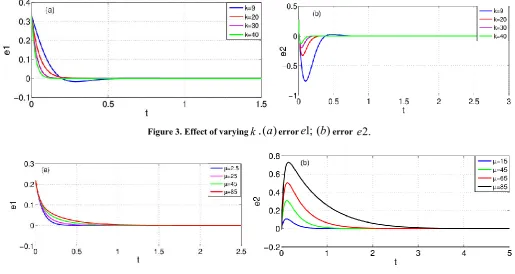
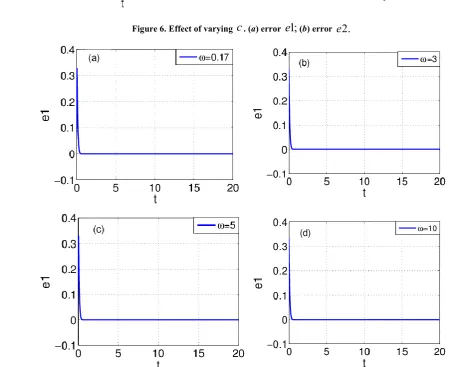
Now we analyze the performance of chaotic secure communication system, the system (13) was simulated in Matlab-Simulink and the result are shown in Fig3-fig7.
[image:6.595.37.553.357.631.2]Figure 3. Effect of varying
k
.(
a
)
errore
1
;
(
b
)
errore
2
.
Figure 5. Effect of varying
.(
a
)
errore
1
;
(
b
)
errore
2
.
Figure 6. Effect of varying
c
. (a) errore
1
;
(b) errore
2
.
[image:7.595.55.524.393.760.2]Conclusion
In this paper we have proposed a new chaotic secure communication scheme. The sufficient criteria for chaos synchronization of the master-salve system are obtained. Numerical simulations have demonstrated the accuracy of those sufficient criteria.
Acknowledgement
This work is supported by the National Nature Science Foundation of China (No.11101191), the Natural Science Foundation of Jiangsu Province (No.SBK2015021674) and it is also sponsored by Qin Lan Project.
REFERENCES
Bunge, C.A., Choi and S. Oh. K. 2006Analysis of ring launching scheme using hollow optical fibre mode converter for 10 Gbps multimode fibre communication. Optical Fiber technology. 12(1), pp.48-58.
Chen, H. Y. and Zhu, H. P. 2015. Controllable behaviors of spatiotemporal breathers in a generalized variable-coefficient nonlinear Schrodinger model from arterial mechanics and optical fibers, Nonlinear Dynamics, 81, 141-149.
Farshidianfar, A. and Saghafi, A. 2014. Identification and control of chaos in nonlinear gear dynamic systems using Melnikov analysis. Physics Letters A. 378 , pp.3457-3463.
Kowalski, M. and Zyczkowski, M. 2016.Data encryption of optical fibre communication using pseudo-random spatial light modulation. Opto-electctronics. Review. 24,pp.5-81.
Levy, E.C. and Horowitz M., 2012. Synchronization between two weakly coupled delay-line oscillators, Physics Review. 86,066209.
Ngueuteu, G.S., Mbouna and Woafo, P. 2012.Dynamics and synchronization analysis of coupled fractional-order nonlinear electromechanical systems, Mechanics Research. Communications, 46, pp.20-25.
Pan, N., Huang, P. and Huang, LG. 2015. Study on transmission characteristics of dark solitons in inhomogeneous optical fibers, Acta Physica Sinica, 64(9) .090540.
Srinivasan, K., Chandrasekar, V. K., Pradeep, R.G. and Murali, K. 2016. Different types of synchronization in coupled network based chaotic circuits, Communications in Nonlinear Science and numerical simulation.39, pp.156-168.
Taghizadeh, N., Mirzazadeh, M. and Mahmmoodirad, A. 2013. Application of Kudryashov Method for high order nonlinear Schridinger equation, IndiaJournal Physics.87, pp.781-785.
Thiruchelvi, N., Meenakshiand M. and Geetha, G. 2002. Multimedia applications using optical FFH-CDMA communication systems. Microwave Optical Technology Letters, 34(4),pp322-326.
Wu, X.F., Cai, J.P. and Wang, M.H. 2008. Global chaos synchronization of the parametrically excited Duffing oscillators by linear state error feedback control, Chaos Soliton Fract. 36, pp.121-128.
Xie, Y. Y., Li,J. C., Zhang, Z.D., Song T.T., Xu C,J. and Wang, G.J.,2016. Long-distance multi-channel bidirectional chaos communication based on synchronized VCSELs subject to chaotic signal injection, Optical communications. 377,pp.1-9. Yin , J. L., Zhao, L.W. and Tian, L.X. 2014. Melnikov’s criteria and chaos Analysis in the Nonlinear schrödinger Equation with
Kerr Law Nonlinearity, Abstract Applied Analysis. 18 pp.121-126.
Younis, M. and Rizvi S.T.R., 2016. Optical Soliton Like-Pulses in Fiber Lasers of Carbon Nanotubes, J. Nanoelectron. Optoe. 11 pp.276-279.