USER ENGAGEMENT MODEL IN INFORMATION SYSTEMS
DEVELOPMENT
GHASSAN A. O. ABUSAMHADANA1, NUR FAZIDAH ELIAS2, MURIATI MUKHTAR3,
UMI ASMA' MOKHTAR 4
1Faculty of Information Science & Technology, Universiti Kebangsaan Malaysia, Palestine
2Center for Software Technology and Management, Universiti Kebangsaan Malaysia, Malaysia
3Center for Software Technology and Management, Universiti Kebangsaan Malaysia, Malaysia
4Center for Cyber Security, Universiti Kebangsaan Malaysia, Malaysia
E-mail: 1[email protected], 2[email protected], 3[email protected], 4[email protected]
ABSTRACT
User engagement combines both factors of user participation and user involvement. It indicates the behavioral and psychological activities of the involved users during information systems development. Some previous researches claimed that these two factors contribute positively to information systems success. Nonetheless, a common understanding is still not tangible from the literature on measuring and validating the effect of these two factors. This paper proposes an integrated model for measuring and validating the factors of user engagement success in information systems development. Therein, a qualitative method is applied to verify the success of user engagement factors and demonstrate their interrelationships. A-priori model of user engagement success in information system development is then proposed and validated via a quantitative method. Questionnaires were distributed to the users, developers, system analysts, and managers who have engaged in information systems development projects at the seven higher learning institutions in Malaysia. Findings show that eight out of twelve user engagement critical success factors are accepted while other rejected factors were Identifying User for Engagement, Top Management Support, Type of User Participation, and User-Developer Attitude.
Keywords: User Engagement; User Participation; User Involvement; Information System Success
1. INTRODUCTION
In general, information systems are computer-based applications that handle several functions on the
organization data, for example, collection,
accessibility, storage, and analysis, in order to enable the managers taking the best business decisions. Information systems cost billions of dollars to be implemented by many organizations (1). Basically, information systems project development is initiated by identifying a solid objective of the intended system, for instance, to solve a problem, produce a new product, or update an existing system features (2). Herein, according to Abelein, Sharp (3), users are an essential source of the critical information in the process of systems development due to their tight relationship with the work context of the system. This is revealed from the dedicated tasks of determining the important requirements, testing the final code, and evaluating the prototypes.
User participation in the information system development is often recognized as a factor that leads to system success. Therefore, user participation still needs further investigation. Also, there is a need to
develop approaches which encourage the
collaboration between users and developers and release the clients’ potential to formulate their requirements easily during the information systems development (4). User engagement enhances the project outcomes of the development process of information systems. However, previous research has a lack of understanding of how to prepare user engagement in the information systems development process (5).
reported the benefits of user engagement to avoid unimportant expensive features and quality improvement to accurate identification requirements. In addition, McGill and Klobas (8) observed that users develop a positive attitude when they mind that they are a part of the development process, which increases user satisfaction with the system. Similarly, it was also deduced that enabling user engagement at Business Information Systems (BIS), returns a high volume of effectiveness to the organization records (9). So, user engagement in this manifest includes both users participation and user involvement (10, 11). User participation is the activities and actions that are performed by users during the development process of systems (12), while user involvement is a psychological state of the individual, defined as the importance and personal relevance of a system to a user (12). The objective of this paper is to determine the critical success factors of user engagement in information system development and construct a model for user engagement success that enhances the knowledge about how to vitally engage users in the information system development process. Minding the remarkable influence of user engagement to information system development success and the lack of comprehensive modules to measure and validate the involved factors, in our previous works, Abusamhadana and Elias (13), we highlighted a number of success factors to user engagement. The
factors are defined as User-Developer
Communication, Identifying Members for
Engagement, User Ability in IT Projects, User Motivation, User Attitude toward System,
User-Developer attitude, Disagreement/Conflict,
Involvement Congruence, Complexity, Top
Management Support, and Organizational or Managerial Culture. These factors are further categorized into four groups: Development Process,
Human Aspects, System Attributes, and
Organizational Factors. Later, the same researcher conducted a qualitative method (interview with experts at two stages) to ensure that all identified success factors are positively correlated with user engagement success. In addition, he refined a-priori model relations of user engagement success in information systems development. A qualitative method resulted in obtaining 12 success factors to user engagement as discussed in the literature review section. By the end of this paper, we are able to answer these questions:
- What are the dimensions and factors that
contribute to effective user engagement in the information system development process?
- How to measure effective user engagement
in information systems development?
2. LITERATURE REVIEW
User engagement within the process of information system implementation has been the core focus of the researchers since 1960. A lot of research concluded that user engagement contributes positively to implement information system successfully; the factual strategies of user engagement is still poorly understood. In spite of the high costs on information systems implementation, the execution failure in these systems is still accountable due to the absence of user engagement process as argued by Chan and Pan (6). Yusof, Ab Aziz (14) stated that users should be engaged psychologically or behaviorally in order to return an imminent performance of business intelligence systems.
For a long time, researchers have discussed several ways to engage users in the software development process, especially in information systems and human-computer interactions area (15). In the information systems area, user involvement reflects how the users are involved in the process of system development; users are engaged directly or via their representative. Later, it was known as the group of behaviors that users performed or not among the development process (16-18). So, user participation and user
involvement were commonly utilized
interchangeability (19).
Because of that, we consider the Cavaye (20) study the start point to build our user engagement knowledge gradually along with years.
User engagement is an important variable that leads to information system success. However, limited studies looked into the factors that affect user engagement as a dependent variable. In this paper, we aim to examine user engagement variable as a dependent variable and identify the independent variables that affect it.
As have been mentioned in section 1, the following sections will provide the definition of the 12 success user engagement factors as identified by Abusamhadana and Elias (13).
2.1 User Participation (UP)
User Participation implies the recognizable manners and actions of clients during the process of
information systems development and
implementation. It is also defined as the collection of activities and operations in that users or their representatives provide during the development and implementation process (22).
2.2 User Involvement (UI)
User involvement (UI) is the psychological side of users; it describes the significance and individual relevance of a system to a user. It is also the users’ reaction toward the development process aspects and its output (23).
2.3 User Developer Communication (UDC)
User-Developer communication is described in the literature as a factor of system success. Communications between users and developers provide information that forms the basis of information system development (24). User-Developer communications play a moderating role in the relationship between user participation-satisfaction when the complexity of the task is high (19). Gallivan and Keil (25) believed that if user participation failed to initiate honest communication between users and developers, the result may not meet
the users’ needs and thus, it may not be accepted or rejected. User participation in developing software is crucial for system success, especially, direct
user-developer communications. User-Developer
communications have been studied also as a moderating variable in the relationship between user participation and system success; yet, it can be an independent variable that contributes to the success of
user participation process. User-Developer
communications are neglected in most large-scale IT projects; this increases both costs of implementation and the testing effort (26).
Previous researchers agreed that User-Developer communication is a primary factor to identify information systems requirements and users’ needs. This, in turn, contributes to system success. While the purpose of having user engagement is finally to achieve information system success, user-developer communication accomplishes the benefits of engagement by identifying the accurate system requirements and keep users updated with the development progress. Furthermore, in information system development, developers should grant more focus on the collected information from users. This
conceives that effective User-Developer
communication produces a proper environment to discuss and share opinions constructively. Minding the essential benefits of User-Developer communications and the high risks in their absence, we hypothesize that these communications have a significant and positive relationship with user engagement success.
H1 There is a significant and positive effect between
User-Developer Communication and User
Engagement Success.
2.4 Identifying Users for Engagement (IUE)
involvement is considered an acceptable principle to develop a valuable and usable system (28-30). Nonetheless, in practice, only a limited number of users can be involved where each of which should be closed as to the developed system as possible and is identified based on the field’s studies, usability tests, user acceptance test, and other collaboration types (31). In the case studies where the users, their environment, and tasks are studied in the actual environment using a qualitative approach, the purpose is usually to realize and understand user needs (32) which is essentially realized by declaring a representative user. In fact, identifying the right users is a tedious task (33) when there is a high level of heterogeneity, or in case of new products or undetermined number and type of potential users. However, there is a strong recommendation to select the right representative based on a cross-section of users.
Previous researchers concluded that the process of user selection is an essential variable to user engagement success. In addition, to procure an effective user engagement, team members must be carefully selected. The previous studies also reviewed decision makers in IT projects should pay more attention to choose the valuable members to be engaged in the information system development. This brings up the implication of user engagement process that depends on knowledge sharing and cooperation between users and developers. So, accurate determining of team members indeed facilitates the engagement process which contributes to system success. Identifying users is a substantial factor that contributes to effective user engagement with high satisfaction. The success of the whole information system development process is the responsibility of all involved members. Moreover, the critical impact selecting users triggered several studies on the effect of identifying users for engagement, so we hypothesize that:
H2. There is a significant and positive effect between Identifying Users for engagement and User Engagement success.
2.5 User Ability in IT Projects (UAI)
Ability reflects the competence to effectively deal with the actual environment and accordingly ensure the
firm’s continuous (34). The ability in this context defines either the mental or physical capability of users within a specific work setting (35). In this paper, user ability refers to the attributes and characteristics that qualify users to participate in the process of an information system development and be one of the members of the development team.
The skills of users are defined as the knowledge and ability owned by users to utilize the facilities and procedures of information technology adopted in information system development and maintenance to perform certain tasks of an application. Torkzadeh and Lee (36) remarked that there is a high correlation between users’ computing skills and user participation in systems development. In addition, user participation could not be recognized effectively without having some users computing skills. Akinnuwesi, Uzoka (37) suggested that the level of user participation in systems development could be influenced by users’ perception of their computing skills. Users who have a high level of perceived ability are expected to be more optimistic toward the output of their respective exploration in the information system features. This, certainly, increases their productivity in exploring the information system features and thus leads to the point that the perceived ability has a positive impact on user performance (38).
success. Therefore, we decide to examine the effect of user ability in IT projects on user engagement success, so it is hypothesized that:
H3. There is a significant and positive effect between User Ability in IT Projects and User Engagement success.
2.6 Type of Participation (TUP)
Type of participation that users perform during the process of information systems development reflects the nature of the followed consultation technique to gain the users’ view (39). For that, Mumford (40) identified three kinds of participation, varying from least to most direct. These participation types are named consultative, representative, and consensus. In the consultative type, a consultation is performed with some selected users, and these users are selected based on their knowledge and position in the organization. The representative type dictates that the selected users can participate via either a reference or a testing group. Besides, the consensus type indicates an attempt to involve a large number of users throughout working groups.
Amrit, van Hillegersberg (39) discussed that the consultative group might not be affected by users’ need. Instead, a comprehensive understanding of the users’ need may be established by the group. The authors also see that both the type and depth of user participation affects the level of user influence in the process of information system development. Thereby, it is obvious that the users’ involvement in the process of information systems development requires accurate planning, execution, and management. Also, more accurate planning for both users and developers is necessary to increase the level of user involvement according to the type of involvement. By realizing the essence of user involvement intensity in the desired benefits of the involvement, there is a need to analyze the relationship between these two aspects (41).
To the best of our knowledge, the type of user involvement term has been used in different names in literature. In some studies, it is referred to as type of involvement (40, 41) while in others, it is known as type of user participation (39). In this paper, we prefer to use the term type of user participation because we
differentiate between the user participation and user involvement terms which is not attempted by the literature.
Analysis in previous researches concluded that user participation influences the increasing level of engagement along with the type of participation and it needs a lot of effort to be improved. Type of participation factor was suggested and recommended by experts in the first and second stages of the interview. In this work, we found that the related works on discussing the relationship between the type of participation and user engagement success are limited. So, based on experts’ suggestions and literature findings, we decide to study the impact of Type of Participation on user engagement success, and we hypothesize that:
H4.There is a significant and positive effect between Type of Participation and User Engagement success.
2.7 User Motivation (UM)
User motivation is a psychological state which is formed based on the desire of the individual. It encourages users to dedicate considerable efforts to achieve the organizational goal and fulfils individual needs (35). Motivation has been referred as the critical determinant of general behavior (42), the acceptable behavior of information technology (43, 44), and the behavior of work-related (45, 46). In addition, it is considered a strong indication for the knowledge sharing (47). Based on theoretical and empirical research, human motivation can be classified into two types, intrinsic and extrinsic.
Organizations have to provide valuable rewords and produce sufficient opportunities for their employees for their exerted time and effort in return (52). For instance, Tan and Igbaria (53) stated that users who realized that their involvement with development team might add a new value to their extrinsic rewards are actually showing more intention to maintain a tight relationship with the development team. Shapira, Kantor (54) conducted an experiment to examine the collaborative activities of users and found that extrinsic motivation restricts the free-riding problems and thereby enhances the user commitment toward producing an evaluation for the systems.
Previous studies also revealed that user motivation was considered as a critical determinant for the general individual behavior and it is also counted as a strong indicator for knowledge sharing. Moreover, it was stated that motivation has a significant effect on user participation, whereby users who are looking to maintain job satisfaction, pay more efforts to share their knowledge with the respective members. In other words, rewards play a motivated role to push the users paying more efforts to elevate their engagement success and henceforth optimizes the developed information system. From the aforementioned benefits of user motivation in his engagement, we decide to examine the effect of the user motivation on his engagement success; so, it is hypothesized that:
H5. There is a significant and positive effect between User Motivation and User Engagement success.
2.8 User Attitude toward System (UAS)
The attitude of users toward a particular system influences their intention to use this system (55). Fundamentally, a common assumption between practitioners is that users who have a positive belief toward the importance of the intended information system are engaged in the development activities from the early stage of the project to achieve project success (56). The attitude of users does not necessarily have to be generated from a reasoned judgment of the
system functionality, although nothing can
compensate the lack of its essential functionality (57). In common cases, some subject's perceptions toward the system characteristics place an effect on the attitude of the user toward the system (55). Therefore,
users may have a positive attitude toward a specific system based on the degree of the importance to them, for instance, being easy to use, or in their area of interest (57). To support, Riley and Smith (58) claimed that when users are enthusiastic toward a system, other issues will become non-critical problems.
Bock, Zmud (59) examined the positive impact of the attitudes related to knowledge sharing on the personal intention to exchange knowledge. Similarly, Lin (60) concluded that there is a positive effect between employees attitude toward knowledge sharing and the intention of knowledge sharing. Sabherwal, Jeyaraj (61) suggested that users who have a positive attitude toward information system are able to achieve valuable contributions during the development process of information system, even if they have an equivalent participation level as the normal users.
Furthermore, it is claimed by the related works that the desired level of engagement in information system development increases on users who have a positive attitude toward the developed system. In user engagement, knowledge sharing and cooperation between users and developers are fundamental to achieve the success user engagement process. Therefore, we decide in this study to examine the impact of user attitude toward system on user engagement success, so it can be hypothesized that:
H6. There is a significant and positive effect between User Attitude toward System and User Engagement Success.
2.9 User-Developer Attitude (UDA)
interactional justice increasingly enrich the positive attitude (64), minimize the antisocial behavior, and support the ability to accept less appropriate situations (65). On the other hand, organizational status with a poor perception of interactional, employees behave against the organization and increase their disapproval of unfavorable outcomes (66). Indeed, main tinging a respect level and information sharing among the tram perceives good responsiveness towards the users improves their interaction with the system which leads to a high success rate (62).
Previous researchers concluded that attitude between users and developers in user engagement process determines the final outcome. In addition, user-developer attitude is associated positively with user involvement. Therein, when users observe that developers appreciate their opinions and inputs, they recognize the importance of their engagement and be more satisfied with the output of the engagement. This certainly motivates users to provide a valuable input while they are engaged in system development and perform brainstorming to support the system maintenance. Therefore, in this study, we analyze the impact of user-developer attitude on user engagement success, so, we hypothesize that:
H7. There is a significant and positive effect
between User-Developer attitude and User
Engagement success.
2.10Conflict Resolution (CR)
It is mutually known that a successful system development requires maintaining a good relationship between system stakeholders to benefit from their contributions and drive the progress toward the projects’ goal (67-69). Ambiguity and conflicts that appear between users and developers regarding the role of information system development members are considered as threats for effective collaboration between members during the project participation (70-72). According to Martínez, Arias (70), role’s ambiguity and user-developer conflicts lead to complexity in identifying system requirements. According to Kankanhalli, Tan (73), if conflicts between users and developers are not managed carefully, the team-work productivity is severely deteriorated. Therefore, user-developer conflict has been ranked by project managers as a risk factor (74),
and it is negatively associated with the user attitude and the final project performance (73, 75, 76).
Conflict resolution is defined in this study as the
degree to which perceived conflicts and
incompatibilities that possibly occur among team members are resolved effectively (77). The remedy to these conflicts is for-reaching ramifications. In details, when the team succeed to find solutions that satisfy meet all the members’ need, this usually returns many advantages such as stability, social harmony encouragement, self-efficacy enhancement, minimal expected future conflicts, and motivating economic prosperity. Ironically, when the team fails to resolve the conflicts of the parties mutual satisfaction, consequences such as participants dissatisfaction, frustration, and disharmony are inevitable (78, 79). Thus, conflict resolution is treated as a critical factor that affects the outcome of the group (80).
The previous researchers underlined that the interpersonal conflicts between users and developers prevent users’ willing to participate in the development process, or in some radical cases, they may reject the developed system, and fail to identify the system needs. The conflict also prevents users and developers to share knowledge and responsibility. This deliberately leads to failure in user engagement process which hinders the system development. With that in mind, in this work, we choose to study the impact of conflict on user engagement success based on the risk issues connected with the presumable existing conflicts between developers and users. Based on the interviewed experts’ recommendations on the impact of conflict resolution on user engagement success, we hypothesize that:
H8. There is a significant and positive effect between Conflict Resolution on User Engagement success.
2.11Involvement Congruence (IC)
The degree of user engagement refers tothe level of
effort and duration that users provide in the
This is due to the sense that users are aware that their opinions and defined options are implemented by developers; thus, their satisfaction is increased. Users are more concerned about outcomes when they feel they are part of the development team (7). Besides, involvement congruence is the degree to which an actual user involvement in system analysis activities matches their perceived level ofinvolvement. Doll and Torkzadeh (82) stated that involvement congruence measures the interaction of users relative to their desire to get participated. Normally, people have different visions on their desire to participate or be involved in a particular issue. Thereby, it can be remarked that motivation to work or participate is essential for user participation success. Participation or involvement can be more effective if the individuals’ desire “motivation to participate” matches the perceptions of a real environment (82).
Based on previous studies, it is observed that the desired involvement is a conditional factor to user engagement which leads to user satisfaction. Besides, user engagement is dramatically affected by the gap of involvement congruence. Whereby, users will not be satisfied with their engagement if they feel the obligation to participate in the engagement process or they are prevented from participating according to their intention. Therefore, in this paper, we decide to study the impact of involvement congruence on user engagement success, so it is hypothesized that:
H9. There is a significant and positive effect between Involvement Congruence and User Engagement Success.
2.12Project Complexity (PC)
Tait and Vessey (83) highlighted the system complexity as a constraint when identifying system requirements, processing complexity, and the overall system design complexity. Meyer and Curley (1991) defined the technology complexity as a diversity of technologies measurement, the intensity of the database, and integration effort of the system. Application complexity can be determined via fourteen characteristics of the development environment. These characteristics influence the level of complexity related to data communication, distributed data processing, transaction rate, online update, complex processing, multiple sites, and
installation ease. Besides, system complexity reflects the complexity of the existed system that is being developed and designed. A simple task may need a high complex system design because of the certain adopted technology or methodology (83). Guimaraes, Program (84) believe that both task and system complexity are considered as determinants to detect the need for user participation. Furthermore, these complex types are playing as pure moderator variables in the relationship between user participation and satisfaction. So, it can be noted that this user participation-satisfaction relationship is affected by the degree of both system and task complexity within the development process. McKeen and Guimaraes (85) provided a basic strategy for user participation in which they measure both task complexity and system complexity complying with minimum time and effort requirements. These measures are then aggregated to provide an overall determination for the need of user participation in information system development project. Thereupon, users are asked to participate in the predefined activities which are strongly associated with user satisfaction. With these features, managers are provided with guidelines on the required activities entailed to the users rather than a full-membership user participation in the team of information system development. This consequently maximizes the contributions of users, via their effective participation, to the development process and ensure the outcome satisfactory.
McKeen, Guimaraes (19) viewed that the user
participation-satisfaction relationship bond is
propotionally supported by the increased level of system and task complexity. The more complex information system is, the more user participation in the development process is needed (86). User involvement is essential in high-complexity systems; hence according to Harris and Weistroffer (7), this is due to the increased difficulty of the system requirements identification which in turn leads to several faults during the system construction phases.
researchers differentiated the activities that users must be engaged in during the information development system in terms of task and system complexity level. In this study, we explore this association between engagement level and the complexity based on experts’ suggestions in the first stage of the interview. Both of task and system complexity are combined under one term called project complexity. So, it is hypothesized that:
H10. There is a significant and positive effect between Project Complexity and User Engagement success.
2.13Top Management Support (TMS)
Top management support indicates the understanding degree of the management toward the importance of the information system and its activities-related contents (87). Wiersema and Bantel (88) declared top management as a group of decision-makers and senior executives who are responsible for all the organization strategic directions. The presence of top management support is reported consistently to frame out the outcome of software systems development (89-91), that is commonly defined as a project risk factor (92, 93). Yetton, Martin (94) concluded that a project with support from senior management does not need to be redefined. The importance of top management support raises from the different handled roles during the software system development process. For instance, top management support is essential to ensure the required volume of human resources for the project or the budgetary availability (95, 96). Besides, process monitoring and observation of procedures complying with the pre-defined plan are among the major roles of top management (93, 95). According to the Standish group international (2001), top management has to take the responsibility to identify the project agenda and propose the justification of the goals of the overall project with a comprehensive understanding. Top management is entailed to control accidental conflicts that may appear during the information system development and implementation (97). Additionally, Top management support is essential to steer the users’ motivation and their attitude regardless of their classification level (91, 98).
Realizing the master role of top management in the system development process as elaborated in different
aspects above, the knowledge sharing expected to increase by providing a proper environment and workplace. Henceforth, users’ engagement success is realized based on their experience and capabilities in system development. Furthermore, users who receive support from top management, usually deliver an intense effort to elevate the system development and ingrain the role of user engagement. In this paper, by studying the effect of top management support on user engagement success, we hypothesized that:
H1. There is a significant and positive effect between Top Management Support and User Engagement success.
2.14Organizational Culture (OC)
Organizational culture has been determined as a significant factor in software process improvement implementation (99, 100). It influences the way in which employees behave, think, act, and interact with process improvement mission (101). Hyde and Wilson (102) stated that organization culture impacts the extent of employees’ collaboration within the software
execution process. Shih and Huang (103)agree that
the culture’s effect may motivate or impede users’ knowledge-sharing activities during software process improvement implementation.
knowledge. McDermott and O’dell (109) highlighted that organizations have to adopt the best culture that can support knowledge sharing as a normal activity in the members’ daily work. According to Cameron and Quinn (110), organizational culture is classified into four types: clan, adhocracy, hierarchy, and market culture. Clan culture implies the organization emphasis on shared values, tradition, teamwork,
loyalty, common goals, commitment, and
participation by members of the organization. Clan culture confirms the internal focusing and flexibility by invoking the characteristics of teamwork, trust, employee involvement and participation, and high level of organizational commitment toward their employees (110). Kim and Lee (111) summarized that the capabilities to knowledge sharing required the employee to interact, collaborate, and disseminate the individual work experience. Besides, in workplaces where there is a high level of trust facilitates improving the communicating knowledge and providing an active knowledge sharing behavior among the users (111, 112). McDermott and O’dell (109) explained the goodness of practising this knowledge sharing culture as it is a part of the users’ normal behavior.
With respect to the aforementioned discussion, the organizational culture places a high effect on the users’ behaviors and interaction during the user engagement process. Moreover, it influences the nature of collaboration between the development team during the system development process and drives the users’ willing toward knowledge sharing. The prior research efforts highlighted that organizational culture has a correlation with user satisfaction and engagement success, hence users become more motivated to engage in information system development and share knowledge with other members of the development team. User engagement process is a collection of interactions and behaviors made by users and developers hence; so, the nature of organizational culture behaviors will affect the engagement process. In addition, organizational culture is considered the key to produce an effective knowledge sharing. Therefore, in this paper, we decide to study the effect of organizational culture on user engagement success, and it is hypothesized that:
H12. There is a significant and positive effect between Organizational Culture and User Engagement success.
3 RESEARCH METHODS
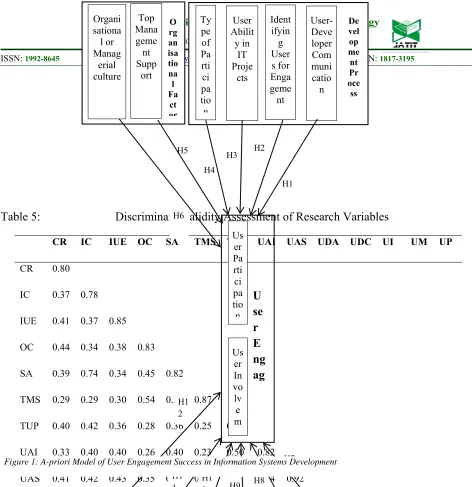
In order to achieve the aforementioned aim as defined in the Introduction section of this study, a literature review was conducted to capture the critical factors that influence user engagement success as discussed in (13). Based on the carried out discussions and the formulated hypothetical statements, we derive the a-priori model. In addition, an in-depth exploratory case study phase (interview with experts) was conducted to justify the critical factors of the a-priori model. The followed qualitative method resulted in providing 12 success factors to user engagement factors which were generously discussed in the literature review section. The primary outcome of this phase is a conceptual user engagement success model as shows as in Figure 1.
To address the objective of this paper, a questionnaire instrument is developed to measure 12 independent factors and 2 dependent factors of user engagement success. The items in the questionnaire for each factor are articulated based on the literature that addresses the same factors. Three steps are used to validate the user engagement success instrument. Firstly, the developed instrument is refined based on the conducted pretest with 3 experts, and it focuses on some aspects such as wording difficulties and limitations with leading questions. According to the feedbacks, 15 items were deleted, and another two were added. Secondly, Content Validity Ratio was conducted to determine the developed instrument further and ensure that the items measure the speculated content area. Finally, a reliability test was conducted to explain the consistency of the variables committed with their aims. The questionnaire that contains 12 factors is valid and can be used to measure user engagement success.
Statistical measures based on the collected data analysis were used to test the model’s validity and reliability. Finally, the overall results (collected from the survey, the case analysis, and the literature review) were analyzed and reported accordingly.
Based on our literature as seen in (13), we identified number of factors related to user engagement success
which are: User-Developer Communication,
Identifying Users for Engagement, User Ability in IT Projects, User-Developer attitude, User Motivation, User Attitude toward System, Disagreement/Conflict, Involvement Congruence, System Complexity, Task Complexity, Top Management Support, and Organizational Culture. In the first stage of the interview study, we conducted interviews with seven experts. The collected data was analyzed, and a new factor, namely type of participation, was added based on experts’ suggestions. Furthermore, majority of the suggested experience recommended merging both system and task complexity under one term called project complexity. In the second stage of the interview, the relationships between the identified factors that are derived from the former stage were examined. The results of the second stage enable constructing a refined a-priori model of user engagement success as shown in Error! Reference
source not found.. Then, a survey was conducted
based on the result obtained from the qualitative approach. To the best of our knowledge, the population of this study combines all the Malaysian citizens belong to one of the group: users, developers, managers, or system analysts who have engaged in any information systems development projects in seven higher learning institutions in Malaysia (UKM, UPM, UM, UNITEN, IUKL, MMU, and APU). Moreover, 232 out of 325 distributed questionnaires were returned; this constituted a response rate of 71.38% of the original sample. Furthermore, 30 responses were rejected from the returned questionnaires in which they had incomplete or blank values. The remaining 202 questionnaires were considered for further data analysis. For assessment of PLS-SEM model, this study follows the roadmap and guidelines introduced by Hair Jr, Hult (113). Sections 4.1, 4.2, and 4.3 demonstrate the tests that are conducted to assess reliability and validity over the measurements of the study model as a precondition before going to structural model examination.
4.1 Internal Consistency
Internal consistency reliability has two assessment techniques associated with it; they are known as Cronbach’s alpha and Composite reliability. The purpose of these two tests is to support the internal consistency of items along with the same variable. The
[image:11.612.363.559.226.409.2]tests are to demonstrate that the items which reflect the variable are combined in one group with an adequate consistency more than 0.7 value (113, 114). For better demonstration, Table 1 depicts the results of the 14 variables. It is interesting to note that all reliability values are larger than the threshold value of 0.7, which implies that all four items of the conflict resolution are consistent.
Table 1: Internal Consistency Assessments of Research Variables
Composite
Reliability
Cronbach’s Alpha
CR 0.88 0.81
IC 0.88 0.84
IUE 0.92 0.88
OC 0.92 0.89
PC 0.91 0.88
TMS 0.94 0.92
TUP 0.89 0.82
UAI 0.91 0.88
UAS 0.94 0.91
UDA 0.91 0.88
UDC 0.87 0.78
UI 0.96 0.95
UM 0.92 0.88
UP 0.93 0.91
4.2 Convergent Validity
Convergent Validity test used to measure and indicate the association of the items within the variable. The measure is called Average Variance Extracted (AVE), and the acceptable threshold value is 0.5 as suggested by (113, 114).
Table 2 summarizes the Average Variance Extracted (AVE) results for the involved research variables. Results show that “User Attitude toward System” has the highest value (0.85), while “User-Developer Attitude” reports the lowest value (0.631). Nevertheless, all variables are in an adequate level of convergent validity since the numerical values are all above the acceptable threshold.
AVE
CR 0.637642
IC 0.601099
IUE 0.729525
OC 0.697207
PC 0.669006
TMS 0.748352
TUP 0.729274
UAI 0.680406
UAS 0.849729
UDA 0.631867
UDC 0.696559
UI 0.787179
UM 0.684852
UP 0.686464
4.3 Discriminant Validity
Discriminant Validity is a test to examine and identify the foreigner items which are not associated with the variable. This test allows demonstrating the unlinked items to the variable and measuring another construct. Discriminant Validity test is also known as Fornell and Larcker (115) criterion, wherein its technique exploits a matrix of a latent variable that is correlated with the replacement of all diagonal values by the square root value of AVE variable. The thumb role is applied such that the value in the diagonal cell must be larger than all other values in the entire row and column (113, 115).
Table 5 demonstrates the criterion matrix for all the involved variables in the study. Results show that the diagonal cell values are always larger than other values in the same row and column. Conflict resolution variable records a value of 0.799 which is larger than all other values. Similarly, the involvement congruence variable returns the highest value of 0.775. The last is the user participation variable, which also holds the highest value of 0.829. With these significant results, it is evident that all study variables have an adequate level of discriminant validity.
4.4 Assessing Predictive Power of Research Model
Explanation of the target endogenous variable variance is estimated by the coefficient of determination (R2) and the predictive relevance (Q2). As Hair Jr, Hult (113) investigated, the rule of thumbs for assessing the values is adopted as follows:
- Predictive power (R2) is weak (0.2-0.5),
moderate (0.5-0.75), or strong (above 0.75)
- Predictive relevance (Q2) is small
(0.02-0.15), medium (0.15-0.35), or large (above 0.35)
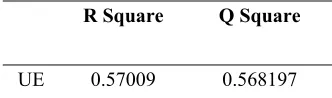
[image:12.612.377.543.403.452.2]Table 3 shows the predictive power and predictive relevance of UE as the endogenous latent variable, and the results show that the associated predictive power (coefficient of determination) R square is 0.57 and the associated predictive relevance Q square is 0.568. For the proposed model in this study, the exogenous variables (CR, IC, IUE, OC, PC, TMS, TUP, UAI, UAS, UDA, UDC, and UM) possess a large predictive relevance and a moderated predictive power.
Table 3: Predictive Power and Predictive Relevance Assessment of Proposed Model
R Square Q Square
UE 0.57009 0.568197
4.5 Path Coefficient of Research Model Relations
The relations assessment of the constructed model is essential to evaluate the hypotheses. Path coefficient (T-statistics) and the probability estimate value (P value) are two possible assessments employed to test the significance of relations; meanwhile, path coefficient (Beta) is adopted to evaluate the impact degree between the predictors.
Based on Hair Jr, Hult (113), the rule of thumb to assess the values is:
2. With 5% significance level, T statistic > 1.96 is significant with a two-tailed test and T Statistics >1.65 is significant for a one-tailed test.
Choosing between one and two-tailed depends on the constructed hypothesis of the research. Therein, we examine the positive impact of the independent variables on the dependent variable. One-tailed is decided as the most appropriate test in this study to investigate the positive relationship. T statistic is applied to detect the significance of the relationship, with 0.98 threshold value, while the beta value measures the effect level.
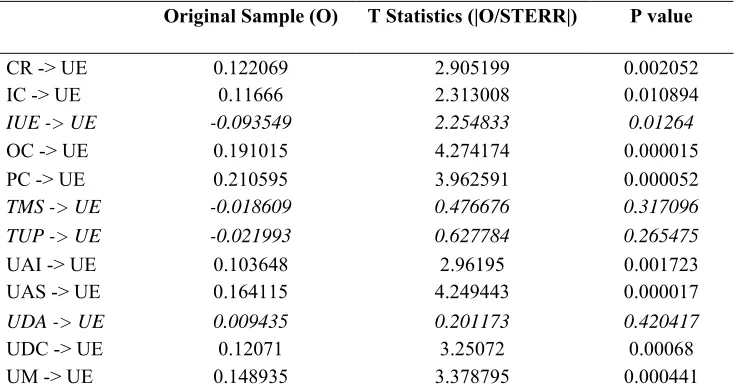
Table 6
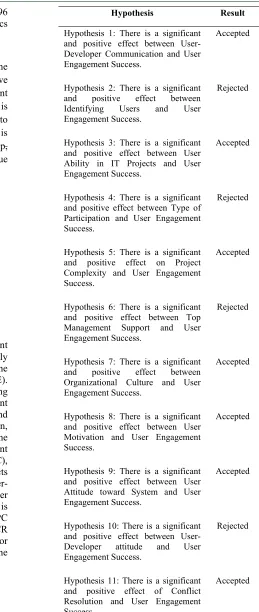
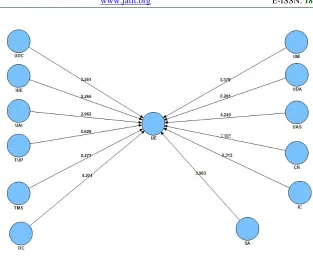
clarifies the path coefficient assessment hence T statistics and Beta values are obviously demonstrated. Four relations are rejected with the main dependent variable of User Engagement (UE). These relations match with the variables of Identifying User for Engagement (IUE), Top Management Support (TMS), Type of User Participation (TUP), and User-Developer Attitude (UDA) though. In addition, eight relations are accepted and match with the variables of Conflict Resolution (CR), Involvement Congruence (IC), Organizational Culture (OC), Project Complexity (PC), User Ability in IT Projects (UAI), User Attitude towards System (UAS), User-Developer Communication (UDC), and User Motivation (UM). The precedence of these relations is based on the path coefficient value (Beta) are PC (0.21), OC (0.19), UAS (0.16), UM (0.14), CR (0.122), UDC (0.120), IC (0.11), and UAI (0.10). For better understanding, Figure 2 presents the significance path coefficient values (T statistics).Table 4: Summary of Research hypotheses
Hypothesis Result
Hypothesis 1: There is a significant and positive effect between User-Developer Communication and User Engagement Success.
Accepted
Hypothesis 2: There is a significant and positive effect between Identifying Users and User Engagement Success.
Rejected
Hypothesis 3: There is a significant and positive effect between User Ability in IT Projects and User Engagement Success.
Accepted
Hypothesis 4: There is a significant and positive effect between Type of Participation and User Engagement Success.
Rejected
Hypothesis 5: There is a significant and positive effect on Project Complexity and User Engagement Success.
Accepted
Hypothesis 6: There is a significant and positive effect between Top Management Support and User Engagement Success.
Rejected
Hypothesis 7: There is a significant and positive effect between Organizational Culture and User Engagement Success.
Accepted
Hypothesis 8: There is a significant and positive effect between User Motivation and User Engagement Success.
Accepted
Hypothesis 9: There is a significant and positive effect between User Attitude toward System and User Engagement Success.
Accepted
Hypothesis 10: There is a significant and positive effect between User-Developer attitude and User Engagement Success.
Rejected
Hypothesis 11: There is a significant and positive effect of Conflict Resolution and User Engagement Success.
[image:13.612.302.561.84.696.2]Hypothesis 12: There is a significant and positive effect between Involvement Congruence and User Engagement Success.
Accepted
4.6 Discussion
The demonstrated numerical results of this study conceive that identifying Users for Engagement (p = 0.01264 < 0.05) have a significant and negative relationship with User Engagement in which, this contradicts the proposed hypothesis. The IUE-> UE perceives a significant but negative relation. This results in accepting the null hypothesis while rejecting the desired alternative hypothesis H2. It is noteworthy that this result is not consistent with the past studies’ findings and suggestions (e.g. Markus and Mao (27), Grudin and Pruitt (31), Bano and Zowghi (41)), whereby it was suggested in these studies that Identifying Users for Engagement holds a significant relation on efficient User Engagement. In summary, it is obvious to remark that Identifying Users for Engagement has a direct and negative effect on User Engagement; this, in fact, does not contribute to the success of information system development which possibly jeopardizes the users’ professionalism during the information systems development. This relation also maps with top management support. Therefore, it can be highlighted that identifying Users for Engagement is not an important variable to adopting user engagement successfully in information systems development for Malaysia context.
Similarly, the results of this study exhibit that Type of Participation (p = 0.265475 < 0.05) holds an insignificant relationship with User Engagement which does not support hypothesis H4. This result is not consistent with the past study findings by Amrit, van Hillegersberg (39) from the sense that Type of Participation affects the level of user influence in the process of information system development. Thereby, it can be inferred that Type of Participation has no effect on User Engagement. Although the experts’ views from the interview claimed that type of participation might have a significant relationship with the user engagement success, the findings in this study ratify that the relationship does not exist. This can be justified based on the discrepancies among the types of participation (Consultative, Representative, and Consensus), which does not affect the output of the
engagement process. This concludes that the type of participation deeply matters throughout the process of information system development regardless of the shape of the participation that users received. Nonetheless, Type of Participation is not an important variable to successfully adopt user engagement during the information systems development in Malaysia context.
The results of this study also report that Top Management Support (p = 0.317096 < 0.05) have an insignificant relationship with User Engagement and thus does not support hypothesis H6. This result is not consistent with the past studies in (e.g. Bano, Zowghi (116), Wang and Noe (117), Lee, Shiue (118)) where it was suggested that Top Management Support affect user engagement success in the process of information systems development. The significance of our findings with respect to the aforementioned previous works is valid in the Malaysian context from the sense that, these results are influenced by the type of the universities where the data is collected, whether classified as public or private. In government universities, the management does not actually concern about the user engagement success, and it may be a general practise when talking about government organization. In contrast, private universities maintain a close relation between top management and other departments; hence all the operations are controlled by the top management. This consequently leads to a solid point that the top management support is not significant with user engagement success; this result may be changed in future research if all included universities were private. In general, for the Malaysian context, Top Management Support is not an important variable to adopt user engagement successfully in information systems development.
dealing with the developers. Instead, these users are dealing with user representative who is considered as a user, not a developer. Moreover, user engagement is not affected by the interaction between users and developers. This finally indicates that User-Developer attitude is not a highly important variable to adopt user engagement successfully in information systems development for Malaysia’s context.
Finally, user engagement term was used in information systems literature as an interchangeable term with user participation and user involvement. Barki and Hartwick (121) differentiated between the definitions of user participation and user involvement. User engagement was defined in the literature as a term which includes both user participation (behavioral) and user involvement (psychologically). However, there is no universal measurement to user engagement as one term. The significance of this study is conceived by providing a universal definition and measurement to user engagement. So, in future, the researcher can use the user engagement variable to reflect both of user participation and user involvement. In addition, this study develops an integrated model that combines the four-factor groups: the development process factors, human aspect factors, system attribute factors, and organizational factors. This study produced the first to both qualitatively and quantitatively validate effective user engagement model in information systems development.
The main practical contribution of this paper is much speaking to information systems vendors, managers, decision makers, and practitioners with the aim of avoiding failures in information systems development. In details, the study novelty is revealed in the following sentences. It identifies the critical factors that should be taken into account when engaging users in information system development. Additionally, it enriches the existing knowledge via adopting user engagement effectively in Malaysia. The study also provides a clear understanding of the essence of applying user engagement. This allows human resource departments to adroitly manage and engage their employees in information systems development benefiting from the eight significant factors of user engagement.
5 CONCLUSION
This paper examines the relationship between development process factors: human aspects factors, organizational factors and system attribute factors with user engagement. These four groups of factors were identified through the literature review, and the delivered factors were refined based on a qualitative study (Two sessions of Interview with Experts) to check their efficiency on contributing to the success of user engagement. A questionnaire instrument is developed to measure 12 independent factors and 2 dependent factors of user engagement success.
A-priori model was then tested using data collected from survey questionnaires. Therein, 192 effective cases were analyzed with the SEM techniques, which were applied to validate the theoretical model and test the hypotheses in order to address the research questions. Internal Consistency, Convergent Validity, and Discriminant Validity tests were conducted over the measurements of the research model as a precondition before going to structural model examination. The Predictive Power and Path Coefficient tests were conducted to assess the relations and effectiveness of the study model.
Findings showed that there are 12 user engagement critical success factors with eight of them were accepted. The rejected factors were Identifying User for Engagement, Top Management Support, Type of User Participation, and User-Developer Attitude. These accepted factors are considered as valid success factors for user engagement, and they well-facilitate the procedures on how to initiate a successful user engagement. A valid user engagement success model was proposed in which the predictive power of the model dominated 57% of user engagement success. With that in mind, it is obvious that the model helps in understanding user engagement success to information systems vendors, managers, decision makers, and practitioners. This simultaneously enables a high fault-resistance during information systems development. As a future effort, this study recommends further research in user engagement area for discovering other possible variables that affect user engagement success in information system development.
6 ACKNOWLEDGEMENT
Scholarship, this research would not have been conducted properly. I will be forever grateful to them.
REFERENCES
[1] Anjariny AH, Zeki AM, editors. Development of
model for assessing organizations' readiness toward successful Business Intelligence systems. 2011 International Conference on Research and Innovation in Information Systems; 2011: IEEE. [2] Harris R, Bala P, editors. Methodologies for
developing community information systems in remote communities of Sarawak. Sixth Biennial Borneo Research Conference; 2000.
[3] Abelein U, Sharp H, Paech B. Does involving users in software development really influence system success? IEEE software. 2013;30(6):17-23.
[4] Wing J, Andrew T, Petkov D, editors. The
changing nature of user involvement in information system development projects. Information Communication Technology and Society (ICTAS), Conference on; 2017: IEEE. [5] Beranek P, Klein G, Jiang JJ. Building user
engagement for successful software projects: meaningfulness, safety, and availability. Pacific Asia Journal of the Association for Information Systems. 2014;6(3).
[6] Chan CM, Pan SL. User engagement in
e-government systems implementation: A
comparative case study of two Singaporean e-government initiatives. The Journal of Strategic Information Systems. 2008;17(2):124-39. [7] Harris MA, Weistroffer HR. A new look at the
relationship between user involvement in systems
development and system success.
Communications of the Association for Information Systems. 2009;24(1):42.
[8] McGill T, Klobas J. User developed application
success: sources and effects of involvement.
Behaviour & Information Technology.
2008;27(5):407-22.
[9] Yusof ZM, Ab Aziz MJ, Shatat ASA. The
relationship between user engagement and business intelligence system effectiveness. World Applied Sciences Journal. 2013;28(7):978-84.
[10]Anawar S, Ananta GP, Abidin ZZ, Ayop Z,
Yahya S, editors. Conceptualizing autonomous engagement in participatory sensing design: A deployment for weight-loss self monitoring campaign. Learning, Management and
e-Services (IC3e), 2013 IEEE Conference on; 2013: IEEE.
[11]Bano M, Zowghi D, editors. User involvement in
software development and system success: a systematic literature review. Proceedings of the 17th International Conference on Evaluation and Assessment in Software Engineering; 2013: ACM.
[12]Barki H, Hartwick J. User participation, conflict, and conflict resolution: the mediating roles of influence. Information Systems Research. 1994;5(4):422-38.
[13]Abusamhadana GA, Elias NF. USERS
ENGAGEMENT SUCCESS FACTORS IN INFORMATION SYSTEMS DEVELOPMENT. Journal of Theoretical & Applied Information Technology. 2018;96(5).
[14]Yusof ZM, Ab Aziz MJ, Shatat A, Saleh A. The
relationship between user engagement and business intelligence system effectiveness. World Applied Sciences Journal. 2013;28(7):978-84. [15]Iivari N, editor Enculturation of user involvement
in software development organizations-an interpretive case study in the product development context. Proceedings of the third
Nordic conference on Human-computer
interaction; 2004: ACM.
[16]Baroudi JJ, Olson MH, Ives B. An empirical study of the impact of user involvement on system
usage and information satisfaction.
Communications of the ACM. 1986;29(3):232-8. [17]Olson MH, Ives B, editors. Measuring User
Involvement in Information System
Development. ICIS; 1980.
[18]Franz CR, Robey D. Organizational context, user involvement, and the usefulness of information systems. Decision sciences. 1986;17(3):329-56.
[19]McKeen JD, Guimaraes T, Wetherbe JC. The
relationship between user participation and user satisfaction: an investigation of four contingency factors. MIS quarterly. 1994:427-51.
[20]Cavaye AL. User participation in system
development revisited. Information &
Management. 1995;28(5):311-23.
[21]Abelein U, Paech B. Understanding the influence of user participation and involvement on system success–A systematic mapping study. Empirical Software Engineering. 2015;20(1):28-81. [22]Spears JL, Barki H. User participation in
information systems security risk management. MIS quarterly. 2010:503-22.
[23]Liao Z, Landry Jr R, Cheung MT. Banking
Evaluation. Review of Business Information Systems (RBIS). 2011;7(2):51-64.
[24]Hartwick J, Barki H. Communication as a
dimension of user participation. IEEE
Transactions on Professional Communication. 2001;44(1):21-36.
[25]Gallivan MJ, Keil M. The user–developer
communication process: a critical case study. Information Systems Journal. 2003;13(1):37-68. [26]Abelein U, Paech B, editors. State of practice of
user-developer communication in large-scale it projects. International Working Conference on Requirements Engineering: Foundation for Software Quality; 2014: Springer.
[27]Markus ML, Mao J-Y. Participation in
development and implementation-updating an old, tired concept for today's IS contexts. Journal of the Association for Information systems. 2004;5(11):14.
[28]Bekker M, Long J. User involvement in the design
of human—computer interactions: Some
similarities and differences between design approaches. People and Computers XIV— Usability or Else!: Springer; 2000. p. 135-47. [29]Karat J. Evolving the scope of user-centered
design. Communications of the ACM.
1997;40(7):33-8.
[30]Wilson S, Bekker M, Johnson P, Johnson H,
editors. Helping and hindering user
involvement—a tale of everyday design. Proceedings of the ACM SIGCHI Conference on Human factors in computing systems; 1997: ACM.
[31]Grudin J, Pruitt J, editors. Personas, participatory
design and product development: An
infrastructure for engagement. PDC; 2002. [32]Wixon DR, Ramey J, Holtzblatt K, Beyer H,
Hackos J, Rosenbaum S, et al., editors. Usability in practice: field methods evolution and revolution. CHI'02 Extended Abstracts on Human factors in computing systems; 2002: ACM. [33]Grudin J. Systematic sources of suboptimal
interface design in large product development organizations. Human-computer interaction. 1991;6(2):147-96.
[34]Ramlall S. A review of employee motivation theories and their implications for employee retention within organizations. Journal of American Academy of Business. 2004;5(1/2):52-63.
[35]Chang K-c, Sheu TS, Klein G, Jiang JJ. User commitment and collaboration: Motivational
antecedents and project performance. Information and Software Technology. 2010;52(6):672-9. [36]Torkzadeh G, Lee J. Measures of rceived end-user
computing skills. Information & Management. 2003;40(7):607-15.
[37]Akinnuwesi BA, Uzoka FM, Olabiyisi SO,
Omidiora EO, Fiddi P. An Empirical Analysis of End‐User Participation in Software Development Projects in a Developing Country Context. The Electronic Journal of Information Systems in Developing Countries. 2013;58(1):1-25.
[38]Ke W, Tan C-H, Sia C-L, Wei K-K. Inducing intrinsic motivation to explore the enterprise system: The supremacy of organizational levers. Journal of Management Information Systems. 2012;29(3):257-90.
[39]Amrit C, van Hillegersberg J, van Diest B. Involving end users to mitigate risk in IS development projects. Journal of Organizational
and End User Computing (JOEUC).
2013;25(3):67-82.
[40]Mumford E. Consensus systems design: An
evaluation of this approach. Design and Implementation of computer based information systems. 1979.
[41]Bano M, Zowghi D. A systematic review on the
relationship between user involvement and system success. Information and Software Technology. 2015;58:148-69.
[42]Deci EL, Ryan RM. The support of autonomy and
the control of behavior. Journal of personality and social psychology. 1987;53(6):1024.
[43]Davis FD, Bagozzi RP, Warshaw PR. Extrinsic and intrinsic motivation to use computers in the workplace. Journal of applied social psychology. 1992;22(14):1111-32.
[44]Venkatesh V, Speier C. Computer technology training in the workplace: A longitudinal
investigation of the effect of mood.
Organizational behavior and human decision processes. 1999;79(1):1-28.
[45]George JM, Brief AP. Motivational agendas in the workplace: The effects of feelings on focus of attention and work motivation: Elsevier Science/JAI Press; 1996.
[46]Luo L. Work motivation, job stress and
employees' well-being. Journal of Applied Management Studies. 1999;8(1):61.
[47]Osterloh M, Frey BS. Motivation, knowledge transfer, and organizational forms. Organization science. 2000;11(5):538-50.
[48]Deci E. Intrinsic motivation plenum. New York.