4538
TEMPERATURE AND POWER
INVESTIGATION OF 6LOWPAN AND RPL
PROTOCOLS FOR LOW POWER INTERNET
OF THINGS
1CHETNA DABAS, 2GAURAV KUMAR NIGAM
1Associate Professor, Jaypee Institute of Information Technology, Department of Computer Science, India
2Assistant Professor, Jaypee Institute of Information Technology, Department of Computer Science, India
E-mail: [email protected], [email protected]
ABSTRACT
Internet of Things (IoT) is a technology which enables the connection, communication and interaction of a huge number of complex heterogeneous devices without human intervention. The communication involved in IoT targets from micro applications to the macro ones while managing vertical through horizontal scalability. Huge number of smart devices connected in the IoT possesses connection mechanisms which may be wireless or wired in nature. The wireless mechanisms in the IoT come with lots of challenges associates with them. There are crucial IoT protocols in the IoT protocol stack namely Low Power Wireless Personal Area Networks (6LoWPAN) and Routing Protocol for Low Power and Lossy Area Networks (RPL) which makes the wireless communications amongst these numerous IoT smart things having low power and limited memory happen. In such a constrained IoT scenario, it becomes very important to evaluate the performance of these protocols in terms of various performance affecting parameters. In the light of the same, this research paper investigates the power and temperature analysis along with comparison of 6LoWPAN and RPL protocols in terms of consumed power. It is observed that the choice of which protocol to use clearly relies on the application of context. Further, temperature and power of the nodes plays vital role in the performance of protocols in the IoT systems. The results are plotted in form of graphs.
Keywords: Internet of Things, 6LoWPAN, RPL, Low power
1. INTRODUCTION
1.1 Internet of Things
Internet of Things (IoT) may be visualized as the extended internet composed up of heterogeneous miniature smart devices or things [1]. Recently, the research in utilizing technology has vastly gained momentum worldwide. Further, the advanced work in this area is getting benefitted from standardization organizations, industry community and academia experts. Extensive research work is presently going on across the globe in IoT which encompass diverse domains. Moreover, other allied and latest technologies like block chain and edge computing are also getting hooked up with Internet of Things [1, 2].
Recent research works related to Internet of Things are finding their goal in establishing novel ways in
the construction, analysis and security of global distributed systems using modular LLVM compilers (set of reusable compilers and toolchain) [3]. From the viewpoint of technology as well as standardization, 5G enablers are also explored in IoT related research works [4].
Payload authentication schemes based on various encryption schemes are being considered in IoT scenarios [5]. IoT Routing protocols which are cognitive in nature are being proposed for Internet of Things [6]. Overall, there are lot many areas where Internet of Things technology is finding its shell areas of research in the present times and IoT protocols are one such very significant area.
1.2 Recent Search Statistics
4539 protocols. This search for the past one year was downloading and plotted as reflected in Figure 1. There are different Internet of Things protocols which are in high demand now days as reflected by this graph namely, 6LoWPAN, RPL, CoAP, MQTT and AMQP [7, 8].
Figure 1 .Relative popularity of search strings (2018-2019): Google Trends Search [7]
1.3 IoT Protocol Stack
In the IoT scenario, the IoT protocols, which are nothing but a set of rules, are required to make communications and interactions amongst smart interconnected devices over the network.
There exists a protocol stack which dictates the organizational structure of these IoT protocols including IoT network protocols which forms the topic of this study [8, 9]. This IoT protocol stack may be layered as proposed by the Internet of Things researchers [10].
Further, machine-to-machine protocol stacks have been suggested by researchers for the IoT [11].
1.4 Applications of IoT Network Protocols
There exists numerous shades between the entire rainbow of IoT applications which benefit from the above mentioned IoT protocols ranging from micro passive ones to macro real time ones. Some of the significant IoT protocols which contribute to the performance in IoT systems include 6LoWPAN and RPL which forms the topic of this study.
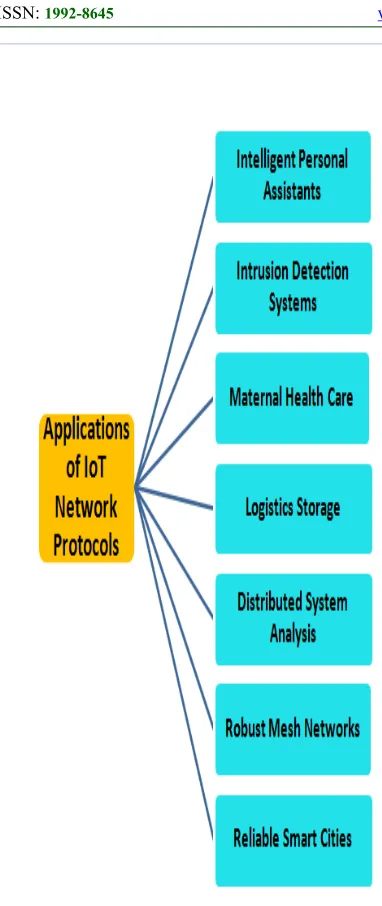
The recent applications of these protocols include Intelligent Personal Digital Assistants (IPDA) [12], Intrusion Detection and Security threats [13, 14], Maternal Health Care Detection [15], Temperature and Humidity Detection of Logistic Storage [16], Distributed System Analysis [17], Autonomous Scheduling in Robust Mesh Networks [18], Design of Reliable Smart Cities [19] to name a few.
4540 Figure 2 Applications of IoT Network Protocols
Organization of this research paper takes the following flow: Related work is presented in Section 2. The Internet of Things protocol namely 6LoWPAN is discussed in Section 3. RPL protocol for Internet of Things is presented in Section 4. Section 5 shows the simulation framework utilized in this research work. Performance Results are analyzed, discussed and plotted in Section 6. Limitations and open issues are given in Section 7. This research work concludes with conclusion and future vision section number 8.
A glimpse of the flow of organization of this research work may be taken in Figure 3.
Figure 3 Picture of the Flow of Organization
2. RELATED WORK
So far, most of the previous research works stressed on proposing protocol design, Routing attacks with solutions, power consumption studies, mobility solutions, resource based discovery in the context of Internet of Things protocols.
For example, authors of [20] suggested the countermeasures for RPL routing attacks, the work in [21] presented the theoretical analysis related to the IPv6 protocol.
[image:3.612.92.283.72.525.2]4541 The research in [24] presents assessment of IoT protocols specific to telemetry applications in the Internet of Things environment. In [25], packet loss analysis is presented for 6LoWPAN for mobile networks in IoT scenario. Further, for 6LoWPAN protocol, a resource and service discovery algorithm is proposed in [26] which is RPL inclined.
On the other hand, very few works focused on the performance analysis and temperature analysis of the low power constrained IoT devices for LoWPAN and RPL IoT protocols.
In the rising market of IoT, in a situation where round the clock service necessities are in demand, the notion of performance analysis of IoT protocols must not be under estimated. Indirectly, the performance analysis of these protocols experimented and evaluated with a vivid variety of applications would be acting as oxygen for the society in the future IoT and IoE era capable.
In the light of the above discussion, the works [27] evaluates the performance of the IoT protocols namely, RPL and 6LoWPAN considering TinyO S and Contiki [28] as the platform for execution. The work [28] revolves around only energy consumption as a prime parameter of study. The recent work [29] presents performance assessment of RPL oriented networks considering both static as well as mobile situations into consideration. The work [30] is a study of the performance analysis of 6LoWPAN IoT protocol.
Most of the aforementioned works simply focused on IoT protocol design, frameworks, and somehow energy specific issues, while only very few discussed and that too limited aspects of performance for both the IoT protocols namely, 6LoWPAN and RPL.
Further, the power consumption and temperature analysis will further play crucial role in portable IoT devices in almost all the domains which serves humanity in one way or the other especially considering LoWPAN and RPL IoT protocols.
In the nutshell, it can be said that there is no much research on power and temperature related issues in IoT using LoWPAN and RPL during the interaction (sensing and transmission) processes. Hence, the author trusts the fact that this research will contribute in a highly significant manner for addressing the aforementioned issues.
The next section describes the 6LoWPAN protocol.
3. IOT PROTOCOL: 6LoWPAN
In the complex, heterogeneous and low power Internet of Things environment, the 6LoWPAN protocol provides an impressive and efficient usage related to IPv6 in context of the lossy networks [31].
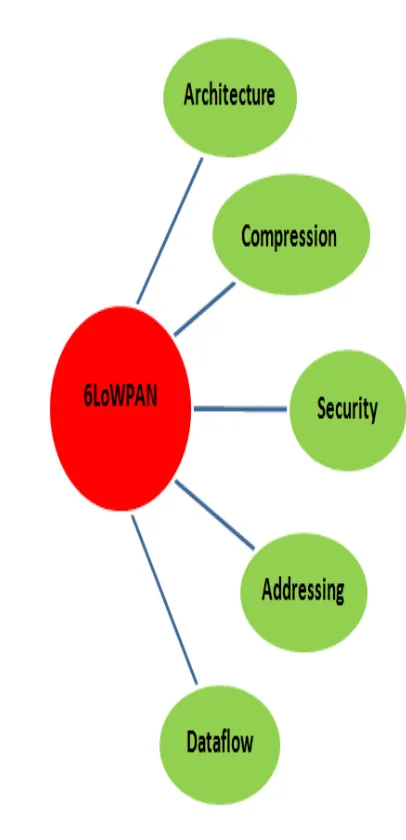
[image:4.612.315.518.281.701.2]Moreover, in order to attain efficiency benefit from the 6LoWPAN protocol, diverse aspects related to it requires to be explored in low power networks in the IoT arena which depicted in figure 4.
4542 The Architecture of 6LoWPAN has been designed and presented in existing research works and it is still being modified using the stack header concept for cost benefits [31, 32].
The packet filtering mechanism 6LoWPAN is made up of a compression and decompression units containing 6LoWPAN_IPHC. This also contains the source as well as destination components.
For handling of the IPv6 mechanisms, the IPv6 packet headers are retrieved from MAC header using the above stated 6LoWPAN_IPHC unit. After compression, the respective IPv6 addresses are computed using MAC addresses [33, 34].
Although the IoT protocol namely 6LoWPAN does not need any specific security functions but rather it executes the functions related to the security at the 6LoWPAN border router on the end devices [35]. Authenticated access using policy controlled is also being considered as an option [36].
Many addressing schemes have been proposed including location oriented configuration of addresses [37, 38] and multi-hop allocation of addresses for 6LoWPAN protocol [39].
Further, hierarchical addressing schemes have been investigated [40]. Stateful address configurations for 6LoWPAN in the lightweight context have also been explored [41].
Data traffic is also being worked on for 6LoWPAN for any-to-any IoT scenario for efficiency and reliability purposes [42].
The next section describes the RPL protocol.
4. IOT PROTOCOL: RPL
RPL is another communication protocol which works well for the requirements of low power and lossy networks. RPL is a part of the network layer in the IoT environment. For the organization of the network structure, DODAG (Destination Oriented Directed Acyclic Graph) is utilized by RPL at the nodes.
Moreover, two different kinds of routes are present in the RPL protocol namely upward and downward which considers the direction of transmission of data.
Trickle timer is used by RPL for reducing the overhead related to control message [43]. Further, RPL is a pro active routing protocol which is usually finds itself amidst Iot networks with typical features like low bandwidth, low power, low data rate, small packet size, lossy (wireless) networks. Multi-path extension of RPL [44, 45] is also considered by researchers in the present scenario. At the same time security aspects of this protocol are being worked upon [46].
In other words RPL oriented networks are widely being adopted across the globe [47].
5. SIMULATION FRAMEWORK
For the wireless networks which contain low power networks like those in the Internet of Things environment, there exist two popular commercial off-the-shelf operating systems namely TinyOS [48] and ContikiOS [49] which leverages mechanisms for implementations in the Internet of Things infrastructure. ContikiOS facilitates the environment for execution and evaluation of IP oriented communication protocols namely 6LoWPAN and RPL to name a few.
This research work makes use of ContikiOS and Cooja for the IoT environment and Foren 6 [50] for the network analysis purposes. For the sensor nodes which are running Contiki OS, Cooja provides the appropriate simulation environment and it is java based.
In this work, in the simulation area, the monitoring region was considered to be 24000m2. The communication range is considered to be 55 meters.
The simulation environment consists up of exists 20 static nodes, varying number of mobile nodes and a 6LoWPAN gateway.
The mobility of the nodes is determined by the random walk mechanism. Further, the Contiki MAC acts as a mechanism for the radio duty cycling.
The Unit Disk Graph is the radio medium and motes are of Skype type.
4543
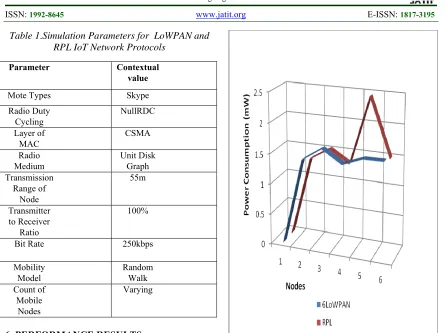
Table 1.Simulation Parameters for LoWPAN and RPL IoT Network Protocols
6. PERFORMANCE RESULTS
The power consumption (in mW) analysis of 6LoWPAN and RPL IoT protocols is presented in Figure 5.
It may be observed from figure 5, that the performance of the two IoT communication protocols namely 6LoWPAN and RPL depends on the application under consideration. Here, in the result graph plotted in Figure 5, the initial power consumption contains the value of 0, but it rises to a value which is greater than 1 after some time. Then for both the protocols the power started fluctuating depending upon the successful number of packets transmitted and received as the applications started executing.
Further, the evaluation of the protocols was achieved by varying the number of nodes in order to predict the power consumed. The number of nodes here included both the static and mobile nodes. Different applications were assigned to different motes. The power consumed (in mW) for varying number of nodes is presented in Table 2.
Figure 5.Power Consumption Plot of 6LoWPAN and RPL IoT protocols
[image:6.612.324.524.525.723.2]The power consumed (in mW) for varying number of nodes is presented in Table 2.
Table 2 Power Consumption Versus Number of Nodes
Node Count Power Consumed (in
mW)
5 0.799
10 0.832
30 0.965
55 1.421
120 2.678
Parameter Contextual
value
Mote Types Skype Radio Duty
Cycling
NullRDC
Layer of MAC
CSMA
Radio Medium
Unit Disk Graph Transmission
Range of Node
55m
Transmitter to Receiver
Ratio
100%
Bit Rate 250kbps
Mobility Model
Random Walk Count of
Mobile Nodes
4544 In table 2, it is observed that the power consumption increases by increasing the number of nodes.
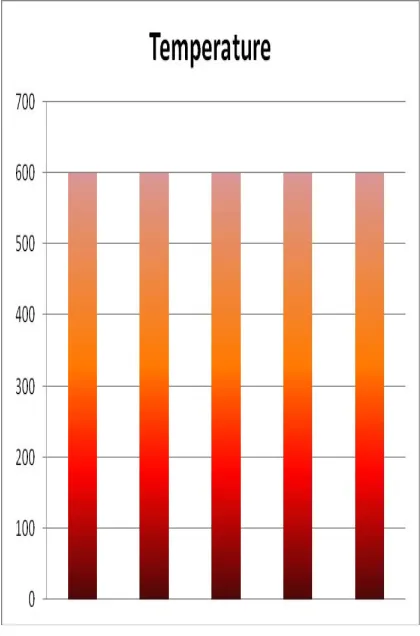
Figure 6.Temperature Plot at the Motes (in Degree Celsius)
The temperature plot result (using Foren 6) of the motes in the Internet of Things environment under consideration is presented in Figure 6. X-axis represents the nodes and Y-axis represents the temperature.
In figure 6, it is observed that the temperature at a node rises when the number of packets sent or received by an application becomes higher. Here, the instances of multiple requests may be fetched from a particular application.
In other words, when the number of packets entertained from a particular application rises, the temperature also rises.
7. LIMITATIONS
The limitation of the work incorporates the inclusion of heterogeneous nodes in the IoT environment.
This analysis must also be carried out on real time test beds in order to get a complete picture of both the worlds.
The temperature and power analysis is specific to certain applications considered at the respective motes and performance may vary if applications are changed.
8. CONCLUSIONS AND FUTURE VISIONS
The temperature and power analysis of IoT protocols namely, 6LoWPAN and RPL for low power IoT devices has been carried out and evaluated on Contiki Operating System in the proposed work.
It may be interpreted that 6LoWPAN and RPL behaves well for network communication in the IoT environment and the power consumption of these protocols is application dependent. Further, the temperature at the nodes while specifically using RPL and 6 LoWPAN increases with the rise in the number of packets delivered (transmitted or received). The author in future wishes to perform this power and temperature analysis of 6LoWPAN and RPL protocols on a real hardware platform with heterogeneous Internet of Things smart sensor devices.
REFERENCES
[1] Dabas, C., & Dabas, A. (2019). Novel Architecture for Internet of Things and Blockchain Technologies. In Data and Communication Networks (pp. 205-218). Springer, Singapore.
[2] Shi, W., & Dustdar, S. (2016). The promise of edge computing. Computer, 49(5), 78-81. [3] Teixeira, F. A., Pereira, F. M., Wong, H. C.,
Nogueira, J. M., & Oliveira, L. B. (2019). SIoT: Securing Internet of Things through distributed systems analysis. Future Generation Computer Systems, 92, 1172-1186.
4545 [5] Jan, M. A., Khan, F., Alam, M., & Usman, M.
(2019). A payload-based mutual authentication scheme for Internet of Things. Future Generation Computer Systems, 92, 1028-1039. [6] Al-Turjman, F. (2019). Cognitive routing
protocol for disaster-inspired internet of things. Future Generation Computer Systems, 92, 1103-1115.
[7] https://trends.google.com
[8] https://www.postscapes.com/internet-of-things-protocols/
[9] Al-Fuqaha, A., Guizani, M., Mohammadi, M., Aledhari, M., & Ayyash, M. (2015). Internet of things: A survey on enabling technologies, protocols, and applications. IEEE Communications Surveys & Tutorials, 17(4), 2347-2376.
[10]Rayes, A., & Salam, S. (2019). IoT protocol stack: a layered view. In Internet of Things from Hype to Reality (pp. 103-154). Springer, Cham.
[11]Aijaz, A., & Aghvami, A. H. (2015). Cognitive machine-to-machine communications for Internet-of-Things: A protocol stack perspective. IEEE Internet of Things Journal, 2(2), 103-112.
[12]Santos, J., Rodrigues, J. J., Casal, J., Saleem, K., & Denisov, V. (2018). Intelligent personal assistants based on internet of things approaches. IEEE Systems Journal, 12(2), 1793-1802.
[13]Le, A., Loo, J., Lasebae, A., Aiash, M., & Luo, Y. (2012). 6LoWPAN: a study on QoS security threats and countermeasures using intrusion detection system approach. International Journal of Communication Systems, 25(9), 1189-1212.
[14]Le, A. (2017). Intrusion Detection System for detecting internal threats in 6LoWPAN (Doctoral dissertation, Middlesex University). [15]Kabilan, K., Bhalaji, N., & Chithra, S. (2019).
Analysis of 6LOWPAN and CoAP Protocols for Maternal Health Care. In Microelectronics, Electromagnetics and Telecommunications (pp. 171-180). Springer, Singapore.
[16]Lan, Z., Wen, C., Sun, Y., Li, P., Cao, Y., & Wang, Y. (2019). Temperature and Humidity Detection of Logistics Storage Environment Based on 6LoWPAN. In Recent Developments in Intelligent Computing, Communication and Devices (pp. 539-547). Springer, Singapore. [17]Teixeira, F. A., Pereira, F. M., Wong, H. C.,
Nogueira, J. M., & Oliveira, L. B. (2019). SIoT: Securing Internet of Things through
distributed systems analysis. Future Generation Computer Systems, 92, 1172-1186.
[18]Duquennoy, S., Al Nahas, B., Landsiedel, O., & Watteyne, T. (2015, November). Orchestra: Robust mesh networks through autonomously scheduled tsch. In Proceedings of the 13th ACM conference on embedded networked sensor systems (pp. 337-350). ACM.
[19]Sebastian, A., & Sivagurunathan, S. (2018). Multi DODAGs in RPL for Reliable Smart City IoT. Journal of Cyber Security and Mobility, 7(1), 69-86.
[20]Wallgren, L., Raza, S., & Voigt, T. (2013). Routing Attacks and Countermeasures in the RPL-based Internet of Things. International Journal of Distributed Sensor Networks, 9(8), 794326.
[21]Montavont, J., Cobârzan, C., & Noel, T. (2015, January). Theoretical analysis of IPv6 stateless address autoconfiguration in Low-power and Lossy Wireless Networks. In Computing & Communication Technologies-Research, Innovation, and Vision for the Future (RIVF), 2015 IEEE RIVF International Conference on (pp. 198-203). IEEE.
[22]Jain, R. (2015). Networking Layer Protocols for Internet of Things: 6LoWPAN and RPL. [23]Mahmoud, M. S., & Mohamad, A. A. (2016).
A study of efficient power consumption wireless communication techniques/modules for internet of things (IoT) applications. [24]Hernández-Rojas, D., Fernández-Caramés, T.,
Fraga-Lamas, P., & Escudero, C. (2018). Design and practical evaluation of a family of lightweight protocols for heterogeneous sensing through BLE beacons in IoT telemetry applications. Sensors, 18(1), 57.
[25]Zamanifar, A., Nazemi, E., & Vahidi-Asl, M. (2018). A mobility solution for hazardous areas based on 6LoWPAN. Mobile Networks and Applications, 23(6), 1539-1554.
[26]Davoli, L., Antonini, M., & Ferrari, G. (2019). DiRPL: A RPL-Based Resource and Service Discovery Algorithm for 6LoWPANs. Applied Sciences, 9(1), 33.
[27]J. Ko, D. Culler, S. Dawson-Haggerty, G. Omprakash, A. Terzis, "Evaluating the performance of RPL and 6LoWPAN in TinyOS", Extending the Internet to Low Power and Lossy Networks, Apr. 11, 2011
4546 Communication Technologies: ICCNCT 2018 (Vol. 15, p. 145). Springer.
[29]Lamaazi, H., Benamar, N., & Jara, A. J. (2018). RPL-Based Networks in static and mobile environment: a performance assessment analysis. Journal of King Saud University-Computer and Information Sciences, 30(3), 320-333.
[30]Pai, V., & Shenoy, U. K. K. (2019). 6LowPan—Performance Analysis on Low Power Networks. In International Conference on Computer Networks and Communication Technologies (pp. 145-156). Springer, Singapore.
[31]Mulligan, G. (2007, June). The 6LoWPAN architecture. In Proceedings of the 4th workshop on Embedded networked sensors (pp. 78-82). ACM.
[32]Shelby, Z., & Bormann, C. (2011). 6LoWPAN: The wireless embedded Internet (Vol. 43). John Wiley & Sons.
[33]Gomes, T., Salgado, F., Pinto, S., Cabral, J., & Tavares, A. (2018). A 6LoWPAN accelerator for Internet of Things endpoint devices. IEEE Internet of Things Journal, 5(1), 371-377. [34]Gomez, C., Kovatsch, M., Tian, H., & Cao, Z.
(2018). Energy-Efficient features of internet of things protocols (No. RFC 8352).
[35]Glissa, G., & Meddeb, A. (2019). 6LowPSec: An end-to-end security protocol for 6LoWPAN. Ad Hoc Networks, 82, 100-112. [36]Rantos, K., Fysarakis, K., Manifavas, C., &
Askoxylakis, I. G. (2018). Policy-controlled authenticated access to LLN-connected healthcare resources. IEEE Systems Journal, 12(1), 92-102.
[37]Wang, X., Le, D., Cheng, H., & Yao, Y. (2015). Location-based address configuration for 6LoWPAN wireless sensor networks. Wireless Networks, 21(6), 2019-2033.
[38]Efendi, A. M., Negara, A. F. P., Kyo, O. S., & Choi, D. (2014). A Design of 6LoWPAN Routing Protocol Border Router with Multi-Uplink Interface: Ethernet and Wi-Fi. Advanced Science Letters, 20(1), 56-60. [39]Peres, B., Santos, B. P., Otavio, A. D. O.,
Goussevskaia, O., Vieira, M. A., Vieira, L. F., & Loureiro, A. A. (2018). Matrix: Multihop address allocation and dynamic any-to-any routing for 6LoWPAN. Computer Networks, 140, 28-40.
[40]Wang, X., Le, D., & Cheng, H. (2018). Hierarchical addressing scheme for 6LoWPAN WSN. Wireless Networks, 24(4), 1119-1137.
[41]Talipov, E., Shin, H., Han, S., & Cha, H. (2011). A lightweight stateful address autoconfiguration for 6LoWPAN. Wireless Networks, 17(1), 183-197.
[42]Peres, B., Santos, B. P., Otavio, A. D. O., Goussevskaia, O., Vieira, M. A., Vieira, L. F., & Loureiro, A. A. (2018). Matrix: Multihop address allocation and dynamic any-to-any routing for 6LoWPAN. Computer Networks, 140, 28-40.
[43]Sebastian, A., & Sivagurunathan, S. (2018). Multi DODAGs in RPL for Reliable Smart City IoT. Journal of Cyber Security and Mobility, 7(1), 69-86.
[44]Lodhi, M. A., Rehman, A., Khan, M. M., Asfand-e-yar, M., & Hussain, F. B. (2017). Transient Multipath routing protocol for low power and lossy networks. KSII Transactions on Internet & Information Systems, 11(4). [45]Quynh, T. N., Le Manh, N., & Nguyen, K. N.
(2015, June). Multipath RPL protocols for greenhouse environment monitoring system based on Internet of Things. In Electrical Engineering/Electronics, Computer, Telecommunications and Information Technology (ECTI-CON), 2015 12th International Conference on (pp. 1-6). IEEE. [46]Wallgren, L., Raza, S., & Voigt, T. (2013).
Routing Attacks and Countermeasures in the RPL-based Internet of Things. International Journal of Distributed Sensor Networks, 9(8), 794326.
[47]Lamaazi, H., Benamar, N., & Jara, A. J. (2018). RPL-Based Networks in static and mobile environment: a performance assessment analysis. Journal of King Saud University-Computer and Information Sciences, 30(3), 320-333.
[48]Levis, P., Madden, S., Polastre, J., Szewczyk, R., Whitehouse, K., Woo, A., ... & Culler, D. (2005). TinyOS: An operating system for sensor networks. In Ambient intelligence (pp. 115-148). Springer, Berlin, Heidelberg. [49]Dunkels, A., Gronvall, B., & Voigt, T. (2004,
November). Contiki-a lightweight and flexible operating system for tiny networked sensors. In 29th annual IEEE international conference on local computer networks (pp. 455-462). IEEE. [50]Dawans, S., & Deru, L. (2014). Demo
![Figure 1 .Relative popularity of search strings (2018-2019): Google Trends Search [7]](https://thumb-us.123doks.com/thumbv2/123dok_us/8898492.953986/2.612.98.298.171.460/figure-relative-popularity-search-strings-google-trends-search.webp)