ISSN: 1992-8645 www.jatit.org E-ISSN: 1817-3195
REAL-TIME FACE DETECTION AND RECOGNITION USING
PRINCIPAL COMPONENT ANALYSIS (PCA) – BACK
PROPAGATION NEURAL NETWORK (BPNN) AND RADIAL
BASIS FUNCTION (RBF)
1
NAWAF HAZIM BARNOUTI, 2SINAN SAMEER MAHMOOD AL-DABBAGH, 3MUHAMMED
HAZIM JAAFER AL-BAMARNI 123
Al-Mansour University College, Baghdad, Iraq
E-mail: [email protected], [email protected],
3
ABSTRACT
Face Recognition is one of the most important and fastest growing biometric area during the last several years and become the most successful application in image processing and broadly used in security systems. A real-time system for recognizing faces using mobile device or webcam was implemented. Face detection is the first basic step of any face recognition system. Viola-Jones method is used to detect and crop face area from the image. Feature extraction considered as a main challenge in any face recognition system. Principal Component Analysis (PCA) is efficient and used for feature extraction and dimension reduction. Back Propagation Neural Network (BPNN) and Radial Basis Function (RBF) are used for classification process. RBF is considered the result of BPNN output layer as input. The system is tested and achieve high recognition rates. Information about individuals was stored in a database.
Keywords: Face Detection, Face Recognition, Feature Extraction, Biometrics, Neural Network, PCA,
BPNN, RBF
1. INTRODUCTION
Face recognition is definitely challenging investigation research area in computer vision and pattern recognition resulting from changes in facial expressions, poses variation, illumination and Imaging conditions. Build an automated system that equals human ability to recognize faces is a true challenge. Although humans are good to identifying known faces, but they are not very skilled when we have to deal with a large amount of unknown faces. The computers, with an almost limitless memory space and computational speed, should solve the problem of human limitations. Several applications, from law enforcement to commercial tasks, request the industry to improve and develop automated and efficient face recognition systems [1]-[2]-[3]. Face detection is very important and it’s the first step in face recognition system. Face detection is the process of figuring out whether or not a face is occurring in an image. Unlike face recognition which distinguishes different human faces, face detection only tell us whether or not a face is occurring in an image. Some applications of face recognition don’t require face detection because in
some cases face images stored in the data bases are already normalized [4]. The problem of face detection is definitely complex because of three types of the problem (view dependences, inconstancy, and lighting). Most of the suggested face detection methods have realized that the face and background includes some limitations, but these limitations made the suggested methods difficult in more general cases, so face detection remains to be an important problem to be solved [4]. There are lots of methods in this area. Many proposed methods are available to identify and recognize human faces form given face database. The current improvement in this area has facilitated us with fast processing ability and high accuracy. The hard work is also going in the direction to involve learning methods in this complex computer vision technology [5]. There are many existing systems to identify and recognize faces, but many systems are not so efficient to have automated face detection and recognition [5]-[6].
ISSN: 1992-8645 www.jatit.org E-ISSN: 1817-3195 biometrics. The recognition of irises, signatures,
fingerprints, voiceprints, and human faces is assigned to the passive methods that require the camera with a high resolution or acquire people biometric information at a short rang [7]. To making it possible for the system to extract facial features much more efficiently and properly, we have to narrow the range of face detection first, and the performance of the face detection method can’t be too low [8]-[9].
Researchers have worked many years on the problem of face recognition, but several challenges still need to be solved. Difference in illumination of the scene, changes in pose, orientation and expression are some of the problems to be dealt very carefully. When the size of face database increases the recognition time will become a big problem [1]. Face recognition is furthermore just about the most successful applications in image analysis. As a result of the problem nature of face recognition, not only computer science researchers have an interest in it, but psychologists and neuroscientists are also interested. General opinion tells that improvement in computer vision research will offer useful ideas to psychologists and neuroscientists into how human brain works, and the opposite way round [10]-[5].
Face recognition methods can be divided into either Appearance based or Feature based methods. The Appearance based methods compare the input image with a set of templates using global facial information. The set of templates can be constructed using statistical tools like Principal Component Analysis (PCA), Linear Discriminant Analysis (LDA), Independent Component Analysis (ICA), Support Vector Machines (SVM), Kernel Methods. The Feature-based methods use local facial features and their geometric relationships. Elastic Bunch Graph Matching (EBGM) method is used. There are methods developed using both Appearance based and Feature based called Hybrid methods. 3D morphable model method can use feature points or texture as well as PCA to build face recognition system [4]-[7]-[8].
2. FACE RECOGNITION APPLICATIONS
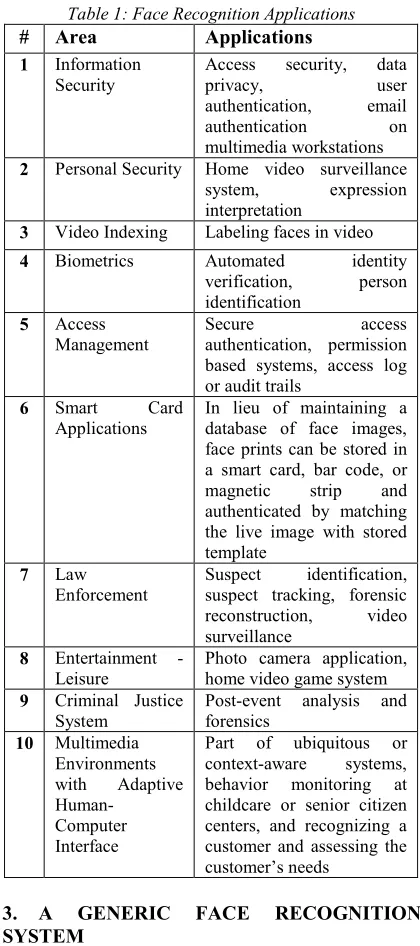
Face recognition is one of the most interesting and fastest growing biometric areas. Face recognition applications that automatically identify an individual from captured images or video stream are everywhere in our daily lives. Large number of applications has been present in face recognition research area [1]-[5]. Important face recognition applications are listed in Table1.
Table 1:Face Recognition Applications
# Area Applications
1 Information Security
Access security, data
privacy, user
authentication, email
authentication on
multimedia workstations
2 Personal Security Home video surveillance
system, expression
interpretation
3 Video Indexing Labeling faces in video
4 Biometrics Automated identity
verification, person identification
5 Access Management
Secure access
authentication, permission based systems, access log or audit trails
6 Smart Card
Applications
In lieu of maintaining a database of face images, face prints can be stored in a smart card, bar code, or magnetic strip and authenticated by matching the live image with stored template
7 Law
Enforcement
Suspect identification, suspect tracking, forensic reconstruction, video surveillance
8 Entertainment - Leisure
Photo camera application, home video game system
9 Criminal Justice System
Post-event analysis and forensics
10 Multimedia Environments with Adaptive
Human-Computer Interface
Part of ubiquitous or context-aware systems, behavior monitoring at childcare or senior citizen centers, and recognizing a customer and assessing the customer’s needs
3. A GENERIC FACE RECOGNITION
SYSTEM
[image:2.612.312.522.92.565.2]The input of a face recognition system is usually an image or video stream. The output is an identification or verification of the individual or individuals that appear in the image or video stream. Several approaches define a face recognition system as a three step process as shown in Figure 1. Through this point of view, the Face Detection and Feature Extraction phases could run simultaneously.
ISSN: 1992-8645 www.jatit.org E-ISSN: 1817-3195 Face detection is considered as the process of
extracting faces from scenes. So that, the system absolutely detects a certain image rectangular region as a face. This procedure offers several applications including pose estimation, face tracking or compression.
Feature extraction includes acquiring relevant facial features from the data. These features could possibly be certain face regions, variations, angles or measures, and this can be human relevant or not. This phase offers other applications including emotion recognition or facial feature tracking. The Final step of face recognition system is measuring the distance by using classification method to determine the similarity between two images. The system will be able to recognize the faces. In an identification task, the system would report an identity from a database that contain information about the individuals.
4. PROPOSED METHODOLOGY
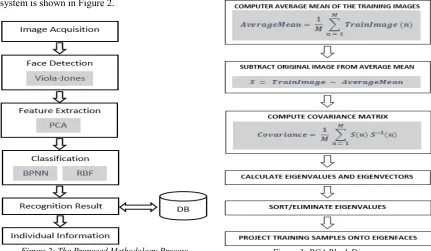
[image:3.612.90.521.476.727.2]Face recognition is a complex image processing problem in real world applications. The main challenge for a face recognition system is an effective feature extraction. In this work, a real time face recognition system based on Principal Component Analysis (PCA), Back Propagation Neural Network (BPNN) and Radial Basis Function (RBF) is proposed. Face detection is done using Viola-Jones method to detect and crop faces. The system is tested using images captured from mobile device or webcam. The process of the proposed system is shown in Figure 2.
Figure 2: The Proposed Methodology Process
4.1 Viola-Jones Face Detection
The Viola-Jones face detector contains three main ideas (the integral image, classifier learning with AdaBoost, and the attentional cascade structure) that make it possible to build a successful face detector that can run in real-time. At a high level, the method scans an image with a window looking for features of a human face. If enough of these features are found, then this particular window of the image is said to be a face [11]. Viola-Jones rescale the detector as an alternative for the input image and run the detector more than one time through the image each time with a different size. Viola-Jones have proposed a scale invariant detector which requires the equivalent number of calculations whatever the size. This detector is produced using integral image and some simple rectangular features similar to Haar wavelets [11]-[12].
4.2 Principal Component Analysis (PCA)
PCA involves a mathematical procedure that transforms a number of possibly correlated variables into a smaller number of uncorrelated variables called principal components (PCs) [6]. PCA solves the recognition problem within a representation space of lower dimension than image space. PCA is an Eigenface method which helps in the reduction the dimensionality of the original data space [7]. PCA block diagram is shown in Figure 3. .
ISSN: 1992-8645 www.jatit.org E-ISSN: 1817-3195 PCA is widely used for feature extraction and
dimension reduction in most face recognition systems. Other methods like LDA achieved by projecting the image onto Eigenface space by PCA after that implementing pure LDA over it.
4.3 Back Propagation Neural Network (BPNN)
Neural network aims to train the network to achieve a balance between the network ability to respond and the ability to give a reasonable response to the input that is similar but not identical to the one used in the training [13].
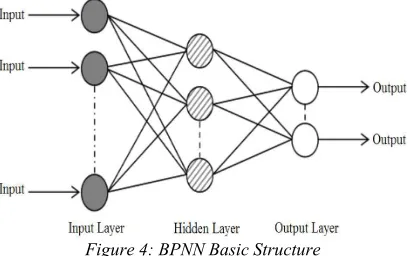
[image:4.612.313.525.188.316.2]BPNN consist of three layers (input layer, hidden layer and output layer). These layers of elements put together independent computation of data and pass it to another layer. The computation of processing elements is completed on the basis of weighted addition of the inputs. The output is compared with the target value and the mean square error is computed which is certainlyprocessed back to the hidden layer to adjust its weights. This process would be having iteration for each and every layer to decrease the error by repeatedly adjusting the weight of each layer [14]. A typical BPNN with Multi-layer feed-forward supervised learning is shown in Figure 4.
Figure 4: BPNN Basic Structure
4.4 Radial Basis Function (RBF)
RBF neural network have recently attached extensive research interest in the community of neural. The RBF neural network has a feed forward architecture with an input layer, hidden layer and output layer. The result obtained from the BPNN output layer is given as the input to the RBF [15]-[16].
Classification part is performed using RBF. A network with radial basis function is an artificial neural network that uses radial basis function as activation functions. The function of an RBF-NN can be viewed as a process which maps a
[image:4.612.93.297.422.550.2]n-dimensional input pattern from input space to a decision space of m-dimension. The training is done by adjusting the center parameters in the radial basis functions that will be used to calculate the connection strengths between the hidden layer and output layer [17]. RBF-NN basic structure is shown in Figure 5.
Figure 5: RBF-NN Basic Structure
The RBF-NN is used in this work for classifying the images because of its simple structure and faster learning abilities. The RBF classifier is a hidden layer neural network with several forms of radial basis activation functions. In a RBF network, a neuron of the hidden layer is activated whenever the input vector is close enough to its center vector [16]-[18]. The most common form is the Gaussian function defined by the equation below:
where is the width parameter, u is the vector determining the center of basis function F and x is the n-dimensional input vector.
5. EXPEREMENT RESULTS
ISSN: 1992-8645 www.jatit.org E-ISSN: 1817-3195 BPNN and RBF-NN recognize all faces. System
performance was very good and able to detect and recognize faces.
5.1 Software and Hardware Implementation
The analysis is done using a laptop with Intel(R) Core(TM) i7-5500U CPU 2.40 GHz with 12.0 GB RAM. The programming language MATLAB R2015a is utilized to build the application program. The operating system is Windows 8.1 Single Language. The face image snapshots have been taken using 8 megapixel iPhone 6 camera with 1.5µm pixel size.
5.2 Face Detection Using Viola-Jones Method
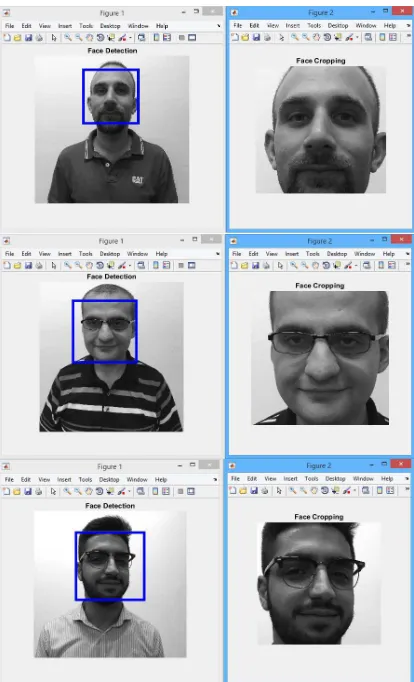
[image:5.612.314.526.77.221.2]Viola-Jones method used to detect and crop faces in the images taken from mobile device or webcam. The method was able to detect all faces from images taken from mobile device and webcam. Figure 6 shows the detect faces and the crop face image using iPhone 6 camera. Figure 7 shows the detect face and the crop face using a webcam.
Figure 6: Face Detection Using Mobile Device Camera
Figure 7: Face Detection Using Webcam
5.3 Feature Extraction Using PCA
[image:5.612.313.522.360.557.2]Once the face is detected from images, cropped faces can be trained and store in database. Three images will be used as training images and only one image will be used as testing image. Increasing the number of training images will increase the recognition rate. Trained face images are shown in Figure 8.
Figure 8: Trained Face Images
PCA is used for feature extraction. Using PCA in face recognition is started by initially performing PCA on a set of training images of known human faces. A group of PCs is then computed from the covariance of the training sample image. Subsequently, the raw data in a high dimensional feature space are projected to a lower feature space through several eigenvectors with the highest eigenvalues.
5.4 Classification Using BPNN and RBF
[image:5.612.91.298.378.719.2]ISSN: 1992-8645 www.jatit.org E-ISSN: 1817-3195 and RBF-NN. Neural networks are actually
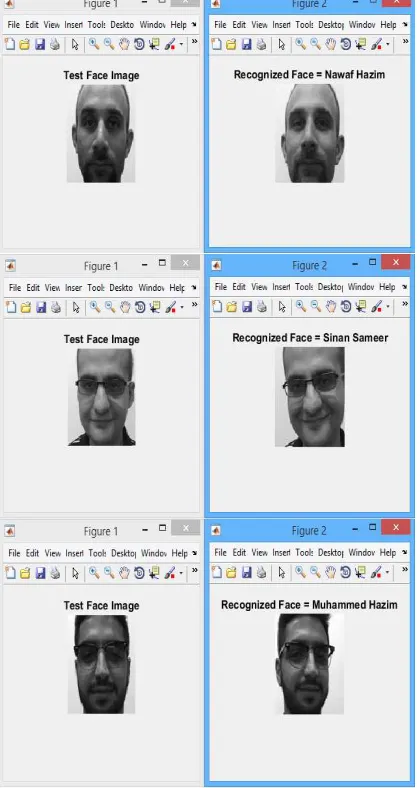
[image:6.612.91.301.236.630.2]employed and compared to typical classifiers for a variety of classification problems. The results show that the accuracy of the neural network methods equal or slightly better than other methods like Euclidean distance and Mahalanobis distance. RBF comes up with the best performance while allowing less neurons in the hidden layer. The system can recognize faces and give information from the database about the recognized person. The recognized faces are shown in Figure 9.
Figure 9: Test Image and Recognized Face
6. CONCLUSION
In this work, a real-time face recognition system is implemented. Images are captured from a mobile device or webcam. Face detection is the first step in face recognition system. Viola-Jones method is used for face detection. PCA is used for feature
extraction. Classification process is done using BPNN and RBF-NN. The neural networks aimed to provide artificial intelligence to the system. Neural networks using Back Propagation and Radial Basis Function is presented for face recognition. The BPNN method is preferred over other neural network methods because of its unique ability to minimize errors. The use of BPNN shows acceptable results. The recognition rate is increased when combine BPNN with RBF-NN. From these results, it can be concluded that this method has the acceptance ratio is more than 90 % and execution time of only few seconds. The results of the experiments indicate that the RBF-NN achieves the best performance while allowing less neurons in the hidden layer. The RBF-NN method shows also to be less sensitive to the choice of the training set. This method can be suitably extended for moving images and the images with varying background.
REFRENCES:
[1] Kasar, Manisha M., Debnath Bhattacharyya, and Tai-hoon Kim. "Face Recognition Using Neural Network: A Review", International Journal of Security and Its Applications, Vol. 10, No. 3, 2016, pp. 81-100.
[2] Masi, Iacopo, Anh Tuan Tran, Jatuporn Toy Leksut, Tal Hassner, and Gerard Medioni. "Do we really need to collect millions of faces for effective face recognition?", arXiv preprint arXiv:1603.07057, 2016, pp. 1-18.
[3] DeGutis, Joseph, Jeremy Wilmer, Rogelio J. Mercado, and Sarah Cohan. "Using regression to measure holistic face processing reveals a strong link with face recognition ability", Cognition 126, No. 1, 2013, pp. 87-100.
[4] Troitsky, Avenir K. "Two-Level Multiple Face Detection Algorithm Based on Local Feature Search and Structure Recognition Methods", International Journal of Applied Engineering Research, Vol. 11, No. 6, 2016, pp. 4640-4647.
[5] Kumar, K. Susheel, Vijay Bhaskar Semwal, and R. C. Tripathi. "Real time face recognition using adaboost improved fast PCA algorithm", International Journal of Artificial Intelligence & Applications (IJAIA), Vol. 2, No. 3, 2011, pp. 45-58.
ISSN: 1992-8645 www.jatit.org E-ISSN: 1817-3195
Mobile Computing, Vol. 3, No. 6, 2014,
pp.407-413.
[7] Barnouti, Nawaf Hazim. "Face Recognition Using Eigen-Face Implemented On DSP Processor", International Journal of Engineering Research and General Science, Vol. 4, No. 2, 2016, pp.107-113.
[8] Arora, Kandla. "Real Time Application of Face Recognition Concept", International Journal of Soft Computing and Engineering (IJSCE), Vol. 2, No. 5, 2012, pp. 191-196.
[9] Fahn, Chin-Shyurng, and Chih-Hsin Wang. “Real-Time Multi-Face Recognition and Tracking Techniques Used for the Interaction
between Humans and Robots”, INTECH Open
Access Publisher, 2011.
[10] Nandini, M., P. Bhargavi, and G. Raja Sekhar. "Face Recognition Using Neural Networks." International Journal of Scientific and Research Publications, Vol. 3, No. 3, 2013, pp. 1-5.
[11] Zhang, Cha, and Zhengyou Zhang. "A survey of recent advances in face detection", 2010. [12] Hefenbrock, Daniel, Jason Oberg, Nhat Tan
Nguyen Thanh, Ryan Kastner, and Scott B. Baden. "Accelerating viola-jones face detection to fpga-level using gpus", In 2010 18th IEEE Annual International Symposium on
Field-Programmable Custom Computing
Machines, IEEE, 2010, pp. 11-18.
[13] Sarawat Anam, Shohidul, Shohidul Islam, M. A. Kashem, M. N. Islam, M. R. Islam, and M. S. Islam. "Face recognition using genetic algorithm and back propagation neural network", In International Multi Conference of Engineers and Computer Scientist, Vol. 1, 2009.
[14] Kashem, Mohammod Abul, Md Nasim Akhter, Shamim Ahmed, and Md Mahbub Alam. "Face recognition system based on principal component analysis (PCA) with back
propagation neural networks
(BPNN)", Canadian Journal on Image Processing and Computer Vision, Vol. 2, No. 4, 2011, pp. 36-45.
[15] Radha, V., and N. Nallammal. "Neural network based face recognition using RBFN classifier",
In Proceedings of the World Congress on
Engineering and Computer Science, Vol. 1, 2011, pp. 19-21.
[16] Aziz, Khairul Azha A., and Shahrum Shah Abdullah. "Face Detection Using Radial Basis Functions Neural Networks With Fixed Spread", arXiv preprint arXiv:1410.2173, 2014.
[17] Joo Er, Meng, Weilong Chen, and Shiqian Wu. "High-speed face recognition based on discrete cosine transform and RBF neural networks", Neural Networks, IEEE Transactions on 16, No. 3, 2005, pp. 679-691. [18] Chelali, Fatma Zohra, and Amar Djeradi. "Face