0095-1137/04/$08.00
⫹
0
DOI: 10.1128/JCM.42.12.5832–5836.2004
Copyright © 2004, American Society for Microbiology. All Rights Reserved.
Construction Strategy for an Internal Amplification Control for
Real-Time Diagnostic Assays Using Nucleic Acid
Sequence-Based Amplification: Development
and Clinical Application
David Rodrı´guez-La
´zaro,
1Martin D’Agostino,
2Maria Pla,
1* and Nigel Cook
2Institute of Food and Agricultural Technology, University of Girona, Girona, Spain,
1and
Defra Central Science Laboratory, Sand Hutton, York, United Kingdom
2Received 2 December 2003/Returned for modification 2 February 2004/Accepted 25 August 2004
An important analytical control in molecular amplification-based methods is an internal amplification
control (IAC), which should be included in each reaction mixture. An IAC is a nontarget nucleic acid sequence
which is coamplified simultaneously with the target sequence. With negative results for the target nucleic acid,
the absence of an IAC signal indicates that amplification has failed. A general strategy for the construction of
an IAC for inclusion in molecular beacon-based real-time nucleic acid sequence-based amplification (NASBA)
assays is presented. Construction proceeds in two phases. In the first phase, a double-stranded DNA molecule
that contains nontarget sequences flanked by target sequences complementary to the NASBA primers is
produced. At the 5
ⴕ
end of this DNA molecule is a T7 RNA polymerase binding sequence. In the second phase
of construction, RNA transcripts are produced from the DNA by T7 RNA polymerase. This RNA is the IAC;
it is amplified by the target NASBA primers and is detected by a molecular beacon probe complementary to the
internal nontarget sequences. As a practical example, an IAC for use in an assay for the detection of
Myco-bacterium avium
subsp.
paratuberculosis
is described, its incorporation and optimization within the assay are
detailed, and its application to spiked and natural clinical samples is shown to illustrate the correct
inter-pretation of the diagnostic results.
Nucleic acid sequence-based amplification (NASBA) (7, 11)
is becoming widely used for the detection of microorganisms in
various sample types, e.g., clinical, environmental, and food
samples (6, 8). The major product of a NASBA reaction is
single-stranded RNA, and there are various means whereby
this product can be detected to produce a NASBA signal, such
as ethidium bromide staining (22), enzyme-linked gel assay
(22), and electrochemiluminescence detection (25).
Alterna-tively, NASBA products can specifically be detected in real
time by using molecular beacons (20) included in the reaction
mixture (13). Molecular beacons are single-stranded nucleic
acid sequence molecules that possess a stem-and-loop
struc-ture which is double labeled with a fluorescent dye and a
universal quencher at the 5
⬘
end and the 3
⬘
end, respectively
(20). The loop region is a sequence complementary to a target
sequence in the nucleic acid to be detected, and the stem is
formed by the annealing of complementary arm sequences on
the ends of the probe. When this structure is closed, the probe
does not produce fluorescence because the energy is
trans-ferred to the quencher and is released as heat (19). However,
during the NASBA reaction, the molecular beacon
hybrid-izes to the target RNA, separating the reporter dye and the
quencher, yielding a real-time measurable fluorescence
emis-sion directly proportional to the concentration of the target
sequence (13). The use of diverse molecular beacons labeled
with different fluorophores allows multiplex detection in a
sin-gle reaction (21). An additional advantage of this detection
system is that no post-NASBA step is needed, which reduces
the risks of cross contamination.
The ultimate goal of the development of new analytical
techniques is their adoption and establishment as routine
di-agnostic tools. The routine use of such tools necessitates the
use of reliable controls to verify the accuracy of the results
obtained. A very important control for molecular
amplifica-tion-based methods is the internal amplification control (IAC)
(1, 9, 10). An IAC is a nontarget nucleic acid sequence that is
present in every reaction mixture and that can be coamplified
simultaneously with the target sequence. In a reaction without
an IAC, a negative response (no signal) can mean that no
target sequence was present in the reaction mixture. It could
also mean, however, that the reaction was inhibited due to an
equipment malfunction, operator error, use of the incorrect
reaction mixture, poor enzyme activity, or the presence of
inhibitory substances in the original sample matrix (2, 3, 16)
which are coextracted with the target sequence. In a reaction
with an IAC, a control signal should always be produced when
no target sequence is present. When no control or target
nu-cleic acid is detected, this means that the reaction has failed,
and the sample must be reanalyzed.
We describe here the principles of development of an RNA
IAC for real-time molecular beacon NASBA and provide a
practical example of its incorporation and optimization for use
in a NASBA assay.
MATERIALS AND METHODS
Nucleic acid samples. Clavibacter michiganensis subsp. sepedonicus strain NCPPB 4053 DNA was used for the construction of an IAC for the NASBA
* Corresponding author. Mailing address: Institute of Food and
Agricultural Technology, University of Girona, Campus Montilivi, s/n
17071 Girona, Spain. Phone: 34 972 419852. Fax: 34 972 418399.
E-mail: [email protected].
5832
on May 15, 2020 by guest
http://jcm.asm.org/
Downloaded from
on May 15, 2020 by guest
http://jcm.asm.org/
Downloaded from
on May 15, 2020 by guest
http://jcm.asm.org/
assay. Long-term maintenance of the strain was at⫺80°C on beads (Protect Biotrading Wilnis). DNA was extracted from strains grown on yeast glucose mineral agar for 2 days at 21°C by use of the DNeasy kit (Qiagen, Hilden, Germany).Mycobacterium aviumsubsp.paratuberculosisstrain ATCC 19698 was used as the NASBA target in this study. This strain was cultured in BBL Her-rold’s egg yolk agar slant with mycobactin J and amphotericin B, nalidixic acid, and vancomycin (Becton Dickinson and Co., Sparks, Md.) and was incubated at 37°C without shaking. Nucleic acids were obtained by using the isolation module of the NucliSens basic kit (bioMe´rieux bv, Boxtel, The Netherlands), according to the recommendations of the manufacturer. The same kit was used to extract nucleic acids from 42 bacterial strains different fromM. aviumsubsp. paratuber-culosispreviously grown in appropriate media.
Oligonucleotide primers and probes.The oligonucleotides used in this study are shown in Table 1. Primers Af2 and Ar and molecular beacon MBCMS1 (specific sequence) were previously designed and tested by van Beckhoven et al. (24) and modified as indicated in Table 1.M. aviumsubsp. paratuberculosis-specific primers MAP57F and MAP57R and molecular beacon MAP57MB were designed from theM. aviumsubsp.paratuberculosisclone uni7 genomic sequence (GenBank accession no. AF445426) (5, 15). The BLAST-n (version 2.2.6) tool (National Center for Biotechnology Information [www.ncbi.nlm.nih.gov]) was used to confirm that none of the selected oligonucleotides recognized any reg-istered sequence other than that of the target. All oligonucleotides were pur-chased from MWG Biotech AG (Ebersberg, Germany).
PCR.C. michiganensissubsp.sepedonicusDNA was used as a template in a PCR with primers Af2 and Ar. The reaction was performed in a 50-l volume containing 1⫻AmpliTaqGold buffer, 1.5 mM MgCl2, 200M deoxynucleoside triphosphates, 300 nM primers, 1 U of AmpliTaqGold DNA polymerase (Ap-plied Biosystems, Foster City, Calif.), and 2l of the target DNA solution. Thermocycling was performed with a GeneAmp PCR System 9700 (Applied Bio-systems) by use of the following program: 10 min at 95°C; 40 cycles of 1 min at 95°C, 1 min at 55°C, and 1 min at 72°C; and a final extension step of 7 min at 72°C. The reaction products were electrophoresed on a 2% (wt/vol) agarose gel and vi-sualized by staining with 10 ng of ethidium bromide ml⫺1
, followed by UV transil-lumination. The amplicon size was 217 bp. This amplicon was purified and used in a second PCR with primers IACF and IACR. The reaction conditions of the sec-ond reaction were identical to those of the first one. The amplicon size was 274 bp.
Purification of PCR amplicons.The amplicon band was excised from the agarose gel and purified with a QIAEX II gel extraction kit (Qiagen), according to the recommendations of the manufacturer.
Production of IAC RNA.The purified amplicons from the second PCR were used as a template for T7 RNA polymerase. Briefly, 10l (1g) of DNA template was added to a reaction mixture containing 20l of transcription-optimized 5⫻buffer (Promega, Madison, Wis.), 10l of 100 nM dithiothreitol, 20l of a recombinant ribonucleotide triphosphate mix at 2.5 mM, 2l of T7 RNA polymerase (20 U/l), and 38l of nuclease-free water. The reaction mixture was incubated at 37°C for 2 h and was stopped by heating at 75°C for 10 min, as indicated by Ausubel et al. (4).
Purification and quantification of IAC RNA.After the T7 reaction, the tem-plate DNA was removed by treatment with DNase with an RQ1 RNase-free DNase kit (Promega). The reaction mixture, which contained 50l of nucleic acid extract, 10l of 10⫻reaction buffer, 5l of DNase (1 U/l), and 35l of nuclease-free water, was incubated at 37°C for 30 min and stopped with 10l of RQ1 DNase Stop solution. For purification of the RNA, the RNeasy MiniElute cleanup kit (Qiagen) was used according to the recommendations of the manu-facturer. The concentration and quality of the RNA were determined by spec-trophotometry at 260 and 280 nm (17).
NASBA.The NASBA reactions were carried out with the reagents and pro-tocols included in the NucliSens basic kit (bioMe´rieux bv). Briefly, 2.5l of target template solution was added to 12.5l of a NASBA reaction premixture, which contained 80 mM Tris-HCl (pH 8.5), 24 mM MgCl2, 140 mM KCl, 30% (vol/vol) dimethyl sulfoxide, a 2 mM concentration of each deoxyribonucleotide triphosphate, a 4 mM concentration of each ribonucleotide triphosphate, 200 nM (each) primers MAP57F and MAP57R, and 2.5l of the IAC. Two different molecular beacons (200 nM [each] MAP57MB and MBI) were used to simulta-neously detect the template and the IAC (Table 1). The target molecular beacon was labeled at the 5⬘end with the fluorophore 6-carboxyfluorescein (FAM), and the IAC molecular beacon was labeled with hexosaminidase A. These fluorophores were selected, as their fluorescent emission peaks do not overlap. For both molecular beacons, 4-(4⬘-dimethylaminophenylaso) benzoic acid (DABCYL) was used as the quencher at the 3⬘end. The reaction mixture was incubated at 65°C for 5 min in order to destabilize the secondary structure of RNA. After the reaction mixture was cooled to 41°C for 5 min to allow primer annealing, 5l of enzyme mixture was added. The enzyme mixture contained (per reaction mixture) 0.08 U of RNase H per
l, 32 U of T7 RNA polymerase perl, and 6.4 U of avian myeloblastosis virus retrotranscriptase perl. The reactions were run at 42°C for 90 min in an ABIPrism 7700 sequence detection system (Applied Biosystems), which allowed real-time monitoring of the signals. The intensity of the fluorescence signal (⌬R), obtained by subtracting the initial fluorescence intensity from its final value, and the time to positivity (TP; in minutes) were examined (12) by using a⌬Rvalue of 20 as the fluorescence threshold. Unless otherwise stated, all reactions were performed at least in triplicate.
Optimization of IAC-containing real-time NASBA. (i) Verification of IAC detection by real-time NASBA.Reactions were performed with molecular bea-con MB1 and 100 fg of IAC, but without theM. aviumsubsp.paratuberculosis template or the specific molecular beacons for this template.
(ii) IAC and template coamplification and detection.Reactions were per-formed with 1 ng ofM. aviumsubsp.paratuberculosistemplate, 100 fg of the IAC, and the two specific molecular beacons.
(iii) Optimization of IAC molecular beacon concentration.NASBA reactions were performed with 1 fg of IAC and 100 pg ofM. aviumsubsp.paratuberculosis nucleic acid as well as decreasing molecular beacon MB1 concentrations (400, 200, and 100 nM).
(iv) Determination of IAC detection limit.The reaction mixtures included decreasing amounts of IAC (100, 10, and 1 fg and 100, 10, and 1 ag per reaction mixture) but notM. aviumsubsp.paratuberculosisnucleic acids.
(v) Determination of IAC inhibition capacity.The NASBA reaction mixtures contained increasing amounts of IAC (i.e., 10 and 100 ag and 1 and 10 fg) and approximately 500M. aviumsubsp.paratuberculosiscells.
Artificial contamination of fecal samples withM. aviumsubsp. paratuberculo-sisand treatment prior to RTi-NASBA.Human fecal samples were taken from a healthy volunteer. One gram of feces was mixed with 1 ml of phosphate-buffered saline (PBS; Dulbecco’s PBS; Gibco, Paisley, Scotland) containing approximately 108
M. aviumsubsp.paratuberculosisstrain ATCC 19698 cells. Subsequently, the nucleic acids were extracted by use of the NucliSens basic kit (bioMe´rieux bv). To simulate a situation in which nucleic acid purification was poorly performed, 50l of unextracted fecal suspension was added to the nucleic acid extract.
Fecal samples were taken from 25 cows testing positive and 25 cows testing negative forM. aviumsubsp.paratuberculosis(by standard methods, i.e., blood enzyme-linked immunosorbent assay [HerdcheckMycobacterium paratuberculo-sisAntibody Test kit; IDEXX Laboratories, Inc., Westbrook, Maine] and fecal culture verification [18]) on cattle farms in the northern part of Spain. One gram of each sample was mixed with 1 ml of PBS, and the mixture was used for nucleic
MAP57MB Molecular beacon 5⬘-FAM-CGA TCG CTG ATG AAA CCG AGC TCG TCG ATC G-DABCYL-3⬘ 15
Af2 Forward primer 5⬘-CGA TGC AAC GCG AAG AAC-3⬘ 24
Ar Reverse primer 5⬘-GGT TGG CCC CGG CAG TCT-3⬘ 24
MBI Molecular beacon 5⬘-HEX-CGC AGG AAC GTG CAG AGA TGT GCG CCC CTG CG-DABCYL-3⬘ 24
IAC F Forward primer 5⬘-aat tct aat acg act cac tat agg gag aag gCA ACG ACG ACC AAG ACG ACG ATG CAA CGC G-3⬘ This work
IAC R Reverse primer 5⬘-AGC AAA CCG ATC ACG ACA GGT TGG CCC CGG CAG TCT-3⬘ This work
aThe stem sequences of the MB1 molecular beacons were changed to avoid a G at the 5⬘end. Lowercase letters indicate the T7 promoter sequence. Underlining indicates the stem sequences of the molecular beacons.
on May 15, 2020 by guest
http://jcm.asm.org/
acid extraction. To test the limit of detection ofM. aviumsubsp.paratuberculosis, 1 g of feces was taken from each of three cows testing negative forM. avium subsp.paratuberculosisby standard methods and mixed with 1 ml of PBS con-taining approximately 106
, 105 , 104
, 103 , 102
, 10, and 1M. aviumsubsp. paratu-berculosisstrain ATCC 19698 cells prior to nucleic acid extraction.
RESULTS AND DISCUSSION
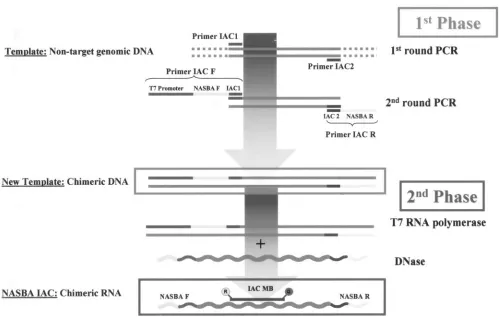
The principles of the construction of the NASBA IAC are
summarized diagrammatically in Fig. 1. Briefly, construction
proceeds in two phases. In the first phase, a double-stranded
DNA fragment that contains nontarget sequences flanked by
target sequences complementary to the NASBA primers is
produced. At the 5
⬘
end of this chimerical DNA is a T7 RNA
polymerase binding sequence. In the second phase of IAC
construction, RNA transcripts are produced from the
chimer-ical DNA by T7 RNA polymerase. This RNA is the IAC; it is
amplified by the target NASBA primers and is detected by a
molecular beacon probe complementary to the internal
non-target sequences. The main features of the molecular beacon
IAC for NASBA are the following: (i) it must be a
single-stranded RNA, (ii) it must show a NASBA target forward
primer sequence close to the 5
⬘
end, (iii) the 3
⬘
end must show
the NASBA target reverse primer sequence (reversed and
complementary), (iv) the internal sequence must not be
ho-mologous to the NASBA template, and (v) the internal
se-quence must show a molecular beacon hybridization site. It
contains the sequences complementary to the target primers
and a nontarget internal sequence which has a binding site for
a molecular beacon labeled with a reporter different from that
for the target molecular beacon probe.
After construction of the IAC, we recommend that the
fol-lowing steps subsequently be performed, in the folfol-lowing
or-der: (i) verify that the IAC can be amplified and detected, (ii)
establish that the IAC and template can be simultaneously
amplified and detected, (iii) optimize the IAC molecular
bea-con bea-concentration, (iv) determine the detection limit of the
IAC in order to optimize the IAC concentration used in the
NASBA reaction, and (v) verify that the system will operate
with the sample matrix chosen.
As a practical example, an IAC was constructed for use in a
molecular beacon-based real-time NASBA assay for
M. avium
subsp.
paratuberculosis
, according to the construction
princi-ples. Then, in accordance with the recommendations, it was
verified that this IAC could be detected in the RTi-NASBA,
with
⌬
R
and
T
Pvalues of 112.26
⫾
21.42 and 46.02
⫾
1.92 min,
respectively. We then established that the IAC and template
can be coamplified and detected simultaneously.
⌬
R
and
T
Pvalues were 201.05
⫾
25.12 and 47.65
⫾
2.96 min, respectively,
for IAC and 210.26
⫾
31.06 and 61.21
⫾
2.55 min, respectively,
for the
M. avium
subsp.
paratuberculosis
template.
[image:3.585.44.543.65.382.2]The next step was to optimize the concentration of the IAC
molecular beacon (MB1). We selected the molecular beacon
FIG. 1. General flowchart of construction of an IAC used for real-time NASBA with molecular beacon (MB) detection. Primer IAC1 and
primer IAC2 are used to amplify the IAC internal sequence, which should display no homology to the template. NASBA F (forward) and NASBA
R (reverse) are the specific primers for the intended target of the NASBA. The specific conditions of both PCRs in the first phase and the T7 RNA
polymerase reaction and DNase treatment in the second phase are described in Materials and Methods. R, reporter fluorophore; Q, quencher.
on May 15, 2020 by guest
http://jcm.asm.org/
Prism 7700 SDS; Applied Biosystems). The MB1
concentra-tion that gave the best results (
⌬
R
⫽
239.56
⫾
32.40;
T
P⫽
53.25
⫾
3.25 min) was 200 nM, and this concentration was
selected for further use.
Determination of the optimal concentration of the IAC in
the NASBA assay is a critical step. The IAC concentration
should be kept as low as possible to avoid inhibition of the
target-specific reaction. As seen in PCR assays (14), the use of
an IAC concentration that is too high could negatively affect
the limit of detection of the target. However, the IAC
concen-tration should not be so low as to make it difficult to obtain an
IAC amplification signal. We determined the detection limit of
the IAC. The IAC could be detected to a concentration of 1 ag
in the reaction mixture. However, below 10 ag, the
⌬
R
values
were very low (mean
⌬
R
values, less than 40) and detectable
amplification was delayed (
T
Pvalues, greater than 80 min). We
then observed that 1 fg of IAC was the largest amount of IAC
that did not inhibit the
M. avium
subsp.
paratuberculosis
signal.
Therefore, 1 fg of IAC was chosen for use in each reaction
mixture. In the absence of the
M. avium
subsp.
paratuberculosis
target, this amount of IAC produced a
T
Pvalue of 54.95
⫾
4.26
min. As 67.72 min was the upper limit of the 99% probability
confidence interval, we established 68 min as the threshold of
the IAC
T
P,above which
M. avium
subsp.
paratuberculosis
-negative RTi-NASBA results were considered invalid and,
thus, the samples needed to be retested. A series of NASBA
experiments with nucleic acids from 42 nontarget bacterial
strains further confirmed the IAC
T
Pvalues (mean, 53.38
⫾
3.66 min). The now fully optimized IAC-containing NASBA
was capable of detecting 150 to 200
M. avium
subsp.
paratu-berculosis
cells per reaction mixture (data not shown).
Use of RTi-NASBA IAC with clinical samples.
Analyses of
samples that possess a strong capacity to inhibit amplification
increases the risk of false-negative results (3, 16). A complex
matrix, feces, was selected to illustrate the use of the IAC to
reveal inhibited reactions. Artificially added
M. avium
subsp.
paratuberculosis
cells could be detected in fecal samples by
NASBA. Analysis of noncontaminated fecal samples showed
positive IAC amplification. The inhibitors present in feces
could adversely affect the NASBA detection of
M. avium
subsp.
paratuberculosis
, even when the bacterium was present at
con-centrations that were quite high (10
8per g). In a simulation of
a situation in which the purification of nucleic acids from feces
had been poorly performed, both target and IAC signals were
lost, revealing an inhibited reaction and the need to repeat the
analysis. The IAC-containing NASBA-based method was
ca-pable of detecting approximately 10
3M. avium
subsp.
paratu-berculosis
cells per g of artificially contaminated feces. In the
absence of IAC in the NASBA, the same limit of detection was
achieved. As a consequence, IAC can assist with the
interpre-tation of RTi-NASBA results for a clinical sample without
interfering with the results for the target.
The final optimized method was applied to 50 natural bovine
fecal samples, 25 of which were obtained from a farm declared
to be infected with
M. avium
subsp.
paratuberculosis
. The
re-were positive for
M. avium
subsp.
paratuberculosis
by NASBA.
In contrast, all 25 samples testing negative for
M. avium
subsp.
paratuberculosis
by standard methods were negative for
M. avium
subsp.
paratuberculosis
by NASBA. Thus, the
RTi-NASBA-based method was capable of detecting realistic levels
of
M. avium
subsp.
paratuberculosis
contamination. In addition,
all IAC results were positive not only by
M. avium
subsp.
paratuberculosis
-negative NASBAs but also by
M. avium
subsp.
paratuberculosis-
positive NASBAs; i.e., the
T
Pvalues were
be-low the threshold (mean IAC
T
Pvalues, 51.36
⫾
4.48 and
48.50
⫾
3.88 min, respectively). This was possibly due to low
M. avium
subsp.
paratuberculosis
loads in feces from infected
animals. The lack of inhibition in any of the reactions suggests
that the preamplification procedure used is effective with this
type of sample.
The details presented above are intended to provide an
illustrative example of the construction and optimization of an
IAC for real-time NASBA. The principles are general and may
be applied to real-time NASBA assays for other targets.
Inci-dentally, the principles may, with little adaptation, also be used
to construct IACs for other RNA detection methods, including
reverse transcription-PCR.
In conclusion, we have presented the first report of a
strat-egy for the construction of a real-time NASBA IAC and have
described its use for assistance with the interpretation of
NASBA results for artificially and naturally contaminated
clinical samples. The method is simple and very easy to
apply without the need for sophisticated molecular
manip-ulation facilities. A molecular beacon NASBA is a highly
use-ful development and should encourage investigators to use
NASBA for routine diagnostics.
ACKNOWLEDGMENTS
We thank E. Ferri for providing natural fecal samples and
perform-ing the standard culture-based
M. avium
subsp.
paratuberculosis
assays.
This work was supported by European Commission-funded project
“SACROHN” N. QLK2-CT-2000-00928, a grant from the UK
Na-tional Association for Colitis and Crohn’s Disease, the “La Marato
´ de
TV3” Foundation, and the Spanish Ministerio de Ciencia y Tecnologı´a
(grants AGL2002-03496 and Inia CAL01-058-C2-2). D.R.-L. was
sup-ported by a University of Girona research fellowship.
REFERENCES
1.Abdulmawjood, A., S. Roth, and M. Bu¨lte.2002. Two methods for construc-tion of internal amplificaconstruc-tion controls for the detecconstruc-tion ofEscherichia coli O157 by polymerase chain reaction. Mol. Cell. Probes16:335–339. 2.Al-Soud, W., and P. Radstrom.2000. Effects of amplification facilitators on
diagnostic PCR in the presence of blood, feces, and meat. J. Clin. Microbiol.
38:4463–4470.
3.Al-Soud, W. A., and P. Radstrom.2001. Purification and characterization of PCR-inhibitory components in blood cells. J. Clin. Microbiol.39:485–493. 4.Ausubel, F. M., R. Brent, R. E. Kingston, D. D. Moore, J. G. Seidman, J. A.
Smith, and K. Struhl.1990. Enzymatic manipulation of DNA and RNA.In Current protocols in molecular biology, vol. 1. John Wiley & Sons, Inc., New York, N.Y.
5.Bannantine, J. P., E. Baechler, Q. Zhang, L. Li, and V. Kapur.2002. Ge-nome scale comparison ofMycobacterium aviumsubsp.paratuberculosiswith Mycobacterium aviumsubsp.aviumreveals potential diagnostic sequences. J. Clin. Microbiol.40:1303–1310.
6.Chan, A. B., and J. D. Fox.1999. NASBA and other transcription-based amplification methods for research and diagnostic microbiology. Rev. Med. Microbiol.10:185–196.
on May 15, 2020 by guest
http://jcm.asm.org/
7.Compton, J.1991. Nucleic acid sequence-based amplification. Nature350:
91–92.
8.Cook, N.2003. The use of NASBA for the detection of microbial pathogens in food and environmental samples. J. Microbiol. Methods53:165–174. 9.Hoorfar, J., and N. Cook.2003. Critical aspects of standardization of PCR,
p. 51–64.InK. Sachse and J. Frey (ed.), Methods in molecular biology: PCR detection of microbial pathogens. Humana Press, Totowa, N.J.
10.Hoorfar, J., N. Cook, B. Malorny, P. Rådstro¨m, D. De Medici, A. Abdul-mawjood, and P. Fach.2003. Diagnostic PCR: making internal amplification control mandatory. J. Clin. Microbiol.41:5835.
11.Kievits, T., B. van Gemen, D. van Strijp, R. Schukkink, M. Dircks, H. Adriaanse, L. Malek, R. Sooknanan, and P. Lens.1991. NASBA isothermal enzymatic in vitro nucleic acid amplification optimised for the diagnosis of HIV-1 infection. J. Virol. Methods35:273–286.
12.Lanciotti, R. S., and A. J. Kerst.2001. Nucleic acid sequence-based ampli-fication assays for rapid detection of West Nile and St. Louis encephalitis viruses. J. Clin. Microbiol.39:4506–4513.
13.Leone, G., H. van Schijndel, B. van Gemen, F. R. Kramer, and C. D. Schoen.
1998. Molecular beacon probes combined with amplification by NASBA enable homogeneous, real-time detection of RNA. Nucleic Acids Res.26:
2150–2155.
14.Malorny, B., J. Hoorfar, C. Bunge, and R. Helmuth. 2003. Multicenter validation of the analytical accuracy ofSalmonellaPCR: towards an inter-national standard. Appl. Environ. Microbiol.69:290–296.
15.Rodrı´guez, D., J. Lloyd, A. Herrewegh, J. Ikonomopoulos, M. D’Agostino, M. Pla, and N. Cook.2004. A molecular beacon-based real-time NASBA assay for detection ofMycobacterium aviumsubsp.paratuberculosisin water and milk. FEMS Microbiol. Lett.237:119–126.
16.Rossen, L., P. Norskov, K. Holmstrom, and O. F. Rasmussen.1992.
Inhibi-tion of PCR by components of food samples, microbial diagnostic assays and DNA-extraction solutions. Int. J. Food Microbiol.17:37–45.
17.Sambrook, J., and D. Russell.2000. Molecular cloning: a laboratory manual, 3rd ed. Cold Spring Harbor Laboratory Press, Cold Spring Harbor, N.Y. 18.Sorensen, O., S. Rawluk, J. Wu, K. Manninen, and G. Ollis.2003.
Myco-bacterium paratuberculosisin dairy herds in Alberta. Can. Vet. J.44:221–226. 19.Stryer, L.1978. Fluorescence energy transfer as a spectroscopic ruler. Annu.
Rev. Biochem.47:819–846.
20.Tyagi, S., and F. R. Kramer.1996. Molecular beacons: probes that fluoresce upon hybridisation. Nat. Biotechnol.14:303–308.
21.Tyagi, S., D. P. Bratu, and F. R. Kramer.1998. Multicolor molecular beacons for allele discrimination. Nat. Biotechnol.16:49–53.
22.Uyttendaele, M., R. Schukkink, B. van Gemen, and J. Debevere.1994. Iden-tification ofCampylobacter jejuni,Campylobacter coliandCampylobacter lari by the nucleic acid amplification system NASBA. J. Appl. Bacteriol.77:
694–701.
23.Uyttendaele, M., R. Schukkink, B. van Gemen, and J. Debevere.1995. De-velopment of NASBA, a nucleic acid amplification system, for identification ofListeria monocytogenesand comparison to ELISA and a modified FDA method. Int. J. Food Microbiol.27:77–89.
24.van Beckhoven, J. R., D. E. Stead, and J. M. van der Wolf.2002. Detection ofClavibacter michiganensissubsp.sepedonicusby AmpliDet RNA, a new technology based on real time monitoring of NASBA amplicons with a molecular beacon. J. Appl. Microbiol.93:840–849.
25.van Gemen, B., R. van Beuningen, A. Nabbe, D. van Strijp, S. Jurriaans, P. Lens, and T. Kievits.1994. A one-tube quantitative HIV-1 RNA NASBA nucleic acid amplification assay using electrochemiluminescent (ECL) la-belled probes. J. Virol. Methods49:157–167.