Evaluating the audio-diary method in qualitative research
Iain
Williamson,
Dawn
Leeming,
Steven
Lyttle
&
Sally
Johnson
Williamson, I., Leeming, D., Lyttle, S. & Johnson, S. (2015). Evaluating the audio‐diary method in qualitative research. Qualitative Research Journal.
Abstract
Purpose: Audio-diary methods are under-utilised in contemporary qualitative research. In this
paper we discuss participants and researchers’ experiences of using audio-diaries alongside
semi-structured interviews to explore breastfeeding experiences in a short-term longitudinal
study with 22 first-time mothers.
Methodology: We provide a qualitative content analysis of the participants’ feedback about
their experiences of the audio-diary method and supplement this with the perspectives of the
research team based on fieldwork notes, memos and team discussions. We pay particular
attention to the ways in which the data attained from diaries compared with those from the
interviews.
Findings: The diaries produced were highly heterogeneous in terms of data length and
quality. Participants’ experiences with the method were varied. Some found the process
therapeutic and useful for reflecting upon the development of breastfeeding skills whilst
negative aspects related to lack of mobility, self-consciousness and concerns about
confidentiality. Researchers were positive about the audio-diary method but raised certain
ethical, epistemological and methodological concerns. These include debates around the use
of prompts, appropriate support for participants and the potential of the method to influence
the behaviour under scrutiny. Interview and diary accounts contrasted and complemented in
Implications: The authors conclude that audio-diaries are a flexible and useful tool for
qualitative research especially within critical realist and phenomenological paradigms.
Originality: This appears to be the first paper to evaluate both participants and researchers’
experiences of using audio-diaries in a detailed and systematic fashion.
Keywords: audio-diaries, breastfeeding, women's health, qualitative content analysis
Introduction
Diary methods are flexible, heterogeneous, have the potential to yield rich qualitative
data and unlike methods which rely on retrospection, offer the potential to ensure that
accounts are sequentially ordered and reduce the likelihood of feelings or events being
forgotten (Milligan et al., 2005, Mackrill, 2008). Furthermore, as no researcher is present
when data are being recorded, participants are able to elaborate on matters of personal
salience freely and spontaneously. This may have particular benefits where intimate
behaviours are the focus of the research (Breakwell, 2012).
The challenges of diary methods are less widely reported although Alaszewski (2006)
outlines some difficulties. He argues that qualitative solicited diaries are a relatively
‘expensive’ form of data collection as the researcher typically has to design study-specific
materials for participants and then provide appropriate training and support for the duration of
the period of data collection. Additionally, as diary keeping as a social practice varies both
across and within class and cultural groups, selection bias in recruitment to diary-based
research is likely. Diary keeping presumes certain skills and motivation and there are
individual, structural and cultural differences in comfort with self-narration to be considered
(Warin and Muldoon, 2009). Having to record entries regularly over time may lead to
participant fatigue and data attrition. Furthermore the researcher has no control over
participant selectivity in reporting and certain psychological phenomena may be consistently
Audio, unlike written, word processed or web-based diaries are not commonly used in
contemporary qualitative research. However, a relatively small number of articles which
describe research in which participants narrate, rather than write (or type), their accounts
have appeared in recent years. These include Bernays et al.’s (2014) constructions of hope
in Serbian people living with HIV, Worth's (2009) research into how visually impaired young
people in Britain adjust to adulthood, and Gibson et al.’s (2013; 2014) research around
identity and inter-sectionality in Canadian young men with Duchenne Muscular Dystrophy. If
audio-diaries are used at all, it appears to be more common for researchers to employ them
alongside other methods rather than using them independently. Audio-diaries have been
surprisingly overlooked as they offer a practical, 'hands-free' method for participants to
provide accounts of experience, whilst facilitating data collection in real time and context
(Bolger et al., 2003). Economical portable voice recording equipment is widely available and
easy to use and data entries can be made whenever and wherever convenient which has
particular benefits for those with constrained health and/or mobility (Johnson and Blytheway,
2001). They can also potentially partially address some concerns relating to selection bias in
diary studies through facilitating the inclusion of participants with limited manual dexterity or
literacy skills.
Because of the lack of currency of audio-diary methods in contemporary research, we
have limited sense of how participants engage with the approach. However, Sargeant and
Gross (2011) explored in detail how six British young people who were receiving treatment
for inflammatory bowel disease responded to recording regular audio-diaries over several
months. After initial awkwardness the participants developed a virtual relationship with the
researchers through using the diary in a ‘continuous conversational sense’ (p. 1365) and
came to appreciate the ‘immediacy and intimacy’ of the method. The diaries appeared to
serve a reflective, therapeutic function for the participants through the provision of a safe
Aims of the Paper
In this article we describe our experiences of using audio-diaries alongside
semi-structured interviews in a short-term longitudinal research project which explored first-time
mothers' breastfeeding experiences in the postpartum period. The aim of the paper is to
evaluate audio-diaries as a method and to explore the implications of their use for collecting
qualitative data. Firstly, we discuss our participants’ engagement with the diaries and
provide a qualitative content analysis of participants’ observations about the diary method in
their daily accounts along with their responses to specific questions they were asked during
interviews. This is followed by researchers’ reflections on ethical, methodological and
epistemological issues including a comparison of the data collected via audio-diaries with
those collected through interviewing. In order to contextualise our commentary on the use of
audio-diaries, we begin with a brief description of the study in which they were used.
The Study in which the Audio-diaries were Employed
The study explored the lived experience of breastfeeding amongst first-time mothers
in the UK. Whilst there had been previous qualitative research into breastfeeding
experiences incorporating written diaries (e.g., Lavender, 2006), we believed that the
coupling of audio-diaries with semi-structured interviews would enable us to explore very
early experiences of breastfeeding as they unfolded and, as audio-diaries potentially enable
mothers to record whilst feeding, facilitate the production of richer experiential data.
The study employed a multi-method, longitudinal design which comprised two phases
of data collection, each of a week's duration. In each phase participants were asked to make
audio-diary recordings over seven days, and this was followed by an interview. Phase one
began as soon as practically and ethically appropriate following the birth of the infant.
mains adaptor, batteries and seven pre-labelled and colour-coded mini-disks. They were
shown how to use the equipment, including how to play back, edit and delete recordings, and
were provided with some general prompts (e.g. to record how the feeding session was going
and how they felt about this). The women were asked to make at least two entries every day,
either during or shortly after feeding sessions, and received contact details of the research
team. At the end of this period a researcher visited participants to carry out an interview
during which they were asked about their breastfeeding experiences and how they had found
keeping the audio-diary. Phase two began when the baby was around 21-25 days old and
followed a similar procedure. Full participation in the study typically represented involvement
over a six week period for the women.
Recruitment to the study took place over a period of approximately six months.
Fifty-eight women registered interest with 22 subsequently agreeing to participate at phase one
and 11 at phase two. (An additional ten women participated in interviews but did not want to
complete daily diaries).
Participants were first-time mothers with singleton infants born at a gestational age of
between 38 and 42 weeks without incidence of significant child or maternal illness. All
participants had declared an intention to breastfeed their infants for at least one month.
Participants were between 18 and 38 years of age, living with male partners and from
various occupational backgrounds. Thirteen of the 22 were degree-educated. Nineteen
described their ethnicity as white, two as African-Caribbean and one as Eurasian.
Pseudonyms are used throughout. Ethical approval for the research was provided by both
The Audio-Diary Method: Participants' Engagement and Perspectives
In this section we provide details of how the participants engaged with the diaries and
then provide a qualitative content analysis of their views on this method of data collection.
This analysis is based on data the 22 women provided during the first phase of the study
when breastfeeding was less well established and the audio-diary method was novel. Our
aim here is to discuss participants’ reported experiences of keeping the diaries rather than to
explore the findings regarding experiences of breastfeeding which are reported elsewhere
(e.g. Johnson et al., 2009; Leeming et al., 2013; Williamson et al., 2012).
Participants' use of the audio-diary was heterogeneous in terms of the number,
duration and nature of entries they made. Thirteen women made entries on all seven days.
The longest diaries exceeded 450 minutes and these were typically associated with mothers
recording during rather than following feeding sessions. Mothers who were experiencing
greater difficulties tended to record more fully and frequently. In contrast, entries made by a
small sub-set of participants were rudimentary. One woman recorded every day but the diary
data totalled 26 minutes. The style of entries of this sub-set of participants was functional
with minimal elaboration. Participants who provided short diaries were also typically reserved
in interviews, perhaps indicating the salience of their interpersonal style rather than the data
collection method. Participants in the mid-range typically recorded between 90 and 180
minutes of data. Interestingly the very considerable variability in the quality and quantity of
data provided by participants (and apparent comfort with self-narration) mirrors the
experiences reported by Gibson et al. (2013) in their study of young men with Duchenne
Muscular Dystrophy.
The interviews at the end of the week focused both on participants’ experiences of
breastfeeding and how they had found keeping the audio-diaries. We also explored the diary
data themselves to collect additional observations about the process of diary keeping. To
approach outlined by Hsieh and Shannon (2005). This comprised reading the data
thoroughly and subsequently generating content categories inductively from the data.
Reliability of coding was checked within the team. We have grouped the responses as
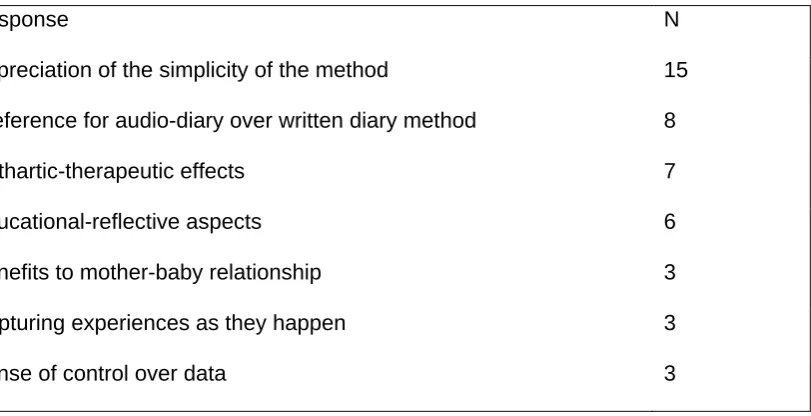
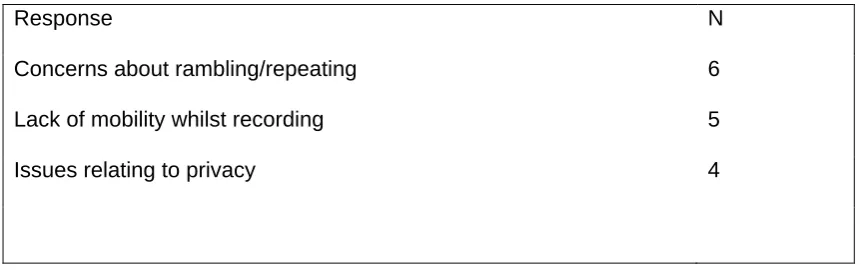
positive aspects and negative aspects (see tables 1 and 2). Each category is subsequently
discussed with an illustrative extract from the data. We have considered only those content
categories which were represented by the responses of at least three participants.
[image:7.595.86.492.323.531.2]Positive Aspects of the Audio-Diaries
Table one: Positive Responses to the Audio-Diary Method in Order of Prevalence
As can be seen from Table 1, the most common response to the question was that
participants found the equipment user-friendly:
It's been easy to use and I'm a bit of a technophobe, clueless really, but I found it
okay. (Emma)
Several participants spontaneously contrasted the audio-diary method with typed or
handwritten diaries and demonstrated a preference for the audio method:
Response N
Appreciation of the simplicity of the method 15
Preference for audio-diary over written diary method 8
Cathartic-therapeutic effects 7
Educational-reflective aspects 6
Benefits to mother-baby relationship 3
Capturing experiences as they happen 3
You wouldn't be able to keep a written diary, it wouldn't work… I think it is the right
way, I mean I don't think I would fancy writing anything and I don't think I would fancy
using a computer to send emails. (Deanne)
Participants who recorded their accounts during rather than after feeding seemed particularly
appreciative of the method:
Writing it down would have been very difficult because you've got your hands full and
trying to stay comfortable whereas you can just talk into that [the recorder] and it is
very easy. (Erica)
Being able to provide accounts as feeds occurred (or soon after) was valued by some
participants who commented that this ensured that key aspects of their experience were not
lost:
It's probably the best way of doing it because writing down you lose things, you forget
things whereas if you are just chatting it seems much more informal and you can just
chat away. (Hannah)
Robin spoke at length about the contrast between giving accounts shortly after feeds
and recounting experiences in an interview several days later:
It's [the audio-diary] an excellent way of picking up information because you forget
things otherwise. You discuss it all but already a week later, I'm sort of slightly
thinking - "am I making a fuss about how bad that was?" - and I wasn't because I
Some participants also spoke of having a sense of personal control over the data
collected. Molly felt that her data were less inhibited and more spontaneous:
I suppose it's quite personal and because nobody else is sort of there you can say
what you like really so, you can be quite honest on it whereas if you think it was like
interview style you might think about what you are supposed to say. (Molly)
Therefore generally the participants seemed to be suggesting that the use of
audio-diaries enabled rather than inhibited their recounting of their experiences of breastfeeding,
especially as this afforded the opportunity to capture experiences contemporaneously.
Participants discussed other benefits. Most commonly, they noted the value of being
able to vent their feelings and frustrations, especially when experiencing difficulties:
It was nice to express my feelings and things like that because there were, you know,
some down days and it was good just to let it out and get that off your chest. (Bianca)
Some participants found it useful to either playback recordings and reflect on
previous feedings or use the time to contemplate how breastfeeding was developing.
It was nice to reflect on what had happened and, instead of that moment was gone
and past, you could sit and think, “right well, why did that not go as well as you
wanted it to” and “why did it go well?” So it was nice to use that reflection in the next
feeding. (Hannah)
Spending quiet time with the baby was also felt by some participants to benefit the
mother-infant relationship. Although no requirement was made for the mothers to record their
confidentially as it gave them a legitimate reason to spend a solitary and private interlude
with the baby:
It was sort of nice just to have a little space with the little one. (Molly)
The other perceived benefit related to the baby hearing the mother's voice during the feed:
It gets you rabbitting away and so she gets to hear your voice constantly as you are
feeding which probably isn't a bad thing. (Amelia)
To summarise, participants reported several positive features of the audio-diary
method. These findings suggest that there are particular advantages to the employment of
audio-diaries for participants experiencing significant transitions when other methods might
be burdensome (Morse, 2009). The participants’ appreciation of the method as a means of
expressing their feelings and as an opportunity to reflect on and make sense of their
experiences suggests that they found the method to be an authentic means of capturing their
subjective worlds. Some of our findings resonate with observations made by Sargeant and
Gross (2011) about their use of audio-diaries with young people with inflammatory bowel
disease. Despite the shorter time-span of involvement for our research, the difference in age
of our participants and the fact that they were adjusting to a temporary phenomenon rather
than a chronic condition, similar benefits were voiced including the therapeutic and reflexive
functions. Another similarity was the way in which many participants utilised the diary as a
conversational tool.
Negative Aspects of the Audio-Diaries
Table two: Negative Responses to the Audio-Diary Method in Order of Prevalence
Negative responses about the audio-diaries were relatively few. The most common
concern related to participants feeling self-conscious and that their accounts were repetitive.
Participants appeared keen to provide the 'right' kind of data and they voiced concerns over
a perceived lack of coherence, originality or precision to some of their entries, using terms to
describe them such as "confused and rambling" (Gina) and "waffling" (Caitlin).
The women who adjusted well to breastfeeding in particular felt that their later entries
were uninformative:
I must admit, the longer it went on, I felt sort of like I was running out of things to say.
(Imogen)
Whilst women were generally positive about the recording equipment, a number did
comment on the restrictions on mobility whilst recording. This was particularly true of
participants who preferred to use the mains adaptor rather than batteries, and for those who
opted to record during feeds:
The only mean feat is trying to get a new born baby, yourself and the mini-disc
recorder all in one place, but you can usually manage it. (Nicole)
Response N
Concerns about rambling/repeating 6
Lack of mobility whilst recording 5
A number of participants initially tried to record feeding sessions but moved quickly to
making entries shortly after the feed was completed and the baby settled:
I have done it after I’ve fed him. I’ve not done it while feeding because, I tried but I
couldn’t multi-task I found that talking to the microphone was putting me off and
putting him off. (Hannah)
Another difficulty mentioned by the participants related to privacy and the challenges
of making recordings when others were present:
There have been lots of times when I've been feeding when other people are around
and I don't want to record when other people are about. (Emma)
These data illustrate some important individual differences in how participants
responded to providing regular narratives of their experience, and how these responses can
change over time. It is also clear that there were some limits to the flexibility of the
audio-diary method with participants reporting practical restrictions as to when and where they
could record their accounts. Although most women overcame difficulties using the
equipment or adapted their use of the equipment to suit their needs, the data suggest that it
may be useful to offer participants greater flexibility in how and how often they complete their
diaries.
Reflections of the Research Team
Ethical Issues
Three ethical concerns warrant further discussion as issues that should be addressed
in research using audio-diaries. The first of these was capturing the voices of other people
on the recordings. In most cases these were family members and it was difficult to ascertain
from participants only, we have not included any extracts containing statements from other
individuals in research articles. However it may be advantageous to consider additional
safeguards to address confidentiality concerns in relation to those people who may interact
with participants.
A second issue relates to the lack of researcher support whilst diaries are being
recorded. Researchers may be unaware of the extent of distress experienced by participants
until the diaries have been completed. Given previous research suggesting that some
women find difficulties with breastfeeding distressing (e.g. Larsen et al., 2008), we had
provided contact details of infant feeding support agencies to participants and a contact
number for the researchers. However, no participant spontaneously contacted us during
'diary weeks' although on the recordings several of the women were tearful and
demonstrated low affect. It may have been the case that had we been aware of this at the
time we would have reiterated the right to withdraw from the study or to skip making entries
on more difficult days if participation appeared to be becoming too burdensome.
The final issue has both ethical and methodological elements and relates to what has
been called 'reactance'. This refers to a situation where keeping the diary affects the
behaviour under investigation (Breakwell, 2012). For example, one of our participants
commented in her interview:
Because I was doing this disc, there was no way I was going to give up, not when I
was doing this. No chance. (Imogen)
The participant stated her commitment to breastfeeding in several diary entries and it
is arguably unlikely that she continued to breastfeed primarily because of her research
pre-Methodological Issues
One of the issues that concerned us when developing the study was whether or not to
provide the participants with prompts for making entries. Following consultation with
researchers, professionals and recent mothers we decided to include some general prompts
relating to feeding and the transitions being experienced as a new mother. These prompts
were phrased as open questions and are listed in table three below:
Table three: Guidelines for Keeping the Infant Feeding Audio-diary
Where possible, please record your experiences of at least two feeding sessions per day, over the next seven days. If you wish to record more than two feeds, this would be welcomed but is not essential. It is important that you try to record your experience as it happens or soon after, rather than relying on
remembering what happened and how you felt, later on in the day/week. Record whatever is important and relevant to you at the time, however trivial it might sound. Take as long as you like to make the
recordings.
For each entry please record:
What is the date and what time of day is it?
Where are you feeding?
What have you just been doing?
Are you alone/what is going on around you?
Here are some ideas of the kinds of things that you might record but don’t feel restricted by this list:
For your first entry:
Please record your experience of feeding your baby since the birth and how you have felt about it. (If it is a few days since your baby was born you may wish to provide a day-by-day account or describe your experiences more generally).
Issues related to the feed
How is the feed going?
How do you feel about this feed? Describe what you are experiencing in as much detail as you can.
What are the most pleasurable aspects of this experience and how does this make you feel?
What do you dislike or is difficult about this experience and how does this make you feel?
Issues related to your life more generally
What are you going to do after the feed?
Any other comments or reflections e.g. on the day as a whole.
How are you finding being a mum and what is it like looking after your baby?
What is going on more generally in your life and do how you feel about this?
It was hoped that the prompts would both help to ensure that the data addressed the
what was required of them and what they should say. The prompts were generally well
received by participants and were not perceived as prescriptive.
At the end of the day, although you set us kind of like pointers as to what you want us
to talk about, you've also allowed us to talk about anything that we may have thought
relevant really. (Yvonne):
Attrition is another methodological concern that warrants some discussion. Completion of a
full set of diaries was exceptional. Forty-five per cent of women who registered an initial
interest in the study subsequently chose not to participate at all and a further 17% consented
to be interviewed but did not wish to, or felt unable to, complete the diary element. Further
attrition at phase two was also considerable. Our analysis of field notes, transcripts and
memos suggests that it was more commonly women who experienced feeding difficulties
and related emotional distress during phase one who did not continue into phase two but it
may have been that these reservations were compounded by elements such as
perceived/anticipated discomfort when recording, lack of comfort with the method, or the
additional time involved compared to interviews. With particular regard to phase two, several
of the mothers had moved away from exclusive breastfeeding and may simply have felt that
their experiences of feeding their infant formula or expressed breast milk from a bottle were
less relevant to the aims of the study. It may also have been that a two-week break between
the two data collection phases (without any contact from the research team during this
period) disrupted the rhythm and momentum of participation, and commitment to the project.
In addition some participants may have produced richer data if expectations of minimum
length diary entry had been provided, although the ethical aspects of this especially
considering that our participants were time-poor and in a novel situation would have needed
very careful consideration. Unrealistic targets might have impacted negatively on the number
The natureof data produced by audio‐diaries compared to interviews
In evaluating the audio-diary as a methodological tool for capturing lived experience,
we were interested in the kind of data that this method produced compared to other methods.
Interviews are the most commonly used method of collecting data for qualitative researchers
(King and Horrocks, 2010) and our study, which used both audio-diaries and interviews,
offered an opportunity to compare the data generated by each.
Whilst the accounts produced by the two methods were sometimes similar, generally
the diaries offered something different to the interviews. In particular they conveyed more
fluctuation and even contradiction in the women’s accounts than the interviews, in which
some of the complexities of varying experiences breastfeeding over the preceding week
were perhaps lost. Although the women talked about change within the interviews, it was
much more apparent within the diaries. Here it was possible to gain a clearer picture of the
‘roller-coaster’ experience of the week and the way in which participants’ well-being and
confidence fluctuated from day to day (or even session to session) and was closely tied to
the success or otherwise of breastfeeding:
I’m just on a bit of a high because I feel like I’m coping for the first time... but we’ll
see. And, yeah, the feeds have all gone well so far, that I’ve, oh, the one I was
actually quite proud of the one I just did now at about 8 am, because I did it all on my
own (Gina, diary – day 2)
They [her husband’s parents] arrived when I was still trying to feed him and at the
time I was in floods of tears because every single feed now, it seems to make me cry,
because it’s like so difficult, and it’s also getting very painful (Gina, diary – day 4)
Being interviewed arguably creates a pressure to produce a coherent and
understandable account. At several points the interview data suggested a less "messy"
moved from feeding her baby at the breast to routinely giving him expressed breast milk
during the week) gave an account within the interview of how she had initially felt a failure at
not finding breastfeeding enjoyable or easy but then how she had been able to resist this
feeling with support from others:
I was feeling so guilty feeling like I had failed and that I should be finding it much easier
and because I wasn’t, just talking to a few people, even talking to my mum, she was
like, “well I struggled as well, you don’t have to do it, you know, there are other ways.”
So, after speaking to a lot of people I finally felt a bit better, and a bit more relaxed, and
then I made the decision, right, you know that’s it, I’m just going to express now ‘cause
I’m not putting myself through it. (Arabella, interview)
However, the diary showed more clearly how this shift in perspective had not been a
straightforward process, how she had initially continued to feel a failure in spite of others’
support and how she fluctuated between a sense of failure and a sense that her difficulties
were not her fault. For example on day four she recorded:
I keep saying I’m trying but I feel like I failed ‘cause I just don’t want to do it but he
[Arabella's husband] keeps saying I haven’t failed at all but it’s just so hard and it’s not
nice at all. When all your friends are doing it as well, you feel like you’re crap really
‘cause they’re all managing it and you aren’t but I guess everybody’s bodies are
different and some maybe aren’t meant for it. (Arabella, diary - day 4)
From the interview data it was also possible to see that some of the women had
experienced considerable distress about the difficulties they had experienced getting
breastfeeding to work. For example Queenie talked about her distress at not being able to
I just cried and cried and cried ‘cause it was just such a big disappointment I felt like I
had failed almost as a woman really, you feel like this is natural thing, why can I not do
this? My baby would die if he was in a country where they didn’t have bottles and all
the rest of it (Queenie, interview)
However, her diary showed how the distress and sense of failure unfolded in real time
and arose out of moment by moment interactions with her baby, where she experienced
trying to breastfeed him as a struggle she was losing. One day she recorded the following
while feeding, alternately talking to her son and the recorder:
“You’ve got to feed darling, Mummy’s so worried about you.” We’ve been trying to
wake him up for the last half an hour, putting him in places he really doesn’t want,
lying on his own and trying to get him a bit cool, and it’s really, really hard. You just
don’t know what you’re supposed to do. “Come on little baby, there’s a good boy.
Upsetting your Mummy, you worry her. Please just have a little bit, Zach, come on.”
Teasing him on his nose, around his mouth, with my nipple, but he’s just not having
any of it. Oh dear. I’m sorry to be crying, it’s just hard. (Queenie, diary - day 3)
From the reflections above, it could seem as if the diaries offered more to us than the
interviews. However, there were times when the interviews seemed to provide the women
with an opportunity to reflect on their experiences in a way that they had not done within the
diary recordings, explaining the meaning of the experiences to the interviewer. Sometimes
the interviews offered additional reflections which had not been recorded previously and
which were more concerned with meaning and less with events than the diaries. For
example, in her diary, Gina had noted that she felt under pressure to breastfeed from her
I’m trying not to stress myself out too much about it, because I was just feeling like my
body wasn’t my own, and that I was on demand all the time, my husband telling me
“you need to get feeding, you need to feed the baby.”(Gina, diary – day 1)
However, in the interview she is more explicit about the meaning of this for her:
I felt, I started to feel resentful, against people like my husband who was really wanting
me to feed, and kept saying, “the baby’s hungry, the baby needs feeding”, and I was
just in the bath or something…But it felt like he was putting the baby completely above
my needs (Gina, interview).
The idea that her husband accorded more importance to the baby’s needs than to
hers was not mentioned explicitly within the diary recordings.
At several points the conversation between the interviewer and the participant
revealed a more nuanced and complex view on the part of the participant than had been
evident in the diary, either as a reaction to a different point of view expressed by the
interviewer or because the interviewer was able to probe the participant’s account. For
example, in her diary Uma made quite strong statements about her ease with feeding in
public:
If she’s screaming and in a public place like in a pub... or a park or wherever and she
needs feeding and I’ve got the choice between bottle and breast, I’ll breastfeed her.
I’ve got no problem - it’s everybody else who'sgot 'em… I’ve got the confidence now
to do that (Uma, diary – day 3)
However, when the interviewer mentioned the embarrassment that some women
Don’t get me wrong, I will probably sit there with a red face…, because yeah, you are
getting your boob out in public, you know, but whose problem is it really? (Uma,
interview)
To conclude this section, the diaries often offered a fuller picture of the day-to-day
changes and fluctuations in experience which were sometimes summarised and somewhat
glossed over within the interviews. They provided a more vivid picture of the degree of
distress that some of the women experienced. However, it was useful to follow the diaries
with interviews as this enabled us to probe, interrogate and clarify some of what had been
recorded and ask the women to reflect further on the meaning of their experiences for them.
Epistemological Issues
It is possible to use audio-diaries to collect data for analysis from a range of
epistemological, ontological and theoretical positions. This could include realist analyses of
the unfolding of events and related processes, consistent with the aims of a traditional
grounded theory approach (Glaser, 1998), phenomenological analyses of meaning-making in
the moment (Giorgi and Giorgi, 2008) and analyses of the way in which day-to-day
accounting is constructed from dominant cultural discourses (Willig, 1999). Thus far, we
have analysed the data from a feminist poststructuralist perspective within a critical realist
framework (e.g. Johnson et al., 2009) and have more recently employed a
social-constructionist version of interpretative phenomenological analysis (e.g. Williamson et al.,
2012) and a thematic analysis informed by symbolic interactionism (e.g. Leeming et al.,
2013). In some of these articles we have examined the data of a smaller, more
homogeneous sub-group of participants, for example those who experienced particular
challenges with initial feeding (Williamson et al. 2012) to maintain analytical depth and the
‘idiographic sensibility’ of an interpretative phenomenological approach. Elsewhere we have
explored processes that appeared to be common for most or all the participants and illustrate
al., 2013). Across both approaches we have taken an ontological position of critical realism
to knowledge-production (Elder-Vass, 2012) and thus regard the diaries as providing an
insight into the women's lived experience whilst recognizing that these accounts and the
experiences themselves are inevitably shaped both by intrapersonal and contextual factors.
We argue that 'truths' about breastfeeding experiences are multiple and contingent and
hermeneutic processes are affected by what participants are willing and able to articulate
(Spencer, 2008). Although the presence of the researcher may not be such a visible factor in
determining what can be said in a diary, there may still be concerns about exposure and
issues of stake and accountability remain relevant, especially as mothering and
breastfeeding are highly scrutinised activities in contemporary Western societies (Marshall et
al., 2007). As illustrated in the previous section, this may mean that subtly or considerably
different versions of events and experiences are expressed at different times or in different
methods in a mixed-methods design, and we have therefore been cautious of using the
concept of triangulation in our interpretations of the data. Brocki and Wearden (2006, p.94)
observe that (audio) diaries appear to be an ‘excellent alternative’ to the more commonly
used interviews for yielding comprehensive narratives for phenomenological and related
forms of analysis, especially where participants can be encouraged to make regular and
detailed entries. It is also notable that when offered an open-ended method of recounting
their experiences, some participants expressed their difficulty in capturing all aspects of their
experiences, an issue which needs consideration as part of any analysis.
Conclusions and Recommendations
Bolger et al. (2003, p. 610) have argued that diary-based studies offer ‘a unique
window on human phenomenology’ and are well placed to capture ‘the particulars of
everyday life’. We found the audio-diary method specifically to have several merits especially
participants in providing spontaneous, moment-by-moment accounts of experience which
reflected their priorities and usually yielded rich experiential data for interpretation. However,
several caveats need to be taken into account. Compared to other methods for collecting
qualitative data, audio-diaries may raise additional ethical issues relating to confidentiality,
the demands of participation and reactance. Used as a stand-alone method diaries also do
not enable the researcher to probe participant accounts and as such some data may be thin
or may not focus sufficiently on the research question. Attrition may also be higher than for
methods which require less commitment from participants. In our study educated and
married participants from middle-class backgrounds were overrepresented although this may
be more reflective of patterns of breastfeeding in the United Kingdom than feelings about the
research methods utilised in the study. None-the-less it is important to retain a degree of
caution in assuming that participants from other demographic groups would respond similarly
to completing audio-diaries.
Two final practical issues to consider are the selection of equipment and the amount and
costs of transcription. We would advise other researchers who are considering using
audio-diaries that the selection of equipment for recording and guidance requires considerable
attention. Participants may find unfamiliar or complex looking devices off-putting. Our
research assistant trained participants in the use of the equipment on first visit and we
provided all participants with a simple set of guidance notes (presented as a colourful,
double-sided, laminated document with the diary prompts on the reverse face). However, a
small number of participants found the use of mains adaptors limited their mobility and
flexibility in recording entries. Despite the quality of the sound-recordings produced, mini-disk
recorders are not widely available and are relatively expensive. Future researchers may wish
to consider using Smartphone devices with Dictaphone functionality. These are lightweight
and highly portable, easily (re)charged and familiar to most participants (Moylan et al.,2013).
Their employment could also facilitate communication with the research team (thus
using audio-diaries, rather than written or especially word-processed/on-line diaries, is that a
considerable amount of transcription is required which requires significant resources. As
illustrated above we wanted diary entries to inform questioning in the interview phase.
Because of the timings of our protocol it was not always possible to have diaries transcribed
in full ahead of the interview and therefore members of the research team had to make notes
from the recordings instead. The costings and timings of transcription require careful
consideration when planning and budgeting the proposed research and because of the
highly heterogeneous amounts of data produced by different participants this aspect can be
more difficult to predict than in interview-based studies.
To conclude, audio-diaries appear to be an under-utilised option within the qualitative
researcher’s toolbox. It appears that they can yield valuable data, either as a standalone
method or when supported by other methods. Whilst audio-diaries raise unique ethical
concerns and researchers need to remain aware of the changing nature of new technologies
and participants’ related training needs, the method appears to have the potential to include
and engage a range of participants in a potentially data-rich method which is not generally
perceived as overly burdensome and which may yield benefits for the participants
References
Alaszewski , A. (2006), Using Diaries for Social Research. Sage, London.
Bernays, S., Rhodes, T. & Jankovic-Terzic, K. (2014), Embodied accounts of HIV and hope:
Using audio-diaries and interviews. Qualitative Health Research (Early View), Available at:
http://qhr.sagepub.com/content/early/2014/03/25/1049732314528812.long (Accessed 14
April 2014).
Bolger, N., Davis, A., and Rafaeli, E. (2003), Diary methods: Capturing life as it is lived.
Annual Review of Psychology, 54, pp. 579-616.
Breakwell, G. M. (2012), Diary and narrative methods. In: Breakwell, G., Smith, J. and
Wright, D. (Eds.) Research Methods in Psychology (4th edition), Sage, London, pp.392-410.
Brocki, J. & Wearden, A. (2006), A critical evaluation of the use of interpretative
phenomenological analysis (IPA) in health psychology. Psychology and Health, Vol. 21, pp.
87-108.
Elder-Vass, J.. (2012), The Reality of Social Construction. Cambridge: Cambridge University
Press.
Gibson, B., Mistry, B., Smith, B., Yoshida, K., Abbott, D, Lindsay, S.and Hamdani, Y. (2014),
Becoming men: Gender, disability and transitioning to adulthood. Health, Vol. 18, pp. 95-114.
Gibson, B., Mistry, B., Smith, B., Yoshida, K., Abbott, D, Lindsay, S.and Hamdani, Y.
(2013).The integrated use of audio-diaries, photography and interviews in research with
http://www.thinkcollege.net/administrator/components/com_resdb/files/Diaries%20Photos%2
0Disabled%20Young%20Men.pdf (Accessed 12 August 2014).
Giorgi, A. and Giorgi, B. (2008) Phenomenological psychology. In: Willig, C. and
Stainton-Rogers, W. (Eds.) The Sage Handbook of Qualitative Methods in Psychology. Sage, London,
pp. 165-178.
Glaser, B. (1998), Doing Grounded Theory: Issues and Discussions, Sociology Press, Mill
Valley.
Hsieh, H-F and Shannon, S. (2005), Three approaches to qualitative content analysis,
Qualitative Health Research, Vol 15, pp. 1277-1288.
Johnson, J. and Blytheway, B. (2001), An evaluation of the use of diaries in a study of
medication in later life, International Journal of Social Research Methodology, Vol 4, pp.
183-204.
Johnson, S., Williamson, I., Lyttle, S. and Leeming, D. (2009), Expressing yourself: A
feminist analysis of talk around expressing breast milk, Social Science and Medicine , Vol 69,
pp. 900-907.
King, N. and Horrocks, C. (2010), Interviews in Qualitative Research. Sage, London.
Larsen, J., Hall, E,. and Aagard, H. (2008), Shattered expectations: When mothers’
confidence in breastfeeding is undermined – a metasynthesis. Scandinavian Journal of
Lavender, T., McFadden, C. and Baker, L. (2006), Breastfeeding and family life. Maternal
and Child Nutrition, Vol 2, pp. 145-155.
Leeming, D., Williamson, I., Johnson, S. and Lyttle, S. (2013), Socially sensitive lactation:
Exploring the social context of breastfeeding, Psychology and Health, Vol 28, pp. 450-468.
Mackrill, T. (2008) Solicited diary studies of psychotherapy in qualitative research - pros and
cons. European Journal of Psychotherapy and Counselling Vol 10, pp. 5-18.
Marshall J.L., Godfrey M. & Renfrew M.J. (2007), Being a ‘good mother’: managing
breastfeeding and merging identities. Social Science and Medicine Vol. 65, pp. 2147–2159.
Milligan, C., Bingley, A. and Gatrell, A. (2005), Digging deep: Using diary techniques to
explore the place of health and well-being among older people. Social Science and Medicine,
Vol. 61, pp. 1882-1892.
Morse, J. M. (2009), Exploring transitions. Qualitative Health Research, Vol 19, pp. 431.
Moylan, C-A., Derr, A. & Lindhorst, T. (2013), Increasingly mobile: How new technologies
can enhance qualitative research. Qualitative Social Work (Early View), available from:
http://qsw.sagepub.com/content/early/2013/12/23/1473325013516988.full.pdf. (Accessed: 12
August 2014).
Sargeant, S. and Gross ,H. (2011), Young people learning to live with inflammatory bowel
disease: Working with an ‘unclosed’ diary. Qualitative Health Research, Vol. 21, pp.1360-
Spencer, R. L. (2008), Research methodologies to investigate the experience of
breastfeeding: A discussion paper. International Journal of Nursing Studies, Vol 45, pp.
1823-1830.
Warin, J. and Muldoon, J. (2009), Wanting to be 'known': Redefining self-awareness through
an understanding of self-narration processes in educational transitions. British Educational
Research Journal, Vol 35, pp. 289-303.
Williamson, I., Leeming, D., Lyttle, S. and Johnson, S. (2012) It should be the most natural
thing in the world: Exploring first-time mothers' breastfeeding difficulties in the UK using
audio-diaries and interviews, Maternal and Child Nutrition, Vol 8, pp. 434-447.
Willig, C. (1999), Applied discourse analysis: Social and psychological interventions, Open
University Press, Buckingham.
Worth, N. (2009), Making use of audio diaries in research with young people: Examining
narrative, participation and audience. Sociological Research Online Vol.14, available from:
http://www.socresonline.org.uk/14/4/9.html (Accessed 14 April 2014).