Issues
ISSN: 2146-4138
available at http: www.econjournals.com
International Journal of Economics and Financial Issues, 2015, 5(Special Issue) 389-396.
2nd AFAP INTERNATIONAL CONFERENCE ON ENTREPRENEURSHIP AND BUSINESS MANAGEMENT (AICEBM 2015), 10-11 January 2015, Universiti Teknologi Malaysia, Kuala Lumpur, Malaysia.
Empirical Validation of Qualitative Data: A Mixed Method
Approach
Amina Imran
1, Rosman Md Yusoff
2*
1Faculty of Science, Technology and Human Development, Universiti Tun Hussein, Malaysia, 2Faculty of Science, Technology and
Human Development, Universiti Tun Hussein, Malaysia. *Email: [email protected]
ABSTRACT
Qualitative research method has been popular among practitioners for epistemological investigation into exposition of facts but generalization and validity of the qualitative design is still subject to question. The possible solution is to employ mixed method research design. The study suggests two stages sequential mixed method research designs that combine both the qualitative and quantitative nature of the data. Two stages mixed method research design provides liberty for collecting contextual information through analyzing qualitative data by using thematic networks. Further, these networks transform into scale to counter validity, reliability and generalization issues.
Keywords: Mixed Method Research, Quantitative Data, Epistemological Investigations, Thematic Networks, Sequential Design
JEL Classifications: C, C1
1. INTRODUCTION
Mixed methods research or multi-method research holds potential for precise, methodologically sound investigations in the social science research (Creswell et al., 2004).Mixed method research combines the strengths of both qualitative and quantitative research methods to enhance the accuracy of the results obtained through such investigations. This type of research combines qualitative and quantitative methods of investigations on several stages of the research design. Data collection involved quantitative and qualitative data gathered both concurrently and sequentially. The integration of the quantitative and qualitative data in these studies occurred between data analysis from one phase and data collection from a subsequent phase, while analyzing the data, and when reporting the results; like a case of qualitative research design quantitative data could be collected. Quantitative data collection involved structured interviews, observational checklists, and chart audits. Similarly, the case of later one, Qualitative data consisted of
semi structured interviews and field observations. Each structure
has its own analysis tools like for quantitative data. Researchers
usually use statistical inferences and at the same time for the qualitative data thematic networks i.e. content analysis and concept mapping. Previous studies recommend instrument-building, triangulation, and data transformation models for mixed methods designs as useful frameworks to add rigor to investigations. Expositions of the strengths and weakness of both methods and the advantages associated with the combination of the both are recently articulated by the many research scholars i.e. Jackson and Trochim (2002), Guthrie et al. (2004), Creswell et al. (2004), Johnson and Onwuegbuzie (2004), Johnson et al. (2007). These study aims to provide solution for the methodological issues related reliability and validity through mixed method research. Onwuegbuzie et al. (2010) introduced a ten phase model for the instruments development and construct validation process using mixed method research. The study argues how constructs could be validated by using mixed method research design. The results
suggest a sequential mixed method research design i.e. first stage
2. MIXED METHOD RESEARCH
Mixed method research is defined as the process of scientific
investigations employing both qualitative and quantitative methods of research either sequential or concurrent way of administrating research. Johnson et al. (2007) provide a comprehensive literature
focusing on the definition of mixed method research in the view
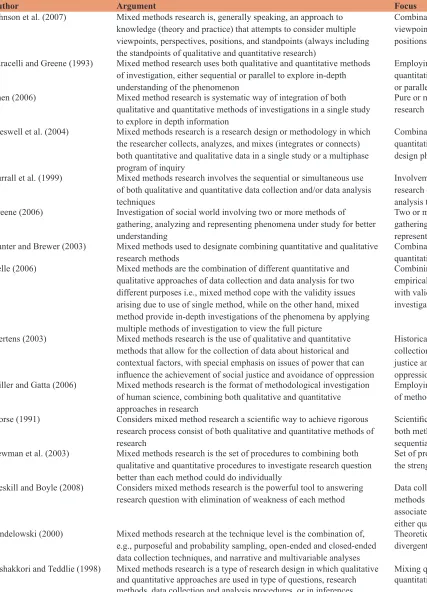
of different advocated of mixed method research. Table 1 provides
an overview of literature focused on defining the mixed method
research.
3. MIXED METHOD RESEARCH DESIGNS
Literature exposes the dominations of both qualitative and quantitative during research design. Studies focused on the domination of each method on the different stages of the research design and discussed the strengths and weakness of each method (Johnson and Onwuegbuzie, 2004). Mix method researches develop and interpret a conceptual framework, to validate quantitative results by linking the information extracted from the qualitative phase of the study, and to construct indices from qualitative data that can be utilized to analyze quantitative data (Madey, 1982). By conducting mixed methods studies, research scholars are in a better position to combine empirical precision with descriptive precision (Onwuegbuzie, 2003a). In addition, by employing a pragmatist lens (i.e. using both quantitative and qualitative techniques), rather than using a single lens (i.e. conducting mono-method studies), investigators are able to
zoom into microscopic detail or to zoom out to indefinite scope
(Willems and Raush, 1969). Mixed research investigations afford researchers with the opportunity to combine macro and micro levels of a study. Teddlie and Tashakkori (2006) presented a general typology of research designs that features those utilizing mixed methods. The methods-strands matrix includes both mono method and mixed methods designs, but the emphasis is on the more complex and adaptable mixed ones. Tashakkori and Teddlie (1998) developed a pragmatic framework for understanding why to use mixed methods. They point out that a research project
has three stages i.e. the first stage concerns are about the type of
project. Projects can be exploratory (without a priori hypotheses)
and/or confirmatory (with a priori hypotheses). The second stage
concerns are about the type of data collection and operations. Research operations include sampling procedures, measurement techniques, and methods for establishing the trustworthiness of the results. The third stage concerns are about the type of data analysis and inference.
From the above discussion it can be concluded that mixed method research deals with discussion on strengths of different designs and liberty to combine qualitative and quantitative research approaches at different stages of the research and their capability to add rigor to research. However, very few studies found a set of techniques through which this combination is possible and its practical implications in real life situations. The present study explores the question i.e. how qualitative and quantitative research design can be mixed up to eliminate reliability, validity and generalization issues by providing a mixed method sequential design and test it on real situation. Onwuegbuzie et al. (2010)
provided 10 phase model and a number of approaches, could optimize use of mixed method approach for the instrument
development and construct validation. The study finds mixed method research design best fitted which was utilized by the
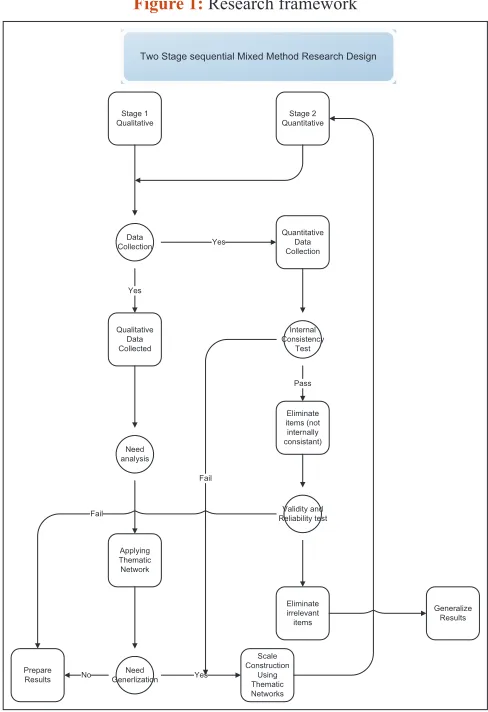
researchers for scale construction and testing validity, reliability and generalization issues. A two stage research design has been proposed for this study. Figure 1 shows the proposed sequential two stage mixed method research design having the potential to counter validity, reliability and generalization issue of research. Proposed research design consist of two stages i.e. qualitative data which is collected and to be analyzed by using thematic networks. The generalization of these results is restricted; as results require generalization that being the case it requires to employee second stage of proposed research design. Stage one provides basis for proceeding to the next stage by constructing a scale based on these thematic networks. Further, validity and reliability of data empirically tested through this scale. Methodological framework of proposed sequential research design is given in Figure 1.
4. THEMATIC NETWORKS
The growth in qualitative research is a well-noted and a welcomed fact within the social sciences; however, there is a regrettable lack of tools available for the analysis of qualitative material. There is a need for greater disclosure in qualitative analysis, and for more sophisticated tools to facilitate such analyses. The study
6WDJH 4XDOLWDWLYH
'DWD &ROOHFWLRQ
4XDOLWDWLYH 'DWD &ROOHFWHG
1HHG DQDO\VLV
$SSO\LQJ 7KHPDWLF 1HWZRUN
1HHG *HQHUOL]DWLRQ
<HV
6FDOH &RQVWUXFWLRQ
8VLQJ 7KHPDWLF 1HWZRUNV 3UHSDUH
5HVXOWV 1R <HV
,QWHUQDO &RQVLVWHQF\
7HVW 6WDJH 4XDQWLWDWLYH
4XDQWLWDWLYH 'DWD &ROOHFWLRQ <HV
3DVV
(OLPLQDWH LWHPV QRW LQWHUQDOO\ FRQVLVWDQW
)DLO
9DOLGLW\ DQG 5HOLDELOLW\ WHVW
(OLPLQDWH LUUHOHYDQW LWHPV
*HQHUDOL]H 5HVXOWV )DLO
7ZR 6WDJH VHTXHQWLDO 0L[HG 0HWKRG 5HVHDUFK 'HVLJQ
developed the thematic analyses that is aided by and presented as thematic networks. Thematic networks are web-like illustrations that summarize the main themes constituting a piece of text. The thematic networks technique is a robust and highly sensitive tool for the systematization and presentation of qualitative analyses (Attride-Stirling, 2001).
Thematic analysis is a poorly demarcated, rarely acknowledged, yet widely used qualitative analytic method within psychology.
It offers an accessible and theoretically flexible approach to
analyzing qualitative data. Thematic analysis locating it in relation to other qualitative analytic methods that searches for themes or patterns, and in relation to different epistemological
Table 1: Defining mixed method research
Author Argument Focus
Johnson et al. (2007) Mixed methods research is, generally speaking, an approach to knowledge (theory and practice) that attempts to consider multiple viewpoints, perspectives, positions, and standpoints (always including the standpoints of qualitative and quantitative research)
Combination of multiple viewpoints, perspective, positions and standpoints
Caracelli and Greene (1993) Mixed method research uses both qualitative and quantitative methods of investigation, either sequential or parallel to explore in-depth understanding of the phenomenon
Employing Qualitative and quantitative method, sequential or parallel
Chen (2006) Mixed method research is systematic way of integration of both qualitative and quantitative methods of investigations in a single study to explore in depth information
Pure or modified mixed method research
Creswell et al. (2004) Mixed methods research is a research design or methodology in which the researcher collects, analyzes, and mixes (integrates or connects) both quantitative and qualitative data in a single study or a multiphase program of inquiry
Combination of qualitative and quantitative data in research design phase
Currall et al. (1999) Mixed methods research involves the sequential or simultaneous use of both qualitative and quantitative data collection and/or data analysis techniques
Involvement of mixed method research on data collection or analysis technique
Greene (2006) Investigation of social world involving two or more methods of gathering, analyzing and representing phenomena under study for better understanding
Two or more methods to gathering, analyzing and representation
Hunter and Brewer (2003) Mixed methods used to designate combining quantitative and qualitative
research methods Combination of qualitative and quantitative research
Kelle (2006) Mixed methods are the combination of different quantitative and qualitative approaches of data collection and data analysis for two different purposes i.e., mixed method cope with the validity issues arising due to use of single method, while on the other hand, mixed method provide in-depth investigations of the phenomena by applying multiple methods of investigation to view the full picture
Combining both in single empirical research, coping with validity issue, in-depth investigation
Mertens (2003) Mixed methods research is the use of qualitative and quantitative methods that allow for the collection of data about historical and contextual factors, with special emphasis on issues of power that can influence the achievement of social justice and avoidance of oppression
Historical and contextual data collection to achieve social justice and avoidance of oppression
Miller and Gatta (2006) Mixed methods research is the format of methodological investigation of human science, combining both qualitative and quantitative approaches in research
Employing different combination of methodological research
Morse (1991) Considers mixed method research a scientific way to achieve rigorous research process consist of both qualitative and quantitative methods of research
Scientifically rigorous process, both methods could be employed sequential or simultaneously Newman et al. (2003) Mixed methods research is the set of procedures to combining both
qualitative and quantitative procedures to investigate research question better than each method could do individually
Set of procedures to combining the strengths of both
Preskill and Boyle (2008) Considers mixed methods research is the powerful tool to answering
research question with elimination of weakness of each method Data collection from both methods to eliminate the biasness associated with each method either qualitative or quantitative Sandelowski (2000) Mixed methods research at the technique level is the combination of,
e.g., purposeful and probability sampling, open-ended and closed-ended data collection techniques, and narrative and multivariable analyses
Theoretically combining divergent approaches to research.
Tashakkori and Teddlie (1998) Mixed methods research is a type of research design in which qualitative and quantitative approaches are used in type of questions, research methods, data collection and analysis procedures, or in inferences
and ontological positions. We then provide clear guidelines to those who are keen to start thematic analysis, or conduct it in a more deliberate and rigorous way, and consider potential pitfalls in conducting thematic analysis. Finally, we outline the disadvantages and advantages of thematic analysis. We conclude by advocating
thematic analysis as a useful and flexible method for qualitative
research in and beyond psychology (Braun and Clarke, 2006).
4.1. Applying Thematic Network on a Real Situation The current study analyzed the effect of civil unrest on the local business in Pakistan. Due to problems faced by the researchers to
understand the actual situation, and keeping in view the difficulties
and limitation of quantitative research design, a mixed method of the research has been adopted. The current study selected snowball sample of 30 business owners from the victimized areas of Pakistan. Unstructured interviews was conducted with the respondents, rationale for choosing snowball sample was because of the integrated relationship between the owners of the business and a local community, attached to business from generation to generation. The study recorded interviews of the respondents and then transforms them into the thematic networks for qualitative analysis by using the following steps.
4.1.1. Step 1: Coding the material
The first step in a thematic networks analysis is to reduce the data.
This may be done by dissecting the text into manageable and meaningful text segments, by using a coding framework
(Attride-Stirling, 2001). A codification of text framework is defined at this
step to dissimilate the text into meaningful segments, based on the research objective.
4.1.2. Step 2: Identify themes
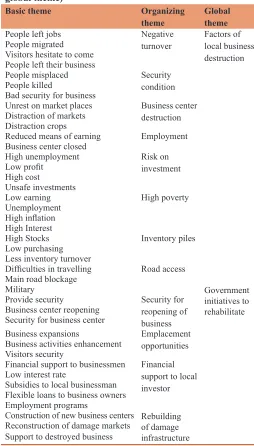
The study identifies 40 basic themes presented in Table 2 generated from the 70 coded segments. In the example, the analysis focused on discursive themes common across the interviewees. The study focuses on the themes that were common in both focus groups; therefore, the themes that were more common were given precedence. This criterion for selection was not intended to attribute greater overall explanatory value to themes on a quantitative basis; it simply made it possible to focus attention on the common, homogenous and popular themes, which was the main focus of this study. The second stage was to develop organizing theme i.e. total 12 organizing themes is developed through 40 basic themes related to the concepts described by each basic themes, further these 12 organizing themes grouped into two major factors and interest of the study as shown column 3 of Table 2.
4.1.3. Step 3: Constructing the networks
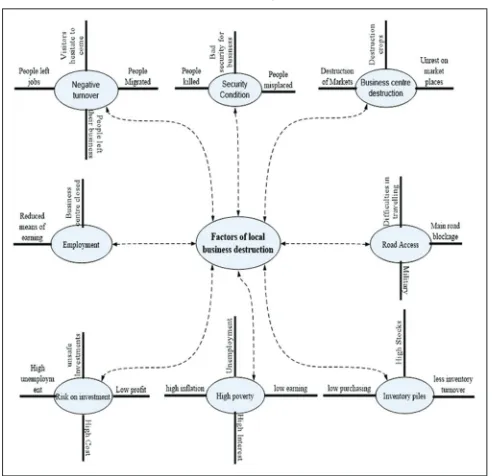
The 40 themes were arranged 12 organizing themes and subdivided into two global themes of interest on the basis of related conceptual content. These were then illustrated as two separate thematic networks – Figures 2 and 3 verified and adjusted
against the data.
4.1.4. Step 4: Interpreting thematic networks
Qualitative data in the above example contains information about
two basic factors, exposed by two global themes first “factors of
local business destruction”which determines the basic factors that affect the local businesses in Pakistan during the military operation against terrorists. Military operation increased negative turnover of the peoples which depicts negative sign on the local
business in Pakistan. Horrific security conditions and business
center destructions lead to high poverty rate and high risk on investments of the local inhabitants, on the other hand access to
road for the locals was difficult, sky-scraping the problems for the
business in Pakistan during the military operation. Second factor
leads to the perceived “Government initiatives to rehabilitate
the local business” after military operation in Pakistan, local communities were of the view that government would facilitate them in rebuilding their business devastated during the military operation in Pakistan. Government should provide facilitation to the local business owner to reconstruct their business centers and
provide financial support to the local investors to rebuild their
trust, meanwhile security for the visitors is a major concern for the rehabilitation process.
Table 2: Thematic networks (from basic theme to global theme)
Basic theme Organizing
theme Global theme
People left jobs Negative
turnover Factors of local business destruction People migrated
Visitors hesitate to come People left their business
People misplaced Security
condition People killed
Bad security for business
Unrest on market places Business center destruction Distraction of markets
Distraction crops
Reduced means of earning Employment Business center closed
High unemployment Risk on
investment Low profit
High cost
Unsafe investments
Low earning High poverty
Unemployment High inflation High Interest
High Stocks Inventory piles
Low purchasing Less inventory turnover
Difficulties in travelling Road access Main road blockage
Military Government
initiatives to rehabilitate
Provide security Security for
reopening of business Business center reopening
Security for business center
Business expansions Emplacement
opportunities Business activities enhancement
Visitors security
Financial support to businessmen Financial support to local investor Low interest rate
Subsidies to local businessman Flexible loans to business owners Employment programs
Construction of new business centers Rebuilding of damage infrastructure Reconstruction of damage markets
4.2. Validity Issue in Thematic Networks
Quantitative research encounters the issue of validity, therefore, many statistical approaches to counter validity issue, but in qualitative research, issue still facing the criticism and different topologies (Tashakkori and Teddlie, 2003; 2006). In mixed method research, where quantitative and qualitative approaches
are combined, discussions about “validity” issues are still in their
infancy (Onwuegbuzie and Johnson, 2006). Mixed research design involves combining complementary strengths and non-overlapping weaknesses of quantitative and qualitative research, and assessing
the validity of findings is particularly complex. As a matter of
fact, the validity of the thematic network is also questioned i.e. Does thematic network interpret what is real? Are these networks competent enough to describe the facts related to certain phenomenon? Do they cope with the validity issue in qualitative
research? Researchers provide the ways to refine qualitative
models with quantitative tools (Qureshi et al., 2013a,b,c).
5. COPING WITH VALIDITY ISSUE:
ONE STEP AHEAD IN MIXED METHOD
RESEARCH
Thematic network itself provides the basis for employing quantitative method of research. Let us consider global network, as latent construct of some formative indicators. The study constructed a Likert scale questionnaire based on the above mentioned criteria and selected a random sample of 800 business owners from the victimized areas of the Pakistan. The results from the respondents are further processed to address the validity and reliability issues in the data.
5.1 Convergent and Discrimenent Validity
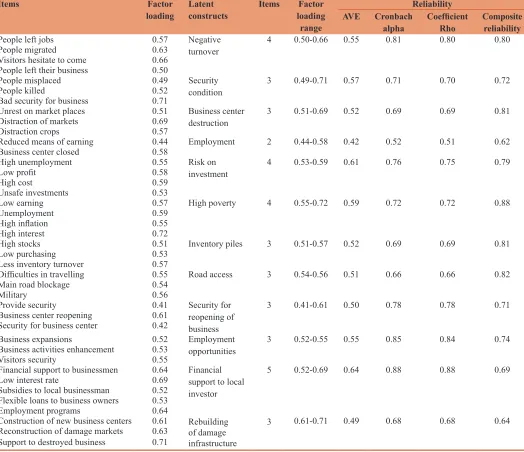
Convergent validity is assessed to determine the extent to which measurement items for a given construct refer to that construct only. Table 3 shows confirmatory factor analysis (CFA) results
which were performed to determine the factor loading for each item, along with its reliability scales (i.e. Cronbach’s alpha and
co-efficient Rho). Factor loading above than 0.50 indicated fitness
of the item to latent constructs (Fornell and Larcker, 1981). Table 3 shows that most of the constructs have factor loading above 0.50 but few has the issues and not reliable to determine the construct. Further the construct have reliability indicators above 0.70 are considerably internally consistent (Hair et al., 1995; Nunnally and Bernstein, 1994; Nunnally, 1978). Constructs having average variation extraction above 0.50 are producing considerable variation (Hair et al., 1995). Table 3 further indicated that few items are showing less factor loading and reliability statistics like employment construct has the item with factor loading 0.44
which reflect the less reliability of the item to determine the
construct, which indicate reliability issue in the generalization of the construct to the population.
The fit indices suggest that the data fits the model, as indicated in
Table 4. All achieved values of fitness indices are in acceptable range.
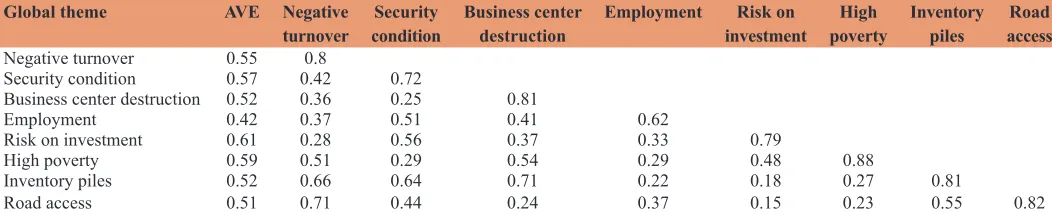
Convergent and discriminant validity is further assessed using the Fornell and Larcker (1981) analysis. As shown in Tables 5 and 6, the average variance extracted (AVE) for each of the new construct was above the suggested cut-off of 0.5 (i.e. variance explained by the construct is greater than the measurement error), thus suggesting evidence of convergent validity. Moreover, the square root of AVE for each construct was greater than all the inter-construct correlations, further suggesting evidence of discriminant validity.
6. CONCLUSION
Advocates of mixed method research claims that mixed method is
more flexible in its administration and more precise than qualitative
or quantitative method separately. Qualitative research usually produces more epistemological results, while the quantitative is more focused on the ontological investigations. Researchers prefer qualitative research when there is a need to explore new phenomena and usually less information on such phenomena Figure 2: Thematic networks (effects of military operation on local
business)
Table 3: CFA and reliability of instrument
Items Factor
loading Latent constructs Items loading Factor range
Reliability AVE Cronbach
alpha Coefficient Rho Composite reliability
People left jobs 0.57 Negative
turnover 4 0.50-0.66 0.55 0.81 0.80 0.80
People migrated 0.63
Visitors hesitate to come 0.66
People left their business 0.50
People misplaced 0.49 Security
condition 3 0.49-0.71 0.57 0.71 0.70 0.72
People killed 0.52
Bad security for business 0.71
Unrest on market places 0.51 Business center
destruction 3 0.51-0.69 0.52 0.69 0.69 0.81
Distraction of markets 0.69
Distraction crops 0.57
Reduced means of earning 0.44 Employment 2 0.44-0.58 0.42 0.52 0.51 0.62
Business center closed 0.58
High unemployment 0.55 Risk on
investment 4 0.53-0.59 0.61 0.76 0.75 0.79
Low profit 0.58
High cost 0.59
Unsafe investments 0.53
Low earning 0.57 High poverty 4 0.55-0.72 0.59 0.72 0.72 0.88
Unemployment 0.59
High inflation 0.55
High interest 0.72
High stocks 0.51 Inventory piles 3 0.51-0.57 0.52 0.69 0.69 0.81
Low purchasing 0.53
Less inventory turnover 0.57
Difficulties in travelling 0.55 Road access 3 0.54-0.56 0.51 0.66 0.66 0.82
Main road blockage 0.54
Military 0.56
Provide security 0.41 Security for
reopening of business
3 0.41-0.61 0.50 0.78 0.78 0.71
Business center reopening 0.61
Security for business center 0.42
Business expansions 0.52 Employment
opportunities 3 0.52-0.55 0.55 0.85 0.84 0.74
Business activities enhancement 0.53
Visitors security 0.55
Financial support to businessmen 0.64 Financial support to local investor
5 0.52-0.69 0.64 0.88 0.88 0.69
Low interest rate 0.69
Subsidies to local businessman 0.52 Flexible loans to business owners 0.53
Employment programs 0.64
Construction of new business centers 0.61 Rebuilding of damage infrastructure
3 0.61-0.71 0.49 0.68 0.68 0.64
Reconstruction of damage markets 0.63 Support to destroyed business 0.71
CFA: Confirmatory factor analysis, AVE: Average variance extracted
Table 4: Model fitness
Fitness indices Standard values Achieved values
GFI ≥0.90 0.920
NFI ≥0.90 0.899
RMSEA P<0.08 0.078
CFI Must exceed 0.80 0.92
AGFI ≥0.80 0.88
Chi-square (χ2/df) <3 2.27
NFI: Normed fit index, AGFI: Adjusted goodness of fit index, CFI: Comparative fit index, RMSEA: Root mean square error of approximation
is available. Qualitative research designs provide in depth information about events and related casual chain but due to shortcomings in its administration data can be collected from very small sample, personal willingness and opinions are indivisible from the respondents’ responses which may cause the issues of reliability, validity and generalizability of the qualitative research design. The current study proposed the framework by employing a
two stage mixed method research design. At first, the study deals
with the qualitative data, for this purpose, the study constructed the thematic networks for the content analysis of qualitative data, as it provides basis for proposed second stages of the research design, which is scale construction for empirical testing of underlying theory. Limitations of stage one can be optimized by employing a quantitative measurement tool, which can further be tested on empirical grounds to ad rigor to results. Further validity and reliability of the thematic networks measured through the CFA. The current study brings a case study of Pakistan by collecting data from 800 business owners nation-wide who have been suffered due to vulnerable situation of terrorism in Pakistan. The results show that terrible law and order situation and devastation of business center leads to high poverty rate and high risk on investments of the local inhabitants. Moreover, accessibility of road for the local
peoples is difficult, which further aggravates the problems for
The study suggested a sequential mixed method research design using thematic network for qualitative data analysis. Further these networks can be utilized for scale construction and eliminating biasness from qualitative results which limits validity, reliability and generalization through empirical tests. Moreover, it could provide both epistemological and ontological results in a single study to provide more precise estimations.
REFERENCES
Attride-Stirling, J. (2001), Thematic networks: An analytic tool for qualitative research. Qualitative Research, 1(3), 385-405.
Braun, V., Clarke, V. (2006), Using thematic analysis in psychology. Qualitative Research in Psychology, 3(2), 77-101.
Caracelli, V.J., Greene, J.C. (1993), Data analysis strategies for mixed-method evaluation designs. Educational Evaluation and Policy Analysis, 15(2), 195-207.
Chen, H.T. (2006), A theory-driven evaluation perspective on mixed methods research. Research in the Schools, 13(1), 75-83.
Creswell, J.W., Fetters, M.D., Ivankova, N.V. (2004), Designing a mixed methods study in primary care. The Annals of Family Medicine, 2(1), 7-12.
Currall, S.C., Hammer, T.H., Baggett, L.S., Doniger, G.M. (1999), Combining qualitative and quantitative methodologies to Study Group processes: An Illustrative study of acorporate board of directors. Organizational Research Methods, 2(1), 5-36.
Fornell, C., Larcker, D.F. (1981), Evaluating structural equation models with unobservable variables and measurement error. Journal of Marketing Research, 39-50.
Greene, J.C. (2006), Toward a methodology of mixed methods social inquiry. Research in the Schools, 13(1), 93-98.
Guthrie, J., Petty, R., Yongvanich, K., Ricceri, F. (2004), Using content analysis as a research method to inquire into intellectual capital reporting. Journal of Intellectual Capital, 5(2), 282-293.
Hair Jr, J.F., Anderson, R.E., Tatham, R.L., Black, W.C. (1995), Multivariate Data Analysis. vol. 4. New Jersey: Prentice-Hall, Inc. Hunter, A., Brewer, J. (2003), Multimethod research in sociology. In:
Tashakkori, A., Teddlie, C., editors. Handbook of Mixed Methods in Social and Behavioral Research. Thousand Oaks, CA: Sage.
p577-594.
Jackson, K.M., Trochim, W.M. (2002), Concept mapping as an alternative approach for the analysis of open-ended survey responses. Organizational Research Methods, 5(4), 307-336.
Johnson, R.B., Onwuegbuzie, A.J. (2004), Mixed methods research: A research paradigm whose time has come. Educational Researcher, 33(7), 14-26.
Johnson, R.B., Onwuegbuzie, A.J., Turner, L.A. (2007), Toward a definition of mixed methods research. Journal of Mixed Methods Research, 1(2), 112-133.
Kelle, U. (2006), Combining qualitative and quantitative methods in research practice: Purposes and advantages. Qualitative Research in Psychology, 3(4), 293-311.
Madey, D.L. (1982), Some benefits of integrating qualitative and quantitative methods in program evaluation, with illustrations. Educational Evaluation and Policy Analysis, 223-236.
Mertens, D. (2003), Mixed methods and the politics of human research: The transformative-emancipatory perspective. In: Tashakkori, A., Teddlie, C., editors. Handbook of Mixed Methods in Social and Behavioral Research. Thousand Oaks, CA: Sage. p135-164. Miller, S., Gatta, J. (2006), The use of mixed methods models and designs
in the human sciences: Problems and prospects. Quality & Quantity, 40(4), 595-610.
Morse, J. (1991), Approaches to qualitative-quantitative methodological triangulation. Nursing Research, 40, 120-123.
Newman, I., Ridenour, C.S., Newman, C., DeMarco, G.M.P. (2003), A typology of research purposes and its relationship to mixed methods. In: Tashakkori, A., Teddlie, C., editors. Handbook of Mixed Methods in Social and Behavioral Research. Thousand Oaks, CA: Sage. p189-208.
Nunnally, J.C. (1978), Psychometric Theory. New York: McGraw Hills. Nunnally, J.C., Bernstein, I.H. (1994), The assessment of reliability.
Psychometric Theory, 3, 248-292.
Onwuegbuzie, A.J. (2003), Expanding the framework of internal and external validity in quantitative research. Research in the Schools, 10(1), 71-90.
Onwuegbuzie, A.J., Bustamante, R.M., Nelson, J.A. (2010), Mixed research as a tool for developing quantitative instruments. Journal of Mixed Methods Research, 4(1), 56-78.
Onwuegbuzie, A.J., Johnson, R.B. (2006), The validity issue in mixed
Table 6: Correlation and AVE
Global theme AVE Security for reopening
of business Employment opportunities Financial support to local investor Rebuilding of damage infrastructure
Security for reopening of business 0.50 0.71
Employment opportunities 0.55 0.57 0.74
Financial support to local investor 0.64 0.55 0.61 0.69
Rebuilding of damage infrastructure 0.49 0.24 0.55 0.51 0.67
Construct variance is shown on the diagonal. AVE: Average variance extracted
Table 5: Correlation and AVE
Global theme AVE Negative
turnover conditionSecurity Business center destruction Employment investmentRisk on povertyHigh Inventory piles accessRoad
Negative turnover 0.55 0.8
Security condition 0.57 0.42 0.72
Business center destruction 0.52 0.36 0.25 0.81
Employment 0.42 0.37 0.51 0.41 0.62
Risk on investment 0.61 0.28 0.56 0.37 0.33 0.79
High poverty 0.59 0.51 0.29 0.54 0.29 0.48 0.88
Inventory piles 0.52 0.66 0.64 0.71 0.22 0.18 0.27 0.81
Road access 0.51 0.71 0.44 0.24 0.37 0.15 0.23 0.55 0.82
research. Research in the Schools, 13(1), 48-63.
Preskill, H., Boyle, S. (2008), A multidisciplinary model of evaluation capacity building. American Journal of Evaluation, 29(4), 443-459. Qureshi, M.I., Iftikhar, M., Bhatti, M.N., Shams, T., Zaman, K. (2013b),
Critical elements in implementations of just-in-time management: Empirical study of cement industry in Pakistan. Springer Plus, 2(1), 645.
Qureshi, M.I., Iftikhar, M., Janjua, S.Y., Zaman, K., Raja, U.M., Javed, Y. (2013a), Empirical investigation of mobbing, stress and employees’ behavior at work place: Quantitatively refining a qualitative model. Quality & Quantity, 49(1), 1-21.
Qureshi, M.I., Janjua, S.Y., Zaman, K., Lodhi, M.S., Tariq, Y.B. (2013c), Internationalization of higher education institutions: Implementation of DMAIC cycle. Scientometrics, 98(3), 1-16.
Sandelowski, M. (2000), Focus on research methods-whatever happened to qualitative description? Research in nursing and health, 23(4), 334-340.
Tashakkori, A., Teddlie, C. (1998), Mixed Methodology: Combining Qualitative and Quantitative Approaches. Applied Social Research Methods Series. Vol. 46. Thousand Oaks, CA: Sage.
Teddlie, C., Tashakkori, A. (2003), Major issues and controveries inthe use of mixed methods in the social and behvioral sciences. Handbook of Mixed Methods in Social & Behavioral Research. Thousand Oaks: Sage, p3-50.
Teddlie, C., Tashakkori, A. (2006), A general typology of research designs featuring mixed methods. Research in the Schools, 13(1), 12-28. Willems, E.P., Raush, H.L. (1969), Naturalistic Viewpoints in