2017 International Conference on Computer Science and Application Engineering (CSAE 2017) ISBN: 978-1-60595-505-6
Iterative Innovation Design Methods for Internet Products
in the Era of Big data
Changxue Pan1,*, Tao Xi1,2, Xianqiang Zheng2 and Haifeng Shan2
1
Wuhan University of Technology, 122 Luoshi Road, Wuhan, China 2
Shanghai Jiaotong University, 800 Dongchuan Road, Shanghai, China
ABSTRACT
This paper aims to elaborate on the iterative innovation design methods of Internet products in the era of big data. Through the analysis of current Internet product iteration design practice, we examine the impact of big data thinking on Internet product design in terms of design scope, design concepts, and design methods, and we propose iterative innovation design methods relating to targeted advertising delivery, customizing users’ potential demands, and dynamic optimization of marketing promotion strategy. Finally, we discuss the advantages and precautions of using big data thinking on Internet product iterative design, proposing the appropriate advice for the development of the Internet product design.
INTRODUCTION
The concept of Internet product extending from the traditional "product", is output and used in the Internet for the management of commodity, it is to meet the Internet users needs and desires of invisible carrier. In short, the Internet product refers to the site to meet the needs of users created for the operation of the functions and services, it is the site function and service integration. What the Internet needs is fast response, rapid practice and adjustment, thinking ahead of action to make timely changes,so iterative design is necessary. Iterative design is a design methodology based on a cyclic process of prototyping, testing, analyzing, and refining a product or process. Based on the results of testing the most recent iteration of a design, changes and refinements are made. This process is intended to ultimately improve the quality and functionality of a design. In iterative design, interaction with the designed system is used as a form of research for informing and evolving a project, as successive versions, or iterations of a design are implemented.
Big data is a term for data sets that are so large or complex that traditional data processing application software is inadequate to deal with them. Challenges include capture, storage, analysis, search, sharing, transfer, visualization, querying, updating and information privacy. The term "big data" often refers simply to the use of predictive analytics, user behavior analytics, or certain other advanced data analytics methods that extract value from data, and seldom to a particular size of data set. And this paper aims to elaborate on the iterative innovation design methods of Internet products in the era of big data.
open data, once handled properly, can provide answers for millions of problems that need to be solved [1]. Designers can perform in-depth exploration of Internet product design through user analysis, personality customization, iterative innovation, and other development techniques, emphasizing big data techniques, in order to improve the development of Internet products.
Iterative Design Characteristics of Existing Internet Products
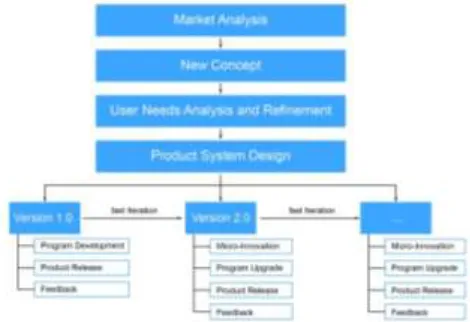
Internet products exist to provide functions and services for people’s lives. The Internet is an invisible medium whose purpose is to meet these needs. It is through the process of continuous update and improvement known as iterative design that these growing needs are met. Figure 1 shows the iterative design process of Internet products. Iterative innovation on the Internet is divided into two primary aspects. In micro-innovation, it is left to the user’s imagination alone to innovate, from quantitative to qualitative change and constant accumulated improvements, ultimately settling upon an innovative product design. Micro-innovation pursues simple design based on a user-centered process. The purpose of user-centered processes is to improve the user experience. For example, the Alibaba company employed user research to find that China’s online buyers and sellers lack trust among one another, resulting in online trading bottlenecks [2]. In response to this pain point, Alibaba launched “security transaction” function, an early prototype of the Alipay product. The biggest difference
[image:2.612.181.416.378.539.2]
Figure 1. The iterative design process for Internet innovation.
The second aspect of iterative Internet innovation is fast iteration. Fast iteration consists of adjusting quickly based on customer feedback, rapidly integrating changes into new versions of a design [3]. To correct HP’s market stagnation, in 1999 Hewlett-Packard CEO Carly Fiorina adopted and imposed a “shoot first, aim later” product-release policy [4]. This new policy was foreign to HP executives, accustomed as they were to 95% product performance before release. Fiorina lowered HP’s legendary quality standard from 95% to 80%, spurring more rapid release of product prototypes, and this move apparently increased sales significantly. Such a process relies on rapid refinement of product prototypes that makes use of an iterative loop turning on user feedback. The goal is to satisfy users’ expectations and demands, ultimately in order to reinforce attachment and dependence on the product. Fast iteration must emphasize the three qualities of speed, precision, and immediacy. Speed refers to a rapid development phase. Precision refers to the ability to quickly identify users’ specific pain points in a prototype review. Immediacy refers to a rapid turn back from review into development without excessive delays. Using these methods to transform the best ideas into products, enterprises have greater success achieving development objectives.
THE IMPACT OF BIG DATA THINKING ON THE ITERATIVE DESIGN OF INTERNET PRODUCTS
Big data thinking calls for a new model of identifying value through large-scale data analysis. Ideally, it offers a new objectivity and rationality not always seen in the conventional design planning model. Proper design thinking is ultimately geared toward creating a supply of a particular commodity that is not merely suited to customer product demand, but ideally suited a truly harmonious combination of big data thinking and design thinking. Hence, it should address users’ urgent needs in a new and improved way.
Changes to Design Scopes
In the traditional design process, a designer comes into close contact with a limited number of users and reviews individual feedback in order to understand how to iteratively improve the design. This may be through direct observation and communication with users or it may be through careful selection and analysis of a small sample of data. Big data thinking changes this relationship fundamentally. Designers do not consider individual users’ active feedback: instead, they detect mass user behaviors through analysis of huge amounts of data, and use the mined data to guide product design.
Changes of Design Concepts
conception of precision. It relies similarly on a probabilistic model; however, its huge sample reflects a different kind of inferential precision as the sample size approaches the full population [1].
Innovation of Design Methods
Modern information technology in the era of big data makes it theoretically possible to capture virtually any measurable datum, classify it, and post it to the cloud among like data for up-to-the-minute analysis, visualization, and human or automated response. Measurable data include users’ Internet product activity, which, when filtered through a creative thinking process aided by rich algorithms and analytical features, can stimulate actionable results that are atypical in traditional data analysis [5], and others call this “reality mining.” While analysis and management of so-called “scopic” big data flows is still a practice in its infancy [6], there are many active efforts to harness and make practical use of big data. One example of this relates to the management of environmental sensors. Practitioners are beginning to develop and negotiate open data formats and tools to view, manage, and ultimately automatically react to potentially huge and intractable quantities of sensed information [7].
BIG-DATA-DRIVEN ITERATIVE INNOVATION DESIGN METHODS FOR INTERNET PRODUCTS
Targeted Advertising Delivery
Due to its delayed nature, discreteness, and other aspects, targeting readers’ needs and interests using traditional advertising placement has always been famously difficult. Although traditional measurements include sales data, promotion response rates, market econometrics, and various other measures, advertising effect is still difficult to quantify for traditional media [8]. With the new technology, Internet marketing firms can employ cookies to capture information about users who visit their website [9]. Assuming cooperation with upstream and downstream providers, traces can be tracked throughout a user’s virtual path through news, e-commerce, online gaming and other life service. Using this traffic flow as a starting point, developers can identify target audiences in a highly focused way and custom-tailor media to each audience.
Customizing User’s Potential Demands
forecasts, local events, urgent news, as well as the now-common log analysis of corresponding purchasing patterns.
Dynamic Optimization of Marketing Promotion Strategy
As stated above, traditional data analysis lacks many of the benefits of big data analysis. As practitioners refine the tools, the models, and the practical applications for big data, we should see further leaps in its capabilities. For marketing, this increasingly means dynamic optimization of promotional prowess. For example, online game companies still use online and hard game media as their preferred promotional channel. These media fall into three main categories: industry media, outdoor advertising, and network media. Among these,70% of marketing budgets are spent on network media [10]. The industry can now analyze cause and effect among these multiple promotional channels to tune their marketing strategy. In fact, through reality mining, discussed above, and new psychosocial network analytical frameworks called “honest signals” [5], paint a future in which big data not only can model in real time, but can actually predict trends far into the future.
ITERATIVE INNOVATION DESIGN STRENGTHS OF INTERNET PRODUCTS UNDER BIG DATA THINKING
High Efficiency
The Internet has brought much wider participation and rapid change. This continuing development has led to efficiencies in the areas of data management and iterative design of products. Increasingly, this is based on big data decisionmaking, which exactly corresponds to three features in the rapid change of Internet products – speed, precision, and immediacy. Using big data thinking to make iterative design has been critical both in terms of solving customer needs and cultivating user loyalty.
Economy
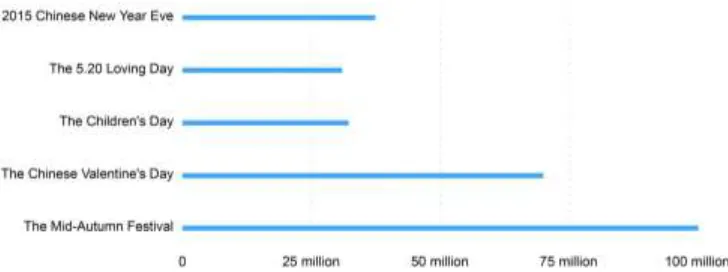
Figure 2. Relationship between the number of WeChat red envelope participants and different festivals.
ITERATIVE INNOVATION DESIGN CONCERNS OF INTERNET PRODUCTS UNDER THE BIG DATA THINKING
The advantage of big data lies not in its enormity, but in its utility. Big data analysts practitioners must come to fully understand the value of the data and how to use it for decision-making and, in turn, value creation [3]. However, an appreciation of the power of big data must be balanced by an imperative of good design. On design, Steve Jobs famously remarked that, “A lot of times, people don’t know what they want until you show it to them” [12]. This reinforced the public’s belief that Apple in its arrogance did not rely on user opinion. On the contrary, Jobs and Apple did in fact rely on market analysis, although he treated designers’ subjective initiative as far more important than at most companies. Correct use of big data will strike a balance with other sources of innovation knowledge. Otherwise, there is the danger of falling into a quagmire of machine-made decisions that displace the human element [13].
For years there have been concerns afloat that users are surrendering control of information that was considered private just a few years ago. Big data pioneers are going further, making surprising presumptions and yet also sweeping concessions about individual data sovereignty. This revolution in information exchange in the big data era is bound to lead to progressive change in privacy norms. Alex Pentland has argued for a “New Deal on Data” that is being carried out as a kind of bill of rights both in the U.S. and Europe [14]. The regulation and ethical application of data is crucial. Data managers and regulators share responsibility of maintaining control of data, through monitoring data collection, storage, use, and all other aspects of its custody.
CONCLUSIONS
drive the present, and rule the future. Designers need a mature sense of the pros and cons of big data. They must ascertain big data’s proper place in the design world, judiciously integrating big data thinking and the iterative process for arriving at new designs.
REFERENCES
1. Mayer-Schönberger, V. and Cukier, K. 2013. Big data: A revolution that will transform how we live,
work, and think. Houghton Mifflin Harcourt, Inc.
2. Li, Q. and Liu, Z. 2007. “Research on chinese C2C e-business institutional trust mechanism: case
study on Taobao and Ebay (cn),” presented at the Wireless Communications, Networking and Mobile Computing International Conference, 2007.
3. Zhao, D. 2014. Internet Thinking Magic.
4. Witzmann, N. and Dörrenbächer, C. 2015. “The link between cultural due diligence and
socio-cultural post-merger integration management as a critical success factor in M&As,” J. Working
Papers.
5. Eagle, N. and Pentland, A. 2006. “Reality mining: sensing complex social systems,” J. Personal and
Ubiquitous Computing, 10(4): 255-268.
6. Czarniawska, B. and Löfgren, O. 2013. Coping with excess: how organizations, communities and
individuals manage overflows. Edward Elgar Publishing, Inc.
7. Gorman, B. L., Resseguie, D. R. and Tomkins-Tinch, C. 2009. “Sensorpedia: Information sharing
across incompatible sensor systems,” presented at the International Symposium on Collaborative Technologies and Systems, May18-May 22, 2009.
8. Ju, H., Huang, Q. and Wang, Y. 2015. “Research on the Effect of Accurate Advertising of Big Data
in the Industrial Reconstruction,” presented at the Journalism and Communication Research.
9. Ni, N. and Jin, S. 2014. “Accurate Advertising and Communication Strategies in the Big Data Era:
Based on Field Theory,” presented at Modern Communication Conference (Communication University of China), China.
10. Lu, H. M. 2014. “Analysis of Network Game Promotion and the Vulgarization Tendency,” presented
at the Edit Journal, China.
11. McAfee, A., Brynjolfsson, E., Davenport, T. H., Patil, D. and Barton, D. 2012. “Big data: The
management revolution,” J. Harvard Business Review, 90(10):61-67.
12. Bloomberg. 1998. Is its comeback for real. May 25, 1998.
13. Pentland, A. 2014. Social physics: How good ideas spread-the lessons from a new science. Penguin,
Inc.
14. Pentland, A. 2009. “Reality mining of mobile communications: Toward a new deal on data,” The