Faculty & Staff Scholarship
2016
Internet of Things and Big Data Analytics for Smart and
Internet of Things and Big Data Analytics for Smart and
Connected Communities
Connected Communities
Yunchuan Sun
Houbing Song
Antonio J. Jara
Rongfang Bie
Follow this and additional works at: https://researchrepository.wvu.edu/faculty_publications Part of the Engineering Commons
Received December 27, 2015, accepted February 1, 2016, date of publication February 12, 2016, date of current version March 11, 2016. Digital Object Identifier 10.1109/ACCESS.2016.2529723
Internet of Things and Big Data Analytics for
Smart and Connected Communities
YUNCHUAN SUN1, (Member, IEEE), HOUBING SONG2, (Senior Member, IEEE),
ANTONIO J. JARA3, (Member, IEEE), AND RONGFANG BIE4, (Member, IEEE)
1Business School, Beijing Normal University, Beijing 100875, China
2Department of Electrical and Computer Engineering, West Virginia University, Montgomery, WV 25136 USA 3University of Applied Sciences Western Switzerland, Sierre 3960, Switzerland
4College of Information Science and Technology, Beijing Normal University, Beijing 100875, China
Corresponding author: Y. Sun ([email protected])
This work was supported by the National Natural Science Foundation of China under Grant 61371185 and Grant 61571049.
ABSTRACT This paper promotes the concept of smart and connected communities SCC, which is evolving from the concept of smart cities. SCC are envisioned to address synergistically the needs of remembering the past (preservation and revitalization), the needs of living in the present (livability), and the needs of planning for the future (attainability). Therefore, the vision of SCC is to improve livability, preservation, revitalization, and attainability of a community. The goal of building SCC for a community is to live in the present, plan for the future, and remember the past. We argue that Internet of Things (IoT) has the potential to provide a ubiquitous network of connected devices and smart sensors for SCC, and big data analytics has the potential to enable the move from IoT to real-time control desired for SCC. We highlight mobile crowdsensing and cyber-physical cloud computing as two most important IoT technologies in promoting SCC. As a case study, we present TreSight, which integrates IoT and big data analytics for smart tourism and sustainable cultural heritage in the city of Trento, Italy.
INDEX TERMS Internet of things, big data analytics, smart and connected communities, smart cities, smart tourism, sustainable cultural heritage.
I. INTRODUCTION
With more than 50 percent of world population living in cities and nearly 70 percent of world population projected to live in cities by 2050, it is expected that cities will face various challenges from sustainability and energy use to safety and effective service delivery. Advances in the effective integra-tion of networked informaintegra-tion systems, sensing and commu-nication devices, data sources, decision making, and physical infrastructure are creating new opportunities to reduce traffic congestion, fight crime, foster economic development, reduce greenhouse gases, and make local governments more open, responsive, and efficient. More and more cities are beginning to harness the power of sensors, engage citizens equipped with smartphones, cloud computing, high-speed networks, and data analytics.
There has been a worldwide trend toward smart cities. In the United States, on September 14, 2015, the Obama Administration announced a new Smart Cities Initiative to help local communities tackle key challenges such as reducing traffic congestion, fighting crime, fostering
economic growth, managing the effects of a changing climate, and improving the delivery of city services. On November 25, 2015, the Networking and Information Technology Research and Development (NITRD) Program announced the release of version 4 of a Smart and Connected Communities Framework [1]. The vision outlined in this framework is that communities in all settings and at all scales have access to advanced cyber-physical systems/Internet of Things technologies and services to enhance the sustainability and quality of life, improved health and safety, and economic prosperity for their residents. The European Commission has also initiated the European Innovation Part-nership on Smart Cities and Communities in July 2012. IEEE formally launched the IEEE Smart Cities Initiative on 25 March 2014.
It is noticeable that the concept of smart cities is evolving into the concept of smart and connected communities (SCC). According to Merriam-Webster, a community is defined as a group of people who live in the same area (such as a city, town, or neighborhood). Although more people live in urban
Y. Sunet al.: IoT and Big Data Analytics for SCCs
areas than in rural areas globally, 46 percent of the world population reside in rural areas in 2014; about 53 million peo-ple live in small towns with populations of less than 25,000. In addition to size difference, typically big cities differ from small towns in history and terrain [2], [3]. Therefore SCC, which takes into account both big cities and small towns, will benefit more people than smart cities.
We argue that internet of things has the potential to provide a ubiquitous network of connected devices and smart sensors for SCC, and big data analytics has the potential to enable the move from IoT to real-time control desired for SCC. The purpose of this article is to characterize SCC, present opportunities and challenges of IoT and big data analytics in SCC, and demonstrate the application of IoT and big data analytics in SCC.
The rest of this article is organized as follows. Section II characterizes SCC. Section III discusses the opportunities and challenges in applying IoT to SCC. Section IV discusses the opportunities and challenges in applying big data analytics to SCC. Section V presents TreSight, a case study of IoT and big data analytics for smart tourism and sustainable cultural heritage in the city of Trento, Italy. Section VI concludes this article.
II. CHARACTERISTICS OF SMART AND CONNECTED COMMUNITIES (SCC)
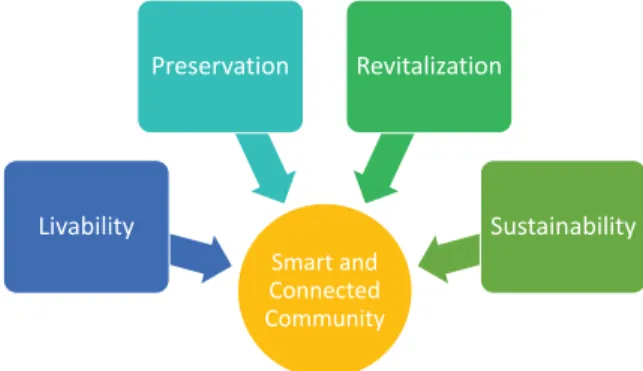
We argue that SCC are envisioned to address synergisti-cally the needs of remembering the past (preservation and revitalization), the needs of living in the present (livability), and the needs of planning for the future (sustainability) [4]. Therefore, the vision of SCC is to improve livability, preser-vation, revitalization, and sustainability, of a community [4], as shown in Figure. 1. The goal of building SCC is to live in the present, plan for the future, and remember the past, of a community.
FIGURE 1. The Vision of Smart and Connected Communities.
A. LIVABILITY
A shared, definitional framework for livability is established by the Interagency Partnership for Sustainable Communi-ties, formed in 2009. This collaboration of U.S. DOT, EPA, and HUD set forth the following six livability principles:
(1) Provide more transportation choices; (2) Promote equi-table, affordable housing; (3) Enhance economic competi-tiveness; (4) Support existing communities; (5) Coordinate policies and leverage investment; and (6) Value communities and neighborhoods [5]. Livability is one of the primary char-acteristics for smart and connected communities.
B. PRESERVATION
Heritage, which can be classified into two categories: cultural heritage and natural heritage, constitutes a source of identity and cohesion for communities disrupted by bewil-dering change and economic instability [6]. In addition to tangible culture (such as buildings, monuments, landscapes, books, works of art, and artifacts), cultural heritage includes intangible culture (such as folklore, traditions, language, and knowledge). In addition to culturally significant landscapes, natural heritage includes biodiversity. Cultural and natural heritage are increasingly threatened with destruction not only by the physical and chemical mechanisms of decay, but also by changing social and economic conditions [7].
C. REVITALIZATION
Many rural communities and small towns are facing chal-lenges, including declining rural populations, rapid growth at metropolitan edges, and loss of farms and working lands [8].
D. SUSTAINABILITY
Sustainable development is defined as the development that meets the needs of the present without compromising the ability of future generations to satisfy their own needs [9]. The sustainability of a community depends on creating and maintaining its economic and environmental health, promot-ing social equity, and fosterpromot-ing broad-based citizen participa-tion in planning and implementaparticipa-tion [10].
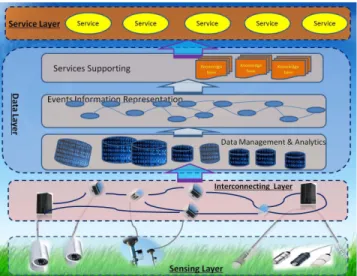
III. OPPORTUNITIES AND CHALLENGES OF IOT IN SCC This section presents an IoT architecture we develop for SCC, as shown in Fig.2, opportunities and challenges of IoT in SCC.
We envision that the architecture of SCC based on IoT is composed of four different layers, i.e., sensing layer, inter-connecting layer, data layer, and services layer, from the bottom up.
• The purpose of the sensing layer is to realize ubiqui-tous sensing. In addition to RFID sensing enabled by wireless sensor networks (WSN), people-centric urban sensing is becoming popular [11], [12]. Further, people-centric sensing can be categorized into three classes: personal sensing, which focuses on personal monitor-ing and archivmonitor-ing; social sensmonitor-ing, which focuses on sharing information within social and special interest groups; and public sensing, which focuses on shar-ing data with everyone for the greater public good (such as entertainment or community action) [11]. Both social sensing and public sensing could be collectively called community sensing, or participatory sensing,
FIGURE 2. Function Architecture of Internet of Things for Smart and Connected Communities.
or opportunistic sensing. With the popularity of smart phones with various sensors such as camera, audio, accelerometer, GPS, gyroscope, compass, proximity, and ambient light, among others, a new community sensing paradigm called mobile crowdsensing (MCS) is emerging [13], [14].
• The purpose of the interconnecting layer is data trans-mission and information exchange among different devices and different domains.
• The purpose of the data layer includes storing the mas-sive, trivial, and heterogeneous data generated from vari-ety kinds of monitoring devices in the sensing layer [15]; extracting useful information from the big sensing data and representing the meaningful information in reason-able and efficient ways [15]–[17]; decision making and service supporting [16], [18]; and knowledge mainte-nance and management [19].
• The purpose of the service layer, or application layer, is to provide various services for communities.
A. OPPORTUNITIES OF IOT IN SCC
We identify two opportunities of IoT in SCC: one is mobile crowdsensing (MCS) and the other is cyber-physical cloud computing.
1) MOBILE CROWDSENSING (MCS)
MCS represents a category of IoT applications that rely on data collection from large number of mobile sensing devices such as smartphones [13], [14]. MCS applications could be categorized into three different classes based on the type of phenomenon being measured or mapped: environmental, infrastructure, and social [13]. In environmental MCS appli-cations, the phenomena measured are those of the natural environment, e.g. measuring air or noise pollution levels in a city; in infrastructure MCS applications, the phenomena mea-sured are those of public infrastructure, e.g., measuring traffic
congestion, road conditions, parking availability, outages of public works and real-time transit tracking; in social MCS applications, individuals share sensed information among themselves, e.g., individuals share their exercise data and compare their exercise levels with the rest of the community to improve their daily exercise routines [13].
Compared with the traditional mote-class wireless sensor networks, MCS’s unique advantages include: (1) most mobile devices have significantly more storage, computation, and communication resources than mote-class sensors, and they are inherently equipped with multimodality sensing capabil-ities; (2) mobile devices avoid the cost and time of deploying large-scale wireless sensor networks because people carry mobile devices wherever they go and whatever they do.
2) CYBER-PHYSICAL CLOUD COMPUTING
IoT is a networking infrastructure for cyber-physical sys-tems (CPS), which are smart networked syssys-tems with embed-ded sensors, processors and actuators that are designed to sense and interact with the physical world (including the human users), and support real-time, guaranteed performance in safety-critical applications [20]. Cyber-Physical Cloud Computing (CPCC) is a new computing paradigm which can rapidly build, modify and provision CPS composed of a set of cloud computing based sensor, processing, control and data services [21]. CPCC has many benefits, including efficient use of resources, modular composition, rapid development and scalability, smart adaption to environment at every scale, reliable and resilient [21]. Such a CPCC paradigm is very important in various SCC applications, such as smart trans-portation, smart grid, smart healthcare, and smart disaster management [22].
B. CHALLENGES OF IOT IN SCC
1) CYBERSECURITY AND PRIVACY
SCC are human-centered systems. It is important to preserve the security and privacy of an individual [23]. MCS appli-cations potentially collect sensitive sensor data pertaining to individuals. For example, GPS sensor readings can be used to estimate traffic congestion levels in a given community but at the same time these GPS sensor readings can be used to infer private information about the individual, such as the routes they take during their daily commutes, home, and work locations. Security and privacy policies unavoidably affect the management of access to provenance information to record ownership and process history of data across and within services.
2) RESOURCE LIMITATIONS
The set of mobile devices that are collecting sensor data are highly dynamic in availability and capabilities. Due to this highly dynamic nature, modeling and predicting the energy, bandwidth requirements in SCC applications is much harder than traditional wireless sensor networks. In addition, identifying and scheduling sensing and communication tasks
Y. Sunet al.: IoT and Big Data Analytics for SCCs
among a large number of available devices with diverse sens-ing capabilities under resource constraints is more complex.
IV. OPPORTUNITIES AND CHALLENGES OF BIG DATA ANALYTICS IN SCC
This section discusses the opportunities and challenges of big data analytics in SCC.
A. OPPORTUNITIES OF BDA IN SCC
Big Data Analytics enables the move from IoT to real-time control, which is desired for many SCC applications. In the era of IoT, SCC feature the deployment of multitude of wire-less sensors and agents spanning many application domains including: environmental, healthcare, smart interconnected automobiles and trucks, and smart buildings. The tight cou-pling of the physical and computational processes in SCC will enable the accumulation of large amounts of data, which can be analyzed, interpreted, and appropriately leveraged to facilitate reasonably accurate decision-making and control.
B. CHALLENGES OF BDA IN SCC
1) DATA HETEROGENEITY
Typically the data relevant to SCC are very heterogeneous. For example, data for smart buildings include not only outdoor-weather data and energy-consumption data, but also data on the state of doors and windows, thermostat settings, HVAC operational parameters, airflows, room occupancy, building structure and materials, among others.
How to translate physical, biological, or social variables into a meaningful electrical signal is a challenge. For exam-ple, occupancy in a building could be derived from appliance usage, acoustics, motion detection, infrared signatures, imag-ing, vibration, disruptions, or other factors, but these serve as a noisy indicator of room occupancy.
Also we need to copy with biased, noisy data and multi-source data streams.
To deal with data heterogeneity, we must address the fol-lowing issues properly: How to improve quality (accuracy) of data in real time, i.e., sampling and filtering; how to unify data representation and processing models to accommodate heterogeneous or new types of data; how to improve intel-ligent data interpretation and semantic interoperability; how to implement inter-situation analysis and prediction; how to implement knowledge creation and reasoning; and how to conduct short-term and long-term storage.
2) DECISION MAKING UNDER UNCERTAINTY
There are many sources of uncertainty which must be consid-ered carefully in decision-making. First, our understanding of many issues facing cities is incomplete; Second, we often lack the data needed to specify the boundary conditions with sufficient accuracy. We must improve decision making under uncertainty by understanding assessment, representation and propagation of uncertainty, developing robust-optimization methods, and designing optimal sequential decision making.
V. CASE STUDY: TRESIGHT
This section presents TreSight, a case study of IoT and big data analytics for smart tourism and sustainable cultural her-itage in the city of Trento, Italy.
Trento is a medium-size Italian town of approximately 116,000 inhabitants located in Trentino-Alto Adige/Sdtirol, among the valleys leading from the Brenner Pass to the Dolomites, Garda Lake, Verona and Venice. Trento is a lively, cosmopolitan city, with highly developed and organized mod-ern social services, committed to combine smart develop-ment and innovation with the typical charm of an alpine town with valuable historical and cultural heritage. Trento is often ranked in the very first position among Italian cities for quality of life, standard of living, and business and job opportunities.
We envision that personal sensors, open data, and participatory sensing enhance the services in the area of tourism and cultural heritage with a Context-Aware Recommendation System. The aim of TreSight is to build a context-aware recommendation system for tourism based on FI-WARE technology. This project will determinate the required data sources for offering a context-aware and knowledge-driven solution, in order to provide personal-ized recommendations. For this purpose, it will be used the data from OpenData Trentino regarding points of interest, weather, recommended typical restaurants, etc., and it will be extended with additional data collected through CrowdSens-ing with a wearable bracelet, in order to provide a fine grain level of details regarding weather, activity levels, and follow-up of the tourists activities.
Further, TreSight will analyze the potential for Big Data analytics in three Tre levels:
• insight: to understand deeply the data itself (e.g. trends and statistics)
• outsight: for its understanding in social and external aspects (e.g. events and situations correlations, such as weather influence)
• foresight: for predictions and prevention (e.g. expected visits for specific places, and the expected crowd areas) Similar to Waze, acquired by Google, which offers real-time traffic based on CrowdSensing, TreSight looks for inte-grating CrowdSensing with existing data repositories, via an OpenData approach, face to enhance/develop services with the new data sources, and extend services from cities to regions. In this way, TreSight offers advantage over tradi-tional solutions based on infrastructure deployment, which are cost prohibitive for the majority of the cities, and con-sequently limited to specific areas.
The target users are cities that want to offer innovative services for citizens and visitors in a cost effective way such as cultural heritage, tourism-related companies that want to promote themselves (hotels, museums, bars, restau-rants, etc.) adding their advertisements, promotion codes, coupons etc. in the mobile app that will be offered to the users for the Context-Aware Recommendation System. Examples of users are the cities that want to offer
an enhanced and more innovative solution to the exist-ing Guest or Tourist Card, e.g, Trentino Guest Card (http://www.visittrentino.it/en/trentinoguestcard), or other similar cards in Berlin, Munich, Barcelona and the top cities/regions around the world.
This new wearable bracelet will provide additional values that a Guest Card since its capabilities to crowd-sense, inter-act with the mobile phone, and interinter-act with the Points of Internet, in order to provide to the system the required data to make it context-aware. The additional cost from a simple Guest Card to a Smart Wearable Bracelet are motivated by the additional functionalities, the gathering of the data, and the active involvement of the tourist, in order to make it more effective.
In addition, this kind of solutions can be partially funded by the Tourism Department of the city, but also receive spon-sorship and support from the restaurants, pubs, bars, theme parks, museums, and other relevant places that have an inter-est to be highlighted in the applications with the provisioning of advertising, coupons, promotions, and premium content. The end-users of the solution are mainly citizens and visitors, who will be benefitted of the new services thanks to the Open Data and the CrowdSensing. In addition, industries and public bodies will be also benefitted, since its availability as Open Data.
The conceptual architecture is shown in Fig.3.
FIGURE 3. The Conceptual Architecture of TreSight.
A. PHYSICAL DEPLOYMENT
The solution requires the deployment of a hotspot for each one of the relevant places that want to be considered a Point of Interest. The hotspot is required to:
• Gather the data about how many tourists have attended • Update the data repository for the tourist indicating that
he has visited this place face to take it into account for future recommendations and promotion
• The hotspots will collect the sensed data about humidity, temperature, noise, etc.
• They are a medium to provide additional informa-tion and content to the visitors through Bluetooth Smart
• They could be interconnectable with the system in the restaurant/museums to collect additional information about real-time availability, reservations, etc. Addition-ally, every visitor should use a bracelet to be able to be benefited of the promotions in every place, and to pro-vide their context details in order to obtain personalized recommendations based on the places that have already attended and the weather conditions.
Finally, a mobile app will be usable by the visitors to interact with the bracelet, obtain the recommendations, get promotions (discounts, offers, and coupons from the pro-moted places and sponsors), and the most important to obtain more details about the points of interest (pictures, comments, statistics, open hours, current status information such as avail-ability etc.). In the future, the mobile app could be also enabled with social capabilities such as discover friends in the city, interconnection with social networks, etc.
B. BACKEND ARCHITECTURE
The backend architecture of TreSight is shown in Fig. 4.
Y. Sunet al.: IoT and Big Data Analytics for SCCs
TreSight will manage static and dynamic data, for this purpose the proposed architecture will make an optimal usage of different Generic Enablers.
1) STATIC DATA
The static data is coming from OpenData Trentino based on CKAN (accessible via FI-LAB). This Open Data is offer-ing the required static data source regardoffer-ing relevant Points of Interest (http://dati.trentino.it/dataset/poi-trento), typi-cal restaurants from Trentino (http://dati.trentino.it/dataset/ osterie-tipiche-trentine) etc. This data will be integrated into the Points of Interest Data Provider Generic Enabler. This enabler supports tourist attractions/services, photos, videos, 3D content, special location data of specific business (in order to be able to integrate also advertising of partners or collab-orators), and any other imaginary items. Thereby, it will be able to offer a valuable source of data to the tourists.
2) DYNAMIC DATA
The dynamic data will come from two sources:
• OpenData Trentino with real-time monitoring of weather stations (http://dati.trentino.it/dataset/dati- recenti-delle-stazioni-meteo/resource/d7cdd2f4-5115-4e6d-a80c-2fdc16c4eb39).
• Crowd-sensing with information from the wearable bracelets and the deployed hotspots in the points of interest.
– Wearable bracelets will crowd-sense the activity, environmental conditions (temperature / humidity), success rate (number of tourists that have attended based on the tracking of the bracelet), and other information coming from the wearable bracelet.
– Hotspots will provide information about availabil-ity in the places, crowd-level (how many people is around), and also opening and closing hours (detecting when a hotspot is on or off).
The dynamic data will be integrated with Orion Context Broker Generic Enabler, since it supports RESTFul Web Interface (HTTP or CoAP) as our sensors. In fact, HOP Ubiq-uitous has contributed to the support of CoAP protocol as one of the protocols supported by Orion Context Broker Generic Enabler. Orion is a context broker for Publish/Subscribe com-munication that will optimize our sensors comcom-munication performance and integrate them into the FI-WARE context and data management platform. The dynamic data will be tagged with a timestamp, this timestamp will be calculated with the Time Service Specific Enabler from FI-STAR. This Specific Enabler provides a Network Time Protocol that satis-fies the requirements for real-time solutions. This timestamp will be added since the dynamic data will have a limited lifetime, and it depends on the specific moment that it is captured. For example, weather status is only relevant for a specific period of time.
All the dynamic data will be converted into rele-vant events with the PROTON Complex Event Processing
Generic Enabler. In details, it will detect events such as the weather evolution, the opening and closing times of a Point of Interest, and the activity evolution.
Additionally, COSMOS Big Data Generic Enabler will be used to integrate Hadoop in order to process all the static data, dynamic data, and events, in order to provide advanced learning capabilities, in terms of trends analysis, and knowledge extraction. As a personal source of data, and for security issues, the Identity Management KeyRock Generic Enabler will be integrated to allow the users to create an user/password that they could use to log-in from the mobile phone application and web platform. This Identity Manage-ment will offer OAuth 2.0 capabilities in order to make the credentials reusable for other systems in the City/Region. In addition, to make easier the usage and creation of creden-tials, we will enable/integrate other OAuth 2.0 severs such as Facebook and/or Linkedin. Therefore, users in the solution can be created from zero, or using existing accounts in the most popular social platforms. At the end, the city will keep a record of the users/visitors in the system. The integration with the other social platforms will make easier the gathering of other details such as age, gender, nationality, etc. Remark, that this additional personal-related data will be also a source of information for the system, since different recommendations will be considered for different age-ranges, genders, etc.
Finally, all the events are processed with PROTON, the personal data (age, gender, etc.) from KeyRock, the crowd-sensed data from the bracelet (places already visited, weather, success rates, noise levels, etc.) and integrated with Orion, the data from the Open Data Trentino (recommended places, points of interest, museums, etc.), and any additional data integrated through the mobile application that the users will use to get the recommendations and provide their interests will be used to build the Context-Aware Recommendation Systems.
VI. CONCLUSION
This article promotes the concept of ‘‘smart and connected communities (SCC)’’, which is evolving from the concept of smart cities. SCC are envisioned to address synergistically the needs of remembering the past (preservation and revi-talization), the needs of living in the present (livability), and the needs of planning for the future (sustainability). There-fore, the vision of SCC is to improve livability, preservation, revitalization, and sustainability, of a community. The goal of building SCC is to live in the present, plan for the future, and remember the past, of a community. We argue that internet of things has the potential to provide a ubiquitous network of connected devices and smart sensors for SCC, and big data analytics has the potential to enable the move from IoT to real-time control desired for SCC. We highlight mobile crowdsensing and cyber-physical cloud computing as two most important IoT technolgies in promoting SCC. As a case study, we present TreSight which integrates IoT and big data analytics for smart tourism and sustainable cultural heritage in the city of Trento, Italy.
REFERENCES
[1] Networking and Information Technology Research and Development (NITRD) Program. (2015). Smart and Connected Communities Framework. [Online]. Available: https://www.nitrd.gov/sccc/materials/ scccframework.pdf.
[2] Y. Sun, Y. Xia, H. Song, and R. Bie, ‘‘Internet of things services for small towns,’’ inProc. Int. Conf. Identificat., Inf. Knowl. Internet Things (IIKI), Oct. 2014, pp. 92–95.
[3] A. J. Jara, Y. Sun, H. Song, R. Bie, D. Genooud, and Y. Bocchi, ‘‘Internet of Things for cultural heritage of smart cities and smart regions,’’ inProc. IEEE 29th Int. Conf. Adv. Inf. Netw. Appl. Workshops (WAINA), Mar. 2015, pp. 668–675.
[4] H. Song, R. Srinivasan, T. Sookoor, and S. Jeschke,Smart Cities: Founda-tions and Principles. Hoboken, NJ, USA: Wiley, 2016.
[5] U.S. Department of Transportation. (2013). Livability 101. [Online]. Available: http://www.dot.gov/livability/101.
[6] UNESCO. (2014). Protecting Our Heritage and Fostering Creativity. [Online]. Available: http://en.unesco.org/themes/protecting-our-heritage-and-fostering-creativity.
[7] S. Simon. (2015). In the company of scholars: ‘Are We Losing Our Past or Our Future? Sustainable Preservation of Cultural Heritage’. [Online]. Available: http://ipch.yale.edu/news/company-scholars-are-we-losing-our-past-or-our-future-sustainable-preservation-cultural. [8] N. D. Milder and A. Dane, ‘‘Revitalizing small towns: Resolving
downtown challenges,’’ Econ. Develop. J., 2013. [Online]. Available: http://www.rural-design.org/resource/revitalizing-small-towns-resolving-downtown-challenges.
[9] Annex, ‘‘World commission on environment and development,’’ Oxford Univ. Press, New York, NY, USA, 1987. Tech. Rep. A/42/427, 1987. [10] Sustainable Communities. (2016). About Sustainable Communities.
[Online]. Available: http://www.sustainable.org/about.
[11] A. T. Campbellet al., ‘‘The rise of people-centric sensing,’’IEEE Internet Comput., vol. 12, no. 4, pp. 12–21, Jul./Aug. 2008.
[12] A. T. Campbell, S. B. Eisenman, N. D. Lane, E. Miluzzo, and R. A. Peterson, ‘‘People-centric urban sensing,’’ in Proc. 2nd Annu. Int. Workshop Wireless Internet (WICON), New York, NY, USA, 2006, Art. no. 18. [Online]. Available: http://doi.acm.org/10.1145/ 1234161.1234179.
[13] R. K. Ganti, F. Ye, and H. Lei, ‘‘Mobile crowdsensing: Current state and future challenges,’’IEEE Commun. Mag., vol. 49, no. 11, pp. 32–39, Nov. 2011.
[14] M. Pouryazdan, B. Kantarci, T. Soyata, and H. Song, ‘‘Anchor-assisted and vote-based trustworthiness assurance in smart city crowdsensing,’’IEEE Access, vol. PP, no. 99, pp. 1–1, doi: 10.1109/ACCESS.2016.2519820. [15] Y. Sunet al., ‘‘Organizing and querying the big sensing data with
event-linked network in the Internet of Things,’’Int. J. Distrib. Sensor Netw., vol. 2014, 2014, Art. no. 218521.
[16] Y. Sun and A. J. Jara, ‘‘An extensible and active semantic model of infor-mation organizing for the Internet of Things,’’Pers. Ubiquitous Comput., vol. 18, no. 8, pp. 1821–1833, 2014.
[17] Y. Sun, H. Yan, C. Lu, R. Bie, and Z. Zhou, ‘‘Constructing the Web of events from raw data in the Web of things,’’Mobile Inf. Syst., vol. 10, no. 1, pp. 105–125, 2014.
[18] Y. Sun, C. Lu, R. Bie, and J. Zhang, ‘‘Semantic relation computing the-ory and its application,’’J. Netw. Comput. Appl., vol. 59, pp. 219–229, Jan. 2016.
[19] H. Zhuge and Y. Sun, ‘‘The schema theory for semantic link network,’’
Future Generat. Comput. Syst., vol. 26, no. 3, pp. 408–420, 2010. [20] Cyber Physical Systems Vision Statement, Netw., Inf. Technol. Res.,
Develop. Program., Washington, DC, USA, Jun. 2015.
[21] E. D. Simmon et al., ‘‘A vision of cyber-physical cloud computing for smart networked systems,’’ Nat. Inst. Standards Technol. (NIST), Tech. Rep. 7951, 2013.
[22] I. Butun, M. Erol-Kantarci, B. Kantarci, and H. Song, ‘‘Cloud-centric multi-level authentication as a service for secure public safety device networks,’’IEEE Commun. Mag., vol. 54, no. 4, Apr. 2016.
[23] H. Song, G. Fink, S. Jeschke, and G. Rosner,Security and Privacy in Cyber-Physical Systems: Foundations and Applications. Chichester, U.K.: Wiley, 2016.
YUNCHUAN SUNreceived the Ph.D. degree from the Institute of Computing Technology, Chinese Academy of Science, Beijing, China, in 2009. He is currently an Associate Professor with Beijing Normal University, Beijing. In the last three years, he published more than 40 papers. His research interests include big data modeling and analysis, event-linked network, Internet of Things, semantic technologies, knowledge engineering, and infor-mation security. He has been the Secretary of the IEEE Communications Society Technical Subcommittee for the Internet of Things since 2013. He has also been an Associate Editor of thePersonal and Ubiquitous Computing(Springer) since 2012. In recent years, as one of the founders and program co-chairs, he has successfully organized the series international events IIKI2012, IIKI2013, IIKI2014, and IIKI2015. He has also organized several special issues in some international journals, such asKnowledge Based Systems,Personal and Ubiquitous Computing
(Springer), theJournal of Networks Computer Applications(Elsevier), and theInternational Journal of Electronic Commerce, Electronic Commerce Research. He also holds or participates in several research projects from NSFC and the 863 Program of China.
HOUBING SONG (M’12–SM’14) received the Ph.D. degree in electrical engineering from the University of Virginia, Charlottesville, VA, in 2012.
He joined the Department of Electrical and Computer Engineering, West Virginia University, Montgomery, WV, in 2012, where he is currently an Assistant Professor and the Founding Director of the Security and Optimization for Networked Globe Laboratory. His research interests lie in the areas of cyber-physical systems, Internet of Things, cloud computing, big data, connected vehicle, wireless communications and networking, and opti-cal communications and networking.
Dr. Song is a member of ACM. He is an Associate Editor for several international journals, including the IEEE ACCESS,KSII Transactions on
Internet and Information Systems, andSpringerPlus, and a Guest Editor of several special issues. He was the General Chair of four international workshops, including the first IEEE International Workshop on Security and Privacy for Internet of Things and Cyber-Physical Systems, London, U.K., the first/second/third IEEE ICCC International Workshop on Inter-net of Things (2013/2014/2015), Xi’an/Shanghai/Shenzhen, China, and the first IEEE International Workshop on Big Data Analytics for Smart and Connected Health, Washington, DC, USA. He also served as the Techni-cal Program Committee Chair of the fourth IEEE International Workshop on Cloud Computing Systems, Networks, and Applications, San Diego, USA. He has served on the technical program committee for numerous international conferences, including ICC, GLOBECOM, INFOCOM, and WCNC. He has published more than 80 academic papers in peer-reviewed international journals and conferences.
Y. Sunet al.: IoT and Big Data Analytics for SCCs
ANTONIO J. JARA received the M.S. (Hons.) degrees, and the Ph.D. (cum laude) degree from the Intelligent Systems and Telematics Research Group, University of Murcia, Spain. He is cur-rently pursuing the M.B.A degree. He is a Post-Doctoral Member with the University of Applied Sciences Western Switzerland, Switzerland, the Vice Chair of the IEEE Communications Society Internet of Things Technical Committee, and the Founder of the Wearable Computing and Personal Area Networks company HOP Ubiquitous S.L. Since 2007, he has been involved in several projects related to IPv6, WSNs, and RFID applications in building automation and healthcare. He is especially focused on the design and development of new protocols for security and mobility for future Internet of Things, which was the topic of his Ph.D. Nowadays, he continues working on IPv6 technologies for the Internet of Things in projects, such as IoT6, and also big data and knowledge engineering for smart cities and e-health. Finally, he participates in several projects about the IPv6, Internet of Things, smart cities, and mobile healthcare. He has authored over 100 international papers, and holds one patent.
RONGFANG BIE received the M.S. and Ph.D. degrees from Beijing Normal University, in 1993 and 1996, respectively. She was with the Computer Laboratory, University of Cambridge, as a Visiting Faculty, from 2003 to 2004. She is currently a Professor with the College of Infor-mation Science and Technology, Beijing Normal University. Her current research interests include knowledge representation and acquisition for the Internet of Things, database application and data mining, software reliability engineering and model theory, and cognitive radio networks. She has authored or co-authored over 80 papers.