2018 International Conference on Modeling, Simulation and Optimization (MSO 2018) ISBN: 978-1-60595-542-1
Modeling the Breakup of Clusters Induced by Internal Repulsion
Jun-sen ZUO
1, Hai-ling XIONG
1,2,*, Ke-bo ZHANG
1and Yi-feng DOU
1 1College of Computer and Information Science, Southwest University, Chongqing 400715, China2Business College, Southwest University, Chongqing 402460, China
*Corresponding author
Keywords:Cluster-Cluster Aggregation, Breakup.
Abstract. In nanoparticles system, particles (or clusters) can aggregate into big-scale clusters, which also can break into small ones by the change of internal conditions. For this purpose, a breakup model was proposed and a JAVA program was developed to simulate the process based on the classic Cluster-Cluster Aggregation (CCA) model. In the simulation, a single cluster, which is gotten from the CCA, breaks into small ones firstly, and then these break into smaller and smaller ones sequentially abiding by specified rules. It is found that clusters present various structure under different parameters in the cube system. Meanwhile, the process visualization can be well displayed by JAVA 3D figures dynamically, and some data analysis can be performed spontaneously based on the data files recorded by the program.
Introduction
In the study of microscopic fields, research on fractals aggregation is a frontier topic in nonlinear science, besides, this research can be applied to physical or chemical science even sociology [1]. Some scholars study fractal aggregation by using several models such as Diffusion-Limited Aggregation (DLA), Ballistic Aggregation (BA), Reaction-Limited Aggregation (RLA) and Cluster-Cluster Aggregation (CCA) [1-6], but few of them investigate the reverse process. K. Higashitani considered many factors on breakup of large particle-clusters, and stated some methods which are applied to simulate the breakup of large particle-clusters in shear and elongational flows [5]. According to the inspirations, we can devote to explore that big clusters (from CCA) break into smaller ones sequentially under the influence of various inside factors.
The CCA model assumes that initially a collection of equal sized individual particles are randomly dispersed in a box at a low concentration and then these particles are allowed to self-diffuse in Brownian motion by random work, collide, and form clusters [1,6-9]. The CCA model is an ingenious model which is authentically recognized and widely used to mimic fractal aggregation, and the model performs well in small-scale simply simulation [3]. However, there is no breakup mentioned in the model. We aim to put forward an extensive model for the breakup based on the classic CCA.
In our model, when particles aggregated into only one single cluster in the cube system based on the classic CCA model, next we focus on simulating the breakup process induced by self-internal repulsion. The above extensive consideration is more comprehensive and of great significance. The objectives of this model are as follows: firstly, to explore the breakup of clusters by its internal repulsion; secondly, to test different parameters for breakup and get results; thirdly, to discuss the relations between the number of the remaining clusters and the time during breakup. These explorations indicate that the research is very valuable and applicable to wide fields.
Mechanisms and Concepts
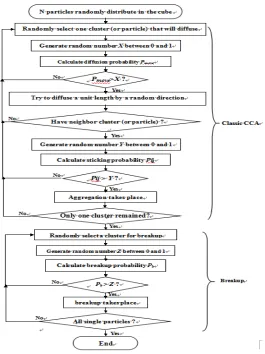
Figure 1. Algorithm flow chart.
The Process of Conventional CCA
The conventional CCA model is depicted as the former part of Figure 1. The details of the CCA are given in the following statement.
First of all, a three dimensional array, CUBE[L][L][L], is used to represent the cubic box system, for L is the side-length of the cube. The number of all the single particles (monomers) N can be calculated by the following equation with the particles concentration C given.
N=C×L3. (1)
Then these N particles are randomly distributed in the cube with non-overlapping. Each particle occupies an element of the three-dimensional array and is labeled with a label using a positive integer, therefore on-lattice. In on-lattice simulation, the cube is divided into equal-size little boxes [9], and side-length of the little box is regard as a unit length. Initially we can regard each single particle as a special cluster of size 1.
When initial work is over, in the cube system, every cluster can be selected randomly to do potential Brownian motion by the diffusion probability Pmove. Assuming some factors can be ignored,
the cluster’s diffusion probability Pmove is only affected by its mass S, which is expressed by the number of particles contained in the cluster. An equation is simply launched in the following for
Pmove,
Pmove = h×S. (2) where parameter (-0.5 0.5) and h denote diffusion exponent and diffusion coefficient
generated over the range 0 to 1 and the cluster get movement only if Pmove >X. When the cluster get movement, it will diffuse a unit length with its all particles, and the diffusion direction (up, down, left, right, front or back) is chosen randomly. If the cluster does not collide with another one, the algorithm will go on with choosing another one for next step.
If a collision event occurs between two clusters (one cluster of size i, and anther of size j) during
movement, they will try to stick together to form a new lager one by the sticking probability Pij [3, 12]:
Pij=P1×(i×j). (3) where parameter P1 is the sticking probability of two single particles, parameter (-0.50.5) is
the sticking exponent. Pij is set to 1 if greater than 1. A random number Y is generated over the range 0 to 1, and aggregation is considered effective only when Pij >Y [1].
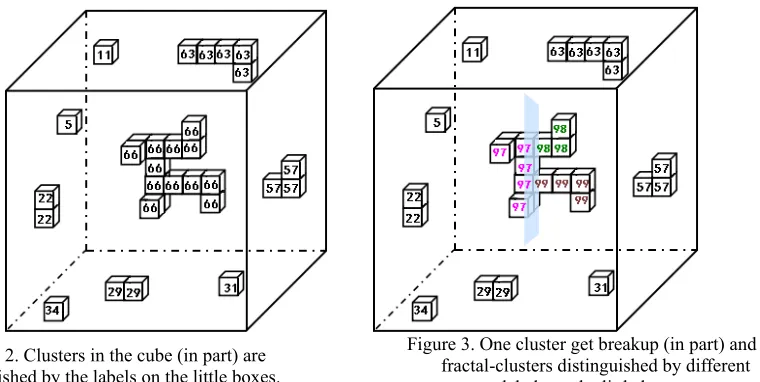
Particles in the same cluster use a unique label as shown in Figure 2. The clusters becomes fewer and fewer with continuous aggregation until only one remained in the system.
[image:3.612.130.510.251.442.2]
Figure 2. Clusters in the cube (in part) are distinguished by the labels on the little boxes.
Figure 3. One cluster get breakup (in part) and the
fractal-clusters distinguished by different labels on the little boxes.
Breakup
The single cluster obtained from the conventional CCA was considered as the initial state for next breakup.The sequential breakups are also selected randomly and the breakup probability can cover a variety of internal or external factors, such as shear force, gravity and repulsive force among inner particles [8].
Here, we mainly consider the internal repulsion among inner particles for the breakup. The cluster mass S and gyration radius Rg [4] are considered as two significant factors. In the system, clusters get breakup at a breakup probability Pb, which is expressed by the following equation:
Pb=K×(S×Rg). (4) where parameter (-0.50.5) is breakup exponent, and parameter K is breakup coefficient. Pb is set to 1 if greater than 1. The random number Z is generated over the range 0 to 1, and the breakup
is effective only when Pb>Z.
One regime is adopted for the breakup just as shown in Figure 3. When a cluster get a chance for breakup, it will be broken into several smaller fractal-clusters along with a random split-plane, which penetrates the cluster and parallels x=0 (y=0, or z=0). These new fractal-clusters will be
labeled with new and different labels on the little boxes respectively.
Experiment and Discussion
The side-length of the cube and the concentration of particles are directly related to the computational complexity. Good hardware conditions are needed to run the program. In order to focus on the phenomena of cluster breakup, we take a single cluster got from the classic CCA as the initial state for the breakup.
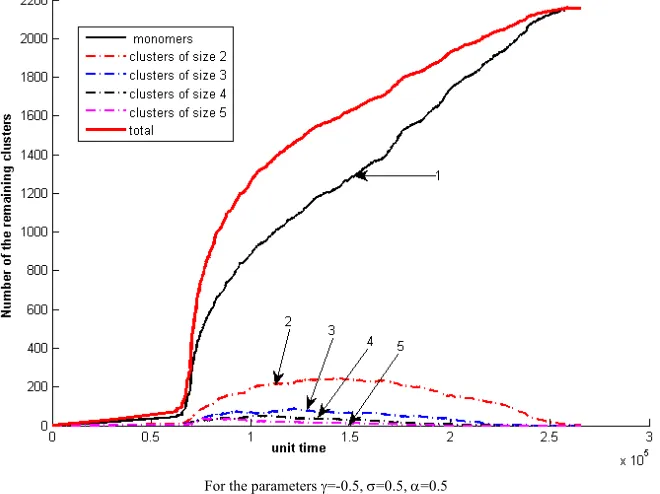
In this study, L = 60 and C = 0.01, so the particle number N is 2160, and the other parameters: h=3, P1=0.5, K=0.01. Some snapshots and results were presented as shown in Figs. 4 and 5, Figs. 4
with parameters =-0.5, =0.5, =0.5, for comparison, Figs. 5 with parameters =-0.5, =-0.5,
=-0.5.
[image:4.612.143.473.196.443.2]For the parameters =-0.5, =0.5, =0.5
Figure 4. The plot of the total clusters and the number clusters of size 1,2,3,4,5 vs. time during breakup.
From Eq. 2, when parameter <0, the larger the cluster mass is, the smaller the diffusion probability is. Thus, the larger clusters have less chance to diffuse than the smaller ones. From Eq. 3, when parameter >0, the larger clusters have more chance to aggregate into a new one than the smaller ones. The single cluster was obtained based on the classic CCA which has a loose structure.
From Eq. 4, when parameter >0, the larger clusters have more chance for breakup than smaller ones. Indicates that clusters become smaller and smaller. Eventually, there are only single particles (monomers) in the system.
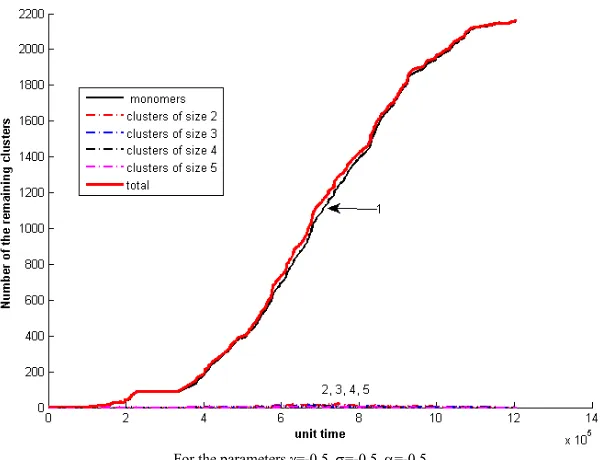
For the parameters =-0.5, =-0.5, =-0.5
Figure 5. The plot of the total clusters and the number clusters of size 1,2,3,4,5 vs. time during breakup.
Similarly, larger clusters have less chance to self-diffuse than smaller ones from Eq. 2 when parameter <0. From Eq. 3, when parameter <0, larger clusters have less chance to aggregate together than smaller ones. A single cluster which has dense structure.
From Eq. 4, larger clusters have less chance for breakup than smaller ones when <0. As we can see that large clusters split very slowly, the others are almost monomers in the system.
Figure 5 shows the number of remaining clusters versus the time during the breakup. As we can see, the number of total clusters increases in a stable way during the whole breakup, and the number of monomers tends to be identical with total clusters. The numbers of clusters with other sizes are very small and almost no change all the time. Comparing Figure 4 with Figure 5, the former regime takes less time than the latter one during the whole breakup process.
The parameters, and have different and important influence on the breakup process. Researchers can adjust these parameters correspond to different regimes.
Summaries
We simulate the breakup of clusters induced by internal repulsion with considering some internal factors based on the conventional CCA model. Besides, the process visualization can be well display in the form of three-dimensional figures dynamically by Java language. This model can be applied to different regimes by adjust parameters of , and .
Acknowledgments
This work was financially supported by the National Natural Science Foundation of China (41271292). This work was also financially supported by the Fundamental Research Funds for the Central Universities, China (No. XDJK2017D058).
References
[1] C. Li, H. Xiong, Computer Physics Communications 185 (2014) 3424-3429. [2] P. Meakin, Physical Review Letters 51 (1983) 1119-1122.
[5] N. Loh, C. Hampton, A. Martin, D. Starodub, R. Sierra, A. Barty, A. Aquila, J. Schulz, L. Lomb, J. Steinbrener, Nature 486 (2012) 513.
[6] C. Allain, M. Cloitre, M. Wafra, Physical Review Letters 74 (1995) 1478.
[7] H. Xiong, H. Li, W. Chen, J. Xu, L. Wu, Journal of Collid and Interface Science 344 (2010) 37-38.
[8] K. Higashitani, K. Iimura, H. Sanda, Chemical Engineering Science 56 (2001) 2927. [9] H. Xiong, H. Li, W. Chen, L. Wu, Computer Physics Communications 185 (2014) 836-840. [10] R. Jullien, R. Botet, Aggregation and fractal aggregates, World Scientfic Singapore, 1987. [11] Y. Yuan, H. Xiong, H. Li, H. Zhu, X. Jiang, ActaPhysico-Chimica Sinica 23 (2007) 688.
[12] P. Sandkühler, M. Lattuada, H. Wu, J. Sefcik, M. Morbidelli, Adv. Colloid Interface Sci. 113 (2005) 65.