2016 Joint International Conference on Artificial Intelligence and Computer Engineering (AICE 2016) and International Conference on Network and Communication Security (NCS 2016)
ISBN: 978-1-60595-362-5
Research on Optimal Allocation Method of Cloud Computing Resources
Hong-Li LI
Department of Electronic Information Engineering, Tianjin Vocational Institute, Tianjin, China, 300410
Keywords: Cloud Computing, Resource Management, Load Prediction, Optimal Resources
Allocation, Virtualization Technology.
Abstract. This paper studies the configuration of cloud computing resource optimization. Establish a
link between short-term load forecasting resources and optimal allocation of resources, the predicted results for the resource allocation decision-making problems which go from the resource load forecasting to construct optimal allocation of resources for such a system resource management mechanism, so as to resources rational and efficient configuration provides a scientific basis. It discusses the optimal allocation of resources to improve the method for calculating the optimal allocation of resources in an adaptive elastic demand forecasting method based on cloud and presents.
Introduction
Cloud computing is a new information resource service system based on internet. Resource management is one of the core issues of cloud computing, and its aim is to use virtualization technology shields the underlying resource heterogeneity and complexity, making massive distributed resources giant to form a unified resource pool, and on this basis, the rational use of Related resources management methods and techniques to ensure the rational and efficient allocation and use of resources.
By studying the optimal allocation of resources approach to cloud computing, so that cloud computing resources can be effectively organized and reasonable allocation, to ensure service quality and at the same time, reduce data center energy consumption and operating costs, improve cloud computing infrastructure operators and profit service providers, to achieve green computing, cloud computing for the healthy and sustained development of the theory of reference [1, 2].
Adaptive Configuration Method Based on Elastic Cloud Resources Demand Forecast
Cloud computing for the optimal allocation of resources and the allocation of resources in the process of elastic problem, distributed resource requirements article in the cloud computing environment and the allocation of resources in response management structure proposed resource allocation with adaptive control system resiliency of the resource requirements forecast and hybrid resource supply policies combine to provide reliable, flexible and efficient supply of resources and services for the cloud computing users [3].
Construction of Cloud Resources on Adaptive System Configuration Flexibility
This paper constructed adaptive resiliency resource allocation control system is the core of cloud computing data centers to achieve a reasonable distribution of resources.
The resource allocation control system consists of control module, forecasting and resource configuration module module three modules, wherein the monitoring module is responsible for cloud computing operating status monitoring, and resource use status collecting data; prediction module uses the monitoring module data collected under a period of time cloud computing resources load forecasting; resource allocation module from the next period of time to monitor the resource load value acquisition module current resource load and predicted module obtains a comprehensive analysis, develop appropriate resource allocation strategy.
In the resource configuration control system, adaptive elastic cloud computing resources mentioned configuration, the first use monitoring module computing platform gathering resource use state data from the cloud. Second prediction module uses data obtained from the monitoring module of the resource requirements of the next period of dynamic change prediction. Finally, resource allocation module uses the current and projected demand for cloud computing resources to take resource allocation strategy based on hybrid control of elastic, resilient implementation of adaptive resource allocation method for active control and passive reaction combining effective use of cloud computing resources.
Cloud Resource Monitoring and Demand Forecast
Cloud computing resources referred to herein adaptive elastic configuration control system is a closed loop control system, the system resource pending request queue model G/G/N queuing model, a single virtual machine (Virtual Machine, VM) resource request service rate obey Poisson distribution, N is the number of virtual machines currently available for service. Previous studies suggest that the number of virtual machines to provide services for a fixed value of the difference is, this paper set N value is uncertain, as the cloud computing resource load changes dynamically adjust resource request has not been processed in a timely manner will be sent into the buffer delay processing.
Resource allocation control system prediction module obtains data center resource requirements of historical data from the monitoring module, available:
t1 C
t D
t1C (1)
Wherein C
t and C
t1, respectively, for the year and the next moment the amount of resources required for processing the request, D
t1 for the next time will increase or decrease in demand for resources, namely the amount of change the next time the resource requirements. Using multi-step prediction model HGE available the next time the resource demand prediction value C
t1 , t time cloud computing overall resource loading of L
t , then:
t B t E t A t
L (2)
It consists of three parts, namely, at time t New resource request amount A
t , at time t is processing resource request amount E
t , at time t and stored in the buffer request amount B
t , the time required to enable the entire buffer, resource request amount of change in time t as follows:) ( ) ( )
(t L t R t
Wherein R(t) at time t for the total amount of resources available to process the request. The next time resource requirements change amount D(t1) estimates P , the next time resource requirements change amount of the estimated value P:
) ( ) 1 (t C t C
P (4)
Control implementation cycle Ti values for the entire control process has a significant impact, it is a key parameter elastic cloud computing resources adaptive control because the controller performs a controlled time interval Ti, Ti prediction module to predict the next one changes in resource demand period, the virtual machine to the next point in time t1,t2,,tTi. Resource reallocation of resources according to changing needs. Cloud computing resources dynamically changes according to the load, the value of Ti is adaptively adjusted according to their needs changes:
0 0 1 0 & 0 / P or K P K P K
Ti (5)
Where K is the greatest resource buffer queue can accommodate the number of request parameter values. When the value of K is small, the control system is able to respond quickly to changes in the resource load adjustment, but likely to cause volatility and instability of the system; when K values is too large, the resource controller response to load changes is more sluggish. Parameter has a similar effect, because it determines the rate buffer enabled resource requests between responsiveness and stability of the controller to play a balancing role.
Configuration Policy Based on Demand Forecasting Adaptive Elastic Cloud Resources
Resource allocation module after receiving the resource requirements of the current load information provided by the monitoring module, and the module provided by the prediction of the next period of change information, the combination of the two information-based Active Control and reactive combination Flexible adaptive resource Allocation policy.
The main idea of this strategy is to increase the resources required in advance, delayed release is currently idle resources. The goal is to provide adequate resources to ensure quality of service (QoS) while reducing unnecessary consumption of resources, to maintain stable operation of the system. And rely solely on reactive configuration policy [4] compared to the increase in advance to ensure that the resources required in the next period of time after the rising demand for resources sufficient amount of resources, so the shortage of resources and resource supply lag does not occur; delayed release currently idle resources are considering cloud computing resources demand uncertainty, because relying solely on forecast information to determine the changes in resource requirements is not enough, and start the virtual machine again will take some time, when resource demand surge, the delayed release resources can play an effective role buffered.
Flexible Adaptive Resource Allocation Policy controls the active and reactive combination, including: the use of data obtained from monitoring module computing resource needs change amount
) (t
D , reactive policy response to the current changes in the desired increase / decrease of resources (number of virtual machines) as follows:
Avg reactive D t SR
N ( )/ (6)
module, active control strategy in response to the amount of resources the next time the resource needs change configured as follows:
Avg proactive P SR
N / (7)
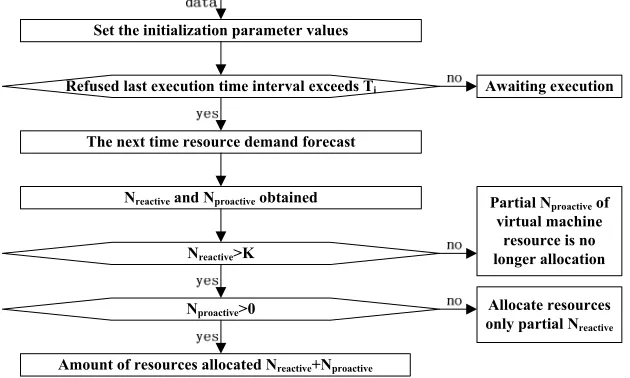
If Nproactive K, that is, changes in demand for resources exceeds the resource request buffer can store the maximum amount of time, and the active control strategies and reactive strategies determine the need to increase the supply of resources, the amount of cloud computing resources will be provided as follows:
reactive proactive N N
t
C() (8)
If reactive policy decisions need to increase the supply of resources, while active control strategy decided to reduce the supply of resources, that is, when the two decisions contradicted perform only a passive response strategy, because passive response strategy to deal with major current resource demand conditions, namely cloud computing the amount of resources provided to:
reactive N t
C( ) (9)
Otherwise, the system will no longer allocate the resources required to implement active control. Algorithm is shown in Fig. 1.
Thus, cloud computing optimal allocation of resources and system theory and method based on adaptive control has been described resilient completed
Set the initialization parameter values
Refused last execution time interval exceeds Ti Awaiting execution
The next time resource demand forecast
Nreactive and Nproactive obtained
Nreactive>K
Partial Nproactive of virtual machine
resource is no longer allocation
Nproactive>0 Allocate resources only partial Nreactive
[image:4.612.150.465.394.583.2]Amount of resources allocated Nreactive+Nproactive
Figure 1. The Algorithm Flowchart of Hybrid Resource Allocation Strategy.
Summary
References
[1]Michael Armbrust, et al. Above the Clouds: A Berkeley View of Cloud Computing, mimeo, UC Berkeley, RAD Laboratory, 2009. http://www.eecs.Berkeley.edu/Pubs/TechRpts/2009/ EECS- 2009-28.pdf.
[2]Peter M, & Timothy G. The NIST definition of cloud computing. http://csrc.nist.gov/ publications /nistpubs/800-145/SP800-145. pdf.
[3]Prevost J.J., et al. Prediction of cloud data center networks loads using stochastic and neural models [C]. 6th International Conference on System of Systems Engineering (SoSE), 2011: 276-281. [4]T. Chieu, A. Mohindra, A. Karve, and A. Segal. Dynamic scaling of web applications in a