A Desk-top tutorial Demonstration of Model-based Fault Detection and
Diagnosis
John Z Shi1,2, Ali Elshanti2, Fengshou Gu2, and Andrew Ball2 1
School of Computing and Engineering, University of Huddersfield, HD1 3DH, UK Telephone: +44 1484 472842 Email: [email protected]
2
MACE, University of Manchester, M13 9PL, UK
Dr John Z Shi received the BSc degree in Mechanical Engineering and MSc degree in Mechatronic Engineering from Hebei University of Technology, Tianjin, China, in 1984 and 1987 respectively. He was a professor in the area
of Measurement and Control in this university before he was awarded his PhD degree in Maintenance Engineering in 2004 from the University of Manchester. Currently, he is senior lecturer in the School of Computing and Engineering at the University of Huddersfield, UK. His research interests include modelling and simulation of mechanical systems, system
measurement and control, advanced signal processing, hardware/software in the loop test for automotive systems and model-based condition monitoring. He has published more than 30 technical papers since 2000.
Ali Hassan Elshanti graduated from the USA, Tulsa Oklahoma, with a B.Sc. in aircraft maintenance engineering in 1980 and has got an associated degree in applied sciences from the same university and worked in the aviation field from 1981 to 1999. In September 2002 he graduated with an M.phil. degree in engineering from the university of Manchester and after that, in Jan. 2005
commenced this in September 2005 for a 2 years PhD and will finish it in September 2007 and will graduate in December 2007.
Fengshou Gu is a Senior Research Fellow of Machine Diagnosis Engineering at the University of Manchester. He is working for and on behalf of Professor
Andrew Ball in supervising 18 PhD students and undertaking more than six contracts funded from UK government and industries. He is one of experts in the fields of machinery diagnosis and vibro-acoustics analysis, with over 20 years of research
experience. He is the author of over 60 technical and professional publications in machine dynamics and related fields. His research interests include vibro-acoustic of internal combustion engines, reciprocating compressors, centrifugal pumps, electric motors, hydraulic power systems, gearboxes and bearings. He has experienced in system modelling, various physical parameter
measurements, advanced signal processing techniques including time-frequency analysis, wavelet transforms, neural network algorithms and statistical analysis.
Professor Andrew Ball received his first degree in Mechanical Engineering, and a Ph.D. in Machinery Condition Monitoring. He established Manchester University's Maintenance Engineering Research Group which is now the largest independent maintenance research group in Europe. This research team specialises in the detection and diagnosis of incipient machine
Key words
Model-based, fault detection and isolation, three-tank system, Simulink, modelling and simulation
1 INTRODUCTION
During the last four decades, model-based fault detection and diagnosis approach has made significant progress. It is so significant to control systems that the model-based
approach almost dominates the area of control system monitoring and diagnosis from its appearance. This can be traced from
some valuable survey papers [1~5] and books [6~8]. Different methods have been developed and implemented in different directions such as observer method [4, 9],
parameter estimation method [5, 10], parity space method [11] and combination of these methods with artificial intelligent [4, 12, 13].
ABSTRACT
In this paper, a demonstration on the model-based approach for fault detection has been presented. The aim of this demo is to provide students a desk-top tool to start learning model-based approach. The demo works on a traditional three-tank system. After a short review of the model-based approach, this paper emphasizes on two difficulties often asked by students when
they start learning model-based approach: how to develop a system model and how to generate residual for fault detection. The demo represents the three-tank system in the Simulink environment so that no hardware is really needed. Faults such as tank leakages, connecting pipe blockage and sensor failure are also simulated in the virtual way by means of different switches.
The model-based approach has following advantages [14]. Firstly, comparing to the model prediction, the influence from control factor can be removed. Secondly, a model that is for control can be shared for
model-based fault detection. Thirdly, no prior experience is necessary for diagnosis, and this makes it possible to diagnose new
designed devices. Finally, it is possible to detect sensor faults and to deal with time varying behaviour of a system. This impels the research of the most active diagnostic
method.
However, when students implement this approach, they often complain the lack of transition from the theoretical research to
real application. Although Isermann [15] has contributed a tutorial paper on parameter estimation method and Patton and Chen [16] have made contributions on parity space
tutorial, students still feel struggle to master this advanced approach, especially on the most frequently used observer method.
Obvious questions like “exactly how does the approach work?”, and “how do I combine the operational features of a real system with its model-predicted equivalent to generate a residual?”, “is there any
practical tool available in the market?” are often met in the education practice. No doubt that a tutorial demonstration is highly
desired to help student to understand this method easily and quickly.
In order to meet this requirement, this paper presents a desk-top demonstration to
illustrate model-based diagnostic approach. By means of Simulink, a mathematical model of a typical three-tank system is developed and virtually implemented.
Different types of faults have been induced in the example system. A diagnostic schematic is then provided also in the form of Simulink. From the illustration, students
and fault detection as well as fault diagnosis. No hardware is needed and merely from the scope, students can objectively view the faults and their locations as well as the severity.
2 THEORETICAL BASIS
2.1 Basic Concept
Although the basic principle of the model-based approach has been introduced
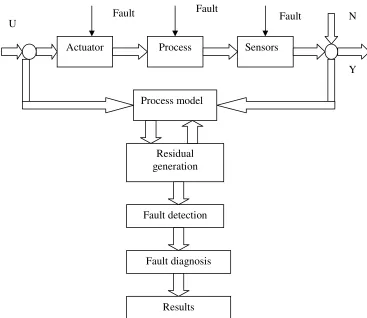
massively in the above references, it is briefly reviewed here for the sake of completion. As shown in figure 1, the diagnostic system contains an actual system and its analytical redundancy that undergoes
the same input. In most cases, the analytical
redundancy is also called a model, which runs in parallel to the actual system. Under healthy conditions, the model output should
be the same as that of the actual system and
Fault Fault Fault
Actuator Process Sensors
Process model
Residual generation
Fault detection
Fault diagnosis
U N
Y
[image:5.595.125.492.272.590.2]Results
otherwise the model has to be modified before use. The difference between the model output and the actual system output is called residual. The process to create residual is called residual generation. The
residual is used to detect fault if it occurs in the system. If the residual does not exceed a pre-designed threshold, the system is
referred to as healthy. Once the residual exceeds the threshold, a fault may occur in the system and the diagnostic scheme will send out a fault alarm. This step is called
fault detection. After a fault is detected, fault diagnosis will be applied to allocate and evaluate the fault.
2.2 Basic Theory
Considering a linear control system with
state variable X(t) and output variableY(t),
its model can be represented by state space equations (1) and (2):
) ( ) ( )
(t AX t BU t
X& = + (1)
) ( )
(t CX t
Y = (2)
WhereU(t) is input variable, A,B,C are
state matrices with proper dimensions.
A system model can be built up in the form of transfer function, or state observer and even non-parameter model if a parametric model is not available. An observer is used
in this demonstration because it is most frequently used control system modeling. For the system represented by equations (1) and (2), a typical observer gives out its
prediction Xˆ(t) and Yˆ(t) in equations (3)
and (4). )] ( ˆ ) ( [ ) ( ) ( ˆ ) (
ˆ t AX t BU t LY t CX t
X& = + + − (3)
) ( ˆ ) (
ˆ t CX t
Y = (4)
Lis the gain matrix of the observer and can be designed according to a specific requirement [17]. A residual ris generated
by calculating the difference between the prediction or observer output and the actual measurement, i.e. ) ( ˆ ) ( ) ( ˆ )
(t Y t Y t CX t Y
r= − = − (5)
Theoretically, when no fault occurs, r=0,
or occurs. However, a real system is always contaminated by disturbance and random noises. Beside, a model that exactly approximates the real system is never achieved. Therefore, a more tolerant
threshold δ instead of zero is usually used
so that the fault detection can be carried out by equation (4).
> ≤
δ δ
r r
(6)
2.3 General Methods
From figure 1, students will gain that the
application of the model-based approach consists of the following four steps: modeling, residual generation, fault detecting, and fault diagnosis. In order to
give them a complete knowledge, the general methods involved in these steps are reviewed before an example is given.
Modeling Generally speaking, modeling of a system is to represent a system with mathematical expressions. Transfer function is a simple model of a control system,
especially in SISO system. Some control components have their transfer functions in their specification when in sale. In this case, the transfer function can be taken to represent the system. However, most control
systems are MIMO systems and consist of non-standard components. In this case, state space equations are always used to model
the system provided that all the parameters in the construction of the system can be obtained. Sometimes, a system is so complicated that it is impossible to get its
parameters. A non-parameter model may be developed by using artificial method like neural networks (NN). For simplification, NN method is not included in this demo, and
instead, an example is given to illustrate the conversion of an actual system to a mathematical representation with state space equations.
Residual generation The techniques used to generate residuals differ from method to method. The frequently used methods are Healthy
observer approach, parameter estimation approach, parity space approach and fault detection filter approach. Details of these methods can be found in [4]. Here in this paper, the observer-based approach is used.
Residual is generated by combine the output measurement Y(k) and the observer
estimationYˆ(k).
)) ( ˆ ) ( ( )
(k W Y k Y k
r = − (7)
Where matrix Wis the weighting matrix.
Fault detection Most fault detection in model-based approach is implemented by comparing the residual signal to the threshold. As mentioned previously, if the
residual doesn’t exceed the threshold, the system is healthy, or otherwise a fault may occur.
There are two types of thresholds, one of which is fixed threshold and the other is
adaptive threshold [4]. The former is simple for design as well as for use. But how to decide the level to be fixed needs to discuss.
The design of threshold is related to the false
alarm rate and the missing alarm rate. The higher the threshold is, the smaller is the false alarm rate but this will decrease the sensitivity to faults and may miss fault alarm. In contrast, if the threshold is
assigned too low, it is more sensitive to faults but there is a risk of false alarm. On the other hand, an adaptive threshold is
designed to adapt to the input. When the model error goes large in its transient period, a relatively large threshold is provided so that a small false alarm rate can be achieved.
For the simplicity, this paper provides a fixed threshold only.
Fault diagnosis Fault diagnosis is to isolate a detected fault, to locate it and sometimes
to indicate the occurring time. Some fault detection methods can locate the fault when it is detected. For example, a parity space will give out the fault as well as its direction.
However, the classifying of the fault needs more complex knowledge. Fuzzy logic and neural network are often used to meet this requirement. This demo does not involve in classification but leaves expendable for this
issue.
3 MODELLING OF THE
EXAMPLE SYSTEM
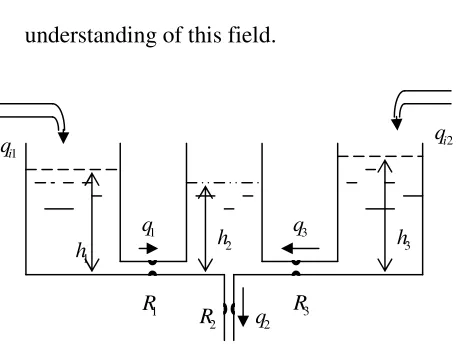
A three-tank system as shown in figure 2 is chosen in this demonstration for the following reasons. It is a realistic physical
representation of many mechanical and chemical processes [18-19], and one which, despite the degree of sophistication to which
control algorithms and model-based approach can be developed, remains sufficiently straight-forward to create within a laboratory. Furthermore, this system is a
non-linear system, which allows us to demonstrate on linearized model and leave students a course work to extend it into non-linear model. Hence, it falls easily within the
realms of desktop demonstration should
anyone wish to develop their own understanding of this field.
3.1 Representation of the System
Figure 2 shows also the operating principle
of the three-tank system. Two inlets on tank
1 and tank 3 supply the flow inputs qi1and
2
i
q separately. The three tanks are connected
with two pipes with resistances R1 and R3to restrict the flow rates q1 and q3 . Liquid (q2) can only leave through the outlet pipe below tank 2 and encountering
resistanceR2. The heights h1, h2and h3of the tanks are taken as both state variables and observed variables as well.
1 i
q qi2
1
h h2 h3
1
q q3
2
q
1
R R3
2
[image:9.595.303.531.122.296.2]R
Faults that are simulated in this example are abrupt pulse disturbance in the tanks, blockages in the connection pipes, and tank leakages as well as sensor failures. The demonstration is also open to students to
induce other faults if they like.
3.2 Model in State Sapce Equations
According to the continuous equation and other fluid motion laws [19], the linearized model of it can be given as follows.
1 2 1 1 1 1 1 1 R h h q h dt d S q
qi − = = i − − (8)
3 2 3 2 3 3 3 2 R h h q h dt d S q
qi − = = i − − (9)
2 2 3 2 3 1 2 1 2 2 2 3 1 R h R h h R h h h dt d S q q q − − + − = = − + (10)
Where Si ( i=1,2,3 ) is the cross-section
areas of the three tanks.
The input variable matrix U is set to be:
T i i T T q q u u
U =[ 1 2] =[ 1 2] (11)
As mentioned above, both the state variable and the observed output are the liquid levels in the three tanks.
T T T h h h x x x
X =[ 1 2 3] =[ 1 2 3]
T T T h h h y y y
Y =[ 1 2 3] =[ 1 2 3]
The model can be represented in the form of
equation (1) and (2) with h dt
d
h&= . It is a
control system with 2 inputs and 3 outputs. The matrices A,B,Care
− + + − − = 3 3 3 3 3 2 3 2 1 2 1 2 1 1 1 1 1 1 0 1 ) 1 1 1 ( 1 1 0 1 1 R S R S R S R R R S R S R S R S A (14) = 3 1 1 0 0 0 0 1 S S
B (15)
3.3 Model in Simulink
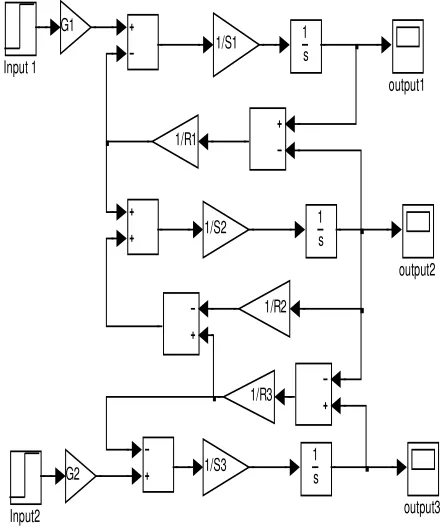
Simulink tool is very powerful platform in system simulation and control [20, 21]. It has the advantages of object and convenient in use. Therefore, it has been widely applied
in many control systems simulation and design. Figure 3 shows the Simulink model of the three-tank system. The inputs are chosen to unit step signal with specific
gains, which can be directly obtained in the
Source Library in Simulink. The parameters in the model are listed in Table 1.
Table 1: The structural parameters of the three-tank system
Parameters S1(m2) S2(m2) S3(m2) Values 7.07e-4 1.3e-3 4.91e-4
Parameters R1(sec/m2) R2(sec/m2) R3(sec/m2) Values 1.724e4 1.e4 2.33e51.e4
4
SIMULATION OF SYSTEM
FAULTS
Four types of faults mentioned previously are simulated in the Simulink model. The
first one is an abrupt disturbance fault (ADF). This type of fault can occur in any tank and result in pulses of the liquid level. The second type of fault is a leakage fault
(LF), which may also occur in any of the three tanks and cause the liquid level below the controlled level. The third type of fault is a blockage or partial blockage in the pipes
that connect the tanks, this fault is referred to as a pipe blockage fault (PBF). The fourth
output3 output2 output1
1 s 1 s 1 s
Input2 Input 1
G2 G1
1/R3 1/R2
1/S3 1/S2 1/R1
[image:11.595.309.549.211.333.2]1/S1
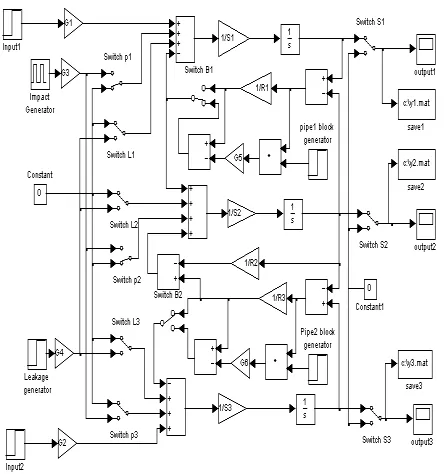
[image:11.595.62.286.394.658.2]type of fault that can occur is a sensor failure (SF), which will result in false monitoring result. All these faults can be virtually implemented in the Simulink by means of various switches. As shown in
figure 4.
There are 11 switches in figure 4: switches P1 to P3 are for abrupt disturbances, switches L1 to L3 are for leakages, switches
S1 to S3 are for sensor fault and switches B1 and B2 are for pipe blockages. Each switch has two states, one for normal condition
(Off), and the other for faulty condition (On). Table 2 shows the states of these 11 switches and their corresponding faults, “+” and “- ” in table 3.2 refer to states “On” and “Off” respectively. All the 11 switches are
labelled in figure 4. They can be run on their own to implement a single fault or in combination to simulate compound faults. In
[image:12.595.68.290.281.518.2]addition, some generators like the pulse generator for example are used to induce faults. Changing the gain of a fault input will vary the degree of that fault.
Table 2: Switches and their responding faults
Switches
Tank 1 Tank 2 Tank 3 LF ADF LF ADF LF ADF
P1 - + - - - -
P2 - - - + - -
P3 - - - +
L1 + - - - - -
L2 - - + - - -
L3 - - - - + -
Switches
Pipe blocks
SF1 SF2 SF3 BF1 BF2
B1 + - - - -
B2 - + - - -
S1 - - + - -
S2 - - - + -
S3 - - - - +
[image:12.595.312.529.456.677.2]Figure 5 shows the simulation results under both normal conditions and faulty
conditions. In all the subplots, the dotted, dashed and solid lines represent the responses of tanks 1, 2 and 3 respectively. Figure 5(a) shows the normal conditions and
Figure 5(b) shows the abrupt disturbance fault (ADF) in tank 1, the ADF is implemented by setting switch P1 to “On” and the others to “Off”. Similarly, Figure
5(c) displays the leakage fault (LF) in tank 3 and Figure 5(d) shows a blockage fault (BF) in pipe one. Figure 5(e) shows a sensor failure in sensor 2 and Figure 5(f) gives the
simulation results for a compound fault. Many other combinations of fault can be simulated by turning on the corresponding switches. It is completely open to students to turn on or off any single switch or any
combination of these 11 switches to check the corresponding results. Results can be displayed on virtual scopes or save to some
Matlab files for further analysis.
5
FAULT DETECTION AND
DIAGNOSIS
Although some changes can be found from the system output as shown in figure 5, it is unclear whether or not these changes are
caused by system faults or by control operations of the system. For example, in figure 5(d) the change may be caused either by a pipe blockage at time instant 40sec or
by an extra system input at time instant 40 sec. A fault diagnosis should be able to distinguish the different sources and remove the influence of the system input. The
[image:13.595.67.269.110.323.2]advantage of a model-based approach can be Figure 5: Simulation results in fault
demonstrated through the following diagnostic scheme.
5.1 Fault Diagnostic Scheme
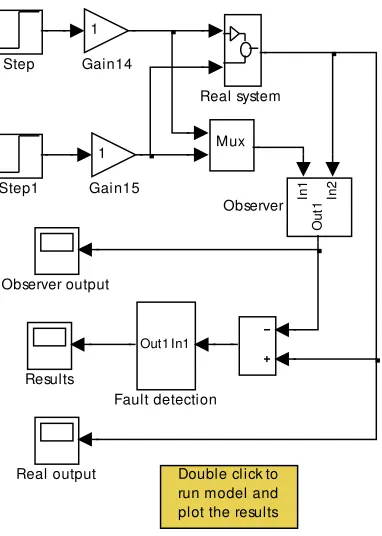
Figure 6 shows a diagnostic schematic in Simulink. A masked Matlab program alongside the diagram will initialize the
parameters and actuate the simulation by double clicking the icon. The “Real system” refers to the three-tank system which is described in figure 4 except that random
noises are added into each output to simulate actual behavior of the three-tank system under fault free and faulty conditions. The “Observer” refers to a full order observer as described by equations (3) to (16) and
parameters in table 1. As shown in figure 7, it shares the same input as the “real system”. The design of gain matrix Lis out of the
scope of this paper and simply set to unit matrix. However, it is changeable for students when they access the masked Matlab program.
A residual generator is designed to compare
the “Observer” outputs and “real system” outputs and to generate the residual signal.
1 Out1
K*u L(y-yhat) 1
s
Integrator K*u
Cx K*u
Bu
K*u
Ax
Add1 Add
2 In2
[image:14.595.69.260.393.661.2]1 In1
Figure 7: A full order observer
Figure 6: Schematics of fault detection and diagnosis
Double click to run model and plot the results Step1
Step
Results
Real system
Real output Observer output
In
1
In
2
O
u
t1
Observer Mux 1
Gain15 1
Gain14
In1 Out1
[image:14.595.314.529.441.591.2]Theoretically, any difference between the real measurement and the model prediction can be referred to as a fault. However, it is impossible to develop such an accurate model and model error is inevitable in
practice. Besides, the measurement is often corrupted by noise. In order to cover these error and noise, a threshold is usually
necessary. The fault detection and diagnosis are then carried out with reference to given thresholds including warning levels and fault alarm levels. All response signals and
residual signals are displayed in the scope. Where and when a fault occurred as well as its severity can be established from the scope as shown latter in conjunction with
fault cases.
When running the demonstration, the “Observer” is not altered, whilst the normal and faulty conditions are implemented in the
“Real system”. A graphical representation of the system condition is displayed on the scope. At the same time, the simulation
results are saved into Workspace in Matlab, which allows further analysis to be carried out. The user interface in Simulink is quite convenient to use. For example, it allows other faults to be added to the system or
locations of faults in the system to be changed. These simulation results give details of the system under selected
conditions.
5.2Case Study of Fault Diagnosis
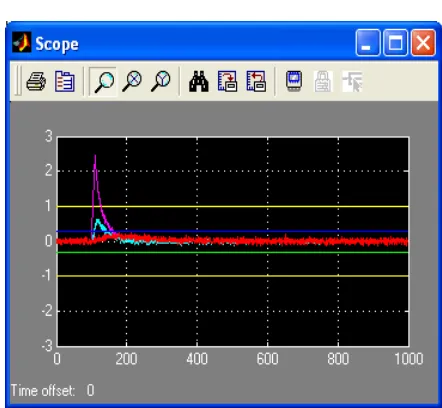
Different types of faults are investigated in this demonstration. The threshold for “fault
level” is set to ±1mm and that for “warning
[image:15.595.308.529.341.545.2]level” is set to ±0.3mm. When the system is
under normal conditions, all three residuals are zeroes or within the warning level thresholds. When a fault occurs in the system, it can be detected on the scope. Figure 8 shows an example of a fault
condition, where the grey line represents the
residual of tank one ( y1 ), the red line represents the residual of tank two (y2) and the green line represents the residual of tank
three ( y3). The same representations will appear in the following figures. In this case, the residual of tank one exceeds the threshold, which means that there is a fault in tank one. The residual response is a pulse
signal, which indicates an abrupt disturbance fault. The fault is detected at time instant 100 sec. Although tank two and three also have abrupt changes in their residuals but
they do not exceed the threshold. This means that both tank two and tank three are affected by the fault in tank one, but no fault occurred in them, except that in tank two the
warning threshold was exceeded. Therefore,
the diagnostic result is that an ADF fault is detected at a time instant 100 sec in tank one.
Figure 9 shows another type of fault, which is detected at a time of 730sec in tank three.
From the residual response of y3, it is found that the residual exceeds the negative
threshold of warning level at 620sec and then fault level at 730sec. This indicates that a leakage fault (LF) is occurring in tank three.
[image:16.595.309.533.412.621.2]As mentioned previously, all the signals from the Simulink user interface can be
saved into Workspace in Matlab window for data processing. Figure 10 shows a fault diagnosis carried out in this way. Figure
10(a) displays the same condition as Figure 5(d) with an obvious change in tank one. A false misdiagnosis may be led because only one change can be seen in it. However, with the model-based approach, a residual shown
in Figure 10(b) indicates clearly two different faults occurring in the system. Besides the obvious fault that is detected at
time instant 420sec, there is also an incipient fault present from the beginning. These two faults not only differ in occurring times but also differ in fault types. A leakage fault
exists in tank one, but the pipe blockage fault most likely occurs in the pipe that connects tank one and tank two. This result also demonstrates the significance of a
model-based approach.
Figure 11 shows an example of detection and diagnosis of multiple faults. An ADF is detected at time instant 103sec in tank one,
and then a PBF is detected at time instant 414sec in pipe one. After that, a LF is
0 100 200 300 400 500 600 700 800 900 1000
-5 -4 -3 -2 -1 0 1 2 3 4 5
R
e
s
id
u
a
l
[image:17.595.78.279.200.402.2]Time
Figure 11: Fault diagnosis of multiple faults
0 100 200 300 400 500 600 700 800 900 1000
-5 0 5 10
S
y
s
te
m
r
e
s
p
o
n
s
e
Time (a)
0 100 200 300 400 500 600 700 800 900 1000
-1 0 1 2
R
e
s
id
u
a
l
Time (b)
[image:17.595.81.276.461.663.2]detected at time instant 660 sec in tank three.
Sensor faults and many other faults that can be diagnosed with the demonstration are also not addressed here because they only
repeat the procedure with different combinations of switches. They are left for student to play with.
6 CONCLUSIONS
In this paper, the model-based fault detection and diagnosis approach is
implemented on Simulink to provide students with tutorial information of this advance approach. A clear picture of the model-based approach from model
development, data measurement, to residual generation as well as fault detection and diagnosis can be obtained to students by running this demonstration virtually. The
demonstration is made of a multi-tank system, but can be suitable for most of control processes. It shows that the
model-based approach is an advanced method in fault diagnosis of various control systems. The demo works very well and conveniently in computer and no hardware is needed. The cases shown in this paper are only of a small
number. The 11 switches provide for a large amount of different fault combinations, which include component fault, connection
fault and disturbance fault as well as sensor failure. One can view any fault condition just by clicking on and off the correlated switches on the screen.
The demonstration not only answers the question mentioned in introduction, but also provides a transition from theories to applications for model-based approach. In
addition, it provides students an open platform, which allows them to extend the demonstration by either introducing more fault types or using other methods such as
REFERENCES
1 Jones, H. L. (1973). Failure detection in
linear systems, PhD thesis, Dept. of Aeronautics, MIT, Cambridge, Mass. 2 Willsky, A.S. (1976). A survey of design
methods for failure detection systems,
Automatic, Vol. 12, pp601-611.
3 Isermann, R. (1984). Process fault detection based on modeling and
estimation methods – A survey, Automatica, pp387-404.
4 Frank , P. M, Ding, S. X., & Marcu, T. (2000), Model-based fault diagnosis in
technical processes, Tans. of Institute of Measurement and Control, Vol. 22(1), pp57-101.
5 Isermann R. (2005). Model-based fault
detection and diagnosis – status and applications, Annual Review of Control, Vol. 29, pp71-85.
6 Patton R., P. Frank and R. Clark (1989).
Fault diagnosis in dynamic systems, theory and application, Prentice Hall.
7 Chen, J and R. J. Patton (1999). Robust model based fault diagnosis for dynamic systems, Kluwer Academic Publisher, London.
8 Simani, S., Fantuzzi, C., & Patton, R. J.,
(2003). Model-based fault diagnosis in dynamic systems using identification techniques, Springer, London.
9 Patton, R. J. (1997). Robustness in model-based fault diagnosis: The 1995 situation, A Review of Control, Vol. 21, pp. 103-123.
10 Börner, M., Straky, H., Weispfenning, T., & Isermann, R. (2002). Model-based fault detection of vehicle suspension and hydraulic brake systems, Mechatronics,
Vol. 12 pp 999-1010.
11 Patton, R. J. and J. Chen (1991). Robust parity space approach to fault detection based on optimal eign-structure
12 Balle, P. (1999). Fuzzy-model-based parity equations for fault isolation, Control Engineering Practice, Vol. 7, pp. 261-271.
13 Kimmich, F., Schwarte, A., Isermann, R.
(2005). Fault detection for mordern diesel engines using signal-and process model-based methods, Control Enginerering
Practice, Vol. 13, pp189-203.
14 Elshanti, A., Shi Z., & Ball, A. D. (2001). Dispelling the rumours about model-based diagnostics, MARCON’2001,
USA.
15 Isermann, R. (1993). Fault diagnosis of machines via parameter estimation and knowledge processing – tutorial paper,
Automatica, Vol. 29(4), pp 815-835. 16 Isermann R. and P. Balle (1997). Trends
in the application of model-based fault detection and diagnosis of technical
processes, Control Engineering Practice, Vol. 5, pp709-719.
17 Duan, G. (1996). Linear system theory, HIT press, China.
18 Dorf, Richard C., Richard Carl (1998). Modern control systems, 7th edition, Addison-Wesley.
19 J. Schwarzenbch, and K. F. Gill, (1986). System modelling and control, Edward Arnold.
20 Singh, K. K. (2001). System design through Matlab, control toolbox and Simulink, Springer, London.
21 Huning-huei Su, et al, (2002). Learning