2017 2nd International Conference on Software, Multimedia and Communication Engineering (SMCE 2017) ISBN: 978-1-60595-458-5
Multi-secret Visual Cryptography Scheme with Tag Information
Yan-yan HAN
1,
Chang LIU
2,*, Wen-cai HE
1and Bin-bin FENG
11Beijing Electronic Science & Technology Institute, Beijing, China
2Xidian University, Xi’an, China
*Corresponding author
Keywords: Visual cryptography, Random grids, Multi-Secret, Tag information.
Abstract. Since that traditional tagged visual cryptography scheme (TVCS) can only hide only one secret image, this paper presents a multi-secret visual cryptography scheme with tag information. By adopting the concept of random grids (RG) to construct the basic share images of secret images and the tag images, and then combined them in the form of probability to generate the final shared images. When folding up each share image, we can observe the tag information. What’s more, it can reveal multiple secret images by simple flip operation which increases the amount of secret information. To verify the security and effectiveness of the proposed scheme, we present the theoretically analysis while the simulation results show that the proposed scheme works well.
Introduction
Visual cryptography (VC) was firstly introduced by Naor and Shamir[1] as a secret sharing technique in the field of images in 1994. It is a way to encrypt the secret image into share images and then the decryption procedure is to extract the secret image via the human visual system after superimposing the share images without any assistance of computations. Compared with traditional complex cryptographic algorithm, VC greatly reduces the cost and the requirements of the user and has received widespread attention. In recent years, the research of visual cryptography scheme (VCS) has lots of achievements, including visual authentication, digital watermarking, secret image
hiding, etc. So far, there has existed two kind of method to conduct the VC scheme. The previous
method has the inevitable problem of pixel extension and design of the codebook for it is based on basic matrix. Now, the VC scheme based on random grid (RGVC) is getting extensive attention for it has solved both of the above problems. There have several relevant literature about RGVC[2-4].
As we all know, conventional VC schemes generate meaningless contents on share images to assure the protected secret unreadable, which suffers from a management problem. That is, the dealers cannot identify each share with naked eyes, and it is not possible to distinguish a share image corresponding to a specific secret. Once the number of share images held by the user becomes larger, the problem becomes more complicated. Tagged visual cryptography (TVC) came into being. It is a brand new type of visual cryptography to conceal the tag images into each share. The associated tag information is visually revealed by folding up each single share image. Thus the tag information can be applied to manage the share images friendly. Another function of TVC is that it can display fake message to establish a verification mechanism to unauthorized users, which can effectively solve the cheating problem.
expansion and code book needed problems. Wang X[8] proposed a lossless TVC scheme. Compared with other scheme, the most important advantage of the scheme is that the embedding of tag images does not lower the quality of the original secret image. Unfortunately, the drawback is that there are only k-1 tag images that can be recovered both in the (k,k) or (k,n) threshold scheme, and there is still a problem with pixel expansion and design of the codebook. Chen[9] researched the application of the TVC. They designed a fine-grained access control mechanism into TVC, which includes benefits as no pixel expansions, high contrasts of reconstructed images, and flexible authorization. Participants identify their own groups by the tag information, and different groups are authorized to recover the different parts of the secret image.
However, all of the TVC programs can only hide one secret. This paper presents a new TVC scheme that not only has the original performance of the TVC scheme, but also increases the number of secret restored. When stacking one share onto the other the first secret image can be recovered. After flipping over one share and then superimposed on each other, the second secret image will be recovered. The program can be applied to the specific scenes that need to take into account more secrets and the characteristics of TVC, which has a higher application value.
Related Works
Kafri and Keren[2] proposed a visual cryptography based random grids first. In their scheme, each pixel of the image is seen as a grid, with a random share image to encrypt the original secret image. In this paper, the proposed (2, 2)-RGVC algorithm are shown as follows.
Input: a M×N binary secret image S. Output: share images R1, R2.
Step1: Randomly assign “1” and “0” to R1, generate the first share image R1, the size of R1 is M×N.
Step2: To every pixel S(i,j) in secret image S, if S(i,j)=1, then R2(I,j)=1-R1(i,j), otherwise R2(i,j)=R1(i,j).
Step3: Repeat Step2 until R2 is generated.
Proposed Scheme
In this paper, we proposed a multi-secret TVC scheme based on random grids, which can conceal two secret images in two shares. Besides some tag images are attached to each share. By the simple
action of folding, flipping and stacking, the tag images and secret images can be revealed.The main
encryption and decryption procedure of this scheme is defined as follows.
Encryption Process
Input: two M×N binary secret images S1 and S2; two M/2×N binary tag images T1 and T2. Output: two share images R1 and R2.
Step 1: Generate transitional shares G1 and G2 from secret images S1 and S2. Randomly assign “1” and “0” to generate the transitional share G1 first. Using the (2, 2)-RGVC algorithm, common share image G1 and secret image Sx (x=1,2) to compute the corresponding share G2x (x=1,2). After
flipping the share G22, we get the share G22’. Randomly generate a real number k where 0 k 1.
If k1/ 2, G i j2( , )G21( , )i j , otherwise G i j2( , )G22'( , )i j . Until all pixels are processed, we get the share R2.
Step 2: Generate transitional shares L1 and L2 from tag images T1 and T2. Using the (2, 2)-RGVC algorithm to encrypt Tx (x=1,2) to generate the corresponding share Cx1 and Cx2. After flipping the share Cx2, we get the share Cx2’. Last, connect Cx1 and Cx2’ into the share Lx(x=1,2), whose size is the same as the secret images.
Step 3: Generate final shares F1 and F2 from G1, G2, L1 and L2. Given a probability p, and randomly generate a real number q where 0 q 1. If qp , Fx i,j Gx( , )i j , otherwise
, L ( , )
Recovery Process
In this module, the recovery of the secret image is as shown in the following steps:
Step1:Through the OR operation, the secret image S1 is recovered after stacking the two shares.
Step2: Flip over the share F2, and then stacking with F1, it can reveal the second secret image S2. Step3: fold up each single share image, and the associated tag information is visually revealed.
Simulation Result
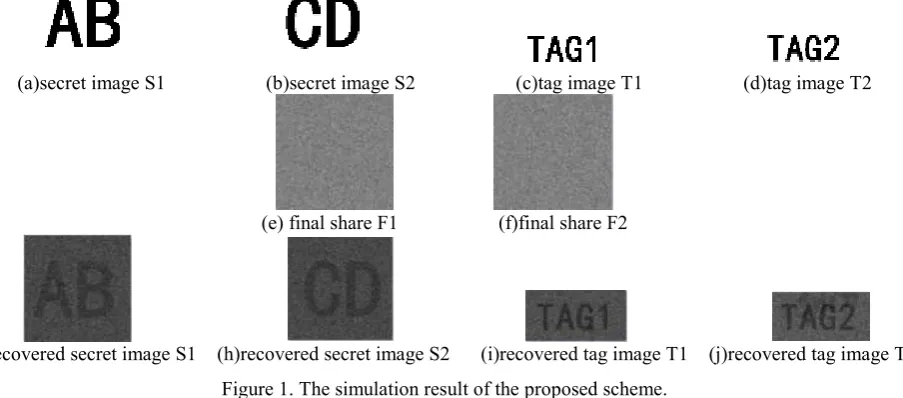
The simulation result is demonstrated in Figure 1, where Fig. 1(a)–(b) shows the secret image S1 and S2, and Fig. 1(c)–(d) exhibits two tag images T1 and T2. The final tagged shares F1 and F2 are shown in Fig. 1(e)–(f). The recovered secret images S1 by superimposing two shares are demonstrated in Fig. 1(g), and Fig. 1(h) shows the stacked result S2 by tagged share F1 and the flipped share F2. By folding up each single tagged share, the associated tag images are revealed as demonstrated in Fig. 8(i)–(j).
(a)secret image S1 (b)secret image S2 (c)tag image T1 (d)tag image T2
(e) final share F1 (f)final share F2
[image:3.595.75.527.282.481.2]
(g)recovered secret image S1 (h)recovered secret image S2 (i)recovered tag image T1 (j)recovered tag image T2 Figure 1. The simulation result of the proposed scheme.
Performance Analysis
In this section, the performance of the proposed scheme is analyzed in term of its security, visual quality and other capability. Some definitions on RG are employed in advance, as given in Definitions 1–2.
Definition 1 (Average light transmission, Shyu [3]). For a certain pixel p in a binary image R whose size is m n , the light transmission of a white pixel is defined as T p( )1. Whereas,
0
T p( ) for p is a black pixel. Totally, the average light transmission of R is defined as
1 1
( ) mi nj ( ( , )) / ( )
T s
T R i j m n . (1)Definition 2 (Contrast, Shyu [3]). The contrast of the reconstructed secret image is estimated by
, defined as( [ (1)]) ( [ (0)]) 1 ( [ (0)])
T R S T R S
T R S
. (2) Where R is the reconstructed image and S is the secret image. In this estimated equation, T(R[S(0)]) (resp.T(R[S(1)])) represents the average light transmission of the corresponding area in R with respect to white pixel (resp. black pixel) area in S. High visual quality comes with larger contrast value.
Based upon Definition1 and Definition2, reconstructed image R can be recognized as S if 0.
Security Analysis
According (2,2)-RGVC algorithm[3] and the Definition 2, T G S( x[ (0)])T G S( x[ (1)]) 1/ 2 (x=1,2). In the
proposed scheme, we generate the transitional shares G1, G21 and G22 by using the basic algorithm,
so their average light transmission of the corresponding area in secret images S1 and S2 for white area or black would go to 1/2. G2 is consisted of 1/ 2G21 and 1/ 2G22, thus for G2, the average light transmission of the corresponding area in secret images S1 and S2 for white area or black would go to 1/2, too. C11, C12, C21, C22 are encrypted by the (2,2)-RGVC algorithm and Tx(x=1,2), and they are random for the secret image Sx(x=1,2), T C S( [ (0)])t T C S( [ (1)]) 1/ 2t
(t=11,12,21,22). Lx is equal to Cx1+Cx2’, so T L S( [ (0)])x T L S( [ (1)]) 1/ 2x . Share Fx (x=1,2) is consisted of p Gx and (1 p) Lx. Hence, T F S( [ (0)])x T F S( [ (1)])x p 1/ 2 (1 p) 1/ 2 1/ 2 for both
S1 and S2. In summary, Fx is secure for they give no clue about the secret image Sx(x=1,2).
G1 and G2 have no relationship about the tag images Tx (x=1,2), T G T( x[ (0)])T G T( x[ (1)]) 1/ 2 .
C11, C12, C21, C22 are encrypted by the (2,2)-RGVC algorithm and Tx(x=1,2), and their average light transmission of the corresponding area in Tx (x=1,2) for white or black area are all 1/2,
( [ (0)])t ( [ (1)]) 1/ 2t
T C T T C T (t=11,12,21,22). Hence, T F T( [ (0)])x T F T( [ (1)])x p 1/ 2 (1 p) 1/ 2 1/ 2 for
both T1 and T2. In summary, Fx(x=1,2) gives no clue about the tag image Tx(x=1,2).
Visual Quality Analysis
According (2,2)-RGVC algorithm[3], the contrast
of G1G2 to S is 1/2, where representsthe OR operation bit by bit. In the proposed scheme, the contrast
of G1G21to S1 is 1/2, and the contrast
of G1G22 to S1 is 0. Thus, the contrast
of G1G2 to S1 is 1/ 2 1/ 2 1/ 2 0 1/ 4 forG2 is consisted of G21 and G22 with the same probability 1/2. However, the contrast
of L1L2to S1 is 0 for they have no relationship with Sx(x=1,2). Share Fx are encoded from G1, G2, L1 and L2. F1F2 is consisted of p G 1G2and (1 p) L1 L2, so the the contrast
of F1F2 to S1 is p1/ 4 (1 p) 0 p 1/ 4 0 . Similarly, after flipping over the share F2, saying F2’, the contrast
of F1F2' to S2 is p1/ 4 (1 p) 0 p 1/ 4 0 . Therefore, reconstructed image S1 and S2 can berecognized.
Generated by (2,2)-RGVC algorithm[3], the contrast
of Cx1Gx2 to Tx is 1/2, thence whenfolding up the share Lx(x=1,2), the contrast
to Tx(x=1,2) is 1/2 for Lx is equal to Cx1+Cx2’.However, after folding up the share Gx(x=1,2), there has no clue about Tx(x=1,2) for Gx(x=1,2)has no relationship with Tx(x=1,2), which are random for the Tx(x=1,2). Share Fx (x=1,2) is consisted of and p Gx and (1 p) Lx, therefore, when folding up the share Fx (x=1,2), the contrast
to Tx(x=1,2) is p 0 (1 p) 1/ 2 (1 p) 1/ 2 0 . Reconstructed image T1 and T2 can be recognized.Capability Analysis
Original visual cryptography scheme has some drawbacks, such as matrix design and pixel expansion. According to the simulation results, in this scheme, we don’t need to design the code book and the share images have no pixel expansion, and the recovery secret image is as the same
size as the original secret images.Meanwhile, we can recover two secret images which have good
visual effect. The image clarity can be adjusted between tag image and secret image by the
parameter p. What’s more, the constructed form of the image can be designed to rotation, translation
or other mode. To sum up, the scheme can meet different needs, which have a wide range of application potential.
Summary
Acknowledgement
This research was financially supported by the Beijing Natural Science Foundation of China (4144084).
References
[1] M Naor, A Shamir, Visual cryptography, Advances in Cryptology — EUROCRYPT'94, Springer Berlin Heidelberg, 1994, pp. 1-12.
[2] O Kafri, E Keren, Encryption of pictures and shapes by random grids, J. Optics Letters, 1987, 12.6 (1987) 377-379.
[3] S. J. Shyu, Image encryption by multiple random grids, J. Pattern Recognition, 42.7 (2009) 1582-1596.
[4] T. H. Chen, K. H. Tsao, Visual secret sharing by random grids revisited, J. Pattern Recognition, 42.9 (2009) 2203-2217.
[5] R. Z. Wang, Y. T. Lee, Random grid-based visual cryptography with identifiable shares, J. Journal of Electronic Imaging, 20.1 (2011) 743-745.
[6] R. Z. Wang, S. F. Hsu, Tagged Visual Cryptography, J. IEEE Signal Processing Letters, 18.11 (2011) 627-630.
[7] X Wu, W Sun, Improved tagged visual cryptography by random grids, J. Signal Processing, 97.7 (2014) 64-82.
[8] Wang X, Pei Q, Li H, A Lossless Tagged Visual Cryptography Scheme[J]. IEEE Signal Processing Letters, 21.7 (2014) 853-856.