© 2016, IRJET | Impact Factor value: 4.45 | ISO 9001:2008 Certified Journal
| Page 1243
Firefly Algorithm Based Data Hiding Technique
Vidya B
1, Bhagya Shree S R
21
PG Student, ATME College of Engineering, Mysuru
2
Associate professor, ATME College of Engineering, Mysuru
e-mail: [email protected],[email protected]
---***---Abstract - In recent times a lot of work has been carried
out in the field of reversible data hiding (RDH) to prevent the secret data from theft, illegal copying and unlawful reproduction. In RDH the cover image will be recovered after extracting the secret data which was embedded in that image. Finding the best location to hide the secret data is an important task so that it will conceal the existence of the message. This paper provides a reversible data hiding technique based on Firefly algorithm (FA). The optimal location to hide the secret data will be found by firefly algorithm. The histogram shifting technique is used to embed the secret data in the cover image. Histogram Techniques have attracted increasing interests due to their low computational complexity, high visual quality and can achieve good performance.
Key Words- Reversible Data Hiding, Firefly Algorithm, Histogram Shifting Technique.
1.INTRODUCTION
Multimedia content transmission over the internet
creates plenty of security issues. These issues can be
solved using the methods like, watermarking,
cryptography and steganography. In watermarking
process carrier signal is used to hide the digital
information, the information that is hidden should, but
it is not necessary to have a relation with carrier signal.
At every distribution point, a digital signal is being
embedded with a watermark. If a certain copy of the
act is obtained later, then entire watermark can be
retrieved and the distribution source is known easily.
In steganography the complete secret message will be
concealed into another different object which is known
as cover object, it may be in image form, data format,
audio / video. Cryptography is the technique, widely
used for secured communication when there is an
existence of third parties called adversaries. In general,
cryptography is regarding establishing and examining
the protocols that stop third parties or the community
from reading or accessing private messages. It provides
security but it is very complex method and occurrence
of message can be obtained by the attackers using
various decoding techniques.
Back Ground
© 2016, IRJET | Impact Factor value: 4.45 | ISO 9001:2008 Certified Journal
| Page 1244
algorithms represent a range of problem-solving techniquesbased on principles of biological evolution, like natural selection and genetic inheritance. Such algorithms can be used to solve a variety of difficult problems, among which are those from the area of cryptography. Md. Rashedul Islam, Ayasha Siddiqa, Md. Palash Uddin, Ashis Kumar Mandal and Md. Delowar Hossain [3] proposed a technique In Steganography, the total message will be invisible into a cover media such as text, audio, video, and image in which attackers don't have any idea about the original message that the media contain and which algorithm use to embed or extract it. Masoud Nosrati, Ronak Karimi and Mehdi Hariri [4] gave a detailed survey on one of data hiding techniques called "Reversible Data Hiding (RDH)". Hengfu YANG, Xingming SUN and Guang SUN [5] discussed Many existing steganographic methods hide more secret data into edged areas than smooth areas in the host image, which does not differentiate textures from edges and causes serious degradation in actual edge areas. Chi-Kwong Chan and L.M. Cheng [6] proposed a data hiding scheme by simple LSB substitution. Yongjian Hu, Heung-Kyu Lee, and Jianwei Li [7] narrates a difference-expansion (DE)-based reversible data hiding. Yun Q. Shi et al [8] discussed about Reversible Data Hiding in which the stago-media can be reversed to the original cover media exactly, has attracted increasing interests from the data hiding community. K. RamaKrishna and R. Sambasiva Rao [9] discussed about Swarm Intelligence (SI)-State-of-Art (SI-SA). Ziyad Tariq Mustafa, Bassim Abdul Baki Juma and Authman Waleed Khalid [10] proposed Enhancing Protocol Steganography Using Firefly Algorithm.
2.OVERVIEW
Data hiding is a process which ensures exclusive data
access to class members and protects object integrity
by preventing unintended or intended changes. Data
hiding also reduces system complexity for increased
robustness. Data hiding is also known as data
encapsulation or information hiding. Subsections
describe about the three techniques in brief.
A.
Watermarking
Watermarking or digital watermarking is the act of
hiding a message or proprietary information related to
a digital signal (i.e. an image, song, video) within the
signal itself. Watermarking tries to hide a message
related to the actual content of the digital signal, Digital
watermarks may be used to verify the authenticity or
integrity of the carrier signal or to show the identity of
its owners. It is prominently used for tracing copyright
infringements and for banknote authentication.
B.
Steganography
Steganography is the art of hiding and transmitting
data through apparently innocuous carriers in an effort
to conceal the existence of the data, the word
Steganography literally means covered or hiding
writing as derived from Greek. Generally
steganography is known as invisible communication.
Steganography has its place in security. Hiding a
message with Steganography methods reduces the
chance of a message being detected. If the message is
also encrypted then it provides another layer of
protection.it do not alter the message structure but
hides inside a cover object. Due to hidden or invisible
factor it is difficult to recover hide information.
Procedure to know the steganography technique is
known as steganalysis.
C.
Cryptography
© 2016, IRJET | Impact Factor value: 4.45 | ISO 9001:2008 Certified Journal
| Page 1245
sometimes be broken by cryptanalysis, also called codebreaking, although modern cryptography techniques are virtually unbreakable. As the Internet and other forms of electronic communication become more prevalent, electronic security is becoming increasingly important. Cryptography is used to protect e-mail messages, credit card information, and corporate data. One of the most popular cryptography systems used on the Internet is Pretty Good Privacy because it's effective and free. Cryptography systems can be broadly classified into symmetric-key systems that use a single key that both the sender and recipient have, and public-key systems that use two keys, a public key known to everyone and a private key that only the recipient of messages uses.
The major factors for the information security is as follows:
Confidentiality: The secret information should not be seen by unauthorized person when the stego image is transferred.
Authentication: The received stego image should ensure that the image is received from authorized person.
Integrity: The received image should ensure that there is no alteration in the content when it is transferred between the source and destination.
Non-repudiation: It is a security service that ensures that an entity cannot refuse the ownership of a previous commitment or an action.
D.
Reversible Data Hiding
Reversible Data Hiding is a type of data hiding
technique that requires the cover object to be exactly
recovered back after extraction of the secret data. It is
widely used in the fields like, military, remote sensing,
medical and judicial sectors.
Reversible data hiding (RDH) has been intensively
studied in the community of signal processing. Also
referred as invertible or lossless data hiding, RDH is to
embed a piece of information into a host signal to
generate the marked one, from which the original signal
can be exactly recovered after extracting the embedded
data. The technique of RDH is useful in some sensitive
applications where no permanent change is allowed on
the host signal. To evaluate the performance of a RDH
algorithm, the hiding rate and the marked image quality
are important metrics. There exists a trade-off between
them because increasing the hiding rate often causes
more distortion in image content. To measure the
distortion, the peak signal-to-noise ratio (PSNR) value
of the marked image is often calculated. Generally
speaking, direct modification of image histogram
provides less embedding capacity. In contrast, the more
recent algorithms manipulate the more centrally
distributed prediction errors by exploiting the
correlations between neighboring pixels so that less
distortion is caused by data hiding.
Least Significant Bit Method
Every pixel in an image indicates a color and the each image is made up of pixels. The lower values of the pixel in a gray scale image signifies dark areas and the higher values signify light areas. So in order to adjust the shades of the image its values can be adjusted and 8 bits are required to represent these values.
Difference Expansion
Difference expansion (DE) is a promising high capacity
reversible data embedding algorithm. This technique
received more attention over the years because of its
high efficiency and simplicity. This is useful to achieve
a very high embedding capacity, while keeping the
distortion low.
3. Firefly Algorithm
© 2016, IRJET | Impact Factor value: 4.45 | ISO 9001:2008 Certified Journal
| Page 1246
which was based on the flashing patterns and
behaviour of fireflies. In essence, FA uses the following
three idealized assumptions:
1. All fireflies are unisexual, so that one firefly will be
attracted by all other fireflies;
2. Attractiveness is proportional to fireflies brightness
3. For any two fireflies, the less brighter one will be
attracted by the more brighter one
4. The brightness can decrease when distance between
fireflies increases;
5. If there are no fireflies brighter than the given firefly,
then it will randomly move.
A.
Behaviour of Fireflies
The flashing light of fireflies is an amazing sight in the
summer sky in the tropical and temperate regions.
There are about two thousand firefly species, and most
fireflies produces host and rhythmic flashes. The
pattern of flashes is often unique for a particular
species. The flashing light is produced by a process of
bioluminescence, and the true functions of such
signaling systems are still debating. However, two
fundamental functions of such flashes are to attract
mating partners (communication), and to attract
potential prey. In addition, flashing may also serve as a
protective warning mechanism. The rhythmic flash, the
rate of flashing and the amount of time form part of the
signal system that brings both sexes together. Females
respond to a male’s unique pattern of flashing in the
same species, while in some species such as photuris,
female fireflies can mimic the mating flashing pattern
of other species so as to lure and eat the male fireflies
who may mistake the flashes as a potential suitable
mate. We know that the light intensity at a particular
distance r from the light source obeys the inverse
square law. That is to say, the light intensity I decreases
as the distance r increases in terms of I
∝
1/r2.
Furthermore, the air absorbs light which becomes
weaker and weaker as the distance increases. These
two combined factors make most fireflies visible only
to a limited distance, usually several hundred meters at
night, which is usually good enough for fireflies to
communicate.
B.
Attractiveness of Fireflies
© 2016, IRJET | Impact Factor value: 4.45 | ISO 9001:2008 Certified Journal
| Page 1247
….. (3.1)
Sometimes, we may need a function which decreases monotonically at a slower rate. In this case, we can use the following approximation
…..(3.2)
At a shorter distance, the above two forms are essentially the same. This is because the series expansions about r = 0 are equivalent to each other up to the order of O(r3).
….. (3.3)
As a firefly’s attractiveness is proportional to the light
intensity seen by adjacent fireflies, we can now define
the attractiveness β of a firefly by
….. (3.4)
where β0 is the attractiveness at r = 0. As it is often
faster to calculate 1/(1+r2) than an exponential
function, the above function, if necessary, can
conveniently be replaced by
Equation 3.4 defines a characteristic distance Γ = 1/ √γ
over which the attractiveness changes significantly
from
.
In the implementation, the actual form of
attractiveness function β(r) can be any monotonically
decreasing functions such as the following generalized
form
….. (3.5)
For a fixed γ, the characteristic length becomes
as m → ∞. Conversely, for a given length scale Γ in an optimization problem, the parameter γ can be used as a typical initial value. That is
….. (3.6)
C.
Distance and Movement of Fireflies
The distance between any two fireflies i and j at xi and xj, respectively, is the Cartesian distance
….. (3.7)
where x i,k is the kth component of the spatial coordinate xi of ith firefly. In 2-D case, we have
….. (3.8)
The movement of a firefly i is attracted to another more attractive (brighter) firefly j is determined by
….. (3.9)
© 2016, IRJET | Impact Factor value: 4.45 | ISO 9001:2008 Certified Journal
| Page 1248
determined by the actual scales of the problem of interest.The parameter γ now characterizes the variation of the attractiveness, and its value is crucially important in determining the speed of the convergence and how the FA algorithm behaves. In theory, γ ∈ [0, ∞), but in practice, γ = 0(1) is determined by the characteristic length Γ of the system to be optimized. Thus, in most applications, it typically varies from 0.01 to 100.
D.
Importance of Firefly Algorithm
Firefly algorithm has attracted much attention and has been applied to many applications. It requires least computation time for digital image compression. It can be efficiently used for feature selection and showed and it produces consistent and better performance in terms of time and optimality than other algorithms.
In the engineering design problems it can efficiently solve highly nonlinear, multimodal design problems. In antenna design optimization it can outperform artificial bee colony (ABC) algorithm. It can also outperform PSO and obtained global best results.
For discrete problems and combinatorial optimization, discrete versions of firefly algorithm have been developed with superior performance which can be used for travelling-salesman problems, graph coloring and other applications. In addition, extension of firefly algorithm to multi objective optimization has also been investigated A few studies show that chaos can enhance the performance of firefly algorithm while other studies have attempted to hybridize FA with other algorithms to enhance their performance.
FA has two major advantages over other algorithms: automatically subdivision and the ability of dealing with multimodality. First, FA is based on attraction and attractiveness decreases with distance. This leads to the fact that the whole population can automatically subdivide into subgroups, and each group can swarm around each mode or local optimum. Among all these modes, the best global
solution can be found. Second, this subdivision allows the fireflies to be able to find all optima simultaneously if the population size is sufficiently higher than the number of modes. Mathematically, 1/√ controls the average distance of a group of fireflies that can be seen by adjacent groups. Therefore, a whole population can subdivide into subgroups with a given, average distance. In the extreme case when γ = 0, the whole population will not subdivide. This automatic subdivision ability makes it particularly suitable for highly nonlinear, multimodal optimization problems.
In addition, the parameters in FA can be tuned to control the randomness as iterations proceed, so that convergence can also be speed up by tuning these parameters. These above advantages makes it flexible to deal with continuous problems, clustering and classifications, and combinatorial optimization as well.
E.
Histogram Shifting Technique
In Histogram Shifting Technique the input image is partitioned into pieces or blocks after that histogram shifting is performed on every block which upgrades the data concealing capacity and visual quality. Quantity of data that could be embedded inside the blocks of image is greater on comparison with embedding inside a particular single image.
This RHD technique primarily comprises of four important phases:
1) Dividing an image into blocks
2) Processing Phase and
3) Embedding Phase
4) Extraction Phase.
First stage comprises of isolating the given image into blocks. Processing stage involves producing the histogram of each and every block and then taking the distinction of histogram once the histogram modification is done.
© 2016, IRJET | Impact Factor value: 4.45 | ISO 9001:2008 Certified Journal
| Page 1249
histogram, it increments the value of the pixel by 1 fromgreater than the peak to lesser than the zero or minimal point in the histogram. During embedding process, the entire image will be searched. When a peak-pixel value is encountered, if the bit to be embedded is '1' the pixel is added by 1, else it is kept intact. Alternatively, if the peak is higher than the zero or minimum point in the histogram, the algorithm decreases pixel values by one from lower than the peak to higher than the zero or minimal factor within the histogram, and to embed bit '1' the encountered peak-pixel value is subtracted by 1. The interpreting procedure is quiet easy and reverse of the embedding method.
The advantages of this method are as follows:
• It is easy,
• Distortions are quite undetectable
• Capacity is high.
The disadvantage are as follows:
• Capacity is restricted by using the frequency of peak-pixel price within the histogram
• It seeks the picture a couple of instances, so the algorithm is period imperceptible.
F.
Block Diagram of Proposed Method
Block diagrams shown in Figure 3.1 represents the proposed method for embedding secret data into the cover image. Each step is explained in the next sections.
Figure 3.1: Block Diagram of Proposed Methodology
Embedding the Secret Data
The steps to embed the key data into quilt image are presented below
Step 1: Get the cov.er image C of size MxN and the secret data S.
Step 2: Each individual character of the secret data is obtained.
Step 3: The cover image is resized into 256X256 non overlapping blocks. It is denoted as Bl, data to be hidden in a block is denoted as r = L/n. where l= 1, 2,…., n.
Step 4: To find the best location in each block using firefly algorithm, we need to perform the following:
• Set the initial parameters: nf (no. of fireflies), its maxim/um count of iterations, randomization parameter (between 0|& 1), C1 and C2 (constants) rand (random number).
• Each firefly has the size of number bits to be hidden in each block r. If r is 5 then each firefly represents the group of 5 bits which is chosen from 64 pixel block.
• The firefly algorithm (FA) is an iterative algorithm. In each iteration, the stego image block for each firefly is obtained by embedding r bits of secret data in that firefly position. The best location is found when the following conditions occur:
iterations
iterations
© 2016, IRJET | Impact Factor value: 4.45 | ISO 9001:2008 Certified Journal
| Page 1250
• For a gray scale image the pixel intensity value x €[0= 255]. The histogram H(x) is generated based on the equation 3.11.
….. (3.10)
• The maximum intensity pixel or peak point and minimum intensity pixel or zero point are found in the histogram H(x).
• If the peak point is greater than the 0 point, then all the pixel values in the histogram are decremented by1. It means that the entire histogram is shifted towards the left by 1unit.
• The image is checked in the consecutive order. Once the peak point is met, then the secret bit is checked. If secret bit is one then the peak point value is incremented by 1. If secret bit is 0 then there is no change in the peak point value.
Extracting the Secret Data
There are three main steps to extract secret data, each one explained as follows
Step 1: The stego image is scanned in the similar order which is second-hand in the embed process. If the maximum intensity pixel-value is greater than peak point then b.it 1 is extracted and if the maximum intensity pixel value is equal to peak point then bit 0 is extracted.
Step 2: The value of maximum intensity pixel is decremented by 1 whenever the bit 1 is extracted.
Step 3: After extracting all bits the entire value of the histogram is incremented by 1. So that the empty place which is created during embedding process is removed.
4. RESULTS
This section describes about the implementation
results of data hiding process into cover images and
cover video through pictorial representation.
A.
Snapshots of Complete Integrated Module
for Image
The Graphical User Interface shown in the Fig
.ur
,e 4.1
represents th
.e steps implicated in the entire da
.ta
hiding proc
.ess in
.to a c
.over im
.age. Each step is
explained with an example below,
Figure 4.1: Graphical User Interface for Image
© 2016, IRJET | Impact Factor value: 4.45 | ISO 9001:2008 Certified Journal
| Page 1251
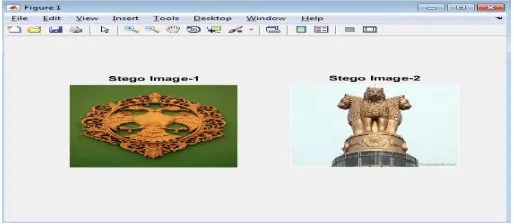
Figure 4.2: Cover Images
Step 2:
Enter the data which is to be hidden into the
cover images. Here there is a provision for entering
two data’s. Input data can be an alphabet, numerical or
special characters. Each individual character of the
input data obtains an optimal location in the
considered cover images.
The best locations for embedding are found using
firefly algorithm. Since number of best locations is
equal to the numbers of characters in the secret
message, N (i.e. Number of fireflies for the firefly
algorithm) is taken as number of characters in the
secret message. While taking the best locations there is
chance of repeated locations considered as the best
thereby making the embedding lossy. So in order to
have lossless embedding the best location should be
non-repetitive. So a care is taken in this regard to
achieve the non-repeated best location in the design.
[image:9.595.240.558.49.376.2]Step 3:
Corresponding locations of each individual
character is represented in terms of rows and columns
i.e.,(r,c). These locations are selected randomly and it is
non repetitive also. Figure 3.3 depicts the data
embedded locations.
Figure 4.3: Data Embedding Locations
Step 4:
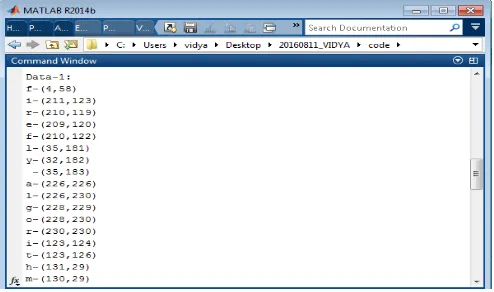
As we can enter two data’s, we can obtain the
embedded locations of each data individually. Figur
.e
4.4 and Fig
.ure 4.5 represents the optimal locations in
[image:9.595.309.556.521.667.2]the (r,c) format for Data-1 and Data-2 respectively.
© 2016, IRJET | Impact Factor value: 4.45 | ISO 9001:2008 Certified Journal
| Page 1252
Figure 4.5: Data Emb.eddin.g Locati.ons of Text-2Step 5:
Data Extraction Details is represented in the
Figure 4.6. It indicates the extraction of original data
without any modifications,
Figure 4.6: Data Eextracting Details
Step 6:
Time Analysis is depi
.cted in Figu
.re 4.7.It
provides the Embedding time and Extraction time
required for Data-1 and Data-2 respectively.
Figure 4.7: Analy.sis of Time