© 2016, IRJET | Impact Factor value: 4.45 | ISO 9001:2008 Certified Journal
| Page 791
Comprehensive Study & Implementation of Robust Dynamic Vehicle
Collision Avoidance System Using Wireless Communication
Vikas Chhabra
1, Er. Ankita Mittal
2M.Tech Research Scholar, Head of Department
Electronics & Communication Engg Department
Galaxy Global Group of Institutes, Dinarpur
Ambala, Haryana, India
Abstract- This work presents the concept of vehicle collision avoidance system in rural areas. It provides the different scenarios with movement of vehicles. It considers the problem of collision avoidance at vehicular intersections for a set of vehicles that are linked by wireless communication. The safety of driver is becoming an important issue in today’s time. The mission is to reduce number of deaths and injuries on our roadways. For this, it designs a controller using fuzzy approach for controlling the movement of vehicles that helps to maintain a distance between vehicles. The main part of the work was to carry out a feasibility study on vehicle collision avoidance system using wireless communication. The problem has major requirements: safety, i.e. vehicular collisions must be avoided; non-blockingness, i.e. vehicles should not deadlock and must reach their final destinations, which in this case means they must completely cross the intersection. It presents the concept of vehicle movement in single lane, two lane, traffic lane etc. The path of projection of vehicle is also presented by the use of controller. Their velocity of propagation, distance from sides and angle of orientation are also measured and evaluated.
Keywords- VANET, Wireless Communication, Vehicle Collision Avoidance, Fuzzy Controller etc.
I. INTRODUCTION
Communication systems using electrical and electronic technology have a significant impact on modern society. Telecommunication is defined by the International Telecommunication Union as the transmission, emission or reception of any signs, signals or messages by electromagnetic systems. Wireless communication involves the transmission of information over a distance without help of wires, cables or any other forms of electrical conductors.
The simplest scheme of wireless communication would be to convert the speech or music to be
transmitted to electric signals using a microphone, boost up the power of the signal using amplifiers and radiate the signal in space with the air of an antenna. This would constitute the transmitter. At the receiver end, one could have a pick-up antenna feeding the speech or music signal to an amplifier and a loud speaker.
The success of the IEEE 802.11 WLAN technology, the availability of a satellite based global position system (GPS), and the allocation of a 75 MHz bandwidth in the 5.9 GHz frequency band by the US Federal Communication Consortium in 1999 stimulated a shift in the focus of subsequent research projects. These studies put more emphasis on the evaluation of architecture and protocol related issues, on a systematic exploration of possible application scenarios and use cases, as well as on the analysis whether the IEEE 802.11a standard specification is suited to support these applications and able to serve as a foundation for inter-vehicle communication systems.
[image:1.595.316.559.592.721.2]In parallel, standardization activities were intensified and consortia were established to develop a harmonized communication architecture that enables inter-operability between all major car manufacturers. All these efforts lead to the final approval of the IEEE 802.11p standard specification in 2010, which is considered to be used by the first generation of inter-vehicle communication networks in the U.S.
© 2016, IRJET | Impact Factor value: 4.45 | ISO 9001:2008 Certified Journal
| Page 792
A Vehicular Ad-Hoc Network is a technology thatuses moving vehicles as nodes in a network to create a mobile network. VANET turns every participating vehicle into a wireless router or node, allowing vehicles approximately 100 to 300 meters of each other to connect and, in turn, create a network with a wide range. VANET is a subgroup of MANET where the nodes refer to vehicles. The primary goal of VANET is to provide road safety measures where information about vehicle’s current speed, location coordinates are passed with or without the deployment of Infrastructure. Paradigms are proposed for vehicular communications are (shown in fig 1):
Vehicle to Vehicle (V2V)
Vehicle to Infrastructure (V2I)
Vehicle to Roadside (V2R)
This section provides literature survey related to vehicle collision avoidance system and provides various approaches related to them. Some authors [1] described the chance of smart video security system implementation. Authors [2] developed a system for collision warning for detecting vehicles ahead and also used to identify safety distance for assisting a distracted driver prior to crash. Researchers [3] presented a real time system for collision avoidance. It was based on characterizing with B-Spline curves. Authors [4] presented a Wireless based system that was capable of detecting vehicle collisions with motorways guardrail. Researchers [5] proposed a resolution algorithm using contention window. As the contention resolution system in IEEE 802.11, binary exponential back-off (BEB) has long been criticized because of its high collision probability in diffusion situation. Authors [6] considered the collision avoidance problem at vehicular intersections for different types of vehicles in controlled and uncontrolled manner.
In this paper, it studies the concept of vehicle collision avoidance system using wireless communication. Further, in section II, it provides the related work of various researchers. In Section III, It defines basics of vehicle collision avoidance technique. Finally, conclusion is explained in Section IV.
II. FUZZY SYSTEM MODEL
[image:2.595.311.553.79.148.2]The Fuzzy Logic tool was introduced in 1965, also by Lotfi Zadeh, and is a mathematical tool for dealing with uncertainty. It offers to a soft computing partnership the important concept of computing with words’. It provides a technique to deal with imprecision and information granularity. The fuzzy theory provides a mechanism for representing linguistic constructs such as “many,” “low,” “medium,” “often,” “few” as shown in fig 2.
Fig 2: A Simple Fuzzy Logic System [18]
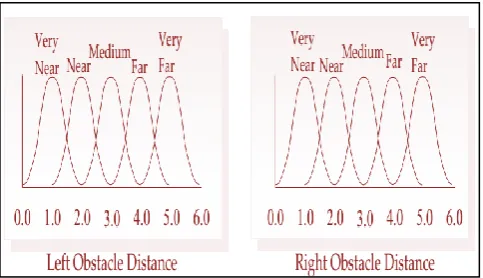
[image:2.595.313.555.517.656.2]The human brain interprets imprecise and incomplete sensory information provided by perceptive organs. Fuzzy set theory provides a systematic calculus to deal with such information linguistically, and it performs numerical computation by using linguistic labels stipulated by membership functions. A fuzzy inference system (FIS) when selected properly can effectively model human expertise in a specific application. A classic set is a crisp set with a crisp boundary. In contrast to a classical set, a fuzzy set, as the name implies, is a set without a crisp boundary. That is, the transition from “belongs to a set” to “does not belong to a set” is gradual, and this smooth transition is characterized by membership functions that give fuzzy sets flexibility in modelling commonly used linguistic expressions, such as “the water is hot” or “the temperature is high”. The fuzziness does not come from the randomness of the constituent members of the set, but from the uncertainties and imprecise nature of abstract thoughts and concepts. The construction of a fuzzy set depends on two things: the identification of a suitable universe of discourse and the specification of an appropriate membership function. Therefore, the subjectivity and non-randomness of fuzzy sets is the primary difference between the study of fuzzy sets and Probability Theory. Fig 3 denotes the membership function for left and right obstacle distance. It helps the vehicle for preventing collision from sides of wall or road.
© 2016, IRJET | Impact Factor value: 4.45 | ISO 9001:2008 Certified Journal
| Page 793
performed using membership functions. In a conventional [image:3.595.38.280.169.306.2]fuzzy logic controller, the number of membership functions and the shapes of these are initially determined by the user. A membership function has a value between 0 and 1, and it indicates the degree of belongingness of a quantity to a fuzzy set. The membership function for speed is shown in fig 4.
Fig 4: Membership Function for Speed
Once the linguistic variables and values are defined, the rules of the fuzzy inference system can be formulated. These rules map the fuzzy inputs to fuzzy outputs. This mapping takes place through compositional rule of inference which is based on Zadeh’s extension of modus ponens which is nothing more than the familiar if-then conditional form. A fuzzy if-if-then rule (also known as fuzzy rule) assumes the form.
If x is A then y is B.
The membership functions can take many forms including triangular, Gaussian, bell shaped, trapezoidal, etc. The knowledge base consists of the data base and the linguistic control rule base. The data base provides the information which is used to define the linguistic control rules and the fuzzy data manipulation in the fuzzy logic controller. The rule base defines (expert rules) specifies the control goal actions by means of a set of linguistic rules. In other words, the rule base contains rules such as would be provided by an expert.
Table 1: IF-THEN Rules for Linguistic Variables
IF THEN
L_Dist is Far and R_Dist is Far R_Vel is high, L_Vel is high
L_Dist is Near and R_Dist is
Near R_Vel is Slow, L_Vel is high L_Dist is Near and R_Dist is
Medium R_Vel is Slow, L_Vel is Slow L_Dist is Near and R_Dist is
Far R_Vel is Slow, L_Vel is Slow
III. PROPOSED IMPLEMENTATION OF SYSTEM
Driving safety is an important issue. There are several factors like human error, mechanical failure of
vehicle, inclement weather conditions and roadway limitations that present a real challenge to the safety of the driver by causing road accidents. We consider the problem of collision avoidance at vehicular intersections for a set of controlled and uncontrolled vehicles that are linked by wireless communication.
While the envisioned scenario of vehicles that exchange information using wireless communication technology to increase safety on the roads is intuitively convincing to many people, the technical implementation of just that is not as straight forward as one might think. Indeed, inter-vehicle communication networks are challenged by several issues and requirements, which exist either due to the inherent characteristics of the considered scenario, or due to the fact that a communication technology has been selected which has not been designed for the usage in such an environment in the first place.
Collision avoidance in networking mainly appears in networks with carrier sense multiple accesses. This is based on the principle that nodes that are willing to transmit data have to listen to the channel for some time to determine whether other nodes are also transmitting on the wireless channel. A node can start transmission only if a channel appears to be idle, otherwise, transmissions are deferred. Collision avoidance divides the wireless channels equally among transmitting nodes within the collision domain. It’s supplemented by exchanging requests to send a packet. Nodes within senders and receivers are alerted not to transmit for the duration of main transmissions.
Fig 5: Proposed System Model of System
[image:3.595.314.558.444.712.2]© 2016, IRJET | Impact Factor value: 4.45 | ISO 9001:2008 Certified Journal
| Page 794
any vehicle to inform neighbouring vehicles about theown presence and status, as well as event-driven alert messages which are sent out in case of an emergency situation that requires an immediate notification of possibly affected neighbours. Whereas periodic messages are envisioned to be only one-hop broadcasted and termed either Cooperative Awareness Message (CAM) or simply “beacon”, event-driven messages may be disseminated over more than one hop. The network has to support scenarios in which only a small number or up to several hundreds of vehicles have to communicate, hence it has to be elastic and scalable.
In this work, it considers the vehicle collision avoidance at rural areas in nation. For this, it uses a fuzzy controller for controlling the movement of vehicles. The vehicle used here are rear wheel drive having two rear wheels, namely left and right rear wheel. The vehicle considered in this thesis is a car or bus for simulation mode. Each vehicle has an array of sensors for measuring the distances around it and locating the target i.e., front obstacle distance (FD), left obstacle distance (LD), right obstacle distance (RD) and detecting the bearing of target. The distance between the vehicle and obstacles act as repulsive forces for avoiding the obstacles, and the bearing of the target acts as an attractive force between vehicles and target. Linguistic variables such as “far”, “medium” and “near” are taken for membership function.
IV. SCENERIOS FOR PROPOSED VEHICLE COLLISION
AVOIDANCE SYSTEM
We know, year by year and day by day, accident ratio increases, and thus traffic safety become a very important issue. Our proposed system assists the driver at cross roads. The traffic patterns at street corners are unpredictable and can often lead to dangerous situations.
In first case, only single lane is available for moving the vehicle. In case the car is going in front side if there is any vehicles is coming in side direction means our both sides of the sensor will detect. The driver can easily stop or save the car from accidents. The base station is provided in the road side. If there is any vehicle wants to cross or overtake the another vehicle and if there is distance between vehicle is less as compared to threshold then base station immediately sends the
message to vehicles to reconfigure the distance and velocity.
The mission of this module is to detect and track obstacles and determine their speed and direction while distinguishing between obstacles that are within the area of interest and may present a risk, and those that are outside. Positioning of the vehicle and the obstacles in accurate and detailed digital maps provide extra information. It decides the best possible action to take to avoid an accident or reduce its consequences based on the information from the surroundings. Its premise is not to generate any additional risks for other road users. This decision module should take into account the road characteristics, the own vehicle movement, the obstacles and should generate manoeuvres that are feasible in practice according to vehicle dynamics and should not be surprising for the drivers.
In 2nd case, two lane roads are available for moving the vehicle. In case the car is going in front side if there is any vehicles is coming in side direction means our both sides of the sensor will detect. In this, it uses the fuzzy controller for controlling the movement of vehicles. It requires position of vehicle as input and provides velocity as an output. These parameters will used to estimate the collision probability of vehicle. The main parameters are velocity of vehicle, angle of orientation, distance from wall and time of simulation etc.
(A)
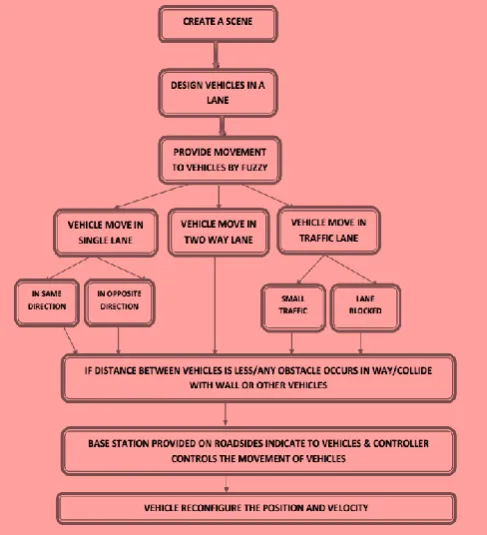
(B) Step 1: Design a Scene
Step 2: Design Vehicles in Scene (V) & provide base station (BS) at road side
Step 3: Fuzzy movement (V); Step 4: Apply Different Cases:
Case 1: if vehicle moving in single lane then If V are in same direction then
If distance between V is less< threshold then BS message to V to maintain the distance to avoid collision
end end
If V are in opposite direction then
If side distance between V is less< threshold then
BS message to V to maintain the side distance end
end End
Case 2: if vehicle moving in double side lane then If distance between V is less< threshold then BS message to V to maintain the distance to avoid collision
End End
Case 3: if vehicle moving in Traffic lane then If small traffic is present then BS message to V to avoid traffic End
If complete lane is blocked then BS message to V to change the lane immediately
© 2016, IRJET | Impact Factor value: 4.45 | ISO 9001:2008 Certified Journal
| Page 795
(c)
[image:5.595.38.285.73.415.2](D)
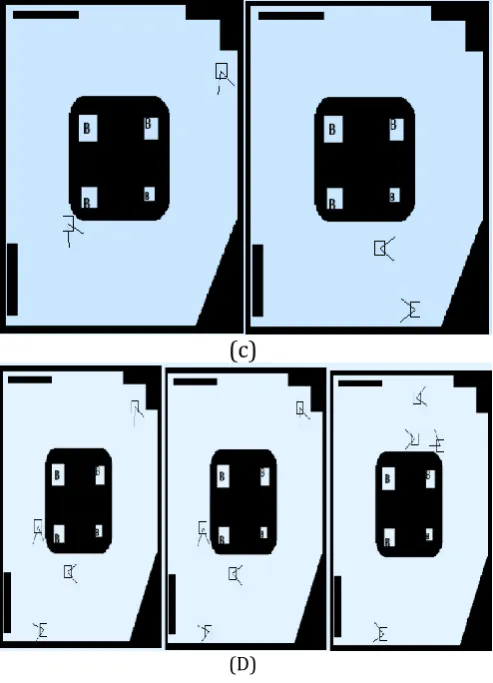
Fig 6: Scenarios for Collision Avoidance System in Areas a) 2 Vehicle in Single Lane b) 4 Vehicle in Single Lane c) 2 Vehicle Moving in Opposite
Direction in Lane d) 4 Vehicle Moving in Opposite Direction
V. CONCLUSIONS
Vehicle-to-vehicle communication promises a safer driving environment. The safety systems are designed to provide warnings to drivers so that necessary actions are taken to prevent accidents. Driving safety is an important issue. It considers the problem of collision avoidance at vehicular intersections for a set of controlled and uncontrolled vehicles that are linked by wireless communication. The foremost objective of work is to prevent rural intersection collisions. In this case, vehicle is controlled by fuzzy controller and communicates by base station present on roadside. If distance between the vehicles is less, then their speed is controlled by controller and hence it avoids the collision between them. In this work, it presents the scenario for rural areas mainly. It presents the scenario with two and four vehicles in a single lane or two lane areas. It follows the rule of left side travelling in each scenario by the use of controller. The path of projection of vehicle is also presented by the use of controller. Their velocity of propagation, distance from sides and angle of orientation are also measured and evaluated.
The future work includes lane detection and collision avoidance system under hilly areas under heavy
traffic. Also implement this system with hardware configuration.
REFERENCES
[1] H. Salmane, L. Khoudour, Yassine Ruichek, “A
Video-Analysis-Based Railway–Road Safety System For Detecting Hazard Situations At Level Crossings”, IEEE Transactions on Intelligent Transportation Systems, 2015.
[2] M. Rezaei, M. Terauchi, “Robust Vehicle Detection And
Distance Estimation Under Challenging Lighting Conditions”, IEEE Transactions On Intelligent Transportation Systems, 2015.
[3] Hamid Alturbeh, James F. Whidborne, “Real-time Obstacle
Collision Avoidance for Fixed Wing Aircraft Using B-splines”, IEEE International Conference on Control, July 2014.
[4] J. Miranda, T. Gomes, R. Abrishambaf, “A Wireless Sensor
Network for Collision Detection on Guardrails”, IEEE 2014.
[5] Hongwei Cheng, Xiao Yan, Hao Lian, “A Novel Collision
Avoidance Algorithm for IEEE 802.11 Wireless LANs”, IEEE Military Communications Conference, 2014.
[6] Eric Dallal, Alessandro Colombo, Domitilla Del Vecchio,
“Supervisory Control for Collision Avoidance in Vehicular Networks Using Discrete Event Abstractions”, American Control Conference (ACC)Washington, USA, June 17-19, 2013.
[7] Fadi Basma, Yehia Tachwali and Hazem H Refai, “Intersection
Collision Avoidance System Using Infrastructure
Communication”, IEEE Conference on Intelligent
Transportation Systems, USA. October 5-7, 2011.
[8] H.Nasser, “Wireless Sensor Network for Monitoring,
Diagnosis and Supervision”, IEEE Mecatronics, Paris, pp.32-39, 2012.
[9] Mohamed Amine Abid, “Pedestrian Collision Avoidance in
Vehicular Networks”, IEEE ICC-Communication Software and Services Symposium, pp.2928-2932, 2013.
[10] Sok-Ian Sou, “Modeling Emergency Messaging for Car
Accident over Dichotomized Headway Model in Vehicular Ad-hoc Networks”, IEEE Transactions on Communications, Vol. 61, No. 2, February 2013.
[11] Yuancao Li, Zhesheng Lin, Huan Liu, Yuehong Gao,
“Performance Evaluation of A Resource Allocation Scheme for Mixed Traffic in Dynamic-TDD Network”, IEEE 2014.
[12] Yi Song and Jiang Xie, “BRACER: A Distributed Broadcast
Protocol in Multi-Hop Cognitive Radio Ad Hoc Networks with Collision Avoidance”, IEEE Transactions on Mobile Computing, Vol. 14, No. 3, pp. 509-524, March 2015.
[13] P.J.A Vignesh, “Relocating Vehicles to Avoid Traffic Collision
through Wireless Sensor Networks”, 4th International
Conference on Computational Intelligence, Communication Systems and Networks, pp. 407-412, Phuket, July 2012.
[14] Huang Zhu and Gurdip Singh, “A Communication Protocol for
Vehicle Collision Warning System”,Green Computing and Communications, IEEE International Conference on & International Conference on Cyber, Physical and Social Computing, pp. 636 – 644, Hangzhou, December 2010.
[15] Umair Ali Khan, “Inter-vehicle Collision Avoidance Using
Zigbee Sensor Networks”, International Journal of Scientific & Engineering Research, Vol. 4, Issue 4, pp. 359-365, April 2013.
[16] Chiung-Yao Fang, Jui-Hung Liang, Chiao-Shan Lo, “A Real-time
Visual-based Front-mounted Vehicle Collision Warning System”, IEEE 2013.
[17] Liu Jiang, Cai Bai-gen, Wang Yun-peng, “Location-based
![Fig 1: Communication Types in VANET [15]](https://thumb-us.123doks.com/thumbv2/123dok_us/8186786.812265/1.595.316.559.592.721/fig-communication-types-in-vanet.webp)