© 2016, IRJET | Impact Factor value: 4.45 | Page 746
EFFECTIVE MULTICASTING USING TRAJECTORY IN SPARSE
VEHICULAR NETWORKS
Mr. Stalin David D
1, Dr.A.Jayachandran
2,
¹PhD Research Scholar, Department of CSE, PSN College of Engineering & Technology,
Tirunelveli,Tamilnadu, India,
² Research Supervisor, Department of CSE, PSN College of Engineering & Technology,
Tirunelveli,Tamilnadu, India
ABSTRACT
-
Multicast is a crucial routine operation for vehicular networks, which underpins important functions such as message dissemination and group coordination. As vehicles may distribute over a vast area, the number of vehicles in a given region can be limited which results in sparse node distribution in part of the vehicular network. This poses several great challenges for efficient multicast, such as network disconnection, scarce communication opportunities and mobility uncertainty. Existing multicast schemes proposed for vehicular networks typically maintain a forwarding structure assuming the vehicles have a high density and move at Low speed while these assumptions are often invalid in a practical vehicular network. TMC is mainly used to exploit vehicle trajectories for efficient multicast in vehicular networks. The novelty of TMC includes a message forwarding metric that characterizes the capability of a vehicle to forward a given message to destination nodes, and a method of predicting the chance of inter-vehicle encounter between two vehicles based only on their trajectories without accurate timing information. TMC is designed to be a distributed approach. Vehicles make message forwarding decisions based on vehicle trajectoriesShared through inter-vehicle exchanges without the Need of central information management.
Keywords: Trajectory based forwarding (TMC), Multicast routing, Packet delivery ratio, DSR Protocol, RSU (road side unit).
1. INTRODUCTION
In TMC, message forwarding metric is proposed to characterize the capability of A vehicle to forward a given message to a group of destination nodes, which is defined as a vector of delivery potential of the message to each of the destination nodes. With this metric, a vehicle can simply forward a message to a vehicle that has a higher multicast delivery gain over the vehicle itself.
The salient feature of TMC is that it is a fully distributed approach in which vehicle trajectories are shared through inter-vehicle exchange and a vehicle makes its message forwarding decision based on the trajectories it learns instead of relying on a central point for information management.
2. EXISTING SYSTEM
© 2016, IRJET | Impact Factor value: 4.45 | Page 747
Sources based routing and Cartesian forwarding inthat the trajectory is set by the source, but the forwarding decision is based on the relationship to the trajectory rather than names of intermediate nodes. The fundamental aspects of TBF are it decouples path naming from the actual path, it provides cheap path diversity, and it trades of communication for computation. In vehicular networks typically maintain a forwarding structure assuming the vehicles have a high density and move at low speed while these assumptions are often invalid in a practical vehicular network. Vehicles may the specification of the trajectory is Key challenge is to predict the chance of encounter between two vehicles based only on their trajectories without accurate timing.
This makes TBF usable as a routing support, when the destination is indicated, as a discovery support primitive, when the destination is not known, or as a flooding replacement. it provides cheap path diversity, when compared to flooding based traditional methods of finding alternate paths. It trades off communication for computation, by declaring paths instead of searching them
Another problem is two vehicles can communicate only when they encounter (i.e., within the communication range of each other), the encounter opportunities become the critical network resources, which are usually insufficient to increased the security level in given message to a group of destination without the knowledge of trajectory, the nodes can communicate with each other. So, the communication cannot be effective and delay is more. With the help of trajectory only the communication
will be more effective. Apart from that direct transmission between nodes takes place, so that the distance and transmission range between source and destination takes place easily. Because of this throughput packet delivery ratio end to end delay and transmission overhead will be very loss.
3. PROPOSED SYSTEM
3.1 MULTICAST ROUTING
ALGORITHM
© 2016, IRJET | Impact Factor value: 4.45 | Page 748
This method provides better transmissionperformance and fault tolerance by providing to avoidance of path Multipath routing is the routing technique of using multiple alternative paths through a network, which can yield a variety of benefits such as fault tolerance, increased bandwidth, or improved security.
Using multicast, the source organization reduces the amount of bandwidth needed to send the data stream to many recipients or endpoints
Transmission range is less
Distance will be very less to communicate
4.
SIMULATION PARAMETER
The simulation parameters used in network Simulators are discussed in the table below
.
Table 4.1
Parameters Used In Ns2
5. SCENARIO ANALYSIS
5.1 With Relay
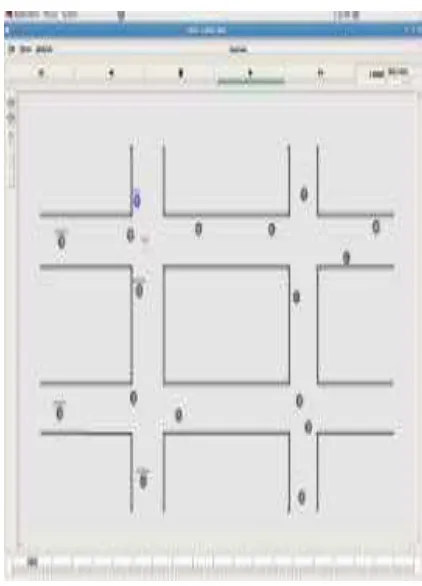
[image:3.612.325.536.190.483.2]A relay network is a broad class of network topology commonly used in wireless networks, where the source and destination are interconnected by means of some nodes. So, that transmission range between the source and destination is reduced. In addition to delay can be maintained. In vehicular networks typically maintain a forwarding structure.
Fig 5.1
presence of relay node
In fig 5.1, the relay nodes is used which is essentially used to maintain the capability of vehicles which is near to the destination node.
5.2 Without relay
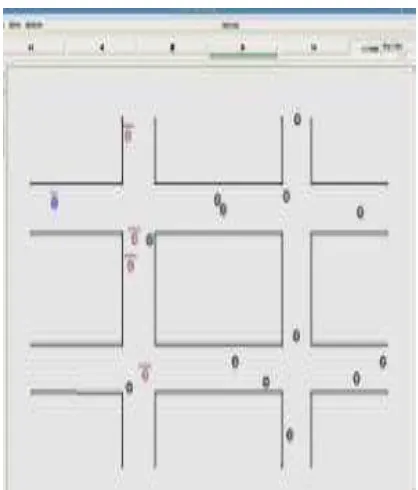
Without intermediate nodes distance between source and destination is more. The number of packets drops will be more. So, the number of overhead packets will be less, the following vehicles to notify other drivers before they reach the potential danger zone on the road.
Parameter
Configuration
protocol
DSR
Network interface PHY/Wireless PHY
type
MAC type
MAC/802.11
© 2016, IRJET | Impact Factor value: 4.45 | Page 749
Fig 5.2
Absence of relay node
6. RESULT AND ANALYSIS
6.1 Throughput
Throughput is the rate of successful message delivery over a communication channel. Without relay node, message or data cannot be delivered successfully. Some drop of packets takes place.
Fig 6.1
Throughput
Above Figure 5.2 shows to compute the metric, thekey challenge is to predict the chance of encounter between two vehicles based only on their trajectories without accurate timing information. In the presence of relay node the transmission range between the source and destination will be less. So, the number of overhead packets will be less
Multipath Routing is often taken to mean simultaneous management and utilization of multiple available paths for the Transmission of streams of data emanating from an application or multiple applications. In vehicular networks typically maintain a forwarding structure assuming the vehicles have a high density and move at low speed while these assumptions are often invalid in a practical vehicular network.
In this form, each stream is assigned a separate path, uniquely to the extent supported by the
number of paths available.
6.2 Packet Delivery Ratio
[image:4.612.316.531.229.362.2]Without relay, the number of packets delivered to receiver will be less. But in the presence of intermediate nodes no loss of packets takes place. Because in presence of relay nodes, source and destination distance will be more. Apart from the distance, the transmission range between two nodes is also more.
Fig 6.2
Packet delivery ratio
[image:4.612.324.533.554.644.2]© 2016, IRJET | Impact Factor value: 4.45 | Page 750
compare to with relay.6.3 End To End Delay
[image:5.612.321.543.45.304.2]In relay node, the node cannot take more time to communicate with source and destination. But without relay node the distance and transmission between nodes is very high. So, the delay is more and it takes more time to communicate with each other
Fig 6.3
End To End Delay
In fig 6.3, end to end delay is compares with relay and without relay. Without relay the distance between the nodes is high. So, that the delay is high when compare to with relay. In the presence of relay node the transmission range between the source and destination will be less. So, the number of overhead packets will be less
6.4 Packet overhead
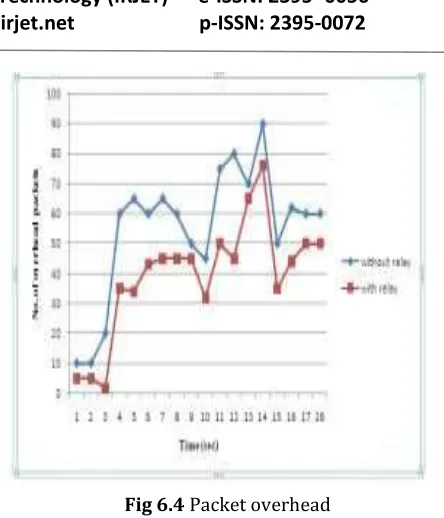
[image:5.612.78.291.246.412.2]Data that you send across a wireless network is housed in a data envelope called a packet. Each transmission includes additional information, called overhead. It refers the time it takes to transmit data to increased security level in packet transmission to destination nodes.
Fig 6.4 Packet overhead
© 2016, IRJET | Impact Factor value: 4.45 | ISO 9001:2008 Certified Journal | Page 751
In vehicular networks typically maintain a forwardingstructure assuming the vehicles have a high density and move at low speed while these assumptions are often invalid in a practical vehicular network. Vehicles may the specification of the trajectory is Key challenge is to predict the chance of encounter between two vehicles based only on their trajectories without accurate timing.
Packet delay between source and destination occur without intermediate node. In such a network the source and destination cannot communicate to each other directly because the distance between the source and destination is greater than the transmission range. In TMC, a novel message forwarding metric is proposed to development to characterize the capability of a vehicle to forward a packets to increased the security level by given message to a group of destination nodes, which is defined as a vector of delivery potential of the message to each of the destination nodes. With this metric, a vehicle can simply forward a message to a vehicle.
CONCLUSION AND FUTURE WORK
TMC can achieve the packet delivery ratio high when compare to direct transmission. In future, road side unit (RSU) will be implemented then the source vehicle that detects an accident can generate a warning message and propagate it to the following vehicles to notify other drivers before they reach the potential danger zone on the road. RSU is an access points, used together with the vehicles, to allow information dissemination in the roads.
REFERENCES
[1] Kim .W and Gerla .M, “Cognitive multicast with partially overlapped channels in vehicular ad hoc networks,” Ad Hoc Networks, 2012. Yoon-JooPark, “The Adaptive clustering method for the long tail problem of recommender systems” IEEE Transcation on knowledge and Data Engineering, 2013.
[2] Adomavicius.G and Tuzhilin.A, “Expert-driven Validation of Rule-based User Models In Personalisation Application “IEEE Trans Data Mining and Knowledge Discovery,2005.
[3] Adomavicius.G and Tuzhilin.A, “Toward the Next Generation of Recommender Systems: A Survey of the State of the Art and possible Extensions” IEEE Transaction on Knowledge and Data Engineering, 2006.
[4] Anderson.C, “The Long Tail.New York: Hyperion Press”, 2007.
[5] Bell.R.M and Yehuda.k, “Improved Neighbood – based collaborative Filtering” KDD Cup07, Calofornia, 2007. [6] Fleder.D.M and Hosanagar.k, “Blockbuster Cultures Next Rise or Fall; The Impact of Recommender Systems on Sales Diversity”, NET Institute Working Paper No.07-10,2008.
[7] Heli,JaesooYoo, “An Efficient Scheme for Continous Skyline Query Processing OverDynamic Data Set” , IEEE Transaction, 2014.
[8] Hervas-Drane.A, “Word of Mouth and Recommender Systems: A Theory of the Long Tail”NET Institute Working Paper No.07-41,2007.
[9] Linden.G, Smith.B, and York.J, “Amazon.com Recommendations: Item-to-Item collaborative filtering” , IEEE Internet Computing, 2003.
[10] Park,Y.J,Tuzhilin.A, “ The Long Tail of Recommender systems and how to leverage It” , Proceeding of the 2008 ACM conference on Recommender Systems, Lausanne Switzerland, PP.no 11-18, 2008.
[11] PunamBedi, Sumit Kr Agarwal, “Managing Security in Aspect-oriented Recommender System”, IEEE Transaction, 2011.
[12] Smola.A.J, Schoelkopf.B, “A tutorial on support vector regression, Statistics and computing”, 2006.
[13] Truong.K.Q.Ishikawa.F, and Honiden.S, Improving Accuracy of Recommender Systems by Item Clustering”, IEICE Transaction on Information and Systems, 2007.
[14] wittenL.H and Frank.E, “Data Mining: Practical Machine Learning Tools and Techniques with Java Implementations” . Burlington, MA: Morgan Kaufmann, 2005. Manuel Uruen´a, Member, IEEE, Rube´n Cuevas, Member, IEEE, A´ ngel Cuevas, Member, IEEE, and Albert Banchs, Member, IEEE, [2013] “A Model to Quantify the Success of a Sybil Attack Targeting RELOAD/Chord Resources”
[15] Xiaohui Liang, Student Member, IEEE, Xiaodong Lin, Member, IEEE, and Xuemin (Sherman) Shen, Fellow, IEEE, [2013] “Enabling Trustworthy Service Evaluation in Service-oriented Mobile Social Networks”
[16] Yingying Chen, Member, IEEE, Jie Yang, Student Member, IEEE, Wade Trappe, Member, IEEE, and Richard P. Martin, Member, IEEE,[2010] “ Detecting and Localizing Identity-Based Attacks in Wireless and Sensor Networks”