http://dx.doi.org/10.4236/msce.2015.32002
Single Phase Li
4
Ti
5
O
12
Synthesis for
Nanoparticles by Two Steps Sintering
Toshihito Ohtake
Department of Mechanical Systems Engineering, Faculty of Engineering, Aich University of Technology, Gamagori, Japan
Email: [email protected]
Received 7 January 2015; accepted 26 January 2015; published 30 January 2015
Copyright © 2015 by author and Scientific Research Publishing Inc.
This work is licensed under the Creative Commons Attribution International License (CC BY).
http://creativecommons.org/licenses/by/4.0/
Abstract
Li4Ti5O12 has been noticed about a negative electrode of a high powered and safe lithium ion sec-ondary battery. These properties require single phase, high crystallization, larger specific surface area and fine nanoparticles. This study carried out the noble synthesis of Li4Ti5O12 using a solid phase synthesis by two steps sintering. These results showed Li4Ti5O12 of 6.1 m2∙g−1 and diameter of 110 nm with the single phase and high crystallization. Li2TiO3 will play an important role in this reaction, obtained by pre-sintering as a precursor.
Keywords
Lithium Ion Secondary Battery, Li4Ti5O12, Solid Phase Synthesis, Sintering, Nanoparticle
1. Introduction
Lithium ion secondary batteries have been noticed for many applications to high performances recently, and the developments have been performed [1]. For example, material development of negative electrode has been con-cerned with safety. The material is currently graphite, which has layer structure and is intercalated by lithium ions into the layers. On the other hand, the graphite is not safe to expand with overcharge to intercalate amount of lithium ions over the stoichiometry into the layer. Therefore, noble materials have been investigated instead of the graphite to prevent ignition by internal short-circuit [2]. The noble materials need some properties, whose crystal structure shows no change and high stability with intercalate lithium ions. Furthermore, the synthesis is easy and inexpensive to mass production. Here, we have studied Li4Ti5O12 as superior negative electrode mate-rials [3].
stabil-2. Experimental
Li4Ti5O12 synthesis was carried out by using CH3COOLi·2H2O (Wako Pure Chemical Industries, Ltd.) as a Li source that was melted with low temperature at about 300˚C, and anataseTiO2 (Toho Titanium Co., Ltd.) as a Ti source. The first synthesis process was mixed with the CH3COOLi·2H2O and TiO2 with Li:Ti = 4:5 by ball mil-ling (Fritsch, Pulversitte 7) at 1 h, rotating speed at 320 rpm and orbital speed at 110 rpm in agate mortar and balls. The mixed powder was pre-sintering at 400˚C, 450˚C and 500˚C with 10˚C/min, 1 h in air, and a precursor was formed. Furthermore, the precursor was mixed by the ball milling at 1 h similarly, and was sintered at 700˚C and 750˚C with 10˚C/min at 1 h in air.
The obtained powder was identified by XRD (Rigaku Corp., Rint 2000) at scanning step 0.02 deg and scan-ning speed 5 deg/min by CuKα, and was also measured by BET specific surface area (Shimadzu Corp., Flow-Sorb III 2305) at 0.1 g sample, gas flow rate 80 cm3/min in N2 and current 50 mA, after degassing the sample with heating at 160˚C at 2 h. Particle size of the obtained sample was observed by FE-SEM (Hitachi, Ltd., S- 4200), and crystalline estimation tried with TEM (JEOL Ltd., JEM-2100).
3. Results and Discussion
3.1. Pre-Sintering
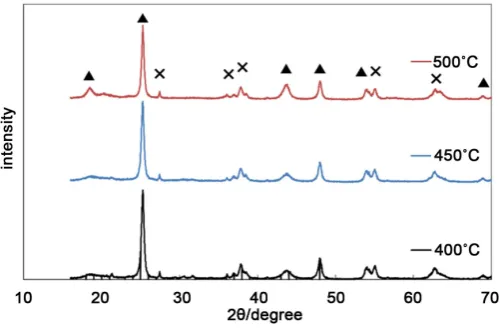
Precursor was formed by pre-sintering the CH3COOLi·2H2O and TiO2 mixed powder at 400˚C, 450˚C and 500˚C in air, and showed in Figure 1. These indicated unreacted TiO2 and sub-phase Li2TiO3 of Li4Ti5O12 under any temperature. This relationship is known as a phase diagram of Li2O-TiO2 among TiO2, Li2TiO3 and Li4Ti5O12, which shows an accurate mixed rate at Li and Ti atoms [6]. Ti site of Li2TiO3 and Li4Ti5O12 is com-mon in center of an octahedron, while Li site exist a tetrahedron in the case of Li2TiO3. Hence, Li2TiO3 shows inactivity as the electrode not to charge and discharge Li ions [7].
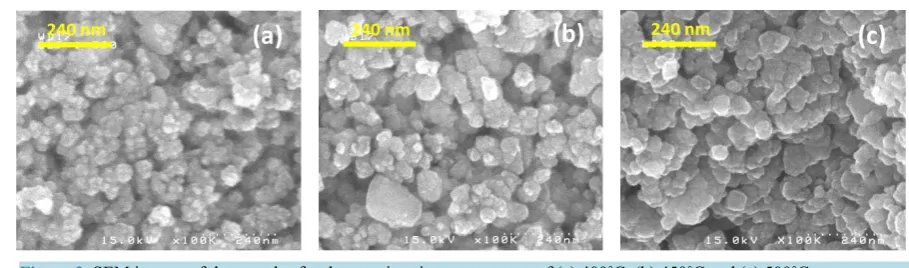
[image:2.595.173.424.522.686.2]SEM images were shown about the precursors in Figure 2. These indicated that average grain size increased with the pre-sintering temperature at 50 nm, 70 nm and 75 nm under 400˚C, 450˚C and 500˚C. Simultaneously,
Figure 1. XRD patterns of the samples pre-sintered at 400˚C (black line), 450˚C (blue line) and 500˚C(red line), which show ▲; Li2TiO3
Figure 2. SEM images of the samples for the pre-sintering temperature of (a) 400˚C, (b) 450˚C and (c) 500˚C.
BET specific surface area presented 27.7 m2∙g−1, 26.6 m2∙g−1 and 26.2 m2∙g−1 under 400˚C, 450˚C and 500˚C. The images of the grain observed two types as deference of contrast at 400˚C in Figure 2(a), and showed a uni-form contrast with the high temperature. These results might indicate a localization of unreacted TiO2 and sub- phase Li2TiO3 in keeping with XRD patterns. This tendency may confirm TEM images in Figure 3, which will show a low crystallization with corresponded to XRD not to observe facet areas.
3.2. Sintering
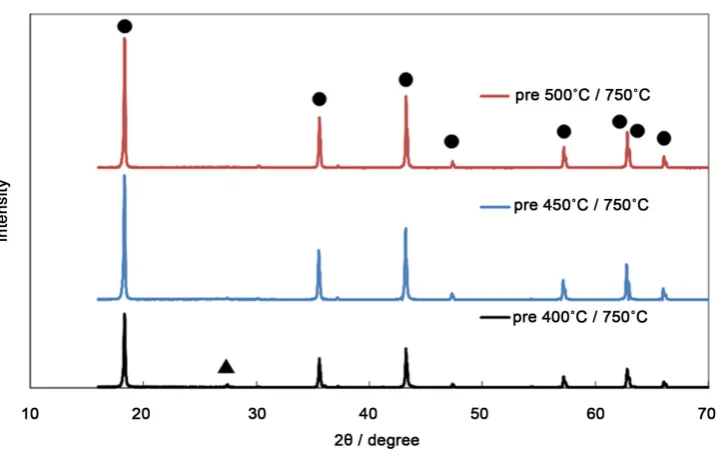
XRD peaks of samples ware showed at sintering temperature of 700˚C and 750˚C inFigure 4 and Figure 5. Peaks intensity of Li2TiO3 decreased, while those of Li4Ti5O12 increased with pre-sintering temperature at 700˚C sintering in Figure 4. Single phase of Li4Ti5O12 was obtained at the pre-sintering temperature of 500˚C in Fig-ure 5, however the peaks intensity indicated the similar tendency about pre-sintering temperature with the sin-tering temperature of 700˚C. Here, we defined a single phase rate to estimate it, which utilized the peaks area of them at shown in following equation.
( )
(
4 5 12) (
{
2 3) (
4 5 12)
}
single phase rate % =I Li Ti O I Li TiO +I Li Ti O ×100
The value at 700˚C was 80%, 84% and 86% at the pre-sintering temperature of 400˚C, 450˚C and 500˚C, which were advantageous with the high pre-sintering temperature. Furthermore, the value at 750˚C was 92%, 99% and 100% similarly, and we could obtain the single phase Li4Ti5O12 at 750˚C. These results will show that the sub-phase Li2TiO3 give effects for the Li4Ti5O12 synthesis.
A surface separation of (002) face of Li2TiO3 at 4.80 Å is very close to that of (111) face of Li4Ti5O12 at 4.83 Å in the spinel structure, which Li4Ti5O12 would be able to form from Li2TiO3 with holding the structure [8]. The knowledge will show that Li4Ti5O12 was synthesized via Li2TiO3 by the pre-sintering, and the single phase was obtained at 750˚C in this process.
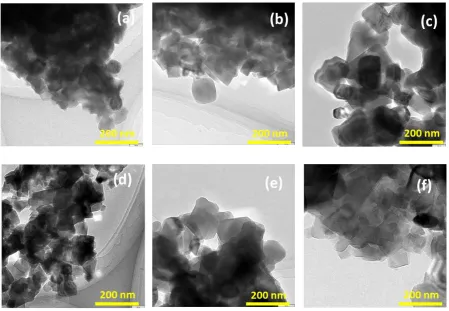
SEM images of the samples showed in Figure 6. The average grain size was observed at about 90 nm in any samples at sintering temperature of 700˚C in Figures 6(a)-(c), and the BET specific surface area was about 10.5 m2∙g−1 for any samples. Similarly, it was at 110 nm under 750˚C in Figures 6(d)-(f), and was 7.3 m2∙g−1, 6.3 m2∙g−1 and 6.1 m2∙g−1 in the specific surface area. The grain size of the single phase Li4Ti5O12 have reported about 600 nm in the solid phase synthesis under 850˚C at 12 h by boll-milling [9]-[11], and Guerfi has especial-ly reported the grain size of 150 nm by mixing graphite into the ball mill [9]. On the other hand, we could syn-thesize that of grain size of 110 nm via Li2TiO3 at 750˚C by the two steps sintering method.
Figure 4. XRD patterns of the samples sintered at 700˚C with the pre-sintered temperature of 400˚C
(black line), 450˚C (blue line) and 500˚C(red line), which show ●; Li4Ti5O12and ▲; Li2TiO3.
[image:4.595.120.482.209.436.2] [image:4.595.119.480.468.694.2]Figure 6. SEM images of the samples sintered at 700˚C with the pre-sintered temperature of (a) 400˚C, (b) 450˚C and (c) 500˚C; and at 750˚C with the pre-sintered temperature of (d) 400˚C, (e) 450˚C and (f) 500˚C.
[image:5.595.89.539.385.696.2][2] Tsutomu, O., Atsushi, U. and Norihiro, Y. (2005) Zero-Strain Insertion Material of Li[Lil/3Ti5/3]O4 for Rechargeable
LithiumCells. Journal of the Electrochemical Society, 142, 1431-1435.
[3] Masataka, W. (2001) Recent Developments in Lithium Ion Batteries. Materials Science and Engineering: R: Reports, 33, 109-134. http://dx.doi.org/10.1016/S0927-796X(01)00030-4
[4] Kosovaa, N.V., Anufrienkob, V.F., Larinab,T.V., Rougierc, A., Aymardc, L. and Tarasconc, J.M. (2002) Disordering and Electronic State of Cobalt Ions in Mechanochemically Synthesized LiCoO2. Journal of Solid State Chemistry, 165,
56-64. http://dx.doi.org/10.1006/jssc.2002.9493
[5] Balaz, P. (2004) Mechanochemistry of Sulphides. Journal of Materials Science, 39, 5097-5102.
[6] Georgina, I. and Anthony, R.W. (1980) Phase Equilibria in the System Li2O-TiO2. Materials Research Bulletin, 15,
1655-1660. http://dx.doi.org/10.1016/0025-5408(80)90248-2
[7] Leonidov, I.A., Leonidova, O.N., Perelyaeva, L.A., Samigullina, R.F., Kovyazina, S.A. and Patrakeev, M.V. (2003) Structure, Ionic Conduction, and Phase Transformations in Lithium Titanate Li4Ti5O12. Physics of the Solid State, 45,
2183-2188. http://dx.doi.org/10.1134/1.1626760
[8] Hwang, C.S., Nakagawa, Z. and Hamano, K. (1993) Microstructure and Mechanical Strength of TiO2-Doped Al2O3
Ceramics Fired in Vacuum Atmosphere. Journal of the Ceramic Society of Japan, 101, 1051-1056. http://dx.doi.org/10.2109/jcersj.101.1051
[9] Guerfi, A., Charest, P., Konoshita, K., Perrier, M. and Zaghib, K. (2004) Nano Electrically Conductive Titanium-Spinel as Lithium Ion Storage Negative Electrode. Journal of Power Sources, 126, 163-168.
http://dx.doi.org/10.1016/j.jpowsour.2003.08.045
[10] Julien, C.M., Massot, M. and Zaghib, K. (2004) Structural Studies of Li4/3Me5/3O4(Me = Ti, Mn) Electrode Materials:
Local Structure and Electrochemical Aspects. Journal of Power Sources, 136, 72-79. ttp://dx.doi.org/10.1016/j.jpowsour.2004.05.001
[11] Aldon, L., Kubiak, P.,Womes, M., Jumas, J.C., Olivier-Fourcade, J., Tirado, J.L., Corredor, J.I. and Vicente, C.P. (2004) Chemical and Electrochemical Li-Insertion into the Li4Ti5O12 Spinel. Chemistry of Materials, 16, 5721-5725.
http://dx.doi.org/10.1021/cm0488837
[12] Lee, S.S., Byun, K.T., Park, J.P., Kim, S.K., Kwak, H.Y. and Shim, I.W. (2007) Preparation of Li4Ti5O12 Nanoparticles
by a Simple Sonochemical Method. Dalton Transactions, 37, 4182-4184. http://dx.doi.org/10.1039/b707164g
[13] Kim, J. and Cho, J. (2007) Spinel Li4Ti5O12 Nanowires for High-Rate Li-Ion Intercalation Electrode. Electrochemical