eradication
Brian M. Greenwood, … , Frank H. Collins, Patrick E. Duffy
J Clin Invest.
2008;
118(4)
:1266-1276.
https://doi.org/10.1172/JCI33996
.
There are still approximately 500 million cases of malaria and 1 million deaths from malaria
each year. Yet recently, malaria incidence has been dramatically reduced in some parts of
Africa by increasing deployment of anti-mosquito measures and new artemisinin-containing
treatments, prompting renewed calls for global eradication. However, treatment and
mosquito control currently depend on too few compounds and thus are vulnerable to the
emergence of compound-resistant parasites and mosquitoes. As discussed in this Review,
new drugs, vaccines, and insecticides, as well as improved surveillance methods, are
research priorities. Insights into parasite biology, human immunity, and vector behavior will
guide efforts to translate parasite and mosquito genome sequences into novel interventions.
Review Series
Find the latest version:
Malaria: progress, perils, and
prospects for eradication
Brian M. Greenwood,1 David A. Fidock,2 Dennis E. Kyle,3 Stefan H.I. Kappe,4
Pedro L. Alonso,5 Frank H. Collins,6 and Patrick E. Duffy4
1Department of Infectious and Tropical Diseases, London School of Hygiene and Tropical Medicine, London, United Kingdom. 2Department of Microbiology and Department of Medicine, Columbia University College of Physicians and Surgeons, New York, New York, USA.
3Department of Global Health, School of Public Health, University of South Florida, Tampa, Florida, USA. 4Malaria Program,
Seattle Biomedical Research Institute, and Department of Pathobiology, University of Washington, Seattle, Washington, USA.
5Barcelona Center for International Health Research, University of Barcelona, Barcelona, Spain. 6Department of Biological Sciences, University of Notre Dame, Notre Dame, Indiana, USA.
There are still approximately 500 million cases of malaria and 1 million deaths from malaria each year. Yet
recent-ly, malaria incidence has been dramatically reduced in some parts of Africa by increasing deployment of
anti-mosquito measures and new artemisinin-containing treatments, prompting renewed calls for global eradication.
However, treatment and mosquito control currently depend on too few compounds and thus are vulnerable to
the emergence of compound-resistant parasites and mosquitoes. As discussed in this Review, new drugs, vaccines,
and insecticides, as well as improved surveillance methods, are research priorities. Insights into parasite biology,
human immunity, and vector behavior will guide efforts to translate parasite and mosquito genome sequences
into novel interventions.
Introduction
More than 2 billion people are at risk of malaria (1), which primari-ly affects poor populations in tropical and subtropical areas, where the temperature and rainfall are most suitable for the development of the malaria-causing Plasmodium parasites in Anopheles mosqui-toes. Malaria once occurred widely in temperate areas, including Western Europe and the United States, but it receded with eco-nomic development and public health measures. The disease was finally eliminated in the US between 1947 and 1951 through a campaign that included household spraying of the residual insec-ticide dichloro-diphenyl-trichloroethane (DDT) throughout the southeastern states (2).
The Global Malaria Eradication Programme was launched by the WHO in 1955 (3) and depended on two key tools: chloroquine for treatment and prevention and DDT for vector control. Imple-mentation of these tools had a substantial impact in some areas, particularly areas with relatively low transmission rates, such as India and Sri Lanka (3). Despite these successes, the campaign foundered in the face of lost political will and the emergence of chloroquine-resistant Plasmodium parasites and DDT-resistant
Anopheles mosquitoes. Global eradication was officially abandoned as a goal in 1972 (4). Furthermore, the campaign never attempted to eradicate malaria in most parts of Africa, where malaria trans-mission is intense.
Since the Global Malaria Eradication Programme ended, the burden of malaria has increased substantially in many parts of the world, although in some countries (e.g., Thailand), transmission
has continued to decline in parallel with economic development, improved health infrastructure, and continued anti-vector measures (5). The resurgence of malaria was sometimes dramatic, includ-ing epidemics in Sri Lanka in 1968–1969 and in Madagascar in 1987–1988 (6). Childhood deaths in Africa due to malaria climbed relentlessly as chloroquine-resistant Plasmodium parasites spread across the continent (7). The rapid emergence of Plasmodium para-sites resistant to sulfadoxine-pyrimethamine soon after this drug replaced chloroquine as first-line therapy in many parts of Africa prompted a group of leading malaria experts to warn of an impend-ing disaster in Africa (8).
In response to this dire situation, the global community is now taking steps to deliver more effective interventions throughout Africa, including drug combinations with an artemisinin deriva-tive and anti-vector measures. The dramatic success of these measures in a few specific areas, such as KwaZulu-Natal in South Africa (9), Eritrea (10), and the Tanzanian island of Zanzibar (11), has inspired a new call for global eradication. Achieving this ambitious goal depends on the development of new tools to treat, prevent, and monitor malaria. Further, the recent availability of genome sequences for humans, Anopheles mosquitoes, and Plas-modium parasites has raised hopes for new interventions. As this Review describes, we need a deeper understanding of parasite biol-ogy, human immunity, and vector behavior to maximally exploit genomic data for the discovery of new interventions, and these dis-covery efforts must be balanced against more applied research that addresses immediate priorities such as optimal implementation and protection of existing treatment and control tools.
The life cycle of Plasmodium parasites and targets for intervention
Among the four Plasmodium species that cause malaria in humans,
Plasmodium falciparum is the most virulent. This speciescauses the vast majority of deaths from malaria and is also distinguished by its ability to bind to endothelium during the blood stage of the infection (Figure 1) and to sequester in organs, including the brain.
Nonstandard abbreviations used: ACT, artemisinin-based combination therapy; CSA, chondroitin sulfate A; CSP, circumsporozoite protein; DDT, dichloro-diphe-nyl-trichloroethane; GPI, glycosylphosphatidylinositol; IE, infected erythrocyte; IRS, indoor residual spraying; ITN, insecticide-treated bednet; PV, parasitophorous vacuole.
Conflict of interest: B.M. Greenwood, D.E. Kyle, F.H. Collins, and P.E. Duffy receive financial support for their research from the Bill and Melinda Gates Foundation. The remaining authors have declared that no conflict of interest exists.
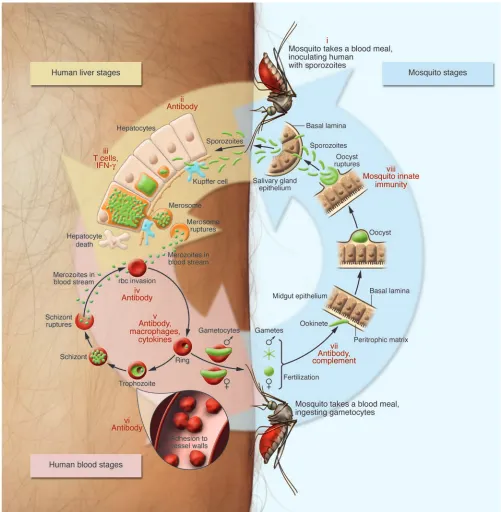
Figure 1
Plasmodium vivax is less deadly but highly disabling; it is common in tropical areas outside Africa (most Africans lack the Duffy blood group antigen that is expressed on the surface of erythrocytes and is a necessary receptor for P. vivax invasion of these cells). The ability of P. vivax and also Plasmodium ovale to remain dormant for months as hypnozoites in the liver makes infection with these parasites dif-ficult to eradicate. Plasmodium malariae does not form hypnozo-ites, but it can persist for decades as an asymptomatic blood stage infection. A fifth species, Plasmodium knowlesi, which was originally described as a malaria parasite of long-tailed macaque monkeys, also naturally infects humans in some areas, such as Malaysia (12). Infection of the human host with a Plasmodium parasite begins with the bite of an infected Anopheles mosquito that inoculates the individual with sporozoites (Figure 1). These motile forms of the parasite rapidly access the blood stream and then the liver, where they invade hepatocytes. The asymptomatic liver stage of infection lasts about 6 days, with each sporozoite yielding tens of thousands of merozoites that then invade and develop within erythrocytes. The blood stages of infection include asexual forms of the parasite that undergo repeated cycles of multiplication as well as male and female sexual forms, called gametocytes, that await ingestion by mosquitoes before developing further. Asexual blood stage para-sites produce 8–20 new merozoites every 48 hours (or 72 hours for P. malariae), causing parasite numbers to rise rapidly to levels as high as 1013 per host. The asexual stages are pathogenic, and
infected individuals can present with diverse sequelae affecting different organ systems. Sexual stage parasites are nonpathogenic but are transmissible to the Anopheles vector, where they recom-bine during a brief period of diploidy and generate genetically distinct sporozoites (13). The mosquito becomes infectious to its next blood meal donor approximately two weeks after ingesting gametocytes, a time frame that is influenced by the external tem-perature. Development of P. vivax within the mosquito can occur at a lower environmental temperature than that required for the development of P. falciparum, explaining the preponderance of
P. vivax infections outside tropical and subtropical regions.
During its peripatetic existence, the unicellular malaria-causing parasite uses a toolkit of more than 5,000 genes (14) to undergo dramatic metamorphoses that are suited to the numerous envi-ronments and barriers it encounters. These changes include the development, at different points in its life cycle, of motile, invasive, encysted, intracellular, sexual, and dormant forms. These distinct forms of the parasite help enable it to complete its full life cycle (Figure 1), during which it must passage through the mosquito midgut and salivary glands; localize and penetrate skin vessels; per-forate and traverse macrophages and several hepatocytes prior to enveloping itself in an intrahepatocytic vacuole; and attach to and reorient itself on the surface of erythrocytes prior to invasion.
Each of the developmental stages discussed above represents a potential target at which the life cycle can be interrupted. Vaccines, drugs, and anti-vector measures are being developed to prevent infection, disease, and transmission. Despite numerous potential targets, the most widely used old compound (quinine, isolated from cinchona bark in 1820) and the best new compound (arte-misinin, purified from Artemisia annua in 1972) for treatment are both derived from ancient herbal therapies. Further, progress with developing a vaccine is incomplete. These limitations stem, in part, from the fact that since its discovery in 1880 (15), the parasite has been slow to reveal its secrets, including its metabolic pathways and its antigens that are targeted by protective immunity. However, recent advances in determining the genome sequences for humans,
Anopheles mosquitoes, and Plasmodium parasites have raised hopes that developing new interventions might be feasible.
Epidemiology and clinical features
Global disease burden and surveillance. Efforts to control malaria are being made on a scale not seen for fifty years. However, the long-term sustainability of this effort depends on demonstrating a beneficial impact on health and development. This requires that the distribution and burden of malaria be determined before and after the initiation of interventions — data that are hard to col-lect. Indeed, most malaria-endemic countries, particularly those in sub-Saharan Africa, have weak health information systems and civil registries, and the consequences of a malaria infection are var-ied, meaning that many indicators are used to measure the impact of an intervention (see Potential end points for assessing the impact of an antimalarial intervention). Malaria is such a common cause of childhood death that successful interventions are likely to have a discernible impact on the overall childhood mortality rate in endemic areas. Overall mortality can be measured either through indirect demographic techniques or directly in sites with continu- ous demographic surveillance systems. In contrast, malaria-spe-cific mortality is much more difficult to document because most deaths from malaria occur at home. Malaria morbidity requires either the use of health facilities as sentinel sites or regularly con-ducted community-based surveys.
Despite the difficulties, considerable progress has been made in defining the global distribution of malaria (16, 17) and its burden. Because the clinical diagnosis of malaria is imprecise, estimates of the burden of malaria that rely upon clinical data without labo-ratory support are unreliable. However, improved regional and global estimates of the malaria burden have used accurate data collected at a limited number of areas with well-defined geographi-cal, entomological, and population characteristics, which are then extrapolated to other areas with similar characteristics and known populations. Studies of this kind suggest that malaria directly
Potential end points for assessing the impact of an anti-malarial intervention
Nonpregnant adults and childrenA
All causes of mortality Malaria-specific mortality
Hospital admissions with severe malaria Laboratory-confirmed clinical attacks of malaria Prevalence of malaria parasitemia in the community Prevalence of anemia in the community
Pregnant women
Maternal mortality Prevalence of anemia Incidence of low birth weight
Vector mosquitoes
Numbers Infection rate
causes just under 1 million deaths and at least 500 million clinical cases each year (1, 18). Furthermore, malaria in pregnancy contrib-utes to a substantial number of maternal deaths as well as infant deaths resulting from low birth weight (19).
Transmission of malaria-causing parasites is typically infre-quent but also unstable (i.e., transmission varies in prevalence and is prone to change) in substantial areas of Southeast Asia and South America and might become more unstable in Africa as disease control improves. Because levels of immunity are also low, areas of unstable transmission are prone to epidemics, dur-ing which mortality and morbidity can be very high. Research that improves the prediction of epidemics is therefore critical. Climate modeling can give long-range warnings of heavy rain-falls, and hence of increased mosquito breeding and risk of malaria (20). Active surveillance at district health centers can detect an early increase in cases and allow appropriate control measures to be put in place before a large epidemic explodes (21). As malaria control improves, surveillance will become necessary to identify persistent and new foci of infection as well as local-ized areas where control measures are not working. Sensitive PCR techniques for detecting asexual (22) and sexual stage infections (23) as well as new serological methods (24) might be helpful at this stage of malaria control.
Diagnosis and clinical spectrum of disease. Clinical diagnosis of malaria is difficult, and misdiagnosis is frequent when laboratory confirma-tion is not available or is disregarded by doctors anxious to identify a treatable cause of illness. Microscopy remains an important tool for diagnosis, but laboratory diagnosis in clinics without micros-copy has now become possible through the development of rapid diagnostic tests (25). Some tests, however, deteriorate under tropical conditions and can give false results (26). Furthermore, health care staff might still overtreat for malaria even when rapid tests are avail-able (27), possibly because they lack facilities to identify other causes of fever and because malaria symptoms overlap with those of many illnesses. Finding ways to change the attitudes of health care provid-ers and the perceptions of patients as to what they should receive at the clinic is an important applied research priority.
Uncomplicated malaria usually presents with fever and nonspe-cific symptoms, such as vomiting and/or diarrhea, a clinical picture that resembles that of many other childhood infectious diseases. In adults, severe malaria caused by P. falciparum is characterized by multiorgan damage, including renal failure. This is uncommon in children with severe malaria, who usually present with prostra-tion, respiratory distress, severe anemia, and/or cerebral malaria. Each of these clinical presentations of malaria probably represents a complex of conditions, each with their individual pathogenesis, complicating the effort to develop broadly effective adjunctive therapies. Additional abnormalities, such as hypoglycemia and acidosis, can complicate and/or contribute to severe malaria.
What determines the pattern of severe malaria in an individual case is not fully understood. Genetic factors are important (28), and both the age of the patient and the intensity of transmission in the community influence susceptibility to cerebral malaria and severe anemia (29). Cerebral malaria is a more common presenta-tion of severe malaria where transmission intensity is low, whereas severe anemia predominates where transmission intensity is high. Retinal changes occur in many patients with severe malaria, and a specific pathology was recently described that might aid diagnosis (30). Children with severe malaria rarely present with the classical features of circulatory shock, but recent studies have suggested,
controversially, that many have hypovolemia that contributes to their acidosis (31, 32).
Malaria can interact with other infectious diseases to modify the susceptibility and/or severity of either disease. For example, solid evidence now indicates that infection with HIV increases the risk of uncomplicated and severe malaria (33). Conversely, malaria causes a transitory increase in viral load (34), and this could pro- mote HIV transmission. In pregnant women, malaria and infec-tion with HIV interact to cause low birth weight, and HIV impairs the efficacy of drugs used for malaria prevention (35). Coinfection with helminths seems to protect against severe malaria in some, but not all, areas, which might indicate that the interaction is site specific and determined by local patterns of malaria and helminth infections (36, 37). Finally, a marked percentage of African chil- dren with severe malaria are increasingly recognized to have associ-ated bacteremia, and these patients might have increased mortality (38). Infection with nontyphoidal Salmonella spp. is an important complication of severe malaria anemia, but the mechanism of this association is not understood (39).
Parasite biology, drugs, and resistance
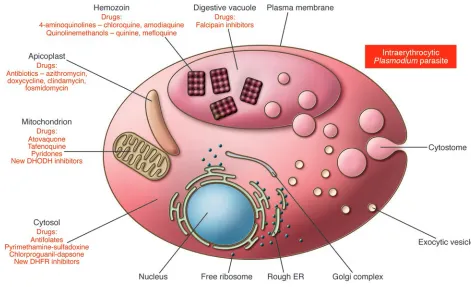
The discovery of new agents to prevent or treat malaria has ben-efited from the sequencing of the parasite genome (14) and the development of improved tools for functional genomics (40–43), yet this area of research remains limited by our incomplete knowl- edge of parasite biology. In the case of the asexual blood stage para-sites, research has identified several processes, such as hemoglobin degradation and heme detoxification, folate biosynthesis, and pro-tein synthesis in the apicoplast, as effective targets for therapeutic intervention (44). An expansion of this research effort is critical to defining the pathways that are most suitable for intervention, to validating candidate drug targets (Figure 2), and to identifying chemically tractable inhibitors for drug development. The discov-ery of drugs targeting either liver or sexual stage parasites faces even greater gaps in knowledge. For example, the only drugs that target liver stage parasites are the long-ago-discovered 8-amino-quinolines (such as primaquine and tafenoquine, whose modes of action are unknown) or are the products of discovery efforts for asexual blood stage parasites (such as atovaquone, an inhibitor of the mitochondrial cytochrome bc1 complex that is part of the elec-tron transport chain in this organelle) (45, 46). Why are drugs with activity against asexual blood stage parasites so often ineffective against liver stage parasites, and which biochemical pathways con-stitute the best targets for developing drugs with activity against liver stage parasites? Recent advances in visualizing the sporozo-ite invasion process and the discovery of merosomes might soon reveal new targets for drug and vaccine discovery (47–49). How-ever, only a few laboratories are able to produce liver stage forms of human parasites because of the technical restrictions of estab-lishing the specialized insectariums required to produce infectious sporozoites in Anopheles mosquitoes and the difficulties of gener-ating large numbers of sporozoite-infected hepatocytes either in vitro or in vivo. Progress in this important area has therefore been slow. New drugs are urgently needed to target P. vivax liver stage parasites, including the dormant hypnozoite forms that can cause relapses, yet no in vitro methods exist to guide the drug discovery and development processes. Only an adequate investment in basic biological investigations of the Plasmodium life cycle, focusing on
To adequately treat malaria, drugs must be fast acting, highly potent against asexual blood stage infections, minimally toxic, and affordable to residents of endemic regions. Drugs are also used to control malaria. For example, intermittent presumptive treatment (IPT) with sulfadoxine-pyrimethamine during second and third tri-mesters improves pregnancy outcomes (50) and is recommended as part of routine antenatal care throughout Africa. IPT strategies might also benefit infants (51, 52). The spread of P. falciparum resis- tant to the former first-line antimalarials chloroquine and sulfadox-ine-pyrimethamine (53–55) has had a devastating impact on malaria treatment and control and has spurred multiple investigations into the development of new antimalarials, with an emphasis on artemis-inin-based combination therapies (ACTs) (56, 57). ACTs combine a derivative of the natural product artemisinin, an extremely potent and fast-acting antimalarial endoperoxide, with a longer-lasting partner drug that continues to reduce the parasite biomass after the short-lived artemisinin has dropped below therapeutic levels. Arte-misinin derivatives act rapidly against asexual blood stage parasites to alleviate symptoms and have the additional beneficial effect of killing gametocytes and therefore decreasing parasite transmission. Distinct modes of action of artemisinins and partner drugs should, in theory, enable the combination to kill parasites that manifest decreased susceptibility to one agent. Clinical studies in Thailand
have shown excellent efficacy with the ACT mefloquine-artesuna-te, despite the relatively facile acquisition of parasite resistance to mefloquine (58). Mefloquine, however, is comparatively expensive and presents toxicity concerns. Current efforts are therefore focused on evaluating the impact of other ACTs, including artemether-lume- fantrine, dihydroartemisinin-piperaquine, and artesunate-amodia-quine, when they are deployed as new first-line treatments. Most countries in the world have now switched to an official policy of using an ACT as the first-line treatment.
[image:6.585.61.532.80.367.2]Will a worldwide switch to ACTs substantially and sustainably reduce the global burden of malaria? We would argue a qualified yes. The potency and clinical efficacy of ACTs, as well as the lack of proven cases of artemisinin treatment failure after ACT therapy until recently, attest to the promise of these drug combinations to dramatically reduce malaria. This occurred in KwaZulu-Natal where indoor residual spraying (IRS), active case detection, and deployment of artemether-lumefantrine in 2001 rapidly reversed an epidemic (9). Achieving similar results in other African nations, which unlike South Africa suffer from inadequate infrastructure and high transmission rates, is uncertain and will require sus-tained investments in health care delivery as well as subsidies for new drugs and other measures. Recent evidence that a similar impact can be achieved comes from a study in Zanzibar (8), which
Figure 2
reported a dramatic reduction in the rates of malaria-associated morbidity and mortality within two years of administering either artesunate-amodiaquine or artemether-lumefantrine free of charge to patients with malaria presenting at public health facilities (11). The subsequent combination of treatment with ACTs and distri-bution of insecticide-treated bednets (ITNs) produced a 10-fold reduction in the prevalence of parasitemia within a year.
Yet substantial concerns about ACTs remain. First, will repeat-ed use of artemisinin derivatives cause toxicities similar to those observed in animal models (59, 60)? For example, brainstem neu-rotoxicity with chromatolysis has been observed in rats after high and repeated parenteral doses of artemisinins; and dihydroarte-misinin-induced damage to primitive erythrocytes during yolk sac hematopoiesis as well as embryonic abnormalities and resorptions occurred in rats if the drug was administered during a short win- dow of time after conception. This issue requires a detailed analy-sis, particularly in children and pregnant women — the individuals that get malaria and malaria treatments most frequently. Second, will resistance (inevitably) arise, and how can this be delayed? In vivo resistance to artemisinin and artemisinin derivatives has been selected in a P. chabaudi rodent malaria line that was repeatedly pas- saged in the presence of increasing concentrations of either arte-misinin or artesunate (61). This result illustrates that resistance can occur in Plasmodium parasites and was obtained in a genetically trac-table model that can be used to define resistance determinants.
Clinical data have revealed that ACT clinical failure can result from parasite resistance to the partner drug, and amplification of the pfmdr1 gene has been identified as a key determinant of resis-tance to mefloquine and lumefantrine in Southeast Asian strains of P. falciparum (62, 63). This amplification is believed to result in overexpression of the PfMDR1 transporter, located on the mem- brane of the digestive vacuole within which hemoglobin degra-dation and heme detoxification occur. PfMDR1 overexpression might confer resistance by sequestering the drug away from its site of action. This mechanism does not seem to account gener-ally for instances of resistance to mefloquine and lumefantrine in African strains of P. falciparum (64). Laboratory studies are urgently required to decipher determinants of resistance to ACT drugs in geographically distinct parasite strains. This should identify the drugs that are least prone to resistance and yield molecular mark-ers that can serve as resistance sentinels. Mode-of-action studies are also essential to create a biological rationale for choosing new ACTs that have complementary and, ideally, synergistic activities and that will not readily fall prey to existing or newly acquired resistance mechanisms. In addition, pharmacokinetic/pharmacodynamic studies are required to optimize treatment regimes and doses and minimize recrudescence or selection for resistant parasites. Finally, discovery and development of new antimalarial drugs, separate from the artemisinins, must proceed so that replacements will be ready if and when ACTs reach the end of their clinical life.
Pathogenesis, immunity, and vaccines
Biology of pre-erythrocytic sporozoites and liver stage parasites. Plasmodium parasites encounter numerous anatomic barriers during their life cycle, and immune responses can interrupt parasite development either by blocking these key transitions or by directly killing the pathogen (Figure 1). Pre-erythrocytic sporozoites and liver stage par-asites are very attractive targets for vaccines that aim to completely prevent infection (65–67). The advantage of targeting these forms of the parasite is that there are only small numbers to eliminate (68);
at most, a few dozen sporozoites are transmitted during mosquito blood feeding and infect the liver. The pre-erythrocytic stages of the life cycle are completely asymptomatic and provide a relatively large window of opportunity for an effective immune response to elimi-nate the parasite (approximately 6 days for P. falciparum ). Unfor-tunately, pre-erythrocytic infection in humans is experimentally intractable for practical purposes and consequently has remained poorly understood. In contrast, the pre-eythrocytic stages of disease in rodent models of malaria are amenable to direct experimental interrogation. Within the past few years, intravital imaging, gene knockouts, and other approaches have contributed to a cellular and molecular understanding of the initial stages of sporozoite trans-mission, liver infection, and liver stage development. Many of these findings have important implications for vaccine development.
When an infected Anopheles mosquito seeks a blood meal, it engag-es in repeated probing, each time releasing saliva and sporozoites into the dermal and subdermal tissue of the host (69). Sporozo-ites migrate through the skin to make contact with a blood vessel, then traverse the endothelium to enter the blood stream (49, 69). This skin phase of infection is highly susceptible to neutraliza-tion by antibodies that bind sporozoite surface proteins, mainly the circumsporozoite protein (CSP), effectively immobilizing the parasite (69). However, sporozoites sometimes gain immediate access to the blood stream, when mosquitoes directly cannulate a blood vessel. Sporozoites are then carried to the liver, entering the sinusoids through the portal fields. Sinusoids exhibit a highly spe-cialized endothelium consisting mainly of fenestrated endothelial cells and stationary macrophages called Kupffer cells.
Sporozoites attach to the endothelial lining of liver sinusoids by interactions of their surface proteins (CSP and thrombospondin-related anonymous protein [TRAP]) with host extracellular matrix proteoglycans (70). CSP and TRAP are also crucial for sporozoite motility and infection of host cells (71). Sporozoites glide along the endothelium, then penetrate and traverse Kupffer cells to gain access to hepatocytes (72). Cell traversal seems to depend on at least two sporozoite secretory proteins, one of which contains a perforin-like membrane insertion domain that might allow the sporozoite to breach the cell membrane (73, 74). Importantly, sporozoites suppress the respiratory burst in Kupffer cells (75) and inhibit antigen presentation and cytokine release, which in turn might weaken an effective immune response against the para-site (76). Sporozoites can subsequently pass through a number of hepatocytes, which die by necrosis, before settling in a hepatocyte for further liver stage development (Figure 1) (77).
Liver stage development requires the formation of a specialized membrane compartment, called the parasitophorous vacuole (PV), in which the parasite is shielded from the host cell cytoplasm (78). Initial PV formation depends on secretory proteins that are char-acterized by 6-cysteine domains; sporozoites lacking 6-cysteine proteins enter hepatocytes but cannot form a PV (79) and do not undergo subsequent liver stage development. Additional proteins that the parasite inserts into the PV membrane might facilitate nutrient uptake from the host cell, as has been suggested for the UIS3 protein (80). Parasites lacking these PV proteins stop grow-ing early in infection (81–83). 6-Cysteine protein–deficient (79) and PV protein–deficient parasites are thus effectively attenuated and cannot initiate blood stage infection (81–83).
1960s and 1970s that showed sterile, long-lasting protection in mice (84) and humans (85) after vaccination with radiation-attenuated sporozoites. In mice, single-dose immunization with specific geneti-cally attenuated parasites can induce complete protection against subsequent sporozoite infection, and prime-boost immunizations induce protection for at least 6 months (83). Protection is, to some extent, mediated by antibodies that prevent sporozoite invasion of hepatocytes. CD8+ T cells, however, are crucial and eliminate the
remaining infected hepatocytes through both direct cytotoxicity and IFN-mediated mechanisms (83, 86, 87) similar to their role in protection induced by radiation-attenuated parasites (88). Efforts are underway to test P. falciparum parasites attenuated by deletion of the essential 6-cysteine proteins P52 and P36 (79), the essential PV membrane protein UIS3 (82), and the essential PV membrane protein UIS4 (81), as vaccines in humans (www.sbri.org). A separate effort seeks to develop the logistical means to deliver a radiation- attenuated vaccine (www.sanaria.com), and these delivery approach-es could equally be applied to a genetically attenuated parasite.
Subunit vaccines have achieved lower efficacy than whole-para-site vaccines in phase IIa clinical trials (89, 90) but are logistically simpler. After a long history of disappointing results with other candidates, one subunit vaccine called RTS,S has shown promise in phase IIb clinical trials (91–94). RTS,S incorporates a fusion protein — which comprises CSP and the HBV surface antigen and aggregates as virus-like particles — and the adjuvant AS02, which is based on monophosphoryl lipid A and QS-21 (89). Vaccination with 3 doses of RTS,S prevented infection in 41% of malaria-naive adult volunteers in the US when they were challenged with sporozoites delivered by mosquito bite (90). In The Gambia, vaccination of adults naturally exposed to malaria-causing parasites with 3 doses of RTS,S achieved 74% efficacy in delaying the appearance of parasitemia during the first 9 weeks following vaccination, but this efficacy waned to 0% by the end of the transmission season; a booster dose the following sea-son provided 47% efficacy during the first 9 weeks (91).
In Mozambique, 3 doses of RTS,S/AS02A given at monthly inter-vals to infants (93) and to children age 1–4 years (94) reduced the risk of infection with P. falciparum. Unlike in the studies in adults in The Gambia, the benefits in children seemed to be sustained for more than a year, with an overall vaccine efficacy of 35.3% against clini-cal malaria and 48.6% against severe malaria during 18.5 months of observation after the third dose of vaccine. These encouraging results have prompted plans for a large, multicenter trial that might lead to licensure of the product. The demonstration that the vaccine retains its efficacy when the AS02 adjuvant is lyophilized and recon-stituted at the time of immunization, rather than coformulated at the time of manufacture, might simplify the logistics of delivering the vaccine (95). The results are also stimulating the search for addi-tional pre-erythrocytic antigens that improve upon this success, either in combination with the CSP antigen or alone.
Immunity and vaccines against blood stage parasites. Vaccines against pre-erythrocytic stage parasites, such as RTS,S, have been designed to prevent infection and thereby prevent disease. Vaccines against the pathogenic asexual blood stages also have a strong rationale, but their primary goal is to prevent disease and not infection. Immunity to blood stage parasites is naturally acquired, limits parasitemia, and prevents disease; it is passively transferred to children in the IgG fraction of immune serum (96). Furthermore, immunity that prevents severe malaria is acquired rapidly, perhaps after only one or two episodes of severe disease (97), suggesting that the target antigens have limited diversity.
Liver stage development is a single cycle for the parasite, whereas asexual blood stage development is a repeating cycle, each cycle terminating with the release of a new brood of merozoites that invade fresh erythrocytes in only a few seconds. The ability of the merozoite to specifically attach to and invade erythrocytes is essen-tial for blood stage development; for example, P. vivax must bind to the Duffy antigen to invade reticulocytes (98). This and other findings have inspired the search for merozoite antigens that elicit antibodies that block parasite invasion of erythrocytes. However, none of the merozoite antigens that have been tested in humans, including merozoite surface protein–1 and apical merozoite anti-gen–1, have yet been shown convincingly to confer high levels of protection. The Duffy antigen–binding protein of P. vivax is soon to be tested as a vaccine in humans, to determine whether antibod-ies blocking this essential receptor-ligand interaction can confer protection (99).Unlike P. vivax, P. falciparum uses multiple redun-dant pathways to invade erythrocytes, complicating the effort to develop anti-invasion vaccines against the latter (100).
Blood stage immunity might also target parasite proteins that are variably expressed on the surface of infected erythrocytes (IEs). These proteins are exported by intraerythrocytic parasites for spe- cialized functions such as adhesion to endothelium and immuno-evasion. The best example of this has been demonstrated during pregnancy. In women who are pregnant, P. falciparum parasites emerge that express distinct IE surface proteins, allowing these IEs to bind chondroitin sulfate A (CSA) and sequester in the placenta (101). First-time mothers lack antibodies specific for the IE surface proteins of these parasites and are highly susceptible to infection and disease (102). Women become resistant over successive preg-nancies as they acquire antibodies that block IE binding to CSA (102). Placental parasites express distinct genes and proteins (103), including an IE variant surface protein called VAR2CSA (104) that is required for adhesion to CSA in some parasite lines (105) and that binds CSA in vitro (106). A program to develop a vaccine based on VAR2CSA or the other proteins expressed by placental parasites is well under way (107).
Preventing malaria in pregnant women offers a paradigm for vaccines that prevent specific syndromes by blocking sequestra- tion of distinct parasite forms. An alternative vaccine model tar-gets parasite toxins that can cause inflammatory responses and severe sequelae; that is, the vaccines target not the parasite causing the infection but the mediators of disease. The febrile paroxysms of malaria occur as merozoites are released from IEs, and the gly-cosylphosphatidylinositol (GPI) tail that is common to several merozoite surface proteins has been implicated as a key parasite toxin (108). Unlike host GPIs, parasite GPIs contain palmitic or myristic acids at C-2 of inositol and lack phosphoethanolamine substitution in core glycan structures (109). Vaccination with par-asite GPI induces protection from disease in animal models (110), and antibodies specific for parasite GPI (mainly for the acylated phosphoinositol portion) are naturally acquired by humans in endemic areas; this is related to improved outcomes in some, but not all, studies (109, 111, 112).
Vaccination against sexual stage parasites. Vaccines against the sexual stages of the malaria parasite life cycle have been successful at pre-venting parasite transmission in experimental animals (113) and are being pursued as approaches to prevent transmission of both
spread deployment will help to reduce transmission of the para-site and thus protect both the vaccinated individual and his/her community. Vaccines that block parasite transmission are likely to be used in combination with vaccines targeting other stages of the infection and might prevent the transmission of parasite escape mutants that arise to evade protective immune responses. When used in combination with vector control measures described below, vaccines that block transmission could play a key role in finally breaking the transmission of malaria-causing parasites, leading to eradication of the disease.
Vector biology and control
The intensity and pattern of transmission of malaria-causing parasites, and therefore the epidemiology of infection and dis-ease, are largely a function of the seasonality, abundance, and feeding habits of the Anopheles mosquito vector. Where malaria elimination programs have been successful, such as those imple-mented in the US and Europe, vector control was an essential program component. Contemporary vector control strategies include ITNs, long-lasting ITNs (LLINs), and IRS. IRS with DDT was an essential component of the Global Malaria Eradication Programme in the past century and remains highly effective in regions where mosquitoes are sensitive to the insecticide, such as KwaZulu-Natal (9). ITNs have been shown to increase child survival substantially in studies at several sites across Africa (114–116). Current priorities for research on vectors include studies to sustain and/or enhance the effectiveness of existing methods, as well as efforts to develop novel strategies for vector-targeted malaria control.
Research to sustain current control methods. Resistance to pyrethroid insecticides is one of the most pressing research problems for vec-tor biologists. Only pyrethroid insecticides are licensed for use in ITNs. Therefore, tools to rapidly detect the many genetic mecha-nisms that can underlie pyrethroid resistance are urgently needed. These insecticides act by binding to a voltage-gated sodium chan-nel responsible for neuronal signal transmission. Unfortunately, pyrethroid resistance has appeared in many vector populations, particularly in Africa. Despite an insecticide program, vector populations rebounded in southern Mozambique when Anopheles funestus resistant to pyrethroid emerged in 1999 (117–119). More recently, pyrethroid resistance in Anopheles gambiae has been associ-ated with program failure in Benin (120). Beyond these two clear examples, insecticide resistance has been detected in many other vector populations but not yet linked to any loss of effectiveness in malaria control programs (121, 122).
In this context, strategies are desperately needed to maximize the longevity of the pyrethroid insecticides used for ITNs and to devel- op and/or license new insecticides for malaria control. IRS strate-gies, although potentially more costly and difficult to implement than ITN and LLIN programs, have the advantage that they can be based on a broader group of licensed insecticides, including the well-known and cost-effective pesticide DDT. Unfortunately, DDT and pyrethroid insecticides target the same voltage-gated sodium channel protein. Furthermore, a set of mutations that alters pro- tein structure and confers resistance to DDT also confers resis-tance to pyrethroids (123). Fortunately, not all forms of resistance to DDT and pyrethroid insecticides cross-react, and thus these two widely effective types of insecticides can often supplement or replace each other. However, the development of new insecticides with active compounds that have different target sites is a priority research area for malaria control.
Given the central place of DDT and pyrethroid insecticides in malaria control today, these two insecticides must be used judi- ciously. Because IRS programs put much larger amounts of insec-ticide into the environment than ITN programs, they effectively subject the vector population to higher levels of selection for resis-tance. For this reason, we believe that pyrethroids should not be used for IRS programs. Another insecticide, such as DDT or one that does not target the same voltage-gated sodium channel as DDT and pyrethroids, should be deployed for IRS programs, pre-serving pyrethroids for use in ITNs.
Development of new, vector-targeted malaria control strategies. New and improved strategies for malaria control are also motivating research on malaria vectors. One approach that offers the poten- tial for near-term results is focused on the molecular and biochem-ical mechanisms that underlie key vector behaviors, for example, blood meal host selection (124, 125). Molecular pathways such as those involving the odorant receptors used in host finding and blood feeding are being studied as potential targets of novel, spe-cies-specific attractants and repellents. Another approach uses genetic manipulation to modify the ability of the natural vector population to transmit the pathogen. Exciting progress has been made in the investigation of genes encoding potential effector proteins that can interrupt parasite development in the mosquito (126, 127), as well as strategies to drive such genes into natural populations (128, 129).
Broad-based analyses of the genomes of vectors (130, 131) and pathogens, and the use of these new genomic data to better understand the complex population structure of natural vector populations, hold the key to long-term solutions. Ultimately, these kinds of research activities will not only advance new control ideas currently being contemplated but will also be the source of new approaches not yet recognized.
Conclusion
Over half a century ago, the development of chloroquine and DDT inspired an international campaign to eradicate malaria that made substantial progress in many areas, especially outside Africa. However, political and financial commitments waned, in parallel with the emergence and spread of chloroquine-resistant Plasmo-dium parasites and DDT-resistant Anopheles mosquitoes. A global resurgence of malaria ensued, including in areas where it had been largely eliminated.
Today, we are witnessing a redoubling of efforts and resources to attack the malaria problem, and this time the emphasis is on Africa, where the burden of malaria is greatest. As malaria comes under control in highly endemic areas, the pattern of infection and disease will change, with an increasing proportion of cases occur-ring in older children and adults and with an increased risk of local outbreaks. The latter will be especially likely to occur if control measures are allowed to lapse in the face of a decreasing burden of infection. Extensive surveillance will therefore be required to monitor these changes and to define optimal and cost-effective strategies for managing pre-elimination situation.
Although current tools make it possible to quickly identify the genetic basis of drug resistance, do we have sufficient knowl-edge, tools, and multinational cooperation to effectively prevent the spread of resistant parasites? Experience indicates that the most effective control programs are those that apply a combination of tools and that the efficacy of current interventions will one day be lost to a changing parasite or mosquito. Furthermore, our existing interventions are insufficient to meet the ambitious goal of global eradication. New concepts and tools are required to achieve eradication, hence the impetus to explore transmission-blocking and live attenuated parasite vaccines as well as anti-vector measures targeting novel process-es. The Plasmodium parasite and its Anopheles vector offer many targets for intervention, and we have only just begun to harvest their genome sequences for insights into new interventions and a deeper understanding of host-parasite interactions. The future of malaria control and eradication efforts hinges on how well the scientific and public health communities can work together to extend the effective life span of our existing tools while discerning new interventions that interrupt the complex life cycle of Plasmo-dium parasites. Acknowledgments S. Mikolajczak helped develop the design for Figure 1. The authors receive financial support for their research from the Bill and Melinda Gates Foundation (B.M. Greenwood, D.E. Kyle, F.H. Col-lins, P.E. Duffy), the Burroughs Wellcome Fund (D.A. Fidock), the Foundation for NIH/Grand Challenges in Global Health (S.H.I. Kappe, P.E. Duffy), the Malaria Vaccine Initiative at PATH (P.L. Alonso, P.E. Duffy), and the NIH (D.A. Fidock, D.E. Kyle, S.H.I. Kappe, F.H. Collins, P.E. Duffy). Address correspondence to: Patrick E. Duffy, Seattle Biomedical Research Institute, 307 Westlake Avenue North, Suite 500, Seattle, Washington 98109, USA. Phone: (206) 256-7311; Fax: (206) 256-7229; E-mail: [email protected]. 1. Snow, R.W., Guerra, C.A., Noor, A.M., Myint, H.Y., and Hay, S.I. 2005. The global distribution of clini-cal episodes of Plasmodium falciparum malaria.
Nature. 434:214–217.
2. Zucker, J.R. 1996. Changing patterns of autoch-thonous malaria transmission in the United States: a review of recent outbreaks. Emerg. Infect. Dis. 2:37–43.
3. WHO. 1999. Making a difference. The World Health Report 1999. Health Millions. 25:3–5. 4. Brito, I. 2001. Eradicating malaria: high hopes or a
tangible goal? Health Policy at Harvard. 2:61–66. 5. Chareonviriyaphap, T., Bangs, M.J., and
Ratanatham, S. 2000. Status of malaria in Thai-land. Southeast Asian J. Trop. Med. Public Health.
31:225–237.
6. Roberts, D.R., Manguin, S., and Mouchet, J. 2000. DDT house spraying and re-emerging malaria.
Lancet. 356:330–332.
7. Snow, R.W., Trape, J.F., and Marsh, K. 2001. The past, present and future of childhood malaria mor-tality in Africa. Trends Parasitol. 17:593–597. 8. White, N.J., et al. 1999. Averting a malaria disaster.
Lancet. 353:1965–1967.
9. Barnes, K.I., et al. 2005. Effect of artemether-lume-fantrine policy and improved vector control on malaria burden in KwaZulu-Natal, South Africa.
PLoS Med. 2:e330.
10. Nyarango, P.M., et al. 2006. A steep decline of malaria morbidity and mortality trends in Eritrea between 2000 and 2004: the effect of combination of control methods. Malar. J. 5:33.
11. Bhattarai, A., et al. 2007. Impact of artemisinin- based combination therapy and insecticide-treat-ed nets on malaria burden in Zanzibar. PLoS Med.
4:e309.
12. Singh, B., et al. 2004. A large focus of naturally acquired Plasmodium knowlesi infections in human beings. Lancet. 363:1017–1024.
13. Aravind, L., Iyer, L.M., Wellems, T.E., and Miller, L.H. 2003. Plasmodium biology: genomic gleanings.
Cell. 115:771–785.
14. Gardner, M.J., et al. 2002. Genome sequence of the human malaria parasite Plasmodium falciparum.
Nature. 419:498–511.
15. Laveran, A. 1882. De la nature parasitaire de l’impaludisme. Bull. Mem. Soc. Med. Hop. Paris.
18:168–176.
16. Hay, S.I., and Snow, R.W. 2006. The Malaria Atlas Project: developing global maps of malaria risk.
PLoS Med. 3:e473.
17. Guerra, C.A., Snow, R.W., and Hay, S.I. 2006. Map-ping the global extent of malaria in 2005. Trends Parasitol. 22:353–358.
18. Rowe, A.K., et al. 2006. The burden of malaria mor-tality among African children in the year 2000. Int. J. Epidemiol. 35:691–704.
19. Desai, M., et al. 2007. Epidemiology and burden of malaria in pregnancy. Lancet Infect. Dis. 7:93–104. 20. Thomson, M.C., et al. 2006. Malaria early warnings
based on seasonal climate forecasts from multi-model ensembles. Nature. 439:576–579. 21. Abeku, T.A., et al. 2004. Malaria epidemic early
warning and detection in African highlands. Trends Parasitol. 20:400–405.
22. Andrews, L., et al. 2005. Quantitative real-time polymerase chain reaction for malaria diagnosis and its use in malaria vaccine clinical trials. Am. J. Trop. Med. Hyg. 73:191–198.
23. Schneider, P., et al. 2007. Submicroscopic Plasmo-dium falciparum gametocyte densities frequently result in mosquito infection. Am. J. Trop. Med. Hyg.
76:470–474.
24. Drakeley, C.J., et al. 2005. Estimating medium- and long-term trends in malaria transmission by using serological markers of malaria exposure. Proc. Natl. Acad. Sci. U. S. A. 102:5108–5113.
25. Moody, A. 2002. Rapid diagnostic tests for malaria parasites. Clin. Microbiol. Rev. 15:66–78.
26. Jorgensen, P., Chanthap, L., Rebueno, A., Tsuyuo-ka, R., and Bell, D. 2006. Malaria rapid diagnostic tests in tropical climates: the need for a cool chain.
Am. J. Trop. Med. Hyg. 74:750–754.
27. Reyburn, H., et al. 2007. Rapid diagnostic tests compared with malaria microscopy for guiding outpatient treatment of febrile illness in Tanzania: randomised trial. BMJ. 334:403.
28. Kwiatkowski, D.P. 2005. How malaria has affected the human genome and what human genetics can teach us about malaria. Am. J. Hum. Genet.
77:171–192.
29. Reyburn, H., et al. 2005. Association of transmis-sion intensity and age with clinical manifestations and case fatality of severe Plasmodium falciparum malaria. JAMA. 293:1461–1470.
30. Beare, N.A., Taylor, T.E., Harding, S.P., Lewallen, S., and Molyneux, M.E. 2006. Malarial retinopathy: a newly established diagnostic sign in severe malaria.
Am. J. Trop. Med. Hyg. 75:790–797.
31. Maitland, K., et al. 2003. Severe P. falciparum malaria in Kenyan children: evidence for hypovo-laemia. QJM. 96:427–434.
32. Planche, T., et al. 2004. Assessment of volume deple-tion in children with malaria. PLoS Med. 1:e18. 33. Korenromp, E.L., et al. 2005. Malaria attributable
to the HIV-1 epidemic, sub-Saharan Africa. Emerg. Infect. Dis. 11:1410–1419.
34. Kublin, J.G., et al. 2005. Effect of Plasmodium falci-parum malaria on concentration of HIV-1-RNA in the blood of adults in rural Malawi: a prospective cohort study. Lancet. 365:233–240.
35. Filler, S.J., et al. 2006. Randomized trial of 2-dose versus monthly sulfadoxine-pyrimethamine inter- mittent preventive treatment for malaria in HIV-positive and HIV-negative pregnant women in Malawi. J. Infect. Dis. 194:286–293.
36. Mwangi, T.W., Bethony, J.M., and Brooker, S. 2006. Malaria and helminth interactions in humans: an epidemiological viewpoint. Ann. Trop. Med. Parasitol.
100:551–570.
37. Hartgers, F.C., and Yazdanbakhsh, M. 2006. Co-infection of helminths and malaria: modulation of the immune responses to malaria. Parasite Immunol.
28:497–506.
38. Berkley, J., Mwarumba, S., Bramham, K., Lowe, B., and Marsh, K. 1999. Bacteraemia complicating severe malaria in children. Trans. R. Soc. Trop. Med. Hyg. 93:283–286.
39. Graham, S.M., et al. 2000. Nontyphoidal Salmonel-la infections of children in tropical Africa. Pediatr. Infect. Dis. J. 19:1189–1196.
40. Sakata, T., and Winzeler, E.A. 2007. Genomics, sys-tems biology and drug development for infectious diseases. Mol. Biosyst. 3:841–848.
41. Meissner, M., Agop-Nersesian, C., and Sullivan, W.J., Jr. 2007. Molecular tools for analysis of gene function in parasitic microorganisms. Appl. Micro-biol. Biotechnol. 75:963–975.
42. Ekland, E.H., and Fidock, D.A. 2007. Advances in understanding the genetic basis of antimalarial drug resistance. Curr. Opin. Microbiol. 10:363–370.
43. Kooij, T.W., Janse, C.J., and Waters, A.P. 2006. Plas-modium post-genomics: better the bug you know?
Nat. Rev. Microbiol. 4:344–357.
44. Fidock, D.A., Rosenthal, P.J., Croft, S.L., Brun, R., and Nwaka, S. 2004. Antimalarial drug discovery: efficacy models for compound screening. Nat. Rev. Drug Discov. 3:509–520.
45. Baird, J.K. 2005. Effectiveness of antimalarial drugs. N. Engl. J. Med. 352:1565–1577.
46. Kain, K.C., Shanks, G.D., and Keystone, J.S. 2001. Malaria chemoprophylaxis in the age of drug resis-tance. I. Currently recommended drug regimens.
Clin. Infect. Dis. 33:226–234.
47. Tarun, A.S., et al. 2006. Quantitative isolation and in vivo imaging of malaria parasite liver stages. Int. J. Parasitol. 36:1283–1293.
48. Sturm, A., et al. 2006. Manipulation of host hepatocytes by the malaria parasite for delivery into liver sinusoids. Science. 313:1287–1290. 49. Amino, R., et al. 2006. Quantitative imaging of