© 2016, IRJET | Impact Factor value: 4.45 | ISO 9001:2008 Certified Journal | Page 213
Separation of Aluminium and Nylon using Automation and Control
Technology
Amaresh Kumar Nayak
1, B Barnabas2, Sameer Padhi3, Jayant Biswas
4, Debi Prasad Das
5,
Jyoti Ranjan Das
61
Dept. Of Electrical and Electronics Engineering, GIET Gunupur, Odisha, India
23456
Dept. Of Electrical and Electronics Engineering, GIET Gunupur, Odisha
---
Abstract
- In the present scenario automation is widely used in different processes of manufacturing and production such as welding and machining. The main advantages of automation is to reduce the manpower and increase the efficiency and simplification of production by low power consumption and increased workflow in mass production. Basically in this project there is a handling chamber which consists of load of aluminium and nylon and sensors with a counter to count the number of materials in the belt. There is use of a motor which makes a delay of time for placing the cube of conveyor belt. The pulse width modulation mechanism is used for the speed regulation of the conveyor belt. Adding to that there is a sensor which use to detect the cube at another end of conveyor belt. There is also another sensor to be used for the detection of material of the cube. According to the output of the sensor the separator, separates the cube and allow them to their destination. Further there is a control panel which is used to control all the equipment’s from the remote location.Key words- speed regulation, pulse width modulation, control panel.
1.INTRODUCTION
Automation means ‘move by itself’ but precisely it can be defined as a set of technologies whichresults in operation of machines and systems without significant human interference and achieving performance greater than manual operation. And Control is a set of technologies where a necessary input signal is given to the system to achieve desired patterns[1]. In product manufacturing industries the separation of metals and non-metals takes more time due to manual labour, but by this project the separation of metals and non-metals can be done in an automated way with much less cost. By using a specific sensor namely Current sensor whose function is todistinguish a metal form the non-metallic materials. This model can be used in large industries which may take large cost for installation but is very efficient in the long run. This model uses programmable automation where the sequence of operation is controlled by a program, which is a set of instructions coded in such a way that they can be read and interpreted by the system. New programs can also be introduced if needed into the equipment to carry out other or new operations. Here the program is set to control the running operation of motor which is driving the conveyor belt such as the motor must start when the product is placed over the conveyor and has to stop when the product reaches the other end, where the products are separated and assembled. By this project labour productivity is increased, worker safety is improved and the high cost of not automating is avoided.
Another benefit of this model is it could be operated from any remote location. Hence if the control room is located at any location within the industrial location there will not be any disturbance in the separation process. Further no man is required to monitor the process at the processing section. The control panel consists of toggle switches for switching the process and a LCD display for showing the messages.
2. IMPORTANT COMPONENTS
2.1 Ball Bearings
It is rolling-element bearing that uses balls to maintain the separation between the bearing races. With this component rotational friction is reduced and it supports radial and axial loads. In such ball bearings at least two races are required to contain the balls and transmit the loads through the balls [2].
Ball bearings are used in most applications that uses moving parts. It is used to reduce the friction of the robotic wheels.
2.2 Voltage Regulator 7809
© 2016, IRJET | Impact Factor value: 4.45 | ISO 9001:2008 Certified Journal | Page 214
applications. It not only protects its self but also to theother components connected to it [3].
Here the ATmega8 and Arduino UNO are power by 9v dc provided by the IC 7809.
2.3 Switches
It is used for switching ON and OFF the entire system or for holding the system in emergency case and some switches are provided for specific heavy component for security reasons.
Here toggle switch is used to switch ON the power, to start and stop the process of separation.
2.4 Liquid Crystal Display
LCD screen is an electronic display module it can display special & even custom characters, animations and much more. Here for the project a 16x2 LCD is used, so it can display 16 characters per line and there are 2 such lines in the display system [2].
In this project the LCD will display the present status of the processes going in the separation process.
3. MODULE DESCRIPTION
3.1 Motor Controller Module
A motor controller module is a device or group of devices that govern the motor in predetermined manner as per the command of processor.A motor controller can be controlled by manual or automatic means for starting and stopping the motion in forward or reverse rotation, for regulating the speed, for limiting the torque, for protecting against overloads and faults[2].
Here in this project it rotates clock wise or anti clock wise according to the command given by the microcontroller.
3.2 Switch Mode Power Supply
A switched-mode power supply provides constant power according to the load to convert electrical power efficiently, basically its uses switching regulator to convert power. It supplies from main power to load as personal computer by converting the voltage and current characteristics [3].
Unlike a linear power supply, the transistor of a switching-mode supply switches between low-dissipation, full-on and full-off states, and low dissipation. It spends very less time in the high
dissipation transitions, which reduce wasted energy.A switched-mode power supply dissipates no power for its conversion.SMPS provide regulated voltage by varying the ratio of switching time. Switched-mode power supplies is smaller in size and lighter than a linear supply due to the smaller transformer size and weight.
In this project the switched-mode power supply gives 12V used for driving the motors. And further this 12 V is reduced to 9Vwhich is utilized for powering the processing kits.
3.3 IR Module
An IR module is a sensor based circuit to indicate the presence of nearby objects and responding the micro controller without any physical contact. A proximity sensor can sometimes emits a beam of electromagnetic radiation and looks for changes in the field or return signal[4].
But in this project it only senses the material or the blocks and sends signal to the controller. The "nominal range" is about the maximum distance that this sensor can detect. Some sensors can adjust nominal range by vary a variable resistance present in the module itself for better adjustment. IR sensors is highly reliable and durable due to absence of moving parts and absence of physical contact between sensor and the sensed object. The best example of IR (proximity sensor) is our best friend namely our smart phone.
3.4 Processing Module
3.4.1 ATmega8
ATmega8 is an 8 bit microcontroller which consumes very less power and it is based on AVR RISC architecture. It is provides highly reliable o/p as per the instruction set burned into it. It can be used for continuous operation. Its program can easily be modified by making use of suitable kit and its program is also very easy to write as its uses c language. It is suitable for small industry and automation system [5].
Here in this model ATmega8 kit is used to control the conveyor movement.
3.4.2 Arduino UNO
© 2016, IRJET | Impact Factor value: 4.45 | ISO 9001:2008 Certified Journal | Page 215
programming the Arduino kit provides an integrateddevelopment environment (IDE) which is based on a programming language which also supports the languages C and C++ [6].
Here in this project the Arduino UNO will check if the block is aluminium or nylon and control the rotation of the separator. The other function of Arduino UNO is to interface the LCD to display thepresent status.
4. DESIGNING OF PARTS
4.1
Designing of Current Sensor
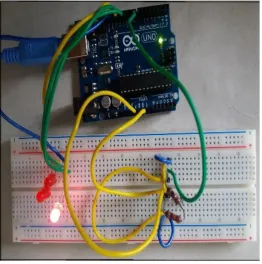
It is designed on the principle of push button. Two thin plates, one as cathode and another as anode are used. The cathode is connected to 5v dc pin of Arduino and the anode is connected to a 10k Ω resistance and grounded. Again a connection from 8th pin is taken to which the data is given (if the current passes through the block or not). This 8th pin is connected to 13th pin to which a LED is connected for indication.
[image:3.595.37.300.442.707.2]When the block touches the anode and cathode while it moves over the conveyor the current sensor senses the block, if current passes through the plates the indicating LED glows which determines that the block is aluminium and if the indicating LED doesn’t glow then the block is nylon.
Figure 4.1 Current sensor
4.2Designing ofConveyor Belt
The conveyor used in this project is made up of foam
leather and its dimensions are 2 ft × 5 in. To reduce the friction the ball bearings are used with robotic wheels so that the conveyor can easily move over the robotic wheel.
The conveyor is driven by a DC gear motor which is not directly connected as pressure exerted directly is more. So to decrease the pressure a thin conveyor belt controls the movement of the main conveyor belt.
4.3 Design of Stack Pusher
Here in this project shaft which pushes the blocks of aluminium and nylon from the stack uses a dc Motor for movement. To the motor shaft a flywheel is connected and at any point on the chord of the flywheel again a shaft or specifically a pusher is connected. This shaft converts the circular motion to linear motion. The motor is controlled motor driver IC.
There is stack present (mixture of Aluminium and Nylon blocks) at the beginning of the conveyor. As the conveyor starts, the motor of stack pusher also rotates and for each rotation of the flywheel the shaft at the chord of the flywheel will push the blocks of the stack one by one onto the conveyor.
4.4 Design of the Separator
In this project the separating blade is made up of wooden cuboid which is connected to the shaft of a dc Motor. The motor is controlled through the motor driver IC. The separator is present above the retarding section of the conveyor.
The main function of the separator is to separate Aluminium and Nylon to their respective sections by its rotation. The separator rotated by the motor is governed by the program burned into the Arduino kit.
5.WORKING
The entire project is automation based with the use of sensors. Here sensors are used to sense devices and send the feedback signal to the respective microcontroller atmega8, further reacting appropriately. First of all the required dc voltage is generated through Switch Mode Power Supply. Precisely the required constant voltage is 12V and current as per the load which is provided from the SMPS. Again there is a power board which converts the 12V dc to required 9V dv and 5V dc, as the Arduino kit and Atmega8 kit are powered by 9V and the indicating LED is powered by 5V. All the passive equipment are connected to the power board by jumper wire. All the components are controlled by control panel
© 2016, IRJET | Impact Factor value: 4.45 | ISO 9001:2008 Certified Journal | Page 216
separation and the stop switch will halt the separationprocess.
[image:4.595.316.579.124.323.2]Once the power switch and start switch are made ON the conveyer belt starts to rotate and the block pusher pushes the cubes or blocks of aluminium and nylon to the conveyer belt. As the conveyor moves, at a point the block reaches to the end point of conveyor where the block is sensed by the IR sensor which in return sends the signal to the ATMEGA8 microcontroller. Then the microcontroller sends signal to the motor driver IC to hold the supply. At that part of conveyor a Current sensing element is used for sensing the cube, such as to check if it is metallic or non-metallic. If current passes through the cube then the circuit will be closed and it will indicated that it is metal Aluminium cube. Then according to the program burned into the ADRIANO UNO the separator motor rotates clockwise direction to collect the Aluminium at the aluminium collecting section (to the right side). And if the current will not pass through the cube then it will sensed as non-metal nylon, in such case the motor will rotate anticlockwise direction to collect the Nylon at the nylon collecting section(to the left side). There are other IR sensors used for sensing and detecting ifhe stack is full or empty. The basic block diagram of the project is shown in the figure 5.1
Figure 5.1 block diagram of the project
All the ongoing processes are shown in the form of messages on the LCD screen, which is present at the control panel. When the process starts the message displayed is “Processing”. If the block is present at the end point of the conveyor the message which will be displayed is “Separation”. If the block found to be metal then the message displayed is “Aluminium” or else “Nylon”. If anyone wants to abort the system, then by triggering the stop toggle switch the system can be stopped or aborted.
The actual picture of the entire project is shown the figure 5.2.
Figure 4.2 actual figure of the project
5. Conclusion
Automation Systems may have many functionality, such as control systems where computational point is set, where system performance is monitored, to start and shutdown a process automatically, scheduling of a particular job and much more. By this project it can be realised that Automation technology is concerned with the application of electronic, mechanical and computer-based systems for operation and controlling the processes in industries.
Automation is the future of technology because it has many benefits such as the routine manual and clerical tasks are eliminated, labour productivity is improved and labour cost is reduced hence profit gained can be maximised. And by automation the product quality is maintained and improved.
Reference
[1] Introduction to Industrial Automation and Control, Version 2 EE IIT, Kharagpur.
[2] Bicycle History, Chronology of the Growth of Bicycling and the Development of Bicycle Technology by David Mozer. Ibike.org. Retrieved on 2012-09-01
[3]Voltage Regulator Databook (Historical 1980), National Semiconductor.
[4] "General Electric Contact Materials". Electrical Contact Catalog (Material Catalog). Tanaka Precious Metals. 2005. Retrieved 2007-02-21.
[image:4.595.37.299.406.619.2]© 2016, IRJET | Impact Factor value: 4.45 | ISO 9001:2008 Certified Journal | Page 217
[7] National Fire Protection Association (2008). "Article100 Definitions". NFPA 70 National Electrical Code. 1 Batterymarch Park, Quincy, MA 02169: NFPA. p. 24. Retrieved January 2008.
[8] Pressman, Abraham I. (1998), Switching Power Supply Design (2nd ed.), McGraw-Hill, ISBN 0-07-052236-7
[9] "Proximity sensor on Android smartphones". TheCodeArtist.
[10] www.atmel.com
[11] "Arduino - Introduction". arduino.cc