© 2016, IRJET | Impact Factor value: 4.45 | ISO 9001:2008 Certified Journal
| Page 2015
“Design of Mobile Ad-hoc network for different Mobilities”
[1]
Akshay P. Kirmirwar
Student
Electronics and
Communication Engineering
Abha Patil- Gaikwad College
of Engineering and
Technology Nagpur, India
[email protected]
[2] Sagar Ghormade
Guide; Assistant Professor
Electronics and Communication
Engineering Abha Patil- Gaikwad
College of Engineering and
Technology Nagpur, India
[email protected]
[3] Sagar Pradhan
M.Tech Coordinator
Electronics and
Communication Engineering
Abha Patil- Gaikwad College of
Engineering and Technology
Nagpur, India
[email protected]
---***---
Abstract-
This paper presents mobile ad-hoc networks(MANETs) which are based on a fundamental aspect, which is the collaborative parameter. This parameter may compromise the networks. In MANET based on SISO (Single-Input Single-Output) technology, the interferences at the monitor no deco promise the observation and the accuracy of the cooperation report. That is why, we concentrates on the MIMO (Multi-Input and Multi-Output) technology to overcome these drawbacks and to significantly improve the monitoring process. Adopting Multiple Input-Multiple-Output (MIMO) technology, we devise two many-to-one cooperative plans under converge-cast for both static and mobile ad hoc networks (MANETs), respectively. We call them Convergimo Schemes. In fixed networks, our Convergimo scheme highly utilizes hierarchical cooperation MIMO transmission.
Key Words:- MANET, Throughput, Delay, MIMO, Packet
Size, AODV, NS2(Network Simulator), TCL.
1.
INTRODUCTION
As we know that significant progress has been made in securing MANETs via the development of secure routing protocols. The network topology in an ad hoc network is highly dynamic due to the movement of the nodes, hence mobility is a major limitations in designing routing protocols for them. Apart from mobility, the other major restriction s are bandwidth and resource availability. Basically Mobile Ad-hoc network (MANET) is a collection of independent mobile nodes that can liaise with each other via radio waves. The mobile nodes that are in radio range of each other can directly communicate, whereas others require the aid of intermediate nodes to route their packets in multi-hop fashion. MANETs are used in tragedy recovery, rescue operations, military communication and many other applications. In multi-hop wireless ad hoc networks, designing energy logical routing protocols is critical since
nodes have very limited energy, computing power and communication abilities. Routing is an important aspect in mobile ad hoc Network. Routing protocol determines the path to be followed by data packets from a source node to a destination node. Mobile ad-hoc networks are wireless networks that offers multi- hop connectivity between self configuring & self organizing mobile hosts. Nodes are serves as routers &may arbitrarily. Self-configuring network of mobile routers (and related hosts) connected by wireless links. While MANETs are self contained, they can also be trussed to an IP-based global or local network – Hybrid MANETs. A set of nodes can be easily compromised such that detecting the malicious behavior is tedious.
Such nodes inundation other nodes with routing traffic; advertise non –existent links, drop packets, changes the contents of packets and thus inflicting failure in network. One of the most well liked routing protocol, Ad-hoc on demand distance vector (AODV) is used in MANET. It is a source aligned routing protocol where routes are uncovered only on demand. However, AODV is unsafe to packet dropping attack. A malicious node stealthily drops some or all data packets or control packets without forwarding them to destination. A group of nodes can drop packets in collaboration in network at such a rate that message communication in network may get degraded or even disrupted. Due to lack of physical protection and reliable mechanisms, packet dropping attack posts a serious threat to routing in MANETs.
© 2016, IRJET | Impact Factor value: 4.45 | ISO 9001:2008 Certified Journal
| Page 2016
is operated through joint dispatch of multiple nodes toothers. Under mobile ad hoc networks (MANETs) where hierarchical cooperation cannot be accepted due to the mobility of nodes, we devise another Convergimo scheme where the network is still split into equal cells. In each time aperture, multiple nodes that possess information for the same destination are allowed for joint dispatch to other nodes within the cell. Other nodes will receive a combination of the information from these transmitters due to the outcome of MIMO through fading channels. This procedure continues, with the number of nodes that hold such mixed data increases, until all the destinations receive sufficient mixed information that can be decipher with high probability. Our main benefactions can be summarized For our Convergimo scheme under MANETs, with optimal network division, the per-node throughput is_ð1Þ with the corresponding delay reduced to _ðkÞ. Our results well combine, and generalize some previous works since all of them can be easily implemented to other traffic modes. Especially, our plan in MANETs breaks the vacancy of such MIMO plan design remaining in mobile networks before.
2. EXISISTING SYSTEM
As we know that, In mobile communication analog repeaters are used in order to increase signal strength. And so many users are at a time coming towards base station, some are fixed and some users are moving away from base station. Also in the existing system base station is continuously moving which resulting in decreased throughput, increased packet loss, increased maximum delay.
Thus in this paper we are using digital relays instead of analog repeaters for signal decoding and amplification and keeping base station stable for all the users. And to overcome all above requirements we are using Adaptive modulation and coding to achieve :-
Increased Packet delivery. Increased Throughput. Decreased Packet loss. Decreased Delay.
and also to increase network efficiency.
3. PROBLMS STATEMENT
First of all, the resources in MANETs are limited in terms of energy, bandwidth, etc. Then, the nodes try to increase their lifespan duration by reducing their energy consumption and the cost of the transmission operation is important in expressions of energy. Secondly, when the nodes route and forward the packets of other nodes, this increases the delay of their own carton transmission and reduces their own
average throughput. Thus, this operation may be recognized by nodes as punishment and not as global network interest. In order to deal with this problem, many researchers focus on the observing mechanisms in order to detect the selfish nodes and to punish them. However, all the proposed mechanisms are established on the classical SISO (Single-Input Single-Output) technology to monitor the communication channel and to diagnose the non forwarding nodes (selfish behavior). The most cited mechanism is Watchdog. Many proposed solutions are based on it, but it bears from the high false alarm rate. The main problem of these mechanisms is related to the intervention at the monitor node which makes the results of its observations wrong.
investigated.
4. PROPOSED WORK
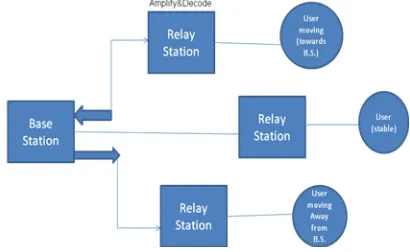
In this section we will design one base station and three relay stations which are used for amplify and decoding purpose. Also we will attached some mobile users and simulate it for different mobility patterns given as follows :-
1). User moving towards base station.
2). User moving away from base station.
3). User are stable.
[image:2.595.330.535.600.726.2]And finally we will compare all these situations and their parametric results for throughput, delay, packet delivery and packet loss ratio. Also Implementation of MIMO (multiple input multiple output) for increasing network efficiency. Then Making AWK files for calculating result and generating result using AWK file and Trace file. And generating graphs of delay for different routing protocols. Comparing all three scenario separately and calculate results based on various parameters based on AODV and DSDV protocols by using Ns2.3 simulator.
© 2016, IRJET | Impact Factor value: 4.45 | ISO 9001:2008 Certified Journal
| Page 2017
Parameters of comparison:- Throughput. Packet delivery. Packet loss. Maximum delay
Mobile next generation wireless targeted as the demand emerging application. The key strategies will be used for data rate improvement that are MIMO and Adaptive modulation &coding. Mobile communication Simulation we will do and Coverage range will be up to 10 kilo-meter . wi-max – Large coverage area, high speed, low cost per bit, high mobility. Routing protocols-AODV. Use of MIMO in MANET. Implementing network for different mobility patterns for mobile user. Tool-Ns2.31 with wimax module. To improve the QoS -Throughput, Delay, Packet delivery ratio, Packet loss ratio & to design MANET with Wi-Max. To design MIMO technique for sending and receiving data by using multiple channel. To AWK file of Throughput, Packet delivery, Packet loss. Also to compare different scenarios and to improve quality of service network. execution of MIMO (multiple input multiple output) for increasing network efficiency. Comparing all three scenario separately and calculate results based on various parameters.
5. SIMULATION PARAMETERS
Channel Type Wireless channel
Frequency 2.4 GHz
Propagation
model Tow way ground propagation
Network Interface
type Wireless physical/OFDM MAC Type 802.16 wi max
Antenna Type Omni directional
Number of mobile
node 4
Number of fixed
node 4
Protocol AODV / DSDV
[image:3.595.321.556.64.255.2][image:3.595.333.537.344.578.2]
Table No. 5.1:- Simulation Parameters
Figure 5.1 :- Flow chart of work
6. RESULTS
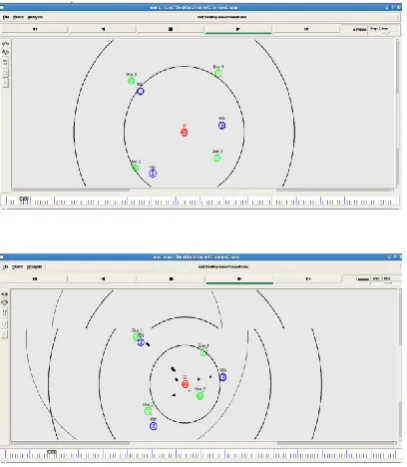
[image:3.595.77.247.463.685.2]1). Simulation Result for Users moving towards Base station :-
Figure 6.1.1 :- Users moving towards B.S.
[image:3.595.336.532.610.715.2]© 2016, IRJET | Impact Factor value: 4.45 | ISO 9001:2008 Certified Journal
| Page 2018
Figure 6.1.3 :- DSDV Max. Delay graph Users moving towards B.S
Parameter AODV DSDV Average
Throughput 787.8325 Kbps 628.4648 Kbps
No. of Packet
sent 1902 1902
No. of packet
Recv. 1462 1163
Packet Deliv
Ratio 76.86% 61.14%
Packet loss
Ratio 23.13% 38.85%
Max. Delay 510µsec 508µsec
Table 6.1.1 :-AODV/DSDV simulation parameters for users moving towards B.S.
2). Simulation Result for Users are fixed :-
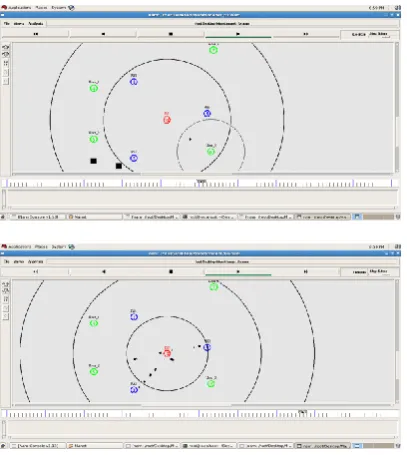
[image:4.595.320.545.373.548.2]Figure 6.2.1 :- Users are stable.
Figure 6.2.2 :- AODV Max .Delay graph Users are fixed.
Figure 6.2.3 :- DSDV Max. Delay graph Users are fixed.
Parameter AODV DSDV Average
Throughput 310.39 Kbps 495.82 Kbps
No. of Packet
sent 1039 1902
No. of packet
Recv. 862 887
Packet Deliv
Ratio 82.96% 46.36%
Packet loss Ratio 17.03% 53.36%
Max. Delay 505µsec 92µsec
Table 6.2.1 :-AODV/DSDV simulation parameters for users are fixed.
[image:4.595.61.265.502.730.2] [image:4.595.332.535.619.728.2]© 2016, IRJET | Impact Factor value: 4.45 | ISO 9001:2008 Certified Journal
| Page 2019
[image:5.595.55.268.372.477.2]Figure 6.3.1 :- Users moving away from B.S.
Figure 6.3.2 :- AODV Max. Delay graph Users moving away from B.S.
Figure 6.3.3 :- DSDV Max. Delay graph Users moving away from B.S.
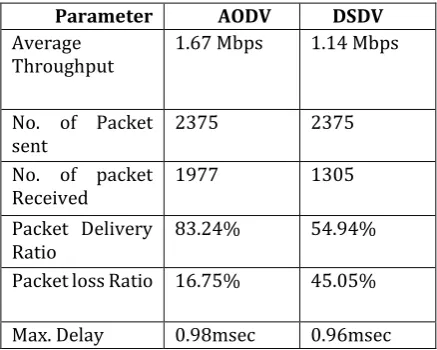
Parameter AODV DSDV Average
Throughput 1.67 Mbps 1.14 Mbps
No. of Packet
sent 2375 2375
No. of packet
Received 1977 1305
Packet Delivery
Ratio 83.24% 54.94%
Packet loss Ratio 16.75% 45.05%
Max. Delay 0.98msec 0.96msec
Table 6.3.1 :-AODV/DSDV simulation parameters for user moving away from B.S
7. CONCLUSION
In this paper we have studied three different scenarios that are, 1) users moving towards base station, 2) users are stable and 3) users moving away fron base station. And we have conclude that the simulation results for the third scenario i.e. users moving away from base station are more efficient as compared with remaining tow.
Also we have conclude that the parametric results obtained from AODV protocol is much better than that of DSDV protocol due to maximum power conservation and on demand connection. In further work we can extent this real work towards mobile handoff technology by considering different routing protocols other than AODV and DSDV. Also we can combine all above three scenarios to obtain realistic network simulation.
8. REFERENCES
[1] S.Mangai & A.Tamilarasi#2Proceedings of the International Conference on Communication and Computational Intelligence – 2010, Kongu Engineering College, Perundurai, Erode, T.N.,India.27 – 29 December,2010.pp.404-409.
[2] S. Mittal, P. Kaur, Performance Comparison of AODV,DSR and ZRP Routing Protocols in MANET’s, 2009 International Conference on Advances in Computing, Control and Telecommunication Technologies (act 2009), 28-29 December 2009, Trivandrum, Kerala,India, pp. 165-168. [3] E. M. Royer, C. E. Perkins, An Implementation Study of AODV Routing Protocol, IEEE Wireless Communications and Networking Conference, 23-28 September 2000, Chicago, pp. 1003-1008. Protocols for Ad Hoc Networks, IEEE Personal Communications Magazine Special Issue on Ad hoc Networking, February 2001, pp: 16-28.
[4] Weihong Hu, Homayoun Yousefi’zadeh, Senior Member, IEEE, and Xiaolong Li, Member, IEEE IEEE TRANSACTIONS ON WIRELESS COMMUNICATIONS, VOL. 10, NO. 11, NOVEMBER 2011.
[5] Hamid R. Sadjadpour Depart. of Electrical Engineering Univ. of California (UCSC) Santa Cruz, CA 95064, USA “On the Link Ergodic Capacity of MIMO MANETs using Cooperation” 1424407850/06/$20.00.
[image:5.595.52.271.521.696.2]