© 2016, IRJET | Impact Factor value: 4.45 | ISO 9001:2008 Certified Journal
| Page 702
Forest Fire Detection Through Various Machine Learning Techniques using
Mobile Agent in WSN
Anupam Mittal
1, Geetika Sharma
2, Ruchi Aggarwal
31
Anupam Mittal, Dept. Of Compuetr Science & Engineering, Chandigarh University, Mohali,India
2Geetika Sharma, Dept. Of Compuetr Science & Engineering, Chandigarh University, Mohali,India
3Ruchi Aggrawal, Dept. Of Compuetr Science & Engineering, Chandigarh University, Mohali,India
---***---Abstract -
Wireless sensor networks monitor dynamic environments that change suddenly over time. Machine learning also inspires many practical solutions that less energy consumption and to increase network lifetime. This paper provides review of machine learning techniques for detection of forest fire in wireless sensor network.Key Words:
Wireless Sensor Network, Machine Learning
Techniques, SVM, ANN, DT, FFNN.
1.INTRODUCTION
Forests play an important role for supporting the human environment and Forest fires are among the largest dangers for forest preservation. WirelessSensor Networks are used to forest fire detection. Wireless sensor networks have been used in a variety of applications such as:
Habitat monitoring Forest fire detection Event detection
Health and medical monitoring Target tracking
Surveillance monitoring
Event detection is one of the applications of data observation in wireless sensor networks. A large amount of sensor data is semantically processed and only relevant information is sent to the user [14].
2.RELATED WORK
Aditi, Yashwant and V. Mohindru [1] provide new approach how regression works best for forest fire detection with high
accuracy by dividing the forest fire dataset. They also present Comparsion of various machine learning techniques like as SVM (support vector machines), neural network, decision tree, regression, so on for detection of forest fires and new approach perform better as compared to other machine learning techniques.
Archana and Dr.Upadhyay [2] introduce a force based algorithm to auto deploy a sensor network to low consumption of energy by sensor nodes and to increase their network lifetime.
M.Oladimeji, M.Turkey and S.Dudley [3] said that hybrid approach of k-means clustering. They are uses three classification approaches like as the FFNN, Naïve Bayes and decision tree make hybrid approach for detection of fire with high accuracy.
K .Trivedi and A. Srivastava provide a framework that centralizes the use of mobile agent in wireless sensor network that can help in quickly detection of forest fire and monitoring of it with less energy consumption [4].
K. Kim et.al. Proposed new feature selection methods random forest-forward selection ranking (RF-FSR) and random forest-backward elimination ranking (RF-BER) [5].
© 2016, IRJET | Impact Factor value: 4.45 | ISO 9001:2008 Certified Journal
| Page 703
P.Bolourchi and S.Uysal [7] focused to make an intelligent decision using a fuzzy logic system in wireless sensor networks for detection of forest fire. A fuzzy logic algorithm is designed using five function as temperature, smoke, light, humidity and distance. Intelligent decision making are two types: 1) Save energy, 2) Pre-defined sensitivity levels.
V.Pande, W.Elmannai and K.Elleithy [8] introduced and implement a fire detection design on calculating the temperature of actual area and detecting the fire. They also provide acoustic ranging technique to detect the location and set the alarm in case of fire.
Varun Pande, Wafa Elmannai and Khaled Elleithy proposed a new detection system for fire detection using a multimedia board in order to detect and prove the fire in less time. They are used the IMB 400 multimedia board in order to take the image and run filtering algorithm over the image to detect the fire [9].
Rui Chen, Yuanyuan Luo and Mohanmad Reza Alsharif [10] discussed forest fire prediction algorithm which is based on image processing. They are introduced the two kinds of method to flame segmentation which are based on flame pixel identification method and k-means clustering method. This algorithm improves fire detection in real time and accurate.
O.Sekkas, S.Hadjieftymiades and E.Zervas [11] provide fire detection mechanism based on multi-level data fusion to enhance the performance of the early detection process.
Majid Bahrepour, Nirvana Meratnia, and Paul J. M. Havinga [12] proposed a two level sensor fusion based event detection technique for the WSN. This two layer fusion based technique provides extra support for dynamic nature of the network, physical failure of the nodes. A.Chauhan, S.Semwal and R.Chawhan [13] introduce a novel approach for real-time detection of forest fire using wireless sensor network.
3. MACHINE LEARNING TECHNIQUES
Recent improvements in computers and communication technology have made staggering amounts of information available to us. Fortunately there has been a concomitant increase in processing power. One of the major challenges for computing lies in finding ways to organize the available processing power in order to extract maximum benefit from the available information. Different aspects of that problem are addressed by machine learning, knowledge discovery and data mining.
Every field of human endeavor is affected by these issues; therefore a few examples will suffice. In bioinformatics, there are opportunities to use information about the human genome to design more effective medications, information from medical records to track drug side-effects or emerging diseases, and information from medical imaging to understand the structure and function of the brain and other organs. In robotics, major challenges lie in making use of visual and other sensed information to allow a robot to adapt flexibly to its environment. In the domain of e-commerce, all but the simplest artificial agents designed to gather information and act on behalf of human users will have to be equipped with the ability to adapt their behavior successfully to unexpected conditions. The very large number of documents and databases available on the web has fostered the development of tools for abstracting, extracting, and combining sources in a variety of ways to make the information more usable to humans.
Review of machine learning techniques for detection of forest fire are given below:
1. Support Vector Machine(SVM)
2. Artificial Neural Network(ANN)
3. Decision Tree(DT)
4. Feed Forward Neural Network (FFNN)
1) Support Vector Machine(SVM)
© 2016, IRJET | Impact Factor value: 4.45 | ISO 9001:2008 Certified Journal
| Page 704
algorithms that analyze data and pattern matching. Support Vector Machine (SVM) models are a close cousin to classical multilayer perception neural networks. Using a kernel function, SVM’s are an alternative training method for polynomial, radial basis function and multi-layer perception classifiers in which the weights of the network are found by solving a quadratic programming problem with linear constraints, rather than by solving a non-convex, unconstrained minimization problem as in standard neural network training.The figure 1 presents SVM algorithm [15].
Figure 1- SVM Algorithm
2) Artificial Neural Network(ANN)
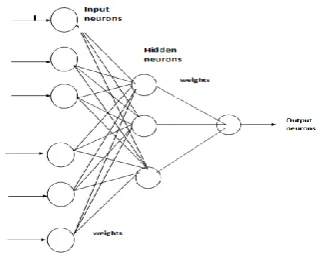
[16] ANN is a nonlinear dynamic system and work pattern of human brain. The Artificial neural networks are kind of learning based algorithms. The models of ANN compose of many neurons that are similar in function and structure. These neurons connect forming a net, and use parallel processing algorithm. ANN is a system that has the ability of learning by itself and learning is an adaptive process. These basically work on principle of neuron. The first model of neuron contained two inputs and one output. Both the inputs should be active for correct output. The weights for both the inputs were equal and output was binary. Figure 2 shows the model of neural network. The mathematical model function is:
F: X Y
Figure 2- ANN model
3) Decision Tree(DT)
Decision tree is a form of multiple variable analyses. They allow predicting, explaining, and classifying an outcome. Decision tree classify instances by sorting them down the tree from the root to some leaf node. The final result is a decision tree in which each branch represents a possible scenario of decision and its outcome. Figure 3 shows decision tree. Decision trees machine learning techniques use for detection of forest fire [17].
Figure 3- Decision Tree
4) Feed Forward Neural Network (FFNN)
Feed-forward networks can be seen as cascaded squashed linear functions. The inputs feed into a layer of hidden units, which can feed into layers of more hidden units, which eventually feed into the output layer. Each of the hidden units is a squashed linear function of its inputs.
© 2016, IRJET | Impact Factor value: 4.45 | ISO 9001:2008 Certified Journal
| Page 705
function of their inputs. For classification it is typical for the output to be a sigmoid function of its inputs (because there is no point in predicting a value outside of [0,1]). For the hidden layers, there is no point in having their output be a linear function of their inputs because a linear function of a linear function is a linear function; adding the extra layers gives no added functionality. The output of each hidden unit is thus a squashed linear function of its inputs. [12].
Figure 4- Architecture of FFNN.
[image:4.595.102.264.241.372.2]Associated with a network are the parameters for all of the linear functions. These parameters can be tuned simultaneously to minimize the prediction error on the training examples.
Figure 5: A neural network with one hidden layer. The wi are
weights. The weight inside the nodes is the weight that does not depend on an input; it is the one multiplied by 1.
Figure 5 shows a neural network with one hidden layer for the classification data. As explained in Example 5, this data set is not linearly separable. In this example, five Boolean inputs correspond to whether there is culture, whether the person has to fly, whether the destination is hot, whether there is music, and whether there is nature, and a single output corresponds to whether the person likes the holiday.
In this network, there is one hidden layer, which contains two hidden units that have no a priori meaning. The network represents the following equations:
pval(e,Likes
) = f(w0+w1×val(e,H1)+w2×val(e,H2))
val(e,H1) = f(w) +w3+w6×val(e,Hot)+ w4×val(e,Culture)+w7×val(e,Music)+ 5×val(e,Fly
w8×val(e,Nature)
val(e,H2) =
f(w9+w10×val(e,Culture)+w11×val(e,Fl
y) +w12×val(e,Hot)+ w13×val(e,Music)
+ w14×val(e,Nature)) ,
Where f(x) is an activation function. For this example, there are 15 real numbers to be learned (w0,...,w14). The hypothesis
space is thus a 15-dimensional real space. Each point in this 15-dimensional space corresponds to a function that predicts a value.
4.CONCLUSION
Forest fires generally occur in wild areas due to human activities and change in environment. They cause threats to the ecosystem and may result in human and animal deaths. In Future this technology can provide real-time monitoring, where it can provide information at the ignition instance or at very small delays, depending on the node used in wake-up/sleep schedule.
5.REFERENCES
[1]. Aditi Kansal, Yashwant Singh, Nagesh Kumar, Vandana Mohindru, “Detection of Forest Fires using Machine Learning Technique: A Perspective,” IEEE, 2015.
[2]. Archana Pandita, Dr. P. K Upadhyay, “Reducing Energy Consumption of Nodes Using Force Based Auto Deployment of WSNs,” IEEE, 2015.
[image:4.595.39.249.464.595.2]© 2016, IRJET | Impact Factor value: 4.45 | ISO 9001:2008 Certified Journal
| Page 706
[4].Kartik Trivedi, Ashish Kumar Srivastava, “An energy efficient framework for detection and monitoring of forest fire using mobile agent in wireless sensor networks,” IEEE, 2014.
[5]. O. Y. Al-Jarrah, A. Siddiqui, M.Elsalamouny and P. D.Yoo, S. Muhaidat and K. Kim, “Machine-Learning-Based Feature Selection Techniques for Large-Scale Network Intrusion Detection,” (34th International Conference on Distributed Computing Systems Workshops) IEEE, 2014.
[6]. Yashwant Singh, Suman Saha, Urvashi Chugh and Chhavi Gupta, “Distributed Event Detection in Wireless Sensor Networks for Forest Fires,” (15th International Conference on Computer Modelling and Simulation) IEEE, 2013. [7]. Pouya Bolourchi and Sener Uysal, “Forest Fire Detection in Wireless Sensor Network Using Fuzzy Logic,” (Fifth International Conference on Computational Intelligence, Communication Systems and Networks) IEEE, 2013. [8]. Varun Pande, Wafa Elmannai, Khaled Elleithy, “ Optimized Algorithm for Fire Detection over WSN using Micaz Motes,” IEEE, May 2013.
[9]. Varun Pande, Wafa Elmannai, Khaled Elleithy, “Classification and Detection of Fire on WSN Using IMB400 Multimedia Sensor Board,” IEEE, 2013.
[10]. Rui Chen, Yuanyuan Luo and Mohanmad Reza Alsharif, “Forest Fire Detection Algorithm Based on Digital Image,” JOURNAL OF SOFTWARE, Vol.8, No.8, AUGUST 2013. [11]. Odysseas Sekkas, Stathes Hadjieftymiades and Evangelos Zervas, “A Multi-level Data Fusion Approach for Early Fire Detection,” IEEE, 2010.
[12]. Majid Bahrepour, Nirvana Meratnia, and Paul J. M. Havinga, “Sensor Fusion-based Event Detection in Wireless Sensor Networks,” IEEE, 2009.
[13]. Anamika Chauhan, Sunil Semwal and Rajneesh Chawhan, “Artificial Neural Network-based Forest Fire Detection System using Wireless Sensor Network,” IEEE, 2013.
[14]. Aditi Kansal and Yashwant Singh, “Survey on Machine Learning Techniques for Event Detection in Wireless Sensor
Networks,” International Journal of Modern Computer Science (IJMCS),Volume No.-2, Issue No.-1, February, 2014. [15]. Dr. M.Mohamed Sathik, M.Syed Mohamed and A.Balasubramanian, “Fire Detection Using Support Vector Machine in Wireless Sensor Network and Rescue Using Pervasive Devices,” Int. J. Advanced Networking and Applications, Volume:02, Issue:02, 2010.
[16]. Parul Mohindru, Vikshant Khanna and Rajdeep Singh, “Forest Fire Detection: Various Approaches,” International Journal of Emerging Science and Engineering (IJESE), Volume-1, Issue-6, April 2013.
[17]. Majid Bahrepour, Nirvana Meratnia, Mannes Poel, Zahra Taghikhaki and Paul J.M. Havinga, “Distributed Event Detection in Wireless Sensor Networks for Disaster Management,” IEEE, 2010.
[18]. Taiwo Oladipupo Ayodele, “Types of Machine Learning Algorithms,” www.intechopen.com.
[19]. Mohammad Abu Alsheikh, Shaowei Lin, Dusit Niyato and Hwee-Pink Tan, “Machine Learning in Wireless Sensor Networks: Algorithms, Strategies, and Applications,” IEEE, 2015.