© 2016, IRJET | Impact Factor value: 4.45 | ISO 9001:2008 Certified Journal | Page 359
Experimental
Analysis
On The Performance And Emission Of Diesel Engine
Using Calophyllum Oil Methyl Ester
K.V.L.Bhuvaneswary1, Digvijay.B.Shelke2
1
P.G Student, Mechanical Department ,D. Y. Patil School of Engineering Academy, Pune ,Maharashtra , India
2Assistant Professor, Mechanical Department, D.Y. Patil College Of Engineering, Ambi, Pune, Maharashtra, India
---***---Abstract -
For the overall development of world utilizationof energy is needed. The main source of energy in the transport, agriculture, commercial, domestic, and industrial sector for generation of power is diesel fuels. The usage of these fuels on large front had lead to the serious shortage of the fossil fuel. So a consistent and a systematic approach for the alternative fuels is needed. And oils extracted from the non
edible sources form one of the best alternative.The current
paper the Calophyllum inophyllum biodiesel is prepared by using thermal cracking process and then transesterified. The blends of the obtained oil is prepared with diesel as 20%,40%,60%,80%.Experiments were conducted on Variable Compression ratio Engine and Performance parameters were determined like Brake Specific Fuel Consumption, Volumetric and Brake Thermal Efficiency. Also the Exhaust Emission parameters like CO, CO2, HC and NOx were determined for biodiesel-diesel blends by incrementing load by 25% and at constant speed of 1500 rpm, injection pressure of 200 bar and injection timing of 27ObTDC. The emissions shown by Pure
Calophyllum biodiesel and B20 are much better and cleaner in comparison to diesel wherein the Carbon monoxide emission
and Hydrocarbon emission reduced by 52% and 49.8%
.
font)Key Words:Biodiesel, Calophyllum inophyllum oil, Thermal
cracking ,Biodiesel Blends, VCR Diesel Engine, Performance and emission, Engine Load
1. INTRODUCTION
In the present days the alternate fuels is the answer to the depleting fossil fuels. The best alternative source is the Biodiesel. Biodiesel is distinct as it is oxygenated, sulfur-free, biodegradable, non-toxic and eco-friendly alternative diesel oil. It can be defined as a fuel self- possessed of mono-alkyl esters or methyl esters of long chain fatty acids derived from renewable sources, for instance vegetable oil, animal fat and used cooking oil which is designated as B100 and also they meet the special requirements such as the ASTM and the European standards. The conversion of vegetable oils into biodiesel is best possible way to use in engine. There are many techniques to convert the vegetable oil into biodiesel and reduce its viscosity .There are both edible and non edible source for
© 2016, IRJET | Impact Factor value: 4.45 | ISO 9001:2008 Certified Journal | Page 360
2. MATERIALS AND MEHODS
There are various process in which the preparation of Biodiesel can be possible, in this work the biodiesel is prepared by the process of thermal cracking of the crude oil and then proceeded for the transesterification process. Thermal cracking is the chemical reaction in which the lower molecular weight products are produced from the organic compound. The crude oil usually has long chains hydrocarbon molecules and also higher viscosity. The chains are broken and the the viscosity of the oil is considerably reduced in the thermal cracking process.
For the purpose of preparation of biodiesel, a three necked flask packed with the column and then a condenser is used as a reactor for crude oil. An amount of 200ml oil is filled in the flask and 1 ml of HCl is used as anti foaming agent. As crude oil has the capability to form foams which can be affected by possible impurities present in it. A heating metal is used for heating the crude oil for a maximum temperature of 250o C. Porcelain bites were introduced into the flask in order to retain the uniform temperature inside the flask. Glass wool is used for the insulation purpose in order to reduce the heat loss to the surrounding [11].The condensed vapors were collected. The so obtained oil is further transesterified .In the present research the 1 litre of thermally cracked oil was made to react with the 180 ml of methanol and 5 gm of potassium hydroxide in a round bottomed flask. A magnetic stirrer was also placed inside the oil for the equal distribution of the temperature. The round bottomed flask is inserted in a water bath in one container and the whole setup was placed on the magnetic stirrer with hot plate. A temperature of about 650C was maintained for 2 hours. Then the entire solution is was taken in separating funnel and allowed to settle for an hour then Calophyllum oil Methyl Ester and glycerol will be formed separately. Carefully the Methyl ester was separated. The one litre of obtained Calophyllum oil Methyl Ester was mixed with one litre of distilled water and shaked vigously then the saponified water and washed methyl ester can be obtained. The process was continued till the complete absence of the saponified water. Then the blends of B20 (20% of Calophyllum Oil Methyl Ester with 80% of diesel by volume), B40, B60, B80 were prepared
[image:2.595.306.547.521.748.2]
.
Table 1: Property Table of Biodiesel
3. EXPERIMENTAL SETUP
Experimentation was conducted on Diesel Engine test rig having single cylinder four stroke, D.I. water cooled type diesel engine with Eddy current loading for diverse fuel blends. The engine is a variable compression ratio engine.
3.1 Experimental methodology:
The testing observations were recorded at constant Engine speed 1500 rpm, injection pressure of 200 bar and injection timing of 27ObTDC. Readings signify the engine parameters recorded were the variation in load and compression ratio with respect to all blends of Diesel-Biodiesel. The measurands are Thermal Performance and Exhaust emissions for different Blends of Bio diesel and the Diesel. The gas analyser used was 5-way in nature that can measure oxides of nitrogen, carbon (like CO and CO2,) hydrocarbons in PPM or % basis
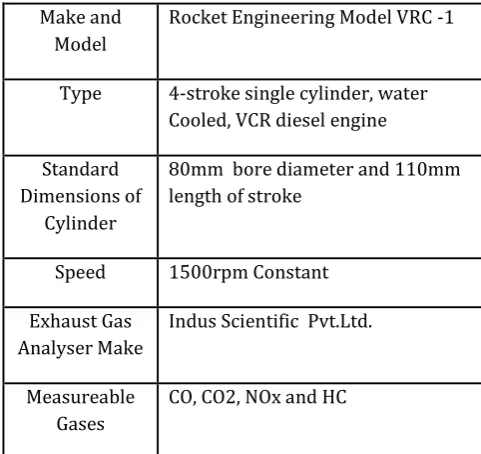
Table 2: Engine Specification and setup
Make and Model
Rocket Engineering Model VRC -1
Type 4-stroke single cylinder, water Cooled, VCR diesel engine
Standard Dimensions of
Cylinder
80mm bore diameter and 110mm length of stroke
Speed 1500rpm Constant
Exhaust Gas Analyser Make
Indus Scientific Pvt.Ltd.
Measureable Gases
CO, CO2, NOx and HC
PROPERTY B100
Viscosity mm2/sec 4.3
Flash PointOC 152
Fire PointOC 158
Net heating Value MJ/kg
© 2016, IRJET | Impact Factor value: 4.45 | ISO 9001:2008 Certified Journal | Page 361
Fig1. Schematic representation of experimental procedure4. RESULTS AND DISCUSSION:
4.1 Load Variation: Engine Performance:
The below experimental study reveals the variations observed when the load was altered for the blends.
4.1.1 Brake Power
:Chart No 1. Illustrates the effect brake power derived from Callophyllum biodiesel to the load that is incremented by 25%. Brake power of an engine is directly proportional to the load applied and hence the BP for all blends shows a linear variation. Also output power is found maximum for B20 Blend which contains 20% vol. Calophyllum methyl ester. The Brake power also derives the knowledge that the actual power delivered or obtained at the crankshaft reminding which is useful observation while considering a alternate fuel for current diesel engines without any high modifications.
Chart -1. Variation of Brake power to load
4.1.2. Brake Mean Effective Pressure
Brake mean effective pressure is a factor of turbulence occurring due to effective burning inside the cylinder recurring to greater BMEP .The Chart No 2 signifies that as the load increases the brake mean effective pressure rises almost linearly. Effective Pressure for diesel is very low in comparison to other mixtures. As the percentage of Calophyllum Methyl ester increases in the blend, relative increase in BMEP is found. The Effective pressure of B100 (Calophyllum oil methyl ester) was maximum than all other the blends of biodiesel-diesel. The BMEP of Diesel has increased by 52.5% on average with conventional fuel.
Chart- 2 Variation of Brake mean Effective Pressure to load
4.1.3 Exhaust Gas Temperature
© 2016, IRJET | Impact Factor value: 4.45 | ISO 9001:2008 Certified Journal | Page 362
the heat release is important which is based on burning offuel or which is also called as complete combustion. The trend observed for all the blends is the same but B20 is increased by 2.4%. The compression ratio 17.5, Injection pressure 200 bar and timing of 27ObTDC were constant during observation. It is inferred from the graph that the B100 pure biodiesel is giving maximum exhaust gas temperature as the load is incremented.
Chart-3. Variation of Exhaust Gas Temperature to load
Chart-4 Variation of Heat carried away from exhaust gas to load
4.1.4. Brake Thermal Efficiency
.
Chart-5. Variation of Brake Thermal efficiency to load
Brake thermal efficiency (%) is the ratio of output
power to heat supplied. The chart-5 shows that the
brake thermal efficiency for diesel is highest as the
calorific value of diesel is higher than the other fuels.
The brake thermal efficiency of all fuels used in the
study is showing an increasing trend to load variation.
The heat input provided is given by the mass of fuel
consumed and the calorific value of the fuel. The bthe
of B20 is almost same at lower loads but as the load
increases, the average reduction is 3% with
comparison to diesel. In the case of B100 the bthe
reduces on a average load of 11%. The brake thermal
efficiency of B100 is lowest and fossil diesel is highest.
4.1.5 Brake Specific fuel Consumption
Chart-6Variation of Brake Specific Fuel to Consumption to load
© 2016, IRJET | Impact Factor value: 4.45 | ISO 9001:2008 Certified Journal | Page 363
which is good and as the blend percentage of Callophyllumbiodiesel increases the BSFC Also increases which is disadvantage when such fuels are considered. The BSFC of B20 blends shows the same as diesel and for B100 the Specific fuel consumption is maximum. The bsfc for 100% biodiesel is 24.3% more than that of diesel fuel.
4.1.6 Volumetric efficiency
The chart 7 indicates the variation of the volumetric
efficiency with the load for calophyllumdiesel blends.
-The volumetric efficiency is the ratio of actual air taken
in to the theoretical air sucked inside the cylinder. The
Vol efficiency is highest for B20 blend and lowest for
conventional fuel or diesel. For B60 blend it first rises
and gradually falls
Chart-7. Variation of Volumetric efficiencyto load
4.2Exhaust Emission:
4.2.1 CO
2emission
Chart-8. Variation of CO2to load
The chart-8 shows the emission of CO2 with the load incrementation for all the blends. Release of carbon dioxide emission is a sign of cleaner emission. As the amount of the biodiesel percentage increases the CO2 levels also increases which is good sign for alternate fuel. Even diesel doesn’t show the the above statement. When load is increased the fuel consumption increases , the carbon dioxide emmision also shows the result in a linear progressive fashion. The CO2 emission for B100 is highest and least for diesel. The increase in carbon dioxide emissions for B100 and B20 is 13.5% and 3.8% respectively to diesel.
4.2.2 Carbon-Monoxide Emission
© 2016, IRJET | Impact Factor value: 4.45 | ISO 9001:2008 Certified Journal | Page 364
Chart-9 Variation of CO emission to Load.At constant injection timing of 27ObTDC, the CO emissions of Diesel fuel is highest and is measured in %. The B100 blends show a reduction by 52% than that of diesel and B20 by 12% for all loads.
4.2.3 Hydrocarbon emission
The hydrocarbon emission (HC) is consequential of
partial burning. As the load is varied, the HC emission
grows. The chart-10 given below indicates the
variation in the HC with load in as the blend. The
hydrocarbon emission for conventional fuel diesel is
found maximum. As the amount of biodiesel increases
in the fuel hydrocarbon emission reduces significantly.
B20 shows a reduction of HC emission by 13.5% and B
100 by 49.8%.
Chart-10. Variation of Hydrocarbon emission to Load
4.2.4 Nitrogen Oxides emission
The variation of Nitrogen Oxides with respect to load is plotted graphically in chart 11. The nitrogen oxides (NOx) emission is a direct function of burning temperature of the fuel in the combustion chamber inside the engine. The fluctuation of load and Oxides of nitrogen is showing a linear trend. The NOx produced by B100 is highest as combustion is found to be complete as due to the chemical structure of biodiesel has oxygen impregnated in it and which is absent in diesel. The NOx emission of B100 increased by 23% in comparison to diesel
Chart-11 Variation of nitrogen oxide emission to Load.
5. CONCLUSION:
The experimental analysis of biodiesel derived from from calophyllum oil is compared to diesel with the variation of engine load incrementing by 25% and then with the variation of compression ratio observes the following points. The Brake thermal efficiency reduced by 3% and 12% for B20 and B100 in comparison of diesel with the variation of load and the brake specific fuel consumption increased by 24.3% for B100 with that of diesel which is a negative point when mileage concept is considered.
The Brake Mean Effective pressure raised by 52% for B100 which adds to point of higher combustion efficiency.
The Hydrocarbon and Carbon monoxide emissions reduced by 49.8 % and 52% which proves a cleaner fuel but the NOx increased by 23% for B100 with reference to the load variation.
6. REFERENCES
1 .Sukumar Puhan,N. Vedaraman, B.V. Ramabramham,
G.Nagarajan. Mahua (Madhuca Indica) seed oil :A source of renewable energy in India, Journal of Sceintific and Industrial Research , Vol 64, Nov (2005)pp 890-896.2. C.D.Rakopoulos, K.A. Antonopoulos, D.C. Rakopoulos, D.T.Hountalas, E.G. Giakoumis, Comparative performance and emissions study of a direct injection Diesel engine using blends of Diesel fuel with vegetable oils or bio-diesels of various origins Energy Conversion and Management 47 (2006) pp 3272–3287
3. Ekrem Buyukkaya, Effects of biodiesel on a DI diesel engine performance, emission and combustion characteristics Fuel 89 (2010) pp 3099–3105
© 2016, IRJET | Impact Factor value: 4.45 | ISO 9001:2008 Certified Journal | Page 365
5. A.M. Liaquata, H.H. Masjukia, M.A. Kalama, M. Varmana,M.A. Hazrata,M. Shahabuddin, M. Mofijur,Application of blend fuels in a diesel engine, Energy Procedia 14 (2012) pp 1124 – 1133
6. A. Velmurugan, M. Loganathan, E. James Gunasekaran Experimental investigations on combustion, performance and emission characteristics of thermal cracked cashew nut shell liquid (TC-CNSL)–diesel blends in a diesel engine Fuel 132 (2014) 236–245
7. B.K Venkanna C. Venkataramana Reddy. Biodiesel Production and optimization from Calophylllum Inophyllum Linn oil (honne oil).A three stage method. Bioresource Technology 100 (2009) pp: 5122–5125
8.Vasanthakumar SathyaSelvabala, Dinesh Kirupha Selvaraj, Jalagandeeswaran Kalimuthu, Premkumar Manickam Periyaraman, Sivanesan Subramanian ,Two-step biodiesel production from Calophyllum inophyllum oil: Optimization of modified b-zeolite catalyzed pre-treatment Bio resource Technology 102 (2011)pp 1066–1072
9 .B.K Venkanna, C.Venkataramana Reddy. Influence of injector pressures on performance, emission and combustion characteristics of DI diesel engine running on Calophyllum Inophyllum linne oil International Journal of Renewal energy. Vol6. No1 (2011) pp15-19
10.S V Channapattanaa*,Kantharaj Cb,V S Shindec Abhay A Paward, Prashant G Kamble Emissions and Performance Evaluation of DI CI - VCR Engine Fuelled with Honne oil Methyl Ester / Diesel Blends ScienceDirectEnergy Procedia 74, (2015) pp281 – 288