A Monthly Double-Blind Peer Reviewed Refereed Open Access International e-Journal - Included in the International Serial Directories.
International Research Journal of Natural and Applied Sciences (IRJNAS) ISSN: (2349-4077) 9 | P a g e
International Research Journal of Natural and Applied Sciences Vol. 3, Issue 8, August 2016 IF- 3.827 ISSN: (2349-4077)
© Associated Asia Research Foundation (AARF)
Website: www.aarf.asiaEmail : [email protected] , [email protected]
SERUM SEROTONIN AND VITAMIN D LEVELSIN BOYS WITH
CONDUCT DISORDER VERSUS NORMAL BEHAVIOR FROM
BAQUBA CITY
Shatha Q. Jawad *, Vean S.Alazawy**
* Assist. Prof. Department Of Basic Science/ College Of Dentistry/ Baghdad University. ** Assist. Lec.Department Of Basic Science/ College Of Dentistry/ Baghdad University.
SUMMARY
Backgrounds : Serotonin and vitamin D concentrations in children and adolescent are
involved in behavior and social relationship through their role in central nervous system, thus
recent studies in the world indicated that the steroid hormones and neurotransmitters linked
and regulate the behavior by acting on the function and physiology of many systems in the
human body.
Aim of the study: This work aimed to compare the neurotransmitter serotonin and 25(OH)
vitamin D levels can altered among prosocailprimary school children and abnormal behavior
conduct disorder for evaluation the role of these essential component in the abnormal
behavior.
Subjects and methods: The study subjects consisted of 80 boys with age between 9-15 years
old. Conduct behavior was diagnosed by Rutter Child Behaviour Questionnaire (RCBQ),
blood sample was collected from the pupils in the two groups of the study between 8-10 Am
under standardized condition. Serotonin and vitamin D analysis was performed by using
indirect enzyme linked immuonosorbent( IELISA ) assay, then data were statistically
A Monthly Double-Blind Peer Reviewed Refereed Open Access International e-Journal - Included in the International Serial Directories.
International Research Journal of Natural and Applied Sciences (IRJNAS) ISSN: (2349-4077) 10 | P a g e
Result: the results showed that mean serum serotonin level was lowered (2.053±0.58
ng/ml)in conduct pupils when compared to control group ( 2.89± 0.73 ng/ml ) but didn’t find
significant differences in the mean of serum serotonin level between the two groups. Also
the mean serum 25(OH) vitamin D was significantly decrease ( p<0.05 ) in conduct group (
18.38± 2.43 ng/ml) as compared to normal control pupils ( 20.57±3.29 ng/ml).there is highly
significant correlation (p<0.001) among them, with the simple linear regression between
25(OH) vitamin D and serotonin, when 25(OH) vitamin D goes up the serotonin rises two.
Conclusion:the information about concentration of serotonin and vitamin D in serum of
school aged children is not completely available or poor especially in Iraq. The deficiency of
serotonin and vitamin D is occur as appear in this study, need further studies and attention
should paid in primary school children to correct the nutrition deficiency that are included in
development and behavioral regulation.
Keywords: Conduct Disorder, Serotonin, 25(OH)- Vitamin D, Primary School Children
Introduction
conduct disorder is consider one of psychiatric syndromes that occur in pre-adolescence and
adolescence period, which increases the risk of many dangerous problems of public health, as
the weapon use, substance abuse and dropping or escaping out of school (1).
Therefore the identification of this disorder it is important as early as possible. It has two
subtypes: the first onset during the period, which if left untreated, has bad prognosis. The
symptoms include, aggression, destruction of the property destruction and lack or bad peer
relationships. And 40% of the type childhood onset of conduct disorder are develop into adult
antisocial personality disorder. The second type is adolescent conduct disorder (2).
Boys are more diagnosed than girls by conduct disorder, may occur at the age between 5-6
years but many pass the threshold between the age 8 to 14. The prevalence of conduct
disorder reach to 4% in 13–16 year olds, In addition, there is evidence that conduct disorder
has an important co morbidity such as oppositional defiant disorder with attention deficit
hyperactivity disorder with rate reach to 50% to 30% with depression, anxiety disorders and
learning disabilities between 30 and 40% (3, 4).
The genetic and hormonal difference are the most possible causes, the monoamines as
A Monthly Double-Blind Peer Reviewed Refereed Open Access International e-Journal - Included in the International Serial Directories.
International Research Journal of Natural and Applied Sciences (IRJNAS) ISSN: (2349-4077) 11 | P a g e
are the most widely studied in relationship to behavior of human specifically conduct and
aggression, because of their role in the brain (5). The number of serotonin receptors are
increased in the past years, reaching 14 different receptors and they are classified into seven
families (5-HT1-7) according to their function, structure, and pharmacology or treatment
(6,7), the number of research on the role of serotonin in the brain since the discover of this
neurotransmitter are increased enormously (8).
5HT1 receptors are auto receptors and are negatively linked to adenylate cyclase.5HT1A is
regulating firing rate because it is located on somas and dentrites of raphe nuclei, but release
modifing 5HT1B receptor is located presynaptically such as substantia nigra. Also the
serotonin 1 receptors are heteroreceptors, found in the axon terminals of non-serotonergic
neurons, postsynaptic to the serotonin releasing neuron (9, 10).
Similarly, vitamin D is consider as one of the neuroactive hormones type steroid that have
important role in the development of normal brain.Vitamin D receptors and 1α-hydroxylase
enzyme, an enzyme responsible for the formation of the active form of vitamin D, arelocated
throughout the central nervous system. Vitamin D receptors and enzymes are located in
neuronal cells of the substantia nigra, hippocampus, hypothalamus, prefrontal cortex, and
cingulated gyrus; many of these regions have also been shown to have abnormalities in
ADHD (11, 12). There is data to suggest that Vitamin D deficiency during development has
deleterious effects on the dopamine system and, in animal models, vitamin D has been shown
to be associated with the production of tyrosine hydroxylase, the rate-limiting enzyme for
dopamine synthesis (13,14). Vitamin D may exert its neurological effects through various
mechanisms. In animal models, it has been shown that vitamin D is an important factor for
the differentiation of developing brain cells, is involved in axonal growth, can increase
antioxidants such as glutathione and therefore protect against oxidative stress, and can
regulate various neurotrophic factors such as nerve growth factor. Although largely
cross-sectional in design, there have been studies demonstrating an association between low
vitamin D levels with schizophrenia, depression, and Alzheimer’s Disease (15).
Methods
Subjects
The subjects selected for this study include 80 Iraqi pupils (40 conduct disorder and 40 in
A Monthly Double-Blind Peer Reviewed Refereed Open Access International e-Journal - Included in the International Serial Directories.
International Research Journal of Natural and Applied Sciences (IRJNAS) ISSN: (2349-4077) 12 | P a g e
city, randomly selected in a systematic random sample, with age ranged between 9- 15 years.
This study was carried out during a period from september 2012 to June 2014.
Assessment and Scoring the child conduct behaviour
Rutter Child Behaviour Questionnaire (RCBQ) was used as a scale for diagnosis of
behavioral disorders having ADHD, versus prosocial behavior. Rutter Child Behaviour
Questionnaire for completion by teacher in its original version was developed by Rutter et
al.(1967), it consist of 59 items, 39 items for total difficulties (conduct, Emotional, and
hyperactivity) and 20 items for pro social trait (16).Special data sheet was designed for
collection of two types of information for each child enrolled in this study.
1- Information completed by the child family
About the child and his family, include personal and socio demographic data, age, gender,
class, school years of scholastic failure, parental age, education, occupation, death,
birth,order, family size, crowding index. (number of family member number of rooms in the
house ) polygamy, divorce and child working status
2- Information completed by the class teachers
Score for each item either 0, 1 or 2 ( dosen᾽t apply, applies somewhat and certainly applies0.
Child with a total score of nine or more (cut-off score at 50 th percentile),
Sample Collection
Five milliliters of venous blood sample were collected from each pupil of the two study
groups who were selected from the primary school children. The serum was obtained by
putting each blood sample in a clean dry plain tube and allowed to clot at 37 o C for 20 – 30
minutes, centrifuged at 3000 rpm for 15 minutes in Diyala Faculty of Medicine. Serotonin
and vitamin D analysis was performed by using indirect enzyme linked immuonosorbent(
IELISA ) assay.
All tests were carried out in the hormones unit of the specialize Center of Endocrinology and
Diabetes (Baghdad Russafa Health Directorate) in Baghdad. SPSS version 18 (statistical
A Monthly Double-Blind Peer Reviewed Refereed Open Access International e-Journal - Included in the International Serial Directories.
International Research Journal of Natural and Applied Sciences (IRJNAS) ISSN: (2349-4077) 13 | P a g e
Results
The results showed that the mean serum 25(OH) vitamin D level was significantly (p<0.05)
increased among pupils with normal behavior (20.57±3.29 ng/ml) than that in conduct
behavior group(18.38±2.43 ng/ml) (table 1).
Table 1: The mean of serum 25(OH) vitamin D level in conduct and control groups
Groups
Number Mean± SD (ng⁄ml) t-test p-value Significance
Normal 40 20.57±3.29 2.225 0.043 S
Conduct
40 18.38±2.43
The result of the present study also showed that the mean serum serotonin level was lowered
(2.05± ng/ml) in pupils with conduct disorder as compared to that in control group
(2.89±ng/ml) , but the differences statistically was not significant as shown in table (2).
Table 2: The mean of serum serotonin level in conduct and control groups
Groups Number Mean± SE (ng⁄ml) t-test p-value Significance
Conduct 40 2.05 ± 0.58 0.948 0.359 NS
Normal 40 2.89 ± 0.73
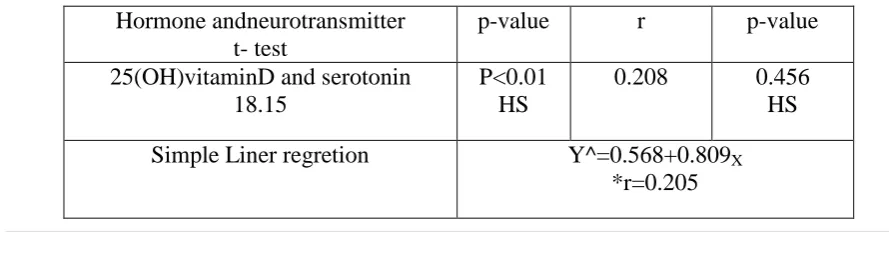
The comparative or the relationship between 25(OH) vitamin D and serotonin among conduct
pupils was detailed in table (3). The data revealed that there is highly significant correlation
(p<0.001) among them, with the simple linear regression between 25(OH) vitamin D and
[image:5.595.68.513.624.754.2]serotonin, when 25(OH) vitamin D goes up the serotonin rises two (figure 1).
Table 3: comparative between 25(OH) vitamin D and serotonin among conduct disorder
goup
Hormone andneurotransmitter t- test
p-value r p-value
25(OH)vitaminD and serotonin 18.15
P<0.01 HS
0.208 0.456
HS
Simple Liner regretion Y^=0.568+0.809X
A Monthly Double-Blind Peer Reviewed Refereed Open Access International e-Journal - Included in the International Serial Directories.
International Research Journal of Natural and Applied Sciences (IRJNAS) ISSN: (2349-4077) 14 | P a g e
Figure (1): Correlation of25(OH) vitamin D and serotonin in conduct group
Discussion
The number of boys that included in this study was 80 pupils with the age range between 9
and 15 years old, there are little number of girls diagnosed with conduct disorder, thus girls
were not considered in this study because of the variation in the sample size in addition to the
variation in the adolescent time and hormones or life stage in this city.
The results of the current study found that the mean serum serotonin concentration is lowered
in pupils with conduct behavior group than in normal behavior group. In accordance, Coccaro
et al.(1997) correlates the conduct –aggressive behavior with lowered brain serotonin.The
results of the present study showed that there were no significant differences in the mean
serum serotonin concentration between the two groups, In fact, Dunlop and Nemeroff (2007)
clarified that the variation in cortical and brain neuro transmitters during the school age
periods may be contribute in the development of at least one the neuropsychiatric disorders.
Similarly, Fineberg et al.( 2008 ) stated that the pathway of the neurotransmitter is strongly
influence the onset of many psychiatric disorders in patient, serotonin has received much
attention as neurotransmitter because of the extensive innervation and its roles in the brain
with the presence of many receptor distribution, also its roles in broad spectrum of central
function and behaviors. Regarding to the vitamin D, the statistical analysis showed that there
was no significant differences in the mean serum 25(OH) vitamin D, while the mean serum
vitamin D is increased in control group than pupils in conduct group. This may be explained
[image:6.595.88.508.64.257.2]A Monthly Double-Blind Peer Reviewed Refereed Open Access International e-Journal - Included in the International Serial Directories.
International Research Journal of Natural and Applied Sciences (IRJNAS) ISSN: (2349-4077) 15 | P a g e
therefore are included in the modulation of human and animal behavior through linking with
neurotransmitters, growth factors, neuroactive steroid and neuropeptide (Holi et al.,2000).
Patrick and Ames (2014) investigated that vitamin D hormone is conceder as a key regulator
in synthesis brain serotonin by the enzyme tryptophan hydroxylase 2, that it contain the
vitamin D response elements, and stated that when vitamin D level was lowered lead to
variation in serotonin synthesis and then may be result abnormal development of the brain.
Furthermore, Walther and Bader(2003) proved that the brain tryptophan is linked with the
concentration of serotonin in the brain.Gong et al.(2013) showed that the lowered serum
25(OH) vitamin D concentration was correlated linked with the severity of autism. In
contrast, D′Eufemia et al(1995) showed that many non autistic individuals are lacking to
suitable concentration of tryptophan, but Passamonti et al.(2012) stated that the increases of
tryptophan level lead to rapid with decreasing in the brain serotonin concentration in the
normal individuals which have strong effect on their social behavior.
Conclusions
Generally, the present study displayed that the boys with conduct disorder who were already
have abnormal behavior have decreased serum serotonin and 25(OH) vitamin D levels which
they are present in nutrition, this may be due to the environmental factors that contribute in
the disruption of behavior especially, there area where the samples collected were born and
raise in a poor security and consider hot area, thus broken family because of parents by ware,
need further studies and nutritional education in primary school children.
Acknowledgements
I would like to acknowledge all the staff members of the department of Education in Baquba
city, all the managers, the teachers and children of the schools involved in this work.My
special thanks extended to all the staff members of the Department of microbiology, college
of medicine, university of Diala, Baquba city . I offer my deep thanks to all the staff members
of the Poisoning Consultation Center, Medical City for their help.
References
A Monthly Double-Blind Peer Reviewed Refereed Open Access International e-Journal - Included in the International Serial Directories.
International Research Journal of Natural and Applied Sciences (IRJNAS) ISSN: (2349-4077) 16 | P a g e
2. Kazdin AE. Conduct disorders in childhood and adolescence. Thousand Oaks, Calif.: Sage,
1995.SEARIGHT,H.R; ROTTNEK,F.; ABBY,S. (2001). Conduct Disorder: Diagnosis and
Treatment in Primary Care. AMERICAN FAMILY PHYSICIAN. 63( 8 ):1579-1588.
3. Buitelaar,J.K.; Montgomery,S.A.; van Zwieten-Boot, B.J. Conduct disorder: guidelines for
investigating efficacy of pharmacological q intervention. European
Neuropsychopharmacology 13 (2003) 305–311-.
4. Angold, A., Costello, E.J., 2000. The Child and Adolescent Psychiatric Assessment (CAPA).
J. Am. Acad. Child Adolesc. Psychiatry 39, 39–48 .
5. B.L. Jacobs, E.C. Azmitia, Structure and function of the brain serotonin system, Physiol Rev
72 (1992) 165-229.
6. P.J. Morgane, J.R. Galler, D.J. Mokler, A review of systems and networks of the limbic
forebrain/limbic midbrain, ProgNeurobiol 75 (2005) 143-160 .
7. X. Zhang, J.M. Beaulieu, T.D. Sotnikova, R.R. Gainetdinov, M.G. Caron, Tryptophan
hydroxylase-2 controls brain serotonin synthesis, Science (New York, N.Y 305 (2004) 217.
8. S.E. Hyman, R.C. Malenka, E.J. Nestler, Neural mechanisms of addiction: the role of
reward-related learning and memory, Annu Rev Neurosci 29 (2006) 565-598.
9. N.M. Barnes, T. Sharp, A review of central 5-HT receptors and their function,
Neuropharmacology 38 (1999) 1083-1152.
10.E. Zifa, G. Fillion, 5-Hydroxytryptamine receptors, Pharmacol Rev44 (1992) 401-458.
11.Eyles, D.W.; Smith, S.; Kinobe, R.; Hewison, M.; McGrath, J.J. Distribution of the Vitamin
D receptor and 1α-hydroxylase in human brain. J. Chem. Neuroanat. 2005, 29, 21–30.
12.Ellison-Wright, I.; Ellison-Wright, Z.; Bullmore, E. Structural brain change in Attention
Deficit Hyperactivity Disorder identified by meta-analysis. BMC Psychiatry 2008, 8, 51.
13.Sanchez, B.; Relova, J.L.; Gallego, R.; Ben-Batalla, I.; Perez-Fernandez, R.
1,25-Dihydroxyvitamin D3 administration to 6-hydroxydopamine-lesioned rats increases glial cell
line-derived neurotrophic factor and partially restores tyrosine hydroxylase expression in
substantia nigra and striatum. J. Neurosci. Res. 2009, 87, 723–732.
14.Eyles, D.W.; Burne, T.H.J.; McGrath, J.J. Frontiers in Neuroendocrinology. Front.
Neuroendocrinol. 2013, 34, 47–64.
15.Kennel, K.A.; Drake, M.T.; Hurley, D.L. Vitamin D Deficiency in Adults: When to Test and
How to Treat. Mayo Clin. Proc. 2010, 85, 752–758.
16.Rutter, M.; Hogg, C. and Richman, N. (1997). Manual of child psychology. Protfolio:1-7.
17.Wayne, W. ( 2010 ). Biostatistics: A foundation for analysis in the health sciences. Wiley
A Monthly Double-Blind Peer Reviewed Refereed Open Access International e-Journal - Included in the International Serial Directories.
International Research Journal of Natural and Applied Sciences (IRJNAS) ISSN: (2349-4077) 17 | P a g e
18.Oner, O. ;Oner, P. and Bozkurt, O. (2010). Effects of zinc and ferritin levels on parent and
teacher reported symptom scores in attention deficit hyperactivity disorder. Child Psychia.
Hum. Dev.,41:441-447 .
19.Coccaro, E.F., Kavoussi, R.J., Cooper, T.B., Hauger, R.L., 1997. Central serotonin activity
and aggression: inverse relationship with prolactin response to D-fenfluramine, but not CSF
5-HIAA concentration, in human subjects. Am. J. Psychiatry 154, 1430–1435.
20.Dunlop, B. and Nemeroff, C. ( 2007 ). The role of dopamine in the pathophysiology of
depression. Arch. Gen. Psychia., 64:327-337 .
21.Fineberg, N.; Krishnaiah, R.; Moerg, J. and O᾽Doherty, C. ( 2008 ). Clinical screening for
obsessive-compulsive and related disorders.Israel J. Psychia.Relat. Sci., 45:151-163.
22.Arnold, L. (1996 ). Sex differences in ADHD: Conference summary. J. Abnor. Child
Psychol., 24:555-69.
23.Holi,M.; Auvinen-lintunen,L. and Lindberg,N. (2006). Invers correlation between severity of
psychopathic traits and serum cortisol levels in young adult violent male offenders.
Psychopath.,39:102-104.
24.Patrick,R.P.;Ames,B.N. Vitamin D hormone regulates serotonin synthesis.Part 1: relevance
for autism. FASEB J. Rev.(2014).28:1-6.
25.Walther, D. J., and Bader, M. (2003) A unique central tryptophanhydroxylase isoform.
Biochem.Pharmacol. 66, 1673–1680
26.Gong, Z. L., Luo, C. M., Wang, L., Shen, L., Wei, F., Tong, R. Jand Liu, Y. (2013) Serum
25-hydroxyvitamin D levels in ., Chinese children with autism spectrum disorders.
Neuroreport25, 23–27
27.D′Eufemia et al(1995)D’Eufemia, P., Finocchiaro, R., Celli, M., Viozzi, L., Monteleone,D.,
and Giardini, O. (1995) Low serum tryptophan tolarge neutral amino acids ratio in idiopathic
infantile autism.Biomed. Pharmacotherapy 49, 288–292
28.Passamonti, L., Crockett, M. J., Apergis-Schoute, A. M., Clark,L., Rowe, J. B., Calder, A. J.,
and Robbins, T. W. (2012) Effectsof acute tryptophan depletion on prefrontal-amygdala