R E S E A R C H
Open Access
Split proximal linearized algorithm and
convergence theorems for the split DC
program
Chih-Sheng Chuang
1and Chi-Ming Chen
2**Correspondence:
2Institute of Computational and
Modeling Science, National Tsing Hua University, Hsinchu, Taiwan Full list of author information is available at the end of the article
Abstract
In this paper, we study the split DC program by using the split proximal linearized algorithm. Further, linear convergence theorem for the proposed algorithm is established under suitable conditions. As applications, we first study the DC program (DCP). Finally, we give numerical results for the proposed convergence results.
MSC: 49J50; 49J53; 49M30; 49M37; 90C26
Keywords: DC program; Proximal linearized algorithm; Strongly monotonicity
1 Introduction
First, we recall the minimization problem for convex functions:
Findx¯∈arg minf(x) :x∈H, (MP1)
whereHis a real Hilbert space andf :H→(–∞,∞] is a proper, lower semicontinuous,
and convex function. This is a classical convex minimization problem with many applica-tions. To study this problem, Martinet [11] introduced the proximal point algorithm
xn+1=arg min
y∈H
f(y) + 1 2βn
y–xn2
, n∈N, (PPA)
and showed that{xn}n∈Nconverges weakly to a minimizer off under suitable conditions. This algorithm is useful, however, only for convex problems, because the idea for this algorithm is based on the monotonicity of subdifferential operators of convex functions. So, it is important to consider the relation between nonconvex problems and a proximal point algorithm.
The following is a well-known nonconvex problem, known as DC program:
Findx¯∈arg min x∈Rn
f(x) =g(x) –h(x), (DCP)
whereg,h:Rn→Rare proper lower semicontinuous and convex functions. Here, the functionf is called a DC function, and functionsgandhare called DC components off.
In the DC program, the convention (+∞) – (+∞) = +∞has been adopted to avoid the ambiguity (+∞) – (+∞) that does not present any interest. It is well known that a necessary condition forx∈dom(f) :={x∈Rn:f(x) <∞}to be a local minimizer off is∂h(x)⊆∂g(x),
where∂g(x) and∂h(x) are the subdifferentials ofgandh, respectively (see Definition2.4). But this condition is hard to be reached. So, many researchers focus their attention on finding points such that∂h(x)∩∂g(x)=∅, wherexis called a critical point off [8].
It is worth mentioning the richness of the class of DC functions which is a subspace containing the class of lower-C2functions. In particular,DC(Rn) contains the spaceC1,1of
functions whose gradient is locally Lipschitz continuous. Further,DC(Rn) is closed under the operations usually considered in optimization. For example, a linear combination, a finite supremum, or the product of two DC functions remain DC. It is also known that the set ofDCfunctions defined on a compact convex set ofRnis dense in the set of continuous
functions on this set.
We also observed that the interest in the theory of DC functions has much increased in the last years. Some interesting optimality conditions and duality theorems related to the DC program have been given (for example, see [6,7,14]). Some algorithms for the DC program are proposed to analyze and solve a variety of highly structured and practical problems (for example, see [13]).
In 2003, Sun, Sampaio, and Candido [16] gave the following algorithm to study problem (DCP).
Algorithm 1.1(Proximal point algorithm for (DCP) [16]) Let{βn}n∈Nbe a sequence in
(0,∞), and letg,h:Rk→Rbe proper lower semicontinuous and convex functions. Let
{xn}n∈Nbe generated by
⎧ ⎪ ⎪ ⎪ ⎪ ⎪ ⎨ ⎪ ⎪ ⎪ ⎪ ⎪ ⎩
x1∈H1 is chosen arbitrarily,
computewn∈∂h(xn) and setyn=xn+βnwn,
xn+1:= (I+βn∂g)–1(yn), n∈N,
stop criteria:xn+1=xn.
In 2016, Souza, Oliveira, and Soubeyran [15] gave the following algorithm to study the DC program.
Algorithm 1.2(Proximal linearized algorithm for (DCP) [15]) Let{βn}n∈Nbe a sequence in (0,∞), and letg,h:Rk→Rbe proper lower semicontinuous and convex functions. Let
{xn}n∈Nbe generated by
⎧ ⎪ ⎪ ⎪ ⎪ ⎪ ⎨ ⎪ ⎪ ⎪ ⎪ ⎪ ⎩
x1∈H1 is chosen arbitrarily,
computewn∈∂h(xn),
xn+1:=arg minu∈H1{g(u) +
1
2βnu–xn
2–w
n,u–xn}, n∈N,
In fact, ifhis differentiable, then it is reduced to the following:
⎧ ⎪ ⎪ ⎨ ⎪ ⎪ ⎩
x1∈H1 is chosen arbitrarily,
xn+1:=arg minu∈H1{g(u) +
1
2βnu–xn
2–∇h(x
n),u–xn}, n∈N.
stop criteria:xn+1=xn.
Further, Souza, Oliveira, and Soubeyran [15] gave the following convergence theorem for problem (DCP).
Theorem 1.1([15, Theorem 3]) Let g,h:Rk→R∪ {+∞}be proper,lower semicontinu-ous,and convex functions,and g–h be bounded from below.Suppose that g isρ-strongly convex,h is differentiable,and∇h(x)is L-Lipschitz continuous.Let{βn}n∈Nbe a bounded sequence withlim infn→∞βn> 0.Let{xn}n∈Nbe generated by Algorithm1.2.Ifρ> 2L,then
{xn}n∈Nconverges linearly to a critical pointx of problem¯ (DCP).
In this paper, we want to study the split DC program:
Findx¯∈H1such thatx¯∈arg min
x∈H1
f1(x) andAx¯∈arg min
y∈H2
f2(y), (SDCP)
whereH1andH2 are real Hilbert spaces,A:H1→H2 is a nonzero linear and bounded
mapping with adjoint operatorA∗,g1,h1:H1→Rare proper lower semicontinuous and
convex functions, andg2,h2:H2→Rare proper lower semicontinuous and convex
func-tions, andf1(x) =g1(x) –h1(x) for allx∈H1, andf2(y) =g2(y) –h2(y) for ally∈H2.
Clearly, (SDCP) is a generalization of problem (DCP). Indeed, ifH1=H2=Rn,A:Rn→
Rnis the identity mapping,g
1=g2, andh1=h2, then problem (SDCP) is reduced to
prob-lem (DCP).
Ifh1(x) = 0 andh2(y) = 0 for allx∈H1andy∈H2, then (SDCP) is reduced to the split
minimization problems (SMP) for convex functions:
Findx¯∈H1such thatg1(¯x) =min
u∈H1
g1(u) andg2(Ax¯) =min
v∈H2
g2(v), (SMP)
whereH1andH2are real Hilbert spaces,A:H1→H2is a linear and bounded mapping
with adjointA∗,g1:H1→Randg2:H2→Rare proper, lower semicontinuous, and
con-vex functions. For example, one can see [4] and the related references.
IfH1=H2=HandA:H→His the identity mapping, then problem (SMP) is reduced
to the common minimization problem for convex functions:
Findx¯∈Hsuch thatg1(¯x) =min
u∈Hg1(u) andg2(¯x) =minv∈Hg2(v), (CMP)
where H is a real Hilbert space,g1,g2:H→Rare proper, lower semicontinuous, and
convex functions. Further, if the solution set of problem (CMP) is nonempty, then problem (CMP) is equivalent to the following problem:
Findx¯∈Hsuch thatg1(¯x) +g2(¯x) =min
where H is a real Hilbert space,g1,g2:H→Rare proper, lower semicontinuous, and
convex functions. This problem is well known and it has many important applications, including multiresolution sparse regularization, Fourier regularization, hard-constrained inconsistent feasibility, and alternating projection signal synthesis problems. For example, one can refer to [5,9] and the related references.
On the other hand, Moudafi [12] introduced the split variational inclusion problem, which is a generalization of problem (SMP):
Findx¯∈H1such that 0H1∈B1(¯x) and 0H2∈B2(Ax¯), (SVIP) whereH1andH2are real Hilbert spaces,B1:H1H1andB2:H2H2are set-valued
maximal monotone mappings,A:H1→H2is a linear and bounded operator, andA∗is
the adjoint ofA. Here, 0H1 and 0H2 are zero elements of real Hilbert spacesH1andH2, respectively. To study problem (SVIP), Byrne et al. [3] gave the following algorithm and related convergence theorem in infinite dimensional Hilbert space.
Theorem 1.2([3]) Let H1and H2be real Hilbert spaces,A:H1→H2be a nonzero linear
and bounded operator,and A∗ denote the adjoint operator of A.Let B1:H1H1 and
B2:H2H2be set-valued maximal monotone mappings,β> 0,andγ ∈(0,A22).LetΩ
be the solution set of(SVIP),and suppose thatΩ=∅.Let{xn}n∈Nbe defined by
xn+1:=JβB1
xn–γA∗
I–JB2
β
Axn
, n∈N.
Then{xn}converges weakly to an elementx¯∈Ω.
IfB1=∂g1 andB2=∂g2(the subdifferential ofgi,i= 1, 2), then the algorithm given by
Theorem1.2is reduced to the following algorithm: ⎧
⎪ ⎪ ⎨ ⎪ ⎪ ⎩
yn=arg minz∈H2{g(z) +
1
2βnz–Axn
2},
zn=xn–γA∗(Axn–yn),
xn+1=arg miny∈H1{g(y) +
1
2βny–zn
2}, n∈N.
In this paper, motivated by the above works on DC programs and related problems, we want to study problem (SDCP) by using the split proximal linearized algorithm:
⎧ ⎪ ⎪ ⎪ ⎪ ⎪ ⎨ ⎪ ⎪ ⎪ ⎪ ⎪ ⎩
x1∈H1 is chosen arbitrarily,
yn:=arg minv∈H2{g2(v) +
1
2βnv–Axn
2–∇h
2(Axn),v–Axn}, zn:=xn–rnA∗(Axn–yn),
xn+1:=arg minu∈H1{g1(u) +
1
2βnu–zn
2–∇h
1(zn),u–zn}, n∈N,
whereH1andH2are real Hilbert spaces,A:H1→H2is a linear and bounded mapping
with adjointA∗,g1,h1:H1→Rare proper lower semicontinuous and convex functions,
andg2,h2:H2→Rare proper lower semicontinuous and convex functions,g1andg2are
strongly convex,h1andh2are Fréchet differentiable,∇h1and∇h2areL-Lipschitz
contin-uous, andf1(x) =g1(x) –h1(x) for allx∈H1, andf2(y) =g2(y) –h2(y) for ally∈H2. Further,
2 Preliminaries
LetHbe a (real) Hilbert space with the inner product·,·and the norm · . We denote the strong and weak convergence of{xn}n∈Ntox∈Hbyxn→xandxnx, respectively.
For eachx,y,u,v∈Handλ∈R, we have
x+y2=x2+ 2x,y+y2, (2.1) λx+ (1 –λ)y2=λx2+ (1 –λ)y2–λ(1 –λ)x–y2, (2.2)
2x–y,u–v=x–v2+y–u2–x–u2–y–v2. (2.3)
Definition 2.1 LetHbe a real Hilbert space,B:H→Hbe a mapping, andρ> 0. Thus, (i) Bis monotone ifx–y,Bx–By ≥0for allx,y∈H.
(ii) Bisρ-strongly monotone ifx–y,Bx–By ≥ρx–y2for allx,y∈H.
Definition 2.2 LetHbe a real Hilbert space andB:HHbe a set-valued mapping with domainD(B) :={x∈H:B(x)=∅}. Thus,
(i) Bis called monotone ifu–v,x–y ≥0for anyu∈B(x)andv∈B(y). (ii) Bis maximal monotone if its graph{(x,y) :x∈D(B),y∈B(x)}is not properly
contained in the graph of any other monotone mapping.
(iii) Bisρ-strongly monotone ifx–y,u–v ≥ρx–y2for allx,y∈Hand all
u∈B(x), andv∈B(y).
Definition 2.3 LetHbe a real Hilbert space, andf :H→Rbe a function. Thus, (i) f is proper ifdom(f) :={x∈H:f(x) <∞} =∅.
(ii) f is lower semicontinuous if{x∈H:f(x)≤r}is closed for eachr∈R.
(iii) f is convex iff(tx+ (1 –t)y)≤tf(x) + (1 –t)f(y)for everyx,y∈Handt∈[0, 1]. (iv) f isρ-strongly convex (ρ> 0) if
ftx+ (1 –t)y+ρ
2 ·t(1 –t)x–y
2≤tf(x) + (1 –t)f(y)
for allx,y∈Handt∈(0, 1).
(v) f is Gâteaux differentiable atx∈Hif there is∇f(x)∈Hsuch that
lim t→0
f(x+ty) –f(x)
t =
y,∇f(x)
for eachy∈H.
(vi) f is Fréchet differentiable atxif there is∇f(x)such that
lim y→0
f(x+y) –f(x) –∇f(x),y
y = 0.
Remark2.1 LetHbe a real Hilbert space. Thenf(x) :=x2is a 2-strongly convex
func-tion. Besides, we knowg:H→Risρ-strongly convex if and only ifg–ρ2 · 2is convex
[1, Proposition 10.6].
Definition 2.4 Letf :H→(–∞,∞] be a proper lower semicontinuous and convex
func-tion. Then the subdifferential∂f off is defined by
∂f(x) :=x∗∈H:f(x) +y–x,x∗≤f(y) for eachy∈H
for eachx∈H.
Lemma 2.1 Let f :H→(–∞,∞]be a proper lower semicontinuous and convex function.
Then the following are satisfied:
(i) ∂f is a set-valued maximal monotone mapping.
(ii) f is Gâteaux differentiable atx∈int(D)if and only if∂f(x)consists of a single element.That is,∂f(x) ={∇f(x)}[2, Proposition 1.1.10].
(iii) Suppose thatf is Fréchet differentiable.Thenf is convex if and only if∇f is a monotone mapping.
Lemma 2.2([1, Example 22.3(iv)]) Letρ> 0,H be a real Hilbert space and f :H→Rbe a proper,lower-semicontinuous,and convex function.If f isρ-strongly convex,then∂f is ρ-strongly monotone.
Lemma 2.3([1, Proposition 16.26]) Let H be a real Hilbert space and f:H→(∞,∞]be a proper,lower semicontinuous,and convex function.If{un}n∈Nand{xn}n∈Nare sequences in H with un∈∂f(xn)for all n∈N,and xnx and un→u,then u∈∂f(x).
Lemma 2.4([17, p. 114]) Let{an}n∈Nand{bn}n∈Nbe sequences of nonnegative real num-bers.If∞n=1an=∞and
∞
n=1anbn<∞,thenlim infn→∞bn= 0.
Lemma 2.5([10]) Let H be a real Hilbert space,B:HH be a set-valued maximal
monotone mapping,β> 0,and JβBbe defined by JβB(x) := (I+βB)–1(x)for each x∈H.Then
JB
β is a single-valued mapping.
3 Split proximal linearized algorithm
Throughout this section, we use the following notations and assumptions. Let ρ ≥ L> 0. LetH1andH2be finite dimensional real Hilbert spaces,A:H1→H2be a nonzero
linear and bounded mapping,A∗ be the adjoint ofA, g1,h1:H1→Rbe proper lower
semicontinuous and convex functions,g2,h2:H2→Rbe proper lower semicontinuous
and convex functions,f1(x) =g1(x) –h1(x) for allx∈H1, andf2(y) =g2(y) –h2(y) for all
y∈H2. Further, we assume thatf1andf2are bounded from below,h1andh2are Fréchet
differentiable,∇h1and∇h2areL-Lipschitz continuous,g1andg2areρ-strongly convex.
Letβ∈(0,∞), and let{βn}n∈Nbe a sequence in [a,b]⊆(0,∞). Letr∈(0,A12) and{rn}n∈N be a sequence in (0,A12). LetΩSDCPbe defined by
ΩSDCP:=
x∈H1:∇h1(x)∈∂g1(x),∇h2(Ax)∈∂g2(Ax)
,
and assume thatΩSDCP=∅.
Proof Ifx,y∈ΩSDCP, then
∇h1(x)∈∂g1(x), ∇h1(y)∈∂g1(y),
∇h2(Ax)∈∂g2(Ax), ∇h2(Ay)∈∂g2(Ay).
Sinceg1isρ-strongly convex, we know∂g1isρ-strongly monotone. Thus,
ρx–y2≤x–y,∇h1(x) –∇h1(y)
≤ x–y ·∇h1(x) –∇h1(y).
Since∇h1isL-Lipschitz continuous, we have
ρx–y2≤ x–y ·∇h1(x) –∇h1(y)≤Lx–y2.
Sinceρ>L, we havex=y. The proof is completed.
In this section, we study the split DC program by the following algorithm.
Algorithm 3.1(Split proximal linearized algorithm)
⎧ ⎪ ⎪ ⎪ ⎪ ⎪ ⎨ ⎪ ⎪ ⎪ ⎪ ⎪ ⎩
x1∈H1 is chosen arbitrarily,
yn:=arg minv∈H2{g2(v) +
1
2βnv–Axn
2–∇h
2(Axn),v–Axn}, zn:=xn–rnA∗(Axn–yn),
xn+1:=arg minu∈H1{g1(u) +
1
2βnu–zn
2–∇h
1(zn),u–zn}, n∈N.
Theorem 3.1 Let {rn}n∈N be a sequence in (0,A12) with 0 < lim infn→∞rn
≤lim supn→∞rn<A12.Let{xn}n∈Nbe generated by Algorithm3.1.Then{xn}n∈Nconverges to an elementx¯∈ΩSDCP.
Proof Take anyw∈ΩSDCPandn∈N, and letwandnbe fixed. First, from the second line
of Algorithm3.1, we get
0∈∂g2(yn) +
1
βn
(yn–Axn) –∇h2(Axn). (3.1)
By (3.1), there existsun∈∂g2(yn) such that
∇h2(Axn) =un+
1
βn
(yn–Axn). (3.2)
Since w∈ΩSDCP, we know that∇h2(Aw)∈∂g2(Aw). By Lemma 2.2, ∂g2 is ρ-strongly
monotone, and then
0≤yn–Aw,un–∇h2(Aw)
–ρyn–Aw2. (3.3)
By (3.2) and (3.3),
0≤
yn–Aw,∇h2(Axn) +
1
βn
(Axn–yn) –∇h2(Aw)
Hence, by (3.4), we have
0≤2βn
yn–Aw,∇h2(Axn) –∇h2(Aw)
+ 2yn–Aw,Axn–yn
– 2βnρyn–Aw2
≤2βnLyn–Aw · Axn–Aw– 2βnρyn–Aw2
+Axn–Aw2–yn–Axn2–yn–Aw2
≤βnLyn–Aw2+βnLAxn–Aw2– 2βnρyn–Aw2
+Axn–Aw2–yn–Axn2–yn–Aw2. (3.5)
By (3.5), we obtain
yn–Aw2≤
βnL+ 1
1 + 2βnρ–βnL
Axn–Aw2–
yn–Axn2
1 + 2βnρ–βnL
≤ Axn–Aw2–
yn–Axn2
1 + 2βnρ–βnL
. (3.6)
In the same way, one obtains
xn+1–w2≤ zn–w2–
1 1 + 2βnρ–βnL
xn+1–zn2≤ zn–w2. (3.7)
Next, we have
2zn–w2= 2
zn–w,xn–rnA∗(Axn–yn) –w
= 2zn–w,xn–w– 2rn
zn–w,A∗(Axn–yn)
= 2zn–w,xn–w– 2rnAzn–Aw,Axn–yn
=zn–w2+xn–w2–xn–zn2–rnAzn–yn2
–rnAxn–Aw2+rnAzn–Axn2+rnyn–Aw2. (3.8)
By (3.6), (3.7), and (3.8),
xn+1–w2
≤ zn–w2
=xn–w2–xn–zn2–rnAzn–yn2
–rnAxn–Aw2+rnAzn–Axn2+rnyn–Aw2
≤ xn–w2–xn–zn2–rnAzn–yn2–rnAxn–Aw2
+rnA2· zn–xn2+rn·
βnL+ 1
1 + 2βnρ–βnL
Axn–Aw2
=xn–w2–
1 –rnA2
xn–zn2–rnAzn–yn2
–rn
1 – βnL+ 1 1 + 2βnρ–βnL
=xn–w2–
1 –rnA2
xn–zn2–rnAzn–yn2
–rn
2βn(ρ–L)
1 + 2βnρ–βnL
Axn–Aw2
≤ xn–w2. (3.9)
By (3.9),limn→∞xn–wexists and{xn}n∈N is a bounded sequence. Further,{Axn}n∈N, {yn}n∈N,{zn}n∈Nare bounded sequences. By (3.9) again, we know that
lim
n→∞xn–w=nlim→∞zn–w, (3.10)
and
lim n→∞
xn+1–zn2
1 + 2βnρ–βnL
= lim
n→∞rnAzn–yn
2= lim
n→∞
1 –rnA2
xn–zn2= 0. (3.11)
It follows from{βn}n∈N⊆(a,b), 0 <lim infn→∞rn≤lim supn→∞rn<A12, and (3.11) that
lim
n→∞xn+1–zn=nlim→∞Azn–yn=nlim→∞xn–zn= 0. (3.12)
Since{xn}n∈Nis bounded, there exists a subsequence{xnk}k∈Nof{xn}n∈Nsuch thatxnk→
¯
x∈H1. Clearly,Axnk →Ax¯,znk → ¯x,Aznk →Ax¯,ynk →Ax¯, andxnk+1→ ¯x. Further, by
(3.2), we obtain
∇h2(Axnk)∈∂g2(ynk) +
1
βnk
(ynk–Axnk). (3.13)
By (3.12), (3.13), Lemma2.3, and{βn}n∈N⊆(a,b), we determine that
∇h2(Ax¯)∈∂g2(Ax¯). (3.14)
Similarly, we have
∇h1(¯x)∈∂g1(¯x). (3.15)
By (3.14) and (3.15), we know thatx¯∈ΩSDCP. Further,limn→∞xn–x¯=limk→∞xnk–
¯
x= 0. Therefore, the proof is completed.
Remark3.1
(i) In Algorithm3.1, ifyn=Axnandxn+1=zn, thenxn=zn, and this implies that
∇h1(xn)∈∂g1(xn)and∇h2(Axn)∈∂g2(Axn). Thus,xn∈ΩSDCP.
(ii) In Algorithm3.1, ifxn+1=zn, thenf1(xn+1) <f1(zn). Indeed, it follows from ∂h1(zn) ={∇h1(zn)}and the definition ofxn+1that
g1(xn+1) –h1(xn+1) +
1 2βn
xn+1–zn2≤g1(zn) –h1(zn).
(iii) In Algorithm3.1, ifyn=Axn, thenf2(yn) <f2(Axn). Indeed, it follows from ∂h2(Axn) ={∇h2(Axn)}and the definition ofynthat
g2(yn) –h2(yn) +
1 2βn
yn–Axn2≤g2(Axn) –h2(Axn).
So, ifyn=Axn, thenf2(yn) <f2(Axn).
(iv) Ifρ>L, then it follows from (3.7) that (3.9) can be rewritten as
xn+1–w2≤knzn–w2≤knxn–w2,
where
kn:=
1 +βnL
1 + 2βnρ–βnL∈
(0, 1).
Hence,{xn}n∈Nconverges linearly tox¯, whereΩSDCP={¯x}.
Remark3.2 From the proof of Theorem3.1, we know that
∇h2(Axn) +
1
βn
(Axn–yn)∈∂g2(yn), (3.16)
and this implies that
Axn+βn∇h2(Axn)∈yn+βn∂g2(yn) = (IH2+βn∂g2)(yn), (3.17)
where IH2 is the identity mapping on H2. Since g2 is proper, lower semicontinuous, and convex, we know that∂g2 is maximal monotone. So, by Lemma2.5, we determine
that
yn= (IH2+βn∂g2)
–1Ax
n+βn∇h2(Axn)
. (3.18)
Similarly, we have
xn+1= (IH1+βn∂g1)
–1z
n+βn∇h1(zn)
, (3.19)
whereIH1 is the identity mapping onH1. Therefore, Algorithm3.1can be rewritten as the following algorithm:
⎧ ⎪ ⎪ ⎨ ⎪ ⎪ ⎩
yn:= (IH2+βn∂g2)
–1(Ax
n+βn∇h2(Axn)), zn:=xn–rnA∗(Axn–yn),
xn+1:= (IH1+βn∂g1)
–1(z
n+βn∇h1(zn)), n∈N.
(Algorithm 3.2)
and related convergence theorems could be presented by using the idea of [16, Algo-rithm 5.3].
Remark3.3 Under the assumptions in this section, consider the following:
⎧ ⎪ ⎪ ⎨ ⎪ ⎪ ⎩
y:=arg minv∈H2{g2(v) +
1
2βv–Ax
2–∇h
2(Ax),v–Ax},
z:=x–rA∗(Ax–y),
w:=arg minu∈H1{g1(u) +
1
2βu–z2–∇h1(z),u–z},
(3.20)
that is,
⎧ ⎪ ⎪ ⎨ ⎪ ⎪ ⎩
y:= (IH2+β∂g2)–1(Ax+β∇h2(Ax)),
z:=x–rA∗(Ax–y),
w:= (IH1+β∂g1)
–1(z+β∇h 1(z)),
(3.21)
we know that
Ax=y and z=w ⇔ x=z∈ΩSDCP. (3.22)
Proof For this equivalence relation, we only need to show thatx=z∈ΩSDCPimplies that
Ax=yandz=w. Indeed, sincex=z∈ΩSDCP, we know that∇h1(z)∈∂g1(z) and∇h2(Ax)∈
∂g2(Ax). By Lemma2.5,
⎧ ⎨ ⎩
(IH2+β∂g2)–1(Ax+β∇h2(Ax)) =Ax, (IH1+β∂g1)–1(z+β∇h1(z)) =z.
(3.23)
By (3.21) and (3.23), we know thatAx=yandz=w.
Remark3.4 In Algorithm3.1, ifβn=βandrn=rfor eachn∈N, andxN+1=xN for some N∈N, thenxn=xN,yn=yN, andzn=zN for eachn∈Nwithn≥N. By Theorem3.1,
we know thatlimn→∞xn=xN ∈ΩSDCP. So,xn+1=xncould be set as a stop criterion in
Algorithm3.1. Further, from (3.21), we have
x=w ⇒ x∈ΩSDCP
⇒ x∈ΩSDCP and y=Ax
⇒ x=z∈ΩSDCP and y=Ax
⇒ x=z=w∈ΩSDCP and y=Ax
⇒ x=w.
This equivalence relation is important for the split DC program.
Proposition 3.2 Under the assumptions in this section,and
⎧ ⎪ ⎪ ⎨ ⎪ ⎪ ⎩
y:=arg minv∈H2{g2(v) +
1
2βv–Ax
2–∇h
2(Ax),v–Ax},
z:=x–rA∗(Ax–y),
w:=arg minu∈H1{g1(u) +
1 2βu–z
2–∇h
1(z),u–z}.
(3.24)
Then x∈ΩSDCPif and only if x=w.
Next, we give another convergence theorem for the split proximal linearized algorithm under different assumptions on{rn}n∈N.
Theorem 3.2 Let{rn}n∈Nbe a sequence in(0,A12)withlimn→∞rn= 0and
∞
n=1rn=∞. Let{xn}n∈Nbe generated by Algorithm3.1.Then{xn}n∈Nconverges to an elementx¯∈ΩSDCP.
Proof Take anyw∈ΩSDCPandn∈N, and letwandnbe fixed. From the proof of
Theo-rem3.1, we have
∇h2(Axn) –
1
βn
(yn–Axn)∈∂g2(Axn), (3.25)
∇h1(zn) –
1
βn
(xn+1–zn)∈∂g1(xn+1), (3.26)
and
xn+1–w2≤ xn–w2–
1 –rnA2
xn–zn2–rnAzn–yn2
–rn
2βn(ρ–L)
1 + 2βnρ–βnL
Axn–Aw2–
1 1 + 2βnρ–βnL
xn+1–zn2
≤ xn–w2. (3.27)
Further, the following are satisfied:
⎧ ⎪ ⎪ ⎪ ⎪ ⎪ ⎨ ⎪ ⎪ ⎪ ⎪ ⎪ ⎩
limn→∞xn–wexists,
{xn}n∈N,{Axn}n∈N,{yn}n∈N,{zn}n∈Nare bounded sequences, limn→∞xn+1–zn= 0,
limn→∞(1 –rnA2)xn–zn2= 0.
Sincelimn→∞rn= 0, we know that
lim
n→∞xn–zn= 0. (3.28)
By (3.27), we have
∞
n=1
rnAzn–yn2≤
∞
n=1
xn–w2–xn+1–w2
By (3.29) and Lemma2.4, we determine that
lim inf
n→∞ Azn–yn
2= 0. (3.30)
Then there exist a subsequence{ynk}k∈Nof{yn}n∈N, a subsequence{znk}k∈Nof{zn}n∈N, and
¯
x∈H1such thatznk→ ¯x,ynk→Ax¯, and
lim inf
n→∞ Azn–yn
2= lim
k→∞Aznk–ynk
2= 0. (3.31)
Clearly,xnk→ ¯x,xnk+1→ ¯x, andAxnk→Ax¯. By (3.25) and (3.26), we know thatx¯∈ΩSDCP.
Thus,x¯=xˆ. Sincelimn→∞xn–x¯exists, we knowlimn→∞xn–x¯=limk→∞xnk–x¯= 0.
Therefore, the proof is completed.
4 Application to the DC program and numerical results
Letρ>L≥0. LetHbe a finite dimensional Hilbert space,g,h:H→Rbe proper, lower semicontinuous, and convex functions. Besides, we also assume that his Fréchet dif-ferentiable, ∇hisL-Lipschitz continuous,g isρ-strongly convex. Let{βn}n∈N be a
se-quence in (a,b)⊆(0,∞). Let{rn}n∈N be a sequence in (0, 1) with 0 <lim infn→∞rn≤ lim supn→∞rn< 1.
Now, we recall the DC program:
Findx¯∈arg min x∈H
f(x) =g(x) –h(x). (DCP)
LetΩDCPbe defined by
ΩDCP:=
x∈H:∇h(x)∈∂g(x),
and assume thatΩDCP=∅. IfH1=H2=H,g1=g2=g, andh1=h2=h, then we get the
following algorithm and convergence theorem from Algorithm3.1and Theorem3.1, re-spectively.
Algorithm 4.1
⎧ ⎪ ⎪ ⎪ ⎪ ⎪ ⎨ ⎪ ⎪ ⎪ ⎪ ⎪ ⎩
x1∈H is chosen arbitrarily,
yn:=arg minv∈H{g(v) +2β1nv–xn
2–∇h(x
n),v–xn}, zn:= (1 –rn)xn+rnyn,
xn+1:=arg minu∈H{g(u) +21βnu–zn
2–∇h(z
n),u–zn}, n∈N.
Theorem 4.1 Let{xn}n∈N be generated by Algorithm4.1.Then {xn}n∈N converges to an elementx¯∈ΩDCP.
Algorithm 4.2
⎧ ⎪ ⎪ ⎪ ⎪ ⎪ ⎨ ⎪ ⎪ ⎪ ⎪ ⎪ ⎩
x1∈H is given,
zn:=arg minu∈H{g(u) +21βnu–xn
2–∇h(x
n),u–xn}, yn:=arg minv∈H{g(v) +2β1nv–zn2–∇h(zn),v–zn}, xn+1:= (1 –rn)zn+rnyn, n∈N.
Theorem 4.2 Let{xn}n∈N be generated by Algorithm4.2.Then {xn}n∈N converges to an elementx¯∈ΩDCP.
Example 4.1 Let g,h : R3 → R be defined by g(x
1,x2,x3) := 2x12 + 2x22 + 2x23 and
h(x1,x2,x3) := 4x1+ 8x2 + 12x3 for all (x1,x2,x3)∈R3. Then ΩDCP:={x∈H :∇h(x)∈
∂g(x)}={(1, 2, 3)}.
Example 4.2 Let g1,h1 : R3 → R be defined by g1(x1,x2,x3) := 2x21 + 2x22 + 2x23 and
h1(x1,x2,x3) := 4x1+ 8x2+ 12x3 for all (x1,x2,x3)∈R3. Letg2,h2:R2 →Rbe defined
by g2(y1,y2) :=y12+y22 andh2(y1,y2) := 28y1+ 64y2 for all (y1,y2)∈R2. LetA:R3→R2
be defined byA(x1,x2,x3) = (x1+ 2x2+ 3x3, 4x1+ 5x2+ 6x3) for all (x1,x2,x3)∈R3. Here,
A ≈0.10517 andΩSDCP={(1, 2, 3)}.
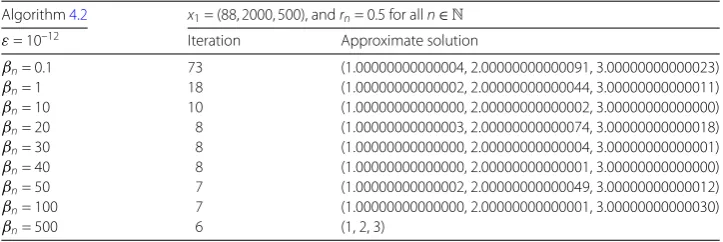
From Table1, we see that Algorithm4.2reaches the required errors only need six it-erations ifβn= 500 for alln∈N, but Algorithm4.2reaches the required errors need 73
iterations ifβn= 0.1 for alln∈N.
From Table2, we see that Algorithm4.2reaches the required errors only need seven iterations ifβn= 100 for alln∈N, but Algorithm4.2reaches the required errors need 72
iterations ifβn= 0.1 for alln∈N.
From Table3, we see that Algorithm3.1reaches the required errors only need seven iterations ifβn= 700 for alln∈N, but Algorithm3.1reaches the required errors need 99
iterations ifβn= 0.1 for alln∈N.
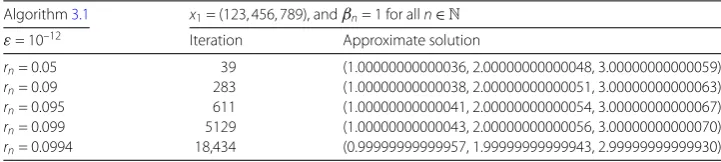
From Table3and Table4, we see that Algorithm3.1reaches the required errors need 283 iterations ifβn= 1 andrn= 0.05 for alln∈N, but Algorithm3.1reaches the required
errors need 39 iterations ifβn= 1 andrn= 0.09 for alln∈N. On the other hand, for other
settings ofβn, we know the numerical results in Table3and Table4show that there are
[image:14.595.117.479.611.732.2]no significant differences in the setting of{rn}n∈N.
Table 1 Numerical results for Example4.1.
Algorithm4.2 x1= (88, 2000, 500), andrn= 0.5 for alln∈N
ε= 10–12 Iteration Approximate solution
βn= 0.1 73 (1.00000000000004, 2.00000000000091, 3.00000000000023)
βn= 1 18 (1.00000000000002, 2.00000000000044, 3.00000000000011)
βn= 10 10 (1.00000000000000, 2.00000000000002, 3.00000000000000)
βn= 20 8 (1.00000000000003, 2.00000000000074, 3.00000000000018)
βn= 30 8 (1.00000000000000, 2.00000000000004, 3.00000000000001)
βn= 40 8 (1.00000000000000, 2.00000000000001, 3.00000000000000)
βn= 50 7 (1.00000000000002, 2.00000000000049, 3.00000000000012)
βn= 100 7 (1.00000000000000, 2.00000000000001, 3.00000000000030)
Table 2 Numerical results for Example4.1.
Algorithm4.2 x1= (123, 456, 789), andrn= 0.5 for alln∈N
ε= 10–12 Iteration Approximate solution
βn= 0.1 72 (1.00000000000009, 2.00000000000034, 3.00000000000059)
βn= 1 18 (1.00000000000003, 2.00000000000010, 3.00000000000017)
βn= 10 9 (1.00000000000007, 2.00000000000027, 3.00000000000047)
βn= 20 8 (1.00000000000005, 2.00000000000017, 3.00000000000029)
βn= 30 8 (1.00000000000000, 2.00000000000001, 3.00000000000002)
βn= 40 7 (1.00000000000011, 2.00000000000042, 3.00000000000073)
βn= 50 7 (1.00000000000003, 2.00000000000011, 3.00000000000019)
[image:15.595.117.479.254.374.2]βn= 100 7 (1, 2, 3)
Table 3 Numerical results for Example4.2.
Algorithm3.1 x1= (123, 456, 789), andrn= 0.05 for alln∈N
ε= 10–12 Iteration Approximate solution
βn= 0.1 99 (0.99999999999927, 1.99999999999990, 3.00000000000052)
βn= 1 39 (1.00000000000036, 2.00000000000048, 3.00000000000059)
βn= 10 15 (1.00000000000018, 2.00000000000024, 3.00000000000030)
βn= 20 12 (0.99999999999973, 1.99999999999964, 2.99999999999955)
βn= 30 11 (1.00000000000013, 2.00000000000017, 3.00000000000021)
βn= 40 10 (0.99999999999963, 1.99999999999952, 2.99999999999940)
βn= 50 10 (0.99999999999995, 1.99999999999993, 2.99999999999992)
βn= 100 9 (1.00000000000001, 2.00000000000002, 3.00000000000002)
βn= 700 7 (1, 2, 3)
Table 4 Numerical results for Example4.2.
Algorithm3.1 x1= (123, 456, 789), andrn= 0.09 for alln∈N
ε= 10–12 Iteration Approximate solution
βn= 0.1 98 (0.99999999999931, 1.99999999999990, 3.00000000000050)
βn= 1 283 (1.00000000000038, 2.00000000000051, 3.00000000000063)
βn= 10 21 (1.00000000000008, 2.00000000000010, 3.00000000000013)
βn= 20 15 (1.00000000000042, 2.00000000000056, 3.00000000000069)
βn= 30 14 (0.99999999999997, 1.99999999999996, 2.99999999999995)
βn= 40 12 (0.99999999999959, 1.99999999999946, 2.99999999999933)
βn= 50 12 (0.99999999999996, 1.99999999999995, 2.99999999999994)
βn= 100 10 (0.99999999999994, 1.99999999999992, 2.99999999999990)
βn= 1300 7 (1, 2, 3)
Table 5 Numerical results for Example4.2.
Algorithm3.1 x1= (123, 456, 789), andβn= 1 for alln∈N
ε= 10–12 Iteration Approximate solution
rn= 0.05 39 (1.00000000000036, 2.00000000000048, 3.00000000000059)
rn= 0.09 283 (1.00000000000038, 2.00000000000051, 3.00000000000063)
rn= 0.095 611 (1.00000000000041, 2.00000000000054, 3.00000000000067)
rn= 0.099 5129 (1.00000000000043, 2.00000000000056, 3.00000000000070)
rn= 0.0994 18,434 (0.99999999999957, 1.99999999999943, 2.99999999999930)
However, in Table5, ifβn= 1 for alln∈N, then we know the numerical results have big
[image:15.595.117.479.421.541.2] [image:15.595.116.477.589.670.2]Acknowledgements
The authors would like to thank referee(s) for many useful comments and suggestions for the improvement of the article. Prof. Chi-Ming Chen was supported by Grant No. MOST 107-2115-M-007-008 of the Ministry of Science and Technology of the Republic of China.
Funding Not applicable.
Competing interests
The authors declare that they have no competing interests.
Authors’ contributions
The authors contributed equally and significantly in writing this paper. The authors read and approved the final manuscript.
Author details
1Department of Applied Mathematics, National Chiayi University, Chiayi, Taiwan.2Institute of Computational and
Modeling Science, National Tsing Hua University, Hsinchu, Taiwan.
Publisher’s Note
Springer Nature remains neutral with regard to jurisdictional claims in published maps and institutional affiliations.
Received: 4 October 2018 Accepted: 29 April 2019 References
1. Bauschke, H.H., Combettes, P.L.: Convex Analysis and Monotone Operator Theory in Hilbert Spaces. Springer, Berlin (2011)
2. Butnariu, D., Iusem, A.N.: Totally Convex Functions for Fixed Points Computation and Infinite Dimensional Optimization. Kluwer Academic, Norwell (2000)
3. Byrne, C., Censor, Y., Gibali, A., Reich, S.: Weak and strong convergence of algorithms for the split common null point problem. J. Nonlinear Convex Anal.13, 759–775 (2011)
4. Chuang, C.S.: Strong convergence theorems for the split variational inclusion problem in Hilbert spaces. Fixed Point Theory Appl.2013, 350 (2013)
5. Combettes, P.L., Wajs, V.R.: Signal recovery by proximal forward-backward splitting. Multiscale Model. Simul.4, 1168–1200 (2005)
6. Fujikara, Y., Kuroiwa, D.: Lagrange duality in canonical DC programming. J. Math. Anal. Appl.408, 476–483 (2013) 7. Harada, R., Kuroiwa, D.: Lagrange-type in DC programming. J. Math. Anal. Appl.418, 415–424 (2014)
8. Hiriart-Urruty, J.B., Tuy, H.: Essays on Nonconvex Optimization. Mathematical Programming, vol. 41. North-Holland, Amsterdam (1988)
9. Levy, A.J.: A fast quadratic programming algorithm for positive signal restoration. IEEE Trans. Acoust. Speech Signal Process.31, 1337–1341 (1983)
10. Marino, G., Xu, H.K.: Convergence of generalized proximal point algorithm. Commun. Pure Appl. Anal.3, 791–808 (2004)
11. Martinet, B.: Régularisation d’inéquations variationnelles par approximations successives. Rev. Fr. Inform. Rech. Opér. 4(Ser R–3), 154–158 (1970)
12. Moudafi, A.: Split monotone variational inclusions. J. Optim. Theory Appl.150, 275–283 (2011)
13. Pham, D.T., An, L.T.H., Akoa, F.: The DC (difference of convex functions) programming and DCA revisited with DC models of real world nonconvex optimization problems. Ann. Oper. Res.133, 23–46 (2005)
14. Saeki, Y., Kuroiwa, D.: Optimality conditions for DC programming problems with reverse convex constraints. Nonlinear Anal.80, 18–27 (2013)
15. Souza, J.C.O., Oliveira, R.P., Soubeyran, A.: Global convergence of a proximal linearized algorithm for difference of convex functions. Optim. Lett.10, 1529–1539 (2016)
16. Sun, W., Sampaio, R.J.B., Candido, M.A.B.: Proximal point algorithm for minimization of DC functions. J. Comput. Math. 21, 451–462 (2003)