Open Access
Research article
A one-year exercise intervention program in pre-pubertal girls does
not influence hip structure
Gayani Alwis
1,2, Christian Linden
1,2, Susanna Stenevi-Lundgren
1,2,
Henrik G Ahlborg
1,2, Jack Besjakov
1,2, Per Gardsell
1,2and
Magnus K Karlsson*
1,2Address: 1Clinical and Molecular Osteoporosis Research Unit, Department of Clinical Sciences, Lund University, Sweden and 2Department of
Orthopedics, Malmö University Hospital, SE-205 02 Malmö, Sweden
Email: Gayani Alwis - [email protected]; Christian Linden - [email protected]; Susanna
Stenevi-Lundgren - [email protected]; Henrik G Ahlborg - [email protected]; Jack Besjakov - [email protected]; Per Gardsell - [email protected]; Magnus K Karlsson* - [email protected]
* Corresponding author
Abstract
Background: We have previously reported that a one-year school-based exercise intervention program influences the accrual of bone mineral in pre-pubertal girls. This report aims to evaluate if also hip structure is affected, as geometry independent of bone mineral influences fracture risk.
Methods: Fifty-three girls aged 7 – 9 years were included in a curriculum-based exercise intervention program comprising 40 minutes of general physical activity per school day (200 minutes/week). Fifty healthy age-matched girls who participated in the general Swedish physical education curriculum (60 minutes/week) served as controls. The hip was scanned by dual X-ray absorptiometry (DXA) and the hip structural analysis (HSA) software was applied to evaluate bone mineral content (BMC), areal bone mineral density (aBMD), periosteal and endosteal diameter, cortical thickness, sectional moment of inertia (CSMI), section modulus (Z) and cross-sectional area (CSA) of the femoral neck (FN). Annual changes were compared. Group comparisons were done by independent student's t-test between means and analyses of covariance (ANCOVA). Pearson's correlation test was used to evaluate associations between activity level and annual changes in FN. All children remained at Tanner stage 1 throughout the study.
Results: No between-group differences were found during the 12 months study period for changes in the FN variables. The total duration of exercise during the year was not correlated with the changes in the FN traits.
Conclusion: Evaluated by the DXA technique and the HSA software, a general one-year school-based exercise program for 7–9-year-old pre-pubertal girls seems not to influence the structure of the hip.
Published: 24 January 2008
BMC Musculoskeletal Disorders 2008, 9:9 doi:10.1186/1471-2474-9-9
Received: 29 August 2007 Accepted: 24 January 2008
This article is available from: http://www.biomedcentral.com/1471-2474/9/9
© 2008 Alwis et al; licensee BioMed Central Ltd.
Background
Physical activity during growth is associated with benefits in bone mineral accrual and possibly bone structure [1-4], a clinically relevant notion, as both traits independently improve bone strength [5]. But, most prospective control-led exercise intervention trials have predominantly focused on the accrual of bone mineral [6-9], a study design that could underestimate the skeletal effects of exercise, as the effect on bone structure is then neglected. That is, also the three-dimensional structure ought to be assessed when evaluating bone strength [10,11]. As a result, the Hip Structural Analysis (HSA) was developed, a software that based on a dual energy X ray absorbtiometry (DXA) hip scan evaluate the geometrical structure of the femoral neck (FN) [12,13]. Exercise studies that have assessed the method have come to contradictory conclu-sions, some supporting [14,15], other opposing [16,17] that training influence the hip structure. The different inferences could be based on the fact that different inten-sities and types of training program may affect the skele-ton differently. As a result, the current study was designed to evaluate if a moderate intense school curriculum based exercise intervention program, possible for all children to participate within, in a population based cohort of pre-pubertal girls could influence the geometrical structure of FN. It must also be emphasized that the study did not aim to estimate the osteogenic effect of specific activities or separately evaluate more or less active children. Instead we wanted to estimate if physical activity could be used as a population based prevention strategy to influence the structure of the FN.
Methods
The Malmö Pediatric Osteoporosis Prevention (POP) study was conducted as a prospective controlled investiga-tion of the impact of an exercise interveninvestiga-tion on skeletal development in children from school start and onwards. The baseline measurements in the school, that was allo-cated as intervention school, were made before the inter-vention was initiated and the follow-up measurements one year later. Three neighboring control schools, allo-cated within the same city suburb, were evaluated in the same way, but the follow-up measurements of the control group were done in the same months but two years later. Due to lack of resources in our research laboratory, con-trols were re-measured first after two years. However, we accepted a two-year follow-up for the controls, because data in the literature imply that skeletal growth and accrual of bone mineral is linear in Tanner stage 1 and before the age of ten [3,18-26]. The design of the investi-gation has previously been evaluated and regarded as accurate when following growth and bone mineral accrual in this age group [8].
The four schools that were contacted agreed to participate. All four were located in the same part of the city in areas that were socio-economically similar; they were govern-ment funded; and allocation of pupils to the schools was done according to residential address. Before the interven-tion, they all used the Swedish standard curriculum for physical education (PE) to the same extent. After the four schools accepted participation, one of them was asked to be the intervention school and agreed to that. The inter-vention school modified its curriculum by increasing the number of PE classes; in other words, we did not choose a school that already had a high level of physical activity (PA) for its pupils. The other three schools were included as a control cohort. Furthermore, in order to ascertain whether there was any selection bias at baseline, we com-pared the girls who took part in the study with those who refused to participate. This was done by considering data on height, weight, and body mass index (BMI) obtained from the initial standard compulsory school health evalu-ation of first grade pupils. The drop-out analyses revealed that, based on data from the school records, there were no significant differences at baseline in height, weight, or BMI between girls who participated in the study and those who refused to take part [8,9].
In the intervention school, all 61 girls in grades 1 and 2 were invited to attend, and 55 agreed to participate (attendance rate 90%). We excluded one girl at baseline, because she was 11 months younger than the second-youngest girl. At follow up, one girl declined further par-ticipation. Therefore, a total of 53 girls with a mean age of 7.7 ± 0.6 (mean ± SD), (range 6.5–8.7), years at baseline were included in the intervention group. Sixty-four volun-teers participated at baseline as controls. At follow-up, 13 had moved out of the region or declined further participa-tion, and we excluded one girl because she was being treated with growth hormone. Thus a total of 50 girls with a mean age of 7.9 ± 0.6 (range 6.8–8.9) at baseline were included in the control group. All participants were healthy Caucasians who had no diseases and were not tak-ing medications known to influence bone metabolism.
reported to be fairly high during and after exercise inter-vention programs [27]. The control schools continued with the same type of activities as previously used, but the duration was kept within the limits stipulated by the com-pulsory PE curriculum, consisting of one to two sessions of PE per week, in total 60 minutes per week.
During the dual X-ray absorptiometry (DXA, DPX-L ver-sion 1.3z, Lunar®, Madison, WI) measurements the
chil-dren were dressed in light clothes and no shoes. Paediatric software was used in all scans with children below 35 kg in weight. That is, the software was changed in some chil-dren between the different measurements. All standard image files of the proximal femur were analyzed by one technician, by use of the hip strength analysis (HSA) soft-ware. The software is provided by Lunar Instruments Cor-poration (Madison, WI). Using this software the X-ray absorption data of the proximal femur is extracted from the output image data file and the bone mineral content (BMC, g) and areal bone mineral density (aBMD, g/cm2)
and its distribution within the FN calculated. First the operator has to manually define the center of the femoral head and place the FN axis as accurately as possible along the FN. Thereafter, the region of interest in the FN is placed in the proximal part of the FN, and finally the fem-oral shaft axis is defined centrally along the shaft. The soft-ware will then iteratively assess all cross sections in the FN region of interest and identify the plane with the least cross-sectional moment of inertia (CSMI, cm4). CSMI is
an estimate of the ability of the FN to withstand bending forces, and that value was calculated using the mass distri-bution derived from the absorption curve [28]. The CSMI estimated by DXA has been found to be highly correlated with the CSMI measured directly on adult cadaver speci-mens (r2 = 0.96) [28]. Automatic identification of the
weakest cross section of the FN is fundamental feature of the HSA software, and this cross-sectional level is then used for subsequent calculation of section modulus (Z, cm3) and cross-sectional area (CSA, cm2). The section
modulus is also an estimate of the ability of the FN to withstand bending forces, and it was computed as CSMI divided by half the width of the FN. CSA is a measure of the resistance of the bone to axial forces, and it represents the area of mineral packed together in the defined cross section of the FN and is essentially proportional to the bone mineral content (BMC). In addition, endosteal diameter was estimated using the algorithm described by Thomas J. Beck [29]. Mean cortical thickness was calcu-lated as the difference between periosteal and endosteal diameter divided by two. The FN vBMD was computed using the formula vBMD = BMC/estimated FN volume (π × r2 × FN length), where r = FN mid-diameter/2, assuming
the FN to be cylindrical [30,31].
The coefficient of variation (CV) was evaluated by dupli-cate measurements in 13 healthy children ages seven to fifteen (mean 10) years was found to be 1.4% for BMC, 1.6% for aBMD, 3.7% for total body fat mass, and 1.5% for total body lean mass. The CV values for the HSA anal-yses were 1.5% for FN periosteal diameter, 2.2% for FN CSA, and 6.2% for FN CSMI. The machine was calibrated daily with the Lunar® phantom. The technicians in our
research group performed all the measurements, and one technician conducted all software analyses. Total lean mass and total fat mass were estimated from the DXA total body scan. Body weight was measured to the nearest 0.1 kg using an electric scale, and height was determined to the nearest 0.5 cm using a wall-mounted measuring rod.
A questionnaire previously used in several studies but modified for pre-pubertal children [32,33] was employed to evaluate lifestyle factors, including the level of physical activity. The total time spent in such activity was calcu-lated as time per week in organized sports within the school curriculum and in organized sports activities out-side the school. The maturity of the children was assessed by Tanner staging [34], conducted by our research nurses.
Informed written consent was obtained from parents or guardians of participants prior to the study start. The study was approved by the Ethics Committee of Lund University (LU 453-98; 1998-09-15), Sweden, and conducted according to the Helsinki Declaration of 2000. The Swed-ish Data Inspection Board approved both the data collec-tion and database.
Research has shown the technical problems when scan-ning small children based on inconsistency in limb posi-tioning and location of the region of interest [35], we advocated the method introduced by Beck et al. when evaluating FN width [12]. This method excludes biologi-cally unlikely values, 3 standard deviations (SD) above or below the mean. This resulted in exclusion of eight proxi-mal femoral scans in the intervention group and six in the control group. In addition, missing scans or scans with obvious technical errors were found in three hip scans in the intervention group and one in the control group. Data are presented as means ± SD. The annual changes were calculated using the data on the evaluated traits. Student's
(Stat-Win®). A p-value < 0.05 was defined as a statistically
significant difference. With known annual growth in the evaluated parameters in Swedish children aged 7 years and with a significance level of p < 0.05 this study was powered to detect an annual difference in gain in BMC of 0.102 g/yrs, BMD of 0.019 g/cm2/yrs, vBMD of 0.011 g/
cm3/yrs, neck length of 0.6 mm/yrs, periosteal width of
0.5 mm/yrs, CSA of 0.05 cm2/yrs, Z of 0.19 cm3/yrs, CSMI
of 0.029 cm4/yrs, endosteal width of 0.5 mm/yrs and
cor-tical thickness of 0.3 mm/yrs.
Results
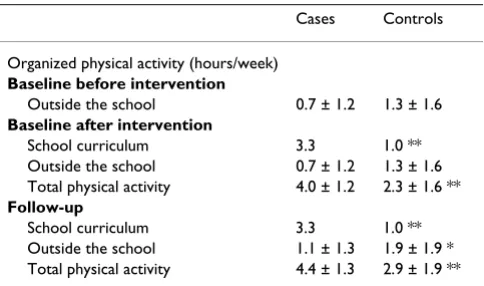
As previously reported, the intervention group and the control group did not at baseline differ with regard to reg-istered lifestyle factors or anthropometric parameters [8]. After onset of the exercise program, the intervention group spent comparatively more time in physical activity in total both at baseline and at follow-up (Table 1). All the participants in the two groups remained at Tanner stage 1 during the study period.
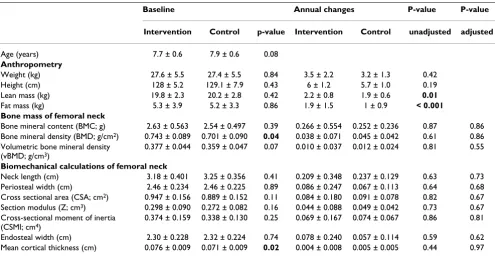
The mean values for the FN at baseline were 6.0% higher for aBMD (p = 0.04) and 7.0% higher for cortical thick-ness (p = 0.02) in the intervention group as compared to the control group (Table 2). In contrast, there were no sig-nificant differences between the two groups with regard to the annual changes in the skeletal traits of the FN. The results remained after adjustment for age at baseline and changes in weight and height (Table 2) as well as after adjustment for age at baseline and changes in fat and lean mass (data not shown). The mean annual increase in FN BMC was 13.1% in the intervention group compared to 10.8% in the control group (p = 0.53), and the corre-sponding values for periosteal diameter were 3.9% vs. 2.9% (p = 0.54) and for endosteal diameter 3.9% vs. 2.7% (p = 0.49).
The weekly duration of physical activity during the study period did not correlate with the changes in the FN traits.
Discussion
We did not find that the exercise program conferred any bone mineral or structural benefits on FN. Nor the weekly duration of training correlated with the gain in FN bone mass or structural parameters. This report is noteworthy, because it refutes the assumption of some researchers that the structural benefits of exercise will be missed if evalua-tions are limited to bone mineral accrual [10]. The previ-ous reports of exercise induced benefits at the lumbar spine in this cohort [8,9,17] but not in the FN, is not sur-prising as weight-loaded skeletal regions with trabecular bone are more responsive to mechanical load than corti-cal regions [6,8,9,36].
The FN structural data in this report opposes some publi-cations in growing children [14,37] but totally or partly supports others [15-17]. The discrepancies in the conclu-sions when comparing the trials could be due to differ-ences in the design in the trials. The maturational level of the girls was different in the trials, and it is known that exercise induced skeletal benefits are most obvious in pre-menarcheal children [11,15,38,39]. The intensities and the proportions of the activities in the exercise programs were different, and it is known that high magnitude repet-itive interventions confer more benefits than repeated endurance training [14,15,39,40]. The follow-up periods varied a fact that also could influence the outcome, as structural benefits may need a longer training period before reaching significance. That is, the study can't exclude that a different exercise program, for example a more intense training program or a program spanning a longer period, possibly could lead to benefits also in FN. As examples, tennis training has been reported to be asso-ciated with geometrical benefits [1,10] and soccer training for three years has in pre-pubertal boys been associated with obvious bone mass benefits also in FN [41].
[image:4.612.55.297.569.712.2]The structural estimate of the FN by HSA may also differ from the three dimensional techniques, computed tom-ography (CT) and magnetic resonance imaging (MRI) [10,42], as the HSA is based on a two dimensional scan-ning technique [12]. In addition, no cited studies have objectively measured the level of physical activity, only relied on subjective estimate of training by question-naires, and it is not certain that duration of exercise is the best method to quantify the level of physical activity. The higher spare time activities in the control group could also mask eventual beneficial osteogenic effects in the inter-vention group. Furthermore, it would have been benefi-cial if we could define the different type of spare time activities, not only the duration of the organized training activities. The population-based design of this trial is a
Table 1: The duration of physical activity at baseline and at follow-up
Cases Controls
Organized physical activity (hours/week) Baseline before intervention
Outside the school 0.7 ± 1.2 1.3 ± 1.6 Baseline after intervention
School curriculum 3.3 1.0 **
Outside the school 0.7 ± 1.2 1.3 ± 1.6 Total physical activity 4.0 ± 1.2 2.3 ± 1.6 ** Follow-up
School curriculum 3.3 1.0 **
Outside the school 1.1 ± 1.3 1.9 ± 1.9 * Total physical activity 4.4 ± 1.3 2.9 ± 1.9 **
strength, while the inability to perform individual rand-omization must be regarded as a weakness, as discussed in our previous reports [8,9]
The technical limitations of the HSA technique must also be highlighted. Inconsistent positioning of the limb or placement of the region of interest results in errors [12,13]. A small width error results in large errors in CSMI, as CSMI is proportional to the fourth power of the radius [5,43]. This is the reason why we excluded outliers as done in previous reports [12]. The cortical thickness and endosteal diameter are estimated after making assumptions of a homogenous porosity in the cortical shell, a homogenous cross-sectional shape and a fixed dis-tribution of trabecular and cortical bone within the FN, assumptions not been tested in children. The estimation of the periosteal dimension are also derived from a two-dimensional image, but the skeleton can expand in other directions [10,44], may be not captured by the HSA. The quality of the resolution by the HSA analyses may also lead to small group differences being missed. In spite of these limitations in mind, HSA should be regarded as one method to focus the interest on not only on the amount of bone mineral but also FN structure, before three
dimensional measuring techniques become general avail-able in research.
It is also well known that differences in fat in the marrow or the soft tissue above, below or around the bones may affect the DXA bone variables [45]. However, our results and inferences remained after adjusting for age at baseline and changes in fat and lean mass.
Conclusion
A one-year moderately intense school based exercise inter-vention program in pre-pubertal girls seems not to influ-ence the by the DXA technique and HSA software estimated FN structure. Further studies are required to determine if an exercise program exceeding one year, a program with a higher intensity of training and a program in early peri-pubertal girls could be beneficial for the FN structure.
Competing interests
[image:5.612.58.553.99.357.2]The author(s) declare that they have no competing inter-ests.
Table 2: Baseline data and annual changes in anthropometry and femoral neck bone parameters.
Baseline Annual changes P-value P-value
Intervention Control p-value Intervention Control unadjusted adjusted
Age (years) 7.7 ± 0.6 7.9 ± 0.6 0.08
Anthropometry
Weight (kg) 27.6 ± 5.5 27.4 ± 5.5 0.84 3.5 ± 2.2 3.2 ± 1.3 0.42
Height (cm) 128 ± 5.2 129.1 ± 7.9 0.43 6 ± 1.2 5.7 ± 1.0 0.19
Lean mass (kg) 19.8 ± 2.3 20.2 ± 2.8 0.42 2.2 ± 0.8 1.9 ± 0.6 0.01
Fat mass (kg) 5.3 ± 3.9 5.2 ± 3.3 0.86 1.9 ± 1.5 1 ± 0.9 < 0.001
Bone mass of femoral neck
Bone mineral content (BMC; g) 2.63 ± 0.563 2.54 ± 0.497 0.39 0.266 ± 0.554 0.252 ± 0.236 0.87 0.86 Bone mineral density (BMD; g/cm2) 0.743 ± 0.089 0.701 ± 0.090 0.04 0.038 ± 0.071 0.045 ± 0.042 0.61 0.86 Volumetric bone mineral density
(vBMD; g/cm3)
0.377 ± 0.044 0.359 ± 0.047 0.07 0.010 ± 0.037 0.012 ± 0.024 0.81 0.55
Biomechanical calculations of femoral neck
Neck length (cm) 3.18 ± 0.401 3.25 ± 0.356 0.41 0.209 ± 0.348 0.237 ± 0.129 0.63 0.73 Periosteal width (cm) 2.46 ± 0.234 2.46 ± 0.225 0.89 0.086 ± 0.247 0.067 ± 0.113 0.64 0.68 Cross sectional area (CSA; cm2) 0.947 ± 0.156 0.889 ± 0.152 0.11 0.084 ± 0.180 0.091 ± 0.078 0.82 0.67 Section modulus (Z; cm3) 0.298 ± 0.090 0.272 ± 0.082 0.16 0.044 ± 0.088 0.049 ± 0.042 0.73 0.67 Cross-sectional moment of inertia
(CSMI; cm4)
0.374 ± 0.159 0.338 ± 0.130 0.25 0.069 ± 0.167 0.074 ± 0.067 0.86 0.81
Endosteal width (cm) 2.30 ± 0.228 2.32 ± 0.224 0.74 0.078 ± 0.240 0.057 ± 0.114 0.59 0.62 Mean cortical thickness (cm) 0.076 ± 0.009 0.071 ± 0.009 0.02 0.004 ± 0.008 0.005 ± 0.005 0.44 0.97
Bone mass and biomechanical calculations of femoral neck in the intervention group (n = 53) and control group (n = 50). After exclusion of outliers, technical errors, and missing scans, anthropometrics were evaluated in 53 cases and 50 controls and femoral neck variables in 42 cases and 43 controls.
Authors' contributions
Study design: MK and PG; Data collection: CL, JB and SSL; Statistical analyses and hip strength analyses and writing of the paper: GA, HA and MK. All authors read and approved the final manuscript
Acknowledgements
Financial support for this study was provided by the Swedish Research Council (K2004-73X-14080-04A), the Center for Athletic Research (137/ 06), the Osterlund Foundation, the Kock Foundation, and the Region Skane Foundation.
References
1. Kannus P, Haapasalo H, Sankelo M, Sievanen H, Pasanen M, Heinonen A, Oja P, Vuori I: Effect of starting age of physical activity on bone mass in the dominant arm of tennis and squash players.
Ann Intern Med 1995, 123(1):27-31.
2. Bass S, Pearce G, Bradney M, Hendrich E, Delmas PD, Harding A, See-man E: Exercise before puberty may confer residual benefits in bone density in adulthood: studies in active prepubertal and retired female gymnasts. J Bone Miner Res 1998,
13(3):500-507.
3. Bailey DA, McKay HA, Mirwald RL, Crocker PR, Faulkner RA: A six-year longitudinal study of the relationship of physical activity to bone mineral accrual in growing children: the university of Saskatchewan bone mineral accrual study. J Bone Miner Res
1999, 14(10):1672-1679.
4. Forwood MR, Baxter-Jones AD, Beck TJ, Mirwald RL, Howard A, Bai-ley DA: Physical activity and strength of the femoral neck dur-ing the adolescent growth spurt: a longitudinal analysis. Bone
2006, 38(4):576-583.
5. Ahlborg HG, Johnell O, Turner CH, Rannevik G, Karlsson MK: Bone loss and bone size after menopause. N Engl J Med 2003,
349(4):327-334.
6. McKay HA, Petit MA, Schutz RW, Prior JC, Barr SI, Khan KM: Aug-mented trochanteric bone mineral density after modified physical education classes: a randomized school-based exer-cise intervention study in prepubescent and early pubescent children. J Pediatr 2000, 136(2):156-162.
7. MacKelvie KJ, Khan KM, Petit MA, Janssen PA, McKay HA: A school-based exercise intervention elicits substantial bone health benefits: a 2-year randomized controlled trial in girls. Pediat-rics 2003, 112(6 Pt 1):e447.
8. Valdimarsson O, Linden C, Johnell O, Gardsell P, Karlsson MK: Daily physical education in the school curriculum in prepubertal girls during 1 year is followed by an increase in bone mineral accrual and bone width--data from the prospective control-led Malmo pediatric osteoporosis prevention study. Calcif Tis-sue Int 2006, 78(2):65-71.
9. Linden C, Ahlborg HG, Besjakov J, Gardsell P, Karlsson MK: A school curriculum-based exercise program increases bone mineral accrual and bone size in prepubertal girls: two-year data from the pediatric osteoporosis prevention (POP) study. J Bone Miner Res 2006, 21(6):829-835.
10. Bass SL, Saxon L, Daly RM, Turner CH, Robling AG, Seeman E, Stuckey S: The effect of mechanical loading on the size and shape of bone in pre-, peri-, and postpubertal girls: a study in tennis players. J Bone Miner Res 2002, 17(12):2274-2280. 11. Heinonen A, Sievanen H, Kannus P, Oja P, Pasanen M, Vuori I:
High-impact exercise and bones of growing girls: a 9-month con-trolled trial. Osteoporos Int 2000, 11(12):1010-1017.
12. Beck TJ, Oreskovic TL, Stone KL, Ruff CB, Ensrud K, Nevitt MC, Genant HK, Cummings SR: Structural adaptation to changing skeletal load in the progression toward hip fragility: the study of osteoporotic fractures. J Bone Miner Res 2001,
16(6):1108-1119.
13. Khoo BC, Beck TJ, Qiao QH, Parakh P, Semanick L, Prince RL, Singer KP, Price RI: In vivo short-term precision of hip structure anal-ysis variables in comparison with bone mineral density using paired dual-energy X-ray absorptiometry scans from multi-center clinical trials. Bone 2005, 37(1):112-121.
14. MacKelvie KJ, Petit MA, Khan KM, Beck TJ, McKay HA: Bone mass and structure are enhanced following a 2-year randomized controlled trial of exercise in prepubertal boys. Bone 2004,
34(4):755-764.
15. Petit MA, McKay HA, MacKelvie KJ, Heinonen A, Khan KM, Beck TJ:
A randomized school-based jumping intervention confers site and maturity-specific benefits on bone structural prop-erties in girls: a hip structural analysis study. J Bone Miner Res
2002, 17(3):363-372.
16. McKay HA, MacLean L, Petit M, MacKelvie-O'Brien K, Janssen P, Beck T, Khan KM: "Bounce at the Bell": a novel program of short bouts of exercise improves proximal femur bone mass in early pubertal children. Br J Sports Med 2005, 39(8):521-526. 17. Linden C, Alwis G, Ahlborg H, Gardsell P, Valdimarsson O,
Stenevi-Lundgren S, Besjakov J, Karlsson MK: Exercise, bone mass and bone size in prepubertal boys: one-year data from the pedi-atric osteoporosis prevention study. Scand J Med Sci Sports 2007,
17(4):340-347.
18. Glastre C, Braillon P, David L, Cochat P, Meunier PJ, Delmas PD:
Measurement of bone mineral content of the lumbar spine by dual energy x-ray absorptiometry in normal children: cor-relations with growth parameters. J Clin Endocrinol Metab 1990,
70(5):1330-1333.
19. Bonjour JP, Theintz G, Buchs B, Slosman D, Rizzoli R: Critical years and stages of puberty for spinal and femoral bone mass accu-mulation during adolescence. J Clin Endocrinol Metab 1991,
73(3):555-563.
20. Kroger H, Kotaniemi A, Vainio P, Alhava E: Bone densitometry of the spine and femur in children by dual-energy x-ray absorp-tiometry. Bone Miner 1992, 17(1):75-85.
21. Kroger H, Kotaniemi A, Kroger L, Alhava E: Development of bone mass and bone density of the spine and femoral neck--a pro-spective study of 65 children and adolescents. Bone Miner
1993, 23(3):171-182.
22. Faulkner RA, Bailey DA, Drinkwater DT, Wilkinson AA, Houston CS, McKay HA: Regional and total body bone mineral content, bone mineral density, and total body tissue composition in children 8-16 years of age. Calcif Tissue Int 1993, 53(1):7-12. 23. Fournier PE, Rizzoli R, Slosman DO, Theintz G, Bonjour JP:
Asyn-chrony between the rates of standing height gain and bone mass accumulation during puberty. Osteoporos Int 1997,
7(6):525-532.
24. Bass S, Delmas PD, Pearce G, Hendrich E, Tabensky A, Seeman E:
The differing tempo of growth in bone size, mass, and den-sity in girls is region-specific [see comments]. J Clin Invest 1999,
104(6):795-804.
25. Liu YX, Wikland KA, Karlberg J: New reference for the age at childhood onset of growth and secular trend in the timing of puberty in Swedish. Acta Paediatr 2000, 89(6):637-643. 26. MacKelvie KJ, Khan KM, McKay HA: Is there a critical period for
bone response to weight-bearing exercise in children and adolescents? a systematic review. Br J Sports Med 2002,
36(4):250-7; discussion 257.
27. Bass S, Saxon L, Iuliano-Burns S, Naughton G, Daly R, Nowson C, Briganti E, Austen S: Limitations of long term exercise inter-ventions aimed at improving bone health in normally active boys. J Bone Miner Res 2003, 18(2 SupplM 151 [http:// www.asbmr.org/meeting/abstracts.cfm#abstracts].
28. Yoshikawa T, Turner CH, Peacock M, Slemenda CW, Weaver CM, Teegarden D, Markwardt P, Burr DB: Geometric structure of the femoral neck measured using dual-energy x-ray absorptiom-etry. J Bone Miner Res 1994, 9(7):1053-1064.
29. Beck TJ, Looker AC, Ruff CB, Sievanen H, Wahner HW: Structural trends in the aging femoral neck and proximal shaft: analysis of the Third National Health and Nutrition Examination Survey dual-energy X-ray absorptiometry data. J Bone Miner Res 2000, 15(12):2297-2304.
30. Cowell CT, Lu PW, Lloyd-Jones SA, Briody JN, Allen JR, Humphries IR, Reed E, Knight J, Howman-Giles R, Gaskin K: Volumetric bone mineral density--a potential role in paediatrics. Acta Paediatr Suppl 1995, 411:12-6, discussion 17.
31. Lu PW, Cowell CT, SA LLJ, Briody JN, Howman-Giles R: Volumet-ric bone mineral density in normal subjects, aged 5-27 years.
J Clin Endocrinol Metab 1996, 81(4):1586-1590.
popula-Publish with BioMed Central and every scientist can read your work free of charge
"BioMed Central will be the most significant development for disseminating the results of biomedical researc h in our lifetime."
Sir Paul Nurse, Cancer Research UK
Your research papers will be:
available free of charge to the entire biomedical community
peer reviewed and published immediately upon acceptance
cited in PubMed and archived on PubMed Central
yours — you keep the copyright
Submit your manuscript here:
http://www.biomedcentral.com/info/publishing_adv.asp
BioMedcentral
tion-based study of 332 subjects aged 15-42 years. Acta Orthop Scand 1997, 68(2):97-103.
33. Sundberg M, Gardsell P, Johnell O, Karlsson MK, Ornstein E, Sandst-edt B, Sernbo I: Physical activity increases bone size in prepu-bertal boys and bone mass in prepuprepu-bertal girls: a combined cross-sectional and 3-year longitudinal study. Calcif Tissue Int
2002, 71(5):406-415.
34. Duke PM, Litt IF, Gross RT: Adolescents' self-assessment of sex-ual maturation. Pediatrics 1980, 66(6):918-920.
35. Binkovitz LA, Henwood MJ: Pediatric DXA: technique and inter-pretation. Pediatr Radiol 2006, 1:21-31.
36. Mundy GR, Chen D, Oyajobi BO: Bone Remodiling. In Primer on the Metabolic Bone Diseases and Disorders of Mineral Metabolism Fifth edition. Edited by: Favus MJ. Washington, D.C , American Society for bone and Mineral Research; 2003:46-58.
37. Janz KF, Burns TL, Levy SM, Torner JC, Willing MC, Beck TJ, Gilmore JM, Marshall TA: Everyday activity predicts bone geometry in children: the iowa bone development study. Med Sci Sports Exerc 2004, 36(7):1124-1131.
38. Mackelvie KJ, McKay HA, Khan KM, Crocker PR: A school-based exercise intervention augments bone mineral accrual in early pubertal girls. J Pediatr 2001, 139(4):501-508.
39. Morris FL, Naughton GA, Gibbs JL, Carlson JS, Wark JD: Prospec-tive ten-month exercise intervention in premenarcheal girls: positive effects on bone and lean mass. J Bone Miner Res 1997,
12(9):1453-1462.
40. Fuchs RK, Bauer JJ, Snow CM: Jumping improves hip and lumbar spine bone mass in prepubescent children: a randomized controlled trial. J Bone Miner Res 2001, 16(1):148-156.
41. Vicente-Rodriguez G, Ara I, Perez-Gomez J, Serrano-Sanchez JA, Dorado C, Calbet JA: High femoral bone mineral density accre-tion in prepubertal soccer players. Med Sci Sports Exerc 2004,
36(10):1789-1795.
42. Kontulainen S, Sievanen H, Kannus P, Pasanen M, Vuori I: Effect of long-term impact-loading on mass, size, and estimated strength of humerus and radius of female racquet-sports players: a peripheral quantitative computed tomography study between young and old starters and controls. J Bone Miner Res 2003, 18(2):352-359.
43. Bradney M, Pearce G, Naughton G, Sullivan C, Bass S, Beck T, Carlson J, Seeman E: Moderate exercise during growth in prepubertal boys: changes in bone mass, size, volumetric density, and bone strength: a controlled prospective study [see com-ments]. J Bone Miner Res 1998, 13(12):1814-1821.
44. Heinonen A, McKay HA, Whittall KP, Forster BB, Khan KM: Muscle cross-sectional area is associated with specific site of bone in prepubertal girls: a quantitative magnetic resonance imag-ing study. Bone 2001, 29(4):388-392.
45. Vicente-Rodriguez G, Ara I, Perez-Gomez J, Dorado C, Calbet JA:
Muscular development and physical activity as major deter-minants of femoral bone mass acquisition during growth. Br J Sports Med 2005, 39(9):611-616.
Pre-publication history
The pre-publication history for this paper can be accessed here: