2019 International Conference on Information Technology, Electrical and Electronic Engineering (ITEEE 2019) ISBN: 978-1-60595-606-0
New Hidden Technology Based on Android
Ji-yue ZHI
1, Chuan-chang LIU
2,*and Zhi-yuan SU
21
State Key laboratory of Networking and Switching Technology, Beijing University of Posts and Telecommunications, Beijing, China
2
School of Automation, Beijing University of Posts and Telecommunications, Beijing, China
*Corresponding author
Keywords: Hidden, Linux kernel, Thin provisioning.
Abstract. Nowadays, smart phones have become an indispensable tool in people's lives, more and used to deal with personal data as well as business data. Under this trend, the privacy of user data becomes the focus of concern. In order to protect the privacy of users, many mobile phone manufacturers provided corresponding security protection measures on the devices they produced. But in some special cases, the security measures provided by mobile phone manufacturers will not work, for example, when a user is held hostage or a user uses a mobile phone to collect evidence in a dangerous situation, the holder will forcibly check the user's mobile phone. At this time, the original protection measures of the equipment will be invalid. We designed a new hidden technology based on Android, which realizes data hiding storage by customizing and extending the Android mobile phone system ROM, and after the data is generated, calls the corresponding encryption module to encrypt the generated photos, audio, video and other files.
Introduction
As technology advances, mobile devices are increasingly used to process personal data, so many sensitive personal and business data are stored on smartphones. Domestic and foreign scholars have also done some research on protecting mobile phone data security. In foreign countries, the Lineage OS team developed the Android native operating system source code based on Google, plus original or third-party program code, and open source code to make the system itself simple and efficient. In China, there are mainly various mobile phone manufacturers and several major mobile phone security research institutions for mobile phone security technology research[1]. The mobile phone manufacturer is mainly represented by Huawei. Huawei customizes the Android native system. In addition to retaining the security protection measures in the native system, it also adds some features to protect the user's private data.
However, in some special cases, it is not enough to rely on the mobile phone's own protection system. We need to use hidden technology to protect data security. Although the traditional file hiding technology realizes the concealment of the file system, it does not solve the problem of data pollution. In order to protect users' private data more effectively, we designed a new hidden technology based on Android to realize data hiding storage by customizing and extending Android mobile phone system ROM[2]. Improve the success rate of forensics and indirectly protect the safety of staff. After the data is generated, the normal application reads the path information of the key and the library file stored in the SIM card, and then calls the corresponding encryption module to encrypt the generated photo, audio, video and other files. After the encryption is completed, the ordinary application calls the storage module to store the encrypted data to the hidden partition. In this process, hidden triggering, dynamic loading, SIM card information hiding, data encryption, and storage into hidden partitions are realized, thereby realizing covert forensics[3].
Design
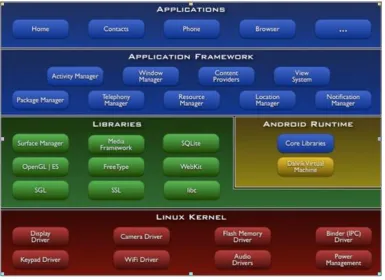
[image:2.595.97.483.163.443.2]Android system is an open source operating system based on Linux kernel development, mainly used in smart mobile terminals. Android system belongs to a software set, adopts the layered architecture, android is divided into four layers, from high level to low level are application, application framework, system runtime and linux kernel[4]. The architecture diagram is as show in Figure. 1.
Figure 1. Android architecture.
The bottom of Android is the user data layer, and the Android system stores all user data here. For security, Android will build a mapped device on the user data layer - encrypt logical volume, the data will be encrypted before being stored in the underlying layer. These two layers are full disk encryption and are inherent to the Android system. What we do is to use the device-mapper technology and thin-provisioning technology to virtualize the encrypted volume into a thin volume pool, and then use the pool resources to create two thin volumes, external and hidden. External volumes are used to store regular files, and hidden volumes are used to store secret files. When creating a thin volume, you can preset a size, and when you need to use resources, go to the thin volume pool. The botton structure of android is as show in Figure. 2.
Encrypt logical volume
Thin Pool
Outter Hidden
Userdata
Encrypt logical volume
[image:2.595.117.455.594.772.2]Create a Logical Block Device
Device Mapper is a generic device mapping mechanism that supports logical volume management in the Linux 2. 6 kernel. It provides a highly modular kernel architecture for implementing block device drivers for storage resource management.
In the kernel, it does the filtering or redirection of IO requests through a modular target driver plugin. In the figure, linear, mirror, snapshot, and multipath represent four target drivers. Device mapper User space related part is mainly responsible for configuring specific policy and control logic, such as mapping between logical devices and physical devices, how to establish these mapping relationships, etc. , and the specific filtering and redirection of IO requests is done by related code in the kernel. So the entire device mapper mechanism consists of two parts -- the device mapper driver for kernel space and the device mapper library for user space.
If we create a mapper device in the kernel, we need to do the following. First, create the corresponding mapped device structure using the dev_create function in the dm-ioctl. c file, based on the parameters passed from the ioctl interface provided by the kernel to the user space. This process is very simple, mainly to apply for the necessary memory resources to the kernel, including the mapped device and the memory pool pre-applied for IO operations. The blk_queue_make_request function provided by the kernel registers the request queue dm_request corresponding to the mapped device. The mapped device is registered to the kernel as a disk block device[5].
Second, call dm_hash_insert to insert the created mapped device into a global hash table in the device mapper that holds all the mapped devices currently created in the kernel. Then, the user space command calls the table_load function through ioctl, which constructs the mapping table of the specified mapped device and the mapped target device according to the parameters passed from the user space. The function first constructs the corresponding dm_table and dm_target structures, and then calls the dm_table_add_target function in dm-table. c to initialize these structures according to the parameters passed by the user, and calls the corresponding target type constructor ctr according to the target type specified by the parameter. The structure corresponding to the target device is constructed in the memory, and then the B tree maintained in the dm_table is updated according to the established dm_target structure. After the above process is completed, the established dm_table is added to the hash_cell structure corresponding to the global hash table of the mapped device.
Finally, the do_resume function is called by ioctl to establish the binding relationship between the mapped device and the mapping table. In fact, the process is to assign the current dm_table structure pointer value to the corresponding map field of the mapped_device through the dm_swap_table function, and then modify the mapped_device to indicate the current state of the domain.
Allocate Space on Demand
File system-based thin provisioning technology has seen an unprecedented explosion in its thin provisioning technology with block-level storage systems since it was first introduced in 2002. By 2004, most NAS vendors offered this technology to alleviate some of the problems associated with file system growth, and many data centers quickly felt the benefits of thin provisioning technology for NAS users.
Thin provisioning can be likened to an empty house with a lot of inflatable storage rooms. Each storage room needs to be filled with a certain amount of gas to get up. Each of them expands independently to the required level, depending on the growth needs. Each storage compartment has an upper limit of expansion, and these inflatable expansion storage compartments generally do not expand beyond the size of the house. By analogy, we consider the storage room inside the house as a file system, and the house is available for storage.
system based on hidden volumes by creating an external volume of the same size as the physical volume and a hidden volume of the appropriate size.
Linux supports Thin-Provisioning technology in the kernel since version 3. 2. The Android 5. 0 system uses Linux Kernel 3. 4. Thin-Provisioning technology is supported by default.
Design of the Encrypt Data
The encryption algorithm is the core of data encryption. It can be divided into symmetric encryption algorithm and asymmetric encryption algorithm according to whether the encryption and decryption keys are the same. Compared with the asymmetric encryption algorithm, the symmetric encryption encrypts the file faster, and is suitable for the embedded system as the encryption method. The commonly used symmetric encryption a lgorithms are DES, RC4, AES, etc. Considering the limitations of the intelligent terminal hardware, the AES128 encryption algorithm is selected. The encryption algorithm is specified by the Cipher. getInstance (“AES”) method of the Cipher class provided by Java itself, and the encryption key is specified by SecreKeySpec (keystring, “AES”).
For different data, we adopt different encryption methods, . Since the photo files generated by the mobile phone photographing are relatively small, we can use the full encryption method, that is, the entire file is encrypted, and the time taken is within an acceptable range. Since the audio/video files are relatively large, the time taken to encrypt the entire file is unacceptable for the mobile terminal device, so we use random partial encryption. Part of the file is encrypted from a different location, so that the time it takes to encrypt the file is within acceptable limits.
By encrypting the data, data leakage can be effectively prevented, and the protection of the data is enhanced.
Results
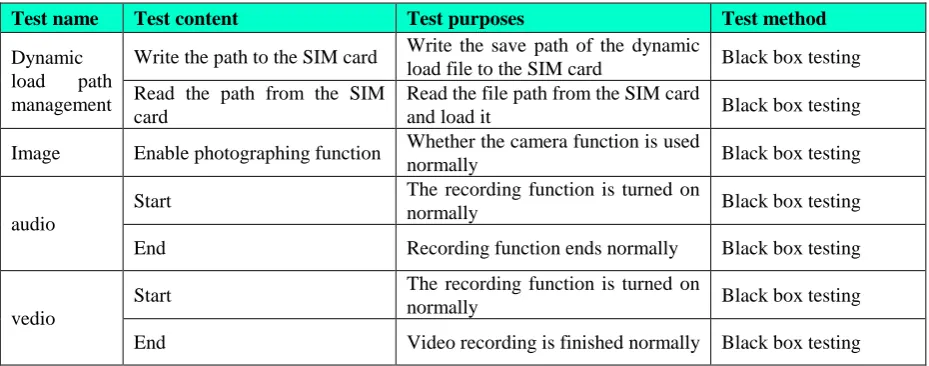
[image:4.595.66.531.540.723.2]The feasibility of the system is verified through the test and analysis of the hidden evidence collection. The tools that can be used include Google Nexus 6P phone, USB type-c cable, the mobile operating system USES a custom ROM developed by itself, which is based on the CyanogenMod 13 system developed by the CyanogenMod team. The operating environment of the dedicated PC client is Win7 and above version operating system, and JRE 8 and above. Test contents include dynamic load path management, Image, audio, vedio, PC decrypt client extract file. The test results are as show in. Table 1.
Table 1. The test results.
Test name Test content Test purposes Test method
Dynamic load path management
Write the path to the SIM card Write the save path of the dynamic
load file to the SIM card Black box testing Read the path from the SIM
card
Read the file path from the SIM card
and load it Black box testing
Image Enable photographing function Whether the camera function is used
normally Black box testing
audio
Start The recording function is turned on
normally Black box testing
End Recording function ends normally Black box testing
vedio
Start The recording function is turned on
normally Black box testing
End Video recording is finished normally Black box testing
Conclusion
customization and extension technology. Through the customized file system driver, the data in the two file systems are isolated from each other, which overcomes the data cross-border pollution and key loss in other prototype systems, and ensures the data. Integrity. And combined with the project requirements, innovatively proposed hidden area management based on Device-Mapper technology and Thin-Provisioning technology, realized the hidden technology without using special file system, strong versatility, and realized the comprehensive innovation of file hiding technology.
Acknowledgments
The work was supported by the National Natural Science Foundation of China (Grant No. U1536112) and Special Funds for Public Industry Research Projects of State Administration of Grain of China (Grant No. 201513002).
References
[1] Yu X, Chen B, Wang Z, et al. MobiHydra: Pragmatic and Multi-level Plausibly Deniable Encryption Storage for Mobile Devices[J]//Information Security. Springer International Publishing, 2014: 555-567.
[2] Chang B, Wang Z, Chen B, et al. MobiPluto: File System Friendly Deniable Storage for Mobile Devices[C]// Computer Security Applications Conference. ACM, 2015:381-390.
[3] Skillen A, Mannan M. Mobiflage: Deniable Storage Encryptionfor Mobile Devices[M]. IEEE Computer Society Press, 2014. Jing L, Chunhua J, Xia Y. Design and implementation of security os based on trustzone[C]//Electronic Measurement & Instruments (ICEMI), 2013 IEEE 11th International Conference on. IEEE, 2013, 2: 1027-1032.
[4] Iyer S C, Sedamkar R R, Gupta S. A novel idea of video encryption using hybrid cryptographic techniques[C]//Inventive Computation Technologies (ICICT), International Conference on. IEEE, 2016, 3: 1-5.