with Cultural Heritage Collections
Mark S. Sweetnam1, Maristella Agosti2, Nicola Orio3, Chiara Ponchia3, Christina M. Steiner4, Eva-Catherine Hillemann4,
Miche´al ´O Siochr´u1, and S´eamus Lawless5
1 Department of History, Trinity College Dublin, Ireland
{sweetnam,osiochrm}@tcd.ie
2 Department of Information Engineering, University of Padua, Italy
3 Department of Cultural Heritage, University of Padua, Italy
[email protected], [email protected]
4 Knowledge Management Institute, Graz University of Technology, Austria
{christina.steiner,eva.hillemann}@tugraz.at
5 Knowledge and Data Engineering Group, Trinity College Dublin, Ireland
Abstract. This paper presents research carried out in order to elicit user needs for the design and development of a digital library and research platform intended to enhance user engagement with cultural heritage collections. It outlines a range of user constituencies for this digital li-brary. The paper outlines a taxonomy of intended users for this system and describes in detail the characteristics and requirements of these users for the facilitation and enhancement of their engagement with and use of textual and visual cultural artefacts.
1
Introduction
In recent decades, considerable investment has been made in the digitization of cultural heritage collections. This has involved the creation of digital rep-resentations of cultural artefacts, and of associated metadata describing those artefacts. As a result, a continually expanding volume of content is now available to humanities scholars. However, these collections are typically monolithic and can be difficult to search and navigate. Existing platforms for digital archives tend either to provide basic tools for interacting with a range of collections, or more complex tools that are tied to a very specific type of collection, or even to a single archive. By contrast, the research presented in this paper is aimed at delivering the next generation of cultural experience, by guiding, assisting and empowering every user’s interaction with a digital cultural collection. It is intended not merely to provide a set of tools that are optimized to exploit a sin-gle cultural resource, or type of resource, but to deliver a fully featured digital library and research platform that is “corpus-agnostic”. This research has been
P. Zaphiris et al. (Eds.): TPDL 2012, LNCS 7489, pp. 64–75, 2012. c
Fig. 1.1641 and IPSA Collections accessible through the CULTURA interface
conducted as part of the CULTURA project1 (Cultivating Understanding and Research through Adaptivity).
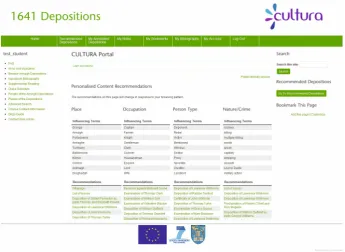
The design of this platform has required extensive engagement between hu-manities, information engineering and computer science research groups. The humanities researchers, based in Trinity College Dublin (TCDH) and the Univer-sity of Padua (UNIPD), are both engaged with very different types of collection. TCDH have a historically significant textual corpus (the 1641 Depositions2), while UNIPD are providing a visual corpus of illuminated medieval astrological and herbal manuscript codices (the Imaginum Patavinae Scientiae Archivum, or IPSA3). Both the 1641 Depositions and IPSA collections are being made accessible via the CULTURA research platform, as depicted in Figure 1.
Designing the structure of a digital library that serves the needs of the users of these disparate collections has required scholars to gain an understanding of the contrasting methodologies employed by colleagues across different disciplines within the humanities. The object of this is not to arrive at a platonic ideal of “the humanities researcher” but to identify and exploit the commonalities in methodology and process that do exist while also supporting the different and distinctive desires of each discipline.
1 CULTURA is co-funded under the 7th Framework Programme of the European
Commission, URL:http://www.cultura-strep.eu/
It is vital that the needs and requirements of the humanities researcher and community are addressed in the design of digital libraries. Rather than informa-tion engineers or computer scientists driving the design and development of a system that is subsequently subjected to user trials, effective design must elicit and incorporate user input at every stage of design and implementation. Suc-cessfully accomplishing this requires effective collaboration between researchers in the humanities and information engineering and computer science throughout the design, implementation and testing of a research environment.
This paper describes the outcomes of a process of investigating and identi-fying the commonalities in methodology and process across the two humanities research communities described above. From this process, a series of user com-munity characteristics and requirements are derived. These characteristics and requirements form the basis of the design of a digital library platform which sup-ports the distinctive desires of each community. Section 2 details related work and literature. Section 3 describes the approach taken during this research. This is followed by Section 4 which describes the community characteristics and Sec-tion 5 which reports on identified user needs. SecSec-tion 6 reports a summary of the outcomes of this research and a discussion of some future work.
2
Background Literature
In addition to direct engagement with users, the literature has been consulted in order to identify accepted requirements in digital libraries and collections. Be-sides explicit research studies on understanding user requirements [1] research on user acceptance in the context of digital libraries can provide useful infor-mation [16]. This literature review confirmed the importance of a user-centered approach [6] to the development of the CULTURA environment, in order to ensure the system gains acceptance and delivers maximum benefit.
Key requirements for digital libraries that are consistently outlined in the lit-erature are that the system should: (i) be easy to learn and easy to use; and (ii) deliver reliable search results [9, 10]. The design of the system, as well as the terminology used, should be clear, consistent and easy to understand [15]. Moreover, there exists a preference for visual-based interfaces that support users in finding information [9]. In particular, map-based visualisations have demon-strated value [12]. Constructing complex searches involving multiple terms has been identified as a key challange [4], and the use of visual interfaces to en-able faceted searching of collections has been identified as an effective way of addressing this challange [14].
users. Direct connections to other resources or digital libraries have also been found to be a feature desired by users [9]. The integration of heterogeneous infor-mation resources, as well as the development of services fostering and allowing cooperation among users has increasingly become a key factor [2]. Moreover, the consideration of previous user habits and practices is important for the design of a digital library or web portal [1] and familiar aspects of a new system should be highlighted in order to support users’ acceptance [13].
Overall, the information that was derived from the literature on relevant as-pects of user requirements provided a useful basis and complement for the en-gagement with user constituencies that was conducted as part of this research. The literature actually demonstrated a high level of correspondence with the results gained from the empirical work with users, as outlined in the following.
3
Research Approach
The aim of the research conducted by the CULTURA project is to stimulate and support the communities of interest which form around digital humanities collections. Based on interactions with users of the artifact collections, the fol-lowing taxonomy was developed to describe the types of users who form these communities of interest:
– Professional researchers: established academics, experienced in the general area covered by the resource, but not necessarily with the specific content of the resource.
– Apprentice investigators: students at advanced undergraduate and post-graduate level. Some knowledge of the historical period and/or cultural con-text addressed by the resource.
– Informed users: researchers who are not professional academics but have knowledge of some aspects addressed by the resource
– General public: adults and children.
In order to characterize users and identify and address their needs, researchers used a combination of surveys and interviews, along with more sustained in-teractions with users of the resource. Surveys were carried out with users from both TCDH and UNIPD. Twenty-five students were surveyed by TCDH, 15 at undergraduate level, and 10 at postgraduate. At UNIPD, 21 undergraduate students and 49 postgraduate students were surveyed. Undergraduate students were taking courses specific to the disciplines of history and art history. Post-graduate users included representatives of these disciplines, as well as students who were completing programmes in digital humanities, and cultural heritage. These surveys were supplemented by detailed focus-group type interactions. In addition, user needs were discussed in detail with 16 users from the professional researcher category (UNIPD 6, TCDH 10).
but subsequently a prototype implementation of CULTURA was evaluated with users. Detailed engagement with users was carried out using a co-operative in-quiry methodology to elicit and refine user needs. This action research method-ology focuses on performing research with users rather than on users and is based on close and sustained cooperation between researchers and users (co-researchers) to develop a framework of inquiry and to explore their experiences and impressions of a research topic. In addition to eliciting the needs and desired benefits of users in each category, interactions with users enabled the description of a model research process for researchers using both of the content collections. This allowed a provisional set of use cases to be developed. The definition of these use cases is the beginning of an ongoing and dynamic process.
In the context of the corpus-agnostic approach adopted by the project, it is noteworthy that these use cases manifest a great deal of common ground. The key areas of interest – people, places, and events – can very readily be concep-tualized in a way that ensures their relevance to the work of researchers across various disciplines. Naturally, not all use cases overlap, and it would be a poor service to humanities researchers if the resulting environment were to become the digital equivalent of a methodological Procrustean bed. Thus, in addition to their overlap, the use cases defined reflect the distinctive and specific needs of each discipline. Extensive work on the elicitation of user needs is essential for providing robust and useful ways of engaging with cultural heritage collections. The following sections describe the findings of the user study in more detail, with a specific focus on the characteristics and requirements of each of the user constituencies described above.
4
Community Characteristics
crucial. By the same token, however, these researchers are well placed to appre-ciate the value added to a cultural heritage collection by tools that enable new ways of looking at that collection, or that make it possible to perceive patterns and features not previously recognized. Thus, these researchers expressed a keen appreciation of the potential of visualization techniques for opening up new av-enues of inquiry. This constituency’s familiarity with the source materials means that they are excellently placed to evaluate the usefulness and accuracy of the impression given by these visualization techniques.
The professional researchers interviewed also tended to have a clear and rel-atively inelastic view of research collaboration. This tended to be modeled on existing practice, and may include collaboration (or the sharing of resources and annotations) with students. In general, they demonstrated some ambivalence to a wider and less formalized collaborative framework.
Apprentice Investigators: These researchers are students who are beginning to acquire familiarity both with the research process and with the content of the heritage collections. They place high importance on tools that allow them to gain this familiarity as rapidly as possible. In particular, the ability to visual-ize collections was identified as an especially useful way for students to gain an overall understanding of the structure of the depositions themselves and of the events that they describe. Map-based visualization was singled out as especially useful. At the same time, these students indicated a detailed grasp of the poten-tial benefits of other visualizations, and of the possible pitfalls associated with their use. The representatives of this constituency provided an excellent snap-shot of the historian’s dilemma about the use of personalization and adaptivity as a guide to their sources. Their low level of familiarity with the sources means that they are very well placed to appreciate the value of the sort of guidance that an adaptive resource would provide. However, some participants expressed concern that this guidance would effectively distort their understanding of their sources, and thus of the stream of historical events. All participants could see the potential value in this guidance, but expressed the need for building trust in the operation of the system. Control, scrutability, and transparency feature highly as essentials in developing user confidence in adaptivity and thus fostering its use.
transcription. Additionally, users expressed this priority in their requirement for a robust and effective search mechanism that would allow them to reliably and quickly identify the items relevant to their interest at a particular moment. Users also expressed the need to be able to “drill down” from visualization to underlying source as readily as possible. In keeping with existing research, these apprentice investigators proved more enthusiastic about the possibilities of collaboration than their senior colleagues. [3,4] Some of the students interviewed have recent experience of carrying out a collaborative research project. They were able to identify ways in which CULTURA could have assisted that collaboration. They identified choice and control as the crucial elements of a collaborative process. They conceptualized possible methodologies for collaboration in terms of “following” as with Twitter4, or the sharing facilities present in Diigo5.
While these users have not yet developed a workflow to the extent that the professional researchers have, their interests, personality, and preferred work process are already being expressed. The choice of digital tools is an important part of their workflow. They expressed a strong preference that the project envi-ronment, in addition to providing tools for analysis and organization internally, should feature a high degree of interoperability. In particular, the ability to ex-port annotations or aggregated sets of data based on the results of search queries was consistently identified as a highly desirable feature.
Informed Users: This constituency includes users belonging to relevant soci-eties or interest groups, and cultural institutions. These informed users are, in some senses, a sub-set of the general public. Their knowledge of, and sometimes their interest in, the sources contained in the project environment is generally quite specific.
General Public: Characterizing this constituency presents a considerable chal-lenge. It is large and diverse, and users will bring a very wide range of interests, technical abilities, and contextual and/or historical awareness to collections of cultural artefacts. In addition, attempts to get members of this group to imagine a resource, as distinct to responding to one that already exists, are fraught with challenges. For these reasons, we will be in a position to interact more usefully with this constituency when a more complete version of the project platform exists and can be tested.
School Children: School children are a particularly challenging constituency to address, but successfully supporting their engagement with historical sources offers the prospect of very rewarding gains. In the case of the 1641 Depositions it has been possible to engage directly with pupils and history teachers. Teach-ers were particularly enthused about the access provided to primary sources. This has the potential not only to educate students about the specific historical
context of the artefacts, but also to teach them about historical methodologies, and especially the use of primary sources. The language of the Depositions was identified as a serious obstacle to student engagement. Teachers – who are not generally specialists in this period – identified the need for supporting material that might guide them through the Depositions. They identified visualization techniques as being particularly useful in offering post-primary students a way into the Depositions.
5
User Needs
5.1 Common Results
Unsurprisingly, there is considerable overlap between the user groups surveyed. A number of user requirements were so basic as to be common to each of the con-stituencies surveyed, and others were shared by a subset of those concon-stituencies. For all users, accurate search was identified as the one “make or break” feature for engaging with a cultural heritage collection. In the case of the 1641Depo-sitions, particularly, the frustrations of searching over unnormalized data mean that users with experience of the website all clamored for the ability to search over a normalized corpus. In addition to early modern spelling variation, the metadata for the IPSA collection features a number of languages: Italian, Latin, and a variety of dialects. The ability to search for all variants of person and place names was identified as particularly important, the need for reliable full text search also had a high priority for all users. In addition, all users high-lighted the usefulness of faceted search, that provided the ability to filter their content dynamically across all available categories of metadata. Users also em-phasized the importance of being able to bookmark the results of this search and to retrieve or recreate a given filter configuration easily.
While direct searching is an important way of allowing users to engage with collections, it is only one of a number of methods identified as useful by users. Users from all groups identified visualizations as a potentially useful way of interacting with the collections. Map-based visualization was identified as be-ing especially useful. Users displayed openness to other forms of visualization strategy, but highlighted the need for clear support material and instructions to extract the maximum possible benefit from such visualizations. This finding represents a shift from the attitude to visualizations noted in earlier research [17] and may be indicative of a wider disciplinary shift.
which users can make the collection their own, enriching and enhancing their developing engagement with its contents. These categories of user are also aware of the value of undirected investigation of a source, of exploring (playing with) the available material, using searches and visualizations to explore its content. However, they are also familiar with the situation of not being able to recover a previously noticed fact or idea that is urgently required to complete a paper. For this reason, they emphasized the value of a log of their interactions with a resource within the research environment. They also felt that there would be con-siderable value in using this log along with a recommendations feature, to render its operations more transparent and accountable. Those users also highlighted the importance of being able to export annotations, aggregated depositions and other data. This requirement is motivated by considerations of data security and of workflow integration. Users, both academics and students, stressed the impor-tance of being able to use the project environment not just as a one-stop-shop, but as part of a wider research process, the ability to export data for analysis elsewhere is seen as a key requirement. In addition, users of the 1641 Depositions expressed a wish to be able to export sub-sets of depositions (the results of a search or query, for example) as text files, for additional analysis, or simply for off-line reading. The same two groups of users stressed that it is essential for a research platform to make a contribution to producing published research. This concern means that they need easy access to the data underlying any of the visualizations generated by within the environment, and the ability to export that data for publication or further analysis.
Professional researchers, apprentice investigators and interested users empha-sized the importance of the project environment supporting a variety of project structures. At the most basic level, all users from these groups wanted to be able to organize their bookmarks and annotations into separate folders. Members of the apprentice investigators group, reflecting on their experience with other sorts of technology, suggested that a tagging system would be a useful adjunct to a more rigid system of bookmarking. To support the variety of ways in which projects evolve, all users require the ability to copy existing bookmarks and an-notations into new folders as well as being able to create a new project from scratch. These users all highlighted the organic way in which many academic projects develop, and the concomitant importance of being able to reconfigure the research environment accordingly.
The requirements outlined above are common to two or more of the user groups surveyed. In the following, the requirements specific to individual groups are outlined.
5.2 User Group-Specific Results
only part of a larger picture. Thus, they place a high premium on the environ-ment’s ability to accommodate and allow interoperation with other collections. These users have a specific understanding of how collaboration would best assist their work. Essentially, they see value in two types of collaborative research. They require a research environment to support collaboration with other researchers on a specific topic or project. Such collaboration is limited to that project, and is probably curtailed to a specific period of time. Secondly, they see the value of collaboration as a pedagogic tool, and believe that this potential would be best supported by the ability to share a specific sub-set of their annotations with students, and to see annotations by students that those students have chosen to share with them.
For art historians, there are two types of historical-artistic search that are especially valuable. Firstly, it is useful to follow the development of the illus-tration system of a specific text. It has to be possible to follow the evolution of a single image through the centuries. Iconography gradually changed over the centuries and it is highly desirable that researchers to be assisted in trac-ing this process of evolution. Secondly, an environment for users of these image collections should allow the researcher to provide information to describe the re-lations between images, possibly through contextual annotations. Ideally, these annotations could be used in the visualization of the links also for use of the other categories of users. The environment should also facilitate the generation of an image stemma codicum (a family-tree representation of different chains of derivation starting from a given image). These should visualize the connections between images and annotations. The stemma codicum should dynamically re-flect the addition of new information by the professional researcher. A graphical way of making explicit the lack of a relation between images should be found, because stating that there is no relation between two images (even if they are visually similar) is another important scientific result. Those users would ben-efit from the possibility of recalling all the similar images that are present in the archive. It is important to note that, for this particular case, they are more interested in search functionalities that are based on textual descriptors, rather than on content-based similarity searches between images.
Apprentice Investigators: Controllable collaboration is of particular impor-tance for apprentice investigators. These users have an understanding of peer-to-peer collaboration very similar to that expressed by users in the professional researcher constituency. However, they also envisaged considerable potential ben-efit from a solution that allowed them to “follow” more senior academics and to see such annotations as they choose to make public.
a wider investigation, and speed, accuracy and straightforward accessibility are, therefore, particularly important. These users are informed in quite a different sense. They have limited interest in the specifics of the collections, but are keen to identify solutions that would assist in the showcasing and exploitation of their own content bases. Given the limited resources available to many of these institutions in the present environment, it is important to foresee ingestion and preparation of additional content bases, and the reuse of existing metadata as straightforward and efficient as possible.
General Public: These users typically have very little contextual information about the collections. They identified the need for accessible introductions to the collections, explaining the material they contain, and its historical context.
6
Conclusions and Further Work
User characterisation and the development of use cases is an ongoing process of refinement and enhancement. A co-operative inquiry methodology is central to the design and implementation of digital libraries that house humanities col-lections, and that make them available to the researchers that use them. Thus, as prototypes of the CULTURA research platform continue to be developed, researchers will work closely with end users to evaluate the usefulness of the environment. This process is crucial to the effective design of a research environ-ment that will be genuinely and robustly useful for a wide range of users who come to the resource, and the collections that it makes available, with a range of experience, interests, and needs.
The research reported in this paper demonstrates the value of a design ap-proach that begins with users. The user taxonomy that it presents provides a very useful model for digital libraries and research platforms that attempt to ad-dress the needs of a wide range of users. This is particularly relevant in relation to making cultural artefacts widely accessible. Tis research has generated an au-thentic set of general and user-group specific design requirements that could help inform the design of a range of resources for digital humanists and for collections of cultural artefacts.
Acknowledgements. The work reported has been partially supported by the CULTURA project, as part of the Seventh Framework Programme of the Eu-ropean Commission, Area “Digital Libraries and Digital Preservation” (ICT-2009.4.1), grant agreement no. 269973. The authors would like to thank all the CULTURA partners for the useful discussions on many aspects related to the user engagement with cultural heritage collections.
References
1. Agosti, M., Crivellari, F., Di Nunzio, G., Gabrielli, S.: Understanding user re-quirements and preferences for a digital library web portal. Int. Jour. on Digital Libraries 11, 225–238 (2010)
2. Agosti, M.: Digital libraries. In: Melucci, M., Baeza-Yates, R. (eds.) Advanced Topics in Information Retrieval. The Information Retrieval Series, vol. 33, pp. 1– 26. Springer, Heidelberg (2011)
3. Barrett, A.: The information-seeking habits of graduate student researchers in the humanities. The Journal of Academic Librarianship 31(4), 324–331 (2005) 4. Buchanan, G., Cunningham, S.J., Blandford, A., Rimmer, J., Warwick, C.:
Infor-mation Seeking by Humanities Scholars. In: Rauber, A., Christodoulakis, S., Tjoa, A.M. (eds.) ECDL 2005. LNCS, vol. 3652, pp. 218–229. Springer, Heidelberg (2005) 5. Fields, B., Keith, S., Blandford, A.: Designing for expert information finding strate-gies. In: Fincher, S., Markopoulos, P., Moore, D., Ruddle, R. (eds.) People and Computers XVIII - Design for Life, pp. 89–102. Springer, London (2005)
6. Fox, E.A., Hix, D., Nowell, L.T., Brueni, D.J., Wake, W.C., Heath, L.S., Rao, D.: Users, user interfaces, and objects: Envision, a digital library. JASIS 44(8), 480–491 (1993)
7. Hong, W., Thong, J., Wong, W.M., Tam, K.T.: Determinants of user acceptance of digital libraries: An empirical examination of individual differences and system characteristics. Jour. of Management Information Systems 18, 97–124 (2002) 8. Hsieh-Yee, I.: Effects of search experience and subject knowledge on the search
tactics of novice and experienced searchers. JASIS 44, 161–174 (1993)
9. Kani-Zabihi, E., Ghinea, G., Chen, S.: Digital libraries: What do user want? Online Information Review, pp. 395–412 (2006)
10. Kimani, S., Panizzi, E., Catarci, T., Antona, M.: Digital library requirements: A questionnaire-based study. In: Theng, Y.L., et al. (eds.) Handbook of Research on Digital Libraries, pp. 287–297. IGI Global, Hershey (2009)
11. Loizides, F., Buchanan, G.: What patrons want: supporting interaction for novice information seeking scholars. In: JCDL, pp. 427–428 (2009)
12. McIntosh, S.J., Bainbridge, D.: An integrated interactive and persistent map-based digital library interface. In: ICADL, pp. 321–330 (2011)
13. Nov, O., Ye, C.: Resistance to change and the adoption of digital libraries: An integrative model. JASIST 60, 1702–1708 (2009)
14. Suominen, O., Viljanen, K., Hyv¨onen, E.: User-Centric Faceted Search for Semantic Portals. In: Franconi, E., Kifer, M., May, W. (eds.) ESWC 2007. LNCS, vol. 4519, pp. 356–370. Springer, Heidelberg (2007)
15. Thong, J., Hong, W., Tam, K.Y.: Understanding user acceptance of digital li-braries: What are the roles of interface characteristics, organizational context, and individual differences? Int. Jour. of Human-Computer Studies 57, 215–242 (2002) 16. Thong, J., Hong, W., Tam, K.: What leads to user acceptance of digital libraries?
Communications of the ACM 47, 79–83 (2004)