READING HABITS AND ATTITUDE IN MALAYSIA: ANALYSIS OF GENDER
AND ACADEMIC PROGRAMME DIFFERENCES
Nor Shahriza Abdul Karim, PhD Assistant Professor
Faculty of ICT, International Islamic University Malaysia, 53100 Gombak, Kuala Lumpur, Malaysia
Abstract
This study is conducted as an attempt to understand the reading habits and attitudes of the Bachelor of IT students and the Bachelor of Art students from the Intenational Islamic University Malaysia. Based on the sample of 127 students, it was found that significant differences exist between the two groups of students in terms of types of reading material and reading resources used. Differences in reading habits and attitudes were also observed between male and female participants. The results of the study are expected to guide professionals in the library and information services to be better equipped to provide more efficient and effective services. The study is also intended to interest researchers from other areas of study who are interested in the realm of reading and literacy.
Abstrak
Kajian ini dijalankan untuk mengenalpasti tingkahlaku dan tabiat membaca di antara pelajar Ijazah Dasar Teknologi Maklumat dan pelajar Ijazah Dasar Sastera dari Universiti Islam Antarabangsa Malaysia. Berdasarkan 127 sampel yang dikumpul, kajian menunjukkan perbezaan tabiat membaca yang ketara di antara dua kumpulan tersebut dari segi jenis bahan yang dibaca dan sumber bacaan yang digunakan. Beberapa perbezaan tingkahlaku dan tabiat membaca telah dikenalpasti di antara peserta perempuan dan lelaki. Hasil daripada kajian menunjukkan bahawa pustakawan dan pakar maklumat pada masa kini perlu melengkapkan diri untuk memberi perkhidmatan yang lebih cekap dan berkesan. Kajian juga berharap untuk mendapatkan penyertaan penyelidik daripada bidang lain yang berminat dalam kajian membaca dan literasi maklumat.
BACKGROUND
In this study, the intention is to explore the reading attitudes and habits among the
International Islamic University Malaysia (IIUM) students by using a survey research method. Data were gathered from the Bachelor of IT students from the Kulliyyah Information and Communication Technology (KICT) and the Bachelor of Art students from the Kulliyyah Islamic Revealed Knowledge and Human Science (IRKHS). This study can be seen as significant in providing useful information which can assist the university authority and library to provide more effective services and a better understanding on the concept of reading for these groups of students. In addition, this study is also significant, through its methodology, in extending future research such as exploring into a wider scope of the Malaysian university environments.
Kekal Abadi 25 (1/2) 2006
INTRODUCTION
17
This study attempts to answer several researchquestions such as the following :
RQ1 : What is the reading habit of the two groups of undergraduate students in terms of the following :
1a.What type of reading material do they read?
1b How much time do undergraduate students spend on reading?
1c Where do they get the reading material?
1d. When do they read?
1e. What do they read during leisure time?
RQ2: What are the students’ attitudes toward reading?
RQ3: Is there any relationship between gender and reading habit and attitude?
RQ4: Is there any relationship between academic programme and reading habit and attitude?
METHODOLOGY
Population and Sample
This study is considered a single case study approach due to the use of only one organization in defining the population. A survey was used as a method in collecting the data. The population of the study were the undergraduate students from two academic faculties at the university.The faculties were Kulliyyah of Information & Communication Technology (KICT), the IT-based and Kuliyyah of Islamic Revealed Knowledge and Human Science (KIRKH), the Art-based. The total number of students from each faculty respectively were 2019 (only those from Islamic Revealed Knowledge) and 454 students (from a total population of 1473). 400 questionnaires were distributed in classrooms. 127 responses (32% response rate) were received from the survey. 73 responses (about 57%) were from KIRKH (Art based) and 54 responses (about 43%) were from KICT (Science based). This number maybe slightly imbalance but considered adequate to represent both programme of studies.
Kekal Abadi 25 (1/2) 2006
Data Collection and Measurement
For the measure of reading attitude, the study adopted the Adult Survey of Reading Attitude (ASRA) from the work of Smith (1991). Subjects respond to the statements on a five-point Likert-type scale (where 5 = Strongly Agree and 1 = Strongly Disagree). Two dimensions of reading attitude were studied. These were recorded as follows:
•
Reading activity and enjoyment ( 6 items) — measured the extent to which the person reads for pleasure.•
Anxiety and Difficulty ( 5 items) - measured the extent to which the person experiences problems or becomes upset when reading.As for reading habits, 6 questions (4 close ended questions and 2 open ended questions) were asked for responses. Subjects answer close-ended questions using frequency scale (i.e. 1 = Never, 2 = Rarely, 3 = Sometimes, 4 = Often and 5 = Always). The questions were related to: How often do they read in a week? What types of reading material do they read, and how frequent do they read these reading materials? What resources do they use to get the reading materials? What time of the day do they read? Respondents were also asked to respond qualitatively on the types of reading material they like to read and the activities that they like to do during their leisure time.
Data analysis
The data were analyzed using descriptive statistics and statistics that measure the relationship between variables such as t-test. Statistical Package for Social Science (SPSS) was used for data analysis purposes.
FINDINGS AND DISCUSSIONS
Demographic
A big majority (respondents) were aged between 19-25 years old (about 90%). This is considered a normal age range for undergraduate studies. Majority of the respondents were in year one (64%) in their programme of study, followed by year two (18%), year three (12%) and year four (6%).
Reading Habit
Findings on reading habits were analyzed through the types of reading materials read, amount of time spent on reading per week, sources used to get the reading materials and the time of day spent on reading.
[image:3.595.325.523.423.567.2]Types of reading material
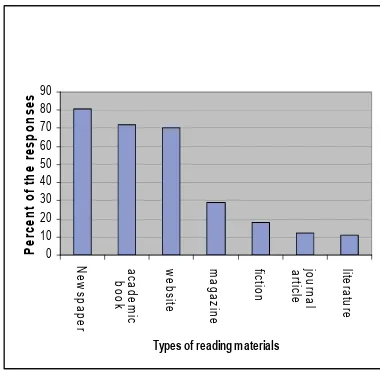
Figure 1 illustrates the distribution of eight types of reading material i.e. newspaper, magazine, journal article, literature, academic book, text book, fiction/novel and website that the respondents read. Majority of the students read the newspaper everyday to at least a few times a week (74%). This is followed by academic books or text books (72%), website (70%), Magazine (39%) followed by fiction, journal article and literature (eg. poem).
The results pinpointed the high rate of website use, in addition to academic books and newpapers among university students. This may explain why Malaysian students were said to be reading for academic purposes only and not for general knowledge or pleasure as indicated by some studies in the past. The trend may have shifted to a digital reading habit which is totally different from the conventional
0 10 20 30 40 50 60 70 80 90 N ew spa per ac ad e m ic boo k we b sit e ma g a zin e fi cti o n jour n al ar tic le lite ra tu re
Types of reading materials
[image:3.595.72.262.607.792.2]P er ce n t of t he r es pons es
Figure 1 :
Type of reading material that respondents read everyday to at least a few times a week (N=
Kekal Abadi 25 (1/2) 2006
Table 1 shows the distribution of amount of time spent on reading per week by the respondents. The result indicates that university students spent a considerable amount of time on reading. 80% of the students read between 3 to above 10 hours per week. On average, the students spent about 7 to 9 hours per week on reading. This result is somewhat expected due to the academic activities that require a significant amount of reading time in order to perform academically. However the amount of time spent on reading should be attributed to reading academic books rather than other materials such as newpapers or fiction. The result is slightly higher than the study conducted by Sheorey and Moktari (1994) on university students in the US, where the average reading time per week was 4.75 hours. The high amount of time spent on reading may have also conformed to the findings by Liu (2005) who indicated that people read more in the digital age. This is because information can be obtained faster, cheaper and more conveniently via the Internet.
Table 1
Time spent on reading
Hour Respondent Percentage (%)
Less than 1
hour 2 2
1.-3 hours 23 18
4 -6 hours 36 29
7 -9 hours 37 29
10 hours and
above 28 22
Sources of reading material
Several sources were identified that were used by the respondents to get their reading materials. These were libraries, book shops, friends, internet and others. The internet was found to be the most frequently used source to get the reading materias (46%). This is followed by the library (28%), friends (23%) and the bookstore (16%).
Time for reading
19
A small number indicate that they read in themorning (36%) and in the afternoon (19%). The classes that the students need to attend during the day may influence the reading time, which naturally take place more at night.
Reading Material during Leisure time
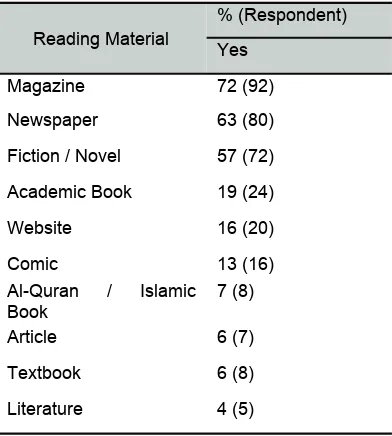
[image:4.595.325.522.117.478.2]Respondents were asked to state three types of reading material that they like or usually read during leisure time. As shown in Table 2, ten types of reading materials were identified. Magazine, newpapers and fiction are among the most popular reading materials read during the respondents’ leisure time. The fact that magazine obtained the highest score is consistent with the result from research conducted by Gallik (1999). University students tend to read magazines during their leisure time.
Table 2
Distribution of respondents on Reading Material during Leisure time
Reading Material
% (Respondent)
Yes
Magazine 72 (92)
Newspaper 63 (80)
Fiction / Novel 57 (72)
Academic Book 19 (24)
Website 16 (20)
Comic 13 (16)
Al-Quran / Islamic
Book 7 (8)
Article 6 (7)
Textbook 6 (8)
Literature 4 (5)
Kekal Abadi 25 (1/2) 2006
Activities during Leisure time
[image:4.595.74.270.377.595.2]Respondents were also asked, using open ended question, about the types of activities that they like to do during leisure time. Table 3 provides the list of activities in descending order. Majority of the respondents were found to choose reading as their main activity during leisure time (61%). This is followed by surfing the Internet, listening to music, engaging in sports, watching tv/movies, etc.
Table 3
Distribution of respondents on Activities during Leisure time
Activities
% (Respondent)
Reading 61 (76)
Surf Internet 37 (47)
Listening to the Music /
Radio 32 (40)
Games / Sport 30 (37)
Watching TV / Movie / VCD
30 (37)
Sleeping 20 (27)
Shopping 9 (11)
Hanging out with friends 8 (10)
Eating 7 (9)
SMS 3 (4)
Cooking 3 (4)
No Activities / Relax 3 (4)
Traveling 2 (3)
Writing 2 (3)
Drawing 2 (2)
Studying 1 (1)
Gardening 1 (1)
Reading Attitude
Item Factor Reliability a
1 2
a. You love to read
b. You have a lot of books in your room.
c. You like to read a book whenever you
have free time.
d. Reading is one of your favorite
activities.
e. You get a lot of enjoyment from
reading.
.786
.584
.671
.854
.746
0.8
f. You think reading is boring.
g. You think reading is a waste of time.
h. It takes you a long time to read a book.
i. You try very hard, but you just can’t
read very well.
.644
.590
.653
.812
0.7
[image:5.595.73.522.102.369.2]Kekal Abadi 25 (1/2) 2006
Table 4
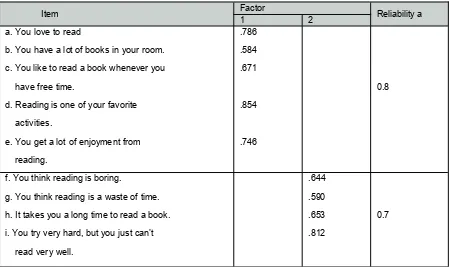
Factor Analysis on Reading Attitude (Enjoyment and Anxiety)
The description of both variables are provided in Table 5 below. The result indicates that the average score for enjoyment is quite high, sending a message that majority of the respondents agree that reading is an enjoyable activity. This high value on enjoyment is subsequently compatible with the low value on anxiety towards reading (mean value 2.3). After the items were reversed, the analysis of overall attidute points towards a conclusion that the respondents’ attitude towards reading is rather positive.
Table 5
Descriptive Statistics of Reading Attitude
N Minimum Maximum Mean Std. Deviation
Enjoyment 127 2 5 3.9 .57282
Anxiety 126 1 4 2.3 .68097
Attitude Overall 124 2.33 5.00 3.8 .57886
Analysis of relationship - Gender Differences
The data were analyzed using t-test to determine whether any significant differences exist between gender and reading habit, and between gender and reading attitude.
Gender and Reading Habits
The result indicates that gender is significantly associated with reading certain types of reading materials. These materials are newspaper, literature and website. The t-test result shows that male students read significantly more on
[image:5.595.79.524.488.569.2]21
Gender and reading attitude
Data were analyzed using t-test to find out the relationship between gender and attitude towards reading. No statistical significant difference was found between males and females in terms of their reading attitude.
Analysis of Relationship – Field of Study differences
The data were analyzed using chi-square and t-test to determine whether any significant differences exist between field of study and reading habit, and field of study and reading attitude.
Field of study and type of reading material
The result of the t-test indicates that students from faculty of ICT tend to read more on websites (t = 38.37, p= 0.00) than those from IRKHS. The significant result may be due to the unique nature of the ICT students who are required to use computers more than any other students from any other field of study. Therefore, their exposure to the web environment is expected to be more.
Field of study and source of reading material
Based on the t-test, the use of libraries and Internet was found to be significantly different between students from the two academic faculties studied. Students from IRKHS used the library significanly more frequently (t= 3.1, p= 0.03) than their ICT counterparts. On the other hand, the ICT students tend to use the Internet significantly more often (t=3.9, p=0.00) than the IRKHS students, as their source of getting reading materials.
Field of study and time for reading
The t-test result indicates a statistically significant difference between field of study and time taken for reading. The test showed that KIRKHS students read more in the morning compared to KICT students (t= 4.5, p= 0.00).
Field of study and reading attitude
The analysis on reading attitude and the differences in the students’ field of study indicates that there is a relationship between the two variables. A statistical significant different ( t= 2.75, p= 0.007) was found between ICT and IRKHS students in terms of their enjoyment towards reading .
Kekal Abadi 25 (1/2) 2006
The result indicates that the IRKHS students enjoy more reading compared to the ICT students. Overall result also indicates that the IRKHS have more positive attitudes towards reading than their ICT counterparts (t= 2.55, p= 0.012). No statistically significant difference is found between the IRKHS and ICT students in terms of reading anxiety.
The evidences provided above indicate that field of study is an important factor of reading habits and attitudes among college or university students. This factor can be explained from the reading exposure and reading requirement of each field. Studies among high schools students indicate that language subjects expose more students to reading than any other subjects (Pandian, 1997). This has become the factor that promote students to have more positive attitudes towards reading. Since students are required to read more in the IRKHS programme, they are found to have more positive attitude towards reading and use the library more for reading purposes. As for the ICT students, they may not be regarded as engaging less in reading because they may be engaged in a different kind of reading which is unique to the digital environement. Their reading habits can be considered as different from those of their Art-based counterpart. This is implied through their significantly high interaction with websites.
Analysis of other Relationships
Performance and reading habits
Performance or the respondents’ CGPA was found to be not significantly related with types of reading materials, sources of reading materials and the amount of time spent reading per week. However, a small correlation was found significant between performance and the extent to which they read in the evening. No logical explanation can be given on this phenomena.
Reading attitude and reading habits
literature (pearson : r=0.202, p-value=0.04), attitude and reading fiction or novel (pearson: r=0.202, p-value=0.024), and attitude and the use of library to find the reading materials (pearson: r=.280, p-value=0.002). These results are found consistent with past research reviewed earlier on reading attidute.
CONCLUSION
This study was conducted as an attempt to enhance our understanding about reading habits and attitudes of the university students in Malaysia, focusing a case of a public university. In this effort, students from two faculties (IT-based versus Art-(IT-based) were chosen as the respondents. In the overall analysis that include both groups, results indicate that university students spend quite a significant amount of time reading newspapers, academic books and websites. Reading has also become a major activity during their leisure time.
The amount of time spent on reading by the university students is seen as higher than the average individual adult surveyed in the past . This group is expected to read more due to their engagement in the academic process that requires them to read. This engagement may have resulted in their selection of reading materials that are less fictional and more academic in nature. On the other hand, the website is seen as an increasingly important reading source.
Analysis on the differences in gender reveals that male students read significantly more for resources other than the academic books. These resources are the newpaper, website and literature. This finding may come as a surprise since several researches in the past have found that females read more than males (Carter 1986; Kirch & Guthrie, 1984; Gallik, 1999).
In addition, differences between IT-based and Art-based students are quite significant in terms of reading resouces and materials. The fact that IT students rely more on websites as their reading materials and resouces may come as
Kekal Abadi 25 (1/2) 2006
no surprise. Findings on a recent research on the use of electronic resources (ER) by both groups of students indicate that the IT based students use ER significantly more than the Art based students (Harianto, 2006). This may call for more effort at the university level to introduce a skill-based course in electronic information system usage and searching.
The knowledge acquired from this study should contribute to better understanding on the phenomena of reading habits and attitudes in Malaysia specifically and in contributing to future research in similar areas generally. Since this study is a case study, the results should contribute significantly in terms of methodology for studies to be conducted for a different category of population or with a broader population base. In addition, the findings of the study should assist the university authority, especially the library and the computer department to look into service matters to accomodate the reading as well as the studying habits of students. For instance, the high percentage of reading time that take place at night may call for the respective authorities to consider opening more reading facilities with longer opening hours. A 24-hour computer service may also allow students to use the internet at any time which is convenient to them, not limiting to daylight hours. This has been done in many academic institutions in the west.
23
ReferencesAli, A. (1994). Reading interest among MIT students with special reference to Islamic literature.
Alexander, J. E. & Filler, R. C. (1976). Attitudes and reading. Newark, DE: International Reading Association
Anderson, R. C., Hiebert, E.H., Scott, J.A., and Wilkinson, I.A.G. (1985). Becoming a nation of readers. Washington, DC: US Department of Education, The National Institute of Education.
Bintz, W. (1993). Resistant readers in secondary education: Some insights and implications. Journal of Reading, 36, 604-615
Blackwood, C. Et.al. (1991). Pleasure Reading by College Students: Fact or Fiction? A paper presented at the Mid-South Educational Research Association, Lexington, KY, November 13-15 1991, ED 344191.
Book Industry Study Group. (1984). 1983 Consumer research study on reading and book purchasing: Focus on Adults. New York: Book Industry Study Group.
Bryman, A. & Craemer, D. (2001) Quantitative Data Analysis with SPSS Release 10 for Windows. New York: Routledge Taylor & Francis Group
Cole, J.Y., & Gold, C.S. (eds). (1979). Reading in America: Selected findings of the Book Industry Study Group’s 1978 Study. Washington: Library of Congress.
Frank Small and Associates. (1998). Reading profile of Malaysians 1996. Kuala Lumpur: Perpustakaan Negara Malaysia.
Gallik, J. D. (1999). Do they read for pleasure? Recreational reading habits of college students. Journal of Adolescent & Adult Literacy, Vol. 42 no. 6, pp. 480.
Harianto, H. (2006). The use, perceived usefulness and satisfaction with electronic recources in the IIUM library: A descriptive study of postgraduate students. A master thesis submitted in partial fulfillment of MLIS degree, International Islamic university Malaysia.
Kirsh, I. S., & Guthrie, J. T. (1984). Adult reading practices for work and leisure. Adult Education Quarterly, 34, 213 – 232.
Kubis, M. (1996). The relationship between home literary environments and attitudes toward reading in ninth-graders. ERIC Document Reproduction Service No. ED 385822.
Landow, G. (1992). Hypertext: The convergence of technology and contemporary critical theory. Baltimore: Johns Hopkins University Press.
Lanham, R. (1993). The electronic word: technology, democracy, and the arts. Chicago: University of Chicago Press.
Liu, Z. (2005). Reading behavior in the digital environment: Changes in reading behavior over the past 10 years. Journal of Documentation, vol. 61 no. 6, pp. 700-712.
Long, A. (1984). A survey on reading habits and interests of Malaysian people. Kuala Lumpur: Dewan Bahasa dan Pustaka.
Machet, M. P. (2004). Reading and use of informational material by South African youth. School Libraries Worldwide, 10(1/2), pg. 1. Retrieved July 29, 2005 from ProQuest. (734528381).
Malaysian National Library. (2006). The Reading Profile of Malaysians 2006. Unpublished research by the Malaysian National Library.
Murray, J.H. (1997). Hamlet on the Holodeck: The future of Narrative in cyberspace. Boston, MA: MIT Press.
O’Donnell, J.J. (1998). Avatars of the word: From papyrus to Cyberspace. Cambrigde MA and London: Harvard University Press.
Pandian, A. (1997). Reading in Malaysia. Bangi, Selangor: Universiti Kebangsaan malaysia.
Pandian, A. (2000). A study on readership behavior among multi-ethnic, multi-lingual Malaysian students. A paper presented at the Seventh International Literacy and Ecducation Research Network (LERN) Conference on Learning, RMIT University, Melbourne, 5-9 July 2000.
Partin, K. (2002). The relationship between positive adolescent attitudes towards reading and home literary environment. Reading Horizon, 43(1), pg. 61. Retrieved July 29, 2005 from ProQuest. (869815781)
Pumfrey, P. D. (1977). Measuring reading abilities. London: Hodder & Stoughton.
Ramirez, E. (2003). The impact of the Internet on the reading practices of a university community: The case of UNAM. World Library and Information Congress: 69th IFLA General Conference and Council, 1-9 August 2003, Berlin.
Ross, C. S. (2002). Reading in a Digital Age. In G.E. Gorman, ed., The Digital Factor in Library and Information Services. International Yearbook of Library and Information Management 2002/2003 (London: Facet Publishing, 2002): pp. 91-111.
Sheorey, R., & Mokhtari, K. (1994). The reading habits of college students at different levels of reading proficiency. Reading Improvement, 31, 156-166.
Smith, M. C. (1991). An investigation of the construct validity of the adult survey of reading attitude. Peper presented at the annual meeting of the College Reading Association, Alexandria, VA. Retrieved August 1, 2005 from http://www.cedu.niu.edu/~smith/papers/asra.htm
Walberg, H., & Tsai, S. (1985). Correlates of reading achievement and attitude: A national assessment study. Journal of Educational Research, 78, 159-167.
Wicks, J. (1995). Pattern of reading among teenage boys: The reading habits and book preferences of 13-15 year old boys. New Library World, Vol. 96 no. 1122, pp. 10-16.
Ziming, L. (2005). Reading behavior in the digital environment: Changes in reading behavior over the past ten years. Journal of Documentation, Vol. 61, no. 6, pp 700-712.