Information Processing and Data Management
Technology in Wireless Sensor Networks
https://doi.org/10.3991/ijoe.v14i09.8270
Yong Liu!!", Baohua Liang, Jiabao Jiang
Chaohu University, Chaohu, Anhui, China
Abstract—The wireless sensor network is essentially a data-centric network that processes the Sequential stream of data, which is collected by different sen-sors. Therefore, the existing data management technologies regard the wireless sensor network, which is named WSN as a distributed database, and it is com-posed of Sequential data streams from the physical world. Wireless sensor net-works are emerging next-generation sensor netnet-works, but their transmission of information is highly dependent. The wireless sensor network processes the se-quential stream of data collected by the sensor. Based on the features of wire-less sensor networks, this paper presents a topology-dependent model of cluster evolution with low packet loss. Through the limited data management, re-sources have reasonably configured, while also saving energy. The model has based on the energy-aware routing protocol in its network layer protocols. The key point is the energy routing principle. According to its own local view, the cluster head node builds the inter-cluster topology to achieve low packet loss and energy-saving goals. Simulation results show that the model has low packet loss rate and energy efficiency.
Keywords—Wireless sensor network; Topology evolution model; Energy per-ception; Routing protocol
1
Introduction
technology, sensor technology, and many other related technologies, in military, in-dustrial, medical, , and other aspects of tremendous value.
WSN is essentially a data-centric network [3]. The data collected by the sensor is called perceptual data. It has characterized by Sequential data stream with additional operations and approximate fuzzy data, and has Sequential queries. Therefore, the existing research regards the WSN database as a distributed database composed of Sequential data flows from the physical world [4]. Due to the limited computing pow-er, storage capacity and communication capacity of nodes in WSN, and the nodes rely on battery power supply in many occasions; the battery is not replaceable and directly affects the life of the network. The perceptual data in WSN and its own characteristics of sensor nodes bring some new challenges to data management that traditional dis-tributed database technology does not have. Specific performance is in the following areas.
1. Need to study data management techniques for WSN data characteristics. Since the sensor nodes can sequentially collect the data in the monitoring environment, the data in the WSN is often a sequential stream of data, and the statistical characteris-tics of the data distribution are unknown [5, 6]. The traditional distributed database data is often intermittent, the statistical characteristics of data distribution are well known.
2. There is a need to study data management techniques that balance energy con-sumption and response time. Energy concon-sumption is an important technical indica-tor of WSN and directly affects the service life of the network. The response time is another important indicator of WSN, especially for real-time monitoring applica-tions [7]. The energy consumption has reduced as much as possible to meet the re-sponse time requirement, which is a subject worth further study.
3. The need to study for flash memory helps to reduce energy consumption as the goal of data storage technology. As flash has some characteristics of high reliabil-ity, high densreliabil-ity, low power consumption, sensor nodes use flash as a permanent memory. Compared with the hard disk technology, flash has many unique features; the traditional database storage technology is no longer applicable.
2
Material and methods
2.1 Traditional database management model
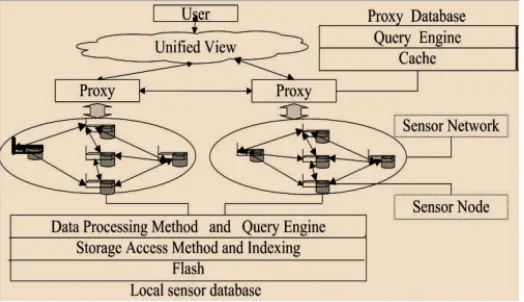
The system architecture of a typical sensor network includes resource constrained sensor nodes, a resource-rich sink node, the Internet, and a user interface [9]. The distributed database system mapped to the sensor network also adopts two-layer architecture. As shown in FIG. 1, the distributed database system is composed of a local database running on a sensor node and a distributed database management layer running on a sink node and interacting with a local database.
Fig. 1. Wireless Sensor Network Database System Architecture
!
"#$%&!'()*! +%(,#&! -./!
+%(,)(0!'()*! "%,,#&! +*#&20%! "%,,)(0!
3()*!
4&2(,1%)5%&! 6#12*)#(!7)(8)(0!,9,*%:! ;#<)=)>%&!
"#$%&! 0%(%&2*#&! "#$%&!'()*!
+%(,#&! -./! +%(,)(0!'()*! +%(,#&! -./! +%(,#&! -./!
+%(,)(0!'()*! "%,,#&! +*#&20%! "%,,)(0!
3()*! "%,,#&!
+*#&20%! "%,,)(0!
3()*!
4&2(,1%)5%&! 6#12*)#(!7)(8)(0!,9,*%:! ;#<)=)>%&!
"#$%&! 0%(%&2*#&!
Fig. 2. Nodes and data processing architecture of WSN
2.2 WSN information processing structure
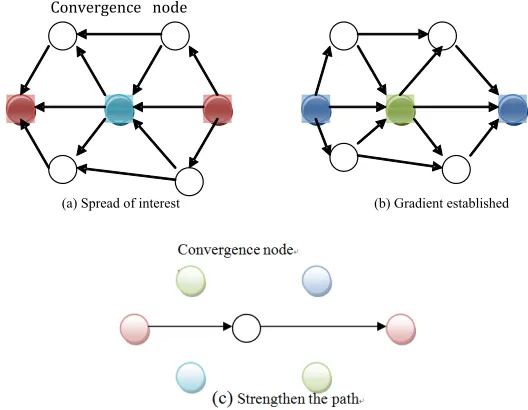
Wireless ad-hoc network is a query-based routing mechanism. Aggregation nodes send queries through interest messages, and flood messages to all sensor nodes in the entire area or in some areas [12]. The interest message represents the task of querying and express information that the network user is interested in the monitoring area, such as environmental information, temperature, humidity, and light in the monitoring area. During the propagation of the interest message, the protocol establishes a re-verse data transfer gradient from the data source to the sink-node on each hop. The sensor node transmits the collected data along the gradient direction.
Directed diffusion routing mechanism can be divided into cyclical interest diffu-sion, gradient establishment, and path enhancement in three stages. Figure 3 shows the data propagation path and force in these three phases.
!
! "#$%&'(&$)&! ! $#*&!
(a) Spread of interest (b) Gradient established
2.3 Data Management Model in WSN
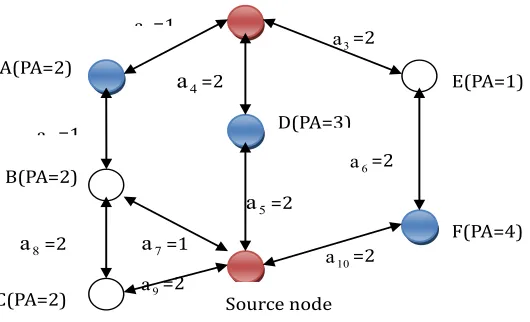
Data routing management. Data routing is one of the earliest proposed sensor network routing mechanism, so this paper will focus on analyzing and exploring it. Energy routing selects the data forwarding path based on the available power (PA) of the requirements. The available energy is the current remaining node [13]. The net-work is shown in Figure 3; capital letters denote nodes, such as node A. The numbers in brackets to the right of the node indicate the available energy. The bidirectional lines in the figure represent the communication links among the nodes, and the num-bers on the links represent the energy consumed for sending data on the link. The source node is a general-purpose sensor node that completes the data acquisition [14, 15]. In Figure 3, possible paths from the source node to the sink node are as follows.
Path 1: Source Node B-A-aggregation Node, the sum of all nodes PA on the path is 4, and the sum of energy required for sending packets on this path is 3.
Path 2: Source node -C-B-A-sink node, the sum of all nodes PA on the path is 6, and the sum of the energy required for sending the packet on the path is 6.
Path 3: Source node-D-sink node, the sum of all nodes PA on the path is 3, and the sum of energy required for sending packets on the path is 4.
Path 4: Source node-F-E-sink node, the sum of all nodes PA on the path is 5, and the sum of energy required to send the packet on this path is 6.
Energy routing strategies are the following.
1. Maximum PA route: Select the path with the largest sum of nodes PA from all the paths, which are from the data source. In Figure 3, the sum of PA in Path 2 is the largest, but Path 2 contains Path 1, so it is not efficient to exclude, and Path 4 has selected.
2. Minimum energy consumption routing: Select the path with the least energy con-sumption among all the paths.
3. Least hop count routing: Select the path from the data source with the fewest hops. Select path 3 in Figure 4.
4. Maximum and minimum PA node routing. There are multiple nodes on each path, which is different from the available energy of the node, and the node with the lowest available energy in each path has selected to represent the available energy of this path [16, 17]. If the available energy of the node in path 4 is a minimum of 1, the available energy of the path is 1. The maximum and minimum PA node rout-ing strategy is to choose the path with the largest available energy.
! "#$%&'(! )#$%&*(! +#$%&,(! 5 a &-! 4
a
&-!.#$%&-(! a9&-!
/#$%&-(! a &*! %#$%&-(!
3 a &-!
! a10&-! 6 a &-!
7
a &*!
.0123453163!1073!
! a &*!
! a1
!
8
a &-!
809463!1073!
Fig. 4. Energy routing algorithm
Multi-path routing. The traditional network routing mechanism often selects the path with the smallest hop count, but in the wireless sensor network. If you frequently use the same - path transmission of data, it will cause nodes on the path; so that the separate parts of the entire network are not connected. Reduce the lifetime of the entire network; Rahul C. Shah et al. have proposed a kind of energy multipath routing mechanism. According to the communication energy consumption of nodes and the remaining energy of nodes, this mechanism gives a certain choice probability for each path, so that the data transmission consumes the energy of the entire network evenly, extend the life of the entire network [18]. Energy multi-path routing protocols include path establishment, data dissemination, and routing maintenance three processes. The path establishment process is the key content of this agreement. Each node needs to know all the next-hop nodes that arrive at the destination node and calculate the prob-ability of selecting the data to transmit. The probprob-ability of selection has calculated from the node to the destination node, which has used in the following description
( )i
Cost N to represent the communication cost of node i. The main process of energy
multipath routing can be briefly described as follows.
(1) The destination node broadcasts message to the neighboring node to start the path establishment process. The path establishment message contains a cost field, which indicates the energy information on the path. We can set the initial value to 0.
(2) When a node sends a message to its neighbor nodes, they need to forward only when they are closer to the source node and farther away from the destination node the news. Otherwise, the message will discard.
(3) If the node decides to forward the path establishment message, it needs to cal-culate the new value to replace the old value. When the path establishment message is
sent from the node
N
i to the nodeN
j.)
,
(
)
(
,N i j i
N
Cost
N
Metric
N
N
i
jN
N
C
, represents the cost that the nodeN
jsends the data to reach the destinationnode
N
i through the node path,Metric
(
N
j,
N
i)
represents the communicationnode energy consumption from node
N
j to nodeN
i, the relationship is as follows.
Metric
(
N
j,
N
i)
=
e
ij"R
i! (2)!
ij
e
denotes the energy consumption of nodeN
j andN
i direct communication,!
i
R
denotes the remaining energy of nodeN
i,!
and!
is constant.(4) Node to give up the path of too much cost, node j will node i join the local routing table conditions are as follows.
))}
C
(
min
(
C
i
{
FT
j=
Nj,Ni"
!
k Nj,Nk (3)!
is greater than 1.(5) The node
N
j uses the following formula to calculate the probability ofselect-ing a node
N
i.
!
"=
j j k i j i
j
FT
k N,N
N , N N , N
C
1
C
1
P
(4)(6) The node calculates the cost of reaching the destination node based on the entry in the selection probability. It defined as the average of the cost of the nodes
)
N
(
Cost
j , which is arriving at the destination.
Cost
(
N
j)
j kj i j N,N
FT k N,N
C
P
!
"
=
(5)The node
N
j replaces the original cost value in the message with the value) N (
Cost j , and then broadcasts the route establishment message to the neighboring
node. In the data propagation phase, for each data packet received, the node selects one node from among the plurality of next hop nodes.
3
Route simulation with the least energy consumption in data
management
3.1 Construction of WSN data management platform
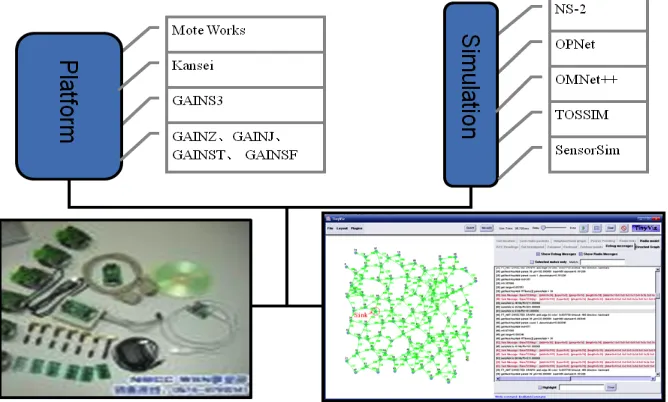
throughout the system configuration and remain static for quite some time thereafter. When the network topology is fixed and the traffic is relatively stable, this algorithm is the best. The system constructs the network node. Based on the TI-MAC underly-ing communication protocol, it independently develops the routunderly-ing protocol support-ing mobile users and constructs a double-layer communication monitorsupport-ing network [19]. Any one of the research results need to be its performance analysis and evalua-tion of verificaevalua-tion, the current verificaevalua-tion methods have divided into two kinds of experimental verification and simulation. The network experiment platform can ana-lyze the large-scale network environment. As a result, researchers have designed and developed many simulation platforms or established wireless sensor network models based on existing platforms. Figure 4 shows the WSN experiment simulation plat-form.
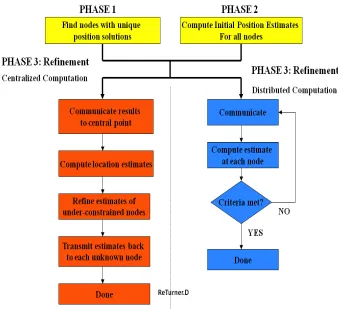
Fig. 5. Workflow of self-localization algorithms
3.2 WSN Self-Localization Algorithms
which TDOA algorithm calculates the distance. The positioning accuracy of TDOA is high. At present, large parts of positioning algorithms use TDOA to obtain the dis-tance. Rather than distance-based algorithms, positioning errors are greater than those based on ranging, but the hardware requirements of nodes are lower and less affected by environmental factors, which make them more suitable for wireless sensor net-works with limited energy.
Fig. 6. Workflow of self-localization algorithms
Fig. 7. Distance measurements to impose constraints
Based on the above operation, we can impose constraints on the x and y coordi-nates, which is more conducive to accurate distance measurement, it is also known as the bounding box. In the same distance from the limits on the x and y coordinates; the same beacons are constantly changing, so the one we choose most is the bounding.
Fig. 8. Multiple hops of distance measurements to impose constraints
Fig. 9. Select the most constraining bounds
3.3 The results of WSN Self-Localization test
In the C language environment, we run the program; the results have shown as fol-lows. First, we must define the number of the wireless sensor network. Then, we enter the source node number. Finally, we build the network and data in the transmission of energy between the two nodes. Finally, the program automatically calculates the path that consumes the least energy.
Fig. 10.
Workflow of self-localization algorithmsdis-cover Sink nodes and transmit data by sensing the data transmission behavior of inner nodes. Throughput reached 13%, packet loss rate of 44%, time delay of 68%, the network life expectancy of 36%. This shows that mobile Sink dynamic load balancing data aggregation algorithm in WSN data processing and data management optimal.
Fig. 11.The test results of self-localization algorithms
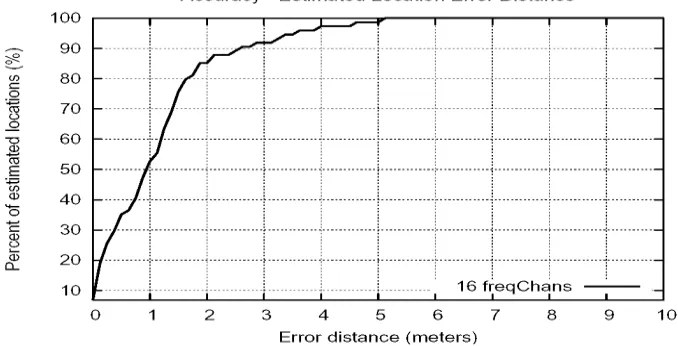
Fig. 12.The test results of estimated location
3.4 Analysis and discussion
For wireless sensor networks, the sensor nodes need to communicate with the cen-tral forwarding node, that is, the sensor nodes have connected to the cencen-tral forward-ing node by sforward-ingle hop or multi-hop. Therefore, all nodes in the coverage area of the central forwarding node must control by the MAC protocol to co-channel the capacity of the channel. On the one hand, when the number of nodes increases, not only the signal interference between the nodes increases, but also the link conflicts at the bot-tom of the link are inevitable. This will result in the single node throughput being
approximately O (1 / n!) with respect to the node number n, When !"1, the
through-put of a single node drops sharply. However, the system capacity of the entire net-work generally does not increase as the number of nodes increases, and even the ca-pacity may have reduced or even collided with all nodes. Since the sensor nodes clos-er to the centclos-er-forwarding node are more heavily loaded with the forwarding traffic, they easily become the "bottleneck" of the system capacity and reliability. Therefore, there exists a conflict area around the center-forwarding node in the wireless sensor network. The nodes included in this area must to send its forwarded and originating traffic competing channels, and the total competitive traffic is approximately propor-tional to the sum of the originating traffic of all nodes in the entire system. Each node
may obtain throughput of only O when each node has the same initial traffic and
guarantees fair access.
competition easier with multiple channels, which belongs to the category of resource scheduling. For wireless sensor networks, access latency is one of the key perfor-mances; multi-node forwarding means that the processing delay increases. The size of the access delay mainly depends on the node's forwarding processing delay and the link-layer competition queuing and retransmission delay. The former has related to the distribution of nodes and the coverage of the network. The latter has related to the average number of competitors per node and the competition. For wireless sensor networks, if the link adaptation strategy has not used to improve the link capacity near the access point. In addition, if the data between nodes is transmitted in parallel, the number of contending nodes in the same conflict area will be greatly reduced, and traffic balancing technology can be used to further reduce the number of link layer conflict, so that the total access delay may be smaller than single-hop access network.
4
Conclusions
Wireless sensor network is a new information acquisition and processing technolo-gy. In special fields, it has the incomparable advantages of traditional technology, and it will also open up a lot of new and valuable commercial applications. Because wire-less sensor network is an emerging technology, there are still few researches done in this special field in our country. In this paper, the concept, architecture, characteris-tics, and research progress of wireless sensor networks have briefly introduced. Low-power wireless transceivers can effectively collect useful information from different environments to distant base stations for processing. Due to the extremely limited battery energy of the sensor nodes, communication between system nodes should utilize energy efficiently to extend the life cycle of the network. In view of this, be-cause of digesting and assimilating the research results of others, the paper deeply analyzes the principle of energy routing in wireless sensor networks and gives a clear explanation based on the legend. The current use of the more common routing proto-col made a summary and comparison. In this paper, we use a brief program simula-tion to illustrate the process of selecting the minimum energy path in the network. This work made a comprehensive study of wireless sensor network energy routing. However, for each specific routing procedure, the specific application environment has played a guiding role. In the future, we should do the model and quantization positioning algorithm performance evaluation, WSN needs to establish standard simu-lation technology and simusimu-lation system. We can also achieve low-cost, high-precision positioning system in a ultra-large-scale network and self-adjusting posi-tioning algorithm in a mobile network environment.
5
Acknowledgment
6
References
[1]Da Xu, L., He, W., & Li, S. (2014). Internet of things in industries: A survey. IEEE Trans-actions on industrial informatics, 10(4), 2233-2243. https://doi.org/10.1109/TII.2014.230 0753
[2]Jin, J., Gubbi, J., Marusic, S., & Palaniswami, M. (2014). An information framework for creating a smart city through internet of things. IEEE Internet of Things Journal, 1(2), 112-121. https://doi.org/10.1109/JIOT.2013.2296516
[3]Hossain, E., & Hasan, M. (2015). 5G cellular: key enabling technologies and research challenges. IEEE Instrumentation & Measurement Magazine, 18(3), 11-21. https://doi.org/10.1109/MIM.2015.7108393
[4]Chen, C. P., & Zhang, C. Y. (2014). Data-intensive applications, challenges, techniques and technologies: A survey on Big Data. Information Sciences, 275, 314-347. https://doi.org/10.1016/j.ins.2014.01.015
[5]Abbasi, A. Z., Islam, N., & Shaikh, Z. A. (2014). A review of wireless sensors and net-works' applications in agriculture. Computer Standards & Interfaces, 36(2), 263-270. https://doi.org/10.1016/j.csi.2011.03.004
[6]Ortiz, A. M., Hussein, D., Park, S., Han, S. N., & Crespi, N. (2014). The cluster between internet of things and social networks: Review and research challenges. IEEE Internet of Things Journal, 1(3), 206-215. https://doi.org/10.1109/JIOT.2014.2318835
[7]Fadel, E., Gungor, V. C., Nassef, L., Akkari, N., Malik, M. A., Almasri, S., & Akyildiz, I. F. (2015). A survey on wireless sensor networks for smart grid. Computer Communica-tions, 71, 22-33. https://doi.org/10.1016/j.comcom.2015.09.006
[8]Zhang, Y., Qiu, M., Tsai, C. W., Hassan, M. M., & Alamri, A. (2017). Health-CPS: Healthcare cyber-physical system assisted by cloud and big data. IEEE Systems Jour-nal, 11(1), 88-95. https://doi.org/10.1109/JSYST.2015.2460747
[9]Hashem, I. A. T., Yaqoob, I., Anuar, N. B., Mokhtar, S., Gani, A., & Khan, S. U. (2015). The rise of “big data” on cloud computing: Review and open research issues. Information Systems, 47, 98-115. https://doi.org/10.1016/j.is.2014.07.006
[10]Han, Q., Liang, S., & Zhang, H. (2015). Mobile cloud sensing, big data, and 5g networks make an intelligent and smart world. IEEE Network, 29(2), 40-45. https://doi.org/10.1109/ MNET.2015.7064901
[11]Aazam, M., & Huh, E. N. (2014, August). Fog computing and smart gateway based com-munication for cloud of things. In Future Internet of Things and Cloud (FiCloud), 2014 In-ternational Conference on (pp. 464-470). IEEE.
[12]Rawat, P., Singh, K. D., Chaouchi, H., & Bonnin, J. M. (2014). Wireless sensor networks: a survey on recent developments and potential synergies. The Journal of supercompu-ting, 68(1), 1-48. https://doi.org/10.1007/s11227-013-1021-9
[13]Zhong, N., Ma, J., Huang, R., Liu, J., Yao, Y., Zhang, Y., & Chen, J. (2016). Research challenges and perspectives on Wisdom Web of Things (W2T). In Wisdom Web of Things (pp. 3-26). Springer International Publishing. https://doi.org/10.1007/978-3-319-44198-6_1
[14]Tran, Tuyen X., Mohammad-Parsa Hosseini, and Dario Pompili. "Mobile edge computing: Recent efforts and five key research directions." IEEE COMSOC MMTC Commun.-Frontiers (2017).
[16]Hu, H., Wen, Y., Chua, T. S., & Li, X. (2014). Toward scalable systems for big data ana-lytics: A technology tutorial. IEEE access, 2, 652-687. https://doi.org/10.1109/ACCESS. 2014.2332453
[17]Suryadevara, N. K., Mukhopadhyay, S. C., Kelly, S. D. T., & Gill, S. P. S. (2015). WSN-based smart sensors and actuator for power management in intelligent build-ings. IEEE/ASME transactions on mechatronics, 20(2), 564-571. https://doi.org/10.1109/ TMECH.2014.2301716
[18]Yang, C., Puthal, D., Mohanty, S. P., & Kougianos, E. (2017). Big-Sensing-Data Curation for the Cloud is Coming: A Promise of Scalable Cloud-Data-Center Mitigation for Next-Generation IoT and Wireless Sensor Networks. IEEE Consumer Electronics Maga-zine, 6(4), 48-56. https://doi.org/10.1109/MCE.2017.2714695
[19]Chin, W. H., Fan, Z., & Haines, R. (2014). Emerging technologies and research challenges for 5G wireless networks. IEEE Wireless Communications, 21(2), 106-112. https://doi.org/10.1109/MWC.2014.6812298
7
Authors
Yong Liu, Baohua Liang, and Jiabao Jiang are with Chaohu University, Chaohu, Anhui, China.