Reaction Mechanisms Simulation
Y.C. Alicia Tang1, Sharifuddin Mohd. Zain2, Noorsaadah Abdul Rahman2, and Rukaini Abdullah3
1
Department of Computer Science, University of Tenaga Nasional Jalan Kajang-Puchong, 43009 Selangor, Malaysia
2
Department of Chemistry, University of Malaya, 50603 Kuala Lumpur, Malaysia 3 Department of Artificial Intelligence, University of Malaya
50603 Kuala Lumpur, Malaysia
[email protected],{smzain,noorsaadah,rukaini}@um.edu.my
Abstract. Many chemistry students have difficulty in understanding an organic chemistry subject called reaction mechanisms. Mastering the subject would require the application of chemical intuition and chemi-cal commonsense adequately. This work discusses a novel framework us-ing Qualitative Reasonus-ing (QR) to provide means for learnus-ing reaction mechanisms through simulation. The framework consists of a number of functional components. These include substrate recognizer, qualitative model constructor, prediction engine, molecule update routine, explana-tion generator, and a knowledge base containing essential chemical facts and chemical theories. Chemical processes are represented as qualitative models using Qualitative Process Theory (QPT) ontology. The construc-tion of these models is automated based on a set of QR algorithms. We have tested the framework on theSN1 and theSN2 reaction mechanisms. Representative cases of reaction simulation and causal explanation are also included to demonstrate how these models can serve as a cognitive tool fostering the acquisition of conceptual understanding via qualitative simulation.
Keywords:qualitative reasoning, reaction mechanisms, QPT, ontology.
1
Introduction
Qualitative Reasoning (QR) is a branch of Artificial Intelligence (AI) research that attempts to model behavior of dynamic physical systems without having to include a bunch of formulas and quantitative data in the system. Qualitative representation captures the intuitive and causal aspects of many human mental models. The research spans all aspects of the theory and applications of qualita-tive reasoning about physical systems. Qualitaqualita-tive Process Theory (QPT)[1] is one of the prominent QR ontology that is widely used to represent the behavior of dynamical systems. CyclePad [2] that teaches analysis and design of ther-mal cycles is the first smart educational software that employed QPT. QALSIC
Z. Zhang and J. Siekmann (Eds.): KSEM 2007, LNAI 4798, pp. 18–29, 2007. c
is among the earliest applications of QPT in inorganic chemistry for qualita-tive analysis of a limited set of chemical reactions [3]. The chemical processes described in this paper were modeled using QPT ontology.
In the study of science subjects such as chemistry, it is believed that stu-dents should deeply understand the qualitative principles that govern the sub-ject, including the physical processes and the causal relationships before they are immersed in complex problem solving. A reaction mechanism describes the sequence of steps that occur during the conversion of reactants to product. Ex-amples of reaction mechanisms areSN1,SN2, electrophilic addition, and elimina-tions. Most of the time, the organic chemists could work out the mechanisms by only using commonsense developed from their chemical intuition and knowledge. A large number of chemistry students had difficulty in understanding reaction mechanisms. They learn the subject by memorizing the steps involved in each reaction. As a result, most students are unable to solve new problems. This finding initiated the work described in this paper. Even though there are many applications of AI techniques in organic chemistry, none has used QPT as the knowledge capture tool. This paper discusses the first use of the QR approach coupled with the QPT ontology to develop a framework that is able to simu-late processes such as “make-bond” and “break-bond” in order to reproduce the chemical behaviors of organic reaction mechanism. The paper also introduced OntoRM, which is a set of ontology specifically for use with reaction mecha-nisms simulation. The framework will later on be transformed into a learning tool called Qualitative Reasoning in Organic Mechanisms (QRIOM).
We have reported in [4] about the modeling decisions and problems faced when trying to cast the expert knowledge into qualitative models. In [5], we justified the problem as a suitable domain by comparing inorganic chemical re-actions and organic reaction mechanisms. In the work, we have also grouped all reacting species as either a nucleophile (charged/neutral) or an electrophile (charged/neutral), upon which chemical processes are selected. In [6], we pro-vided guidelines for chemical properties abstraction and a description of how the QPT is used for modeling. In [7], we further ascertained that there are two main reusable processes, namely “make-bond” and “break-bond”, for the entire reaction mechanisms, specifically onSN1 andSN2. An algorithm for automating the “make-bond” and the “break-bond” processes in QPT terms has also been discussed in the paper, where the initiation of the entire process is from a simple substrate.
In Sect. 2, we provide the methodology of our work. These include data sets, algorithms and functional components used by the framework. Section 3 dis-cusses the simulation algorithm together with a process reasoning scenario and an explanation generation example. Section 4 concludes the work.
2
Methodology
2.1 QPT as the Knowledge Capture Tool
Among the well-known QR ontology are component-centered [8], constraint-based [9] and process-centered [1]. QPT is a process-centered ontology. The the-ory provides the necessary means for representing qualitative knowledge, and the notion of processes needed in expressing chemical reaction steps (E.g. “pro-tonation” and “dissociation” processes). In QPT, a description of the model is given by a set of individual views and processes. The individual views (E.g. a nucleophile) describe objects and their general characteristics while theprocesses (E.g. “make-bond”) support changes in system behavior. A process is described by five slots:Individuals, Preconditions, Quantity-conditions,Relations and In-fluences. TheQuantity-conditionsslot contains inequalities involvingquantities. A quantity is used to represent an object’s characteristic, which is crucial in determining the status of a process (active/inactive). The statements in the Re-lations slot defined functional dependencies amongquantities. Other important design constructs are the qualitative proportionalities and the quantity spaces (see Sect. 2.2). Note: words typed in italics are QPT modeling constructs. Fur-ther discussion about the ontology is beyond the scope of this paper. Readers may refer to Forbus [1] for a complete description of the ontology.
2.2 Qualitative Proportionality, Direct Influence, and Quantity
Space
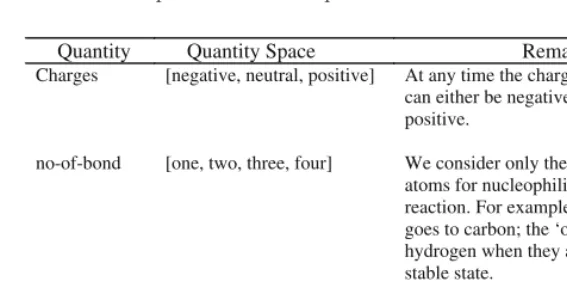
This section discusses the main modeling constructs used in the framework. Qualitative proportionalities are responsible for propagating the effects of pro-cesses execution. For example: lone-pair-electron (O)P−+ no-of-bond (O) means “an increase in covalent bond on the ‘O’ atom will cause a decrease in the num-ber of lone-pair electrons on it”. In QPT, the dynamic aspects are expressed by the notion of direct influence, represented in the slot calledInfluences as either I+ or I-. For example, I+(no-of-bond(O),Am[bond-activity]) indicates that in a chemical process, the direct effect on ‘O’ is the extra covalent bond it would gain. This effect will be propagated to other statements in the Relations slot. Examples ofquantities are number of covalent bond, lone-pair electrons and nu-cleophilic reactivity. A quantity consists of two parts: amount (magnitude) and derivative (sign).Quantity space is a collection of numbers which form a partial order. Processes start and stop when orderings between thequantities change. Table 1 gives the three mainquantities used in the problem. The main task of qualitative simulation based on this formalism is to keep track of the changing states in each quantity for each individual view used in a reaction, in order to explain why and how a particular process happens or ends.
2.3 Data Sets
Table 1. Quantities and quantity spaces used in the framework for modeling the behaviors of nucleophiles and electrophiles
Quantity Quantity Space Remarks
Charges [negative, neutral, positive] At any time the charge on any atom can either be negative, neutral or positive.
no-of-bond [one, two, three, four] We consider only the important atoms for nucleophilic substitution reaction. For example, the ‘four’ goes to carbon; the ‘one’ is for hydrogen when they are in the most stable state.
lone-pair-electrons
[zero, one, two, three, four] The maximum value ‘four’ is for halide ions. The minimum ‘zero’ goes to hydrogen ion.
Examples of the reaction formulas used in modeling and simulation are (1) and (2).
(CH3)3COH+HCl → (CH3)3CCl+H2O. (1) (CH3)3CBr+H2O → (CH3)3COH+HBr. (2)
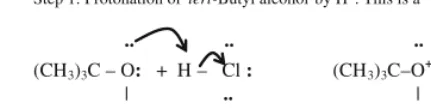
Both the equations can be explained by theSN1 mechanism. In general,SN1 is a two-stage mechanism. In the first stage, the alcohol oxygen (the ‘O’ from the ‘OH’ group) is protonated. Meaning, the ‘O’ captures the electrophile (‘H+’). This is to make the ‘O+H2’ as a good leaving group, in order to break the bond between the ‘C’ and the ‘O+H2’. Once broken, a carbocation will be produced. In the second stage, the incoming nucleophile (‘X−’) can bond to the carboca-tion to form a neutral and stable final product. In any chemical reaccarboca-tion, some bonds are broken and new bonds are made. Often, these changes are too com-plicated to happen in one simple stage. Usually, a reaction may involve a series of small changes one after the other. Thus, (1) can be subdivided into a series of small step, as shown in Fig. 1. The main ideas of the reactions in Fig. 1 will be modeled as QPT processes. These processes are automatically generated by the Qualitative Model Constructor (module 2, Fig. 4). In which, the chemical properties of each organic reaction are represented as chemical theories using the qualitative proportionality construct. To avoid being too technical in terms of chemistry contents, we provided in this paper only the results (qualitative models in QPT syntax), rather than the entire modeling activity. A qualitative simulation scenario for the first reaction step in (1) is demonstrated in Sect. 3.
2.4 Knowledge Validation
Step 1: Protonation of tert-Butyl alcohol by H+. This is a “make -bond” process.
.. .. .. ..
(CH3)3C – O: + H – Cl : (CH3)3C–O +
[image:5.513.89.305.75.129.2] [image:5.513.82.349.411.526.2]–H + : Cl : | .. | ..
H H
tert-butyl alcohol hydrogen chloride tert-butyloxonium ion chloride ion
Step 2: Dissociation of tert-butyloxonium ion. This is a “break -bond” process.
.. .. (CH3)3C – O
+
– H CH3)3C +
+ : O–H | |
H H
tert-butyloxonium tert-butyl cation water
Step 3: Capturing of tert-butyl cation by chloride ion. This is a “make -bond” process.
.. ..
(CH3)3C +
+ : Cl : (CH3)3C – Cl :
.. ..
tert-butyl cation chloride ion tert-butyl chloride
Fig. 1.The production of alkyl halide can be explained by a series of three reaction steps
facilitate knowledge validation during simulation such as to constrain the use of the chemical knowledge base. As an example, the OntoRM can be used to check if a primary alcohol can undergo a SN1 reaction. Representative examples of OntoRM are given in Fig. 3. Further discussion about OntoRM is not the focus of this paper.
OntoRM (upper tier)
(A chemistry ontology for describing the requirements and constraints in reaction mechanism simulation)
Some items include: Possible
end products
List of allowable
reagents
Common processes in nucleophilic
substitution reaction
Possible order of processes
execution
Pairs of nucleophile
and electrophile
Chemical Knowledge Base (lower tier)
(Basic chemical facts and chemical such as elements and their unchanged properties)
ReactionMechanism Sn1 [
hasAlias =>> STRING; hasReactants =>> FuncUnit; hasReactantNames =>> STRING; hasProduct =>> PROD_STRING; hasProductNames =>> STRING; hasDegreeSubstituent =>> NUMBER; hasReactivity =>> BOOLEAN;
hasRateDetermineStep =>> WHAT_STEP_STRING; hasProcessOrder =>> PROCESS_ORDER_STR; hasViewsPairConstraint =>> SPECIES_TYPE; hasSpecialCause = >> SOLVENT_TYPE; ]
ElectrophileView[
hasName =>> STRING;
hasNeutral =>> Electrophile; hasCharge =>> Electrophile; hasBond =>> NUMBER;
hasRsDegree =>> NUMBER;
hasCarbocationStability=>>FUZZY_VALUE; hasLonePair =>> NUMBER;
hasReactivity =>>BOOLEAN;
[image:6.513.103.316.346.571.2]hasChargeOperator =>> PLUS_MINUS; hasBondOperator =>> ADD_REMOVE; ]
Fig. 3.Definitions ofSN1 mechanism and electrophile in OntoRM
Explanation 5 Generator and
Causal Model Reasoner
(Results justification)
3 Molecule Prediction Limit Update Engine Analyzer Routine (Simulator)
Qualitative 2 Model Constructor
Graphical User Interface
Chemical Facts & Chemical Theories
Substrate Recognizer 1 Results 4 (Final products and the
mechanism used)
OntoRM
QPT Processes Data
Structure Store
2.5 Functional Components
The QR framework is presented in Fig. 4. The framework consists of a set of reusable components such as the substrate recognizer, qualitative models, On-toRM, prediction engine, and causal explanation generator. The roles of the prediction engine and the explanation generator are discussed in Sect. 3.
The modules in Fig. 4 serve as embedded intelligence to the simulator. When used, it is expected to generate the following outputs: Final products; interme-diates produced at each step; the sequence of use of the chemical processes; the name of the mechanism used; the structural change of the substrate; and the parameters change of each nucleophile and electrophile.
3
Qualitative Simulation
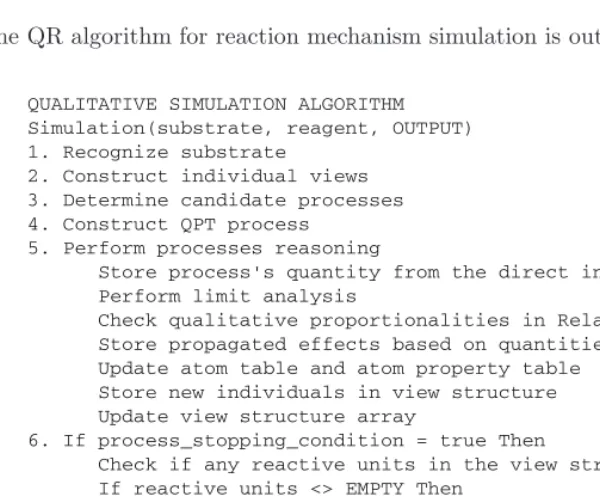
The QR algorithm for reaction mechanism simulation is outlined in Fig. 5.
QUALITATIVE SIMULATION ALGORITHM Simulation(substrate, reagent, OUTPUT) 1. Recognize substrate
2. Construct individual views 3. Determine candidate processes 4. Construct QPT process
5. Perform processes reasoning
Store process's quantity from the direct influence slot Perform limit analysis
Check qualitative proportionalities in Relation-slot Store propagated effects based on quantities dependency Update atom table and atom property table
Store new individuals in view structure Update view structure array
6. If process_stopping_condition = true Then
Check if any reactive units in the view structure If reactive units <> EMPTY Then
Go to step 3 Else
Suggest the mechanism used in the simulation Show the overall reaction route
Display final products End_If
End_If
[image:7.513.61.361.254.502.2]7. Generate explanations
Fig. 5.QR algorithm based on QPT for reaction mechanism simulation
3.1 Top Level Design of the Simulation Algorithm
(IS). Next, it is the checking of what processes can be used. When a process is in active state, reasoning will begin (details are given in Sect. 3.2). Briefly, the reasoning engine will keep track of the values of the affectedquantities, starting from the first process until the entire reaction ends. A process will stop when the statements in itsquantity-condition slot are invalid. If there are still reactive units (E.g. charged species or species that have not completed their valences), the reasoning process will be repeated. The entire reaction will end when there is no moreviews in the IS. When a reaction ends, outputs are displayed, together with all steps/processes involved in producing the outputs. If a user needs an explanation for the results or has a question regarding the behavior of aquantity, then the explanation module will be run.
3.2 Process Reasoning
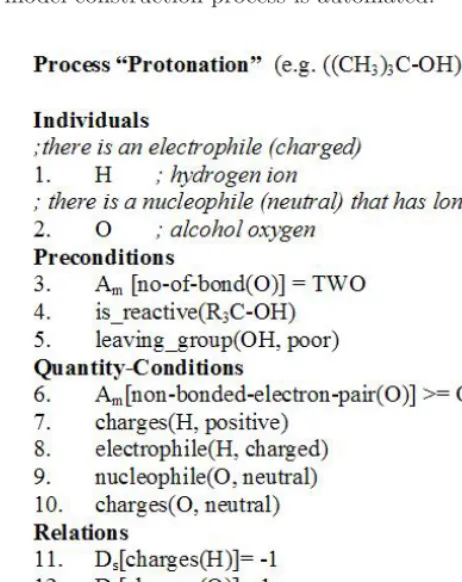
[image:8.513.78.309.299.590.2]A qualitative model for the “protonation” process is shown in Fig. 6. All com-plexities in constructing a qualitative model are hidden from the users, since the QPT model construction process is automated.
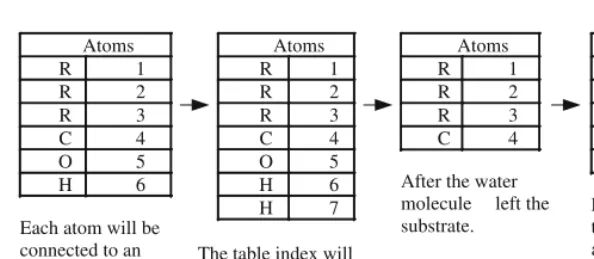
Atoms R 1 R 2 R 3 C 4 O 5 H 6
Each atom will be connected to an array of its basic chemical properties. Atoms R 1 R 2 R 3 C 4 O 5 H 6 H 7
The table index will differentiate which ‘H’ is recently attached.
Atoms R 1 R 2 R 3 C 4
After the water molecule left the substrate.
[image:9.513.59.356.53.182.2]Elements in the table are retrieved and displayed as output. Atoms R 1 R 2 R 3 C 4 Cl 5
Fig. 7.A snapshot of the contents of an atom array during simulation.R=CH3.
[image:9.513.96.328.397.579.2]“Protonation” is the first reaction step of theSN1 mechanism for predicting the final product for (CH3)3COH+HCl. Prediction begins with theInfluences slot where the number of covalent bond on the ‘O’ will increase (Line 17). Such effect will propagate to other dependentquantities. For example, the number of lone-pair electrons will decrease when more covalent bonds are made on the ‘O’ via the inversequalitative proportionality (Line 13). When the lone-pair electron of ‘O’ decreases, the charges on ‘O’ will also increase (Line 14). This will make the ‘O’ become positively charged and having an extra covalent bond (hence it is un-stable). When ‘O’ is protonated, the ‘H’ is no longer positively charged (Line 16), thus violating the statement in thequantity-conditions slot. All values assigned
Table 2.Atom property array keeps track of the step-by-step changing of values in various quantities
Charges No. of
covalent bond
Lone -pair electron
C Neutral 4 0
O Neutral 2 2
H Neutral 1 0
(+)
Charges No. of
covalent bond
Lone -pair electron
H Positive 0 0
(=)
Charges No. of
covalent bond
Lone -pair electron
C Neutral 4 0
O Positi ve 3 1
H Neutral 1 0
to each individual view are taken from thequantity spaces by the limit analyzer, in that it keeps track of the current values of eachquantityand their direction of change. The running result of the limit analyzer, acted on the atom array will be used to produce the molecule structure for the final product. An atom array is a table that stores the elements of a substrate during reasoning in order to produce the structure of the final product. Figure 7 depicts the contents of an atom array during processes simulation for reaction formula in (1). When performing limit analysis, the atom property array will also be updated. This is when the pro-cesses move from one to another until the entire reaction ended. A snapshot of the atom property array during process reasoning is given in Table 2. The above is achieved through constant updating of thequalitative proportionality statements (Lines 13-16) using values in thequantity spaces. In QRIOM, qualitative models can be inspected by learners at any stage of the learning process. This helps to sharpen a learner’s logical and critical thinking in the way that the learner has to think hard for why the statements in each slot are relevant or negligible.
3.3 Explanation Generation
The ability to generate causal explanation has been one of the promises of the QR approach. Causality is normally used to impose order. For example, when given ‘P causes Q’, we believe that if we want to obtain Q we would bring about P. As such, when we observe Q we will think that P might be the reason for it. We will demonstrate how the modeling constructs of QPT can provide this nature of explanation. Figure 8 shows a partial causal diagram derived from Fig. 6.
Two qualitative proportionalities (abstracted from the left branch of Fig. 8) are presented (3) and (4) to manifest the explanation generation ability of the approach.
lone pair electron(O) P−+ no of bond(O). (3) charges(O) P+− lone pair electron(O). (4) Based on the above parameters dependency statements, a set of hypothetical Q&A and answers can be devised, as follows:
– Question 1: How would you explain a decrease in the lone-pair-electron on the ‘O’ atom?
– Answer 1: The immediate cause of the process is the number of covalent bond on ‘O’ will increase. This quantity will influence the lone-pair-electron on ‘O’, and the influence is strictly decreasing through the inverse proportionality relationship. Thus, a decrease in the lone-pair-electron on ‘O’ is observed.
– Question 2: How would the above qualitative proportionalities explain the ‘O’ atom become positively charged?
– Answer 2: The number of lone-pair-electron will decrease when more covalent bonds are made on ‘O’ via the inverse proportionality defined in (3). In (4), when the lone-pair-electron on ‘O’ decreases, the charge on it will increase.
lone -pair-electron(O) >= min -electron-pair(O)
bond-activity
I+ I-
no-of-bond(O) charges(H)
P
P
lone-pair-electron(O) no-of-bond(H)
P
[image:11.513.110.323.52.203.2]charges(O)
Fig. 8.The inequality above the dotted line is the entry condition to the process. Effects propagation is modeled using the ‘Is’ and the ‘Ps’ of the QPT design constructs.
4
Conclusion
We proposed a QR framework using the QPT ontology to systematically gather, reuse, and explain the knowledge about reaction mechanisms. The ontology pro-vides the means to describe processes in conceptual terms, and embody notions of causality which is important to explain the behavior of chemical systems. The framework can provide a learning environment that assists learners in un-derstanding the ‘How’, ‘Why’, ‘Why-not’, and ‘What’ aspects of the general principles of organic reactions. Our approach enables prediction (for the out-puts) to be made, as well as causal explanation generation about theories of chemical phenomenon. The system can be expected to provide explanation to the following questions: (1) What are the chemical processes used? (2) What was their sequence of use? (3) What happened to each functional group (E.g. a particular nucleophile) in a reaction? With this promise, students can better understand the underlying chemical concepts. Their critical thinking can be im-proved especially from inspecting the cause-effect chain that explains an aspect of system behavior using only the ontological primitives. We envisage that the tool will improve a student’s intuitive learning, in that it can lead to deeper and systematic understanding of chemical processes.
References
1. Forbus, K.: Qualitative Process Theory. Artificial Intelligence 24, 85–168 (1984) 2. Forbus, K., Whalley, P., Everett, J., Ureel, L., Brokowski, M., Baher, J., Kuehne,
S.: CyclePad: An Articulate Virtual Laboratory for Engineering Thermodynamics, Artificial Intelligence Journal 114, 297–347 (1999)
4. Alicia Tang, Y.C., Zain, S.M., Abdul Rahman, N., Abdullah, R.: Modelling of Or-ganic Reaction Mechanism Using Qualitative Process Theory: A Modeller’s Experi-ence. In: ATC. Conference on Intelligent System and Robotics, Advanced Technol-ogy Congress, Malaysia (2005)
5. Alicia Tang, Y.C., Syed Mustapha, S.M.F.D.: Representing SN1 Reaction Mecha-nism using the Qualitative Process Theory. In: Bailey-Kellogg, C., Kuipers, B. (eds.) International Workshop on Qualitative Reasoning 2006, Hanover, USA, pp. 137–147 (2006)
6. Alicia Tang, Y.C., Zain, S.M., Abdul Rahman, N., Abdullah, R.: Knowledge Repre-sentation and Simulation of Nucleophilic Substitution Reactions using Qualitative Reasoning Approach. In: IEEE TENCON, Hong Kong (2006) ISBN: 1-4244-0549-1 7. Alicia Tang, Y.C., Syed Mustapha, S.M.F.D., Abdullah, R., Zain, S.M., Abdul Rah-man, N.: Towards Automating QPT Model Construction for Reaction Mechanisms Simulation. In: Price, C., Snooke, N. (eds.) International Workshop on Qualitative Reasoning 2007, Aberystwyth, United Kingdom (2007) (poster)
8. de Kleer, J., Brown, J.S.: Qualitative Physics Based on Confluences. Artificial In-telligence Journal 24, 7–83 (1984)