Journal of Criminal Law and Criminology
Volume 104 | Issue 3
Article 2
Fall 2014
Why So Contrived? Fourth Amendment
Balancing, Per Se Rules, and DNA Databases After
Maryland v. King
David H. Kaye
Follow this and additional works at:
https://scholarlycommons.law.northwestern.edu/jclc
Part of the
Criminal Law Commons
This Criminal Law is brought to you for free and open access by Northwestern University School of Law Scholarly Commons. It has been accepted for inclusion in Journal of Criminal Law and Criminology by an authorized editor of Northwestern University School of Law Scholarly Commons.
Recommended Citation
David H. Kaye,Why So Contrived? Fourth Amendment Balancing, Per Se Rules, and DNA Databases After Maryland v. King, 104 J. Crim. L. & Criminology 535 (2014).
535
WHY SO CONTRIVED?
FOURTH AMENDMENT BALANCING,
PER SE RULES,
AND
DNA DATABASES AFTER
MARYLAND V. KING
DAVID H. KAYE*
In Maryland v. King, 133 S. Ct. 1958 (2013), the Supreme Court narrowly upheld the constitutionality of routine collection and storage of DNA samples and profiles from arrestees. In doing so, it stepped outside the usual framework that treats warrantless searches as per se unconstitutional unless they fall within specified exceptions to the warrant and probable cause requirements. Instead, the Court balanced various individual and state interests. Yet, as regards the state interests, the Court confined this direct balancing analysis to the perceived value of using DNA to inform certain pretrial decisions. Oddly, it avoided relying directly on DNA’s more obvious value in generating investigative leads in unsolved crimes.
This Article suggests that this contrived analysis resulted from the structure of existing Fourth Amendment case law (and perhaps a desire to avoid intimating that a more egalitarian and extensive DNA database system also would be constitutional). It demonstrates that the opinion does not support a “no lines” system of ad hoc judgments about the reasonableness of every search using the totality of the circumstances. Recognizing that the existing framework of categorical exceptions to the warrant requirement diverges from an older “warrant preference” rule that demands a warrant whenever feasible, the Article shows that King leaves the current per se framework largely intact.
Nevertheless, this Article questions the resort to direct balancing. It presents a more coherent doctrinal framework for scrutinizing not just DNA profiling, but all forms of biometric data collection and analysis. In this regard, it notes that the dissenting King opinion overstates the differences between fingerprinting and DNA profiling as currently practiced. Finally, it suggests that the cramped reasoning in both opinions limits the implications of the case for more aggressive DNA database laws—ones that cover more crimes, more people, more loci, and more methods for acquiring DNA samples.
TABLE OF CONTENTS
INTRODUCTION ... 536
I.THE COURT’S REASONING:FREE-FORM BALANCING WITH BLINDERS ... 541
A. Deciding to Balance ... 542
B. Balancing to Decide ... 544
C. The Dissent’s Suspicionless Search Doctrine... 549
II.DOCTRINAL ALTERNATIVES:ACLOSER LOOK AT PSUWE AND THE DEMISE OF THE WARRANT-PREFERENCE RULE ... 556
A. Discarding the Per Se Rule ... 557
B. Special Needs Balancing ... 566
C. A Broader Biometric Exception ... 568
III.MORE TO COME ... 572
A. Noncoding Loci and Statutory Privacy Protections ... 573
B. From “Serious Offenses” to Universal Coverage ... 577
C. Uniformity of Application ... 585
D. No Bodily Intrusion ... 587
E. Outer-directed Database Trawling (a.k.a. “Familial Searching”) ... 588
F. Profiling Before Charging ... 589
G. Retaining Without Convicting... 591
CONCLUSION ... 593
INTRODUCTION
In Maryland v. King,1 the Supreme Court rejected a constitutional
challenge to the practice of routinely collecting DNA from arrested individuals.2 A bare majority of five Justices effusively endorsed the
1 133 S. Ct. 1958 (2013).
2 Id. at 1980. A similar but shorter description of the case than the one provided here can
acquisition of DNA samples for “identification” before conviction (DNA-BC).3 In response, four dissenting Justices called the opinion a
precedent-shattering and “scary”4 foundation for “the construction of . . . a genetic
panopticon”5 that could gaze into the DNA of airline travelers, motorists,
and public school students.6
The case began when police in Maryland arrested Alonzo King for menacing people with a shotgun.7 Following the arrest, they took his
picture, recorded his fingerprints—and swabbed the inside of his cheeks.8
When checked against Maryland’s DNA database, his DNA profile led to the discovery that six years earlier, King had held a gun to the head of a fifty-three-year-old woman and raped her.9 Before the DNA match, the
police had no reason to suspect King of that crime. Lacking probable cause—or even reasonable suspicion—they did not rely on a judicial order to swab his cheek. They relied on a state law that mandated collection of DNA from all people charged with a crime of violence or burglary.10
King appealed the resulting rape conviction.11 He argued that the
DNA collection deprived him of the right, guaranteed by the Fourth Amendment to the Constitution, to be free from unreasonable searches or seizures.12 Maryland’s highest court agreed.13 It held that except in the
rarest of circumstances where a suspect’s true identity could not be established by conventional methods—the court gave the example of a face transplant14—forcing an arrestee to submit to DNA sampling was
unconstitutional.15
The state petitioned the Supreme Court for review.16 Over and over,
the Court had denied requests from convicted offenders and, more recently,
3 See King, 133 S. Ct. at 1966 (“The advent of DNA technology is one of the most
significant scientific advancements of our era.”); see also infra text accompanying notes 52, 61, and 72.
4 Id. at 1989 (Scalia, J., dissenting). 5 Id.
6 Id.
7 Id. at 1966 (majority opinion). 8 Id.
9 See King v. State, 42 A.3d 549, 553–54 (Md. 2012).
10 Id. at 552, 553; see also MD.CODE ANN.,PUB.SAFETY, § 2-504(a)(3)(i) (LexisNexis
2011).
11 King, 42 A.3d at 555. 12 See id.
13 See id. at 555–56. 14 Id. at 580 n.35. 15 See id. at 580.
16 See Maryland v. King, 133 S. Ct. 1, 2 (2012) (Roberts, C.J., in chambers) (granting a
from arrestees to address the legality of state and federal laws mandating routine collection of their DNA. But this case was different. Never before had a state supreme court or a federal appellate court deemed a DNA database law unconstitutional.17 Even before the Court met to consider
whether it would review the case, Chief Justice John Roberts stayed the Maryland judgment.18 His chambers opinion stated “there is a fair prospect
that this Court will reverse the decision below”19 and found that “the
decision below subjects Maryland to ongoing irreparable harm.”20
The Chief Justice’s prediction proved correct. But the margin of victory was as narrow as it could be, and the majority opinion leaves important questions unresolved. Moreover, the dissenting Justices issued a biting opinion importuning the Court “some day”21 to repudiate its
“incursion upon the Fourth Amendment.”22 Indeed, when Justice Anthony
Kennedy announced the opinion of the Court, Justice Antonin Scalia invoked the rare practice of reading a dissent aloud. For eleven minutes, he mocked the majority’s defense of Maryland’s law as a means of identifying arrestees.23 “[I]f the Court’s identification theory is not wrong, there is no
such thing as error,” he railed.24 As he and the three Justices who joined his
dissenting opinion (Justices Ruth Bader Ginsburg, Sonia Sotomayor, and Elena Kagan) saw it, the majority’s reasoning “taxes the credulity of the credulous.”25
17 See David H. Kaye, On the “Considered Analysis” of Collecting DNA Before
Conviction, 60 UCLA L. REV. DISC. 104, 106 (2013) [hereinafter Kaye, “Considered
Analysis”]. The only appellate defeat before 2012 came in In re C.T.L., 722 N.W.2d 484 (Minn. Ct. App. 2006). See David H. Kaye, The Constitutionality of DNA Collection Before Conviction: An Updated Scorecard, FORENSIC SCI. STATISTICS &LAW (Mar. 30, 2013), http://goo.gl/D4b4Dl (listing earlier cases in which courts found DNA database laws constitutional).
18 See King, 133 S. Ct. at 3. 19 Id.
20 Id. The Chief Justice maintained that “[a]ny time a State is enjoined by a court from
effectuating statutes enacted by representatives of its people, it suffers a form of irreparable injury.” Id. (quoting New Motor Vehicle Bd. v. Orrin W. Fox Co., 434 U.S. 1345, 1351 (1977) (Rehnquist, J., in chambers)). But the notion that every court order that blocks enforcement of a duly enacted law works an irreparable injury seems extravagant. See
David H. Kaye, Supreme Court to Review DNA Swabbing on Arrest??, FORENSIC SCI. STATISTICS &LAW (July 31, 2012), http://goo.gl/ugxcaG.
21 Maryland v. King, 133 S. Ct. 1958, 1990 (2013) (Scalia, J., dissenting). 22 Id. at 1989–90.
23 See Joan Biskupic, Analysis: With Trademark Vigor, Justice Scalia Dissents in DNA
Case, REUTERS (June 3, 2013, 3:40 PM), http://goo.gl/T5UhRd; Joan Biskupic, Colorful
Dissent Is in Scalia’s DNA, COLUMBUS DISPATCH (June 4, 2013, 8:24 AM), http://goo.gl/gkalGW.
The popular press and bloggers seized on the dissent’s portrayal of the Court’s opinion.26 One trenchant journalist asked, “Why did Kennedy write
his opinion in a way that makes him sound like the last guy on Earth to discover Law & Order?”27 Why indeed? Justice Kennedy knew perfectly
well that DNA-BC was being used to solve crimes. That was why the Chief Justice had granted the stay. It was why Justice Samuel Alito had flagged the case during the oral argument as “perhaps the most important criminal procedure case that [the Supreme] Court has heard in decades.”28 It was
why the first words from Maryland’s Deputy Attorney General at oral argument were “Mr. Chief Justice, and may it please the Court: Since 2009, when Maryland began to collect DNA samples from arrestees charged with violent crimes and burglary, there had been 225 matches, 75 prosecutions and 42 convictions, including that of Respondent King.”29
This Article explains why Justice Kennedy’s opinion seems so contrived, describes more convincing (and doctrinally adequate) ways to analyze the constitutionality of DNA-BC, and probes the boundaries of the Court’s decision. I suggest that the King Court treated the primary value of DNA-BC—as a crime-solving tool—as merely incidental to other functions because of the Court’s ambivalent jurisprudence on the propriety of balancing state and individual interests to ascertain the reasonableness of searches under the Fourth Amendment. The majority was unwilling or unable to speak clearly about the category of cases in which balancing is permissible. It was unwilling or unable to consider creating an express exception to accommodate the traditional rule that searches that do not fall within defined exceptions necessarily require probable cause and a warrant.30 As a result, the Court opened itself to the dissent’s charge of
26 Professor Jeffrey Rosen called the opinion Justice Scalia’s wittiest and finest
moment—“one of the best Fourth Amendment[] dissents, ever.” Jeffrey Rosen, A Damning Dissent: Scalia’s Smartest, Wittiest Ruling of All Time, NEW REPUBLIC (June 4, 2013), http://goo.gl/RgQzj2. Professor Noah Feldman agreed with the opinion’s “libertarian impulse.” Noah Feldman, Court’s DNA Ruling Brings U.S. a Step Closer to ‘Gattaca,’
BLOOMBERG (June 3, 2013, 1:12 PM), http://goo.gl/fvIM8B, but described it as a “pungent” declaration of “Luddite liberty,” id., “dripping with contempt,” Noah Feldman, Grumpy Old Scalia v. Those Pesky Kids, BLOOMBERG (June 30, 2013, 11:00 AM), http://goo.gl/qZcjfw.
27 Emily Bazelon, They’re Coming for Your DNA, SLATE, http://goo.gl/QpebpT (last
visited May 28, 2014).
28 Transcript of Oral Argument at 35, Maryland v. King, 133 S. Ct. 1958 (2013) (No.
12-207) [hereinafter Transcript].
29 Id. at 3. This was as far as she got before encountering Justice Scalia’s sarcasm:
“Well, that’s really good. I’ll bet you if you conducted a lot of unreasonable searches and seizures, you’d get more convictions, too. (Laughter.) That proves absolutely nothing.” Id.
30 This possibility was noted in the state’s petition for a writ of certiorari but studiously
blinking reality and of being less than “minimally competent [in] English.”31
But the dissenting opinion, I maintain, fares no better. For all its barbs and jibes, its turns of phrases, and its literary allusions, the opinion points to no fundamental individual interest or social value that could justify so bilious a condemnation of DNA-BC. It presents an oversimplified description of Fourth Amendment jurisprudence and applies a one-size-fits-all approach to one-size-fits-all types of searches of the person, even though these searches vary greatly in their impact on legitimate individual interests and in their value to law enforcement.
In short, the opinions represent a lost opportunity to clarify the law on balancing tests for Fourth Amendment rights and to scrutinize biometric data collection and analysis practices within a more coherent doctrinal framework. To explain and justify this assessment, Part I describes the reasoning of the Justices. It shows how the majority opinion expands an ill-defined set of cases in which a direct balancing of interests determines the reasonableness of certain searches or seizures. It also maintains that the dissent simply drew an arbitrary line that was compelled neither by precedent nor by the interests that should determine the scope of Fourth Amendment protection.
Part II looks more deeply into how the Court reasoned about reasonableness. It describes the existing version of the rule that searches without a warrant and probable cause are unreasonable without an applicable exception—what I call the PSUWE (per-se-unreasonable-with-exceptions) framework. It contrasts this framework to an earlier “warrant preference” rule,32 regime,33 model,34 or view35 that “the modern Court has
31 King, 133 S. Ct. at 1985 (Scalia, J., dissenting); see also infra note 53.
32 See, e.g., Tracey Maclin & Julia Mirabella, Book Review, Framing the Fourth, 109
MICH.L.REV. 1049, 1061 (2011) (“[T]he ‘warrant preference’ rule . . . holds that a warrant is a necessary precondition of a reasonable search, unless there is a compelling reason for proceeding without one.”); David E. Steinberg, The Uses and Misuses of Fourth Amendment History, 10 U.PA.J.CONST.L. 581, 584 (2008) (“According to a number of scholars, the Framers enacted the Fourth Amendment to impose a ‘warrant preference rule’ favoring, and sometimes mandating, searches pursuant to a specific warrant.”).
33 Carol S. Steiker, Second Thoughts About First Principles, 107 HARV.L.REV. 820, 856
n.196 (1994) (“In Professor Amar’s scheme of endlessly sliding scales of ‘reasonableness,’ the rigidity of probable cause has no place. But in a warrant preference regime, a probable cause requirement is necessary to prevent the exceptions to the Warrant Clause from swallowing the rule by giving police broader power to search without warrants than with them.”).
34 Thomas K. Clancy, The Importance of James Otis, 82 MISS.L.J. 487, 514 (2013)
increasingly abandoned.”36 After explicating the difference between those
two methods for analyzing warrantless searches, it argues that King does not obliterate the PSUWE framework. In addition, it suggests that balancing within this framework to create either an exception under the special needs rubric or a categorical exception for certain types of biometric data would have been preferable to the majority’s direct resort to balancing.
Part III shows that the opinions in King, having been forged in the crucible of incremental, case-by-case adjudication, do not come to grips with obvious variations on Maryland’s version of DNA-BC, let alone the most basic questions about DNA databases for law enforcement that society must confront. In this Part, I try to elucidate these questions and to enucleate the opinions’ implications for some variations in DNA-BC statutes in light of likely advances in DNA science and technology. This analysis requires us to attend to the nature of the DNA sequences that are, and might be, used in law enforcement databases, the analogy between anatomical biometrics and these DNA sequences, and the adequacy of statutory protections against the misuse of genetic information. I conclude with a brief discussion of the way in which legislatures should think about building DNA databases for law enforcement now that the Court has issued a construction permit.
I.THE COURT’S REASONING:FREE-FORM BALANCING WITH BLINDERS
Given the facts before the Court, King determined three things: (1) buccal swabbing is a search subject to the Fourth Amendment; (2) the constitutionality of this kind of search, performed on all individuals arrested for serious crimes, turns on the balance of state and individual interests; and (3) this balance favors the state when the swabbing is done (a) after charges have been filed, (b) the loci tested do not reveal sensitive personal information, and (c) statutory and administrative privacy safeguards are in place.37 The first point was not in contention, as previous opinions had held
that blood and urine sampling—indeed, even scraping a little debris from beneath a fingernail of a suspect38—are searches.39 The real controversies
35 Cynthia Lee, Reasonableness with Teeth: The Future of Fourth Amendment
Reasonableness Analysis, 81 MISS.L.J. 1133, 1134–35 (2012) (“For much of the twentieth century, the Court embraced what is called the warrant preference view of the Fourth Amendment under which the validity of a search turned on whether the police sought prior judicial authorization in the form of a warrant based on probable cause issued by a magistrate judge.”).
36 Id. at 1135.
37 See generally Maryland v. King, 133 S. Ct. 1958 (2013); infra Parts I.A–C. 38 Cupp v. Murphy, 412 U.S. 291, 292, 295 (1973).
39 See, e.g., id.; D.H. Kaye, The Constitutionality of DNA Sampling on Arrest, 10
in the case were over the second and, to a lesser extent, the third point— whether to balance and what outcome results from balancing.
A. DECIDING TO BALANCE
Justice Kennedy’s opinion (joined by Chief Justice Roberts and Justices Clarence Thomas, Stephen Breyer, and Alito) concluded that “the search . . . falls within the category of cases this Court has analyzed by reference to the proposition that the ‘touchstone of the Fourth Amendment is reasonableness, not individualized suspicion.’”40 At first glance, this
phrasing is puzzling. The touchstone in every case is reasonableness,41 but
a longstanding rule renders searches without probable cause or a warrant automatically unreasonable unless they fall within “a few specifically established and well-delineated exceptions.”42 A related rule renders
seizing a person without probable cause unreasonable—subject, again, to various categorical exceptions.43 Typically, the PSUWE
(per-se-unreasonable-with-exceptions) rule suffices to invalidate warrantless searches or detentions without probable cause without any further analysis of the totality of the circumstances. King argued that this per se framework applied in his case and that DNA-BC fits no existing exception.44
40 King, 133 S. Ct. at 1970 (quoting Samson v. California, 547 U.S. 843, 855 n.4 (2006)). 41 See, e.g., Whren v. United States, 517 U.S. 806, 817 (1996) (“It is of course true that
in principle every Fourth Amendment case, since it turns upon a ‘reasonableness’ determination, involves a balancing of all relevant factors.”).
42 Katz v. United States, 389 U.S. 347, 357 (1967). In some twenty cases since Katz, the
Court has reiterated the per se rule. See Missouri v. McNeely, 133 S. Ct. 1552, 1558 (2013) (“Our cases have held that a warrantless search of the person is reasonable only if it falls within a recognized exception.”). It has been called “[t]he Supreme Court’s favorite, and oft-repeated, Fourth Amendment maxim.” Craig M. Bradley, Rehnquist’s Fourth Amendment: Be Reasonable, 82 MISS.L.J. 259, 272 (2013). The characterization of the exceptions as “few” and “well-delineated,” however, is increasingly difficult to swallow.
See infra Part II.
43 See, e.g., Bailey v. United States, 133 S. Ct. 1031, 1037 (2013). Bailey delimited the
exception that permits “officers executing a search warrant to detain the occupants of the premises while a proper search is conducted,” id. (internal quotation marks and citation omitted), even though the detention is “without probable cause to arrest for a crime,” id., and without “particular suspicion that an individual is involved in criminal activity or poses a specific danger to the officers,” id. at 1037–38.
44 Brief for Respondent at 14, King, 133 S. Ct. 1958 (No. 12-207) (“This Court has only
Despite academic criticism of the historical pedigree and value of insisting on warrants whenever possible,45 the Court accepted the premise
that most searches require prior judicial approval or an established exception to the warrant requirement.46 Rather than identify an existing
applicable exception or explicitly devise a new one, however, the Court tried to confine the need for a categorical exception to a subset of all searches, leaving the search before it to be judged under a balancing standard. Thus, Justice Kennedy described the categorical-exception approach as a preference defeasible “[i]n some circumstances such as [w]hen faced with special law enforcement needs, diminished expectations of privacy, minimal intrusions, or the like.”47
This elliptical description of the circumstances in which the per se rule gives way to direct balancing is reminiscent of the theory of “family resemblances” propounded by the philosopher Ludwig Wittgenstein.48
Wittgenstein famously argued that some terms, such as “games,” do not denote a set of elements with any single property in common, but that the items in question are linked together like “members of a family—build, features, colour of eyes, gait, temperament, and so on and so forth—overlap and criss-cross.”49 Like Wittgenstein, who knew a game when he saw one
but who deemed it unnecessary to articulate a common denominator, Justice Kennedy pointed to a family of cases for which direct balancing is appropriate without articulating any essential features of its members.50
45 The now-classic challenge to the warrant preference rule comes from Akhil Reed
Amar, Fourth Amendment First Principles, 107 HARV.L.REV. 757, 762 (1994). Professor Amar, joined by Professor Katyal, later applied the notion that there is no historical case for the rule to Maryland v. King. Akhil Reed Amar & Neal K. Katyal, Why the Court Was Right to Allow Cheek Swabs, N.Y.TIMES (June 3, 2013), http://goo.gl/Y75vcL. For descriptions of the foundations of the rule and some of the academic commentary on it, see infra Part II.A.
46 See Maryland v. King, 133 S. Ct. 1958, 1969 (2013) (stating that “[i]n giving content
to the inquiry whether an intrusion is reasonable, the Court has preferred some quantum of individualized suspicion . . . [as] a prerequisite to a constitutional search or seizure,” but that “[i]n some circumstances, such as [w]hen faced with special law enforcement needs, diminished expectations of privacy, minimal intrusions, or the like, the Court has found that certain general, or individual, circumstances may render a warrantless search or seizure reasonable,” because “[t]hose circumstances diminish the need for a warrant” (internal quotation marks omitted)).
47 Id. (internal quotation marks and citation omitted).
48 LUDWIG WITTGENSTEIN, PHILOSOPHICAL INVESTIGATIONS 36e (P. M. S. Hacker &
Joachim Schulte eds., G. E. M. Anscombe et al. trans., Blackwell Publ’g 4th ed. 2009) (1953). This paragraph is adapted from David H. Kaye, Response, Maryland v. King:Per Se Unreasonableness, the Golden Rule, and the Future of DNA Databases, 127 HARV.L. REV.F.39,42(2013).
49 WITTGENSTEIN, supra note 48, at 36e.
50 The opinion suggests that the pointlessness of individualized factual determinations in
Thus, although the majority was certain that the King case was part of this still-small family, the opinion provides little guidance on recognizing other cases that can be said to fall outside the PSUWE analysis.
B. BALANCING TO DECIDE
Having settled on the open-ended balancing standard for ascertaining the reasonableness of the Maryland law, the majority applied it uncritically. After praising “DNA technology [as] one of the most significant scientific advancements of our era,”51 the Court noted “the need for law enforcement
officers in a safe and accurate way to process and identify the persons and possessions they must take into custody.”52 To appreciate (and clarify) the
Court’s understanding of processing and identifying arrestees, two concepts need to be disentangled. The dissent’s concern for the English language notwithstanding,53 there is nothing linguistically sinful in using a single
overarching term. But the majority could have been clearer about how each facet of “identification” figures into the balance of interests.
Justice Kennedy used the word “identification” to denote at least two uses of biometric data. The first we can call “authentication-identification,”54 for it refers to authenticating claims of identity (or
establishing true identity). Authentication is the most common application of biometric identifiers. A fingerprint-activated door lock can provide a valid and reliable method for ensuring that only those employees who are authorized to enter can open the lock.55 Authentication of a person’s
identity is, of course, a matter of real concern to police, who need to detect escapees, bail jumpers, and other individuals who may have disguised their identity. Photographs, fingerprints, iris scans, retinal patterns, DNA
who meets the statutory criteria) is an important but not a necessary trait of this family of cases. See Kaye, supra note 48; see also infra Part II.
51 King, 133 S. Ct. at 1966. 52 Id. at 1970 (emphasis added).
53 Although Justice Scalia claimed that this use of the term “identify” offended proper
English speech, id. at 1985 (Scalia, J., dissenting), speaking of investigation to identify a culprit creates no dissonance with common parlance or statutory intent. The point that the dissent was making was that laws authorizing DNA collection for “identification” have the primary purpose to allow DNA to be used for identifying individuals to solve crimes, rather than to inform decisions about pretrial custody or to create a permanent record for authentication—although they do or can serve these purposes as well. But what follows from this historical fact about legislative motivation is far less clear than the dissent suggested. See infra Part II.
54 See Kaye, supra note 48, at 38.
55 Of course, any pattern recognition device (and especially ones based on a single
polymorphisms, and still more biological traits can be used, singly or in conjunction, for this purpose.56 There should be little doubt that DNA has
some value in a multimodal system for identifying arrestees with biometrics.57
However, the Court did not claim that the state’s interest in authentication-identification of suspects is sufficient to justify DNA-BC. The majority also described what can be called “association-identification.”58 The Court recognized that acquiring biometric data as a
marker or token of individual identity can lead to other information about an individual.59 In particular, sometimes it can perform the
criminal-intelligence function of associating an individual with past or future crimes. The major crime-solving power of a DNA profile that is distinctive to an individual (or to a small number of people) comes from the ability to screen a database of unsolved crime scene samples for matches to the arrestee’s profile. In addition, the record of the arrestee’s DNA profile could be useful in solving future crimes. A database of DNA profiles of suspected terrorists is one such intelligence tool, as it can be used to inform analysts of these suspects’ possible involvement in bombings or other incidents in which DNA traces are found.60 In Justice Kennedy’s words:
A DNA profile is useful to the police because it gives them a form of identification to search the records already in their valid possession. In this respect the use of DNA for identification is no different than matching an arrestee’s face to a wanted poster of a previously unidentified suspect; or matching tattoos to known gang symbols to reveal a criminal affiliation; or matching the arrestee’s fingerprints to those recovered from a crime scene.61
56 See, e.g., NANCY YUE LIU,BIO-PRIVACY:PRIVACY REGULATIONS AND THE CHALLENGE
OF BIOMETRICS 38–44 (2012).
57 See ARUN A.ROSS ET AL.,HANDBOOK OF MULTIBIOMETRICS 22 (2006) (“[F]ingerprints
of a small fraction of the population may be unsuitable for automatic identification because of genetic factors, aging, environmental or occupational reasons (e.g., manual workers may have a large number of cuts and bruises on their fingerprints that keep changing).”).
58 See Kaye, supra note 48, at 44–45.
59 Maryland v. King, 133 S. Ct. 1958, 1972 (2013) (majority opinion) (“The task of
identification necessarily entails searching public and police records based on the identifying information provided by the arrestee to see what is already known about him.”).
60 See David Johnston & James Risen, U.S. Forces Join Big Assault on an Afghan
Stronghold; One G.I. Killed; Others Hurt, N.Y. TIMES, Mar. 3, 2002, at A1 (“Law enforcement officials cited [Richard] Reid’s case [who was accused of trying to blow up a trans-Atlantic flight with explosives hidden in his shoes] as an example of how the databank could be useful. Investigators discovered two human hairs embedded in a crude igniting device in Reid’s shoes. The authorities said that the strands did not match Reid’s hair and that if a DNA database existed, analysts could search it for a match and perhaps identify an accomplice.”).
Indeed, the Court insisted that with respect to trawling a database of crime scene records, “the only difference between DNA analysis and the accepted use of fingerprint databases is the unparalleled accuracy DNA provides.”62 The biometric data, whether they relate to friction-ridge skin
or to DNA molecules, can associate individuals with a crime scene or a victim.63
But how, precisely, is this intelligence function of DNA-BC constitutionally significant? Justice Kennedy did not simply write that the contribution of DNA-BC to criminal intelligence is a legitimate and powerful state interest because it permits criminal prosecutions for matters unrelated to the original arrest. Instead, he reasoned that the intelligence obtained from pretrial DNA database trawls was valuable (only?) because it could help in the disposition of pretrial matters with respect to the crime for which the defendant was arrested.64 The idea is that once officials discover
a recorded criminal history or an apparent involvement in an unsolved crime—whether by fingerprints, DNA, or anything else—they can make better “choices about how to proceed”65 with respect to the period and
nature of confinement.66 These choices are “critical,” and they implicate
62 Id.
63 “Trait identification” is yet another form of identification. Some DNA sequences (and
some fingerprint features) are correlated (to some extent) with other physical or mental traits. However, the majority did not use the term “identification” to refer to analyzing DNA sequences to infer phenotypes as opposed to ascertaining variations that differentiate an individual’s DNA from almost everyone else’s. See Kaye, supra note 48, at 46.
64 See King, 133 S. Ct. at 1972. 65 Id.
66 The opinion states that “DNA identification can provide untainted information to those
charged with detaining suspects and detaining the property of any felon.” Id. By revealing “the type of person whom they are detaining, . . . DNA allows them to make critical choices about how to proceed.” Id. “[L]ooking forward to future stages of criminal prosecution, ‘the Government has a substantial interest in ensuring that persons accused of crimes are available for trials,’” and “[a] person who is arrested for one offense but knows that he has yet to answer for some past crime may be more inclined to flee the instant charges, lest continued contact with the criminal justice system expose one or more other serious offenses.” Id. at 1972–73 (citation omitted). And beyond this possible influence on flight risk, “an arrestee’s past conduct is essential to an assessment of the danger he poses to the public, and this will inform a court’s determination whether the individual should be released on bail.” Id. at 1973. “The government’s interest in preventing crime by arrestees is both legitimate and compelling. . . . This interest is not speculative. . . . Present capabilities make it possible to complete a DNA identification that provides information essential to determining whether a detained suspect can be released pending trial.” Id. (internal quotation marks and citation omitted).
“legitimate,” “substantial,” and “compelling” interests involving pretrial detention.67 Should a defendant be released before trial? On what
conditions? What plea bargain should a prosecutor be willing to consider? Knowing that someone picked up for one offense may be guilty of even more serious crimes is relevant to these pretrial matters.
But the Court’s analysis of the extent to which DNA-BC actually furthers these interests is not especially probing. After all, many arrestees already have criminal records.68 It is far from clear that law enforcement
officials often will discover nonredundant bail or jail-security-related information from a DNA database trawl of arrestees. This deferential mode of balancing, however, is nothing new. It typifies the Court’s handling of special needs cases.69
More surprising is that the majority’s list of state interests omits the very thing for which the DNA sample in King was used—to charge and convict the defendant of an unrelated crime. The closest the Court comes to acknowledging the state’s dominant objective of developing criminal intelligence data that link arrestees to unsolved crimes is a short paragraph stating that “[f]inally, in the interests of justice, the identification of an arrestee as the perpetrator of some heinous crime may have the salutary
Murphy, License, Registration, Cheek Swab: DNA Testing and the Divided Court, 127 HARV.L.REV. 161, 180 (2013). But it is clear that both the King majority opinion and the statutes adopted well before King use the term “identification” only insofar as the DNA authenticates an individual’s identity and produces further information through a database trawl. To use these hypothetical genotypes to infer phenotypes would be to seek “information beyond identification,” King, 133 S. Ct. at 1979, as the Court used the phrase;
see also Kaye, supra note 48, at 46 (discussing the opinion’s use of the phrase and the different meanings of “identification”); cf. United States v. Pool, 621 F.3d 1213, 1221 (9th Cir. 2010) (“[E]ven if . . . it is physically possible for the government to extract genetic traits from the 13 loci, there is no evidence that the government could legally do so without further legislation, or that the government has any intention of doing so.”), vacated as moot, 659 F.3d 761 (9th Cir. 2011) (en banc).
67 See King, 133 S. Ct. at 1972–73.
68 In fiscal year 2001, about 60% of federal offenders had criminal history points as
defined in sentencing guidelines. See U.S. SENTENCING COMM’N, RECIDIVISM AND THE “FIRST OFFENDER” 4 (2004), available at http://goo.gl/md1WF3. Over 40% of state felony defendants in large counties had at least one prior felony conviction. BUREAU OF JUSTICE STATISTICS,BULLETIN:FELONY DEFENDANTS IN LARGE URBAN COUNTIES,2006 (May 2010), http://goo.gl/NJYjmE. Of course, the percentage with prior criminal histories would be lower among individuals who are merely arrested, and not later tried or convicted.
69 See, e.g., Eve Brensike Primus, Disentangling Administrative Searches, 111 COLUM.
effect of freeing a person wrongfully imprisoned for the same offense.”70 If
the Court is willing to allow balancing at all, why was it not willing to place on the scale the state’s interest in determining whether arrestees might be associated with other crimes so that they can be charged with those crimes?71
Having articulated at least a subset of all the state interests in DNA-BC, the Court had to weigh them against the individual interests that underlie the Fourth Amendment. First, the Court depicted the state’s interests as substantial. Properly processing arrestees, it stressed, is not only “legitimate,”72 but also “is so important [that it] has consequences for
every stage of the criminal process.”73 Next, the Court perceived a close
link between these interests and “DNA identification,” which “represents an important advance in the techniques used by law enforcement to serve legitimate police concerns.”74 Indeed, the Court insisted that “DNA
identification is an advanced technique superior to fingerprinting in many ways, so much so that to insist on fingerprints as the norm would make little sense to either the forensic expert or a layperson.”75 But the opinion
pointed to only one superior aspect of DNA profiling for authentication: its power to confound the “suspect who has changed his facial features to evade photographic identification or even one who has undertaken the more arduous task of altering his fingerprints.”76 Moreover, the Court did not
mention the inability of normal DNA profiling to distinguish between monozygotic twins (who represent roughly 8 individuals per 1,000).77 In
that regard at least, fingerprints are superior.78
On the other side of the ledger, the Court perceived no significant “intrusion upon the arrestee’s privacy beyond that associated with
70 King, 133 S. Ct. at 1974. The opinion also states, more cryptically, that “knowing
identity may help clear a suspect and allow the police to concentrate their efforts elsewhere.”
Id. at 1972.
71 One explanation might be that the majority wanted to avoid an opinion that would pave
the way for population-wide DNA sampling. See infra Part III.A. Another is that the Court did not see fit to question the common understanding of the special needs line of cases as resting on an inquiry into the dominant purpose of a program alleged to advance an immediate interest other than the investigation and prosecution of criminals. See infra Part II.
72 King, 133 S. Ct. at 1970. 73 Id. at 1974.
74 Id. at 1975. 75 Id. at 1976. 76 Id.
77 See Jeroen Smits & Christiaan Monden, Twinning Across the Developing World, 6
PLOSONE 1, 4 (2011), http://goo.gl/GaVmHl (“[A]bout 4 in 1000 births [are] known to be monozygotic across the globe.”).
78 See Anil K. Jain et al., On the Similarity of Identical Twin Fingerprints, 35 PATTERN
fingerprinting.”79 The sampling procedure itself—the “cheek swab”—is a
minimal [intrusion].”80 Neither do the details of King’s “13 CODIS loci . . .
intrude on . . . privacy in a way that would make his DNA identification unconstitutional.”81 After all, “alleles at the CODIS loci are not at present
revealing information beyond identification,”82 and “even if non-coding
alleles could provide some information, they are not in fact tested for that end.”83 Under Maryland’s law, “[a] person may not willfully test a DNA
sample for information that does not relate to the identification of individuals.”84 Thus, “[i]n light of the scientific and statutory
safeguards, . . . the STR analysis of respondent’s DNA pursuant to CODIS procedures did not amount to a significant invasion of privacy”85 when
compared to the value of DNA-BC for pretrial authentication of identity and informed decisionmaking about arrestees.
In sum, the Court rejected the need to find a categorical exception to the warrant and probable cause requirements. It regarded photographing, fingerprinting, and DNA profiling of arrestees as comparable actions amply justified by the utility of these biometrics in establishing the true identity of the individual (authentication-identification) and learning whether he might be responsible for other crimes (intelligence, or association-identification). But the analysis was oddly truncated. The majority did not present the intelligence function as an important weapon in catching criminals. It only relied on DNA profiling of arrestees as a source of information for pretrial decisions about detention for the crimes that triggered the arrests.
C. THE DISSENT’S SUSPICIONLESS SEARCH DOCTRINE
Like the majority, the four dissenters recognized that “free-form” balancing is not generally available,86 but they drew the line at a different
79 King, 133 S. Ct. at 1974. 80 Id. at 1977.
81 Id. at 1979.
82 Id. (internal quotation marks and citation omitted). 83 Id.
84 Id. at 1980 (citation omitted).
85 Id. “STR analysis” refers to ascertaining the lengths of certain DNA sequences
composed of “short tandem repeats” of a core of several nucleotide bases. One individual might have four repeats of a particular STR at a site on one chromosome (a “locus”) and six on the other chromosome. A different individual could have the pair seven and eleven. The list of the pairs of numbers for thirteen such loci is the CODIS profile. See id. at 1968; see also JOHN M.BUTLER,FUNDAMENTALS OF FORENSIC DNATYPING 154–57 (2010).
86 King, 133 S. Ct. at 1982 (Scalia, J., dissenting). Justice Kagan used the term
point. Justice Scalia’s opinion asserted that “[t]he Fourth Amendment forbids searching a person for evidence of a crime when there is no basis for believing the person is guilty of the crime or is in possession of incriminating evidence. . . . Whenever this Court has allowed a suspicionless search, it has insisted upon a justifying motive apart from the investigation of crime.”87 The dissent then argued, caustically and
convincingly, that the Maryland legislature was not thinking primarily (if at all) about things like setting bail and catching escapees who may have changed their other biometric features when it expanded its DNA databanking law to encompass arrestees.88 Those lawmakers aimed to
enhance the efficacy of the state database in catching criminals by using it to associate the unidentified crime scene samples with a larger collection of known samples (from arrestees and from the previous base of convicted offenders). And that the Constitution forbids—no matter how minor the intrusion on the person and on privacy—for the Fourth Amendment “prohibition [on suspicionless searches] is categorical and without exception.”89
As a descriptive matter, the dissent’s broad claim that “a suspicionless search” is permissible only when there is “a justifying motive apart from the investigation of crime”90 is inaccurate. Within the PSUWE framework,
the existence of interests beyond generating information and evidence in criminal investigations does trigger balancing. This balancing almost always enables the Court to uphold programs for special needs or administrative searches, such as fire and safety inspections, without individualized suspicion of any code violations,91 or the compulsory testing
of all high school athletes for drug usage.92 Moreover, the Court has said
that if the program of searches or seizures is not designed primarily to advance special interests, then this special needs balancing is not available.93
“free-form” appears pejoratively in a few opinions on different topics. See, e.g., McQuiggin v. Perkins, 133 S. Ct. 1924, 1940 (2013) (Scalia, J., dissenting) (criticizing “free-form improvisation” in interpreting a statute); J. McIntyre Machinery, Ltd. v. Nicastro, 131 S. Ct. 2780, 2787 (2011) (plurality opinion) (rejecting “[f]reeform notions of fundamental fairness divorced from traditional practice” in analyzing claims of jurisdiction).
87 King, 133 S. Ct. at 1980 (Scalia, J., dissenting). 88 See id. at 1985–86.
89 Id. at 1980. 90 Id.
91 Camara v. Mun. Court, 387 U.S. 523, 539–40 (1967).
92 Vernonia Sch. Dist. 47J v. Acton, 515 U.S. 646, 664–65 (1995); see also infra Part
II.A.
93 See infra Part II.B (describing the two cases in which the Court has declined to engage
That is why, to the consternation of the dissent,94 the majority did not
present DNA-BC as falling into the special needs category.95 The majority
ventured outside the PSUWE framework entirely—as the Court has done on a few previous occasions. In Illinois v. Lidster96 and again in Samson v.
California,97 the Court upheld suspicionless searches or seizures whose
primary purpose—indeed, whose solitary purpose—was to develop investigatory leads or to find evidence of guilt.98 These cases are
exceptions to any putative rule that suspicionless searches or seizures cannot have evidence production as their primary purpose.
In Lidster, the police were looking for a driver who had struck and killed a seventy-year-old bicyclist.99 Police cars with flashing lights forced
motorists to stop to be asked whether they had seen anything the previous weekend—when the accident occurred—that might help them identify this person.100 As Robert Lidster’s minivan approached the checkpoint, it
nearly hit one of the officers.101 Lidster failed a sobriety test and was
convicted of driving under the influence of alcohol.102 The Appellate Court
of Illinois reversed the conviction, and the Illinois Supreme Court agreed.103
These courts reasoned that the primary purpose exception to the special needs exception,104 articulated in City of Indianapolis v. Edmond,105
rendered the stop unconstitutional.106
That decision seemed correct. In Edmond, police established a roadblock to check for illegal drugs with a drug-sniffing dog.107 In Lidster,
they instituted a roadblock to discover the identity of the hit-and-run
94 See King, 133 S. Ct. at 1982 n.1. 95 See id. at 1978–79 (majority opinion). 96 540 U.S. 419 (2004).
97 547 U.S. 843 (2006).
98 See id. at 847; Lidster, 540 U.S.at 423. Lidster is usually considered to be a special
needs case. See infra note 117. On the view taken here—that searches or seizures for the sake of learning about crimes or generating evidence for use at a trial constitute the canonical law enforcement activity for which a warrant or probable cause normally is required—this conventional classification is incorrect.
99 See Lidster, 540 U.S. at 422. 100 Id.
101 Id. 102 Id.
103 Id. at 422–23.
104 This limitation on the special needs exception is discussed infra Part II.B. 105 531 U.S. 32, 41–42, 48 (2000).
106 Lidster, 540 U.S. at 423.
107 Edmond, 531 U.S. at 35–36. The Court had just held in Illinois v. Caballes that a
driver.108 In both cases, it was undeniable that the sole purpose of the
roadblock was to discover evidence of a crime. In Lidster, however, the Supreme Court brushed aside the argument that the actual primary purpose of the program barred direct balancing. Considering “context” and “circumstances”109—including the small amount of time it took for the
stop110 and the limited nature of the questioning111—the Court held the
roadblock constitutional via free-form balancing.112
In choosing to balance outside the special needs category, the Lidster
Court emphasized that the roadblock represented only a minor invasion of the motorists’ interests.113 Justice Scalia did not assert then, as he later did
in King, that “[n]o matter the degree of invasiveness, suspicionless searches are never allowed if their principal end is ordinary crime-solving.”114 To
the contrary, he joined the majority opinion in full. At that time, Justice Scalia apparently was willing to utilize the degree of invasiveness as a factor in deciding whether to balance. So too, the Court in Samson,115 again
with Justice Scalia’s approval, upheld a police officer’s search of the clothing of a parolee—even though the officer had neither a special need to search the person nor a pretense of individualized suspicion.116
To be sure, these cases can be distinguished from King. In Lidster, “[t]he police expected the information elicited to help them apprehend, not the vehicle’s occupants, but other individuals.”117 In contrast, DNA-BC
108 Lidster, 540 U.S. at 422. Asking questions or distributing a flyer, as occurred in
Lidster, is not a search. Id. at 428; see also id.at 425 (“[T]he law ordinarily permits police to seek the voluntary cooperation of members of the public in the investigation of a crime.”);
id. at 426 (“[I]t would seem anomalous were the law (1) ordinarily to allow police freely to seek the voluntary cooperation of pedestrians but (2) ordinarily to forbid police to seek similar voluntary cooperation from motorists.”). As in Edmond, the only Fourth Amendment interest at stake in Lidster was freedom of movement. See id. at 427–28.
109 Id. at 424–26.
110 Id. at 426 (“After all, as we have said, the motorist stop will likely be brief. Any
accompanying traffic delay should prove no more onerous than many that typically accompany normal traffic congestion.”).
111 Id. at 425 (“The police are not likely to ask questions designed to elicit
self-incriminating information.”).
112 Id. at 428.
113 Id. at 424 (“Neither do we believe, Edmond aside, that the Fourth Amendment would
have us apply an Edmond-type rule of automatic unconstitutionality to brief, information-seeking highway stops of the kind now before us.”).
114 Maryland v. King, 133 S. Ct. 1958, 1982 (2013) (Scalia, J., dissenting). 115 Samson v. California, 547 U.S. 843 (2006).
116 Id. at 857.
117 Lidster, 540 U.S. at 423. This may be why Lidster is regarded conventionally as a
seeks information that could incriminate many of the arrestees even if, as in
Lidster, that is not the expectation in every, or even the majority, of the cases. As for Samson, one can limit its reach by insisting that parolees simply forfeit their Fourth Amendment rights.118 But that it is not how
Justice Thomas’s opinion for the Court in Samson presents the result,119 and
the King dissent’s theory of a “prohibition that is categorical and without exception” and that “lies at the very heart of the Fourth Amendment”120 is
not an accurate statement of the Court’s Fourth Amendment jurisprudence. When considering routine, suspicionless DNA collection for database trawls, especially but not exclusively after conviction, a great many judges in state and federal courts alike were convinced that a categorical rule like the dissent’s rule was not a barrier to such DNA collection.121
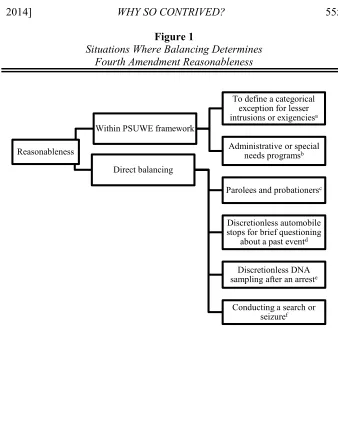
The dissent’s theory certainly would have simplified matters, but the law before, and now after, King is not so simple. Figure 1 shows the more complex current state of affairs.122 It supplies a more complete picture of
have witnessed a fatal hit-and-run accident the week before.”); Josh Gupta-Kagan, Beyond Law Enforcement: Camreta v. Greene, Child Protection Investigations, and the Need to Reform the Fourth Amendment Special Needs Doctrine, 87 TUL.L.REV. 353, 373 (2012) (referring to Lidster as “an earlier special needs case”); Kit Kinports, Camreta and al-Kidd: The Supreme Court, the Fourth Amendment, and Witnesses, 102 J.CRIM.L.&CRIMINOLOGY 283, 306 (2012) (analyzing the reach of “the special need recognized” in Lidster). The perception is that questioning members of the public to gather information on crimes in which they were not known to be involved is a special need. On this understanding, however, it is arguable, as the Second Circuit determined in Amerson, 483 F.3d at 82–83, and Nicholas v. Goord, 430 F.3d 652, 668–69 (2d Cir. 2005), that creating a DNA database is also a special need. The point of a DNA database system, like the dragnet questioning of the many motorists in Lidster, is to yield information about crimes when those who are subject to the program are not known to be associated with the crimes.
118 During the oral argument in King, Justice Sotomayor stated “[a]s I read Samson, it
was the special relationship between the parolee or the probationary person, that line of cases, and the assumption being that they’re out in the world, I think, by the largesse of the State,” and that therefore “a State has a right to search their home, just as it would their cell, essentially.” Transcript, supra note 28, at 11.
119 The opinion pursued a more extended balancing. It did not stop with the observation
that “[e]xamining the totality of the circumstances pertaining to petitioner’s status as a parolee . . . including [but not limited to] the plain terms of the parole search condition, we conclude that petitioner did not have an expectation of privacy that society would recognize as legitimate.” Samson, 547 U.S. at 852. It also enumerated “substantial” state interests. Id. at 853–55.
120 Maryland v. King, 133 S. Ct. 1958, 1980 (2013) (Scalia, J., dissenting).
121 See, e.g., Kaye, “Considered Analysis,”supra note17, at 114–17 (criticizing the
readiness of three such courts to balance rather than to apply a categorical rule). See generally Robin Cheryl Miller, Annotation, Validity, Construction, and Operation of State DNA Database Statutes, 76 A.L.R. 5th 239 (2005).
122 The final category applies not to the decision to search or seize, but to the manner in
when the Court uses balancing to establish Fourth Amendment reasonableness.123 To support Justice Scalia’s theory for suspicionless
searches, we would have to eliminate parts of the direct-balancing branch of the case law. This pruning might be desirable, but the dissent offered no normatively grounded defense of its no-suspicionless-search rule.124
Angeles County v. Rettele, 550 U.S. 609, 614 (2007) (“In executing a search warrant officers may take reasonable action to secure the premises and ensure their own safety . . . [but] unreasonable actions include the use of excessive force[.]”), and “unreasonably burdensome” administrative demands for documents, e.g., See v. City of Seattle, 387 U.S. 541, 544 (1967) ( “[T]he Fourth Amendment requires that the [agency] subpoena . . . not be unreasonably burdensome.”).
123 For discussion of specific cases in which the Court has balanced, see generally David
H. Kaye, A Fourth Amendment Theory for Arrestee DNA and Other Biometric Databases, 15 U.PA.J.CONST. L. 1095 (2013) [hereinafter Kaye, A Fourth Amendment Theory]; Kaye,
“Considered Analysis,”supra note 17.
124 Cf. Kaye, A Fourth Amendment Theory, supra note 123, at 1118 (maintaining that
Figure 1
Situations Where Balancing Determines Fourth Amendment Reasonableness
a See Terry v. Ohio, 392 U.S. 1, 30–31 (1968).
b See Skinner v. Ry. Labor Execs. Ass’n, 489 U.S. 602, 619 (1989) (“When faced with
such special needs, we have not hesitated to balance the governmental and privacy interests to assess the practicality of the warrant and probable-cause requirements in the particular context.”).
c See Samson v. California, 547 U.S. 843, 846 (2006); United States v. Knights, 534 U.S.
112, 121–22 (2001).
d See Illinois v. Lidster, 540 U.S. 419, 421 (2004). e See Maryland v. King, 133 S. Ct. 1958, 1965–66 (2013). f See Tennessee v. Garner, 471 U.S. 1, 3 (1985).
Reasonableness
Within PSUWE framework
To define a categorical exception for lesser intrusions or exigenciesa
Administrative or special needs programsb
Direct balancing
Parolees and probationersc
Discretionless automobile stops for brief questioning
about a past eventd
Discretionless DNA sampling after an arreste
Because the dissent dismissed the majority’s “free-form reasonableness” analysis as impermissible, it did not directly question the details of that balancing or argue that, in a sensible and complete balancing of the relevant state and individual interests, the latter should prevail. In fact, the dissent objected to the balancing precisely because it thought that such balancing must justify far more than the collection of DNA from arrestees.125
At the same time, the dissent did maintain that arrestee databasing, as actually practiced in Maryland and elsewhere, was inconsistent with the purposes the majority ascribed to DNA-BC. The state did not collect the sample, analyze it, and upload the profile all as part of the booking process.126 Days, weeks, and months went by before the state completed
this process. King’s profile was not checked against the existing offender and arrestee indices to see whether he was who he claimed to be. For the dissent, the fact that “DNA . . . was [not] used for identification [in the sense of authentication] here”127 was dispositive. The dissent doubted that
“the proud men who wrote the charter of our liberties would have been so eager to open their mouths for royal inspection,”128 and that was that.
II.DOCTRINAL ALTERNATIVES:ACLOSER LOOK AT PSUWE AND THE
DEMISE OF THE WARRANT-PREFERENCE RULE
Although the King Court rejected the need to find a categorical exception to the warrant and probable cause requirements for searches, this Article has shown that doing so did not breach a previously impermeable barrier to balancing outside of the PSUWE framework. But the very permeability of the barrier is worrisome. The family resemblance theory of when to balance is intrinsically vague,129 and excluding the value of DNA
databases for criminal investigations in the subsequent balancing strains credulity because it is disconnected from the dominant legislative purpose and the use to which King’s profile was put. This Part therefore outlines less contrived defenses of DNA-BC under the Fourth Amendment. In addition, it offers a conceptualization of the case law that is less convoluted than the Court’s current off-again, on-again PSUWE framework.
A court determined to uphold DNA sampling before conviction could have dealt with the per se rule in four ways. First, it could have replaced the PSUWE framework with universal free-form balancing—a universe in
125 See infra Part III.
126 See King, 133 S. Ct. at 1983–84 (Scalia, J., dissenting). 127 Id. at 1988–89.
which courts always look at all relevant factors and circumstances bearing on the reasonableness of a search or seizure without worrying about categorical rules.130 Second, the Court could have found a niche for
DNA-BC programs, such as Maryland’s, within the special needs exception. Third, the Court could have explicitly created a new, sui generis exception for collecting and using DNA samples (and other biometric data) from arrestees. Finally, considering the differences between biometric-data acquisition and use and traditional searches, it could have explicitly recognized a broader categorical exception for acquiring and using certain types of biometric data, including DNA identification profiles, in a program with sufficient privacy safeguards. Instead of adopting any of these approaches, the Court implicitly, and awkwardly, created a new special-needs-type exception for DNA-BC programs. Let us examine just what the
King Court did—and what it might have done—more carefully.
A. DISCARDING THE PER SE RULE
In theory, the Court could have adopted a new regime in which every case involves a direct inquiry into the reasonableness of the search or seizure under all the case-specific circumstances. This “no lines” regime, as it has been called,131 would resemble that of tort cases in which juries are
asked to use their best judgment to decide whether the defendant’s conduct was unreasonable.132 If this is what “free-form balancing” means, then the
King Court did not embrace it. Rather, King’s balancing incorporated only the state’s special (non-crime-solving) interests, and the Court did not question the need for categorical exceptions in most cases. The opinions thus do little to resolve two overlapping debates about the meaning of reasonableness in the Fourth Amendment and the need for the PSUWE framework. This Section explains the two intersecting debates and their relationship to the decision to balance in King.
130 See Craig M. Bradley, Two Models of the Fourth Amendment, 83 MICH. L. REV.
1468, 1471 (1985).
131 See id.
132 See id. Many other analogies are apt. See Lee, supra note 35, at 1133–34