i
THE EFFECT OF AMBIENT TEMPERATURE TO THE PERFORMANCE OF INTERNAL COMBUSTION ENGINE
MOHAMAD FUAD BIN ABDUL AZIZ
A project report submitted in partial
fulfillment of the requirement for the award of the Degree of Master of Mechanical Engineering
Faculty of Mechanical and Manufacturing Engineering Universiti Tun Hussein Onn Malaysia
ABSTRACT
v
ABSTRAK
CONTENTS
TITLE i
DECLARATION ii
ACKNOWLEDGEMENT iii
ABSTRACT iv
ABSTRAK v
CONTENTS vi
LIST OF TABLES ix
LIST OF FIGURES x
LIST OF SYMBOLS AND ABBREVIATIONS xii
CHAPTER 1 INTRODUCTION 1
1.1 Background of Study 1
1.2 Problem Statement 2
1.3 Objectives 2
1.4 Scopes of Study 3
1.5 Thesis Outline 3
CHAPTER 2 LITERATURE REVIEW 4
2.1 Internal Combustion Engine 4
2.2 Otto Cycle 6
2.3 Spark Ignition Engine 8
2.4 Comparing Spark Ignition Engine and Compression Ignition Engine
vii
2.5 Engine Performance Parameter 13
2.5.1 Engine Power 13
2.5.2 Brake Mean Effective Pressure (BMEP) 14 2.5.3 Brake Specific Fuel Consumption
(BSFC)
14
2.6 Temperature and Ambient Temperature 15
2.7 Inlet Air Temperature 17
2.8 Combustion in Internal Combustion Engine 18
2.8.1 Complete Combustion 18
2.9
2.10
2.8.2 Incomplete Combustion
Emission in Internal Combustion Engine
GT-Power
19
19
22
CHAPTER 3 METHODOLOGY 24
3.1 Introduction 24
3.2 Engine Selection 26
3.3 Dynamometer 27
3.4 Emission Analyzer 28
3.5 Experimental Setup 30
3.6 Simulation by using GT Power 31
3.6.1 GT Power Setup 32
3.7 Performance Parameter 34
CHAPTER 4 RESULTS AND DISCUSSIONS 36
4.1 Introduction 36
4.2 Simulation Result 37
4.2.3 Summary from Simulation Data 42
4.3 Experimental Result 44
4.3.1 Engine Performance 44
4.3.2 Engine Emission 47
4.3.3 Summary from Experimental Data 50
CHAPTER 5 CONCLUSIONS AND RECOMMENDATIONS 51
5.1 Conclusions 51
5.1.1 The effects of ambient temperature to the performance of internal combustion engine
52
5.1.2 The effects of ambient temperature to the emission of internal combustion engine
52
5.2 Recommendations 53
5.2 Future Work 53
ix
LIST OF TABLES
2.1 Comparison between spark ignition engine and compression ignition engine.
11
3.2 Engine Specification 26
LIST OF FIGURES
2.1 Types of Internal Combustion Engine 5
2.2 The p-V (pressure –volume) diagram in Otto Cycle 7 2.3 The T- s (Temperature- Entropy) diagram in Otto Cycle 7 2.4 The movement of the piston to complete the four stroke
cycle in spark ignition engine.
9
2.5 Component in Spark Ignition Engine 10
2.6 Effect of inlet air temperature on the brake specific fuel consumption, at constant engine torque (50 N.m) and different engine speeds
15
2.7 Inlet manifold in internal combustion engine 17 2.8 Complete combustion of methane, a hydrocarbon 19
2.9 The figure show CO2 emission versus ambient temperature graph
20
2.10 Example of modelling internal combustion engine in GT Power software simulation
23
2.11 Example of GT Power Modelling 23
3.1 Research flowchart 25
3.2 Example setup using dynamometer 28
3.3 Emission analyzer 29
3.4 Schematic Diagram of experimental setup by using Dynamometer
xi
3.5 Dialog box engine specifications 31
3.6 Component arrangement 32
3.7 Complete component connection 32
3.8 The component parameter settings 33
3.9 imulation results graph and table 33
4.1 Brake Power versus engine speed at different ambient temperature for simulation study.
38
4.2 Brake Mean Effective Pressure versus engine speed at different ambient temperature for simulation study
38
4.3 Brake Specific fuel consumption versus engine speed at different ambient temperature for simulation study
39
4.4 CO emission versus engine speed at different ambient temperature for simulation study
36
4.5 CO2 emissions versus engine speed at different ambient temperature for simulation study
41
4.6 HC emissions versus engine speed at different ambient temperature for simulation study
42
4.7 Brake Power versus load at different ambient temperature for experimental work
44
4.8 Brake Mean Effective Pressure versus load at different ambient temperature for experimental work.
45
4.9 Brake Specific Fuel Consumption versus load at different ambient temperature for experimental work
46
4.10 CO emission versus load at different ambient temperature for experimental work
47
4.11 CO2 versus load at different ambient temperature for experimental work
48
4.12 Hydrocarbon emission at four different ambient temperatures for experimental work
xii
LIST OF SYMBOLS AND ABBREVIATIONS
BMEP - Brake Mean Effective Pressure BSFC - Specific fuel consumption
cc - Cubic centimeter
cm - Centimeter
CO - Carbon monoxide
CO2 - Carbon dioxide
h - hour
HC - Hydrocarbon
kg - kilogram
kW - kilowatt
MPa - Megapascal
Nm - Newton meter
NOx - Nitrogen oxides
O2 - Oxygen
o
C - Degree celsius
ppm - Parts per million rpm - Revolution per minute
s - Second
CHAPTER 1
INTRODUCTION
1.1 Background of Study
2
values is ambient temperature. The other are exhaust gases, water cooling, lubricating oil temperatures etc. Therefore the aim of this research is to investigate the effect of ambient temperatures to the performances of internal combustion engine. This research will be conducted by collecting GT-Power simulation and experimental data by using small 4-strokespark ignition engine. The results such as brake torque, brake specific fuel consumption, brake mean effective pressure, and emissions will be analysed and followed with discussion.
1.2 Problem Statement
Temperature plays an important role to the performance of internal combustion engine. It is crucial to the engine or automobile designer especially in hot country weather to produce a better performance engine without increased their cost. Due to increasing weather temperature in Malaysia especially, the study will investigate the effect of ambient temperature to the performance of internal combustion engine.
1.3 Objectives
The aim of the study is to improve the performance of internal combustion engine by investigate the effect of ambient temperature.
i. To investigate the effect of surrounding temperature (inlet air temperature) to the performances of internal combustion engine
1.4 Scopes of Study
The study focuses on small 4-stroke spark ignition engine or gasoline engine vehicle that widely used in Malaysia. To ensure the result of the study effective and viable, the study has put certain limitations. Here are the scopes of study have been worked:
i. This research focused on a small 4-stroke duty gasoline engine with engine capacity of 125 cc.
ii. Simulation and analysis study were carried out using GT-Power software.
iii. The engine was operated at steady state condition with variable dynamometer loads for experimental investigation.
1.5 Thesis Outline
4
CHAPTER 2
LITERATURE REVIEW
2.1 Internal Combustion Engine
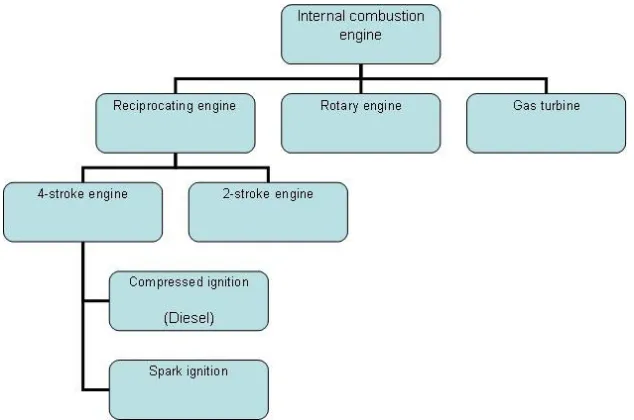
rotate the crankshaft. Crankshaft reacted as an output of the engine, connected to a transmission or power train to transmit the energy to drive a vehicle. There three type of internal combustion engine. There are rotary engine, reciprocating engine and gas turbine engine. In rotary engines, a rotor rotates inside the engine to produce power. In the case of the reciprocating engines, a piston reciprocates within a cylinder. The reciprocating motion of the piston is converted into the rotary motion of the vehicle's wheels. In automobiles, reciprocating engines are used. They are the most widely used type of engine. The classification of internal combustion engine been shown at Figure 2.1 (Wallington, Kaiser, & Farrell, 2006). The reciprocating engine mechanism consist of a piston which moves in a cylinder and forms a movable gas tight seal from crankshaft and connecting rod to create a rotary motion (Gupta, 2013). Pistons generally are dome-shaped on top, and hollow at the bottom. In a four-stroke engine, the piston completes one reciprocation cycle in four strokes: intake, compression, power, and exhaust. There are two types of reciprocating engine; which are spark ignition (SI) engine also known as gasoline engine and compression ignition (CI) engine or usually known as diesel engine. Since reciprocating engines are the most widely used engines, they have become synonym with the termed IC engines.
6
2.2 Otto Cycle
Otto cycle is one of the cycle that implemented by referring to internal combustion concept. It also gas power cycle that used in modern spark ignition or gasoline engine. The basic process of internal combustion engine can be understand by referring to the figure below that show the p-V (Pressure-volume) and T- s (Temperature- Entropy) diagrams. Entropy can be defined as the measurement of the disorder of a system. It also can be described as an amount of energy is unavailable to do work. Entropy is a state variable for a reversible process whose change at any point. Given the formula to calculate entropy, S (Laurikko, 2002)
dS = dQ/T
where Q is the heat in joules entering the system at any point in the cycle and T in is the temperature in °K at the point of heat entry.
Entropy also defined as a measure of unusable energy within a closed or isolated system. As usable energy decreases and unusable energy increases, entropy also increases. Abassi, Khalilarya, & Jafarmadar (2010), concluded in their research that increase in the inlet temperature causes the indicated work availability, combustion cannot change and entropy generation per cycle be reduced and the loss availability and exhaust gas availability be increased.
Figure 2.2: The p-V (pressure–volume) diagram in Otto Cycle (mpoweruk, 2005). At compression stroke ( from point A to B) where position of piston travel from bottom dead centre (BDC) to top dead centre (TDC) air undergoes reversible adiabatic compression. We know that compression is a process in which volume decreases and pressure increases. For this reason, from Figure 2.2 shows volumes of air decreases, pressure increases and temperature increases. As this an isentropic process, entropy remains constant. From point B to C is heat addition process. Piston will remain at top dead centre where the pressure, temperature and entropy increase. In this stage, ignitions of the compression air are happened where heats are supplied to the system and volume remains constant.
[image:18.612.211.443.499.654.2]8
Expansion stroke happened at point C to D where the piston travels from top dead centre to bottom dead centre. At this point pressure decrease and volume rises. Figure 2.3 shows at this point temperature falls and entropy remain constant. The piston rest at bottom dead centre where heat rejected from the system during exhaust stroke (point D to A). Pressure decrease resulting to temperature and entropy decrease and it will complete the cycle (Ust, Sahin, & Safa, 2011). On the same time, induction stroke happened where intake of the next air charge into the cylinder. The volume of exhaust gasses is the same as the air charge.
2.3 Spark Ignition Engine
C.H (2008), in his research by using 1800 cc, 4 strokes Diesel Engine stated that increased fuel intake temperature for internal combustion engine expected to produce more power and improve fuel economy.
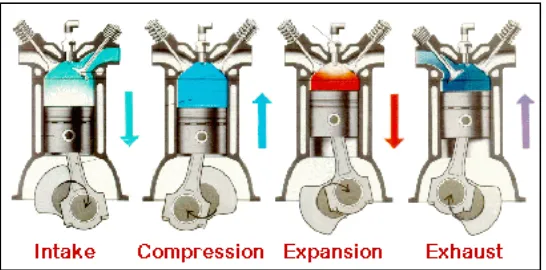
Spark ignition engine or synonym with petrol engines take in a flammable mixture of air and petrol which is ignited by a timed spark when the charge is compressed. The basic principle of operation is that a piston moves up and down in a cylinder, transmitting its motion through a connecting rod to the crankshaft which drives the vehicle. The most common engine cycle involves four strokes has been simplified by Ganesan (2004), in his books
1. Intake. The descending piston draws a mixture of fuel and air through the open intake
valve. 2. Compression. The intake valve is closed and the rising piston compresses the
fuel-air mixture. Near the top of the stroke, the spark plug is fired, igniting the mixture.
3. Expansion. The burning mixture expands, driving the piston down and delivering
power. 4. Exhaust. The exhaust valve opens and the piston rises, expelling the burned
[image:20.612.191.464.420.555.2]gas from the cylinder.
Figure 2.4: The movement of the piston to complete the four stroke cycle in spark ignition engine(Wallington et al., 2006).
10
combustion of the fuel-air mixture takes place with the help of spark plug then it is known as four strokes Spark Ignition Engine. The SI engine operates at a compression ratio of 6 to 10. Compression ratio represents the ratio of the volume of its combustion chamber from its largest capacity to its smallest capacity. Higher compression ratio advantage to the engine to supply more mechanical energy to the system. On the other hand, for gasoline engine higher compression will lead to knocking. The compression ratio has a large influence on the engine brake thermal efficiency increases with increase in the compression ratio at low and medium engine loads, but the brake thermal efficiency increases with increasing compression ratio up to a limit of 12 at high engine loads (Zheng, Wang, Wang, & Huang, 2008).
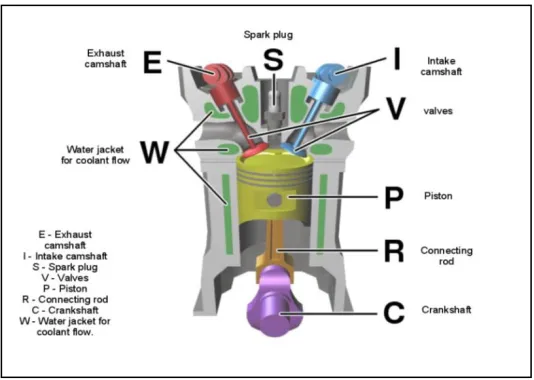
The major components of a four stroke spark Ignition engine are combustion chamber, piston, inlet and exhaust valve, cam shaft, connecting rod, crankshaft etc. Combustion chamber is a cylindrical container in which a piston makes up and down motion where combustion of air-fuel mixture takes place. Connecting rod is a component that connect piston to a crankshaft to convert reciprocating movement of piston into the rotary movement. Inlet and exhaust valve allow fresh air fuel mixture to enter the combustion chamber and the exhaust valve discharges the wastes of combustion. The opening inlet and exhaust valve control by camshaft.
[image:21.612.195.462.471.661.2].
2.4 Comparing Spark Ignition Engine and Compression Ignition Engine
The major difference between Spark Ignition and Compression Ignition engines is the type of fuel used. In Spark Ignition engines petrol or gasoline is used as fuel, so these engines are also called gasoline engines. In Compression Ignition, engines diesel is used as fuel, so they are also called diesel engines.
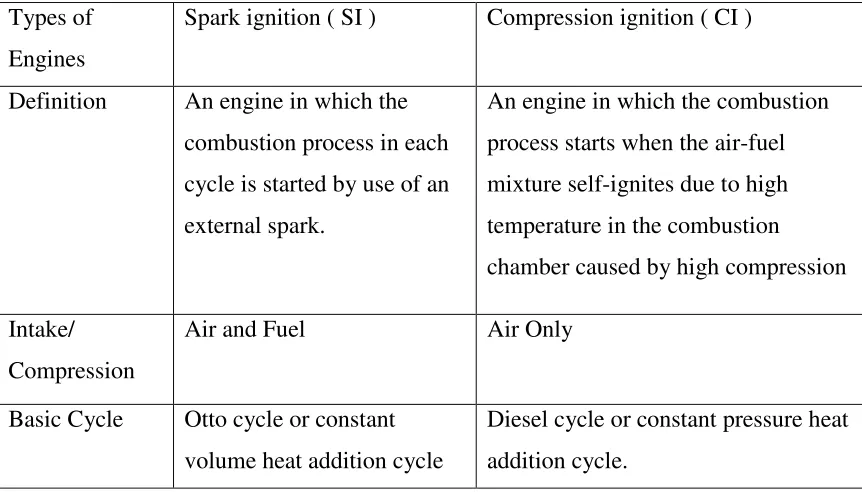
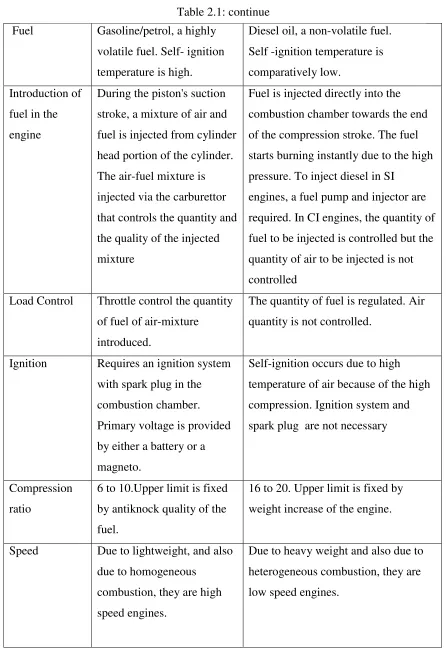
[image:22.612.109.540.474.720.2]Basically, diesel engines and gasoline engines are quite similar. They are both internal combustion engines that designed to convert the chemical energy available in fuel into mechanical energy. This mechanical energy moves pistons up and down inside cylinders. These two methods of ignition are used in engines in their combustion stroke. In order to ignite the fuel and get the thermal energy, the ignition should take place. In spark ignition engine technology, electric spark is used to provide the ignition to a properly mixed air-fuel mixture, but in compression ignition technology, the air is compressed to a higher temperature. Here are some other major differences between the SI and CI engines that had been simplified by Ganesan, (2004):
Table 2.1: Comparison between spark ignition engine and compression ignition engine. Types of
Engines
Spark ignition ( SI ) Compression ignition ( CI )
Definition An engine in which the combustion process in each cycle is started by use of an external spark.
An engine in which the combustion process starts when the air-fuel mixture self-ignites due to high temperature in the combustion
chamber caused by high compression Intake/
Compression
Air and Fuel Air Only
Basic Cycle Otto cycle or constant volume heat addition cycle
12
Fuel Gasoline/petrol, a highly volatile fuel. Self- ignition temperature is high.
Diesel oil, a non-volatile fuel. Self -ignition temperature is comparatively low.
Introduction of fuel in the engine
During the piston's suction stroke, a mixture of air and fuel is injected from cylinder head portion of the cylinder. The air-fuel mixture is injected via the carburettor that controls the quantity and the quality of the injected mixture
Fuel is injected directly into the combustion chamber towards the end of the compression stroke. The fuel starts burning instantly due to the high pressure. To inject diesel in SI
engines, a fuel pump and injector are required. In CI engines, the quantity of fuel to be injected is controlled but the quantity of air to be injected is not controlled
Load Control Throttle control the quantity of fuel of air-mixture
introduced.
The quantity of fuel is regulated. Air quantity is not controlled.
Ignition Requires an ignition system with spark plug in the combustion chamber. Primary voltage is provided by either a battery or a magneto.
Self-ignition occurs due to high temperature of air because of the high compression. Ignition system and spark plug are not necessary
Compression ratio
6 to 10.Upper limit is fixed by antiknock quality of the fuel.
16 to 20. Upper limit is fixed by weight increase of the engine.
Speed Due to lightweight, and also due to homogeneous
combustion, they are high speed engines.
[image:23.612.104.550.49.698.2]Due to heavy weight and also due to heterogeneous combustion, they are low speed engines.
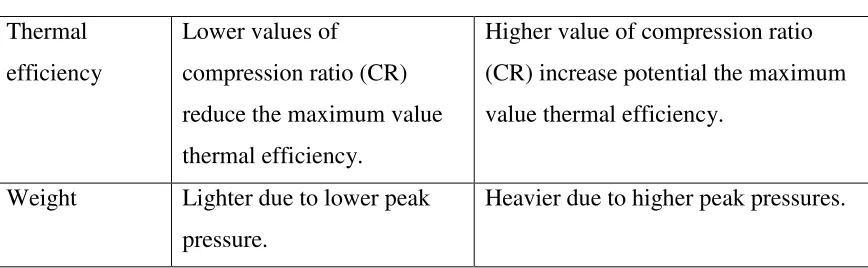
Thermal efficiency
Lower values of
compression ratio (CR) reduce the maximum value thermal efficiency.
Higher value of compression ratio (CR) increase potential the maximum value thermal efficiency.
Weight Lighter due to lower peak pressure.
Heavier due to higher peak pressures.
2.5 Engine Performance Parameter
The engine performance can be determined by using several parameters. There are related to the term efficiency. Nowadays, developing an internal combustion engine required to take in consideration all the parameters affecting the engines design and performance.The engine performance parameters are given below;
2.5.1 Engine Power
[image:24.612.110.544.64.198.2]Power is the amount of work done per specific time or the rate of doing work. The measure of the engine's ability to apply power generations called torque. Engine torque is normally measured by a dynamometer. The engine is clamped on a test bed and the shaft is connected to the dynamometer rotor. Brake power refers to the amount of usable power delivered by the engine to the crankshaft (Wallington et al., 2006). Brake Power also refers to the measurement output of the engine. This power from the engine drive shaft is measured by a dynamometer also known as brake. The engine is connected to a brake or dynamometer, which can be loaded in such a way that the torque exerted by the engine can be measured.
14
2.5.2 Brake Mean Effective Pressure
Brake Mean Effective Pressure. Mean is another word for average, which in this case means average effective pressure of all stroke cycles. This is used to evaluate all engines whether they are two or four Cycle. Brake Mean Effective Pressure is a function of temperature of the gases in the cylinder. To increase the temperature you need to burn more fuel, thus making more heat. The term BMEP is an engineering term that means BMEP is a function of temperature of the gases in the cylinder. Or another way is to make better use of the existing fuel. Brake mean effective pressure is often referred to as specific torque it is proportional to brake torque but is independent of the engine displacement (Goering, Stone, Smith, & Turnquist, 2003). The most effective is to increase the number of cylinders. The more efficient it is, the higher the average pressure or BMEP.
2.5.3 Brake Specific Fuel Consumption
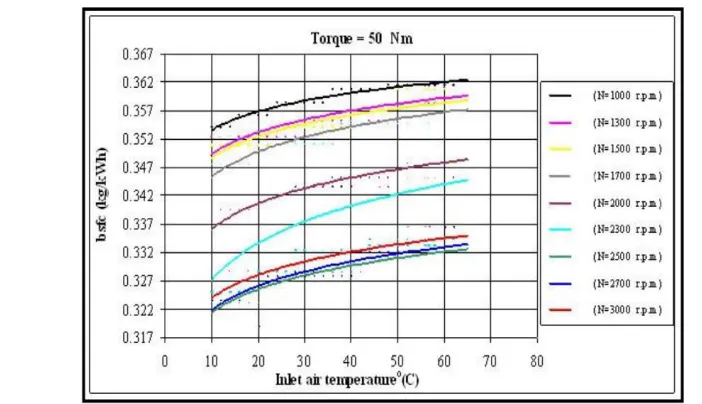
Figure 2.6: Effect of inlet air temperature on the brake specific fuel consumption, at constant engine torque (50 N.m) and different engine speeds (Saber et al., 2013)
Saber et al.(2013), experimentally found that show in figure 2.6 that brake specific fuel consumption increases with increasing inlet air temperature in all experimental results used in the present work and decreases with both engine torque and engine speed. The decreasing of brake specific fuel consumption with engine speed occurs until reaching (2500 rpm) then increases at (2700 rpm) and above. The brake specific fuel consumption decreases with increasing brake mean effective pressure.
2.6 Temperature and Ambient Temperature
16
combust the fuel and run the engine. High temperatures always called heat in internal combustion engine need to combust the fuel, so it is necessary to keep the temperature at a controllable level in order to operate the engine safely. Once the temperature in the engine has reached intolerable values, the engine blocks and components may suffer damage. Therefore it is essential to have a heat removal process which will maintain the engine at a safe operating condition (Safakish, 2012).
Ambient temperature is the temperature of the surrounding environment. The performance of an engine is influenced by the ambient conditions. The most important ambient conditions influence internal combustion engine performance is air humidity and inlet air temperature. Air humidity has an influence on the combustion since an increase in humidity is slowing down the combustion speed as well as reducing the maximum combustion temperature. On the one hand this will influence the knock margin and the NOX emissions in a positive way, but on the other hand the efficiency of the engine is affected negatively. In this research, inlet air temperature will take into account as a subject to been discussed regarding the performance of internal combustion engine. But there are different definitions for ambient air temperature and air inlet temperature. Laurikko (2002), describe ambient air temperature is the temperature that is measured outside of the engine compartment and air inlet temperature is the temperature measured at the inlet of the turbocharger.
2.7 Inlet Air Temperature
Any engine that runs by internal combustion of fuel needs air to operate. That's because without air especially oxygen, fuels cannot burn and provide the combustion that force to power the engine. In modern automobiles, the air must be cleaned before introduced the inlet manifold and combustion chamber. In addition, modern engines rely on a precise ratio of air to fuel. When the engine is starved of air, the fuel mix is said to run too rich, which in effect the performance of the engine. The air supplied to the engine through inlet manifold.
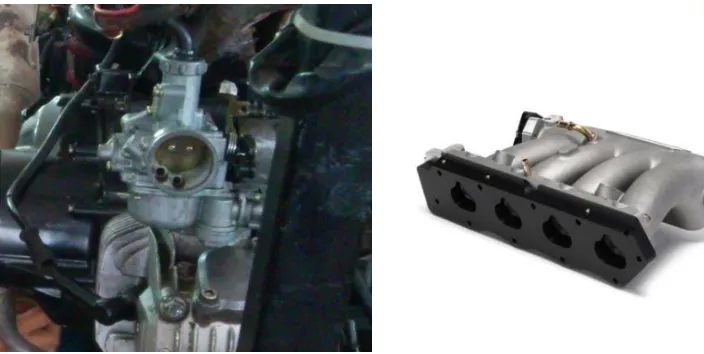
[image:28.612.123.475.441.618.2]Inlet manifold is the pipe that connect intake system to the inlet valve of the engine and where the air fuel mixture come through is called intake manifold. Gupta(2013), says an increase in the inlet temperature of the mixture increases the temperature at the end of compression, which in turn increases the temperature of the last part of the charge to burn, thus shortening the delay period and greatly increasing the tendency to knock. Therefore is preferred to keep the inlet temperature low but not too low so it can prevent fuel start to vaporize before
Figure 2.7: Inlet manifold in internal combustion engine
18
system. Within the limits of this work, the greater the amount of heat supplied to the charge and the higher its temperature at the intake port, the more rapidly the engine would accelerate. Torregrosa, Olmeda, Martín, & Degraeuwe (2006), constructed a fully controlled diesel engine to study the influence of inlet air charge temperature on the performance and emissions of a diesel engine. The intake temperatures were varies but the coolant temperature was controlled to isolate the effect of cylinder walls temperature effect.
2.8 Combustion in Internal Combustion Engine
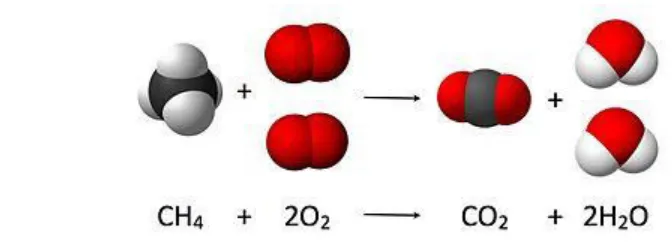
Combustion is usually understood to be a synonym for burning or fire. Combustion is the chemical reaction that involved fuel and air especially oxygen, O2that produces a smoke. In internal combustion engine, air and fuel mix burn in the combustion chamber. Combustion in internal combustion engine usually divided to two, which are complete combustion and incomplete combustion.
2.8.1 Complete Combustion
Figure 2.8 Complete combustion of methane, a hydrocarbon
2.8.2 Incomplete Combustion
If there is not enough oxygen present to completely burn the fuel to carbon dioxide and water, it is called in complete combustion. Incomplete combustion can cause pollution and fuel inefficiency. Usually in complete combustion produce less heat than complete combustion. According to Ganesan(2004), incomplete combustion is due to improper mixing and flame quenching. Improper mixing is incomplete mixing of air and fuel,
when some particle of fuel does not find molecule of oxygen to burn. This can cause an exhaust emission. The other factors of incomplete combustion is
flame quenching happen when flame goes very close to the wall, and it’s get rid of and
leaving a small amount of fuel mixture unreacted.
2.9 Emission in Internal Combustion Engine
20
[image:31.612.164.491.157.389.2]are three ways to reduce emissions form spark-ignition engines which are; changes in engine design, combustion conditions, and catalytic after-treatment.
Figure 2.9: The figure show CO2 emission versus ambient temperature graph(Andrews et al., 2004)
According to Andrews et al., (2004) in their study, The Effect of Ambient temperature on Cold Start Urban Traffic Emission real World SI Car that CO2emissions were decreased slightly with the increase of ambient temperature, due to the better fuel economy in summer. This was mainly due to the lower friction as the lubricating oil heated up faster under higher ambient temperatures, as shown earlier.
between NOX emissions and ambient temperature (Andrews et al., 2004). Greenhouse gas has a negative effect to human and environment.
According to EPA (2012), most of greenhouse gaseous that produce by combustion from internal combustion engine can harm human such as Carbon dioxide (CO2) that will lead to increase the earth surface temperature that would melt sufficient ice to cause an increase in the level of the oceans. Carbon monoxide (CO) is a poisonous, colorless, odorless, and tasteless gas. Carbon monoxide is harmful when breathed because it can replace oxygen in the blood and discharge the function of heart, brain, and other vital organs of oxygen. Large amounts of CO can make people unconsciousness and suffocate. Hydrocarbon emissions result from fuel that does not burn completely in the engine.Some cancers appear to be caused by exposure to hydrocarbons. Unburned hydrocarbons in combination with the oxides of nitrogen in the presence of sunlight form photochemical oxidants, components of photochemical smog, which do have adverse effects on human health and on plants.
While Nitrogen Oxides (NOX) is a poisonous, reddish-brown gas with unpleasant odour. NO2 can react with moisture present in the atmosphere to form nitric acid, causes direct damage to materials. It is also responsible to the formation of smog which is the most damaging to human health.Soot and smoke both refer to particulate matter that gets trapped in gases during combustion. The visible, dark black component of smoke is carbon that has incompletely burned and, rather than forming CO2, has formed solid carbon compounds known as amorphous carbon. These carbon compounds are collectively referred to as soot. Soot, in particular, contains large amounts of polycyclic aromatic hydrocarbons, which are well-known mutagens and carcinogens. Diesel exhaust is considered the most carcinogenic of fossil fuels used in transportation.
The major emissions from gasoline engines can be classified as either products
of incomplete combustion or species formed at high temperature in the cylinder. The
main incomplete combustion products include carbon monoxide (CO) and unburned or
partially-burned fuel, usually denoted as hydrocarbon (HC) or volatile organic
22
are reduced to very low levels by exhaust catalysts. Lean-burn gasoline engines can
have higher CO levels than stoichiometric engines since the lower burned gas
temperatures contribute to slower flame propagation, and combustion may not progress
to completion (Wallington et al., 2006).
2.10GT-Power
GT-Power is software developed by Gamma Technologies that can simulate an entire ICE. It is applicable to all sizes and types of engines. The software is used by almost all major car and truck manufacturer. The software can simulate all the parts of the engine. The program main parts are GT-POWER contains the industry’s most comprehensive and advanced set of models for engine performance analysis such as:
i. Steady state or full transient analysis, under any driving scenario
ii. Turbocharged, supercharged, turbo compound, e-boost, pneumatic assist
iii. SI, DI, HCCI and multi-mode combustion, multi-fuel, and multi-pulse injection. A computer model of engine is used to simulate the engine by using GT Power software from Gamma Technologies. All engine specification and physical information of the engine are entered in a specific window. For the gasoline engine only one test for each temperature was available, which causes an uncertainty due to the inability to compare deviations between tests runs (Johansson & Wagnborg, 2014).
Figure 2.10: Example of modelling internal combustion engine in GT Power software simulation (gtisoft, 2014)
Figure 2.11 Example of GT Power Modelling(Mamat et al., 2010)
[image:34.612.114.548.429.566.2]24
CHAPTER 3
METHODOLOGY
3.1 Introduction
This chapter listed all steps that will be done to fulfil the objectives of the study. The following procedure work will be conducted to evaluate and examine the effect of ambient temperature to the performance of internal combustion engine. The work done in order to archive the objective of the study.
REFERENCES
Abassi, A., Khalilarya, S., & Jafarmadar, S. (2010). The influence of inlet charge
temperature on the second law balance under various operating engine speeds in DI engine. Fuel, 89(9), 2425-2432
Andrews, G. E., Zhu, G., Li, H., Simpson, A., Wylie, J. a., Bell, M., & Tate, J. (2004). The Effect of ambient temperature on cold start urban traffic emissions for a real world SI Car.
Brace, C. J., Hawley, J. G., Akehurst, S., Piddock, M., & Pegg, I. (2008). Cooling system improvements - Assessing the effects on emissions and fuel economy. Choon Hing, N. (2008). The effect of increased fuel intake temperature on the
performance of internal combustion engine. utp.
EPA. (2012). Major greenhouse gases associated with human activities. Retrieved from www.epa.gov
Faisal, M., Hushim, B., Jais, A., Alimin, B., Faizal, M., Mohideen, Mohd, B. (2011). A review and investigation framework on port-fuel injection for small 4-stroke single cylinder engine.
Ganesan, V. (2004). Internal combustion engine. Mc Graw Hill (Vol. 2nd edition). Gitano, H. (n.d.). Dynamometer basics.
Pundir, B. P. (2010). IC engines: combustion and emissions. Alpha Science International.
Goering, Stone, M. L., Smith, W., & Turnquist, P. K. (2003). Engine performance measure.
Gupta, H. (2013). Fundamentals of internal combustion engines. PHI Private Ltd. Hamarashid, L. (2008). GT - Power modeling of a 6 - cylinder natural gas engine and
56
Hushim, M. F., Alimin, A. J., Selamat, H., & Muslim, M. T. (2013). PFI System for retrofitting small 4-stroke gasoline engines. International Journal of Environmental Science and Development, 4(4), 375–378.
Johansson, E., & Wagnborg, S. (2014). Analysis of engine cold start simulation in GT-Power.
Krishna, M. V. S. M., Kishor, K., Gupta, A. V. S. S. K. S., Kumar, S. N., & Reddy, D. (2010). Investigations on reduction of carbon monoxide -in spark ignition engine with catalytic converter with gasohol
Laurikko, J. (2002). Cold start emission and excess fuel consumption in low ambient temperature, 15–17.
Mamat, R., Abdullah, N. R., Xu, H., Wyszynski, M. L., & Tsolakis, a. (2010). Effect of boost temperature on the performance and emissions of a common rail diesel engine operating with rapeseed methyl ester ( RME ).
Rahman. (2009). Trends of rotational speed on engine performance for four cylinder direct injection hydrogen fueled engine. Trends in Applied Sciences Research, 4(4), 188–199.
Saber, H. a, Al-barwari, R. R. I., & Talabany, Z. J. (2013). Effect of ambient air temperature on specific fuel consumption of naturally aspirated diesel, 1, 1–7. Safakish, G. R. (2012). Temperature estimation in the combustion chamber of an
internal combustion engine. Advances in Mechanical Engineering Volume 2012 , Article ID, 6.
Semin, Idris, A., Abu Bakar, R., & Ismail, A. R. (2009). Engine cylinder fluid characteristics of diesel engine converted to CNG engine. European Journal of Scientific Research, 26(3), 443–452.
Shahid, S., Minhans, A., & Che, O. (2014). Jurnal teknologi full paper assessment of greenhouse gas emission reduction measures in transportation sector of Malaysia, 4, 1–8.
Shehata, M. S., & Razek, S. M. A. (2008). Engine performance parametres and emissions reduction methods for spark ignition engine. Industrial Engineering, (December), 32–57.
Siddharth, J., Sharma, M. P., & Shalini, R. (2005). Evaluation of engine performance on biodiesel from waste cooking oil.
Torregrosa, a. J., Olmeda, P., Martín, J., & Degraeuwe, B. (2006). Experiments on the influence of inlet charge and coolant temperature on performance and emissions of a DI Diesel engine. Experimental Thermal and Fluid Science, 30(7), 633–641. Ust, Y., Sahin, B., & Safa, a. (2011). The effects of cycle temperature and cycle pressure
ratios on the performance of an irreversible Otto cycle. Acta Physica Polonica A, 120(3), 412–416.
Vianna, J. N. D. S., Reis, a. D. V., Oliveira, a. B. D. S., Fraga, a. G., & Sousa, M. T. De. (2005). Reduction of pollutants emissions on SI engines: accomplishments with efficiency increase. Journal of the Brazilian Society of Mechanical Sciences and Engineering, 27(3), 217–222.
Wallington, T. J., Kaiser, E. W., & Farrell, J. T. (2006). Automotive fuels and internal combustion engines: a chemical perspective. Chemical Society Reviews, 35(4), 335–347.
Zheng, J.-J., Wang, J.-H., Wang, B., & Huang, Z.-H. (2008). Effect of the compression ratio on the performance and combustion of a natural-gas direct-injection engine. Proceedings of the Institution of Mechanical Engineers, Part D: Journal of Automobile Engineering, 223(1), 85–98.
Gtisoft (2014). Gamma technologies-engine and vehicle simulation Retrieved from http://www.gtisoft.com