Early Childhood Development Programs:Consideration
for Implementation in India
Nikolova K
1, Wright R
2,*, Ponnuswami I
31Factor-Inwentash Faculty of Social Work, University of Toronto, Toronto, Canada 2School of Social Work, University of Windsor, Windsor, Canada 3School of Social Work, Bharathidasan University, Trichy, Tamil Nadu, S. India
*Corresponding Author: [email protected]
Abstract
The objective of this paper was to explore the rationale for early childhood education programs (ECD) and the effectiveness, financial benefits, and relevance of early childhood development (ECD) models in the Indian context. Results suggest that childhood educational and health policy is enroute to being developed in India but insufficient resources, a lack of interdepartmental communication, and a lack of monitoring of early childhood development outcomes and related programming have resulted in implementation problems in service delivery. Implications and recommendations for implementing effective early childhood development models are discussed in relation to the findings.Keywords
Early Childhood Education And Development, Evidence-Based Models, IndiaIntroduction
Internationally, an estimated 200 million children under the age of five are not reaching their developmental potential (Siraj-Blatchford & Woodhead, 2009). Early childhood development (ECD) and access to early childhood education (ECE) are impacted by many adverse social determinants, including poverty, isolation, and gender inequity. Unfavorable developmental and educational outcomes are highest for children in poor, rural households where parents are also often lacking education (Moss & Woodhead, 2007). Further, where ECD programs are available, services are impacted by access and quality, with the most disadvantaged families having the least access to quality programs (Irwin, Siddiqi & Hertzman, 2007; Moss & Woodhead, 2007).
As well, gender inequality and a feminization of poverty in developing countries often reduces the availability of resources, including essentials like food and healthcare, for female children and decreases their access to education (Irwin, Siddiqi & Hertzman, 2007; Pascal, 2009; UNICEF,
2007).
These girls are therefore less likely to join the work force and have an income as adults, and more likely to experience higher fertility, earlier marriage and parenthood, and increased rates of mortality and ill mental and physical health. The children of these mothers, especially the girls, are in turn more likely to die in infancy or early childhood, suffer from malnutrition, poverty, and decreased access to quality ECE, thus further promoting gender and social inequality in future generations (UNICEF, 2007).
The objective, therefore, of this paper is to: (1) review the literature on ECD and the rationale for early childhood interventions; (2) review evidence-based ECD models within the Indian and international contexts including the cost-benefit analyses of such models, and (3) make recommendations for implementation of programs in India.
Methods
The following articles are included based on empirically proven effectiveness. The type, and reproducibility, of the information is taken into account, with randomized control trials taken to be more representative of actual ECD program effectiveness than quasi-experimental studies or qualitative studies. Only large scale programs, programs that have been researched multiple times, or programs that feature random assignment are included, while small scale studies and initial program assessments that have not been reproduced are excluded until more data becomes available. Articles on program effectiveness were found using a systematic review of the literature in social work and social service work related databases using the key words “early childhood development,” or “early childhood education,” or “early childhood care and education.” The search was then refined to focus on those articles outlining specific ECD programs and evaluations of their effectiveness. Grey literature and organization reports are also included if they meet the above requirements.
Results: Review of the Literature
The experiences of children in the first five years will influence their adult health and well-being through three pathways, material, behavioral and psychosocial, each of which is impacted by social determinants (Marmot & Wilkinson, 2006). For instance, material deprivation, such as a lack of proper nutrition at critical phases of prenatal development, can reduce cell growth in multiple organs resulting in lifelong biological effects. Stunting due to lack of nutrition at 24 months has been found to influence IQ, school enrolment, and school achievement at the age of 18 years (Grantham-McGregor et al., 2007). On the other hand, good childhood nutrition promotes growth and cognitive function and protects against illness. Neural plasticity, which is highest in early childhood, is affected by stimulation, stress, and nutrition which have been shown to have long-term effects on brain development by influencing gene expression and the formation of neural networks (Mustard, 2006; Siraj-Blatchford & Woodhead, 2009). Stimulating early environments increase the number of neural connections made in the brain and improve the child’s physical, emotional and social development (Irwin, Siddiqi & Hertzman, 2007). Interventions that address this critical developmental period are more effective in the long-term than interventions applied at later stages of development and, therefore, should not be ignored in program and policy implementation. For instance, a child’s developmental score at 22 months can predict his/her educational outcomes and criminal behavior 24 years later (Allen, 2011).
Psychosocial factors such as chronic anxiety and insecurity damage mental and physical health by lowering immune responses and raising stress hormone levels (Marmot & Wilkinson, 2006). Parenting behaviors and socioeconomic status can either exacerbate or mediate material and psychosocial factors by either providing a loving environment where children are confident to explore and learn about their surroundings or a harsh environment where learning is not encouraged (Gammage, 2008; Irwin, Siddiqi & Hertzman, 2007). Several researchers have suggested that parental education and appropriate parenting in early childhood can have a larger effect on developmental outcomes than socioeconomic status (Allen, 2011; Field, 2010). Therefore, alleviating poverty alone is not sufficient to improve child developmental outcomes and prevent poor children from becoming poor adults (Field, 2010). Both low mental and physical health in children influence educational potential and receptivity and social behavior, which in turn influences their employability and income as adults (Marmot & Wilkinson, 2006). Unemployment then puts adults at increased risk for ill health and poverty, which can then be passed on to the next generation, perpetuating a cycle that can only be broken if the social determinants that influence it are addressed. A child’s educational attainment is protective against future ill health and poverty by increasing the chances of
employment and sufficient income (Marmot & Wilkinson, 2006). Therefore, programs that promote ECD and ECE can disrupt the cycle of poverty and promote social equity (Siraj-Blatchford & Woodhead, 2009).
The social determinants of ECD that result in long-term inequalities can be addressed through the provision of early childcare services that aim to compensate for the disadvantages faced by at-risk children (Siraj-Blatchford & Woodhead, 2009). These disadvantages are a result of what Hertzman and Wiens (1996) call the socioeconomic gradient, wherein the richest quintile enjoys the highest levels of health and ECD, and the poorest quintile suffers from the worst health outcomes and ECD. The gradient results from an unequal distribution of resources due to a combination of unfair social and economical policies (Marmot et al., 2008). Evans, Brooks-Gunn, and Klebanov (2011) suggest that poverty, and the stressful environment it creates, leads to cumulative risk exposure for children that impedes their physical and psychosocial development. These risks include single parents, family violence, overcrowding, and poor quality schools. Parenting style and cognitive stimulation can both either reduce or increase the amount of exposure to risks. Overall, by affecting development, cumulative risk exposure results in an achievement gap between the rich and the poor and in physical changes like increased blood pressure and higher levels of stress hormones in children facing poverty (Evans, Brooks-Gunn, & Klebanov, 2011). The achievement gap is particularly apparent in literacy, vocabulary, and math scores between children of different classes and in their behaviors, all of which impact their probability of finishing school (McCain & Mustard, 1999). At present, schools are ineffective at closing this gap and many services are fragmented and inaccessible to those that need them most (Field, 2010). In summary, both gender inequality and poverty gradients result in adverse early childhood development and later adulthood unemployment and must be addressed to break the intergenerational cycle of disadvantage.
Many successful inputs and activities undertaken to improve ECE have been shown to have positive output and outcome indicators with regards to future child social and economic success and will be outlined in this paper. The factors that influence childhood outcomes, including maternal health, parental education, feeding practices, parenting and home environment, and quality of childcare, can, when sufficiently addressed, result in improved child outcomes (Field, 2010).
India Context
population is illiterate and living in poverty. It has a maternal mortality rate of 200 deaths per 100 000 and an infant mortality rate of 46 deaths per 1 000 live births (CIA, 2012). The life expectancy at birth is 67 years, ranking 161st in the world. There are only .6 physicians and 1 hospital bed for every 1000 people. Overall, the strong economic context has the potential to ensure that maternal and infant mortality is lowered, literacy rates increased, and life expectancy made on par with the rest of the developed world. Early childhood education is one way of ensuring that these things happen.
Primary education in India is considered a constitutional right and it is governed by the Right of Children to Free and Compulsory Education Act (2009). This Act outlines that education must be free and compulsory for all children aged 5 to 14 years. For example, to encourage enrolment and retention, Tamil Nadu has implemented the Nutritious Meal Scheme, offers free textbooks and free uniforms to rural and urban children up to age 15 (Perakath, 2005). However, though 30.5 million children are enrolled in Class I, only 3.5 million make it to Class XII, signaling that the programs currently in place are not influencing enrolment and retention sufficiently (Perakath, 2005). As well, achievement scores are showing that in Tamil Nadu only 45% of boys and 48% of girls in Classes I to V are achieving grades over 60% (Perakath, 2005). The situation is even worse in Classes VII to VIII where only 25% of boys and 27% of girls are achieving grades over 60%. This indicates that children, even enrolled in school, are not learning. As a result, their chances of entering post-secondary education are decreased, thereby limiting their future employment opportunities.
One potential reason for the above educational outcomes is the lack of policy addressing ECE, which, unlike primary education, is not recognized as a fundamental right (Ministry of Women and Child Development, 2012). However, India was one of the first countries to implement a model of early childhood care and education through the Integrated Child Development Scheme (ICDS) in 1975. The ICDS was aimed at reducing child and infant mortality and improving nutritional outcomes in 0-5 year old children and improving the outcomes of mothers prenatally and postnatally (Population Research Centre, 2009). However, a recent Evaluation Report on the scheme found that inadequate supervision, lack of medical resources, lack of coordination with Health Department, and other implementation issues have contributed to the general failure of the program to have as large of an impact as expected (Population Research Centre, 2009). Currently, Indian ECE programming is run under the provision of the ICDS (Ministry of Women and Child Development, 2012). This indicates that the implementation failures of the ICDS are also potentially influencing the success of ECE programs.
ECE programs run under private and non-government organizations also exist, but data concerning their process
and outcome evaluations have not been run (Ministry of Women and Child Development, 2012). Recent budgetary increases to the ICDS might have a positive impact on implementation issues (Kaul & Sankar, 2009). As well, the ICDS framework has been changed in recent years from input by international and non-government organizations and will now begin to focus more not just on providing adequate nutrition, but on changing the community behaviour practices to ensure that there is a continuum of care between home and school (Kaul & Sankar, 2009).
Cost Benefit Analysis of ECD and ECE
Early childhood development and education programs are aimed at improving the outcomes of at-risk children by addressing their physical, socio-emotional, and cognitive needs and interrupting the cycle of poverty and inequity (Siraj-Blatchford & Woodhead, 2009). Interventions can include home visiting programs, childcare, preschool programs, parental education services, nutrition programs, and community-level programs, and can start from before birth up until, and sometimes after, the child starts primary school.
Home visiting programs show success in outcome indicators especially in the post-natal period with young, first-time mothers (GLA, 2011). Programs like the Nurse Family Partnership in the United States have been shown to result in improved cognitive and behavioral developmental outcomes in children, fewer subsequent maternal pregnancies, and less use of welfare among single, poor, African American mothers (Olds et al., 2004). Other parent-infant stimulation programs have been shown to have short term benefits in increasing cognitive and socio-emotional gains until preschool (Hertzman & Wiens, 1996).
In Australia, the Triple P, Positive Parenting Program, has reduced child maltreatment, conduct problems, and family conflict and improved child-parent interactions, and parental capacity, resiliency and confidence in program families (Oates, 2010). Similar, though more moderate, outcome indicators have been found for the Incredible Years parenting program in the United States and the Sure Start program in England (Oates, 2010). Home visiting has also been shown to be beneficial in developing countries. One study of disadvantaged children in Jamaica found that home visiting increased school achievement, reduced drop-out, and improved mental health at 18 years (Siraj-Blatchford & Woodhead, 2009).
would not be able to work had this childcare option not existed (Pascal, 2009). Early quality childcare has also been shown to improve cognitive and language development by age 3, with effects that continued through the high school years (Mustard, 2006).
Preschool programs have also been proven to be particularly beneficial. The Effective Preschool and Primary Education (EPPE) study in England reported that preschool attending children had more cognitive, social, and behavioral progress up to 11 years of age than those who did not attend preschool, regardless of parents’ social class or education levels (Siraj-Blatchford & Woodhead, 2009).
Both increased duration of preschool attendance and better quality of programs resulted in higher levels of cognitive development, increased independence, concentration, and socialization. In the United States, the Perry Preschool project found that at-risk children participating in the program had higher IQs, higher school completion rates, higher incomes, more likely to be employed, and engaged in less criminal activity (GLA, 2011). However, even these impressive results are not sufficient to entirely close the achievement gap and program participants were still well below middle class outcomes at follow-up in adulthood (Hertzman & Wiens, 1996).
Other preschool programs, like the Abecedarian study, designed for at-risk children have shown that program participation of longer duration that starts earlier in life have more lasting effects on mathematical and vocabulary scores than control groups (Hertzman & Wiens, 1996). These programs also had a significant impact on IQ and class success rate, bringing program participants on par with the school population as a whole. The authors suggest that early programs have benefits that transcend cognitive gains, including a more successful adjustment to school as shown through higher levels of socio-emotional function, fewer disruptive behaviors, and an overall more positive attitude towards school. Further, the best long term cognitive outcomes were found for children who participated in both the preschool and the continuing school-aged intervention, than for children who participated in only one component (Mustard, 2006). These results point to the importance of providing a continuum of care for children to enable them to make a successful transition from preschool to primary school and to maximize the benefits gained during preschool programs. Other similar findings indicate that remedial education during the kindergarten to grade 12 (K-12) years is less effective in addressing the achievement gap than ECD programs (Perez-Johnson & Maynard, 2007). This is because by the time children enter school there is a gap of up to one full standard deviation in cognitive ability between racial and socioeconomic groups.
Preschools and ECD programs have also been used to introduce strategies aimed at reducing violent behavior. One US study found that conflict resolution training for Head Start children results in increased pro-social solutions to interpersonal problems (Vestal & Jones, 2004). This is an important finding because Head Start children are
significantly at-risk for maladaptive, forceful behavior due to their home and community environments. Though no long-term follow-ups have been conducted, these results are promising for the future reduction of violent behavior in this population.
Preschools and home visiting programs have also been used to increase family literacy. Studies show that just the provision of books for at-risk families, either at home or in the child centers, is enough to increase adult-child reading behavior and children’s literacy activities (Beller, 2008). Other programs addressing both parents and children, such as the Even Start Literacy program in the United States have not been so successful, showing little difference between treatment and control groups (Beller, 2008). On the other hand, programs in Germany that promoted increased language interaction between teachers and preschoolers found an overall improvement in child language skills, even in immigrant children whose first language was not German (Beller, 2008). This program indicates the potential of ECE programs to decrease the achievement gap between native and immigrant populations.
A review of both North American and European preschool initiatives demonstrated that overall most studies report that programs provide a favorable start at school with long-term positive effects throughout the school years (Burger, 2010). Often, the short term cognitive benefits were found to be greater than the long-term cognitive benefits.
Program effectiveness and quality is also affected by the education level of teachers and quality of student-teacher interaction, especially in developing countries like India (AKF, 2010). Teacher training programs have shown some positive results in improving program quality and increasing positive student-teacher interactions (Kontos & Wilcox-Herzog, 2003; Saracho & Spodek, 2007).
and the development of ECE programs (Mustard & Picherack, 2002).
Combining interventions is also highly beneficial. A review of ECD programs found that center-based interventions and a combination of center and home visiting interventions produced greater effects for cognitive development than home visit programs alone (Blok, Fukkink, Gebhardt, & Leseman, 2005). Programs that combine nutritional supplementation with home visiting have been shown to improve the developmental outcomes of poor, stunted children almost to the levels of their middle class counterparts and the effects lasted until late adolescence (Siraj-Blatchford & Woodhead, 2009). Overall, malnutrition reduces child developmental potential by decreasing the number of years spent in school resulting in less learning per year spent in school (Grantham-McGregor et al., 2007). For example, Grantham-McGregor et al., (2007) suggest each year spent in school increases income by 9.7%, therefore it is important for programs to address nutrition in order to maximize the quality and the amount of time spent in school.
In economic terms, the benefits of ECD programs can be anywhere from $3 per dollar invested for good quality programs to $17.07 for high quality programs (Siraj-Blatchford & Woodhead, 2009; GLA, 2011). Economic benefits can include both increased individual productivity, and fewer health care and criminal justice costs. Further, research has found that intervention investments made earlier in development, including prenatally, have an exponentially higher return rate of investment capital than interventions aimed at later schooling or post-school job training (see Table 1; GLA, 2011). On the other hand, the costs to not investing can be estimated to be £231 million for teenage pregnancy and £36.2 billion for crime against individuals and households, both of which can be outcomes of adverse early childhood development (GLA, 2011). However, since the costs of implementing an ECD intervention are immediate and the benefits that result from improved child outcomes take many years to be realized, there is a hesitation on the part of policy makers to approve such programs, particularly in the current economic climate. Overall, well known studies like the Perry Preschool project, the Abecedarian program and the Chicago Child-Parent Centers, show large short term gains in IQ that start to erode by school age, but long term gains in school achievement, employment and income and decreases in crime and delinquency (Perez-Johnson & Maynard, 2007). Less successful government programs, including Head Start, still show moderate short term gains in cognitive development, but these tend to disappear by the end of the first grade (Schweinhart & Weikart, 1998).
The effects of Head Start, however, are strongest for those participants who are at-risk both racially and socioeconomically, which means that they are at least partially successful at addressing social inequalities (Burger, 2010). These findings indicate that successful interventions must be both high-quality and high-intensity in order to have
an influence on outcome indicators and have a significant impact on the achievement gap (Perez-Johnson & Maynard, 2007).
India has the political stage necessary to implement a continuum of care not just for children, but also for mothers, and adolescent girls. International commitments, constitutional provisions, policy provisions, and the National Plan of Action all present India’s explicit commitment to improving the outcomes of children through ECD, nutrition, and health programs (Working Group on Development of Children Eleventh Five Year Plan, 2006). As well, an increase in creche programming, particularly for the children of working mothers and those in tribal villages, has facilitated enrollment in the ICDS. One of the concerns about ICDS centers is that children in rural areas are not always able to get to the programs due to distance between villages. The crèche programming is an attempt to address this issue (WGDCEFYP, 2006).
Potential for Broader Societal Change
Early childhood experiences can shape adult outcomes as a result of pre-existing social determinants (Marmot & Wilkinson, 2006). Poverty and inequity in particular can impact the developmental potential of children, often resulting in achievement gaps that are evident in primary school and widen with time (Perez-Johnson & Maynard, 2007). These gaps then influence educational attainment and subsequent employment opportunities. As a result, without intervention poor children will grow up to be poor adults. Poverty in turn affects health outcomes, further impacting the ability to work and obtain quality healthcare and resources (Marmot & Wilkinson, 2006). As well, health inequalities due to poverty are further reinforced right from birth, as children living in poverty have less access to nutritious food, adequate housing, and healthcare. This sets them on a life course of ill health that impacts their developmental and academic potential and adversely affects their subsequent employment outcomes, further perpetuating a cycle of poverty from generation to generation (Irwin, Siddiqi, & Hertzman, 2007). Gender differences in educational attainment and mortality are similarly perpetuated between generations, resulting in a reinforced gender inequity. Women with lower levels of education have worse health outcomes, lower levels of employment, higher fertility levels, an increased chance of dying during childbirth, and their children are significantly more likely to die before the age of five (Bhattacharya, 2006; Chowdhury et al., 2007; Devlieger, Martens, & Bekaert, 2005; Jatrana, 2005; Schoeps et al., 2007). All of these factors place women at an increased risk of poverty, which as discussed, is passed on to their children.
would allow them to succeed in school, improve their employment outcomes, and break out of the cycle of poverty that plagues their parents. Programs like the Perry Preschool project and PROMESA show that the long term benefits of these center and home based programs are substantial in reducing gender, income, and health gaps in both developed and developing countries. Early childhood presents the optimal time to introduce interventions in order to promote healthy brain development and ensure that every child meets his/her full developmental potential (Irwin, Siddiqi, & Hertzman, 2007). Reactive interventions attempting to address gaps in adolescence and adulthood are less likely to have an effect on inequality, because developmental potential, once lost, cannot be regained (Perez-Johnson & Maynard, 2007). By addressing the physical, socio-emotional, and cognitive needs of children, and providing education and support for parents, ECD can address issues of premature mortality, gender inequality, poverty, and the social determinants of health (Irwin, Siddiqi, & Hertzman, 2007). Social policy has to take a preventative stance by ensuring that children have the skills and abilities necessary to escape the cycles of poverty and inequity of previous generations, and early childhood programs have shown that they can accomplish this task.
Social policy has to address the above social determinants at all levels in order to ensure fulfillment of potential: the individual, family, community, and socio-political (Irwin, Siddiqi & Hertzman, 2007). The child’s health and socio-emotional needs must be addressed, often through the family environment, which must provide a nurturing environment free of abuse. Family health, including maternal depression, illness, violence, and stress, impacts the availability of a home learning environment and positive child-parent interactions (Irwin, Siddiqi & Hertzman, 2007). Positive early relationships with caregivers provide the blueprint for all subsequent interactions and promote emotional security (Brooker & Woodhead, 2010). As well, a lack of caregiver education can result in adverse parenting, feeding, resilience, and poor health outcomes in children (Irwin, Siddiqi & Hertzman, 2007). The community must provide cohesive social networks and support services for parents, as well as quality child care and education programs and facilities. Communities are also important in helping children feel social inclusion, and thereby relay a sense of self-worth and self-esteem and promote socialization (Irwin, Siddiqi & Hertzman, 2007). The socio-political environment is the one that has the power to provide the opportunities and resources that individuals and families need in order to thrive and to realize the full developmental potential of each child.
Relevance for India
As mentioned, one fifth of India’s population lives in poverty. As well, gender inequalities continue to exist in literacy rates and health outcomes, as evidenced by a
continued high maternal mortality rates and gender disparities in child mortality rates. The constitutional and international commitments are in place to address these factors; however, they must be acted upon. Low levels of school completion and poor access to quality healthcare, particularly in rural areas, are two social determinants that continue to promote poverty and inequality in India. Other determinants include high fertility rates, low rates of pre and post natal coverage, lack of family planning, malnutrition, lack of immunization, lack of water and sanitation, and poor quality housing (WHO, 2010). Similarly, the use of child labour and a lack of child care also impacts school attendance and enrolment in India, particularly for girls (Perakath, 2005). The Nutrition Meal Scheme that was introduced in the early 1980s has worked to address the issues of malnutrition; however, other determinants have not been as successfully addressed in policy and programming (Perakath, 2005). ECE and ECD programs have the potential to address the adverse social determinants impacting India.
Based on reviews of ECD programs internationally, the top factors that influence program effectiveness are quality of interventions, parental involvement, cultural sensitivity, program intensity, service continuity, a combination of both universal and targeted components, home visiting, parent education, and continuous program evaluation ( GLA, 2011). Center and home visiting interventions combined tend to be more effective than home visiting interventions alone (Blok et al., 2005), therefore Allen and Smith (2008) suggest that in the first 10 years of life there should be a foundation package that includes a combination of a prenatal program, a postnatal nurse family partnership providing parental support and education, early childhood education, and primary school follow-on programs.
Lack of children’s school participation in India due to malnutrition and stunting, ill health, insufficient income, large class sizes, illiterate parents, and unskilled teachers can be addressed through a holistic integration of program services. Each of these aspects has the potential to be addressed through integrated ECD interventions and ultimately break the cycle of poverty that drives these issues (Irwin, Siddiqi, & Hertzman, 2007;Nordveit, 2008). Unlike the current Tamil Nadu primary school-only nutrition program, food supplementation programs and health packages can be introduced across the prenatal, postnatal, ECE, and primary school levels to ensure that children get the most out of programs and enable at-risk children to keep up with their peers. Parenting education and literacy services can be offered at the home visiting level and through the ECE initiatives to ensure that parents are providing the nurturing and stimulating environment essential for children to reach their full developmental potential (McCain & Mustard, 1999). The combination of universal and target programs ensures that there is no stigma associated with program participation, but also that services are provided to those who need them most in order to address the achievement gap (GLA, 2011).
promoting successful transitions between home and ECE and ECE and primary school. If transitions are not managed successfully then many of the gains in closing the achievement gap made during ECE can be lost (Vogler, Crivello, & Woodhead, 2008). Perakath (2005) reports that poor transitioning is one of the factors that affects academic achievement in India. Follow-on programs during primary school, combined with increased alignment between preschool and primary school programs and expectations, can work to ensure that developmental outcomes in children are promoted and maintained (Brown & Mowry, 2009; Vogler et al., 2008). These connections will ensure school readiness on the part of children and student readiness on the part of schools (Burke & Burke, 2005).
An issue that must be addressed when implementing programs in India is the amount of diversity inherent in the population. ECD outcomes and enrolment rates are lowest when programs do not take into account the family’s first language and culture, especially in linguistically diverse countries like India, because they create a barrier to education for both parents and children (Brooker & Woodhead, 2010). When programs are culturally and contextually appropriate their enrolment rates and effectiveness increase, reducing the achievement gap (Smale, 1998). The opinion of the community within which the program is taking place must be sought, because members are often the ones who have the clearest idea of what services are needed (Pascal, 2009). Another problem with implementing high quality programs in India is the shortage of qualified teachers. However, studies have shown that it is possible to train unqualified teachers in effective teaching practices, even in resource poor settings (O’Sullivan, 2003).
It is important to involve fathers as well as mothers in early childhood initiatives, especially as female employment increases, fathers are needed to increase their child-raising responsibilities (Baker et al., 2004). This is an issue of gender equality that requires the recognition that fathers are
just as capable of raising children as mothers and that both parents have the potential to be equally involved both within the home environment and the external work environment. However, this requires the development of father-friendly ECD initiatives and fatherhood support systems in order to make the fathers’ involvement successful (see Baker et al., 2004 for a compilation of current fatherhood programs).
Parents should also be involved in a partnership with childcare providers in order to promote program quality (De Graaff & Van Keulen, 2008). Having a successful partnership ensures that both professionals and parents have the same goals when it comes to child development, especially in highly migrant communities that have very different parenting styles. These partnerships also help to ensure that parents understand their role in promoting a continuum of ECD between the school and home environments (De Graaff & Van Keulen, 2008).
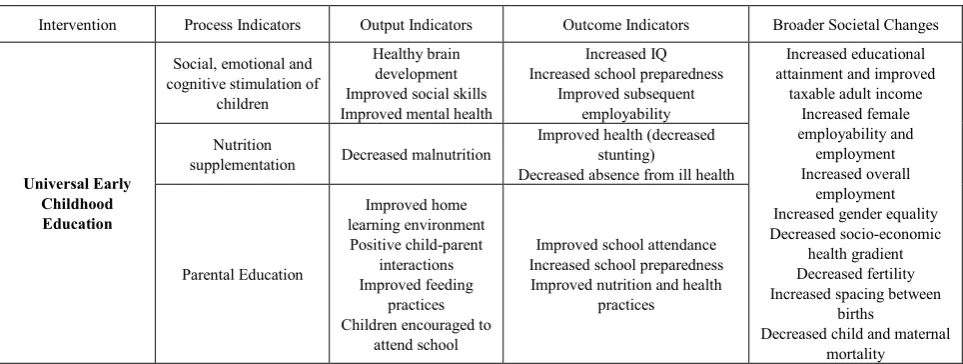
[image:7.595.64.546.559.741.2]In summary, an ideal program would consider all of the spheres of influence on a child, including home, school, community, health, social, and economic factors (See Table 1: Logic Model for ECE Programming). In order to implement such a program, an early development index would have to be taken of the Tamil Nadu province. At present, no such index has been used to determine the developmental needs of children in the India. Fernald et al. (2009), have compiled a review of all the current reliable early development instruments along with instructions on how they can be adapted to other countries. This would allow tests developed outside of India to potentially be used to assess the needs of India. According to Fernald et al. (2009) the only test developed specifically for India is the ICMR Psychosocial Developmental Screening Test which has been reliably tested on over 13 000 children under the age of 5. As this test has shown good validity, its use is recommended over the use of international measures that might not be as suitable for the population
Table 1. Logic Model of ECE Programing
Intervention Process Indicators Output Indicators Outcome Indicators Broader Societal Changes
Universal Early Childhood Education
Social, emotional and cognitive stimulation of
children
Healthy brain development Improved social skills Improved mental health
Increased IQ Increased school preparedness
Improved subsequent employability
Increased educational attainment and improved
taxable adult income Increased female employability and employment Increased overall
employment Increased gender equality Decreased socio-economic
health gradient Decreased fertility Increased spacing between
births
Decreased child and maternal mortality Nutrition
supplementation Decreased malnutrition
Improved health (decreased stunting)
Decreased absence from ill health
Parental Education
Improved home learning environment
Positive child-parent interactions Improved feeding
practices Children encouraged to
attend school
Improved school attendance Increased school preparedness Improved nutrition and health
mplications for social work in India
Social workers are in the unique position to promote ECD as they are the link between children, families, and the wider community. Particularly in India, school social workers work with the community to minimize the environmental barriers that prevent children from learning (Naidu, 2013). These exact barriers are what ECD seeks to address. As well, ECD programs would provide social work students with an important placement opportunity that provides them the ability to practice on micro, mezzo and macro levels as they coordinate programs, support community outreach for the programs, and analyze program effectiveness. Social workers in India also have an important role in advocating for the children and families that are most disadvantaged – these are the people that would benefit most from ECD, but usually have the least access to quality programs.
Discussion and Recommendations
Childhood educational and health policy is enroute to being developed in India; however, the importance of early childhood development continues to be insufficiently addressed (Perakath, 2005). Inadequate resources and a lack of interdepartmental communication have resulted in implementation problems in service delivery, thereby impacting the output and outcome indicators. As well, a lack of monitoring of ECD outcomes and related programming has decreased the government’s ability to respond adequately to developmental needs during critical periods of neural development. Although the emphasis of this literature review has been on educational outcomes, the benefits of ECD are long term and multigenerational. Early years programming that encompasses all aspects of a child’s life, including physical, cognitive, and social, are necessary to bring about social change required to reduce poverty and gender inequality in India.
The following recommendations are made for a successful early childhood development in the India context:
1. The explicit inclusion of ECD and ECE in health and education policies.
2. The social and political recognition that women and female children are under increased pressures due to gender inequities and that measures must be taken to ensure equal participation and opportunity. As such, issues of child workers and the use of young girls as childcare providers need to be politically addressed. 3. Increased resource allotment to the 0-6 year period to
reflect the potential in brain and behavioral development.
4. Improved monitoring of childhood development to determine changing needs.
5. Improved monitoring and evaluation of programming to ensure program quality and effectiveness.
6. A continuum of programming that begins pre-natally
and continues to support children and families through primary school.
7. Ensuring programming is both universal and with proportionate support for at risk families and children, such as those in rural areas or in poverty. 8. Early childhood programs should reflect the physical,
social, emotional, language, cognitive, and health needs of children.
9. Programs should ensure parental participation and include a parenting component to promote development both inside and outside the home. 10. Provide outreach to isolated families and children to
ensure full participation.
Conclusion
Early childhood development and education is a critical component of the Millennium Development Goals. ECD has the potential to improve the outcomes of not just children, but also their parents. Though many different programs exist, only those that are strictly controlled and long-term have the necessary impact needed to break the intergenerational cycle of poverty that these children find themselves in. India has the economic and political stage necessary to provide early childhood care and education to its child population and fight the high rates of illiteracy and ill health. At present, 43.5% of children are underweight in India, but programs like the ICDS that provide ECD, nutrition, and immunization, have the potential of decreasing this number and ensuring that every child has the right start to life.
REFERENCES
Aga Khan Foundation (AKF). (2010). Improving learning achievement in early primary in low-income countries: A review of the literature. Retrieved from www.akdn.org
Allen, G. (2011). Early intervention: The next steps. Retrieved from
http://grahamallenmp.files.wordpress.com/2011/01/early-intervent ion-7th.pdf
Allen, G. & Smith, I.D. (2008). Early Intervention: Good Parents, Great Kids, Better Citizens. Retrieved from http://www.centreforsocialjustice.org.uk/client/downloads/EarlyInt erventionpaperFINAL.pdf
Barker, G., Barlett, D., Beardshaw, T., Brown, J., Burgess, A., Lamb, M.E., ... Vann, N. (2004). Supporting Fathers: Contributions from the International Fatherhood Summit 2003: Early Childhood Development: Practice and Reflections 20. Bernard van Leer Foundation: The Hague, The Netherlands.
Bhattacharya, P.C. (2006). Economic development, gender inequality and demographic outcomes: Evidence from India.
Population and Development Review, 32, 263-291.
What does the research tell us? Working Paper No. 49. The Hague, The Netherlands: Bernard van Leer Foundation.
Blok, H., Fukkink, R.G., Gebhardt, E.C., & Leseman, P.P.M. (2005). The relevance of delivery mode and other programme characteristics for the effectiveness of early childhood intervention.
International Journal of Behavioural Development, 29, 35-47. Brooker, L. & Woodhead, M. Eds. (2010). Culture and Learning: Early Childhood in Focus 6. Milton Keynes, UK: The Open University.
Brown, C. & Mowry, B. (2009). Preparing for change: A case study of successful alignment between a pre-K program and K-12 education. Childhood Education, 85, 173-178.
Burger, K. (2010). How does early childhood care and education affect cognitive development? An international review of the effects of early interventions for children from different social backgrounds. Early Childhood Research Quarterly, 25, 140-165. Burke, C.J.F. & Burke, W.M. (2005). Student-ready schools.
Childhood Education, 81, 281-285.
Census India. (2011). Census India2011. Retrieved from http://censusindia.gov.in/
Chowdhury, M.E., Botlero, R., Koblinsky, M., Saha, S.K., Dieltiens, G., & Ronsmans, C. (2007). Determinants of reduction in maternal mortality in Matlab, Bangladesh: A 30-year cohort study.
Lancet, 370, 1320-28.
CIA. (2012). The world fact book: India. Retrieved from https://www.cia.gov/library/publications/the-world-factbook/geos/ in.html
De Graaff, F. & Van Keulen, A. (2008) Making the road as we go: Parents and professionals as partners managing diversity in early childhood education. Practice and Reflections No. 23. The Hague, The Netherlands: Bernard van Leer Foundation.
Department of Women and Child Development. (2012). Child Development. Retrieved from http://wcd.nic.in/
Devlieger, H., Martens, G., & Bekaert, A. (2005). Social inequalities in perinatal and infant mortality in the northern region of Belgium (the Flanders). European Journal of Public Health, 15, 15-19.
Evans, G.W., Brooks-Gunn, J., & Klebanov, P.K. (2011). Stressing out the poor: Chronic physiological stress and the income-achievement gap. Pathways, Winter 2011, 16-21.
Fernald, L., Kariger, P., Engle, P., & Raikes, A. (2009). Examining early child development in low-income countries: A toolkit for the assessment of children in the first five years of life. Washington, DC: The World Bank.
Field, F. (2010). The foundation years: Preventing poor children becoming poor adults. Retrieved from http://www.politiquessociales.net/IMG/pdf/p2_poverty-report.pdf Gammage P. (2008). The social agenda and early childhood care and education: Can we really help create a better world? Online Outreach Paper 4. The Hague, The Netherlands: Bernard van Leer Foundation.
GLA Economics. (2011). Early years interventions to address health inequalities in London – the economic case. London, UK: GLA Economics.
Government of India. (2011). Statistical Handbook 2011. Retrieved from
http://india.gov.in/outerwin.php?id=http://www.tn.gov.in/deptst/ Grantham-McGregor, S. Cheung, Y.B., Cueto, S., Glewwe, P., Richter, L., Strupp, B., & International Child Development Steering Group. (2007). Developmental potential in the first 5 years for children in developing countries. Lancet, 369, 60-70.
Hertzman, C. & Wiens, M. (1996). Child development and long-term outcomes: A population health perspective and summary of successful interventions. Social Science & Medicine, 43, 1083-95.
High Commission. (2012). India Factsheet. Retrieved from http://www.hcindia-au.org/factsheet_of_india.html
Irwin, L.G., Siddiqi, A., & Hertzman, C. (2007). Early child development: A powerful equalizer. Vancouver, BC: Human Early Learning Partnership.
Jatrana, S. (2005). Why do some infants survive and others not? Determinants of infantmortality in the Mewat Region of Haryana State, India. Asian Journal of Social Science, 33, 186-207.
Kartal, H. (2007). Investments for future: Early childhood development and education. Educational Sciences: Theory & Practice, 7, 543-554.
Kaul, V., & Sankar, D. (2009). Early childhood care and education
in India. Retrieved from
http://www.educationforallinindia.com/early-childhood-care-and-e ducation-in-india-1.pdf
Kontos, S. & Wilcox-Herzog, A. (2003). Effective preparation for early childhood education: What does North American research tell us? European Early Childhood Education Research Journal, 11, 79-92.
Marmot, M., Friel, S., Bell, R., Houweling, T.A.J., & Taylor, S. (2008). Closing the gap in a generation: Health equity through action on the social determinants of health. Lancet, 372, 1661-69. Marmot, M. & Wilkinson, R.G. (2006). Social Determinants of Health (2nd ed.). Oxford, UK: Oxford University Press.
McCain, M. & Mustard, J.F. (1999). Reversing the real brain drain: Early Years Study Final Report. Toronto, ON: Child’s Secretariat. Moss, P. & Woodhead, M. Eds. (2007). Early Childhood and Primary Education: Transitions in the lives of young children: Early Childhood in Focus 2. Milton Keynes, UK: The Open University. Mustard, F. & Picherack, F. (2002). Early Child Development in British Columbia: Enabling Communities. Toronto, ON: The Founders Network.
Mustard, J.F. (2006). Early child development sets the foundation for learning, behaviour and health. The CAP Journal, 14, 1-23. Naidu, P. J. (2013). Aims of School Social Work. Journal of School Social Work, 9, 35.
Nordtveit, B.H. (2008). Poverty alleviation and integrated service delivery: Literacy, early child development and health. International Journal of Educational Development, 28, 405-418. Oates, J. Ed. (2010). Supporting Parenting: Early Childhood in Focus 5. Milton Keynes, UK: The Open University.
D.W., ... Holmberg, J. (2004). Effects of nurse home-visiting on maternal life course and child development: Age 6 follow-up results of a randomized trial. Pediatrics, 114, 1550-59.
O’Sullivan, M. (2003). The development of effective strategies to teach reading among unqualified primary teachers in a developing context. International Journal of Early Years Education, 11, 129-140.
Pascal, C.E. (2009). With our best future in mind: Implementing Early Learning in Ontario. Retrieved from http://www.ontario.ca/en/initiatives/early_learning/ONT06_01886 5
Perakath, A. (2005). CET policy formulation in Tamil Nadu: A study of government policy, the regulatory framework, and the decision-making process for school curricula, exams and textbooks. Retrieved fromhttp://ccs.in/ccsindia/internship_papers_ 2005.asp
Perez-Johnson, I. & Maynard, R. (2007). The case for early, targeted interventions to prevent academic failure. Peabody Journal of Education, 82, 587-616.
Population Research Centre. (2009). Evaluation report on integrated child development scheme (ICDS) Jammy & Kashmir. Retrieved from
http://planningcommission.nic.in/reports/peoreport/peo/peo_icds.p df
Saracho, O.N. & Spodek, B. (2007). Early childhood teachers’ preparation and the quality of program outcomes. Early Child Development and Care, 177, 71-91.
Schoeps, D., de Almeida, M.F., Alencar, G.P., França, I., Dutilh Novaes, H.M., de Siqueira, A.A.F., Campbell, O., & Rodrigues,
L.C. (2007). Risk factors for early neonatal mortality. Rev Saúde Pública, 41, 1-9.
Schweinhart, L.J. & Weikart, D.P. (1998). High/Scope Perry Preschool Program Effects at Age Twenty Seven in Social Programs that Work. Ed. J. Crane. New York, NY: Russell Sage. Siraj-Blatchford, I. & Woodhead, M. Eds. (2009). Effective Early
Childhood Programmes: Early Childhood in Focus 4. Milton
Keynes, UK: The Open University.
Smale, J. Ed. (1998). Early Childhood Matters No. 90: The Bulletin of the Bernard van Leer Foundation. The Hague, The Netherlands: Bernard van Leer Foundation.
UNICEF. (2007). State of the world’s children: Women and children: The double dividend of gender equality. Retrieved from http://www.unicef.org/sowc07/report/report.php
Vestal, A. & Jones, N.A. (2004). Peace building and conflict resolution in preschool children. Journal of Research in Childhood Education, 19, 131-142.
Vogler, P., Crivello, G. & Woodhead, M. (2008) Early childhood transitions research: A review of concepts, theory, and practice. Working Paper No. 48. The Hague, The Netherlands: Bernard van Leer Foundation.
WHO. (2010). World Health Statistics India 2010 retrieved February 20, 2010, from http://www.who.int/whosis/whostat/en/in dex.html
Working Group on Development of Children for the Eleventh Five Year Plan. (2006). Early Childhood Education in the Eleventh Five
Year Plan (2007-2012). Retrieved from