Abstract
The fast development of RFID technology having challenging issues of the optimal deployment of RFID network are tags coverage, interference, economic efficiency and load balance. In this paper the novel approach of Multi-Colony Global Particle Swarm Optimization (MC-GPSO) algorithm was used to deploy minimum number of reader which covers all tags with minimum interference effect in large scale basis. The main aim of this algorithm is to divide the swarm in to multi-colony for achieving the optimal results as compared to the basic PSO. Simulation results show the optimal solution of RFID Network Planning (RNP).
A Novel Optimal RFID Network Planning
by MC-GPSO
Khalid Hasnan*, Aftab Ahmed, Badrul-aisham, Qadir Bakhsh, Kashif Hussain and Kamran Latif
Universiti Tun Hussein Onn Malaysia, 86400, Parit Raja, Batu Pahat, Johor, Malaysia; [email protected], [email protected], [email protected], [email protected], [email protected], [email protected]
Keywords: MC-GPSO, PSO, RFID, RNP
1. Introduction
The RFID wireless communication system has been used for real time identification and data collection of entities at global level since last more than half century. Currently the RFID technology most commonly used in toll collection, tracking the luggage at airport, inventory management at retail shop, warehousing, logistics and supply chain management. The RFID system has three basic components such as tag, reader and Middleware.
The RFID tag is small electronic chip data carrying device used to attach with items for identification and tracking. The RFID reader is a device used for data col-lection from tagged items by electromagnetic wave and transmits to the middleware. The Middleware transmit and receive data directly from the interrogator, carry out a business-related process, stores the data as per the requirement, sends data to the enterprise applications.
The working principle of RFID system described as, when the reader send an electromagnetic wave through their antenna towards the tagged items, tags in the range transmit back a radio wave signal towards the reader through their embedded antenna along with the data stored in it. Then reader transmits that data
to the middleware which updates the information of
business software1. However RFID is an enabling and
promising technology, even though it has issues dur-ing deployment of the RFID system among various working environment. The fast development of RFID technology having challenging issues of the optimal deployment of RFID network are tags coverage,
inter-ference; economic efficiency and load balance2–5. Due
to the limited range and high cost of RFID reader the following constrained are to be considered before deploying the reader network. (1) How many mini-mum readers are required to cover all tags? (2) Where to deploy these minimum readers? (3) What parameters are to be set for each reader?
Owing to the development of computer applications in every field the latest scientific approach is used to compute any task by using various computer software’s and programming to fulfill the particular computation in very short time. The Artificial Intelligence (AI) is a branch of computer science, used for computing very complex problems5,6; it behaves like a human intelligence
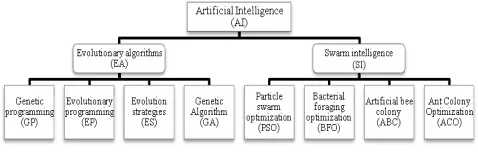
in order to work multiple tasks concurrently. AI has two major branches such as Evolutionary Algorithm (EA) and Swarm Intelligence (SI) and its further developed
*Author for correspondence
the Multi-Colony Global Particle Swarm Optimization (MC-GPSO) algorithm was used to solve the RNP issues by deploying minimum number of readers to cover all tags with minimum interference between readers.
2. Basic Concept of Particle
Swarm Optimization
The particle swarm optimization algorithm was first developed in 1995 by James Kennedy and Russell C. Eberhart. This idea was created with the inspiration of nature based social behavior of fish schooling or bird flocking8,9. It is a
population based heuristic evolutionary technique used for global optimization. This technique is used for best solution of problems in n-dimensional space by randomly initializ-ing the particle velocity and their interaction with respect to each particle. PSO has two basic equations which are to be implementing to serve the purpose of optimization into the
solution space10 and achieve required goal of RNP. These
equations are in mathematical order as follows.
Vid V
id
= × + × ×
(
−)
+ × ×
(
−)
ω c rand pBest x
c rand gBest x
d i d i d d i d i d 1 1
2 2 (1)
Xid X V
id id
= + (2)
Where, d = 1, 2,……, D (dimension of the search space) i = 1, 2….., N (index of each reader)
In this algorithm, each particle individually moves through the problem space with a velocity. The veloc-ity vector having speed and direction, which has to be regulated on the basis of particle’s previous best known (self-cognitive) and the historical best knowledge in its neighborhood (social-influence)2–4.
Inertia weight is an important parameter which con-trols the convergence and balancing the exploration and exploitation by setting higher value at first and then gradually reduce toward its lower value for achieving bet-ter performance4,7. Inertia part (ω x V
id) is used to avoid
sudden changing the velocity of readers in the search
space. The cognitive part c randd pBest x c rand gBest x
id id d id id
1× 1 ×
(
−)
+ ×2 2×(
−)
c randd pBest x c rand gBest x
id id d id id
1× 1×
(
−)
+ ×2 2×(
−)
is used to represent as an
external force to drag the particle to move towards better
position. The social part c randd gBest x
i d
i d 2× 2×
(
−)
is used
to closely interact with each swarm and predict to plan the number of better positions in the search space3. c
1 and
techniques are as shown in Figure 1. These techniques are used to find out the user defined tasks by computer pro-gramming as an innovative manner to solve difficult and
complex problems3,7. These techniques works on the basis
of nature inspired behavior of biological and of social animals; they are searching their food collectively as self-organized with the systematic approach4,5,7.
There is no centralized control to organize the agents to follow the rule to interact with the local agents and environment2. It is a built-in natural property for
search-ing based approach to perform collectively. Each agent interacts with other agents locally according to the environment. The following are the basic advantages of artificial intelligence: (1) compute in an easy way to per-form repeated operations according to the nature based inspiration, (2) highly efficient having capability of exploring most suitable optimal solutions in a very short passage of time, (3) flexible to solve various problems of different application areas with slight changes, (4) robust to perform in difficult, harsh and uncertain environ-mental conditions and (5) able to integrate with other techniques3. Keeping in view of these benefits, the EA and
SI could be applicable in various industrial, domestic and commercial applications in the field of wireless communi-cation networks such as Wireless Sensor Network (WSN),
RFID network and cellular radio network7.
[image:2.612.60.299.625.702.2]In this research it was essential to consider the criteria regarding RFID network planning, such as the coordinates of tags and interrogators were fixed as static RNP prob-lem. On the contrary in actual practice during continuous working area RFID tags and readers can be placed at any location. Due to the complexity of the network and cost of RFID system depends on the number of readers, so it was essential to minimize the number of readers at opti-mum level to achieve the target of cost effective planning of network and the goal of optimum business benefits. In this context many previous researchers were tried to fig-ure-out the optimal network planning in order to operate large-scale network. Keeping in view the facts consider-ing the basic requirement of RFID network plannconsider-ing,
c2 (acceleration coefficients) are the learning rates which specify the proportional importance of self-cognitive and social-influence. The rand1 and rand2are random numbers uniformly distributed in (0,1). In this way, the particle can move towards a promising area in the global search. PSO algorithm has advantages such as easy to apply, fast convergence, highly efficient and firm validity. Due to these advantages the algorithm has been used in wide range of application in various systems in recent years and also has provision for further improvements in future applications3,4. In PSO population, each particle randomly
initialize in the search space has a position and a velocity. In first step each particles has to search its own optimal best position in the space with respect to its
pre-vious position that is called personnel best “pBest” and
is recorded in its memory. In second step its position is compared to the neighbor particles in their group and set their positions best fittest possible that is called local best “lBest”. Finally their position is compared to the global search among all particles existing in the search space and set their position, that position is called global best “gBest”. This is the iteration based techniques fol-lowed by each particle in each iteration step and updates velocity and optimal best positions until meets the termi-nation conditions11. In this context readers are particles
which have to be randomly initialized the velocity and position first. In the next step it evaluates the fitness of each reader followed by objective functions according to
precedence and finds their “pBest” and “gBest” of each
reader until termination conditions meets. If termina-tion conditermina-tions on priority basis meets the requirement of objective functions, then reader is deployed at its proper place to achieve the business benefits of enter-prise in supply chain cycle, otherwise update velocity and positions of each reader until meets the objective function at optimum level.
In this research particle swarm optimization algorithm was used innovatively for solving RNP issues by Multi-Colony Global Particle Swarm Optimization (MC-GPSO) algorithm.
3. Methodology of RFID Network
Planning
In this research the methodology of solving objective functions of RNP problems such as tags coverage, mini-mum interference and deploying minimini-mum number of readers described as follows.
3.1 Tags Coverage
The very important and basic objective function of all RFID systems is the entire tags coverage in specified area. It has been achieved by placing the RFID readers at the centre of each cluster of the tags in the working area. If the signal power received at the tags higher than the minimum required power level (threshold power) is –10 dBm, the contact between reader and tags has to be estab-lished. In order to activate the tag with required power, it responses back to the reader through backscatter signal. The objective function, tags coverage has been formulated as the sum of the difference between the actual powers received by each tag to the required power. The mathe-matical equation of tags coverage is described as follows.
Coverage=
∑
iNT=(
Ptagi−Preq)
1 (3)
Ptagi= Actual received power at each tag,
Preq= required threshold power = –10dBm
NT=Number of tags in working area
By Friis transmission equation power at each tag can calculate by the following equation4.
Ptag =Preader×Gtag×Greader× 4λπ 2
d (4)
Coverage P G G
x a
readeri i
NT
tagi readeri
i i
= + +
+
−
=
∑
[log ( .
1
10
20 0 026
((
)
2+(
y bi− i)
2 +10]) (5)3.2 Interference
The interference between RFID readers took place at the area of thick populated reader environment where the inter-rogation range of each reader overlap to the other reader interrogation range, in this scenario each reader attempt to read the similar tags at the same time, as a consequence unaffordable level of misinterpret to be happened3. Due
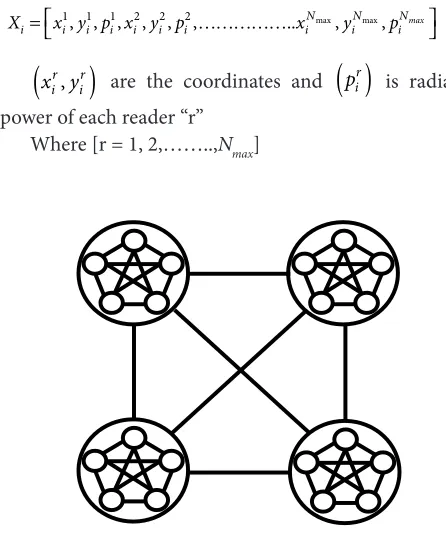
groups. The 3 number of swarms were generated in the solution space. Each swarm having number of RFID read-ers which can interact and share information with each other. It builds a fully connected mesh topology within the swarm as well as neighboring swarms as shown in Figure 2, which were initialized in the working area. It evaluates their fitness best positions such as local best position “lBest” and the global best “gBest” position by sharing knowledge within the group and among the adjacent groups.
3.5
Coding of RFID Reader Representation
The coding translates the variable parameters of reader representation. It indicates the number of readers deployed in the network and their locations and radi-ated power of each reader. In this research each reader
is represented as D = 3Nmax, multidimensional real
num-ber vector. Nmax is maximum number of available readers
which was deployed in the network at initial stage. By
the representation of readers coding as the vector 2Nmax
is denoted the coordinates
( )
x yir, ir of each ith reader and the vector 1 Nmax denoted as radiated power( )
pir of each ith reader which decide the interrogation range of each reader. To consider the above vector notations then the entire ith reader notation in the whole swarm is denoted asXi=x y p x y p1i, , , , , ,i1 1i i2 i2 i2 ………..xiNmax,yiNmax,piNmax (8)
x yir, ir
( )
are the coordinates and( )
pir is radiated power of each reader “r”Where [r = 1, 2,……..,Nmax]
Interference=
∑
iN=max−∑
Nj i= +max d R R( )
i, j −( )
r ri+ j 11
1 (6)
Nmax is the total available number of readers, “d” is distance between readers, Riis the position of ith reader,
Rj is the position of jth reader, r
i is the interrogation range
of ith reader and r
j is the interrogation range of jth reader.
According to the above formula the interference condition can be occurred when the sum of interrogation ranges of two readers (ri + rj) is greater than the center to center distance “d” between the same readers [(ri + rj) > d].
3.3 Number of Readers
After solution of the most important problem tags coverage by deploying the number of readers in the work-ing area of RF network, it needs to reduce the number of readers because its cost is too high, if greater the number of readers higher is the overall cost of the system. So it was necessary to figure-out how much extra readers were deployed at initial stage which were no more to be useful and must be removed from the network using Multi-Colony Global Particle Swarm Optimization (MC-GPOS) algorithm. This objective function can be solved by the following formula3.
Nreq = Nmax – Nextra (7)
N
req is the number of required readers, Nmax is thenumber of available readers and Nextra is the number of
extra readers
The equations of each objective function such as tags coverage, minimum interference and required number of readers were put in to the multi-colony global PSO algo-rithm. The MC-GPSO was calculated the optimum level of network planning according to the priority of objective function.
3.4 Setting Topology of Search Space
The topology of the search space was set as an architectural structure of particles positions and their interaction between each other. The particles were divided into groups as multi-colony to make easy and an efficient working environment. These groups have been deployed for the implementation of a specific task in a large scale net-work. As a result the overall target was easily be achieved within short passage of time with less effort. In the pro-posed algorithm the whole swarm divided into 3 groups. The interaction of each particle of multi-colony approach
[image:4.612.323.546.435.702.2]3.6 Setting Parameters
The parameter was set as the Nmax =10 Number of RFID
reader initially deployed, the radiated power range of reader at each tag (Ptag) is 0.1 to 2 watt (20 to 33 dBm), this variation was directly proportional to the circular range of radiated power of reader from its center. The minimum
threshold power of tags (Ttag) is -10 dBm. The minimum
threshold power of readers (Treader) is – 70 dBm. The power gain of tag antenna (Gtag) is 3.9 dBi and the power gain of reader antenna (Greader) is 7.3 dBi. Inertia weight (ω) is 0.9
to 0.4 and acceleration coefficients were set as c1 = c2 = 2.0. Operating frequency of reader was set as UHF 915 MHz and the number of iteration was set as 15000. The
working area was set as 50m × 50m.
3.7
Application of MC-GPSO
At the start of the MC-GPSO algorithm, each indi-vidual reader in the swarm initializes its velocity first, within the limit of [Vmin, Vmax] and positions were
uni-formly distributed in random numbers as [Xmin, Xmax],
where Xmin is the lower bound and Xmax is the upper bound of the readers position. The PSO population comprised on “N” number of reader in “D” dimen-sional search space, so each reader has velocity vector Vi = [Vi1, V
i2, ……, ViD], position vector Xi = [Xi1, Xi2,
……., XiD] and pervious best position vectors pBest
i =
[pBesti1, pBest
i2,…,pBestiD] and global best position
vec-tor gBest = [gBesti1, gBesti2,…,gBestiD]. In this process
the velocity and position of each reader is randomly ini-tialized in the search space according to the coordinates
x yir i r ,
( )
.( )
pir is radiated power within the transmis-sion range of each reader (r = 1, 2,…….., Nmax). At first instance all readers “Nmax” were deployed in the working area for RFID network planning. At the initial stage the availability of all readers in the network represented by a vector as switch on position (1, 1,…….., 1). Those read-ers meets the objective functions is remain switched on, otherwise it is switched off. The switched off readers are represented by the vector (0, 0,….0).3.8
Operating Procedure of MC-GPSO
The step by step operating procedure of Multi-Colony Particle Swarm Optimization (MC-GPSO) is described as follows.
Step1. Randomly initialize the velocity and position of each reader.
Step2. Evaluate the fitness of each reader according to the objective functions by using equation (5), (6) and (7) in each swarm and then record the “pBest” of each reader. Then calculate the “gBest” in each swarm.
Step3. Update the position and velocity of all readers by using equations (1) and (2). If the updated posi-tion and velocity of each reader is better than the previous best, then new best position fixed as cur-rent best position, otherwise kept as the previous best.
Step4. Evaluate the fitness value of each reader and com-pare with the previous best fitness position and velocity on the basis of recorded knowledge and then update each reader position according to the global position in each group.
Step5. If the fitness value achieved so far as global best and maximum iteration has to be completed and global best position achieved, then go to the next step as stop operation else go to step 3.
3.9 Simulation Result
The scenario of the working area was set as 50m × 50m
as shown in Figure 3 (a). The 100 numbers of tags are randomly distributed in working space as shown in Figure 3 (b)
4. Conclusion
The innovative application of MC-GPSO algorithm gives optimal result of objective functions of RNP including
full coverage of tags in 50m × 50m square working area
using minimum number of readers with minimum inter-ference. The MC-GPSO algorithm reduces the overall cost of the RFID network planning on the basis of calculating optimal number of readers and its coordinates for best placement. The overall cost of RNP is less as compared to existing state-of-the-art ones due to minimum number of RFID readers calculated. This algorithm can be used for different size and shapes of indoor working areas and is reliable on the basis of simulations results before physical implementation.
5. Acknowledgement
This research supported by the Postgraduate Incentive Research Grant under Vot. No.1156. The authors would like to thank the University Tun Hussein Onn Malaysia (UTHM) for financially supporting of this research.
6. References
1. Ahmed A, Hasnan K, Aisham B, Bakhsh Q. Impact of RFID and Xbee Communication Network on Supply Chain Management. Applied Mechanics and Materials. 2014; 660:983–7.
2. Chen H, Zhu Y, Hu K, Ku T. RFID network planning using a multi-swarm optimizer. Journal of Network and Computer Applications. 2011; 34(3):888–901.
3. Gong Y, Shen M, Zhang J. Optimizing RFID Network Planning by using a Particle Swarm Optimization Algorithm With Redundant Reader Elimination. IEEE Transactions on Industrial Informatics. 2012; 8(4):900–12.
4. Feng H, Qi J. Optimal RFID networks planning using a hybrid evolutionary algorithm and swarm intelligence with multi-community population structure. 14th International Conference on Advanced Communication Technology (ICACT); 2012. p. 1063–8.
5. Ma L, Chen H, Hu K, Zhu Y Hierarchical artificial bee colony algorithm for RFID network planning optimization. The Scientific World Journal. 2014; 2014:1–21.
6. Barton R, Thomas A. Implementation of intelligent systems, enabling integration of SMEs to high-value sup-ply chain networks. Engineering Applications of Artificial Intelligence. 2009; 22(6):929–38.
7. Chen H, Zhu Y, Hu K, Ku T. Dynamic RFID Network Optimization using a Self-adaptive Bacterial Foraging
(a)
(b)
(c)
(d)
[image:6.612.89.271.60.686.2]Algorithm. International Journal of Artificial Intelligence. 2011a; 7(A11):219–31.
8. Eberhart RC, Shi Y. Comparing inertia weights and constric-tion factors in particle swarm optimizaconstric-tion. Proceedings of the Congress on Evolutionary Computation. 2000; 1(7):84–8.
9. Bansal JC, Singh PK, Saraswat M, Verma A, Jadon SS, Abraham A. Inertia Weight Strategies in Particle Swarm. Third World Congress on Nature and Biologically Inspired Computing; 2011; p. 633–40.
10. Antonio S. Algorithm and Swarm Intelligence. Proceedings of the 2009 IEEE International Conference on Systems, Man, and Cybernetic; 2009. p. 1201–8.