iv
THREE PHASE INVERTER FOR INDUCTION MOTOR CONTROL USING FUZZY-PI CONTROLLER WITH ARDUINO
ABDUL SALAM BIN SAAD
A project report submitted in partial fulfillment of the requirement for the award of the
Master of Electrical Engineering
Faculty of Electrical and Electronic Engineering Universiti Tun Hussein Onn Malaysia
viii
ABSTRACT
ix
ABSTRAK
x
CONTENTS
TITLE i
DECLARATION ii
DEDICATION iii
ACKNOWLEDGEMENT iv
ABSTRACT vii
CONTENTS ix
LIST OF TABLE xi
LIST OF FIGURE xii
LIST OF SYMBOLS AND ABBREVIATIONS xiii
LIST OF APPENDICES xiv
CHAPTER 1 INTRODUCTION 1
1.1 Project Background 1
1.2 Problem Statement 2
1.3 Project Objectives 3
1.4 Scope Project 3
CHAPTER 2 LITERATURE REVIEW
Error! Bookmark not defined.4
2.1 Induction Motor 4
2.2 3-Phase Inverter 5
xi
2.3.1 Direct Torque Control 7
2.4 Propose Controller 11
2.5 Arduino 12
CHAPTER 3 METHODOLOGY 15
3.1 Block Diagram of Project 15
3.2 Flow Chart of system 18
3.3 Flow chart of project 19
3.4 Inverter Design 22
3.5 Gate Driver Design 25
3.6 Controller Design 25
3.7 Current Sensor 26
3.8 Experiment set up 27
CHAPTER 4 DATA ANALYSIS AND RESULT 27
4.1 Simulation from MATLAB/Simulink 27
4.2 Hardware Analysis 29
4.2.1 Gate driver analysis 34
4.2.2 Inverter circuit analysis 35
4.4 Close Loop Control 37
4.4.1 PWM Comparison 39
4.4.2 Controller Performance 40
CHAPTER 5 CONCLUSION AND RECOMMENDATION 41
5.1 Conclusion 41
5.2 Recommendations 41
REFERENCES 58
xii
LIST OF TABLES
xiii
LIST OF FIGURES
2.1 Three phase full bridge inverter 6
2.2 PWM illustration by the sine-triangle comparison method
(a) sine triangle comparison (b) switching pulses 7
2.3 PID control logic block diagram 10
2.4 Block diagram of typical fuzzy logic controller 11
3.1 Block diagram of the project 16
3.2 Flow chart of project development 17
3.3 Schematic diagram of three phase inverter 18
3.4 PCB layout for three phase inverter 19
3.5 Hardware development for three phase inverter 19
3.6 The schematic diagram of the gate driver 21
3.7 Hardware development for gate driver 21
3.8 The design of Fuzzy-PI controller 22
3.9 PI controller 22
3.10 ADC block 23
3.11 DAC block 23
3.12 Fuzzy Logic controller 24
3.13 Rules set for Fuzzy Logic controller 24
3.14 Surface viewer for the Fuzzy Logic controller 24
3.15 Current sensor 25
3.16 Experiment setup 26
4.1 The PWM generator 46
4.2 The generated PWM signal 46
4.3 The LC filter block 47
4.4 The output voltage after the inverter 47
xiv
4.6 The current output after the filter 48
4.7 Full simulation block diagram for close loop 49
4.8 Fuzzy-PI controller designed in MATLAB/Simulink 50
4.9 The setup for the Fuzzy block Diagram 50
4.10 The PI controller block diagram 50
4.11 The generated PWM signal 51
4.12 The Output voltage after the inverter 51
4.13 The output voltage after the filter 52
4.14 Current output after the filter 52
4.15 Output from the gate driver. 53
4.16 Output from the inverter 54
4.17 Output voltage after the inverter during open loop experiment 54 4.18 The Simulink model for Fuzzy-PI controller for close loop experiment 55
4.19 Current sensor 55
4.20 Generated PWM during the close loop experiment 56
4.21 Output voltage after the inverter. 56
xv
LIST OF SYMBOL AND ABBREVIATIONS
ABS - Automatic Brake System AC - Alternating Current
ADC – Analogue to Digital
DAC - Digital to Analogue
DC - Direct Current;
DOL - Direct On Line
DTC - Direct Torque Control
DSP - Digital Signal Processing
FFNN - Feed Forward Neural Network FOC - Field Oriented Control
GA - Genetic Algorithms
MV - Manipulated Variable
PCB - Printed Circuit Board
PD – Proportional Derivative
PI - Proportional Integral
PID - Proportional Integral Derivative;
PWM - Pulse Width Modulation;
CHAPTER 1
INTRODUCTION
1.1 Project Background
Induction motor also known as asynchronous motor is a popular choice among the other type of motor and can be found easily within our surrounding, cover wide range of applications in both industrial and home appliance, from fan, compressor, pump, washing machine, freezer and many more. The main reason for these phenomena is none other than it advantages such as robustness, reliability, low price, maintenance free operation and no magnetic interference [1].
In terms of usage, it is by far the most important, with something like one third of all the electricity generated being converted back to mechanical energy in induction motors. It will continue to dominate these fixed-speed applications, but thanks to the availability of reliable variable-frequency inverters, it is now also the leader in the controlled-speed arena [2].
2
There are a lot of microcontrollers with the built-in PWM feature, range from 8-bit to 32-bit architecture design. These microcontroller usually are cheap, great resources and easy to obtained. But there are manufacturers that provide more interesting microcontroller based product like Chipkit, Sakura and Arduino. These products were called electronic prototyping platform. It can be used straight out-of the-box, without any additional devices or component [3, 4].
1.2 Problem Statement
Three-phase AC induction motors are widely used in industrial and commercial applications. They are classified either as squirrel cage or wound-rotor motors. It produces medium to high degrees of starting torque. The power capabilities and efficiency in these motors range from medium to high. Popular applications pumps, compressors, conveyors, farm equipment and other mechanical duty applications.
AC induction motors are often operated in open loop with no velocity or position feedback. The Volt/freq ratio is maintained constant to provide a constant (maximum) torque over the operating range. This form of control is relatively inexpensive and easy to implement. Feedback from the rotor is not utilized and the rotor is assumed to follow the rotating flux generated in the stator, with a certain amount of slip present depending upon the load.
The disadvantage of open-loop Volt/freq control is that the motor can stall if the speed is ramped up too quickly or the load otherwise changes rapidly. Without some form of feedback, it is impossible to detect whether the motor is turning as expected, or if it is stalled. A stall causes high currents and the motor loses torque. By monitoring current, excessive slip can be detected, and the motor frequency can be adjusted accordingly by using controlled PWM.
3
1.3 Project Objectives
The main objectives for this project are:
i. To design a closed-loop control for a three phase induction motor.
ii. To design a combination of PI-Fuzzy controller to control the speed a three phase induction motor.
iii. To develop the hardware (inverter and gate driver) of the controller to control a three phase induction motor.
iv. To successfully make a communication between computer using Matlab software and Arduino.
1.4 Scope Project
The scope of this project is:
i. Design the closed-loop control with current feedback for the 1kWatt three phase induction motor type squirrel cage.
ii. Design the Fuzzy- PI controller using volt/frequency method to control the current of a three phase induction motor.
iii. Build the hardware for this project, which is the inverter using MOSFET as the switching device and the gate-driver for the inverter.
CHAPTER 2
LITERATURE REVIEW
2.1 Induction Motor
The three-phase induction motors are the most widely used electric motors in industry. They run at essentially constant speed from no-load to full-load. However, the speed is frequency dependent and consequently these motors are not easily adapted to speed control. Nevertheless, the 3-phase induction motors are simple, rugged, low-priced, easy to maintain and can be manufactured with characteristics to suit most industrial requirements.
Like any electric motor, a 3-phase induction motor has a stator and a rotor. The stator carries a 3-phase winding (called stator winding) while the rotor carries a short-circuited winding (called rotor winding). Only the stator winding is fed from 3-phase supply. The rotor winding derives its voltage and power from the externally energized stator winding through electromagnetic induction and hence the name. The induction motor may be considered to be a transformer with a rotating secondary and it can, therefore, be described as a “transformer type” AC machine in which electrical energy is converted into mechanical energy.
The squirrel cage type consists of a laminated cylindrical core having parallel slots on its outer periphery. One copper or aluminium bar is placed in each slot. All these bars are joined at each end by metal rings called end rings. This forms a permanently short-circuited winding which is indestructible. The entire construction (bars and end rings) resembles a squirrel cage and hence the name [5].
5
brought out and joined to three insulated slip rings mounted on the rotor shaft with one brush resting on each slip ring.
Most of 3-phase induction motors use squirrel cage rotor as it has a remarkably simple and robust construction enabling it to operate in the most adverse circumstances. However, it suffers from the disadvantage of a low starting torque. It is because the rotor bars are permanently short-circuited and it is not possible to add any external resistance to the rotor circuit to have a large starting torque [6].
However, the use of induction motors is challenging because of its complex mathematical model, its non-linear behavior during saturation and the electrical parameter oscillation that depends on the physical influence of the temperature.
2.2 Three Phase Inverter
Inverter is an electrical power converter that changes direct current (DC) to alternating current (AC). The converted AC can be at any required voltage and frequency with the use of appropriate transformers, switching, and control circuits. Inverters are commonly used to supply AC power from DC sources such as solar panels or batteries.
6
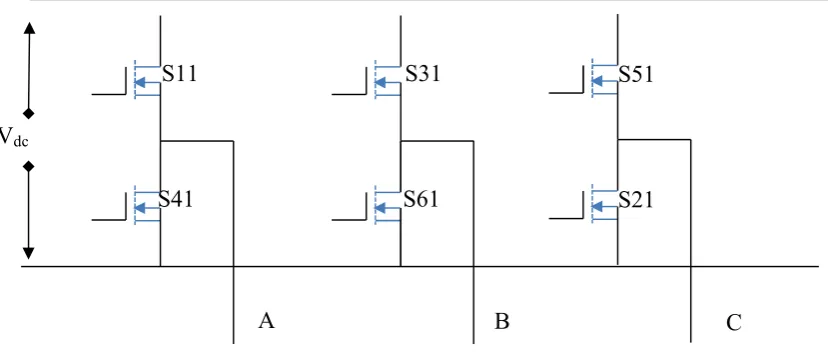
S11 S31 S51
S41 S61 S21
A B C
[image:15.595.102.519.100.277.2]Vdc
Figure 2.1:Three phase full bridge inverter
7
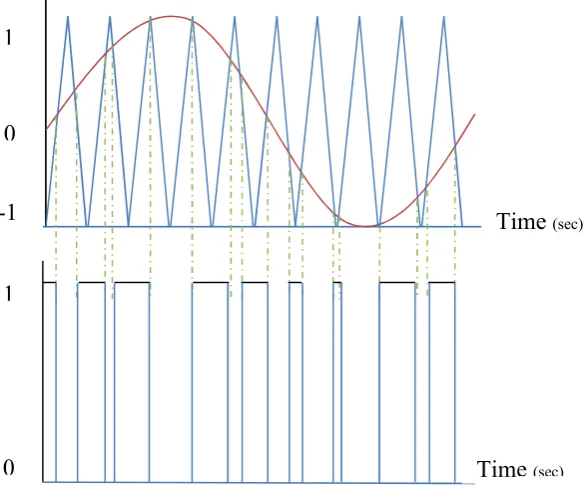
Figure 2.2: PWM illustration by the sine-triangle comparison method (a) sine triangle comparison (b) switching pulses
2.3 Controller
Generally there are three type of controller that can be used to control the induction motor. The direct torque control, field oriented control and volts/hertz control. Each controller has pros and cons and the user can choose based on the requirement and application of the motor.
2.3.1 Direct Torque Control
Direct Torque Control or DTC, as the name indicates, is the direct control of torque and flux of an electrical motor by the selection, through a look-up table, of the power converter voltage space vectors. The main advantage of DTC is its structure simplicity, since no coordinate transformations, current controllers and modulations are needed.
Moreover the controller does not depend on motor parameters. DTC is considered to be a simple and robust control scheme which achieves quick and precise torque control response. However, torque and flux modulus values and the
1
0
-1
1
0
Time (sec)
8
sector of the flux are needed and more importantly, short sampling period time for the torque and flux control loops are needed in order to keep electromagnetic torque ripple within an acceptable value [8].
There are also a few experiment using this technique for induction motor controller which gave promising result as the controller is capable of controlling the induction motor at any speed like in [9].
2.3.2 Field Oriented Control
Field oriented control or FOC methods control the frequency, amplitude and phase of the motor drive voltage. The key to field oriented control is to generate a 3-phase voltage as a phasor to control the 3-phase stator current as a phasor that controls the rotor flux vector and finally the rotor current phasor [10].
The Field Orientated Control consists of controlling the stator currents represented by a vector. This control is based on projections which transform a three-phase time and speed dependent system into a two coordinate (d and q coordinates) time invariant system.
Field orientated controlled machines need two constants as input references, the torque component (aligned with the q coordinate) and the flux component (aligned with d coordinate). As Field Orientated Control is simply based on projections the control structure handles instantaneous electrical quantities. This makes the control accurate in every working operation (steady state and transient) and independent of the limited bandwidth mathematical model [11].
2.3.3 Volts/Hertz Control
9
The magnitude of stator flux is proportional to the ratio of stator voltage & frequency. If ratio is kept constant the stator flux remains constant & motor torque will only depend upon slip frequency.
When stator frequency fails under a given frequency threshold (boost frequency), the voltage magnitude must be kept at given level called boost voltage to keep rotor flux magnitude constant. Vboost means small voltage is added to dc voltage reference to compensate stator resistance drop at low frequency.
At opposite when frequency becomes higher than rated value, the voltage magnitude is kept at rated value. The stator flux is no more constant & torque decreases. The characteristic is defined by the base point of the motor. Below the base point the motor operates at optimum excitation because of the constant v/f ratio [14].
Above this point the motor operates under-excited because of the DC-bus voltage limit. If speed is changed by maintaining v/f ratio constant, then maximum torque remains same.
2.3.4 PID Controller
The Proportional, Integral and Derivative or PID is a control algorithm that tries to compensate for characteristics in your system. There are three primary components to think about in a PID control loop. Each component is prefixed with a gain constant, and when added together, give you the instantaneous control value that you use to drive your system [15].
The ideal version of the PID controller is given by the formula
( ) = ( ) + ∫ ( ) + ( )
Where is the control signal and is the control error ( =r−y). The reference value, r, is also called the set point. The control signal is thus a sum of three terms: a proportional term that is proportional to the error, an integral term that is proportional to the integral of the error, and a derivative term that is proportional to the derivative of the error. The controller parameters are proportional gain, , integral gain, and derivative gain, .
10
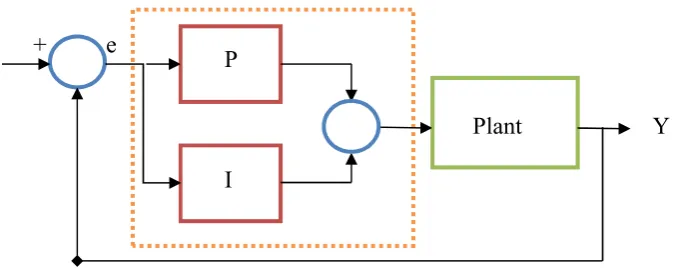
The proportional term drives a change to the output that is proportional to the current error. This proportional term, is concerned with the current state of the process variable. The integral term, is proportional to both the magnitude of the error and the duration of the error.
It (when added to the proportional term) accelerates the movement of the process towards the set point and often eliminates the residual steady-state error that may occur with a proportional only controller. The rate of change of the process error is calculated by determining the differential slope of the error over time (i.e., its first derivative with respect to time). This rate of change in the error is multiplied by the derivative gain ( ) [16].
[image:19.595.152.489.408.542.2]The PID controller has been in use for over a century in various forms. It has enjoyed popularity as a purely mechanical device, as a pneumatic device, and as an electronic device. The digital PID controller using a microprocessor has recently come into its own in industry. As you will see, it is a straightforward task to embed a PID controller into your code [17].
Figure 2.3: PID control logic block diagram
2.3.5 Fuzzy Logic Controller
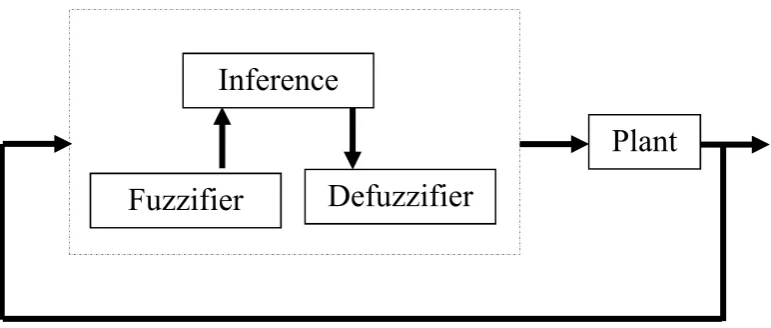
The fuzzy set theory introduced by Zadeh has found many applications in a variety of fields. Among the most successful applications of this theory is fuzzy logic control. A fuzzy logic controller consists of three major process blocks. They are (a) fuzzification, (b) rule evaluation, and (c) defuzzification. The block diagram of a closed-loop fuzzy logic control system is shown in Figure 2.4.
+ e
P
I
11
[image:20.595.133.519.48.212.2]
Figure 2.4: Block diagram of typical fuzzy logic controller.
The fuzzification process takes input values and combines them with stored membership function information to produce the grade of membership function. After the grade of membership function is produced, the fuzzy inference will evaluate rules [18].
The truth value for each rule is the minimum of the fuzzy inputs for that rule, and this truth value is stored to each fuzzy output for that rule unless a larger value is already stored in the fuzzy output. When all fuzzy outputs are derived, the defuzzification is performed by combining all fuzzy outputs into a specific composite result to the system.
By contrast, in the technical sense, fuzzy systems are precisely defined systems, and fuzzy control is a precisely defined method of non-linear control. The main goal of fuzzy logic is to mimic and improve on "human-like" reasoning. "Fuzzy systems are knowledge-based or rule-based systems". Specifically, the key components of fuzzy system's knowledge base are a set of IF-THEN rules obtained from human knowledge and expertise [19].
2.4 Arduino
Arduino is a single-board microcontroller designed to make the process of using electronics in multidisciplinary projects more accessible. The hardware consists of a simple open source hardware board designed around an 8 bit Atmel AVR microcontroller, though a new model has been designed around a 32-bit Atmel ARM. The software consists of a standard programming language compiler and a boot loader that executes on the microcontroller.
Inference
Fuzzifier
Defuzzifier
12
The Arduino project is a fork of the open source Wiring platform and is programmed using a Wiring-based language (syntax and libraries), similar to C++ with some slight simplifications and modifications, and a Processing-based integrated development environment (IDE).
The Arduino integrated development environment (IDE) is a cross-platform application written in Java, and is derived from the IDE for the Processing programming language and the Wiring projects. It is designed to introduce programming to artists and other newcomers unfamiliar with software development [20].
CHAPTER 3
METHODOLOGY
All the work process can be dividing into 3 major part, software, firmware and hardware. The software and firmware part includes stage such as designing and simulation, the hardware part involve the implementation and verification process.
3.1 Block Diagram of Project
Figure 3.1 shows the block diagram of the project that consists of 4 mains parts which are the DC source, the three phase inverter, the three phase induction motor as a load and the Arduino controller.
[image:22.595.161.461.486.646.2]The first part of the block diagram is the DC source to give the power for the whole system. The second part is the three phase inverter. The general function of the inverter is to convert the DC voltage to the AC voltage. In this system, the three phase inverter will be used because the load is the three phase induction motor.
Figure 3.1: Block diagram of the project DC
Source
3 phase inverter
r
Arduino Current Sensor
IM
15
In this motor control system, Fuzzy-PI controller is being used with the current source control technique. The controller will compare the motor current with the reference current. Based on the value of the error signal, the controller will generate the pulse width modulation (PWM) to feed into the three phase inverter and rescale the output to power up the load.
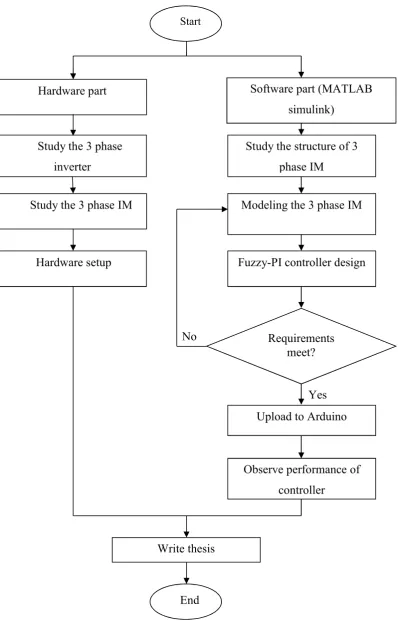
Figure 3.2 shows the general flow of the whole project development, it is including the hardware, software and firmware development. The process of designing the controller can be said as the core of the whole project and can be resources demanding.
In general, the first step designing the three phase inverter and the gate driver circuit, the process were done using PROTEUS software. After that is the generating the firmware for Arduino.
In this project, Matlab’s Simulink has been used. The Simulink Support Package for Arduino Hardware within the Simulink has been utilized for this project. This is where the firmware stage start, instead lines of coding in programming language, this project involved the coding by using Simulink’s block diagram to design the controller and generating the hex file used in Arduino.
16
Yes No
Hardware part
Study the 3 phase inverter
Study the 3 phase IM
Upload to Arduino Fuzzy-PI controller design
Modeling the 3 phase IM Study the structure of 3
phase IM
Software part (MATLAB simulink)
Write thesis Hardware setup
Requirements meet?
Observe performance of controller
Start
[image:24.595.123.522.65.709.2]End
17
3.2 Inverter Design
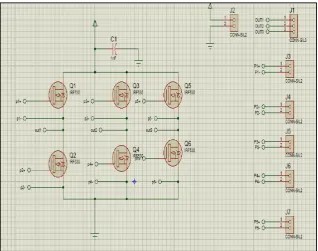
Figure 3.4 shows the schematic diagram for three phase inverter. This circuit consists of power transistor MOSFET (IRF840) and a 470µH power capacitor. The general function of inverter is used to convert DC power into three phase AC power. For inverter operation, power flow from the DC side to the AC side and able to carry the voltage supply up to 600 volts, but this value depend on the type of MOSFET used for inverter. The three phase inverter circuit consists of several components as listed in the Table 3.1.
[image:25.595.160.479.359.610.2]The main part during inverter design is the MOSFET selection. A few considerations have to be chosen carefully like Vgs, voltage limitation, heat resistance and maximum current. These figures have to be carefully chosen to meet the project requirement.
18
Table 3.1: List of components for three phase inverter
No Component Unit
1. MOSFET IRF840 6
[image:26.595.157.483.132.397.2]2. Capacitor 470µF (450V) 1
[image:26.595.174.464.449.667.2]Figure 3.5: PCB layout for three phase inverter
Figure 3.6: Hardware development for three phase inverter
19
design. The threads in this PCB layout need to be quite thick to support high current flow. Figure 3.6 shows the finished product of PCB for three phase inverter used in this project. The used of heat sink is a safety precaution and component protection as induction motor characteristic tend to have a peak of current during start up operation.
3.3 Gate Driver Design
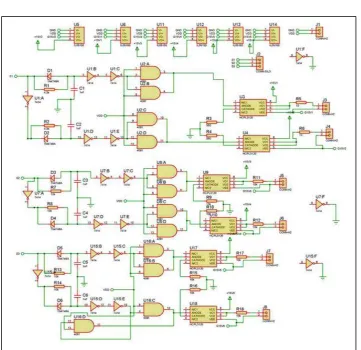
Figure 3.7 shows the schematic diagram of gate driver circuit. The function of the gate driver is to amplify the PWM signals generated by the Arduino board. This include to produce the appropriate gate signals to drive the MOSFET.
The PWM signals generated by the controller will split into two by the Hex Schmit-Trigger Inverter (IC 7414) and flow through the zener diode. The use of zener diode is as a protection to the circuit. Then both of the output from the IC 7414 flow into the IC 4081 which are Quad 2-input AND gate. These AND gate to double up the amplitude of the PWM before flow into the Optocoupler (HCPL3120).
In less technical explanation, the gate driver takes three 5VDC PWM input signal from Arduino and amplify these PWM signal to generate six 15VDC PWM output signal. All six PWM signal were used to trigger the MOSFET.
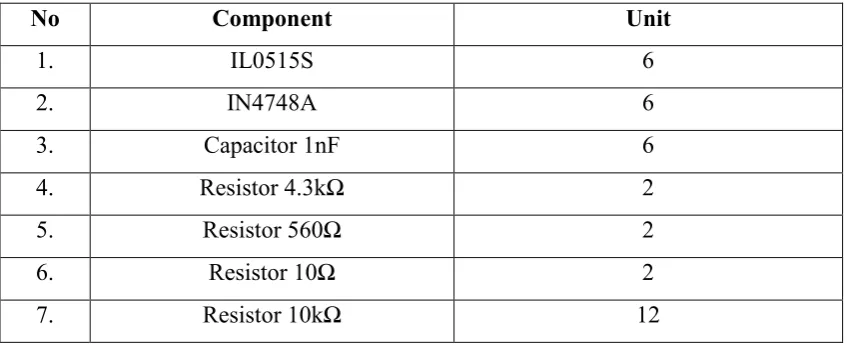
[image:27.595.108.532.587.760.2]Table 3.2 shows the list of components that required for the construction of the gate driver circuit. The IL0515S can be said as the main component for this driver circuit, this component is a boost DC to DC converter, a component which increase the 5VDC input voltage to 15VDC output voltage to trigger the MOSFET.
Table 3.2: Lists of components for gate driver circuit
No Component Unit
1. IL0515S 6
2. IN4748A 6
3. Capacitor 1nF 6
4. Resistor 4.3kΩ 2
5. Resistor 560Ω 2
6. Resistor 10Ω 2
20
8. IC 7414 3
9. IC 4081 3
[image:28.595.140.502.161.511.2]10. HCPL3120 6
21
Figure 3.8: Hardware development for gate driver
Figure 3.7 show the schematic diagram for the gate driver circuit. The Proteus software was used to make the schematic. Figure 3.8 show the finished product of the PCB for gate driver. The gate driver is the man part of the project, it just pure electronic circuit but it was design to cope with the project requirement like high frequency switching. Every component was chosen for the purpose of to make sure the gate driver circuit can manage with the high frequency switching.
3.4 Analog to Digital and Digital to Analog design
In the simulation of the project, to imitate what happen in real hardware testing, the used of ADC and DAC block are required. In real hardware testing, the current sensor output in an analog voltage with the range value of 5VDC. This analog voltage was fed to Arduino to provide the feedback for the whole system, but the Arduino can only process digital value. The analog voltage were convert to digital value by the built in 10-ADC in the Arduino. Thus the project need to employ the DAC block to generate the original analog current signal. Figure 3.9 show the ADC block used in the project.
22
output voltage to represent the current, thus some calculation need to be done to get the original current signal from the analog voltage.
[image:30.595.186.458.307.669.2]The predetermine referent current was set within the Arduino board as an analog signal, this is to mimic the generated output current from the inverter that feed to the induction motor. The output from the current sensor also in analog signal but in form of voltage value not in form of current value. Thus, this project require an ADC block to convert the analog voltage output to digital value using the built-in 10-bit ADC feature in Arduino and some calculation to revert back this digital signal to original analog current signal read by the current sensor. Figure 3.10 shows the DAC block used in this project to get back the original analog current signal from the digital signal.
Figure 3.9: ADC block
23
3.5 Controller Design
[image:31.595.120.523.255.346.2]Figure 3.11 and Figure 3.12 shows the controller design using MATLAB/Simulink consists of combination of the Fuzzy block and PI controller. In general, the function of this controller is to provide a signal to the PWM generator based on the error signal produce by the differentiation of the predetermine referent current and the current from the current sensor.
[image:31.595.157.480.431.522.2]Figure 3.11: The design of Fuzzy-PI controller
Figure 3.12: PI controller
The Fuzzy Logic Controller is the first controller to get the error signal, the main reason for this action is because of the fast response from the Fuzzy controller. The Fuzzy controller is not using any mathematical equation, it only use logic function to generate the output. The Fuzzy Logic Controller employ the rule of something like this, ‘IF the input_1 is X AND input_2 is Y, THEN the output is Z’, there is no calculation needed, thus this is the main reason for the fast response of the Fuzzy controller.
24
The designed Fuzzy Logic controller needs two inputs, which are an error signal and change in error signal. The error signal is taken straight from the different of referent current and the output from current sensor. The change in error signal basically is a different value of error signal with a delayed error signal. This is to see how much different the error signal right now with the previous signal.
[image:32.595.123.515.236.369.2]The output of the Fuzzy Logic controller is based on the set of rules which is predetermined when designing the Fuzzy Logic block.
Figure 3.13: Fuzzy Logic controller
[image:32.595.164.472.418.616.2]42
REFERENCES
[1] M. P. Kazmierkowski and L. Malesani, "Current control techniques for three-phase voltage-source PWM converters: a survey," Industrial Electronics,
IEEE Transactions on, vol. 45, pp. 691-703, 1998.
[2] M. Masiala, B. Vafakhah, J. Salmon, and A. M. Knight, "Fuzzy self-tuning speed control of an indirect field-oriented control induction motor drive,"
Industry Applications, IEEE Transactions on, vol. 44, pp. 1732-1740, 2008.
[3] L. A. Alvarado-Yañez, L. M. Torres-Treviño, and A. Rodríguez-Liñán, "An Embedded Fuzzy Agent for Online Tuning of a PID Controller for Position Control of a DC Motor," in Advances in Soft Computing and Its Applications, ed: Springer, 2013, pp. 225-232.
[4] J. Bauer, "A Complete Low-Cost Design and Analysis for Single and Multi-Phase AC Induction Motors Using an 8-Bit PIC16 Microcontroller," 2014. [5] R. Cardenas and R. Pena, "Sensorless vector control of induction machines
for variable-speed wind energy applications," Energy Conversion, IEEE
Transactions on, vol. 19, pp. 196-205, 2004.
[6] S. V. Ustun and M. Demirtas, "Optimal tuning of PI coefficients by using fuzzy-genetic for V/f controlled induction motor," Expert Systems with
Applications, vol. 34, pp. 2714-2720, 2008.
[7] V. Raviraj and P. C. Sen, "Comparative study of proportional-integral, sliding mode, and fuzzy logic controllers for power converters," IEEE Transactions
on Industry Applications, vol. 33, pp. 518-524, 1997.
[8] C. Ortega, A. Arias, X. Del Toro, E. Aldabas, and J. Balcells, "Novel direct torque control for induction motors using short voltage vectors of matrix converters," in Industrial Electronics Society, 2005. IECON 2005. 31st
Annual Conference of IEEE, 2005, p. 6 pp.
[9] L. Harnefors and H.-P. Nee, "Model-based current control of AC machines using the internal model control method," Industry Applications, IEEE
Transactions on, vol. 34, pp. 133-141, 1998.
[10] D.-I. H. S. Mihai Cheles, "Sensorless Field Oriented Control (FOC) of an AC Induction Motor (ACIM)," Microchip Technology Inc., 2008.
[11] D. W. Novotny and T. A. Lipo, Vector Control and Dynamics of AC Drives: Clarendon Press, 1996.
[12] I. E. Mehmet Tumay, and H. Firat Aksoy, "Dynalic Performance of Adjustable Speed ac drives part 2: Control and Simulation of ac machines,"
Pakistan Journal of Information and Technology, pp. 106-117, 2002.
[13] M. Tsuji, S. Chen, S. Hamasaki, Z. Xiaodan, and E. Yamada, "A novel V/f control of induction motors for wide and precise speed operation," in Power
Electronics, Electrical Drives, Automation and Motion, 2008. SPEEDAM 2008. International Symposium on, 2008, pp. 1130-1135.
43
[15] A. O'Dwyer, Handbook of PI and PID Controller Tuning Rules: Imperial College Press, 2009.
[16] S. Panda, X. Zhu, and P. Dash, "Fuzzy gain scheduled PI speed controller for switched reluctance motor drive," in Industrial Electronics, Control and
Instrumentation, 1997. IECON 97. 23rd International Conference on, 1997,
pp. 989-994.
[17] K. Ogata, Modern Control Engineering: Prentice Hall, 2010.
[18] A. Hazzab, I. Bousserhane, M. Zerbo, and P. Sicard, "Real time implementation of fuzzy gain scheduling of PI controller for induction motor machine control," Neural processing letters, vol. 24, pp. 203-215, 2006. [19] D. Asija, "Speed control of induction motor using fuzzy-PI controller," in
Mechanical and Electronics Engineering (ICMEE), 2010 2nd International Conference on, 2010, pp. V2-460-V2-463.
[20] M. Arifin and A. Izzat, "Hysteresis current control technique for three phase induction motor (MATLAB Simulink & ARDUINO)," Universiti Tun Hussein Onn Malaysia, 2014.
[21] H. Wang, J. Lu, Q. Yang, and J. Zhou, "PWM predictive current control strategy based on self-adaptive intelligent fuzzy PID controller," in Intelligent
Control and Automation, 2004. WCICA 2004. Fifth World Congress on,
2004, pp. 2575-2578.
[22] Q. Zhu, X. Zhong, and B. Xu, "Design of Fuzzy-PI Compound Control system for three-cylinder hydraulic parallel robot," in Mechatronics and
Automation, 2007. ICMA 2007. International Conference on, 2007, pp.