Journal of Chemical and Pharmaceutical Research, 2014, 6(5):249-257
Research Article
CODEN(USA) : JCPRC5
ISSN : 0975-7384
Evaluation research of implementation effect for emergency communications
plan based on fuzzy comprehensive evaluation in China
Zifu Fan, Lihua Wang and Xiaoyu Wan
Key Lab of Electronic Commerce and Modern Logistics of Chongqing University of Posts and
Telecommunications, Chongqing, China
_____________________________________________________________________________________________
ABSTRACT
In the case of unconventional emergencies, emergency communications is the key to implementation of the command and control and security of information transmission. The emergency system of communications plan is reasonable and effective, which is the important prerequisite and basis. Therefore, according to the research of emergency management, the main factors that affect the evaluation of emergency effect for communications plan are proposed. In order to avoid the effect of individual subjective judgment and favoritism on the result of evaluation, a method based on Analytic Network Process (ANP) and Fuzzy Comprehensive Evaluation (FCE) is applied. There into, ANP is used to determine the weight of each index, the FCE is applied to information processing of the evaluation. The evaluation system proposed in this paper can provide a beneficial reference for evaluating the emergency effectiveness of communications plan.
Keywords: Emergency Communications Plan, Evaluation, Implementation Effect, FCE
_____________________________________________________________________________________________
INTRODUCTION
The communications industry is the basic industry of the national economy. It is possible to ensure smooth communications, ability to quickly and efficiently restore the damaged communications system, which is the key to success in response, command, scheduling, rescue and many other aspects of the emergency actions, when the unconventional emergency comes [1]. Therefore, the emergency plan is reasonable, effective, feasible or not, related to emergency communications support for the work of the pros and cons of unconventional emergency, thereby affecting the entire emergency rescue operation [2]. Based on this, it is particularly to measure the effectiveness of existing emergency communications plan in our country.
Combing the basis of the relevant researches that, the assessment of effectiveness of the emergency communications plan should be carried from two aspects of operating efficiency and implementation effect[3]. The operating efficiency indirectly also affects the implementation effect of the emergency communications plan. It shows that the implementation effect has important effect on measure of emergency communications plan, and is an important reference for determination of the actual operating capacity of the emergency communications plan[8]. So this paper embarks form the implementation effect of perspective, aims to construct the evaluation model of emergency communications plan system and provides reference and basis for the assessment of emergency communications plan system.
investigation[4]. Of course, many scholars also have put forward many valuable suggestions on how to establish the emergency communications plan, and government also has pay enough attention to the formulation and improvement of emergency communications plan. But to really play the role of the emergency communications plan, we should be more focus on the feasibility and effectiveness of the plan. The research on the effectiveness of emergency communications plan of the academic circle is still in the initial stage. Liu Jifu, Zhang Panjuan, Chen Zhifen and Chen Jin [10], proceed form natural disaster emergency play, used fault tree analysis (FTA) to evaluate its completeness, summed up that the natural disaster emergency plan in China mainly consists of 41 kinds of role types according to the traits of emergency, and on this basis to establish the responsibility matrix and evaluation standards between the emergency procedures and emergency personnel, converted the operability evaluation into the complex complexity to construct the operational evaluation method for emergency plan structure From the point of view of plans for the implementation of personnel. Gong Weiguo [11] introduced the fuzzy comprehensive evaluation method to overall and generally understand scientific nature and feasibility of unexpected public emergency incidents, for some evaluation indexes unable to quantitatively describe, usually adopts the qualitative prediction scheme, relying on expert knowledge, experience and judgment, and provides some study on assessment of the early warning. Yu Yingying[13] uses the project network planning to plan each step strictly in accordance with the provisions of the network planning steps. Zhang Yingju [1] adopts the grey hierarchy evaluation and elastic perspective on the evaluation of the effectiveness of emergency plan. Fan zifu et all[6] Establish the index system
based on the four main indexes including Scientific, integrity, flexibility and operability to evaluate the effectiveness of emergency plan. Ronald W.Perry and Michael K. Lindel1[15]clarify the relationships among three critical components of community emergency preparedness - planning, training and written plans-with an emphasis on the role of the planning process and it should be in response to natural disasters. Yuko Nakanishi et all[14] propose the development of performance indicators, which measure the achievement of emergency preparedness goals and policies of a transit agency. Abu-Zaid and Sameer A[7] Computational fluid dynamics is used to analyze a transit subway station during fire emergency conditions To evaluate the emergency plan.
2.The Proposed Method
2.1. Data gathering and analysis
Firstly , sum up the current situation of emergency plan system in China by search and collect the related literature and all levels of emergency communication plan including national, provincial, municipal, communication management department and telecom operators. And it lays the foundation for extracting indexes. Secondly, interview the emergency communication management experts in-depth to extract relevant indexes of Emergency communication plan implementation effect. With assistance from Society Science Foundation of China Grant 12XGL015, research teams visited the experts from communication management department of Chongqing, the three main telecom operators and the telecom manufactures in China who give the main assistance in the study. Thirdly, construct a mark sheet of the indexes and post it to the experts to mark it by email for three times in Delphi method. And get the average score to mark the indexes as the final result. Lastly, construct the assessment model of implementation effect for emergency communications plan based on Fuzzy Comprehensive Evaluation Analytic Network Process (ANP) and Fuzzy Comprehensive Evaluation (FCE).
2.2. Fuzzy comprehensive evaluation method
11 12 1
21 22 2
1 2
. . .
. . .
. . .
. . .
. . .
. . .
. . .
ii i i p
i i i p
i n i n i np
r
r
r
r
r
r
r
r
r
R
=
(1)According to the fuzzy transformation theory [10], fuzzy decision-making of the second hierarchy about the first stage can be determined as
(
1
2
)
(
)
11
12
1
2
1
1
22
2
2
1
2
ri
ri
ri p
ri
ri
ri p
ri n ri n
r
ai
ai
ai n
di
d
i
i
i
n
p
p
d
=
= × =
Di
Ai
Ri
L
L
L
M
M
L
M
L
L
(2)
Where Ai is weight set of n factors of the second hierarchy influencing ith factor of the first hierarchy. Thus, the first stage fuzzy evaluation matrix is
11 12 1 21 22 2
1 2
. . .
. . .
. . . .
. . .
p pn n np
d
d
d
d
d
d
D
d
d
d
×
=
=
A
R
(3)And the second stage fuzzy evaluation matrix is
1 1 * 1 2 2 * 2
*
'
'
'
'
'
'
'
'
m'
m'
mD
A
R
D
A
R
R
D
D
A
R
=
=
=
M
M
(4)Therefore, the second stage fuzzy decision-making for the grinding quality can be determined as
*
D
=
A
R
(5)here A is weight set of factors influencing the implementation effect for emergency communications plan.
2.3. Analytic hierarchy process (ANP) to determine factor weights
The factor weights are calculated via the ANP method. The ANP is a general form of the AHP [18]. Whereas AHP models a decision making framework that assumes a unidirectional hierarchical relationship among decision levels, ANP allows for more complex interrelationships among the decision levels and attributes. Typically in AHP, the top element of the hierarchy is the overall goal for the decision model. The hierarchy decomposes from the general to a more specific attribute until a level of manageable decision criteria is met. ANP does not require this strictly hierarchical structure. There are many factors influence the assessment of emergency effect of communications plan, it is complex to consider the interdependencies among criteria, so ANP is more adaptive than AHP for this study.
The procedure using ANP to determine factor weights is as follows:
(1) Build a hierarchy of the criteria that influences behaviors of the problem. level of the hierarchy.
usually used by ANP to evaluate vectors of priorities of parameters. The vector of priorities of the parameters in the lower level in the hierarchy is first calculated and then it progresses to get the overall priority vector. Finally, evaluate the consistency. The consistency ratio (CR ) is used to estimate the consistency of the judgments of the participants. The CR is defined as
/
CR
=
RI
CI
(6)Where CI is called the consistency index which is defined as
(
max) (
/
1
)
CI
=
λ
−
n
n
−
(7)
The λmax is the maximum eigenvalue of the pairwise comparison matrix and n is the number of activities in
the matrix.
2.3.1. Super matrix integration and operation.
There are three supermatrices associated with each network: the Unweighted Supermatrix, the Weighted Supermatrix and the Limit Supermatrix. And get them as follows:
(1)Fistly,The unweighted supermatrix w contains the local priorities derived from the pairwise comparisons throughout the network.
11 12 13 14 1m
21 22 23 24 2m
n1 n2 n3 n4 nm
w=
C C C C C
C C C C C
C C C C C
K
K
M M M M K M
L
(8)
(2)Secondly, The weighted supermatrix is obtained by multiplying all the elements in a component of the unweighted supermatrix by the corresponding cluster weight.
1 2
n
w
TW
=
B
B
L
B
×
(9)
(3) Lastly, The limit supermatrix is obtained by raising the weighted supermatrix to powers by multiplying it times itself
3. Research Method
Our research team reviews 20 experts from Chinese government, communication management department and the three telecom operators in china to generate the main indexes
3.1. Construction of the Evaluation System
There are 7 higher indexes and 27 lower indexes in the evaluation system.
3.1.1. The Indexes of Grade-B to Design
The implementation effect of plan is good or bad, often depends on the following factors:
The factor of time (B1): Obviously, in the case of other conditions fixed, the time of emergency response is shorter, the time of rescue shorter, and better effect, on the contrary, worse effect.
The loss of personnel and property (B2): here the personal mainly refers to the emergency communications technical personnel. in the case of other conditions fixed, casualties are less, the loss of communications equipment and other property less, that plans to effect the better, on the contrary, implementation effect of plan is worse[6].
The investment of emergency communications resources (B4): in the case of other conditions fixed, the less human, material and capital invested, that is, the lower the cost, the better the implementation effect of plan, on the contrary, the worse the implementation effect of plan.
The management of organization(B5): in the case of other conditions fixed, the management of organization more coordination, such as unified leadership, a clear division of labor, to illustrate the implementation effect of plan is better, conversely, implementation effect is worse.
The security of emergency communications (B6): whether disaster relief personnel, technology, equipment is complete and can reach the unexpected scene in a timely manner or not, traffic safety and other departments to timely assistance or not, also affect the implementation effect of plan[7].
The dynamic adjustment factor of plan(B7): in the implementation process, due to the change of time, resource consumption, natural conditions, new situation, emergency level changes produced will not make the existing plan play a better role in the process, so we should make the dynamic adjustment for implementation of the plan. Among them, the feedback timely of monitoring information is the premise and guarantee to dynamic adjustment of plan.
3.1.2. The Indexes of Grade-C to Design
Based on the indicators of Grade-C, reference to the large number of documents, combined with expert interviews and other methods, the 27 evaluation indicators of Grade-C are established, and the evaluation system is more refinement.
The factor of time (B1) contains the emergency response time (C11), the arrival time of emergency communication technical personnel (C12), the arrival time of emergency communication equipment (C13), the time from the emergency response to the communication recovery (C14), monitoring information transfer time (C15).
The loss of personnel and property (B2) contains the loss of communication equipment and other related emergency resource (C21), the loss of emergency technical personnel (C22).
Social impact (B3), that is the degree of Social panic (C31), publicity and education of the public (C32), public opinion guided by the news media correctly (C33) due to the burst communications failure[8].
The investment of emergency communications resources (B4) contains human investment (C41), material investment (C42), capital investment (C43).
The management of organization (B5), that is, whether the Organization structure is reasonable or not (C51), whether the division of labor is clear or not (C52), whether the team construction is complete or not (C53), whether the organization is coordinate or not (C54).
The security of emergency communications (B6) includes security of emergency communications equipment (C61), security of emergency communications technical (C62), emergency communications personnel protection (C63), financial security (C64), traffic safety security (C65), security of electric, hydraulic and other relevant departments (C66).
The dynamic adjustment factor of plan (B7): unified leadership, level-to-level responsibility to detect network information, upgrade and downgrade warning (C71). According to the change of time, emergency situation, or changes in supply and demand, the plan can be dynamically adjusted(C72), the individual disaster can be reacted and treated effectively in time (C73), To strengthen the coordination of information sharing of various departments (C74).
3.2. Calculation of the Indexes’weights
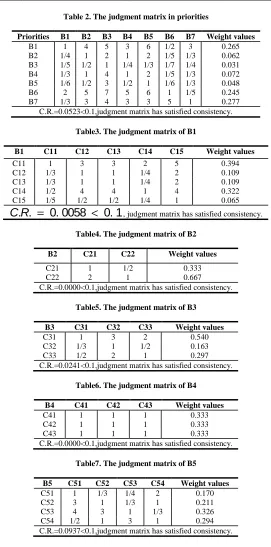
First of all, according to 1-9 scale sheet proposed by T.L.Saaty, we use Delphi method to determine the relative importance between any two indicators, and then assign the weight of each index through ANP. This method can overcome the subjectivity, that is, to rely solely on the advices of expert and experiences of research, to establish the index system. And it can ensure the scientific of index system and the reliability of the assessment result.
Table 1. Saaty scaling table
The scale
of amn 1 3 5 7 9 2,4,6,8 Reciprocal
The comparison between Pm and Pn
Equally important
Slightly important
Obviously important
Strongly important
Extremely important
intermediate value between two adjacent
judgments
[image:6.595.170.441.199.746.2]amn=1/anm
Table 2. The judgment matrix in priorities
Priorities B1 B2 B3 B4 B5 B6 B7 Weight values
B1 1 4 5 3 6 1/2 3 0.265
B2 1/4 1 2 1 2 1/5 1/3 0.062
B3 1/5 1/2 1 1/4 1/3 1/7 1/4 0.031
B4 1/3 1 4 1 2 1/5 1/3 0.072
B5 1/6 1/2 3 1/2 1 1/6 1/3 0.048
B6 2 5 7 5 6 1 1/5 0.245
B7 1/3 3 4 3 3 5 1 0.277
C.R.=0.0523<0.1,judgment matrix has satisfied consistency.
Table3. The judgment matrix of B1
B1 C11 C12 C13 C14 C15 Weight values
C11 1 3 3 2 5 0.394
C12 1/3 1 1 1/4 2 0.109
C13 1/3 1 1 1/4 2 0.109
C14 1/2 4 4 1 4 0.322
C15 1/5 1/2 1/2 1/4 1 0.065
. .
0. 0058
0. 1
C R
=
<
, judgment matrix has satisfied consistency.Table4. The judgment matrix of B2
B2 C21 C22 Weight values
C21 1 1/2 0.333
C22 2 1 0.667
C.R.=0.0000<0.1,judgment matrix has satisfied consistency.
Table5. The judgment matrix of B3
B3 C31 C32 C33 Weight values
C31 1 3 2 0.540
C32 1/3 1 1/2 0.163
C33 1/2 2 1 0.297
C.R.=0.0241<0.1,judgment matrix has satisfied consistency.
Table6. The judgment matrix of B4
B4 C41 C42 C43 Weight values
C41 1 1 1 0.333
C42 1 1 1 0.333
C43 1 1 1 0.333
C.R.=0.0000<0.1,judgment matrix has satisfied consistency.
Table7. The judgment matrix of B5
B5 C51 C52 C53 C54 Weight values
C51 1 1/3 1/4 2 0.170
C52 3 1 1/3 1 0.211
C53 4 3 1 1/3 0.326
C54 1/2 1 3 1 0.294
C.R.=0.0937<0.1,judgment matrix has satisfied consistency.
layer, and then get the judgment matrix according to the priority weight. At last the relative weight of each indicator relative to the upper guidelines is obtained using the software of Super Decisions.
Table8. The judgment matrix of B7
B7 C71 C72 C73 C74 Weight values
C71 1 2 4 3 0.462
C72 1/2 1 3 2 0.274
C73 1/4 1/3 1 1/3 0.086
C74 1/3 1/2 3 1 0.178
C.R.=0.0904<0.1,judgment matrix has satisfied consistency.
Table9. The judgment matrix of B6
B6 C61 C62 C63 C64 C65 C66 Weight values
C61 1 1/2 2 3 5 6 0.275
C62 2 1 2 3 4 5 0.329
C63 1/2 1/2 1 2 3 4 0.172
C64 1/3 1/3 1/2 1 3 4 0.122
C65 1/5 1/4 1/3 1/3 1 2 0.061
C66 1/6 1/5 1/4 1/4 1/2 1 0.041
C.R.=0.0653<0.1,judgment matrix has satisfied consistency.
RESULTS AND DISCUSSION
Firstly, construct fuzzy estimation matrix. There are registration proportion method, membership function method, frequency method, expert evaluation method and other methods to calculate the estimation matrix. Considering the features of emergency communications plan, establish estimation matrix by estimating from the single elements of the index system and determine the degree of the index system and determine the degree of membership that the evaluation objects relying on the elements. Evaluation set is established with five levels for the indexes, they are excellent, moderate, common, bad, worst, which can be expressed as R(r1,r2,r3,r4,r5).
According to 10 experts’ test, estimation matrix is constructed as follows.
Table 10. Assessment System and Estimation Matrix
Grade-A Index Weight (B→A)
Weight
(C→B) Weight(C→A)
Estimation Matrix
E M C B W
A
B1 (0.265)
C11 (0.395) 0.104 0.2 0.3 0.3 0.1 0.1
C12 (0.109) 0.029 0.3 0.2 0.3 0.1 0.1
C13 (0.109) 0.029 0.3 0.2 0.3 0.1 0.1
C14 (0.322) 0.085 0.1 0.4 0.3 0.1 0.1
C15 (0.065) 0.017 0.3 0..3 0..2 0.1 0.1
B2 (0.062)
C21 (0.333) 0.021 0.0 0.3 0.3 0.2 0.2
C22 (0.667) 0.041 0.2 0.3 0..3 0.1 0.1
B3 (0.031)
C31 (0.540) 0.017 0.0 0.3 0.3 0.2 0.2
C32 (0.163) 0.005 0.1 0.3 0.3 0.2 0.1
C33 (0.297) 0.009 0.0 0.3 0.3 0.2 0.2
B4 (0.072)
C41 (0.333) 0.024 0.3 0.3 0.2 0.2 0.0
C42 (0.333) 0.024 0.2 0.4 0.3 0.1 0.0
C43 (0.334) 0.024 0.2 0.4 0.3 0.1 0.0
B5 (0.048)
C51 (0.170) 0.008 0.1 0.4 0.3 0.1 0.1
C52 (0.210) 0.011 0.2 0.3 0.2 0.2 0.1
C53 (0.326) 0.016 0.3 0.3 0.2 0.1 0.1
C54 (0.294) 0.014 0.2 0.3 0.3 0.1 0.1
B6 (0.245)
C61 (0.275) 0.064 0.2 0.4 0.3 0.1 0.0
C62 (0.329) 0.082 0.3 0.3 0.2 0.2 0.0
C63 (0.172) 0.042 0.3 0.3 0.2 0.2 0.0
C64 (0.122) 0.031 0.2 0.4 0.3 0.1 0.0
C65 (0.061) 0.015 0.1 0.2 0.4 0.2 0.1
C66 (0.041) 0.011 0.1 0.3 0.3 0.2 0.1
B7 (0.277)
C71 (0.462) 0.128 0.1 0.2 0.3 0.3 0.1
C72 (0.274) 0.076 0.2 0.3 0.3 0.1 0.1
C73 (0.086) 0.024 0.1 0.3 0.4 0.1 0.1
C74 (0.178) 0.049 0.1 0.2 0.3 0.3 0.1
Level-1 fuzzy comprehensive evaluation:
(
)
(
)
1 1 1
0. 2 0. 3 0. 3 0. 1 0. 1
0. 3 0. 2 0. 3 0. 1 0. 1 0. 395 0. 109 0. 109 0. 322 0. 065 0. 3 0. 2 0. 3 0. 1 0. 1
0. 1 0. 4 0. 3 0. 1 0. 1 0. 3 0. 3 0. 2 0. 1 0. 1
0. 1961 0. 3104 0. 2935 0. 1000 0. 1000 T
Y
ω
R = • = =
Similarly, Y2,Y3,Y4,Y5,Y6 and Y7 obtained, which form fuzzy matrix R:
= 1000 . 0 2280 . 0 3086 . 0 2360 . 0 1274 . 0 0102 . 0 1603 . 0 2560 . 0 3336 . 0 2399 . 0 1000 . 0 1210 . 0 2464 . 0 3170 . 0 2156 . 0 000 . 0 1333 . 0 2667 . 0 3667 . 0 2333 . 0 1837 . 0 2000 . 0 3000 . 0 3000 . 0 0163 . 0 1333 . 0 1333 . 0 3000 . 0 3000 . 0 1334 . 0 1000 . 0 1000 . 0 2935 . 0 3104 . 0 1961 . 0 R
Level-2 fuzzy comprehensive evaluation:
(
)
0. 1961 0. 3104 0. 2935 0. 1000 0. 1000 0. 1334 0. 3000 0. 3000 0. 1333 0. 1333 0. 0163 0. 3000 0. 3000 0. 2000 0. 1837 0. 265 0. 062 0. 031 0. 072 0. 048 0. 245 0. 277 0. 2333 0. 3667 0. 2667 0. 1333 0. 0000 0. 2156 0. 3170 0. 2464 0. 1210 0. 1000 0. 2399 0
T B Y =ω • =R
(
)
. 3336 0. 2560 0. 1603 0. 0102 0. 1274 0. 2360 0. 3086 0. 2280 0. 1000 0. 1819 0. 2989 0. 2849 0. 1588 0. 0755
=
According to the calculation above, choose “0.2989” to be the result, which indicates that the evaluation level is “moderate”. Specifically, the indexes that have biggest impact on the effect of emergency communications Plan, referring to the factor of time (B1), the security of emergency communications (B6), the dynamic adjustment factor of plan(B7),achieve the level of “ideal”, which is the key reason of the final result evaluated as “ideal”. Generally speaking, there is a wide shortfall between 0.1819 and 0.2989 ,which respectively indicates the level of “ideal” and “better”, while 0.2849 is close to 0.2989, which respectively indicates the level of “common” and “better”. Seen that the implementation effect of emergency communications plan in China is only in general slightly preferred position, there is still some distance to reach the “ideal” level. But fortunately, 0.1588 and 0.0755 are smaller, which respectively indicates the level of “poor” and “bad”. To sum up, there is enough room to improve the level of the implementation effect of emergency communications plan.
CONCLUSION
In the case of unconventional emergencies, emergency communications is the implementation key of the command and control and security of information transmission. The emergency system of communications plan is reasonable and effective, which is the important prerequisite and basis. So an assessment system of implementation effect of emergency communications plan is established in this paper. It consists of seven Grade-B indexes related to the factor of time (B1), the loss of personnel and property (B2), social impact (B3), the investment of emergency communications resources (B4), the management of organization (B5), the security of emergency communications (B6), the dynamic adjustment factor of plan (B7). And 27 detailed indexes of Grade-C are also designed in this paper.
communication recovery (C14), unified leadership, level-to-level responsibility to detect network information, upgrade and downgrade warning (C71). According to the change of time, emergency situation, or changes in supply and demand, the plan can be dynamically adjusted(C72), the individual disaster can be reacted and treated effectively in time (C73), To strengthen the coordination of information sharing of various departments (C74), which indicates that these aspects can be promoted.
This paper uses the method of ANP and FCE combined to determine the indexes’ weight, and makes a comprehensive evaluation, to some extent, which avoids the effect of individual judgment on the result of evaluation. But the effect of emergency communications plan involves so many factors, which relate to governments, enterprises, the public, and so on. So it is difficult to avoid omitting some information. Besides, in order to make the assessment system more perfect, much more practical work is needed. All of this is the main direction of the research.
Acknowledgments
This work was supported in part by a grant from Society Science Foundation of China (Grant No. 12XGL015), Society Science Foundation of China Ministry of Education (Grant No. 11YJA630016), Open Foundation of Key Lab of E-commerce and Modern Logistics of CQUPT (Grant No. ECML1004).
REFERENCES
[1] Zhang Yingju(2011). "Research on Aid-design and Evaluation Problems of Contingency Plans". DaLian:
DaLian University of Technology, pp.37~41,
[2] Jiang Huixian, Lin Guangfa, Zhang Mingfeng, Huang Wanli(2012). JDCTA, Vol. 6, No. 18, pp.279~286
[3] Wan Xiaoyu, Sun Sanshan, Luanwen(2009). Journal of Chongqing University of Posts and Telecommunications
(Social Science Edition) , Vol. 21, No. 1, pp.29~34,
[4] CHEN Xin, CUI Bin-ge, ZHANG Feng(2012). IJACT, Vol. 4, No. 14, pp.225~232, [5] Huang Weidong, Liu Yinmao, Zhao Jia (2012). JCIT, Vol. 7, No. 4, pp.35~41, [6] Fan zifu, Wei jinying, Wan xiaoyu(2012). digital communications,(1) :15-18 [7]Abu-Zaid, Sameer A(1996). Transportation Research Record, 1996, 1521:
[8] Xiaoyu Wan, Zhenyu Jin, Jinying Wei(2010). "Probe into the Effectiveness Connotation of Emergency
Telecommunication Plan and it's Assessment Method under Unconventional Emergency", The 1st International Conference on Sustainable Construction & Risk Management, pp.613~618, 2010
[9] H. Z. Huang( 1999): Fuzzy Design (Beijing, China Machine Press,. (In Chinese)
[10] Liu, J.F., Zhu, J.J., Zhang, P.J. and Chen,J.(2008) China Safety Science Journal Vol.18,No.4,pp:6-15. [11] Gong, W.G. (2007) 'Journal of Hunan Business College,Vol.14, No. 6, pp.41-43.
[12] Zhang, H.L., Li, X.F. and Dong, L.Y.(2009) The journal of safety science,Vol.19,No.7,pp:142-148
[13]Yu,Y.Y.2008 Contingency plans to develop the evaluation studies, University of Science and Technology of
China,Beijing.
[14]Yuko Nakanishi, Kibeum Kim, Yavuz Ulusoy(2003). Assessing Emergency Preparedness of Transit Agencies:A
Focus on Performance Indicators[C]. The 82nd Annual Meeting of the Transportation Research Board , Washington,
D.C.,