Journal of Chemical and Pharmaceutical Research, 2016, 8(12):5-12
Review Article
CODEN(USA) : JCPRC5
ISSN : 0975-7384
5
Classification of Disease Data Using Bijective Soft Set
Jagadeesh Gopal
1*, Jai Ganesh K
2and Salman Ahmed G
21Associate Professor, VIT University,Vellore, Tamilnadu, India 2M.S Software Engineering, VIT University,Vellore, Tamilnadu, India
_____________________________________________________________________________
ABSTRACT
Arrangement is a problem in the today’s trend world where data should be handling in more accurate way there is lot of software available to store the data in a systematic way but the size of data is too large to keep. There are server problem issues and cost issues. Most of the research is going on big data. Classification of data is also a big problem. When data are not systematic it is very problem to search and analyze the data from a group of data. Soft computing play an important role in classification of data. Artificial Intelligent techniques play a important role in classifying the data. There are many approaches such as neural network, fuzzy set; decision trees and other expect system. To maintain the data in medical field is a huge confidential and classification of data should be done with certain good approach. Artificial Intelligent always play a important role in these fields. In these we are going to use one of the new algorithm for classification is bijective softest. This algorithm helps to give more accuracy then previous traditional methods. We are going to predict the level of diseases such as Kidney cancer, fever, and diagnosis. The software helps as to predict the diseases level accuracy from the data which is classified by using the bijective. It helps to reduce paper work and cost estimation and time for the customer.
Keywords: Bijective soft set; Online prediction of diseases; Decision rules generation; Classification of data
______________________________________________________________________________________
INTRODUCTION
In todays world data play a important role for understanding and manipulating any system. But major problem is that data is too large to keep. If we classify the data means the data size can be reduce like uncertain data and data which are outdated can be remove easily. So we can maintain the consistent data. Bijective soft set helps in classifying the data with more accurate results. For classifying the data in medical fields play an important role because if data is not accurate means total system will be collapse. In medical field patient data play a key role.
6
SIMILAR WORK
Molodstov first started to work on Soft set theory to solve data problem which is not solved by previous methods He has apply Soft set theory in many practical problems in field such as engineering and medical science. About Ella Hassanien proposed the artificial intelligent techniques by analysis breast cancer based on rough set model. Aktasand Cagman has done in the concept of rough set with the help of softest theory for the purpose of prediction. Maji also proposed a model for decision making with additional studied on softest. Pawlak’s and Iwinski”s proposed a model in rought set with according to the soft set rule generation. K.Gong et al have proposed a operation set with the help of soft set.
MOTIVATION FACTOR
The motivation of this paper is started from CMC hospital. Where, huge number of patient visits all over the world. Storing the patient details in the hospital plays a very important role. But the data is too large to store in the server and checking patient details takes lot of time. Same Patient visit often to hospital for different diseases related causes;
But certain patient can have same disease related to one another. Some patient can have same inheritance relation. So classifying the data helps the hospital to search and reducing the sector of data play a very important role. So this helps me to classify the data with an idea of new approach bijective soft set. All the sample data is taken from CMC database. The data was taken from diseases like kidney Cancer, liver diseases, fever and diagnosis etc.
Overall structure
PRELIMINARIES
Soft set theory
Let’s understand the basic notions of soft sets approach. Let we can take U be the initial universe of any objects and e can be considered as set of parameters in relation to objects in U. Parameters are often, characteristics, attributes or properties of objects[10].
Definition 1: A pair (f, a) is called a soft set over U, where f is a mapping given by f : a → p(U)
In other words, a soft set over U is a parameterized family of subsets of the universe U. For e ∈ a, f(e) may be considered as the set of e - elements of the soft set (f, a) or as the set of e - approximate elements of the soft set.
Bijective soft set theory
In overall section U refers to an initial universe, e is a set of parameters, p(U) is the power set of and a ⊆e.[4]
Cleanin
g
Bijection Soft
Set
Data
Partition
CMC Data Set
Data
Preprocessing
Processed
Input Data
Training
Set
(55%)
Testing
Set
(45%)
Decision
Classes
Class
Validation
7
Definition 2: Let (f, b) be a soft set over a common universe U, where f is a mapping f : b →p(U) and b is nonempty parameter set. We say that (f, b) is a bijective soft set, if (f , b) such that
a) Ue∈b f(e) = U.
b) For any two parameters ei, ej b, ei
ej, f(ei)∩f(ej) = ∅c) In other words, Suppose y ⊆p(U) and y = {f(e1), f(e2), . . . , f(en)}, e1, e2, . . . , en ∈b. From definition 2, the mapping f : b →p(U) can be transformed to the mapping f : b →y, which is a bijective function. i.e. for every y ∈Y, there is exactly one parameter e ∈b such that f(e) = y and no unmapped element remains in both b and y.[1]
And operation
Definition 3: (See [10]) And operation on two soft sets. If (f, a) and (g, b) are two soft sets then ‘‘(f, a)And(g, b)’’ denoted by (f , a) ∧(g, b) is defined by (f , a) ∧(g, b) = (h, a × b), where H(α, β) = f(α) ∩g(β), ∀(α, β) ∈a × b.[4]
Definition 4: Suppose that (f, e) and (g, b) are two bijective soft sets over common universe U. (h, c) = (f, e) ∧(g, b) is a bijective soft set.[4]
Restricted and operation
Definition 5: (Restricted And Operation on a Bijective Soft Set and a Subset of Universe). Let U = {o1, o2, . . . , on} be a common universe, x be a subset of U, and (f , e) be a bijective soft set over U. The operation of ‘‘(f , e) restricted AND x’’ denoted by
(f , e)∧∼x is defined by Ue ∈ e {f(e): f(e) ⊆x}[4].
BIJECTIVE SOFT BASED ON CLASSIFICATION
Bijective soft set based on classification - proposed algorithm
In the new Bijective soft set based classification algorithm, the rules generation is achieved by using And, Restricted And operations in bijective soft set theory. It starts with constructing bijective soft set and apply And, Restricted And operations the finally propose classification rules.
Algorithm Bijective – Soft set Classification (BSCLASS)
Input: Data set D Output: A set of Rules R
Step 1: Construct bijective soft set for all conditional attributes (fi,ei) for i=1 to n-1, n is the number of attributes.
Step 2: Construct bijective soft set for decision attribute (g, b).
Step 3: Apply AND operation on the bijective soft set (fi,ei). And result to be stored in (H,C). Step 4: Apply the Restricted AND operation (h, c) and decision attribute (g, b).
“(fi, ei) restricted AND (g, b)” , for i=1 to n-1 and store the result in (f, d) Step 5: Obtain the decision rules from each bijective soft set (f, d)
[image:3.612.86.528.603.710.2]Numerical Example
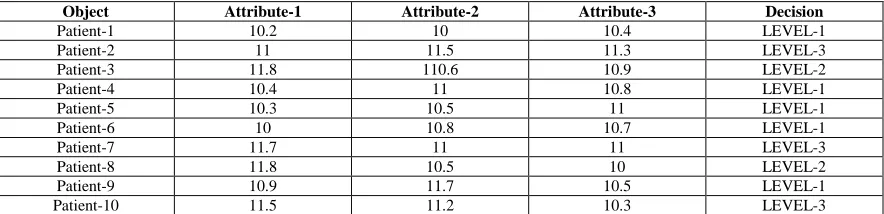
Table 1: Sample Report Data
Object Attribute-1 Attribute-2 Attribute-3 Decision
Patient-1 10.2 10 10.4 LEVEL-1
Patient-2 11 11.5 11.3 LEVEL-3
Patient-3 11.8 110.6 10.9 LEVEL-2
Patient-4 10.4 11 10.8 LEVEL-1
Patient-5 10.3 10.5 11 LEVEL-1
Patient-6 10 10.8 10.7 LEVEL-1
Patient-7 11.7 11 11 LEVEL-3
Patient-8 11.8 10.5 10 LEVEL-2
Patient-9 10.9 11.7 10.5 LEVEL-1
8
Let’s take p1,p2,p3,p4,p5,p6,p7,p8,p9,p10 are patient conditional attribute.
Step 1: Conditional attributes helps to construct bijective softest (s1, Attribute-1) = {p1, p4, p5, p6, p9} {p2, p3, p7, p8, p10} (s2, Attribute-2) = {p1, p3, p5, p6, p8} {p2, p4, p7, p9, p10} (s3, Attribute-3) = {p1, p3, p4, p6, p8, p9, p10} (p2, p5, p7}
Step 2: Decision attributes helps to construct bijective softest Decision (1) = {p1, p4, p5, p6, p9}
Decision (2) = {p3, p8} Decision (3) = {p2, p7, p10}
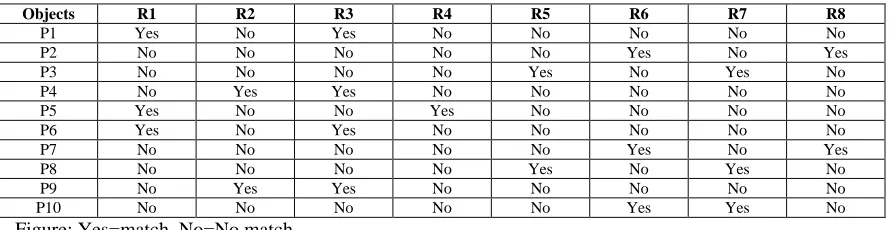
[image:4.612.85.531.264.379.2]Step 3: Apply and operation on the bijective soft set (fi, ai). Table 2 shows tabular form of this And operation.
Table 2: Tabular Form of (s1, p1) ^ (s2, p2) ^ (s3, p3)
Objects R1 R2 R3 R4 R5 R6 R7 R8
P1 Yes No Yes No No No No No
P2 No No No No No Yes No Yes
P3 No No No No Yes No Yes No
P4 No Yes Yes No No No No No
P5 Yes No No Yes No No No No
P6 Yes No Yes No No No No No
P7 No No No No No Yes No Yes
P8 No No No No Yes No Yes No
P9 No Yes Yes No No No No No
P10 No No No No No Yes Yes No
Figure: Yes=match, No=No match
Where R1 = {P1, P4, P5, P6, P9} ∧ {P1, P3, P5, P6, P8} = {P1, P5, P6} R2 = {P1, P4, P5, P6, P9} ∧ {P2, P4, P7, P9, P10} = {P4, P9}
R3 = {P1, P4, P5, P6, P9} ∧ {P1, P3, P4, P6, P8, P9, P10} = {P1, P4, P6, P9} R4 = {P1, P4, P5, P6, P9} ∧ {P2, P5, P7} = {P5}
R5 = {P2, P3, P7, P8, P10} ∧ {P1, P3, P5, P6, P8} = {P3, P8} R6 = {P2, P3, P7, P8, P10} ∧ {P2, P4, P7, P9, P10} = {P2, P7, P10} R7 = {P2, P3, P7, P8, P10} ∧ {P1, P3, P4, P6, P8, P9, P10} = {P3, P8, P10} R8 = {P2, P3, P7, P8, P10} ∧ {P2, P5, P7} = {P2, P7}
(f1, a1) ∧ (f2, a2) ∧ (f3, a3) = (h, c)
(h, c) = {{P1, P5, P6}, {P4, P9}, {P1, P4, P6, P9}, {P5}, {P3, P8}, {P2, P7, P10}, {P3, P8, P10}, {P2, P7}}
Step 4: Apply the restricted And operation (h, c) and decision attribute (g, d). (h, c) ∧∼d(1) = {{P1, P5, P6}, {P4, P9}}
(h, c) ∧∼d(2) = {P3, P8} (h, c) ∧∼d(3) = {P2, P7, P10}
(f, b) = {{P1, P5, P6}, {P4, P9}, {P3, P8}, {P2, P7, P10}}
Step 5: Generating decision rules based on restricted And result (f, b). The following deterministic decision rules are extracted:
9
BIJECTIVE SOFT SET BASED ON CLASSIFICATION
Classification is a data mining technique used to predict group membership for data instances. The classification algorithm learns from the training set and builds a model. The model is used to classify new objects. In this work, classification accuracy of the proposed approach is compared to two different classifiers Naïve Byes and decision table used for computing the Precision, Recall and F-measure.
Data description
Data sets are taken from the CMC hospital where classifying the data is a huge problem.
Diseases data such as fever, kidney cancer, liver diseases and other diagnosis data sets. For experimental analysis we have taken this data set for practical propose.
VALIDATION MEASURES
Precision
It is defined by accuracy provided that a specific class has been predicted. Precision=tp / (tp+fp)
Where tp and fp are the numbers of true positive and false positive respectively;
Recall
Recall is also known as sensitivity. It is measure of the ability of a prediction model to select instance of a certain class from a data sets. Its value is corresponds to the true positive rate.
Recall (or) Sensitivity = tp / (tp + fn)
F-measure
It is defined as combining precision and recall is the harmonic mean of precision and recall, the traditional F-measure or balanced F-score of
[image:5.612.126.487.426.532.2]F-Measure = (2*Precision*Recall) / (Precision + Recall)
Table 3: Performance analysis of classification algorithms on breast cancer data set
Accuracy Measures
Classification Algorithm
Bijective soft set based classification Decision Table Naïve Bayes
Precision 0.98 0.44 0.9
Recall 1 0.667 0.889
F-Measure 0.99 0.533 0.882
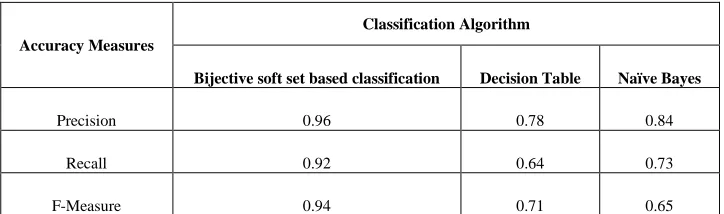
Table 4: Performance analysis of classification algorithms on Pima Indian diabetes data set
Accuracy Measures
Classification Algorithm
Bijective soft set based classification Decision Table Naïve Bayes
Precision 0.96 0.78 0.84
Recall 0.92 0.64 0.73
[image:5.612.126.488.564.671.2]10
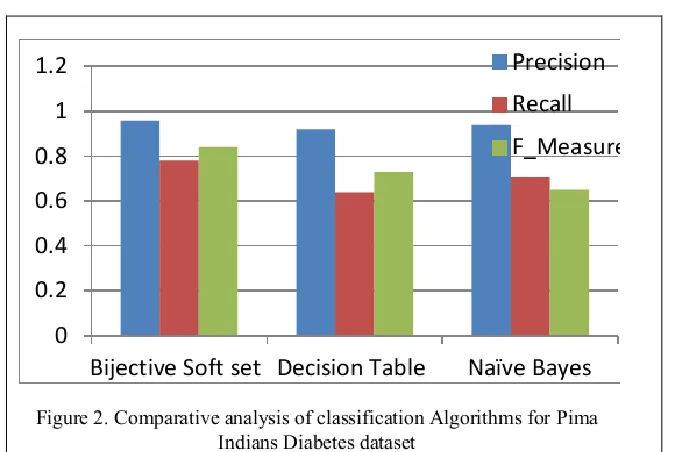
[image:6.612.139.476.365.591.2]Tables 3, 4 and 5 helps to predict performance analysis of the classification algorithm on breast cancer from other two dataset such as Pima Indians diabetes and liver-disorders dataset; Bijective soft set performs better approaches then other two approaches.
Figure 1: Comparative analysis of classification algorithms for breast cancer data set
11
Table 5: Components and their classifications with normal values
Attributes Normalized value Classification
Haemoglobin (HB)
09-Dec Low (1)
07-Sep Medium (2)
05-Jul High (3)
< 5 Very high (4)
Serum urea (SU)
40-80 Low (1)
80-120 Medium (2)
120-200 High (3)
>200 Very high (4)
Serum creatine (SC)
01-Mar Low (1)
03-May Medium (2)
05-Oct High (3)
> 10 Very high (4)
Protein (Prot)
0.031-0.99 Low (1)
1-1.99 Medium (2)
2-2.99 High (3)
> 3 Very high (4)
Weight loss (WL)
5%-7% Low (1)
7%-12% Medium (2)
12%-15% High (3)
>15% Very high (4)
High blood pressure (HBP)
120 to 139 / 80 to 90 Normal (1)
140 to 159 / 90 to 99 Medium (2)
160 to 179 / 100 High (3)
to 109 Very high (4)
>180 / 110
Abdominal pain (AP)
High (1)
---- Medium (2)
Low (3)
Colour of urine (COU)
Reddish yellow (1)
Pale yellow (2)
---- Colour less (3)
Level of Kidney cancer (KCL)
Level (1)
Level (2)
---- Level (3)
12
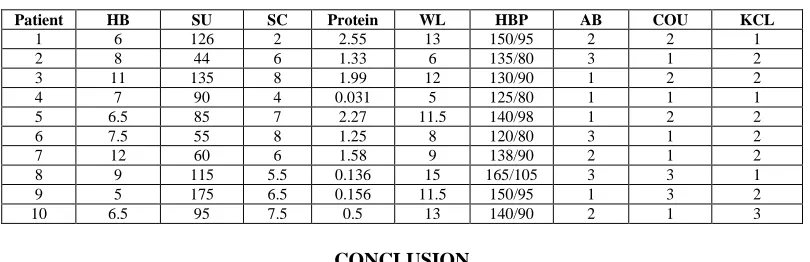
Table 6: Patients’ component values
Patient HB SU SC Protein WL HBP AB COU KCL 1 6 126 2 2.55 13 150/95 2 2 1 2 8 44 6 1.33 6 135/80 3 1 2 3 11 135 8 1.99 12 130/90 1 2 2 4 7 90 4 0.031 5 125/80 1 1 1 5 6.5 85 7 2.27 11.5 140/98 1 2 2 6 7.5 55 8 1.25 8 120/80 3 1 2 7 12 60 6 1.58 9 138/90 2 1 2 8 9 115 5.5 0.136 15 165/105 3 3 1 9 5 175 6.5 0.156 11.5 150/95 1 3 2 10 6.5 95 7.5 0.5 13 140/90 2 1 3
CONCLUSION
Classification plays an important role in today’s data formation. Bijective soft set helps them to classify the data with help of rules. In future Big data and digital technology play a very important role, So maintaining a data is a huge problem and removing the data which is outdated is most important and classifying it play a very important role for searching, modifying, classifying. These helps to reduce cost, time and size of data. So in digital world bijective soft set can play a very important role in future publication.
REFERENCES
[1] AE HAssanien. Intelligent data analysis of breast cancer based on Rough set theory. International Journal on Artificial Intelligence Tools2003 12(4): 465-479.
[2] Aktaş.H, Çagman.N. Soft sets and soft groups. Information Science. 2007 177 (13): 2726–2735. [3] Bana Handaga and Mustafa Mat. Similarity Approach on Fuzzy Soft Set Based Numerical Data Classification”, ICSECS, Part II,CCIS 2011 180: 575–589.
[4] Gong K et al. The bijective soft set with its operations. Computers & Mathematics with Applications
2010.
[5] Herawan.T, Deris.M.M. A direct proof of every rough set is a soft set”, Third Asia International Conference on Modelling & Simulation2009 4: 119–124.
[6] Ivo D and Gunther G. Statistical Evaluation of Rough Set Dependency Analysis. International Journal of Human-Computer Studies1997 46: 589- 604.
[7] Kalaiselvi.N, Hannah Inbarani.H. Fuzzy Soft Set Based Classification for Gene Expression Data.
International Journal of Fuzzy Set Theory2003 1(2): 23-34.
[8] Maji.P.K, Biswas.R and Roy.A.R. Fuzzy Soft Sets. Journal of Fuzzy Mathematics. 2001 9: 589-602 [9] Maji PK, Roy A, Biswas R. An application of soft sets in a decision making problem. Computer Mathematical Application 2002 44: 1077–1083.
[10] Molodtsov D. Soft set theory-first results. Computers & Mathematics with Applications. 1999 37: 19– 31.