Effect of TiO
2
on Plasma Sprayed Al
2
O
3
Based
Composite Coatings at 900°C in Molten
Salt Environment
Gurdeep Singh1, Khushdeep Goyal1,*, Rakesh Goyal2
1Department of Mechanical Engineering, Punjabi University, India
2Chitkara University Institute of Engineering and Technology, Chitkara University, Punjab, India
Copyright©2019 by authors, all rights reserved. Authors agree that this article remains permanently open access under the terms of the Creative Commons Attribution License 4.0 International License
Abstract
The present work investigates the effect of hot corrosion on ASTM-SA213-T-22 Steel with different coatings of Al2O3-TiO2 at 900°C in molten saltenvironment (40wt%Na2SO4+60wt%V2O5). The
experimentation consisted of 50 cycles of heating coated and uncoated specimens for 1 hour at 900°C in muffle furnace and cooling for 20 minutes at ambient temperature. The corroded specimens were analyzed using visual examination, weight change measurement, X-ray diffraction technique and Scanning electron microscopy/Energy-disperse X-ray analysis. The results showed that the uncoated substrate had been more affected with corrosion and gained more mass due to formation of iron oxide (Fe2O3) as compared to coated
substrate because of better adhesion of Al2O3 coating with
base metal SA213-T22 due to presence of TiO2. The
presence of TiO2 increased the strength and durability of
Al2O3 coating to withstand with high temperatures.
Keywords
Hot Corrosion, Boiler Steel, Composites, Thermal Spray, High Temperature1. Introduction
The corrosion occurs at elevated temperatures due to exposure of steels and alloys in atmosphere, which causes formation of oxide layer, when the environmental oxygen reacts with ferrous metal, and is called hot corrosion [1-4]. The failure occurs in boiler tubes is due to the corrosion of base metal at elevated temperature in the molten salt environment which results in damage to the physical and chemical properties of the substrate [5-7]. This can be prevented by applying thin layer of coating on the surface of base metal by the various coating processes like plasma spray coating, high velocity oxy fuel (HVOF) and powder coating etc. As analyzed by literature survey, the alumina
based coatings provide higher corrosion and wear resistance to steel alloys up to 900°C [8, 9]. The rate of corrosion is very fast in metals and alloys; this results in the formation of porous non-protective oxide layer on the surface of material [7, 10-12]. The corrosion rate is highly dependent on the presence of corrosive elements, such as Na2SO4 and V2O5 in atmosphere with elevated
temperature.
Na2SO4 + V2O5 → (Na2O) .V2O5 + SO3
In this reaction, the sodium sulphate and vanadium pentoxide results in formation of Sodium oxide and sulfur tri-oxide which is known as corrosive agent [4, 13]. To coat the substrate, various coating process are used such as Plasma spray coating, High Velocity Oxy Fuel (HVOF) coating and D-gun spray coating, to decrease the rate of corrosion. Goya et al [14] all stated that all coatings are porous, due to the porosity at microscopic level in coating, allows oxygen to react with the base metal through pores and cause formation of oxide layer under the coating region in molten salt environment. Due to oxide layer formation between the coating and base metal boundaries spallation takes place which results in erosion in between the coating and the surface of substrate [15-20]. Hot corrosion is of two types; high temperature hot corrosion (HTHC) – above750°C and low temperature hot corrosion (LTHC) – 550-750°C. The high rate corrosion occurs with the reaction of sulfur, sodium, potassium, lead and vanadium, usually having low melting points. The rate of corrosion is highly dependent on partial pressure of oxygen present in atmosphere [21-24]. Various coatings are used to prevent the rate of corrosion, as per analysis, the Al2O3 is more
protective in prevention of oxidation rate, formation of cracks and spallation caused by oxides of molybdenum after repetitive cycle at elevated temperature in molten salt environment. It is observed from literature study that various types of coatings are used on the substrates with different deposition method. To reduce this effect of
coating, bi-layered coating of Al2O3-TiO2 is used [8-10]. It
is analyzed that the use of Al2O3-TiO2 coating shows better
results. The bilayer of TiO2 with Al2O3 sprayed with
plasma coating helps to reduce pores so that the electrolyte and other corrosive elements could not react with the base metal of substrate. It also increases the properties of substrate to withstand with high temperature, wear and corrosion. TiO2 is used along with fabrication of Al2O3
coating, TiO2 helps in adhesion of coating with base metal
[3]. It has been observed with analysis of various research papers that Al2O3 enhance the properties of material by
both physically or chemically to prevent the rate of corrosion at 900°C [17, 18]. The aim of this experiment is to slow down the rate of corrosion at elevated temperatures in molten salt environment by using the reinforced coating of Al2O3 and TiO2 with different weight percentage
composition, exposed to molten salt environment at 900°C. This experiment defines the behavior of hot corrosion on SA213-T22 boiler steels coated with Al2O3-TiO2, with
different weight-percent combinations, in silicon tube furnace at 900°C for 50 cycles consisting of one hour heating followed by 20 minutes of cooling in molten salt
(40wt%Na2SO4+60wt%V2O5). XRD, SEM/EDS is
undertaken to obtain various results.
2. Experimental Procedure
2.1. Basic Composition of SA213-T22 Material
ASTM-SA213-T-22 Steel is used as base material, obtained from Guru Gobind Singh Thermal Power station, Rupnagar, Punjab. Detailed specifications are given in Table 1.
2.2. Preparation of Coatings
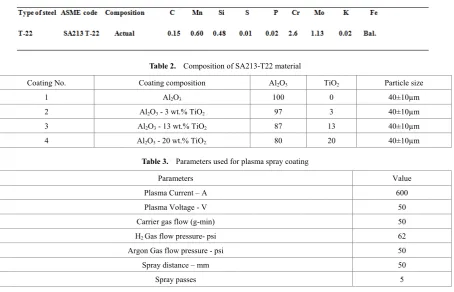
The coating was sprayed on steel specimens at Metallizing Equipment Corporation Private Ltd. Jodhpur, Rajasthan. The size of each specimen was 20 mm x 15 mm x 5 mm. Table 2 shows the composition of coatings obtained, and Table 3 shows the parameters employed in plasma spraying process.
Table 1. Composition of SA213-T22 steel boiler tubes
Table 2. Composition of SA213-T22 material
Coating No. Coating composition Al2O3 TiO2 Particle size
1 Al2O3 100 0 40±10µm
2 Al2O3 - 3 wt.% TiO2 97 3 40±10µm
3 Al2O3 - 13 wt.% TiO2 87 13 40±10µm
4 Al2O3 - 20 wt.% TiO2. 80 20 40±10µm
Table 3. Parameters used for plasma spray coating
Parameters Value
Plasma Current – A 600
Plasma Voltage - V 50
Carrier gas flow (g-min) 50
H2 Gas flow pressure- psi 62
Argon Gas flow pressure - psi 50
Spray distance – mm 50
[image:2.595.72.527.365.657.2]2.3. Formulation of Coating
Experimental studies are undertaken in molten salt
environment (40wt%Na2SO4+60wt% V2O5).
The behaviour of TiO2-Al2O3 coatings on T-22 boiler
steel at 900°C in the molten salt environment (40wt% Na2SO4-60wt% V2O5) was examined. The experiment was
consisted of 50 cycles. Each cycle consisted of 1 hour heating in a silicon tube muffle furnace followed by 20 minutes of cooling in room temperature. Before conducting the experiment, the physical dimensions of each specimen was measured with the help of vernier caliper. The de-burring operation was performed on each surface to remove any foreign particles at the microscopic level. The plasma spray coating was performed before the application of molten salt on the surface of specimens. The (40wt% Na2SO4-60wt% V2O5) salt was mixed with distilled water
and was applied on each face of the specimen after washing all specimens with acetone. The layer of molten salt was applied gently on each face of specimen with the help of camel hair brush. To make the proper adhesion of molten salt on each surface of the specimen, all specimens were heated up to 250°C in the oven. The molten salt environment becomes more aggressive to react with metals with the increase in temperature and the rate of reaction also increases. The increase in temperature causes the faster rate of corrosion on the surface of the metal. The samples were kept in alumina boats in a muffle furnace at 900°C with 50 repetitive cycles of 1-hour heating followed
by 20 minutes of cooling at room temperature. The aggressiveness of corrosion was examined with a number of repetitions in cycles. After the experimentation, all the specimens were analyzed by the X-ray diffraction, SEM and EDS. The experiment was performed in metallurgy laboratory of Chandigarh Engineering College, Landran (Mohali), Punjab.
3. Results
3.1. Visual Examination
Before conducting the experiment, all samples were in physically perfect condition. The experiment was conducted in a molten salt environment (40wt% Na2SO4-60wt% V2O5) kept in silicon tube muffle furnace
at 900°C. During the experiment, after the 4th cycle, the
uncoated T-22 specimen started to change in brownish colour and after 15th cycles formation of cracks were
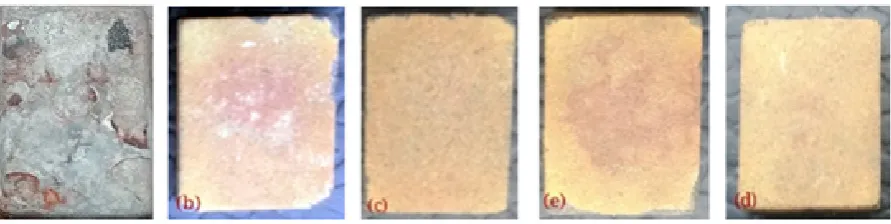
started to develop near corners of the specimen as shown in (Fig. 1(a)). In the case of Al2O3 coated T-22 specimen,
cracks were started to appear on the coated surface after 30th cycle. Minor spallation of scale was seen on the
surface after 50th cycle as shown in (Fig. 1(b)). But in the
case of other specimens coated with TiO2-Al2O3 composite
coatings, no change in colour was observed and till 30th
cycle, there was no development of cracks found even after 50cycles as shown in images (Fig. 1(c-e)).
Figure 1. Visual inspected images of (a) uncoated, (b) Al2O3 (c) Al2O3 - 3 wt.% TiO2, (d) Al2O3 - 13 wt.% TiO2, and (e) Al2O3 - 20 wt.% TiO2 coated
[image:3.595.78.524.461.573.2]3.2. Mass Change Observations
The thermo gravimetric study was done to find the mass change characteristics showed by coated and uncoated T-22 boiler steel. The change in mass of uncoated and coated T-22 steels were analyzed after exposing each specimen in the molten salt environment (40wt%Na2SO4-60wt%V2O5) for 50 cycles at 900°C. The
change in mass showed the kinetics of corrosion. The high mass gain is identified as a high rate of corrosion. The graph shows that uncoated specimen showed the higher
mass gain, the specimen coated with Al2O3 shows a little
less mass gain than uncoated specimen.
The mass change is observed after each complete cycle shown in. (Fig 2)
3.3. XRD Analysis
X-Ray diffraction tests are conducted to figure out the nature of metallurgy of material affected due to high temperature and corrosive environment.
[image:4.595.69.526.234.743.2]Figure 3. Xrd spectrum of (a) uncoated, (b) Al2O3 (c) Al2O3 - 3 wt.% TiO2, (d) Al2O3 - 13 wt.% TiO2, and (e) Al2O3 - 20 wt.% TiO2 coated substrates The XRD graph shows that, the uncoated T-22
Specimen shows the formation of Fe2O3 at oxide scales.
The specimen with the coating of pure Al2O3 shows the
Al2O3 peaks along with Na2SO4 and Fe2O3. The specimen
containing Al2O3-3TiO2 shows formation of TiO2 and
Al2O3, Na2SO4, and no presence of Fe2O3 is found on the
surface of specimen. The specimen coated with Al2O3-13TiO2 shows the peak of TiO2, Na2SO4 and no
presence of Fe2O3 is found on the surface and specimen
coated with Al2O3-20TiO2 shows presence of TiO2, Na2SO4
and Al2O3 along with of V2O5 and no peak of Fe2O3 is
found on coated surface of specimen.
The XRD graph clearly shows that the uncoated specimen mostly affected by the formation of Fe2O3 and
nearly no formation of Fe2O3 found on the surface of the
specimen coated with TiO2- Al2O3.
[image:5.595.97.502.353.717.2]3.4. SEM/EDS Analysis
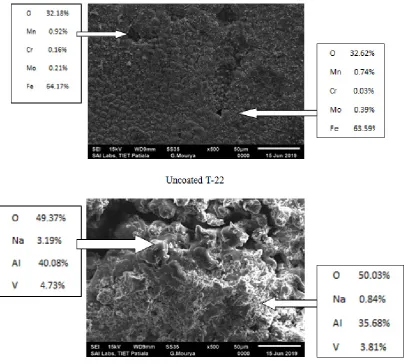
Figure 4 shows the SEM micrograph of T-22 uncoated steel substrate after exposing it in molten salt environment for 50 cycles of heating inside a silicon tube muffle furnace. The EDS analysis on spectrum indicates the presence of Fe and Cr which might be the reason of formation of Fe2O3
and Cr2O3. SEM Micrograph shows the spallation in the
coating layer. The Fe and O found along with small percentage of Cr. For Al2O3 coated T-22 specimen the EDS
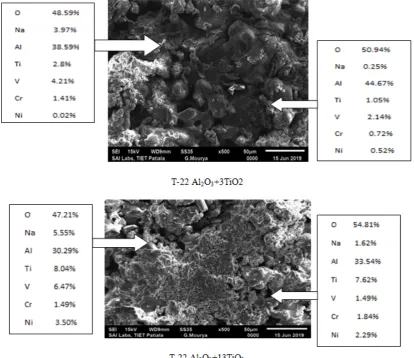
analysis spectrum shows the presence of Al, O, Cr and Fe. The presence of Al and Fe might cause the formation of Al2O3, Cr2O3 and Fe2O3. In case of coated specimens
3Wt% TiO2-Al2O3, 13Wt% TiO2-Al2O3 and 20Wt%
TiO2-Al2O3 respectively shows the morphology of surface
coating of specimens and the EDS analysis shows the major formation of Al2O3 and TiO2. The TiO2 was well
spotted with bright particle in darker region of Al2O3. The
Figure 4. SEM/EDAX results of different corroded specimens
The SEM/EDS result showed that the coated specimens formed preventive elements such as Al, Cr and Ti on their surface, but in uncoated specimen the formation of Feand Mo was found. The presence of Feand Mo on the surface of uncoated specimen, might have caused the formation of
[image:6.595.93.508.84.442.2]4. Discussion
In this experiment, the hot corrosion behaviour of different reinforced coatings of TiO2-Al2O3 on T-22 boiler
steel was examined. Each specimen was kept is molten salt environment (40wt% Na2SO4-60wt% V2O5). After the
successful completion of experiment the result were obtained.
The macrograph showed the rate of corrosion was high in uncoated T-22 specimen as compared to coated specimens. The change in colour to brownish was found in early stage in uncoated T-22 specimen. After 25th cycle the
development of cracks were observed on the corner of uncoated specimen in visual observations. The thermo gravimetric study revealed that the uncoated specimen gained maximum mass in the experiment as compared to other specimens. The change in mass showed the kinetics of corrosion in the molten salt environment at elevated temperature. The thermo gravimetric graph (Fig. 2) showed that mass gained by the uncoated specimen was 54.61mg/cm2. The XRD (Fig. 3) graph indicated the
formation of Fe2O3 in oxide scale on the surface of
uncoated specimen. The SEM/EDS analysis indicated the presence of Fe, Mo and V on the surface of uncoated T-22 specimen (Fig. 4). These elements are highly responsible for the hot corrosion [2]. The molybdenum oxide is found in molten state at 550°C. At 900°C the liquid molybdenum oxide dissolves the protective layer of chromium, which causes corrosion on the surface of substrate. The protective oxide layer of chromium helps to resist the corrosive species to react with the surface of metal [9]. The iron oxide reacts with the base metal with time, due to this the mass of substrate increases with respect to time. The thick iron oxide layer forms on the surface of specimens which is responsible for corrosion [13].
Al2O3 coated specimen showed 25.41% less mass gain
as compared to uncoated specimen. Small pores were noticed on the surface of the specimen after exposing it to the molten salt environment for 50 cycles. XRD graph indicated the presence of Al2O3, Cr2O3 and Fe2O3 oxide
layers. The less mass gained by the specimen is might be due to the formation of Al2O3 and Cr2O3 which resist the
corrosive element to attack the base metal. However, porosities in Al2O3 coatings might have abled the corrosive
elements to attack the base metal. SEM/EDS analysis also showed presence of Al, Cr and Fe which validated the XRD results. The spallation produced on the specimen was might be due to the formation of Fe2O3 oxide layer.
After exposing the 3wt%TiO2-Al2O3, 13wt%
TiO2-Al2O3 and 20wt%Ti-Al2O3 coated substrates in
molten salt environment (40wt% Na2SO4-60wt% V2O5) at
900°C. These coatings were found safe to hot corrosion. There was no colour change found till 30th cycle and no
cracks were visualized in the coated specimen after completion of all 50 cycles in molten salt environment at elevated temperature. The specimen coated with
20TiO2-Al2O3 coating showed least mass gain. The mass
gained by specimen coated with Al2O3-3TiO2 was 40.06%
less than that of uncoated T-22 steel. The specimen coated with Al2O3-13TiO2 gained less mass by 54.18% and the
specimen coated with Al2O3-20TiO2 showed least mass
gain of 18.01 mg/cm2 and gained 67.02% less mass as
compared to uncoated specimen showed by thermo gravimetric method shown in. The XRD graph showed the presence of Al2O3, Cr2O3 and TiO2 oxides on the surface of
coated specimens. These elements are corrosion resistant in nature. In SEM/EDS analysis, the coated specimen showed the presence of Ti, Alin major phase. There were no traces of Feand Mo found on the surface of coated specimens even after 50 numbers of cycles in molten salt environment at elevated temperatures.
This reinforcement of TiO2 inAl2O3 might have helped
to reduce the porosity in the coating layer. It is observed that the composition of Al2O3-20TiO2 showed better results.
It has been analyzed that by increase in percentage of TiO2
with Al2O3 coating, the hot corrosion resistance increases.
The TiO2 along with Al2O3 showed better adhesion
properties with base metal and found preventive from hot corrosion. The rate of hot corrosion resistance showed the following trend:
Uncoated T-22 steel ˂ Al2O3 ˂ 3Wt% TiO2-Al2O3 ˂
13Wt% TiO2-Al2O3 ˂ 20Wt%Ti-Al2O
5. Conclusions
Different coatings of 100Al2O3, 3TiO2-Al2O3,
13TiO2-Al2O3 and 20TiO2-Al2O3 were deposited on
SA213-T22 with plasma spray coating technique.
The uncoated specimen showed maximum mass change where as the specimen coated with TiO2-Al2O3 showed least mass change.
The XRD and SEM/EDS analysis indicates that uncoated steel specimen contained Fe2O3 and Cr2O3
as major phase in oxide scale.
In the case of coatings of 3TiO2-Al2O3,13TiO2-Al2O3
and 20TiO2-Al2O3, the major phases of TiO2 and
Al2O3 were found in XRD, SEM/EDS analysis.
The better resistance was provided by Al2O3-20TiO2
among all other coatings when reacted to molten salt environment (40wt% Na2SO4-60wt% V2O5) for 50
cycles at 900°C.
The 100Al2O3, 3TiO2-Al2O3, 13TiO2-Al2O3 and
20TiO2-Al2O3 coated specimen indicated the mass
gain reduction by 25.41%, 40.06%, 54.18% and 67.02 % respectively, as compared to uncoated specimen.
The TiO2-Al2O3 specimens showed no formation of
cracks after experimentation done in molten salt environment (40wt% Na2SO4-60wt% V2O5) at
The sequence of the coating provided better resistance of corrosion in decreasing order is Al2O3-20TiO2
coating ˃ Al2O3-13TiO2 coating ˃ Al2O3-3TiO2
coating ˃ 100 Al2O3 coating ˃ uncoated T-22
REFERENCES
P. Sassatelli, G. Bolelli, M. L. Gualtieri, E. Heinonen, M. [1]
Honkanen, L. Lusvarghi, "Properties of HVOF-sprayed Stellite-6 coatings," Surface and Coatings Technology, Vol. 338, pp. 45-62, 2018.
V. P. S. Sidhu, K. Goyal, and R. Goyal, "Hot corrosion [2]
behaviour of HVOF-sprayed 93 (WC-Cr3C2)-7Ni and
83WC-17Co coatings on boiler tube steel in coal fired boiler," Australian Journal of Mechanical Engineering, Vol. 17, No. 2, pp. 127-132, 2017.
G. Singh, K. Goyal, and R. Bhatia, "Hot corrosion studies of [3]
plasma-sprayed chromium oxide coatings on boiler tube steel at 850 C in simulated boiler environment," Iranian Journal of Science and Technology, Transactions of Mechanical Engineering, Vol. 42, No. 2, pp. 149-159, 2018.
R. Taylor, J. Brandon, and P. Morrell, "Microstructure, [4]
composition and property relationships of plasma-sprayed thermal barrier coatings," Surface and Coatings technology,
Vol. 50, No. 2, pp. 141-149, 1992.
S. Sampath, "Thermal sprayed ceramic coatings: [5]
fundamental issues and application considerations,"
International Journal of Materials and Product Technology,
Vol. 35, No. 3-4, pp. 425-448, 2009.
B. A. Shaw and R. G. Kelly, "What is corrosion?," [6]
Interface-Electrochemical Society, Vol. 15, No. 1, pp. 24-27, 2006.
V. P. S. Sidhu, K. Goyal, and R. Goyal, "An investigation of [7]
corrosion resistance of HVOF coated ASME SA213 T91 boiler steel in an actual boiler environment,"
Anti-Corrosion Methods and Materials, Vol. 64, No. 5, pp. 499-507, 2017.
B. S. Sidhu and S. Prakash, "Performance of NiCrAlY, Ni– [8]
Cr, Stellite-6 and Ni 3 Al coatings in Na2SO4–60% V2 O5
environment at 900° C under cyclic conditions," Surface and Coatings Technology, Vol. 201, No. 3, pp. 1643-1654, 2006.
Ş. Yılmaz, M. Ipek, G. F. Celebi, and C. Bindal, "The effect [9]
of bond coat on mechanical properties of plasma-sprayed Al2O3 and Al2O3–13wt% TiO 2 coatings on AISI 316L
stainless steel," Vacuum, Vol. 77, No. 3, pp. 315-321, 2005. V. P. S. Sidhu, K. Goyal, and R. Goyal, "Comparative study [10]
of corrosion behaviour of HVOF-coated boiler steel in actual boiler environment of a thermal power plant,"
Journal of the Australian Ceramic Society, Vol. 53, No. 2, pp. 925-932, 2017.
L. Singh, N. K. Grover, V. Chawla, and J. Grewal, [11]
"Microstructure and Characterization of Detonation Gun Sprayed Al2O3 Coating," Asian Journal of Engineering and
Applied Technology, Vol. 5, No. 1, pp. 15-17, 2016. K. Goyal, H. Singh, and R. Bhatia, "Current status of thermal [12]
spray coatings for high temperature corrosion resistance of boiler steel," Journal of Material & Metallurgical Engineering, Vol. 6, No. 1, pp. 29-35, 2016.
V. P. Singh Sidhu, K. Goyal, and R. Goyal, "Corrosion [13]
behaviour of HVOF sprayed coatings on ASME SA213 T22 boiler steel in an actual boiler environment," in Advanced Engineering Forum, 2017, pp. 1-9.
K. Goyal, H. Singh, and R. Bhatia, "Effect of Carbon [14]
Nanotubes on Properties of Ceramics Based Composite Coatings," in Advanced Engineering Forum, 2018, pp. 53-66.
E. Irissou, J.-G. Legoux, B. Arsenault, and C. Moreau, [15]
"Investigation of Al-Al2O3 cold spray coating formation
and properties," Journal of Thermal Spray Technology, Vol. 16, No. 5-6, pp. 661-668, 2007.
R. Jones, "Hot Corrosion in Gas Turbines," DTIC [16]
Document1983.
A. Keyvani and M. Bahamirian, "Oxidation resistance of [17]
Al2O3-nanostructured/CSZ composite compared to
conventional CSZ and YSZ thermal barrier coatings,"
Materials Research Express, Vol. 3, No. 10, p. 105047, 2016.
A. Keyvani and M. Bahamirian, "Hot corrosion and [18]
mechanical properties of nanostructured Al2O3/CSZ
composite TBCs," Surface Engineering, Vol. 33, No. 6, pp. 433-443, 2017.
K. Goyal, H. Singh, and R. Bhatia, "Mechanical and [19]
microstructural properties of carbon nanotubes reinforced chromium oxide coated boiler steel," World Journal of Engineering, Vol. 15, No. 4, pp. 429-439, 2018.
K. Goyal, H. Singh, and R. Bhatia, "Experimental [20]
investigations of carbon nanotubes reinforcement on properties of ceramic-based composite coating," Journal of the Australian Ceramic Society, Vol. 55, No. 2, pp. 315-322, 2018.
M. A. Khan, S. Sundarrajan, and S. Natarajan, "Hot [21]
corrosion behaviour of Super 304H for marine applications at elevated temperatures," Anti-Corrosion Methods and Materials, Vol. 64, No. 5, pp. 508-514, 2017.
S. K. Kim and Y. S. Hwang, "Hot Corrosion of T22, T23, [22]
and T91 Steels in Na2SO4 Salts at 800 and 900°C," Journal
of the Korean Institute of Metals and Materials, Vol. 51, No. 12, pp. 849-856, 2013.
K. Goyal, H. Singh, and R. Bhatia, "Behaviour of carbon [23]
nanotubes-Cr2O3 thermal barrier coatings in actual boiler,"
Surface Engineering, pp. 1-11, 2019, published online, https://doi.org/10.1080/02670844.2019.1584966
K. Goyal, H. Singh, and R. Bhatia, "Hot-corrosion behavior [24]
of Cr2O3-CNT-coated ASTM-SA213-T22 steel in a molten