
SIMULATION OF SPEED CONTROL BRUSHLESS DC MOTOR USING GAUSSIAN FUZZY LOGIC CONTROLLER
NURLIANA BINTI ABD KARIM
A project report submitted in partial
fulfillment of the requirement for the award of the Master of Electrical Engineering
Faculty of Electrical and Electronic Engineering Universiti Tun Hussein Onn Malaysia
ABSTRAK
v
ABSTRACT
This paper presents a control scheme of a Fuzzy Logic for the brushless direct current (BLDC) motor drives. The BLDC motor has some advantages compare to others type of motors. However, the nonlinearity of this motor drive characteristics cause it is difficult to handle using conventional proportional-integral-differential (PID) controller. In order to overcome this main problem, Fuzzy Logic controller with a Gaussian membership function is developed. The mathematical model of BLDC motor is derived. The controller is designed to tracks variations of speed references and stabilizes the output speed during load variations. The effectiveness of the proposed method is verified by develop simulation model in Matlab Simulink software. The simulation results show that the proposed Fuzzy Logic controller (FLC) produce significant improvement control performance compare to the PID controller for both condition controlling speed reference variations and load disturbance variations.
CONTENTS
TITLE i
DECLARATION ii
DEDICATION iii
ACKNOWLEDGEMENT iv
ABSTRACT v
CONTENTS vii
LIST OF TABLES x
LIST OF FIGURES xi
LIST OF SYMBOLS AND ABBREVIATIONS xiii
viii
CHAPTER 1 INTRODUCTION 1
1.1 Project Overview 1
1.2 Problem Statements 2
1.3 Project Objectives 2
1.4 Project Scopes 3
CHAPTER 2 LITERATURE REVIEW 4
2.1 Introduction 4
2.2 Previous Case Study 4
2.3 Brushless Direct Current Motor 6
2.3.1 Construction and Operating Principle 7
2.3.1.1 Stator 7
2.3.1.2 Rotor 8
2.3.1.3 Hall Sensor 9
2.3.1.4 Theory of Operation 10
2.3.2 Torque/Speed Characteristics 10
2.3.3 Commutation Sequence 11
2.3.4 Back EMF 12
2.4 Fuzzy Logic Controller System 13
2.4.1 Fuzzification 14
2.4.2 Rule Base 16
2.4.3 Inference Engine 16
2.4.4 Deffuzzification 17
CHAPTER 3 METHODOLOGY 19
3.1 Introduction 19
3.2 System Structure 20
3.2.1 Structure of BLDC motor 20
3.2.2 Modelling of BLDC motor 22
3.2.3 Modelling of a Trapezoidal Back EMF
3.2.4 Voltage Source Inverter (VSI) 25 3.2.5 Reference Current Generator 27
3.3 Proposed Controller 29
3.4 Fuzzy Logic Controller Design 29
3.4.1 Inference Mechanism 30
3.4.2 Defuzzifier 31
CHAPTER 4 RESULTS AND ANALYSIS 32
CHAPTER 5 CONCLUSIONS AND FUTURE WORK 47
5.1 Conclusions 47
5.2 Future Works 48
REFERENCES 49
x
LIST OF TABLES
3.1 Reference currents of BLDC motor 28
3.2 Rule Base 31
LIST OF SYMBOL AND ABBREVIATIONS
B - Friction Coefficient BLDC - Brushless Direct Current
DC - Direct Current
DSP - Digital Signal Processing e
a, eb, ec - The Phase Back-EMF e
ab, ebc, eca - Line-to-line Back-EMF e
ia, eib, eic - Error Phase Current EMF - Electromagnetic Field FLC - Fuzzy Logic Controller fabc(θr) - Function of rotor position i a, ib, ic - Stator Phase Current ia ref, ib ref, icref - Reference Phase Current I max - Reference Current
J - Moment of Inertia
jth - Numbers of Neuron
K
e - Back-EMF Constant
K t - Torque Constant
L - Self-inductance
M - Mutual Inductance
N - North
PID - Proportional Integral Derivative
R - Phase Resistance
xiv
S - South
T a, Tb, Tc - Phase Electromagnetic Torque T e - Electromagnetic Torque T
L - Load Torque
TP - Peak Torque
TR - Rated Torque
V
a, Vb, Vc - Phase Voltage V
dc - DC Supply Voltage
V
ao, Vbo, Vco - Reference to Midpoint of DC Supply Voltage ω
m - Rotor Speed in mechanical ω
r - Rotor Speed in electrical
Y - Star connection
- Delta connection
LIST OF FIGURES
2.1 The stator of BLDC motor 8
2.2 Rotor magnet cross section 9
2.3 BLDC motor cross section 10
2.4 Torque speed characteristics 11
2.5 The hall sensor and trapezoidal back EMF waveforms of BLDC
motor drive 12
2.6 Triangular membership function shape 14
2.7 Trapezoidal membership function shape 15
2.8 Gaussian membership function shape 15
2.9 Generalized bell membership function shape 16 3.1 The block diagram of speed control using Gaussian fuzzy logic
controller for BLDC motor drive system. 19
3.2 Disassembled view of BLDC motor 20
3.3 The system for controlling the voltage and speed with the associated current and voltage waveforms superimposed
on the circuits. 21
3.4 Trapezoidal back-EMF and phase current waveforms of
BLDC motor drive 23
3.5 Simulink diagram of generating back-EMF from rotor position 25
3.6 Simulink diagram of three-phase currents 27
3.7 Simulink diagram of reference currents block 28 3.8 Fuzzy logic for BLDC motor drive system 29
xii 4.1 Block diagram of the proposed Fuzzy Logic control for
BLDC motor 32
4.2 Rotor position waveform at speed 1500 rpm 34 4.3 Back-EMF waveform based on rotor position at speed 1500 rpm 34 4.4 Phase current waveform based on rotor position at speed 1500 rpm 35 4.5 Phase current reference waveform at speed 1500 rpm 35 4.6 Fuzzy controller response with Gaussian membership function
at load step change from 4 N-m to 2 N-m at t = 1s 36 4.7 Fuzzy controller response with triangular membership function
at load step change from 4 N-m to 2 N-m at t = 1s 37 4.8 Fuzzy controller response with trapezoidal membership
function at load step change from 4 N-m to 2 N-m at t = 1s 38 4.9 Fuzzy controller response with generalized bell membership
function at load step change from 4 N-m to 2 N-m at t = 1s 39 4.10 Speed performance of the PID controller for step up speed
reference 40
4.11 Speed performance of the FLC for step up speed reference 40 4.12 Speed performance of the PID controller for step up speed
reference 41
4.13 Speed performance of the FLC for step up speed reference 41 4.14 Speed performance of the PID controller for step
down speed reference 42
4.15 Speed performance of the FLC for step down speed reference 43 4.16 Speed performance of the PID controller for step
down speed reference 43
4.17 Speed performance of the FLC for step down speed reference 44 4.18 Speed performance during step load disturbance using PID
controller at 1000 rpm 45
4.19 Speed performance during step load disturbance using FLC
at 1000 rpm 45
4.20 Speed performance during step load disturbance using PID
controller at 1500 rpm 46
4.21 Speed performance during step load disturbance using PID
LIST OF APPENDICES
A Gaussian Fuzzy Logic Programming 51
B iabc_ref Programming 55
C Emf_abc Programming 57
D ref_wave Programming 59
E v_abc Programming 61
CHAPTER 1
INTRODUCTION
1.1 Project Overview
Nowadays, Brushless Direct Current (BLDC) motors are one of the motor types rapidly gaining popularity [1]. As the name implies, their only drawback is that they need a commutator and brushes which are subject to wear and require maintenance. When the functions of commutator and brushes were implemented by solid-state switches, maintenance-free motors were realized.
BLDC motors have many advantages over brushed DC motors and induction motors which is better speed versus torque characteristics, high dynamic response, high efficiency, long operating life, noiseless operation and higher speed ranges. In addition, the ratio of torque delivered to the size of the motor is higher, making it useful in applications where space and weight are critical factors [1].
The applications BLDC motor are widely used in many industries as growth as the rapidly developments in power electronic technology, manufacturing technology for high performance magnetic materials and modern control theory for motor drives [2]. Modern intelligent motion applications demand accurate speed and position control due to the favorable electrical and mechanical properties of BLDC motor. Many machine and control method have been developed to improve the performance of BLDC motor drives [3].
as BLDC motor drive, control performance of the PID controller becomes poor and difficult to determine the controller parameters. So that, Fuzzy Logic Control (FLC) will be used in order to improve the control performance.
In this project, a complete simulation model with FLC method for BLDC motor drive is proposed using Matlab/Simulink.
1.2 Problem Statements
Direct Current (DC) motor was chosen for the speed control applications due to the control simplicity on the intrinsic decoupling between the flux and the torque. As the name implies, there are physical limitations to speed and life time because of brush wear. However, BLDC have been produced to overcome this problem. Since there are no carbon brushes to wear out, a BLDC motor can provide significantly greater life being now only limited by bearing wear. This advantage make BLDC motor becomes popular in the industry but this motor is a non-linear system hence, need more complex speed controller than the DC motor.
By this reason, the Gaussian Fuzzy Logic controller will be developed to improve the performance of variable speed for BLDC motor since the system of this motor is non-linear system.
1.3 Project Objectives
The objectives of this project are:
i. To derive simulation model of BLDC motor using Matlab Simulation. ii. To improve speed performances of BLDC motor such as reduces
3
1.4 Project Scopes
The scopes of this project are to simulate BLDC motor using Matlab Simulink software and develop the FLC that will be used to control the variable speed of the BLDC motor. The scopes of proposed FLC is limited to Gaussian membership function. The other membership function of FLC also will be develop to compare the effectiveness of the proposed
CHAPTER 2
LITERATURE REVIEW
2.1 Introduction
In order to design and construct Gaussian Fuzzy Logic controller for BLDC motor speed, research in FLC need to be performed. This chapter would discuss the previous study of FLC that has been developing through the year.
2.2 Previous Case Study
Many approaches for designing controller based on the brushless DC motor has been proposed on the previous papers. The fuzzy speed controller was chosen by the designer due to their property. Fuzzy logic provides a useful methodology to create a practical solution for controlling complex system.
Siong T. C. et al. (2011) are proposed fuzzy logic controller for BLDC permanent magnet drives. The results shows that the fuzzy logic controller system provided a good dynamic performances in both simulation and experimental.
5 This rapid control prototyping approach to fuzzy speed control of BLDC motor paper are study by Tuncay R. N. et al.. In this paper, fuzzy controller is successfully controlling the motor and the model based programming of DSPs. Fuzzy logic controller is founded more robust and fast than other conventional control techniques. It is also very simple and versatile.
This research has proposed a speed controller with adaptive fuzzy tuning method for the BLDC motor drives by Kwon C. J. et al. (2003). The simulation results have confirmed the good speed response and the efficiency of the proposed adaptive fuzzy logic scheme for changing motor parameter and load torque.
In this paper, a speed control for the BLDC motor based on a combination between sliding mode control and fuzzy logic is presented by Rusu C. The results of simulation and experiment show that the performance of the system drive has some advantages than using a pure siding mode control. The control precision of the system by using fuzzy sliding mode control is improved.
Cunkas M. et al. (2010) proposed realization of fuzzy logic controlled BLDC motor drives using matlab/simulink. In this study, it is seen that the desired real speed and torque values could be reached in a short time by fuzzy logic controller. The results show that MATLAB paired with simulink is a good simulation tool for modeling and analyze fuzzy logic controlled brushless DC motor drives.
In addition, Parhizkar N. et al. (2011) have presented direct torque control of BLDC motor drives with reduced starting current using fuzzy logic controller. Direct torque control offers some advantages such as simple algorithm, simplicity to implement, faster torque response, reduced torque ripple and less sensitivity to parameters variations. Fuzzy logic controller is used in order to eliminate overshoot exists in speed and torque responses. In addition by using fuzzy logic controller, starting current reduced due to reliability of this controller.
Oyedepo J. A. et al. (2011) have proposed Implementation of a fuzzy logic speed controller for a permanent magnet BLDC motor drive system. In this paper, the characteristics of permanent brushless DC motor, its steady state operation and its various torque-speeds/torque-current characteristics are studied. The speed of a BLDC Motor has been successfully controlled by using fuzzy logic controller technique. A comprehensive analysis of BLDC drive system has been performed by using fuzzy logic controller.
Chen W. et al. (2006) have presented sensorless control of BLDC motor based on fuzzy logic. The result shows that fuzzy logic controller can reduce the torque ripple. There is also has no neutral voltage, phase shifted or silent phase are required in this method which ensure its accuracy and stability.
Based on the previous case study, the researchers make a great effort to propose the good controller to control the speed of BLDC motor. Although the method is differ from each other, it is still can be conclude that fuzzy logic controller is the better controller compared to other conventional controller. Therefore, in this paper will use the fuzzy logic control as the controller of BLDC motor speed.
2.3 Brushless Direct Current Motor
The Brushless Direct Current (BLDC) motor is the ideal choice for applications that require high reliability, high efficiency, and high power-to-volume ratio. Generally speaking, a BLDC motor is considered to be a high performance motor that is
capable of providing large amounts of torque over a vast speed range. BLDC motors are a derivative of the most commonly used DC motor, the brushed DC motor, and they share the same torque and speed performance curve characteristics.
7
move, so no physical commutator is necessary. A BLDC motor is highly reliable since it does not have any brushes to wear out and replace.
2.3.1 Construction and Operating Principle
BLDC motors are a type of synchronous motor. This means the magnetic field generated by the stator and rotor rotate at the same frequency. BLDC motor does not operate directly off a DC voltage source. It consists of a rotor with permanent
magnets, a stator with windings and commutation that is performed electronically. Normally three Hall sensors are used to detect the rotor position and commutation is performed based on Hall sensor inputs. There are two types of stator windings variants which are trapezoidal and sinusoidal motors.
2.3.1.1 Stator
Figure 2.1: The stator of BLDC motor [13]
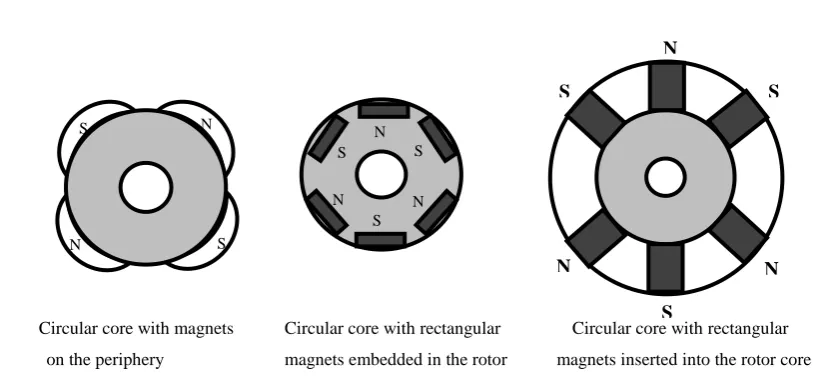
2.3.1.2 Rotor
9
N
S N N
S S
S
S
S
N N
N
N
S N
S
[image:21.595.115.530.57.246.2]Circular core with magnets Circular core with rectangular Circular core with rectangular on the periphery magnets embedded in the rotor magnets inserted into the rotor core
Figure 2.2: Rotor Magnet Cross Section
2.3.1.3 Hall Sensor
Hall sensors work on the hall-effect principle that when a current-carrying conductor is exposed to the magnetic field, charge carriers experience a force based on the voltage developed across the two sides of the conductor. If the direction of the magnetic field is reversed, the voltage developed will reverse as well. For Hall-effect sensors used in BLDC motors, whenever rotor magnetic poles North (N) or South (S) pass near the hall sensor, they generate a HIGH or LOW level signal, which can be used to determine the position of the shaft. Most BLDC motor consists of three Hall
Figure 2.3: BLDC motor cross section [2]
2.3.1.4 Theory of Operation
Three windings on each commutation have different function. First windings will energized to positive power (current inflow into the winding), the second winding for negative (current out flow the winding) and the last winding is in a non-energized condition. The interaction between the permanent magnet and magnetic field generated by the stator coils will produce the torque. Basically, the peak torque occurs when these two fields are at 90˚ to each other and falls off as the field move together. In order to keep the motor running, the magnetic field produced by the winding should shift position as the rotor moves to catch up with the stator field.
2.3.2 Torque/Speed Characteristics
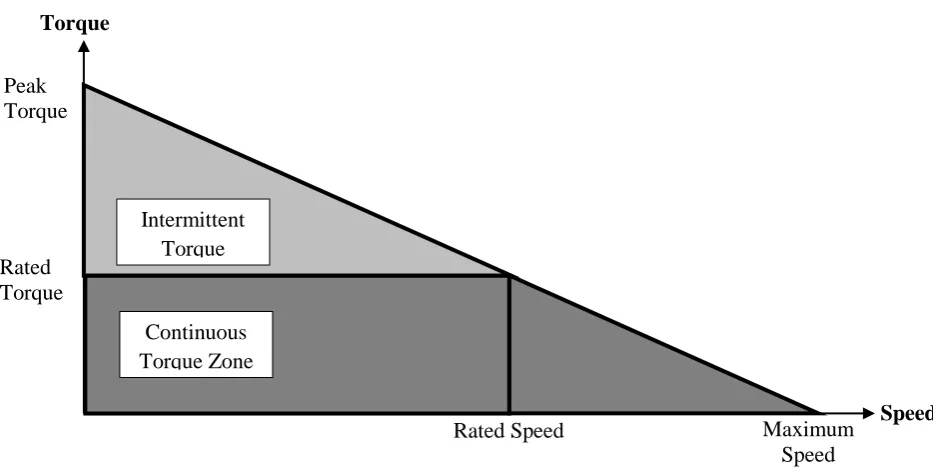
Based on the Figure 2.4, the BLDC motor can define using two torque parameters, a peak torque (TP) and rated torque (TR). The motor can be loaded up to the rated torque during continuous operations. The torque remains constant in a BLDC motor for speed range up to the rated speed. Meanwhile it capable to run up to the
11
Peak Torque
Maximum Speed Rated Speed
Rated Torque
Speed Torque
Intermittent Torque
[image:23.595.90.557.69.305.2]Continuous Torque Zone
Figure 2.4: Torque/Speed Characteristic
2.3.3 Commutation Sequence
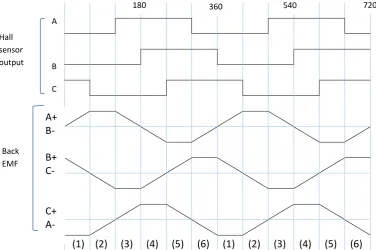
Every 60 electrical degrees of rotation, one of the Hall sensors changes the state. Given this, it takes six steps to complete an electrical cycle. In synchronous, with every 60 electrical degrees, the phase current switching should be updated. However, one electrical cycle may not correspond to a complete mechanical
[image:24.595.135.512.83.333.2]
(1) (2) (3) (4) (5) (6) (1) (2) (3) (4) (5) (6)
Figure 2.5: The hall sensor and trapezoidal back EMF waveforms of BLDC motor drive
2.3.4 Back EMF
According to Faradays law of electromagnetic induction, an EMF is induced or produced in a conductor and if a closed path is provided, the current will flows through it when a current carrying conductor is placed in a magnetic field. When the same thing happens in a brushless DC motor (BLDC) as a result of motor torque, the EMF produced is known as back EMF. It is so called because this EMF that is induced in the motor opposes the EMF of the generator.
This back EMF that is induced in the brushless DC motor (BLDC) is directly proportional to the speed of the armature (rotor) and field strength of the motor, which means that if the speed of the motor or field strength is increased, the back EMF will be increased and vice versa. When the DC motor is first started, there is no back EMF induced and there is maximum current flow from the DC generator or distribution lines to the motor armature and as a result the motor toque will be maximum. During normal operation (rated speed) of DC motor, the back EMF induced will be maximum which reduces the motor armature current to its minimum
180 360 540 720
13 level and as a result the motor torque is also reduced. When the load on the motor is increased, the motor speed (RPM) is decreased and this reduces the back EMF. This decrease in back EMF automatically increases the motor torque thereby bringing the motor to its rated speed.
2.4 Fuzzy Logic Controller System
Fuzzy logic and fuzzy control theories added a new dimension to control systems engineering in the early 1970s. From its beginnings as mostly heuristic, somewhat ad-hoc, more recent and rigorous approaches to fuzzy control theory have helped make it integral part of modem control theory and produced many exciting results. Fuzzy logic is a technique to embody human like thinking which is much less rigid than the calculations computer generally perform into a control system. Fuzzy controller can be designed to emulate human deductive thinking, that is, the process people use to infer conclusion from what they know. Meanwhile, conventional controller requires formal modeling of the physical reality of any plant.
Apart from that, fuzzy control incorporates ambiguous human logic into computer programs. It suit control problem that cannot be easily represented by mathematical model. Design of such controller leads to faster development and implementation cycles due to its unconventional approach.
2.4.1 Fuzzification
Fuzzification is a process of making a crisp quantity fuzzy. Before this process is taken in action, the definition of the linguistic variables and terms is needed.
Linguistic variables are the input or output variables of the system whose values are words or sentences from a natural language, instead of numerical values. A linguistic variable is generally decomposed into asset of linguistic terms.
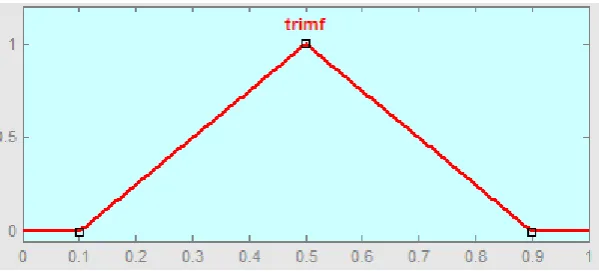
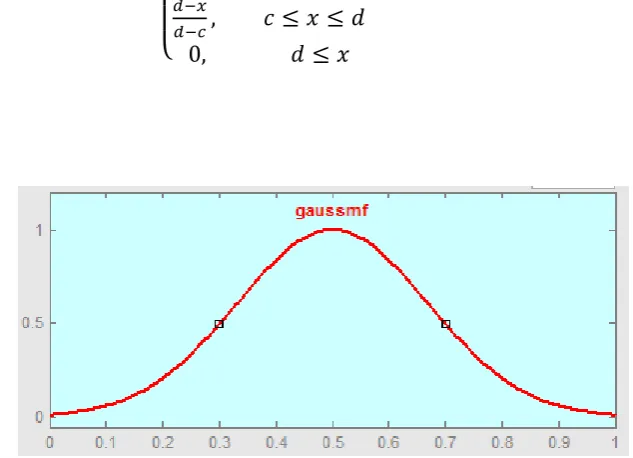
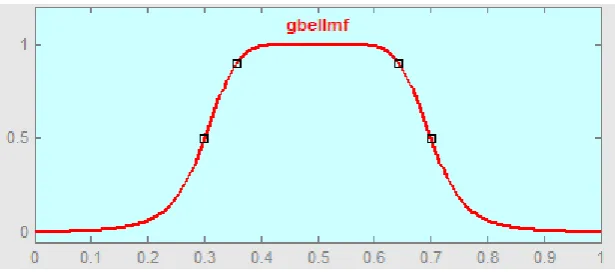
[image:26.595.170.470.380.516.2]There are different forms or shapes of membership functions in Fuzzy Logic such as triangular, Gaussian, trapezoidal and generalized bell. The most common type of membership function used by many applications is triangular. The type of the membership function can be context dependent and it is generally chosen arbitrarily according to the user experience. Figure 2.6 to Figure 2.9 shows the different types of membership function shape.
Figure 2.6: Triangular membership function shape
The equation of triangular membership can defined as follows;
𝑡𝑟𝑖𝑎𝑛𝑔𝑙𝑒 (𝑥; 𝑎, 𝑏, 𝑐) =
{
0, 𝑥 ≤ 𝑎
𝑥−𝑎
𝑏−𝑎, 𝑎 ≤ 𝑥 ≤ 𝑏 𝑐−𝑥
𝑐−𝑏, 𝑏 ≤ 𝑥 ≤ 𝑐
0, 𝑐 ≤ 𝑥
15
Figure 2.7: Trapezoidal membership function shape
The equation of trapezoidal membership can defined as follows;
𝑡𝑟𝑎𝑝𝑒𝑧𝑜𝑖𝑑 (𝑥; 𝑎, 𝑏, 𝑐) =
{
0, 𝑥 ≤ 𝑎
𝑥−𝑎
𝑏−𝑎, 𝑎 ≤ 𝑥 ≤ 𝑏
1, 𝑏 ≤ 𝑥 ≤ 𝑐
𝑑−𝑥
𝑑−𝑐, 𝑐 ≤ 𝑥 ≤ 𝑑
0, 𝑑 ≤ 𝑥
(2.2)
Figure 2.8: Gaussian membership function shape
The equation of Gaussian membership can defined as follows;
𝑔𝑎𝑢𝑠𝑠𝑖𝑎𝑛 (𝑥; 𝑐, 𝜎) = {𝑒−
1
2(
𝑥−𝑐
𝜎 )
2
[image:27.595.157.474.388.617.2]Figure 2.9: Generalized bell membership function shape
The equation of generalized bell membership can defined as follows;
𝑏𝑒𝑙𝑙 (𝑥; 𝑎, 𝑏, 𝑐) = 1
1+|𝑥−𝑐
𝑎 |
2𝑏 (2.4)
2.4.2 Rule base
Fuzzy logic’s linguistic terms are most often expressed in the form of logical implications, such as If-Then rules. These rules define a range of values known as fuzzy membership functions. A rule base (a set of If-Then rules), which contains a fuzzy logic quantification of the expert’s linguistic description of how to achieve good control. Once the rules have been established, a fuzzy logic system can be viewed as a mapping from inputs to outputs.
2.4.3 Inference engine
In general, inference is a process of obtaining new knowledge through existing knowledge. In the context of fuzzy logic control system, it can be defined as a process to obtain the final result of combination of the result of each rule in fuzzy value.
17 method was proposed by Ebrahim Mamdani as an attempt to control a steam engine and boiler in 1975. It is based on Lofti Zadeh’s 1973 paper on fuzzy algorithms for complex system and decision processes. This method uses the minimum operation Rc as a fuzzy implication and the max-min operator for the composition. Suppose a rule base is given in the following form;
IF input x = A AND input y = B THEN output z = C (2.5)
After the aggregation process, there is a fuzzy set for each output variable that needs defuzzification. It is possible and in many cases much more efficient, to use a single spike as the output membership functions rather than a distributed fuzzy set. This is sometimes known as a singleton output membership function. It enhances the efficiency of defuzzification process because it greatly simplifies the computation required by the more general Mamdani method, which finds the centroid of two dimensional function.
Meanwhile, Takagi-Sugeno-Kang method was introduced in 1985 and it is similar to the Mamdani method in many aspects. The first two parts of fuzzy
inference process which are fuzzifying the inputs and applying the fuzzy operator are exactly the same. But, the main difference is that the Takagi-Sugeno-Kang output membership function is either linear or constant. A typical rule in Takagi-Sugeno-Kang fuzzy model has the form as follows;
IF input 1 = x AND input 2 = y THEN output z = ax + by+ c (2.6)
2.4.4 Defuzzification
After the inference step, the overall result is a fuzzy value. This result should be defuzzified to obtain a final crisp output. This is the purpose of the defuzzification component of a fuzzy logic controller system. Defuzzification is performed according to the membership function of the output variable.
choosing a good defuzzification strategy, but the selection of defuzzification procedure is depends on the properties of the application.
Centroid of Gravity (COG) is the most frequent used and the most prevalent and physically appealing of all defuzzification methods. The basic equation of Centroid of Gravity (COG) as below;
𝑢0 = ∫ 𝜇𝑢 𝑢 (𝑢)𝑢 𝑑𝑢
∫ 𝜇𝑢 𝑢 (𝑢)𝑑𝑢
(2.7)
CHAPTER 3
METHODOLOGY
3.1 Introduction
This chapter will divide into three phases. The first phase is understands the BLDC motor drive. The second phase is implementing the basic concept of fuzzy logic controller. The last phase is design and constructs the fuzzy logic controller for BLDC motor speed.
The proposed general block diagram for speed control of BLDC motor drive system using Gaussian fuzzy logic controller is shown in Figure 3.1.
[image:31.595.111.526.479.546.2]
Figure 3.1: The block diagram of speed control using Gaussian fuzzy logic controller for BLDC motor drive system.
Reference speed
Gaussian Fuzzy Logic Controller
Brushless DC
3.2 System Structure
3.2.1 Structure of BLDC Motor
The speed and torque characteristics of Brushless DC (BLDC) motors are very similar to a shunt wound "brushed" (field energized) DC motor with constant excitation. As with brushed motors the rotating magnets passing the stator poles create a back EMF in the stator windings. When the motor is fed with a three phase stepped waveform with positive and negative going pulses of 120 degrees duration, the back EMF or flux wave will be trapezoidal in shape.
[image:32.595.184.457.556.691.2]BLDC motors are not strictly DC motors. It is use a pulsed DC fed to the stator field windings to create a rotating magnetic field and operate at synchronous speed. In figure 3.2 shown that, pole pair A is first fed with a DC pulse which magnetizes pole A1 as a South Pole and A2 as a North Pole drawing the magnet into its initial position. As the magnet passes the first magnetized pole pair, the current to pole pair A is switched off and the next pole pair B is fed with a similar DC pulse as pole pair A. The magnet will then rotate clockwise to align itself with pole pair B. By pulsing the stator pole pairs in sequence the magnet will continue to rotate clockwise to keep itself aligned with the energized pole pair.
21
A six step inverter is used to generate the three phase supply and the electronic commutation between the three pairs of stator coils needed to provide the rotating field. Only two out of three pole pairs are energized at any one time. The speed of rotation is controlled by the pulse frequency and the torque by the pulse current.
[image:33.595.99.520.348.551.2]The inverter current pulses are triggered in a closed loop system by a signal which represents the instantaneous angular position of the rotor. The frequency of the power supply is thus controlled by the motor speed. Rotor position can be determined by a Hall Effect device, embedded in the stator, which provide an electrical signal representing the magnetic field strength. The amplitude of this signal changes as the magnetic rotor poles pass over the sensor. Figure 3.3 shows the system for controlling the voltage and speed with the associated current and voltage waveforms superimposed on the circuits.
Figure 3.3: The system for controlling the voltage and speed with the associated current and voltage waveforms superimposed on the circuits. [14]
3.2.2 Modelling of a BLDC motor
The analysis of BLDC motor is based on the assumption for simplification and accuracy. The BLDC motor is type of unsaturated. The stator resistances for all the winding are equal and the self and mutual inductance are constant. Semiconductor devices of inverter are ideal and iron losses are negligible. Meanwhile, the back-EMF wave-forms of all phases are equal. Based on the equivalent circuit of BLDC motor and VSI system shown in Figure 3.3, the dynamic equations of BLDC motor using the assumption can be derived as
𝑉𝑎 = 𝑅𝐼𝑎+ (𝐿 − 𝑀) 𝑑𝑖𝑎
𝑑𝑡 + 𝑒𝑎 (3.1)
𝑉𝑏 = 𝑅𝐼𝑏+ (𝐿 − 𝑀)𝑑𝑖𝑏
𝑑𝑡 + 𝑒𝑏 (3.2)
𝑉𝑐 = 𝑅𝐼𝑐 + (𝐿 − 𝑀)𝑑𝑖𝑐
𝑑𝑡 + 𝑒𝑐 (3.3)
Where
Va, Vb, Vc = Stator phase voltages ia, ib, ic = Stator phase current ea, eb, ec =Phase back EMF
L = Self inductance
M = Mutual inductance
R = Phase resistance
The motion equation is defined as :-
𝑑𝜔𝑚
𝑑𝑡 = ( 𝑃
2𝐽) (𝑇𝑒− 𝑇𝐿− 𝐵𝜔𝑟) (3.4)
𝑑𝜃
𝑑𝑡 = 𝜔𝑟 (3.5)
Where
Te = The electromagnetic torque TL = Load torque (Nm)
23
B = Friction coefficient (Nms/rad)
m = Rotor speed in mechanical (rad/s)
r = Rotor speed in electrical (rad/s)
3.2.3 Modelling of a Trapezoidal Back EMF of BLDC motor
The trapezoidal back-EMF wave forms are modeled as a function of rotor position so that rotor position can be actively calculated according to the operation speed. The back EMFs are expressed as a function of rotor position (θr).
𝑒𝑎𝑏𝑐 = 𝑓𝑎𝑏𝑐(𝜃𝑟 ) × 𝐸 (3.6)
𝐸 = 𝑘𝑒𝜔𝑟 (3.7)
[image:35.595.198.439.424.704.2]Where (𝑘𝑒) is back-EMF constant, 𝑓𝑎𝑏𝑐(𝜃𝑟 ) are the function of rotor position.
Figure 3.4 represent the back-EMF is a function of rotor position and has the amplitude. Based on the rotor position, the expression of the back-EMF can be generated as equation (3.8), (3.9) and (3.10) where named as trapezoidal shape functions with limit values between +1 and -1
𝑓𝑎(𝜃𝑟) =
[
(6) 𝜃𝑟 (0 < 𝜃𝑟 ≤ 𝜋 6)
1 (𝜋
6 < 𝜃𝑟 ≤ 5 𝜋 6)
− (6) 𝜃𝑟+ 6 (5𝜋
6 < 𝜃𝑟 ≤ 7 𝜋 6)
−1 (7𝜋
6 < 𝜃𝑟 ≤ 11 𝜋 6)
(6) 𝜃𝑟− 12 (11𝜋
6 < 𝜃𝑟 ≤ 2𝜋) ]
(3.8)
𝑓𝑏(𝜃𝑟) =
[
−1 (0 < 𝜃𝑟 ≤ 𝜋
6)
(6) 𝜃𝑟− 4 ( 𝜋
6 < 𝜃𝑟 ≤ 5 𝜋 6)
1 (5𝜋
6 < 𝜃𝑟 ≤ 7 𝜋 6)
− (6) 𝜃𝑟+ 10 (7 𝜋
6 < 𝜃𝑟 ≤ 11 𝜋 6)
−1 (11𝜋
6 < 𝜃𝑟 ≤ 2𝜋)]
(3.9)
𝑓𝑐(𝜃𝑟) =
[
1 (0 < 𝜃𝑟 ≤ 𝜋 6)
− (6) 𝜃𝑟+ 2 (𝜋
6 < 𝜃𝑟 ≤ 5 𝜋 6)
−1 (5𝜋
6 < 𝜃𝑟 ≤ 7 𝜋 6)
(6) 𝜃𝑟− 8 (7𝜋
6 < 𝜃𝑟 ≤ 11 𝜋 6)
1 (11𝜋
6 < 𝜃𝑟 ≤ 2𝜋) ]
(3.10)
The electromagnetic torque is defined by using back-EMFs as follows
𝑇𝑎 = 𝑒𝑎𝑖𝑎
𝜔𝑟 (3.11)
𝑇𝑏 =𝑒𝑏𝑖𝑏
𝜔𝑟 (3.12)
𝑇𝑐 =𝑒𝑐𝑖𝑐
49
REFERENCES
[1] Padmaraja Yedamale, “Brushless DC (BLDC) Motor Fundamentals”, in Microchip Technology Inc. AN885 Datasheet, 2003, pp. 1.
[2] Raja Siti Nur Adiimah binti Raja Aris, “Simulation of a Variables Speed Brushless DC Motor using Neural Network Controller,” Universiti Tun Hussein Onn Malaysia, 2011.
[3] T.C Siong, B.Ismail, S.F.Siraj and M.F Mohammed, “Fuzzy Logic Controller for BLDC Permanent Magnet Motor Drives,” in International Journal of Electrical & Computer Sciences IJECS-IJENS Vol:11 No.2, Universiti Malaysia Perlis, Malaysia, 2011, pp. 13-18.
[4] Rodriguez F. and Emadi A., “A Novel Control Technique for Brushless DC Motor Drives,” in IEEE Transaction on Industrial Electronics, Vol. 54, No. 5, 2007, pp. 2365-2373.
[5] Tuncay R. N., Erenay Z., Yilmaz M., and Ustun O., “Rapid Prototyping Approach to Fuzzy Speed Control of Brushless DC Motor”, Istanbul Technical University, pp. 1-5.
[6] Kwon C. J., Han W. Y., Kim S. J. and Lee C. G., “Speed Controller with Adaptive Fuzzy Tuning for BLDC Motor Drive under Load Variations”, SICE Annual Conference in Fukui, 2003, pp. 2696-2699.
[8] Parhizkar N., Shafiei M. and Kouhshahi M. B., “Direct Torque Control of Brushless DC Motor Drives with Reduced Starting Current Using Fuzzy Logic Controller”, International Conference on Uncertainty Reasoning and Knowledge Engineering,2011, pp. 129-132.
[9] Sharmila B. and Devarajan N., “Neuro-Fuzzy Controller for Networked DC Motor Control”, European Journal of Scientific Research, 2011, pp. 219-228.
[10] Lv Y., Fan H., Zou Q. and Wan J., “Brushless DC Motor Speed Control System Based on Fuzzy Neural Network Control”, Proceedings of the 2009 International Workshop on Information Security and Application, 2009, pp. 173-176.
[11] R. Akkaya, A.A. Kulaksız, and O Aydogdu, “DSP implementation of a PV system with GA-MLP-NN based MPPT controller supplying BLDC motor drive”, Energy Conv. and Management 48, 210-218, 2007.
[12] A. Pooja and P. Arpita, “Brushless DC Motor Speed Control Using Proportional-Integral and Fuzzy Controller”, IOSR Journal of Electrical and Electronics Engineering (IOSR-JEEE),68-78,2013.
[13] Techzone (2013), Microcontroller Solution, Retrieved on March 3, 2012, from http://www.digikey.com.
![Figure 2.1: The stator of BLDC motor [13]](https://thumb-us.123doks.com/thumbv2/123dok_us/8766292.896606/20.595.115.540.71.354/figure-stator-bldc-motor.webp)
![Figure 2.3: BLDC motor cross section [2]](https://thumb-us.123doks.com/thumbv2/123dok_us/8766292.896606/22.595.134.526.79.215/figure-bldc-motor-cross-section.webp)

![Figure 3.2: Disassembled view of BLDC motor. [14]](https://thumb-us.123doks.com/thumbv2/123dok_us/8766292.896606/32.595.184.457.556.691/figure-disassembled-view-bldc-motor.webp)
