Journal of Chemical and Pharmaceutical Research, 2018, 10(9): 64-72
Research Article
ISSN : 0975-7384
CODEN(USA) : JCPRC5
64
Stability Indicating Method Development and Validation for the
Simultaneous Estimation of Amlodipine and Chlorthalidone in Bulk and
Pharmaceutical Dosage form by RP-HPLC
SJ Subathra* and S Ravichandran
Department of Pharmaceutical Analysis, PSG College of Pharmacy, Coimbatore, Tamil Nadu, India
_____________________________________________________________________________
ABSTRACT
A simple, rapid and accurate RP-HPLC method was developed to determine the drug such as Amlodipine and chlorthalidone in bulk and pharmaceutical dosage form .The chromatographic separation performed on a shim pack GWS C18(250 mm length x 4.6 mm ,5µ). The eluent were monitored on UV Visible detector at a wavelength of 266nm using mixture of 0.1% formic acid: methanol: acetonitrile in the ratio of (50:5:45v/v) at pH 3 the flow rate 1ml/min. Validation parameters such as system suitability, linearity, precision, accuracy, specificity, limit of detection (LOD) and limit of quantification (LOQ), stability of sample and standard stock solutions and robustness were studies to reported in the ICH guidelines. The retention time of Amlodipine and chlorthalidone was 4.8min, 3.9 min respectively. Assay method further evaluated for Amlodipine and chlorthalidone analysis at low concentration of analyte and found limit of detection 0.78,0.60 µg/mL and limit of quantification is 2.2,1.83 µg/mL respectively. Linearity of Amlodipine and chlorthalidone was from 5-25 µg/mL and 12.5-62.5 µg/mL and the R2 is 0.998. The method was fast, accurate, precise and sensitive hence it can be employed for routine quality control analysis of Amlodipine and chlorthalidone in pure and tablet dosage form.
Keywords: RP-HPLC; Amlodipine; Chlorthalidone; Forced degradation; Validation
_____________________________________________________________________________
INTRODUCTION
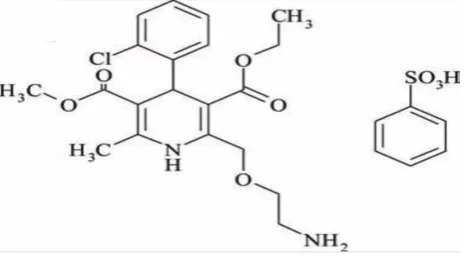
[image:1.595.184.417.605.736.2]It is used to treat angina, high blood pressure and coronary heart disease. Amlodipine (Figure 1) is chemically described as 3-Ethyl-5-methyl (±)-2-[(2-aminoethoxy) methyl]-4-(2-chlorophenyl)-1,4 dihydro-6-methyl-3,5-pyridine dicarboxylate, monobenzenesulphonate) is a long acting dihydrodihydro-6-methyl-3,5-pyridine(DHP) calcium channel blocker. It works by relaxing blood vessels.
65
[image:2.595.194.399.114.218.2]Chlorthalidone (Figure 2) is chemically described as (RS)-2-Chloro-5-(1-hydroxy-3-oxo-2,3-dihydro-1H-isoindol-1-yl)benzene-1-sulfonamide. Is a diuretic drug used to treat hypertension. It prevents re absorption of sodium and chloride by inhibiting the Na+/Clˉ symporter in the distal convoluted tubule [1,2].
Figure 2: Structure of chlorthalidone
While many methods are available for single or dual combination of the drug under study. The literature survey revealed that several methods are developed for Amlodipine and chlorthalidone individually. Liquid chromatographic methods, liquid chromatography-mass spectrometric method has been developed for Amlodipine and chlorthalidone in pharmaceutical dosage form. To best of our knowledge none of the forced degradation method has been reported for estimation of Amlodipine and chlorthalidone in combined dosage form. Hence, attempt has been making to develop new forced degradation study for its estimation in pharmaceutical dosage formulation with good accuracy, simplicity and sensitivity [3-5].
EXPERIMENTAL SECTION
Materials
Instruments used: Analysis was carried out by Waters 515 HPLC with UV detector, used shim pack GWS C18 (250mm length X 4.6mm,5µ column, shimazdu double beam UV/Visible spectrophotometer model UV1650PC.
Chemicals and reagents: Active pharmaceutical ingredients Amlodipine and chlorthalidone were obtained as a gift sample from Sai Moheshwar Healthcare, Vadodara. The pharmaceutical dosage form (Amlodac CH (5 mg/12.5 mg) was purchased from local pharmacy. HPLC grade acetonitrile was purchased from Himedia laboratories Pvt ltd, Mumbai, India. Formic acid was purchased from sigma Aldrich.
Method Development
Preparation of standard stock solution: Accurately weigh and transferred 5 mg of Amlodipine and 12.5 mg of chlorthalidone in 10ml volumetric flask and make up to 10 mL with diluents. 5 mL from stock solution were taken and transferred into 50ml volumetric flask make up with 50ml diluents. 1ml from above two stock solutions was taken into a 10 mL volumetric flask and made up to 10 mL diluents [6].
Preparation of sample stock solution: 10 tablets are weighed and powdered. The weight 150mg is equivalent to 5mg of Amlodipine and 12.5 mg of chlorthalidone was transferred into 10 mL volumetric flask and make up with 10ml diluents. 5ml from stock solution were taken and transferred into 50ml volumetric flask and make up with 50 mL diluents. 1 mL from above stock solution was taken and transferred into 10 mL volumetric flask make up to 10 mL with diluents [7-10].
[image:2.595.142.468.601.737.2]66
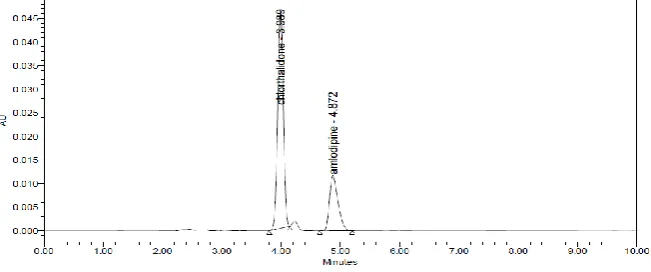
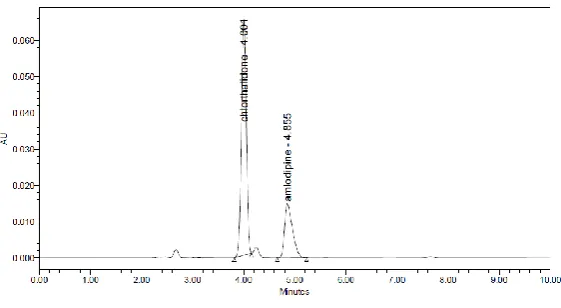
Method ValidationThe method was validated according to ICH guidelines. The different validation parameters are performed like linearity, precision, accuracy, limit of detection, limit of quantification, robustness (Figure 3).
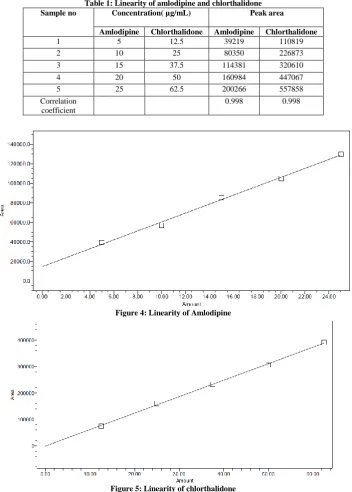
[image:3.595.124.477.177.670.2]Linearity: Linearity was evaluated by analysis of preparing the solution range of Amlodipine (5-25 µg/mL) and chlorthalidone (12.5-62.5 µg/mL). The linearity was plotted against peak area Vs concentration as explained in Figures 4 and 5. The correlation co efficient was found to be 0.998 respectively [11-13] (Table 1).
Table 1: Linearity of amlodipine and chlorthalidone
Sample no Concentration( µg/mL) Peak area
Amlodipine Chlorthalidone Amlodipine Chlorthalidone
1 5 12.5 39219 110819
2 10 25 80350 226873
3 15 37.5 114381 320610
4 20 50 160984 447067
5 25 62.5 200266 557858
Correlation coefficient
0.998 0.998
Figure 4: Linearity of Amlodipine
Figure 5: Linearity of chlorthalidone
67
Table 2: Recovery studies of amlodipine
Nominal concentration
( µg/mL)
LQC MQC HQC
7.5 15 22.5
S.NO Calculated
concentratio n ( µg/mL)
Accuracy %
Calculated concentratio n ( µg/mL)
Accuracy % Calculated concentration ( µg/mL) Accuracy %
1. 7.47 99.6 14.79 98.6 22.18 98.5
2. 7.34 97.8 14.99 99.9 22.44 99.8
3. 7.48 99.7 14.72 98.1 22.47 99.8
4. 7.29 97.2 14.77 98.5 22.48 99.9
5. 7.31 97.4 14.81 98.7 22.42 99.6
6. 7.35 98.1 14.62 99.5 22.43 99.7
Mean 98.3 98.8 99.5
SD 1.091 0.676 0.524
%RSD 1.11 0.68 0.52
Table 3: Recovery studies of chlorthalidone
Nominal concentration
( µg/mL)
LQC MQC HQC
18.75 37.5 56.25
S.NO Calculated
concentration ( µg/mL) Accuracy % Calculated concentration (µg/mL) Accuracy % Calculated concentration ( µg/mL) Accuracy %
1. 18.71 99.8 37.46 99.9 56.22 99.9
2. 18.73 99.9 37.43 99.4 55.99 99.5
3. 18.61 99.3 37.31 99.5 56.17 99.8
4. 18.72 99.8 37.38 99.6 56.10 99.8
5. 18.68 99.6 37.44 99.8 56.13 99.7
6. 18.65 99.4 37.39 99.5 56.20 99.9
Mean 99.6 99.6 99.7
SD 0.242 0.209 0.150
%RSD 0.24 0.21 0.15
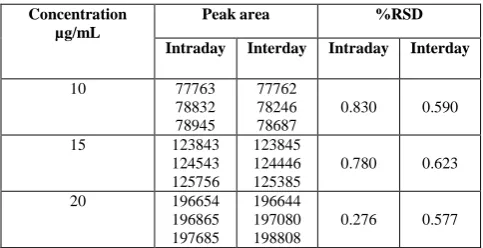
[image:4.595.177.419.561.685.2]Precision: In repeatability, six standard solutions were prepared each having a concentration of 15 µg/mL and 37.5 µg/mL of Amlodipine and chlorthalidone. The response of each of these solutions was measured and percentage relative standard deviation (%RSD) was calculated in Tables 4 and 5.
Table 4: Interday and intraday precision data for amlodipine
Concentration µg/mL
Peak area %RSD
Intraday Interday Intraday Interday
10 77763
78832 78945
77762 78246 78687
0.830 0.590
15 123843
124543 125756
123845 124446 125385
0.780 0.623
20 196654
196865 197685
196644 197080 198808
68
Table 5: Interday and intraday precision data for chlorthalidone
Concentration µg/mL
Peak area %RSD
Intraday Interday Intraday Interday
25 185092
186284 187394
185093 187063 187654
0.618 0.718
37.5 292970
295992 298030
292969 293800 297387
0.861 0.796
50 376576
378567 379897
376575 377875 379885
0.441 0.146
Limit of detection and limit of quantification: The limit of detection (LOD) and limit of quantification (LOQ) of the developed method were established by injecting the low concentration of the standard solution using the developed RP-HPLC method. The limit of detection found to be 0.78 µg/mL and 0.60 µg/mL, respectively. The limit of quantification was found to be 2.21 µg/mL and 1.83 µg/mL, respectively.
Robustness: The robustness of test method was demonstrated by carrying out mobile phase variation ± 2%, flow rate variation ±2% and wavelength variation ±2% is shown in Table 6.
Table 6: Robustness
Amlodipine %RSD
Chlorthalidone %RSD
Flow rate 0.8ml/min 1.4 1.3
1.2ml/min 0.9 1.0
Mobile phase 43:5:52 0.9 1.2
48:5:47 0.7 0.9
wavelength 264nm o.4 0.7
268nm 0.8 1.1
Forced Degradation Studies
Forced degradation studies were performed on Amlodipine and chlorthalidone. The drug was subjected to under various stress conditions like acid degradation (0.1 M HCl), base degradation (0.1 M NaoH), oxidation30% (H2O2), thermal and photolytic (exposure to light).
Acid degradation: Accurately weigh and transferred 5.mg of Amlodipine and 12.5 mg of chlorthalidone in 10ml volumetric flask to add 0.1M HCl and make up the volume with mobile phase kept aside for 3.hrs. After completion of 3 hrs, about 0.1ml of the above solution was transferred into 10ml volumetric flask and diluted with10 mL using mobile phase (5. µg/mL of AMLO, 12.5. µg/mL of CHLOR). The solution was injected into HPLC and chromatogram was recorded (Figure 6).
Figure 6: Chromatogram of acid degradation
[image:5.595.160.441.574.728.2]69
[image:6.595.137.453.117.288.2]aside for 3 hrs. After completion of 3 hrs, about 0.1ml of the above solution was transferred into 10 mL volumetric flask and diluted with10 mL using mobile phase (5 µg/mL of AMLO, 12.5 µg/mL of CHLOR). The solution was injected into HPLC and chromatogram was recorded (Figure 7).
Figure 7: Chromatogram of acid degradation
Oxidation condition: Accurately weigh and transferred 5 mg of Amlodipine and 12.5 mg of chlorthalidone in 10 mL volumetric flask to add 30% H2O2 and make up the volume with mobile phase kept aside for 3 hrs. After
completion of 3 hrs, about 0.1ml of the above solution was transferred into 10ml volumetric flask and diluted with10 mL using mobile phase (5 µg/mL of AMLO, 12.5 µg/mL of CHLOR). The solution was injected into HPLC and chromatogram was recorded (Figure 8).
Figure 8: Chromatogram of oxidation condition
[image:6.595.111.486.378.572.2]70
Figure 9: Chromatogram of thermal degradation
[image:7.595.143.457.339.503.2]Photolytic degradation: Accurately weighed 5 mg of Amlodipine and 12.5 mg of chlorthalidone was transferred into a clean, dry petridish. The petridish was placed in direct sunlight for 5days. The drug was transferred into 10ml volumetric flask and make up the volume with mobile phase. 0.1ml of the above solution was transferred into 10 mL volumetric flask and diluted with10 mL using mobile phase (5 µg/mL of AMLO, 12.5 µg/mL of CHLOR). The solution was injected into HPLC and chromatogram was recorded (Figure 10). .
Figure 10: Chromatogram of photolytic degradation
RESULTS AND DISCUSSION
In present work an RP-HPLC method was developed for the simultaneous estimation of Amlodipine and chlorthalidone in tablet dosage form using UV detector. The chromatographic conditions were optimized to provide appropriate results of the assay which will be able to estimate the drugs in the formulation within single wavelength using simple mobile phase and appropriate flow rate. The selection of mobile phase was based upon the polarity. Different trials were performed and the chromatographic conditions were fixed. Acetonitrile: methanol:0.1%formic acid (45:5:50%v/v) pH 3 at 1 mL flow rate using shim pack GWS C18 (250 mm length X 4.6 mm,5 µ) column (Table 7).
Table 7: Chromatographic conditions
HPLC System
Waters 515
Column shim pack GWS C18, 5µm (250 mm X 4.6 mm)
Mobile phase Acetonitrile:methanol:0.1%formic acid (45:5:50%v/v)
Flow rate 1 mL/min
Injection volume
20 µL/min
Run time 10 mins
[image:7.595.190.406.655.766.2]71
The retention time was 3.9 min for chlorthalidone and 4.8 min for Amlodipine. The linearity was found to be in the range of Amlodipine 5-25µ/ml and chlorthalidone 12.5-62.5 µg/mL. The correlation co efficient was 0.998.The method was validated as per ICH guidelines by using various parameters to ensure the accomplishment of its application (Tables 8 and 9).
Table 8: System suitability test parameters
S.NO Parameters Amlodipine Chlorthalidone
1 Range 5-25 µg/mL 12.5-62.5
µg/mL 2 Detection
Wavelength
266nm 266nm
3 Tailing Factor 1.1 1.3
4 Retention Time 4.8 3.9
Table 9: Assay of formulation
Drug Amount
labelled(mg/mL)
Amount found (mg/mL)
%assay %RSD
Amlodipine 5 mg 4.8 97.1 1.7
Chlorthalidone 12.5 mg 12.31 98.4 0.48
Forced degradation study
The stability studies were conducted by exposing the dosage form to different stress conditions like acid, base, peroxide, thermal and light. It was found that dosage form slightly degraded in acid, base, oxidation conditions but stable on thermal and photolytic condition (Tables 10-12).
Table 10: Forced degradation studies of amlodipine
Stress condition
Sample concentration
Area % Assay %
Degradation
Acid 5 µg/mL 42421 92.4 7.6
Base 5 µg/mL 42300 92.7 7.3
Oxidation 5 µg/mL 41987 93.4 6.6
Photolytic 5 µg/mL 41678 94.1 5.9
Thermal 5 µg/mL 41768 93.8 6.1
Table 11: Forced degradation studies of chlorthalidone
Stress condition
Sample concentration Area % assay %degradation
Acid 12.5 µg/mL 121321 91.3 8.7
Base 12.5 µg/mL 119497 92.7 7.3
Oxidation 12.5 µg/mL 118456 93.3 6.7
Photolytic 12.5 µg/mL 117652 94.1 5.9
Thermal 12.5 µg/mL 116653 94.9 5.1
Table 12: Study on degradation
Stress condition
Sample concentration
% Assay % Degradation
AMLO CHLOR AMLO CHLOR
Acid 100 µg/mL 92.7 91.7 7.3 8.3
Base 100 µg/mL 93.3 92.9 6.7 7.1
Oxidation 100 93.9 93.7 6.1 6.3
Photolytic 100 µg/mL 94.3 94.6 5.7 5.4
72
CONCLUSIONA simple, novel, precise and economical stability indicating RP-HPLC method for the simultaneous estimation of Amlodipine and chlorthalidone. The method was subjected to forced degradation studies and the percentage degradation at each degradation study was within the limits. The results of each validation parameter were in good with acceptance criteria. Hence, this method can be applied for the estimation of Amlodipine and chlorthalidone in drug testing laboratories and pharmaceutical industries.
ACKNOWLEDGEMENTS
The authors also thankful to Sai moheshwar healthcare, vadodara for providing the gift samples of drugs Amlodipine and chlorthalidone respectively.
REFERENCES
[1] P Janhavi Vartak , MN Shikha Roy. Analytical Chemistry: An Indian Journal. 2015,15(3), 111-116. [2] SB Wadkar, KC Raka, SS Chitlange. Indian J Pharm Sci. 2009, 71(5), 563-7.
[3] Avani Sheth, CN Patel, Nehal Shah. Pharm Analysis & Quality Assurance. 2013.
[4] RA Mhaske, S Sahasrabudhe, AA Mhaske, DJ Garole. International Journal of Pharmaceutical Sciences And Research. 2012, 3(3), 793-80.
[5] ICH, International conference on hormonization of technical requirements for registration of pharmaceutical for human use, stability testing of new drug substance and products Q1A (R2),2003. [6] Muhammad Ashafaq, Tazeem Akhtar. Braz J Pharm Sci. 2014, 50(3).
[7] BG Chaudhari, NM Patel, PB Shah. Chem Pharm Bull. 2007, 55, 241-246.
[8] TP Aneesh, Radhakrishnan, PM Renju. International Research Journal of Pharmacy. 2015, 6(7), 453-457.
[9] RA Mhaske, S Sahasrabudhe, AA Mhaske.Internationa Journal of Pharmaceutical Science and Research. 2012, 3(4), 1116-1123.
[10]El-Gindy A. J Sep Sci. 2008, 31(4), 677-82.
[11]Neelima Kudumula. Pharmacophore . 2014, 5(4), 442-450.
[12]Hyeon Woo Moon, Han Gon Choi Asian J Pharm. 2014, 9(3), 123-128.
[13]A Mohammadi, N Rezanour, M Ansari Dogaheh. J Chromatiogr B. 2007, 215-221. [14]Sandeep Sonawane. Scientifica. 2016, 9.
[15]Krishna Chinthala. Int J Pharm. 2016, 6(3), 149-160.